The lunch tray struck the polished cafeteria floor with a crash loud enough to silence nearly two hundred students at Oakridge Academy. Jasmine Taylor remained on her knees beside the spilled spaghetti and milk, one hand gripping the strap of her faded orange backpack while the other slowly gathered the chemistry notes scattered beneath expensive shoes. Standing over her was seventeen-year-old Whitney Caldwell, blonde, wealthy, perfectly dressed, and wearing the satisfied expression of someone who had never been punished for cruelty. Around them, students lifted their phones as Whitney leaned closer and said, “Stay down, trash.”
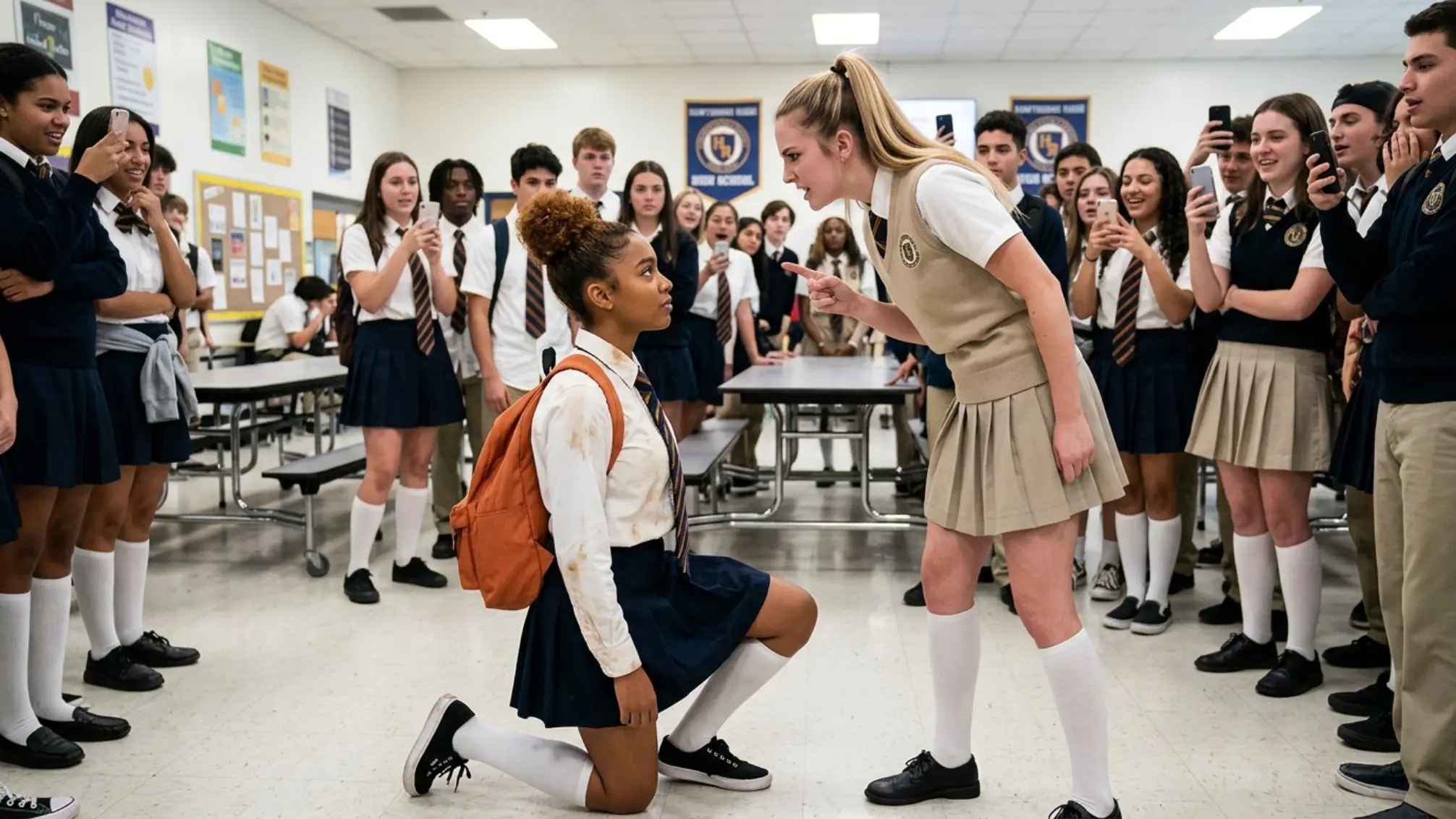
Jasmine looked up without crying, even though tomato sauce stained the front of her white uniform shirt and laughter rolled through the cafeteria. Whitney had expected tears, begging, maybe an angry outburst she could record and send to the administration as proof that Jasmine was “aggressive.” Instead, Jasmine’s brown eyes remained steady, and beneath the table her fingers briefly formed the beginning of a defensive position before relaxing again. “Keep talking,” she said quietly.
Whitney’s smile tightened. “I’ll humiliate you again.” Jasmine rose slowly, picked up her backpack, and looked directly into Whitney’s eyes. “Touch me again and regret it.”
For half a second, the cafeteria changed. Whitney took an unconscious step backward, confused by something in Jasmine’s posture that none of the students understood, but Jasmine understood perfectly. Inside her backpack, wrapped beneath a spare sweatshirt, was the third-degree black belt she had earned through years of taekwondo training. She could have reacted differently, but the words of Master Park had been drilled into her almost as deeply as the techniques themselves: control was not weakness.
Jasmine walked away while the crowd laughed behind her. Every step felt heavier than the last, but she refused to lower her head because Oakridge had already taken enough from her dignity that morning. She had spent 312 days protecting the academic scholarship that allowed her to attend one of the most prestigious private schools in the state, and she knew one disciplinary report could threaten everything. Whitney Caldwell knew it too.
Oakridge Academy was built from polished stone, manicured lawns, donor plaques, and old family names. Jasmine had entered through academic achievement, not inheritance, and almost immediately she discovered that everyone understood the difference. Whitney’s father had funded part of the library renovation, her mother chaired several charity committees, and the Caldwell name appeared on enough school programs that teachers treated Whitney like a difficult customer rather than a student. Jasmine, meanwhile, was reminded constantly that her place could disappear.
That evening, Jasmine unlocked apartment 3B and stepped into the small home she shared with Grandma Ruth. The living room smelled faintly of lemon cleaner and herbal tea, and the pullout couch where Jasmine slept every night had already been folded away to make space. Grandma Ruth emerged from the kitchen wearing pale blue hospital scrubs, exhaustion visible beneath her eyes after another long shift at Memorial Hospital. She took one look at Jasmine and asked, “What happened?”
“Nothing.” Jasmine immediately regretted how quickly she answered. She had washed the sauce from her face in the school restroom and cleaned her shirt as well as she could, but a faint orange stain remained around the collar. Grandma Ruth noticed everything, especially after raising Jasmine almost entirely on her own since Jasmine’s father died three years earlier. Still, Jasmine refused to tell her about Whitney.
Grandma Ruth already worked too much. She took extra hospital shifts to cover rent, food, transportation, and every expense Oakridge’s scholarship did not pay. Jasmine could not bear the thought of adding cafeteria cruelty to the stack of bills sitting on their kitchen table. Instead, she mentioned that Mrs. Chen believed she still had a chance at becoming valedictorian.
Grandma Ruth smiled instantly. “Your daddy would be proud.” Those five words followed Jasmine long after her grandmother left for the night shift. She pushed the coffee table against the wall, unfolded the worn training mat her father had bought for her seventh birthday, and stood barefoot in the center of the cramped living room. Then she began to move.
The frightened scholarship student disappeared. Jasmine’s feet became precise, her balance effortless, her strikes controlled within inches, and her kicks snapped through the air with enough speed to make the hanging curtain tremble. She moved through forms she had practiced thousands of times until anger transformed into concentration. By the time she finished, Whitney Caldwell’s voice had become background noise.
Jasmine’s father had introduced her to taekwondo after children in elementary school teased her about secondhand clothes. He never told her to hit anyone who insulted her. Instead, he taught her that discipline meant becoming strong enough that insults did not control her actions. After his sudden death, Grandma Ruth had somehow continued paying Jasmine’s reduced community-center training fee because she believed it kept part of her son alive.
Now Jasmine trained under Master Park, who believed she could compete nationally. She had placed second in a regional tournament the previous year, and the upcoming national championship could put her in front of college recruiters offering athletic scholarships. There was only one problem. Registration and travel would cost almost $2,000.
The next morning, Jasmine received the championship reminder while riding the city bus toward Oakridge. She stared at the registration amount until the screen dimmed in her hand. Asking Grandma Ruth was impossible, especially when Jasmine knew how carefully her grandmother divided each paycheck. For now, the national championship seemed like another door built specifically for people who could afford to open it.
At school, Whitney continued making sure Jasmine understood her position. She excluded her from study groups, made jokes about her clothes, and encouraged friends to treat her presence as an inconvenience. When Jasmine approached a chemistry group in the library, Trevor Hayes glanced at three empty chairs before telling her, “We’re full.” Whitney barely looked up from her phone.
Then Whitney mentioned Oakridge’s annual charity showcase. The competition featured music, dancing, theater, and unusual talents, with wealthy parents and alumni attending each year. Whitney’s family was one of the principal sponsors. First prize was $2,500.
Jasmine stopped walking. Two thousand dollars would cover championship registration and much of the travel. The remaining money could help Grandma Ruth with household expenses. Whitney noticed Jasmine staring at the showcase poster and laughed.
“You’re thinking about entering?” Whitney asked. “With what?” Jasmine said nothing. Whitney leaned back and added, “That stage is for people with actual talent.” Jasmine walked away before her face revealed how deeply the comment had landed.
She reported the harassment to guidance counselor Margaret Bennett that afternoon. Ms. Bennett listened without interrupting, but the response Jasmine received was worse than silence. She reminded Jasmine how much the Caldwell family had contributed to Oakridge and suggested that adjusting socially was part of succeeding in an elite school environment. Then she mentioned Jasmine’s scholarship.
“We took a chance on you,” Ms. Bennett said. “Don’t make things unnecessarily difficult.” Jasmine left the office understanding the message perfectly. Whitney could create problems; Jasmine was expected to absorb them.
The following week became worse. During chemistry laboratory, Whitney deliberately bumped Jasmine’s workstation, spilling liquid across the lab report Jasmine had spent hours preparing. Mr. Phillips saw only the aftermath and gave Jasmine a zero. When she attempted to explain, he threatened detention.
After school, Jasmine attacked a training pad at Master Park’s dojang with enough controlled force to make him stop her. “Technique is good,” he said. “Mind is somewhere else.” Jasmine lowered her hands. “They already decided what I am before I ever walked into that school.”
Master Park nodded slowly. “Then do not waste yourself trying to change every person’s mind.” He gestured toward the training floor. “Show the truth where it matters.” Jasmine understood immediately that he was talking about the showcase.
Another unexpected push came from Coach Denise Powell. Jasmine discovered the physical education teacher practicing alone in the gym after school and learned that Powell had once played professional basketball. Powell noticed Jasmine’s unusual balance and asked whether she had martial arts training. Jasmine finally admitted she held a third-degree black belt.
Coach Powell stared at her. “And you’ve been letting Caldwell think you can’t defend yourself?” Jasmine explained the scholarship. Powell’s expression hardened. “Self-control and helplessness aren’t the same thing.” Then she asked the question Jasmine had been avoiding: “Why aren’t you entering the showcase?”
That night, Jasmine opened the online registration form. Her hand hovered over the submit button for nearly five minutes. If Whitney discovered she was competing, the harassment would become worse, and Jasmine feared the administration might suddenly find a reason to reconsider her scholarship. But she also pictured the championship registration screen.
Jasmine entered her name as J. Taylor. For performance type she selected Martial Arts Demonstration. Then she clicked submit. Performance slot fourteen appeared on the screen.
Within days, problems at home raised the stakes again. Grandma Ruth developed pneumonia after weeks of exhausting hospital shifts and was ordered to stay home. The missed wages were painful enough, but medical expenses added another $1,800 they could barely afford. Jasmine suddenly understood that even winning the showcase would not solve everything.
She considered withdrawing and finding evening work. Grandma Ruth refused. “Your education is the job right now,” she told Jasmine between coughs. Jasmine tried explaining that a championship could lead to college scholarship opportunities, but Grandma Ruth already understood. “Then compete.”
At Oakridge, Whitney had problems of her own. Jasmine accidentally overheard her speaking with Allison Pierce in an empty locker room about the showcase. Whitney was terrified because her parents expected her to win the contemporary dance competition, yet the routine she planned to perform had largely been copied from a popular online performance. Beneath the arrogance, Jasmine heard panic.
She could have exposed Whitney immediately. She did not. Winning by destroying Whitney’s reputation before the competition would make Jasmine no different from the people who had tried to destroy hers. Instead, she went home and trained harder.
For two weeks Jasmine lived by an exhausting schedule. She woke before dawn to practice quietly before Grandma Ruth woke, attended classes, completed assignments, cared for her grandmother, and trained again after dark. Master Park helped transform her competition forms into a showcase routine that combined traditional technique, controlled board breaking, and acrobatic movement. Coach Powell secretly allowed her to practice inside the gym.
The day before the showcase, another email appeared. Scholarship Midyear Review: Meeting Scheduled. The meeting would take place the morning after the competition. Jasmine stared at the message until her throat tightened.
She knew it was probably not coincidence. Ms. Bennett knew Jasmine had entered the showcase. Whitney’s parents knew as well. Jasmine realized she could potentially walk onto a stage one night and lose her entire future the following morning.
Master Park refused to let fear change the performance. “Do not perform against Whitney,” he told her. “Perform for the girl you were before Oakridge convinced you to become smaller.” Then he reminded Jasmine of her father. That finally settled her mind.
The Oakridge Performing Arts Center filled with luxury cars and formally dressed families on showcase night. Backstage, students wore expensive costumes and carried instruments worth more than Jasmine and Grandma Ruth’s car. Jasmine entered an empty dressing room and changed into her white dobok. She tied her black belt firmly around her waist.
Around her wrist she wrapped the thin gold chain that had belonged to her father. When Jasmine looked into the mirror, she no longer saw the girl covered in cafeteria spaghetti. She saw every early morning, every sacrifice, every lesson, every bruise from training, and every hour Grandma Ruth had worked to keep doors open for her. She stepped into the hallway.
Whitney nearly laughed when she saw her. “You’re J. Taylor?” Jasmine nodded. Whitney looked at the black belt. “This isn’t some neighborhood talent night.”
“It’s taekwondo,” Jasmine said. “And we’ll see what the judges think.”
Whitney’s contemporary dance performance came sixth. It was polished, dramatic, and technically impressive, supported by professional lighting and music. The audience applauded loudly, especially Whitney’s parents in the front row. Jasmine watched from backstage and admitted silently that Whitney had worked hard despite copying portions of the routine.
Then number fourteen was called. Jasmine stepped onto the stage barefoot. Confused whispers spread through the auditorium when students recognized her.
She bowed. The music began. Jasmine moved.
At first, the audience remained politely silent. Her opening movements were traditional, controlled, and deliberate. Then the routine accelerated, and the atmosphere changed.
Boards cracked beneath precisely placed strikes. Jasmine spun into combinations that required years of balance and timing. She launched into aerial kicks, landed silently, shifted immediately into forms, and moved with a mixture of discipline and explosive athleticism that students had never imagined existed beneath her quiet school uniform.
Phones rose across the auditorium. Whitney stopped smiling backstage. Even her parents leaned forward.
Jasmine finished with the hardest sequence she had ever attempted publicly. She sprinted forward and launched into a high turning kick over a controlled obstacle, landing cleanly before immediately dropping into the final stance. Her father’s gold chain flashed beneath the stage lights as she raised her wrist briefly, then bowed.
The auditorium remained silent for one heartbeat. Then people stood.
The applause became deafening. Students who had ignored Jasmine for months shouted her name. Teachers looked at one another in disbelief. Coach Powell remained near the side wall with her arms folded and the smallest satisfied smile on her face.
Third place went to a violinist. Second place went to Whitney Caldwell. Whitney accepted the award with a stiff smile while her parents remained seated.
First place went to Jasmine Taylor.
The $2,500 prize check shook slightly in Jasmine’s hand as she accepted it. She looked into the audience and imagined Grandma Ruth sitting at home waiting for her call. More importantly, she imagined her father watching. For the first time since entering Oakridge, Jasmine felt seen without having to explain herself.
Backstage, Whitney cornered her. Her face was red beneath the makeup. “You planned this to embarrass me.”
“I entered a competition.”
“My family sponsors this event.”
“That didn’t make your performance better than mine.”
Whitney shoved Jasmine against the wall.
The movement lasted less than a second. Jasmine redirected Whitney’s arm, stepped aside, and allowed her own momentum to carry her forward without throwing, hitting, or hurting her. Whitney stumbled and caught herself against a chair.
“Don’t touch me again,” Jasmine said.
Neither girl noticed the three students standing near the partially open dressing-room door. Their phones had recorded everything, including Whitney saying her father could destroy Jasmine’s scholarship with one call. Before Jasmine reached home, the video had spread across Oakridge.
Grandma Ruth cried when Jasmine placed the trophy on their kitchen table. They divided the prize carefully: most would go toward the national championship registration, while the remainder would help with medical bills. Their financial problems were not magically solved, but for the first time in weeks they had room to breathe. Then Grandma Ruth asked about the scholarship meeting.
“I don’t know what happens tomorrow,” Jasmine admitted. Grandma Ruth squeezed her hand. “But tomorrow they meet the same Jasmine who walked onto that stage tonight.”
Headmaster Richard Williams waited behind a massive desk the following morning. Ms. Bennett sat beside him looking uncomfortable. Jasmine expected bad news.
Instead, Williams opened her academic file. Jasmine had one of the highest GPAs at Oakridge, excellent teacher evaluations from most departments, and near-perfect attendance. Academically, he said, her scholarship had never been in genuine danger.
Then he mentioned the videos. He had seen Whitney shove Jasmine. He had seen Jasmine’s restrained response. He had also been shown older clips of cafeteria harassment that students had uploaded while laughing.
His expression changed. “The question is no longer whether you belong at Oakridge, Miss Taylor.” He looked toward Ms. Bennett. “The question is why a student reporting repeated harassment believed she had to remain silent to keep her scholarship.”
Ms. Bennett lowered her eyes.
Jasmine’s scholarship was renewed.
Oakridge also opened a formal review of its harassment procedures. Coach Powell agreed to supervise a new martial arts club, and within weeks more than twenty students enrolled. Some were wealthy, some scholarship students, and several were classmates who had previously been too afraid to speak to Jasmine.
Whitney received disciplinary consequences for the recorded confrontation and was removed from a student leadership committee. Her parents attempted to pressure administrators, but public attention surrounding the video made quiet intervention difficult. For the first time in Whitney’s life, family influence could not erase what everyone had watched happen.
Months later, Jasmine traveled to the national taekwondo championship. She did not win first place. She finished third.
But third place came with recognition from college representatives and scholarship opportunities Jasmine had once believed were impossible. Grandma Ruth sat in the audience screaming loudly enough to embarrass her, while Master Park simply bowed when Jasmine stepped down from the podium. Jasmine treasured both reactions equally.
When she returned to Oakridge for her senior year, the cafeteria looked exactly as it had the morning Whitney forced her to her knees. Same polished floor, same expensive tables, same uniforms. Yet Jasmine walked through it differently.
A younger scholarship student named Maya sat alone near the windows one afternoon while several girls whispered nearby. Jasmine recognized the posture immediately: shoulders tight, eyes lowered, trying to become invisible enough to survive. She carried her lunch over and sat beside her without asking permission.
Maya looked surprised. “You’re Jasmine Taylor.”
“So?”
“You won the showcase.”
Jasmine smiled. “I also once had spaghetti dumped all over me right about where you’re sitting.”
Maya stared at her, unsure whether she was joking. Jasmine glanced toward the students whispering nearby and then back at Maya. “People can decide what they think you are,” she said. “That doesn’t mean you have to become it.”
Across the cafeteria, Whitney Caldwell briefly met Jasmine’s eyes. The hostility was still there, but something else had replaced the old certainty. Whitney looked away first.
Jasmine did not celebrate that small victory. She had learned something more important than defeating a bully. She no longer needed Whitney’s fear, apology, approval, or defeat to know her own value.
The black belt remained inside Jasmine’s backpack most school days. Not because it was a secret anymore, but because she finally understood what Master Park had been teaching her all along. The strongest thing she carried had never been the belt.
It was the discipline to rise when someone wanted her kneeling.
And this time, the whole school had seen her stand.