“Boy, you’ve got grease under your nails and dirt on your boots.”
Richard Whitmore looked Ethan Cole up and down as if those two things had already settled the question.
“You call yourself a mechanic?”
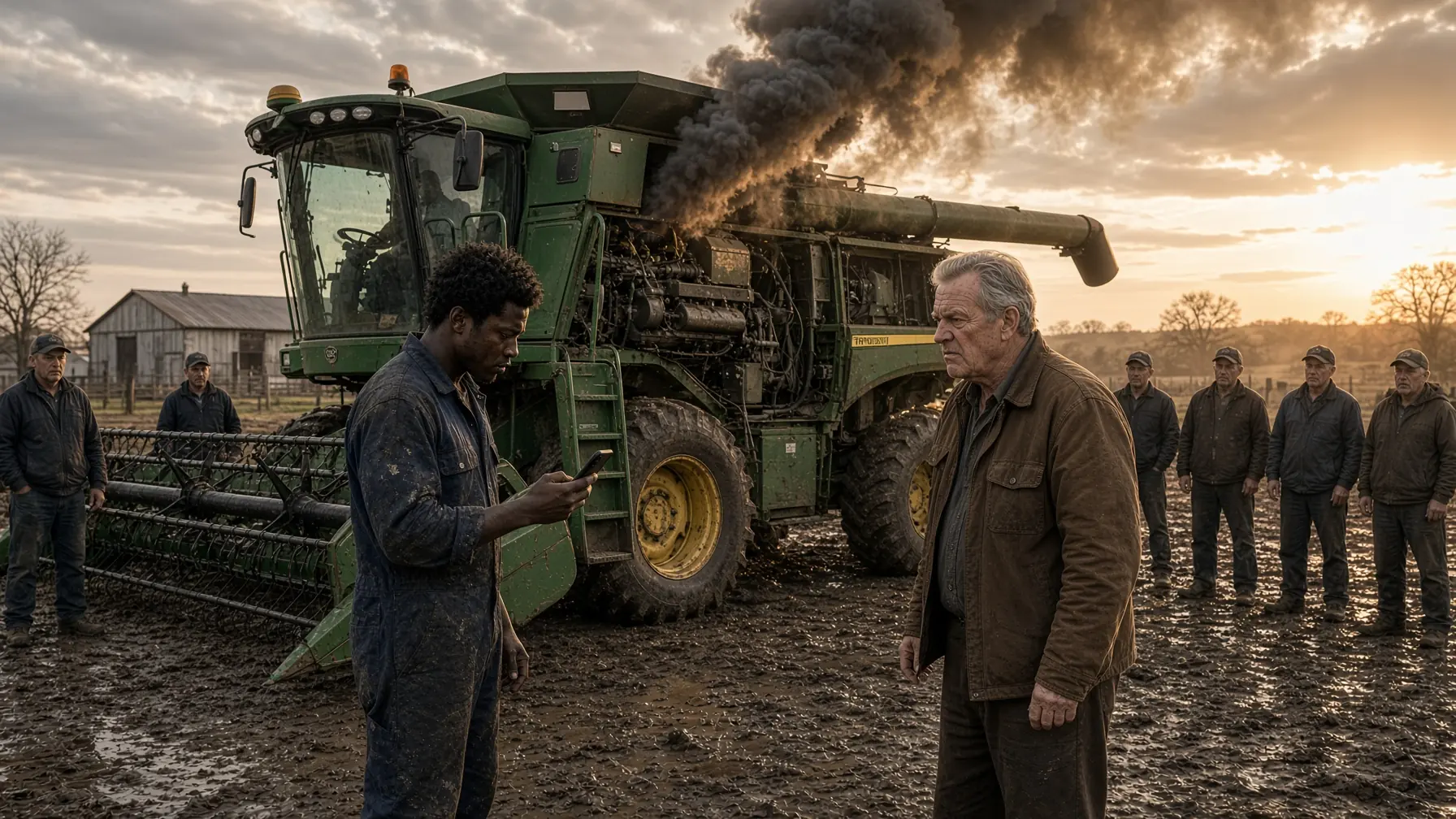
Ethan shifted the metal toolbox in his hand.
“I do.”
Behind Richard stood fourteen men.
Farmhands.
Neighbors.
A foreman.
Two equipment dealers who had heard about the machines and come mostly to see who would fail next.
Inside the enormous barn behind them sat seven pieces of equipment that had not moved in months.
Two tractors.
A combine.
A bulldozer.
A sprayer.
A drainage trencher.
And an old articulated loader.
Richard took a slow sip of coffee.
“Seven machines.”
He smiled.
“Every certified mechanic I hired walked away.”
A few men laughed.
“And you think you're different?”
Ethan looked past him into the barn.
He had been studying the equipment for almost twenty minutes.
Not touching.
Watching.
Corrosion patterns.
Fuel lines.
Missing fasteners.
The way one access panel sat half an inch lower than it should.
The expression on his face bothered Richard slightly.
Ethan finally looked back.
“Give me five days.”
Silence.
Then laughter exploded across the yard.
Richard laughed hardest.
“Five?”
“Yes.”
“You don't even have a shop.”
“I don't need one.”
That made the men laugh again.
Richard glanced toward the eastern horizon.
Six hundred acres stretched beyond a broken fence line.
Gray-brown.
Waterlogged in places.
Choked with weeds in others.
Land that had not produced a profitable crop in fifteen years.
Richard pointed toward it.
“Fine.”
Ethan followed his hand.
“Fix all seven by Friday.”
Richard smiled.
“And the eastern six hundred acres are yours.”
The laughter disappeared.
Ethan stared at him.
Richard believed he had finally surprised the boy.
What Ethan did not know was that those six hundred acres were almost worthless.
Drainage collapsed.
Roads swallowed by brush.
Fields holding standing water.
Banks refused to lend against them.
Developers had passed.
Richard had spent years telling people the land was beyond saving.
Offering it publicly cost him nothing.
Because Ethan would never collect.
Richard turned toward his foreman.
“Get paper.”
The man hesitated.
“You serious?”
“Completely.”
Paper was brought.
Richard wrote the terms himself.
SEVEN MACHINES RETURNED TO FULL WORKING CONDITION WITHIN FIVE DAYS IN EXCHANGE FOR TRANSFER OF THE SIX HUNDRED EASTERN ACRES.
He signed.
Fourteen witnesses watched.
Then he pushed the pen toward Ethan.
“Still feeling confident?”
Ethan read every line.
Then signed.
Richard laughed again.
“Clean yourself up when you fail.”
Ethan folded his copy of the agreement.
Put it into his jacket.
Then picked up his toolbox.
He did not answer.
That bothered Richard more than an insult would have.
Because Ethan had already seen something inside the barn.
Something none of the expensive mechanics before him had noticed.
Those machines had not simply failed.
Somebody had made sure they would.
Ethan Cole was twenty-four years old and owned almost nothing.
A truck that knocked on cold mornings.
A toolbox built from three generations of mismatched equipment.
Six hundred dollars in savings.
And a reputation that existed mostly among people too poor to hire dealership mechanics.
His father, Samuel Cole, had repaired farm equipment out of a corrugated shed behind their house.
Samuel never attended technical school.
He learned engines because broken machinery was cheaper to own than working machinery.
He bought dead tractors.
Dead combines.
Dead trucks.
Then made them live again.
Ethan grew up holding flashlights.
Sorting sockets.
Listening.
His father had one rule he repeated so often Ethan could still hear the exact tone years after Samuel died.
Don't repair the symptom. Find the reason the symptom exists.
Another: