“I’m calling 911. Dirt people like you don’t belong here.”
Linda Whitmore held her phone high enough for everyone in Marcus Grant’s backyard to see it. Her bright yellow designer blazer looked almost painfully cheerful against the anger twisting her face, and a thick HOA folder was tucked beneath her left arm like an official weapon. Behind Marcus, sixty relatives and friends stood frozen around folding tables covered with ribs, corn, macaroni and cheese, peach cobbler, and children’s paper plates. Smoke continued rising from the grill, but the music had stopped.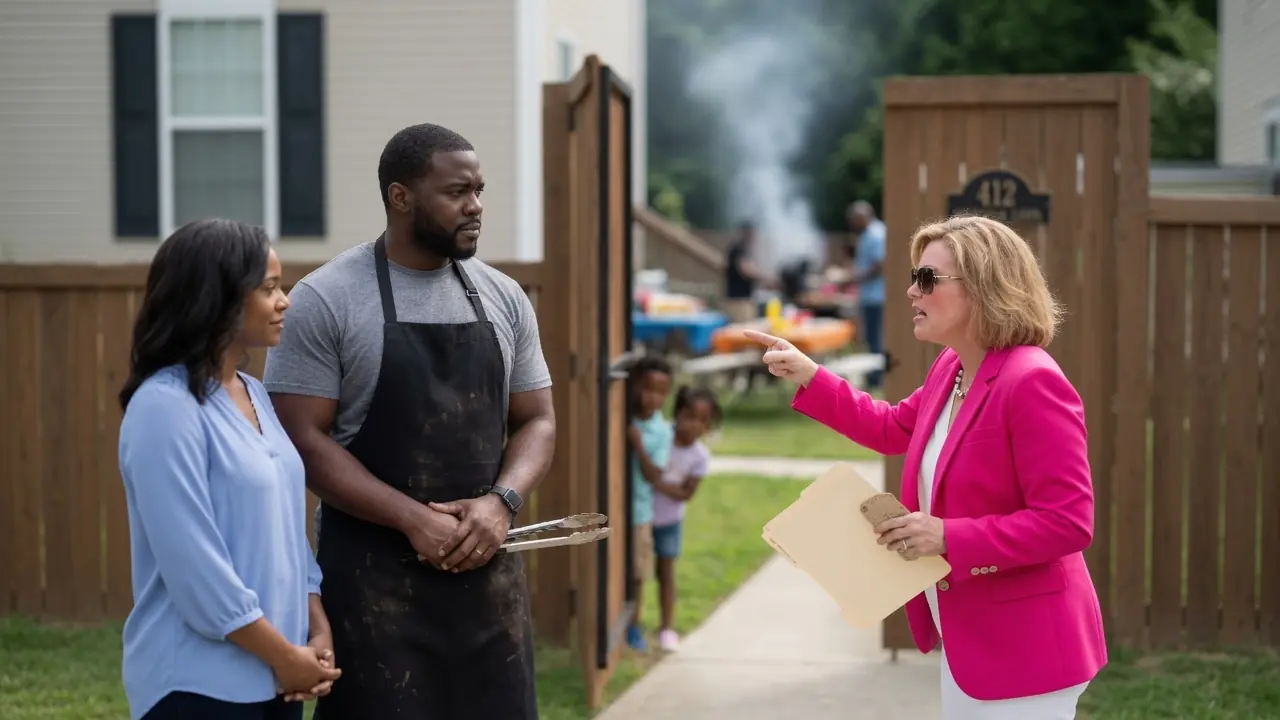
Marcus remained beside the open gate with a pair of barbecue tongs in one hand. He was thirty-nine, broad-shouldered, and calm in the deliberate way of a man who understood how quickly anger could be used against him. His gray shirt was darkened with heat beneath a black apron, and his nine-year-old daughter, Nia, watched from behind the fence with her younger brother gripping her hand. Marcus looked at Linda’s phone, then at the expensive homes lining Magnolia Ridge.
“Ma’am, we’re having a barbecue on private property,” he said.
“A barbecue?” Linda repeated. “No. This is an infestation.”
A quiet wave of disbelief moved through the yard. Marcus’s older sister, Camille, stepped forward, but he raised one hand without looking back. He knew his family. He knew which cousins would challenge Linda immediately and which uncles had spent too many years swallowing public disrespect to remain silent now. He also knew the first angry reaction would become the only part of the story Linda repeated.
“This is my home,” Marcus said. “These are my guests.”
Linda pointed through the gate. “Your guests have blocked parking, filled the neighborhood with smoke, and turned a respectable community into a public park.”
Only three vehicles were parked along the curb, all legally spaced. The music had been playing at a low volume from a speaker near the patio, and the smoke came from two grills placed well inside Marcus’s backyard. Children had drawn with sidewalk chalk on his driveway, not the street. Linda’s real complaint had nothing to do with noise, smoke, or parking.
Marcus and his children had moved into Magnolia Ridge six days earlier.
The house was a two-story beige property with black shutters, a fenced yard, and enough bedrooms for Nia and six-year-old Caleb to stop sharing space. Marcus had spent fourteen years saving for it, working long hours while raising his children after their mother died from an aggressive illness four years earlier. The backyard gathering was supposed to celebrate the first place that truly felt permanent since her death.
Linda had watched the moving truck from across the street.
She introduced herself as HOA board president before Marcus finished carrying in the first box. She asked whether he was the owner or “helping the actual buyers.” When he confirmed the deed was in his name, her smile stiffened. She then explained the community’s “standards” with the careful tone of someone expecting him not to understand large words.
Marcus listened politely.
He had dealt with people like Linda in conference rooms, city hearings, traffic stops, and neighborhood meetings. They rarely considered themselves prejudiced. They simply believed their fear became a rule whenever someone unfamiliar entered their space. Linda did not think she hated Marcus; she thought she was protecting Magnolia Ridge from becoming the kind of neighborhood where people like him felt comfortable.
Three days after the move, she left the first violation notice.
The document accused Marcus of displaying trash containers too close to the street, though collection had occurred that morning. The second notice criticized the basketball hoop beside his driveway, despite six identical hoops on nearby properties. The third warned that “large social gatherings” required HOA approval, a rule Marcus could not find anywhere in the community bylaws.
He responded to each notice in writing.
He included photographs, timestamps, and exact references to the association’s governing documents. Linda did not appreciate receiving evidence from someone she had already decided should be intimidated. She arrived at the barbecue carrying the full folder and an expectation that public embarrassment would force Marcus to submit.
Instead, he refused to perform fear for her.
“Please leave my property,” Marcus said.
Linda lifted her chin. “You don’t tell me to leave. I represent every homeowner in this community.”
“You represent an association. You do not own my yard.”
“I decide what violates community standards.”
“No,” Marcus replied. “The written bylaws do.”
Several guests murmured their agreement.
Linda’s face reddened. “This is exactly the hostile behavior I expected.”
Marcus looked at the phone in her hand. “You walked into my gate, insulted my family, and threatened to call the police. The hostility is coming from one direction.”
She pressed the call button.
Nia moved closer to her father.
“Daddy, is she really calling them?”
Marcus turned slightly. “Yes.”
“Are we in trouble?”
“No, baby.”
Linda heard him and laughed. “You should not promise her that.”
The words changed something inside Marcus. He could tolerate insults aimed at him. He had spent a career learning how to absorb contempt without letting it distort his judgment. But watching his daughter wonder whether her family could be removed from their own home awakened an anger far colder than shouting.
He opened the gate wider.
“Go ahead,” he told Linda. “Call them.”
Her eyes narrowed. “You think this is funny?”
“No. I think you should say every word clearly while the call is recorded.”
Linda hesitated for half a second.
Then the emergency operator answered.
She transformed her voice immediately. The sharpness disappeared, replaced by a trembling concern that had not existed moments earlier. She reported an “aggressive crowd,” possible intoxication, threatening behavior, blocked access, and a homeowner who refused to cooperate with HOA authority. She never mentioned entering Marcus’s yard uninvited or calling his family dirt people.
Marcus took out his phone and began recording.
Linda noticed. “You cannot record me without permission.”
“We are outside,” Marcus said.
She turned away and continued speaking to the operator. “Yes, the man is becoming confrontational. He’s holding a metal object.”
Every person in the yard looked at the barbecue tongs.
Marcus slowly placed them on the grill table.
Camille whispered, “She is trying to make cooking sound dangerous.”
“I know.”
“She called us an infestation.”
“I heard her.”
“You’re too calm.”
“No,” Marcus said quietly. “I’m exactly calm enough.”
Linda ended the call with a satisfied smile. “They’re sending multiple units.”
“Good.”
“You still have time to send these people away.”
“They’re my family.”
“Then they can watch.”
The first patrol vehicle arrived eight minutes later.
Its lights flashed silently as it turned onto Magnolia Lane, followed by a second cruiser and a supervisor’s SUV. Children stopped playing. Adults gathered closer together, and several neighbors emerged onto porches to watch. Linda stepped into the driveway and lifted both arms like someone rescuing the officers from confusion.
“Thank goodness,” she called. “I’m the HOA president.”
Sergeant Daniel Ruiz exited the first cruiser.
He was a veteran officer in his early forties who had served in the city for seventeen years. The younger officer beside him scanned the yard, the guests, and the open gate. Their expressions were alert but not aggressive.
Linda hurried toward them.
“The man at this address has organized an unauthorized event,” she said. “He became threatening when I informed him of the rules.”
Ruiz looked toward Marcus.
Recognition crossed his face instantly.
His posture straightened.
The younger officer followed his gaze and did the same.
“Chief Grant?” Ruiz said.
Every voice in the yard disappeared.
Linda turned slowly.
Marcus untied his apron and stepped onto the driveway. “Sergeant Ruiz.”
Ruiz’s eyes moved toward the family members, food tables, children, and decorations. “Sir, dispatch reported a hostile crowd and an armed individual.”
Marcus gestured toward the grill. “The weapon was a pair of barbecue tongs.”
The younger officer looked down, briefly hiding a reaction.
Linda stepped between them. “Chief?”
Marcus met her eyes. “Marcus Grant, Columbus chief of police.”
Her mouth opened, but no sound emerged.
He had accepted the appointment three weeks earlier after serving as deputy chief and leading the city’s community safety division. His official announcement had appeared in newspapers and local broadcasts, but Linda rarely paid attention to city affairs unless they affected her property values. Marcus had deliberately avoided mentioning his position after moving into Magnolia Ridge.
He wanted his neighbors to know the father before the title.
Linda looked toward Sergeant Ruiz. “That does not change the violations.”
Ruiz kept his voice professional. “What violation occurred?”
“There are at least sixty people here.”
“Is attendance restricted by law?”
“It violates our standards.”
“I’m asking about the law, ma’am.”
“The noise is excessive.”
Ruiz paused and listened. No music was playing.
One of the neighbors across the street called from her porch, “The music was quieter than my television.”
Linda spun toward her. “Stay out of this, Susan.”
Susan folded her arms. “You made it the whole street’s business when you brought police here.”
Ruiz turned back to Linda. “Did you enter Chief Grant’s property?”
“I approached the gate in my official capacity.”
“That isn’t an answer.”
“The gate was open.”
“Were you invited?”
Linda glanced at Marcus. “I was performing HOA enforcement.”
Marcus held up his phone. “The entire interaction is recorded.”
Her face changed again.
Sergeant Ruiz asked to see the video.
Marcus played it from the beginning. The recording captured Linda pointing toward his family and saying, “Dirt people like you don’t belong here.” It captured her calling the barbecue an infestation, threatening that officers would drag everyone away, and describing the tongs as a weapon.
Several neighbors moved closer.
Linda attempted to interrupt. “That recording lacks context.”
Ruiz paused the video. “What context makes that statement appropriate?”
“I was referring to the mess.”
“There is no mess,” Camille said.
The yard was cleaner than it had been before the gathering began. Trash bags were secured beside the patio, the tables were organized, and no food or bottles covered the lawn. Even the children’s chalk drawings remained confined to the driveway.
Linda clutched her HOA folder against her chest.
“You cannot treat me like a criminal for protecting this neighborhood.”
Marcus’s voice remained level. “No one called you a criminal.”
“You’re using your position to intimidate me.”
“I did not summon the police.”
The truth landed hard.
Linda had called emergency services expecting authority to validate her prejudice. Now that the same authority refused to obey, she tried to transform herself into the victim. It was a pattern Marcus had witnessed many times.
Ruiz asked whether Marcus wanted Linda formally removed from the property.
“Yes,” he said. “And I want the call documented accurately.”
Linda stared at him. “You’re pressing charges?”
“I’m requesting a report.”
“For what?”
“Misuse of emergency services, false statements to dispatch, trespassing, and harassment.”
“I did not trespass.”
“You were asked to leave.”
“As HOA president, I have inspection rights.”
Marcus shook his head. “Not inside fenced private property without notice, consent, or an emergency.”
Linda opened the binder and pulled out a page. “Section twelve gives the association authority to investigate visible violations.”
“From common areas,” Marcus said. “It does not authorize entry.”
She looked at the officers. “He memorized the bylaws just to argue with me.”
“I read documents before signing them.”
Ruiz instructed Linda to step back onto the public sidewalk.
She complied only after the younger officer moved closer. As she left the gate, several children watched from behind their parents. Marcus saw the uncertainty in their faces and hated that the celebration had become a lesson in public humiliation.
He turned toward them.
“Everything is okay,” he said. “Nobody is being taken away.”
Caleb raised his hand as though he were in school. “Can we still eat?”
Laughter broke the tension.
“Yes,” Marcus said. “We can still eat.”
The music resumed quietly, but the officers remained long enough to complete statements. Ruiz spoke with Marcus, Camille, Susan, and two other witnesses. Dispatch recordings later confirmed that Linda repeatedly exaggerated the situation and implied Marcus possessed a weapon after seeing ordinary cooking tools.
She was not arrested that afternoon.
Marcus did not want his children’s first barbecue in their new home to end with a neighbor placed in handcuffs. He wanted the incident investigated properly, not turned into a public display that Linda could use to claim political persecution. Ruiz issued a formal trespass warning and explained that another unauthorized entry could result in charges.
Linda returned home under the eyes of half the neighborhood.
By evening, the video had spread.
One of Marcus’s cousins posted a short clip showing Linda’s insult and the moment Ruiz addressed Marcus as chief. Within hours, local journalists contacted the family, the HOA board, and the police department. Marcus declined interviews until the department’s internal ethics counsel confirmed he had no role in the responding officers’ decisions.
Linda issued a statement before sunset.
She claimed her words were misunderstood, edited, and spoken during an emotional dispute about safety. She described herself as a lifelong advocate for “all appropriate families” and insisted she would never judge anyone based on race. The phrase appropriate families became its own scandal.
Residents began sharing their experiences.
A Latino couple revealed Linda repeatedly questioned whether their relatives were permanent occupants. An Indian family received violation notices whenever they held religious gatherings, though Christmas parties filled nearby homes every December. A white single mother said Linda threatened fines because her children’s bicycles remained visible beside the garage for two afternoons.
The problem was larger than one barbecue.
Linda had used HOA rules selectively for years, targeting anyone she considered undesirable while ignoring identical behavior from residents she respected. She approved landscaping exceptions for friends, reduced fines for board allies, and denied residents access to financial records. Marcus’s family had simply become her latest target.
The HOA board called an emergency meeting.
Linda attempted to control it from the front table, wearing a navy suit and speaking through a microphone. More than one hundred homeowners filled the community clubhouse, with others standing in the hallway. Marcus attended without his uniform, sitting beside Camille and two neighbors who asked him to review the bylaws before the vote.
Linda began with an apology that avoided responsibility.
“I regret that certain words were interpreted in a hurtful way.”
A man near the back called, “You said exactly what you meant.”
She raised her voice. “This meeting will remain orderly.”
Marcus stood only when public comments began.
He carried no badge, report, or official document. He spoke as a homeowner.
“My family moved here because I believed this neighborhood offered safety, stability, and community,” he said. “Six days later, my daughter watched someone tell us people like us did not belong. Then she watched that person call police and attempt to turn a family gathering into a threat.”
The room remained silent.
“This is not about whether I am police chief. That title protected me from the lie because officers recognized me. Most families do not have that shield. The question is what would have happened if I were a mechanic, a teacher, a delivery driver, or simply a Black father grilling dinner in his own yard.”
Several residents lowered their eyes.
Marcus continued, “A community is not safe when rules depend on who is standing in front of the person enforcing them. It is not orderly when fear becomes evidence. And it is not respectable when children must watch adults debate whether their families belong.”
Nia sat beside Camille, listening.
Linda interrupted from the table. “This is political theater.”
Marcus looked toward her. “You made the emergency call.”
“You concealed your position.”
“I did not owe you a résumé before receiving basic respect.”
Applause filled the room.
The board treasurer then presented financial discrepancies discovered after residents demanded records. Linda had approved thousands of dollars in legal consultations without board votes, used association funds for private landscaping near her home, and charged the HOA for surveillance cameras facing properties she considered problematic.
Her authority collapsed in real time.
A motion was introduced to remove her as president.
Linda called the effort mob rule. She accused residents of surrendering to media pressure and warned that property values would suffer if the association appeared divided. The vote proceeded anyway.
Eighty-seven percent supported removal.
Linda gathered her papers with shaking hands.
Before leaving, she stopped beside Marcus. “You destroyed my reputation.”
“No,” he said. “You recorded it in front of sixty witnesses.”
The city investigation concluded several weeks later. Prosecutors declined to pursue a major criminal case but charged Linda with misuse of emergency services and issued a civil trespass citation. She entered a diversion program, paid a fine, and was required to complete community mediation and bias education.
The HOA adopted broader reforms.
Inspection powers were clearly limited, violation notices required photographic evidence, and appeals were reviewed by rotating residents rather than one board president. Emergency services could not be contacted for association disputes unless an actual threat existed. Financial records became available online to every homeowner.
Marcus refused every offer to become HOA president.
“I already have one impossible management job,” he joked.
Susan accepted the position instead.
The following summer, Marcus hosted another barbecue.
This one was larger.
Families from across Magnolia Ridge brought food representing their own traditions. There were ribs beside biryani, tamales beside baked beans, dumplings beside cornbread, and children running between yards without anyone asking whether they belonged. Sergeant Ruiz attended off duty with his wife, and several officers stopped briefly after their shifts.
Marcus stood near the grill while Nia arranged plates.
“Dad,” she said, “do you remember when Ms. Whitmore called us an infestation?”
“Yes.”
“I hated this neighborhood that day.”
“I know.”
“But I don’t hate it now.”
Marcus looked across the yards.
People who had once watched silently were now speaking, laughing, and carrying chairs between houses. The neighborhood had not become perfect. No community did. But enough residents had decided that comfort built on someone else’s exclusion was not peace.
“What changed?” he asked.
Nia thought carefully. “Everyone stopped acting like it was only our problem.”
Marcus smiled.
“That’s exactly what changed.”
Linda’s house remained across the street for another year before she sold it. On moving day, she saw Marcus repairing a loose board near his gate. She crossed the road slowly but stopped outside the property line.
“I’m leaving,” she said.
“I heard.”
“The neighborhood isn’t what it was.”
“No.”
She looked toward his yard, where Caleb and two friends played basketball.
“I still believe gatherings should have limits.”
“Then host smaller ones.”
Linda almost smiled, but shame prevented it.
“I was wrong about some things,” she said.
Marcus waited.
Her apology did not become complete. She could not bring herself to repeat the words she used or name the prejudice behind them. Still, the old certainty had disappeared.
“You were wrong about my family,” he said.
“Yes.”
“That is where the apology starts.”
Linda nodded once.
Then she returned to her moving truck.
Marcus watched her leave without satisfaction or anger. Accountability did not always transform people completely. Sometimes it only removed their ability to harm others without resistance.
That was enough for the moment.
Years later, the video still appeared occasionally online under dramatic headlines about a racist neighbor calling police on a Black family’s barbecue. Most viewers focused on the reveal that Marcus was police chief and the expression on Linda’s face when the officers recognized him.
Marcus always believed they missed the most important part.
His title should never have been necessary.
His uniform, rank, education, and public authority were not what made his family worthy of safety. He deserved respect when he was only a father in a stained apron holding barbecue tongs. Camille deserved it while carrying food to the table. Nia and Caleb deserved it before understanding why a stranger looked at them with contempt.
Linda called 911 because she believed police belonged to her side.
What she discovered was that the law did not exist to protect her discomfort from other people’s presence. It existed to protect everyone’s right to live peacefully in their own home.
The barbecue she tried to destroy became an annual Magnolia Ridge tradition.
Every summer, the gate remained open.
Children played across the lawn, neighbors filled the tables, and smoke rose from the grills into the clean afternoon sky. A small wooden sign hung beside the entrance, painted by Nia during her first year of middle school.
It read:
EVERY FAMILY BELONGS AT THIS TABLE.
Marcus saw it each time he opened the gate.
Then he picked up his tongs, turned toward the people he loved, and kept cooking.