“A dead tree doesn’t water cows.”
Cordell Whip said it without laughing, which somehow made the words cut deeper. He sat beside the door of Ezra Ketering’s bank office with his weathered hat resting over one knee, while banker Ezra looked down at the appraisal sheet and county clerk Silas Renfro stood near a filing cabinet holding a folder he had come to sign. Merritt Gail Ashcroft sat across the desk from all three men with her father’s old deed unfolded beneath her hands.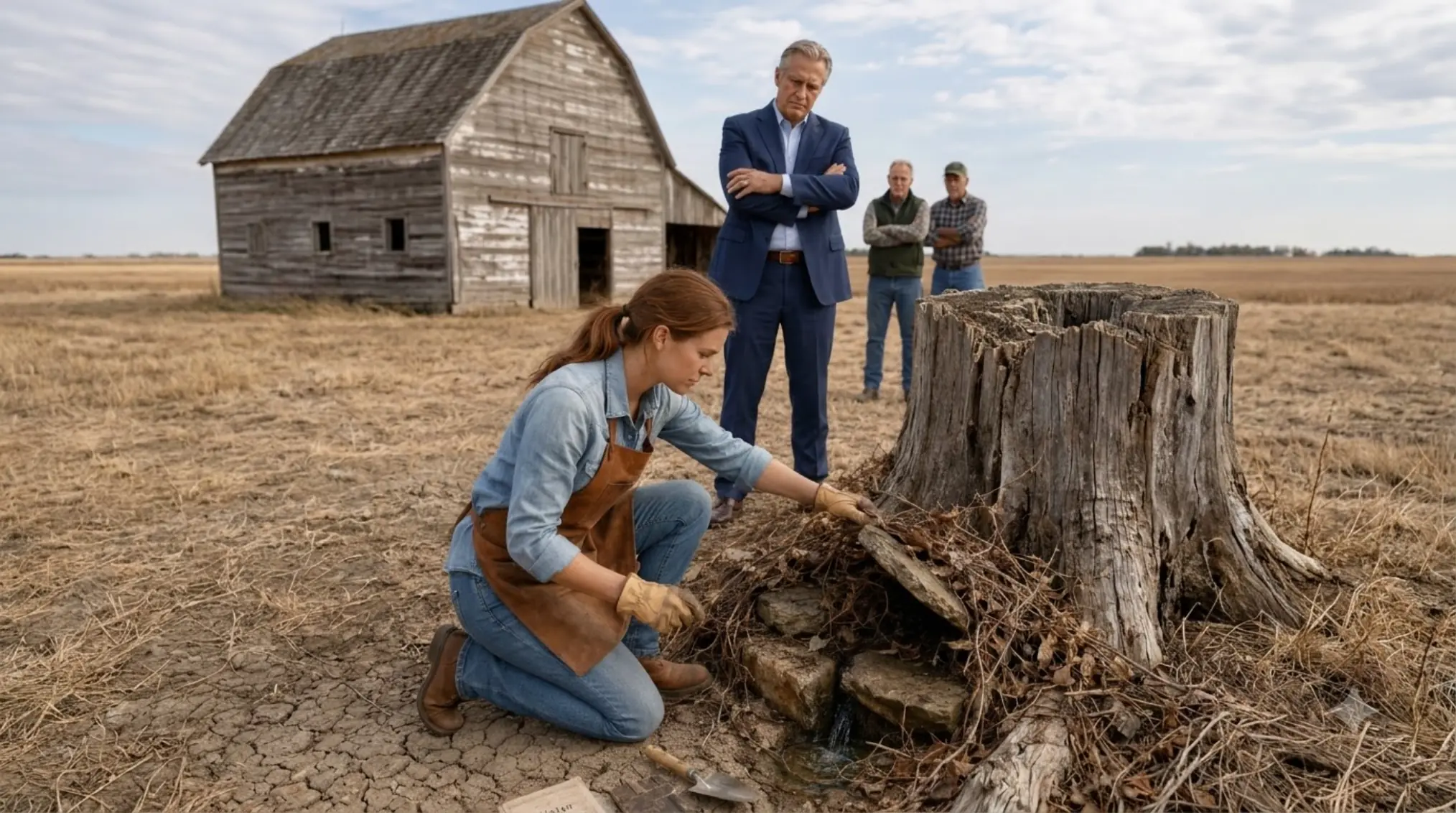
Her finger rested on four faded words.
Water at the Walnut.
Ezra removed his glasses slowly.
“Merritt, where is the walnut?”
She looked at him.
“Dead.”
Silas answered before she could explain further.
“Been dead longer than she’s been alive.”
That was when Cordell gave his verdict.
A dead tree did not water cows.
To the men in the room, the problem was settled.
Merritt looked down at the appraisal.
No well of record. No pond. No reliable stock water.
Three flat sentences had somehow reduced four generations of Ashcroft history to dry acreage and doubtful collateral.
Her father, Thurman Ashcroft, had died three days after Christmas at sixty-two years old. He left behind seventy-four acres east of the Little Piney River, nineteen carefully bred cow-calf pairs, a weathered farmhouse, a leaning hay barn, miles of imperfect fence, and a bank note carrying a balance of $6,800. He had also left behind Merritt, twenty-five years old, unmarried, two years of experience working among deeds and ledgers at the county clerk’s office, and far more stubbornness than most men in the county understood.
Ezra turned the appraisal toward her.
“The bank carried your father because I trusted him. I trust your word too, Merritt, but I can’t lend against what isn’t there.”
“It’s there.”
“Where?”
She touched the deed.
“According to this, at the walnut.”
Cordell shifted in his chair.
Ezra looked almost sorry for her.
“The tree is gone.”
“The tree isn’t the water.”
Nobody answered.
Merritt knew how absurd the sentence sounded.
Ezra folded his glasses.
“You have twenty-one days.”
Her stomach tightened.
“To do what?”
“Prove usable stock water exists. Documented, accessible, running. Enough to carry the herd.”
“And if I can’t?”
“I call the note against the cattle.”
She held his gaze.
“And after the cattle?”
Ezra did not answer immediately.
That told her enough.
Without the herd, income disappeared. Without reliable water, the land remained badly appraised. Without enough value behind the note, the next conversation would not be about cattle.
It would be about the farm.
Merritt opened her notebook.
She wrote three things.
21 days.
$6,800.
Called against herd.
She did not write that her hands were trembling.
Her notebook was for facts.
Feelings had never paid a note.
Outside the bank, she heard men talking through the open door of the drugstore coffee counter.
“A phrase isn’t a water source.”
“No well means no cattle.”
“You can’t borrow against a sentence.”
Merritt kept walking.
She climbed into her father’s pickup and drove eleven miles toward home without turning on the radio.
She had nearly reached the crossroads diner when she noticed a polished black Ford pickup behind her.
Holston Crow.
Everyone knew his truck.
Crow owned more land than anyone bordering the eastern side of the Ashcroft farm. At fifty-eight, he was broad through the shoulders, wealthy enough to wear polished shoes into a feed store, and patient in the particular way powerful men became patient when they believed time itself worked for them.
When Merritt turned into the diner, Holston followed.
He ordered coffee.
Then asked permission to sit.
His manners were flawless.
That made her trust them less.
A gold signet ring sat on the smallest finger of his right hand. Cut deeply into its face was an old block-style C, polished by decades of wear.
Merritt noticed.
She noticed everything.
“I heard about the appraisal,” Holston said.
“News travels.”
“It does when land is involved.”
He drank his coffee.
“Your father was a good man.”
“Yes.”
“He worked hard.”
“Yes.”
“And I imagine he wouldn’t want you trapped trying to prove something to people who’ve already made up their minds.”
Merritt remained silent.
Holston leaned back.
“I’ll give you eleven thousand two hundred dollars for the seventy-four acres.”
She stared at him.
“Cash.”
“Your herd can be sold separately, or I’ll include it if you prefer. The bank note comes out at closing. You walk away with money instead of trouble.”
Eleven thousand two hundred.
The low end of Ezra’s already-depressed dry-ground appraisal was more than three thousand dollars higher.
Holston was not offering market value.
He was offering what he thought desperation would accept.
“You’ve been thinking about this awhile,” Merritt said.
“I think about land.”
“Apparently mine.”
He smiled.
“I think about opportunities.”
Merritt set down her water.
“My father worked that ridge forty-one years. His father worked it before him. My great-grandfather cut the first field with a mule my grandmother talked about like it was family.”
“Merritt—”
“My answer is no.”
Holston’s expression barely changed.
“Twenty-one days isn’t long.”
“It’s long enough to say no twice.”
He smiled again.
Then he stood and left five dollars beside a coffee that had cost him thirty-five cents.
“Think about it.”
“I already did.”
That night Merritt unfolded the deed beneath the kitchen lamp.
She read every word slowly.
Not like a landowner.
Like a clerk.
Beginning at the south stone corner, then north by the marked lane to the black walnut with water at the walnut, then west along the ridge…
She stopped.
Everyone had treated the walnut as a boundary monument.
That made sense.
Before steel survey pins became common, trees marked corners, turns, lanes, and property lines.
But the deed did not simply say black walnut.
It said water at the walnut.
Legal descriptions did not waste words.
Stone corner had a purpose.
Marked lane had a purpose.
Black walnut had a purpose.
Therefore, Merritt decided, water had a purpose too.
The walnut was not the source.
It was the sign.
The next morning she walked to the south stone corner.
Honeysuckle had nearly buried it.
She cut vines until six stones emerged in the old configuration her father had taught her to recognize as a legitimate boundary monument.
Then she followed the deed north.
At first there was nothing.
Then she began noticing details that only became visible when she stopped looking for a road and started looking for the memory of one.
A shallow depression through the pasture.
Two rotten fence posts about eight feet apart.
A break through an old stone wall.
Cedar trees growing at an angle inconsistent with the surrounding fence line.
A mule lane had once passed there.
It had simply stopped being used.
Merritt followed the depression almost four hundred yards.
She marked bearings with her father’s brass compass and distances in her notebook.
By evening, she knew two things.
The south stone corner was real.
And so was the old lane.
When her uncle Boyd arrived that evening, she told him about the bank.
She told him about Holston.
She told him about the deed.
Boyd listened over coffee.
Then he sighed.
“Your father would understand eleven thousand two hundred isn’t enough. So do I.”
“Good.”
“But it clears the debt.”
Merritt stopped smiling.
Boyd looked uncomfortable.
“You know books, Merritt. That isn’t an insult. You’re better with papers than half the courthouse. But seventy-four acres and nineteen cattle are another thing.”