Officer Thomas Briggs held the suitcase upside down over the shoulder of Interstate 16 and shook it as if he were trying to punish the man who owned it.
Rain beat against the raised trunk of the black Dodge Charger. Red-and-blue light rolled across pine trees, wet asphalt, and the low curtain of mist beyond the guardrail. A charcoal shirt fell first, then folded trousers, clean socks, a pair of running shoes, a leather toiletry bag, and three pressed white shirts still wrapped around cardboard from a hotel laundry. Everything struck the road. Water soaked the fabric almost instantly.
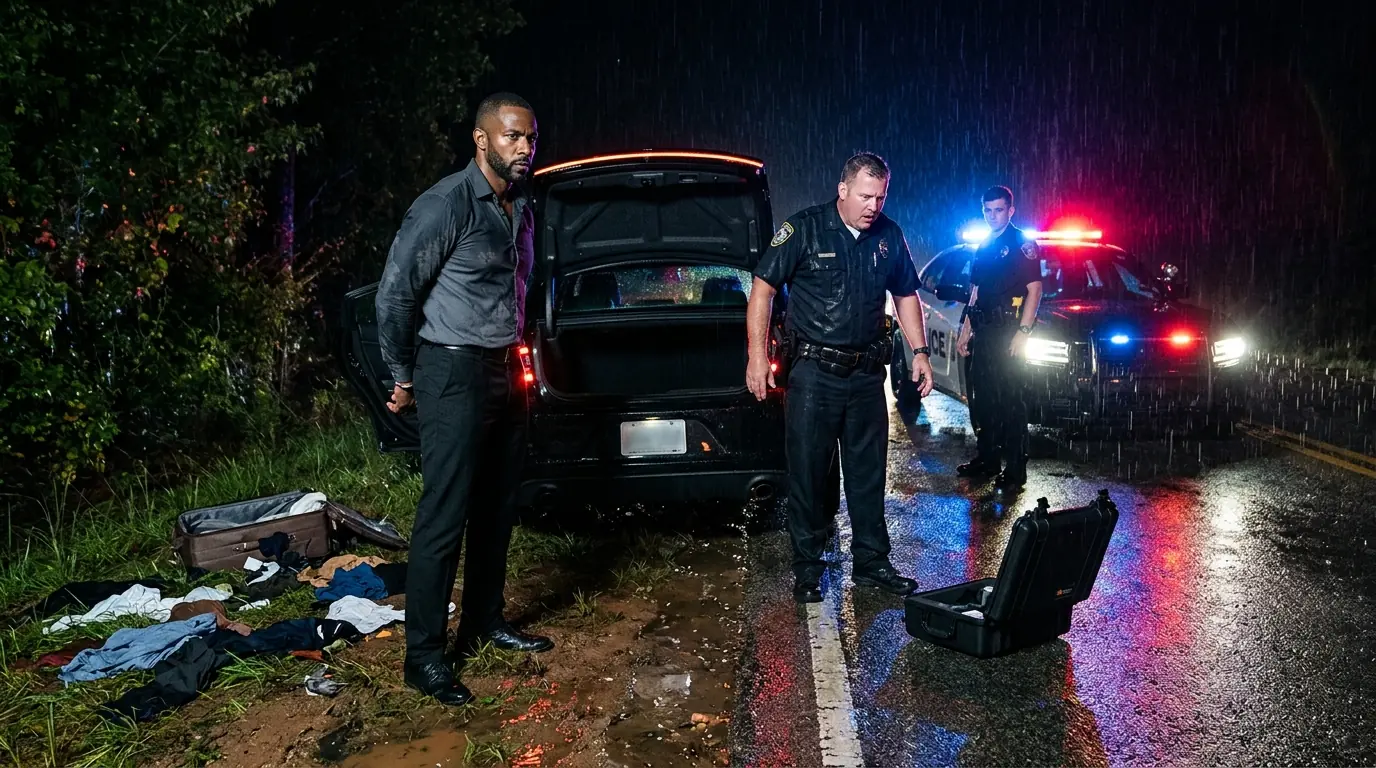
David Cole stood beside the rear quarter panel with his hands cuffed behind his back. He was forty-two, tall, athletic, and usually difficult to move against his will. The steel around his wrists changed that. So did the second officer watching from beside the patrol car with one hand near her holster.
David stepped forward before he could stop himself.
“Please—those are all I have.”
Briggs looked at the clothes, then at David. His face carried the bright, ugly satisfaction of a man who believed the darkness belonged to him.
“They stink just like you.”
He kicked one of the white shirts into brown water at the edge of the pavement.
The younger officer flinched. Her nameplate read TORRES. She was perhaps twenty-seven, with rain plastering loose strands of black hair against her temple. She had watched Briggs search the passenger compartment, pull up floor mats, empty the glove box, and remove the suitcase without finding contraband. Twice she had opened her mouth. Twice Briggs had continued before she spoke.
David looked past him into the trunk. A black Pelican case remained strapped against the rear seat. It was rectangular, hard-sided, and secured with two locks. No agency marking showed on the exterior. Briggs had tried the latches once, demanded the combination, and moved on when David refused.
“You should stop,” David said.
Briggs stepped close enough that David smelled coffee and wintergreen tobacco. “You don't tell me what to do on my highway.”
“It isn't your highway.”
Briggs drove both hands into David's chest.
David's back hit the Charger. The impact knocked air from his lungs and sent pain through his cuffed wrists. Torres took one step forward.
“Briggs,” she said. “He's secured.”
“Then he should quit resisting.”
David had not resisted the stop. At one forty-eight in the morning, Briggs had appeared behind him near mile marker 127 and followed for six miles without activating lights. David had held the Charger at sixty-eight in a seventy-mile zone. He signaled every lane change. When the emergency lights finally came on, he pulled onto the widest available shoulder, lowered his window, placed both hands on the wheel, and waited.
Briggs said the right taillight flickered. David knew it did not; he had inspected the car before leaving Atlanta. He provided his license, registration, and proof of insurance. Briggs asked where he was going, how much cash he carried, whether he had drugs, and why a man driving alone at that hour needed such a large car. David answered only the questions required for the stop and declined consent to search.
That changed Briggs's tone.