Held against the hood of a police cruiser in a humid federal parking lot, my credentials slammed beside my face, I said nothing while a rookie officer called me a fraud.
My silence was the only thing I could legally give him.
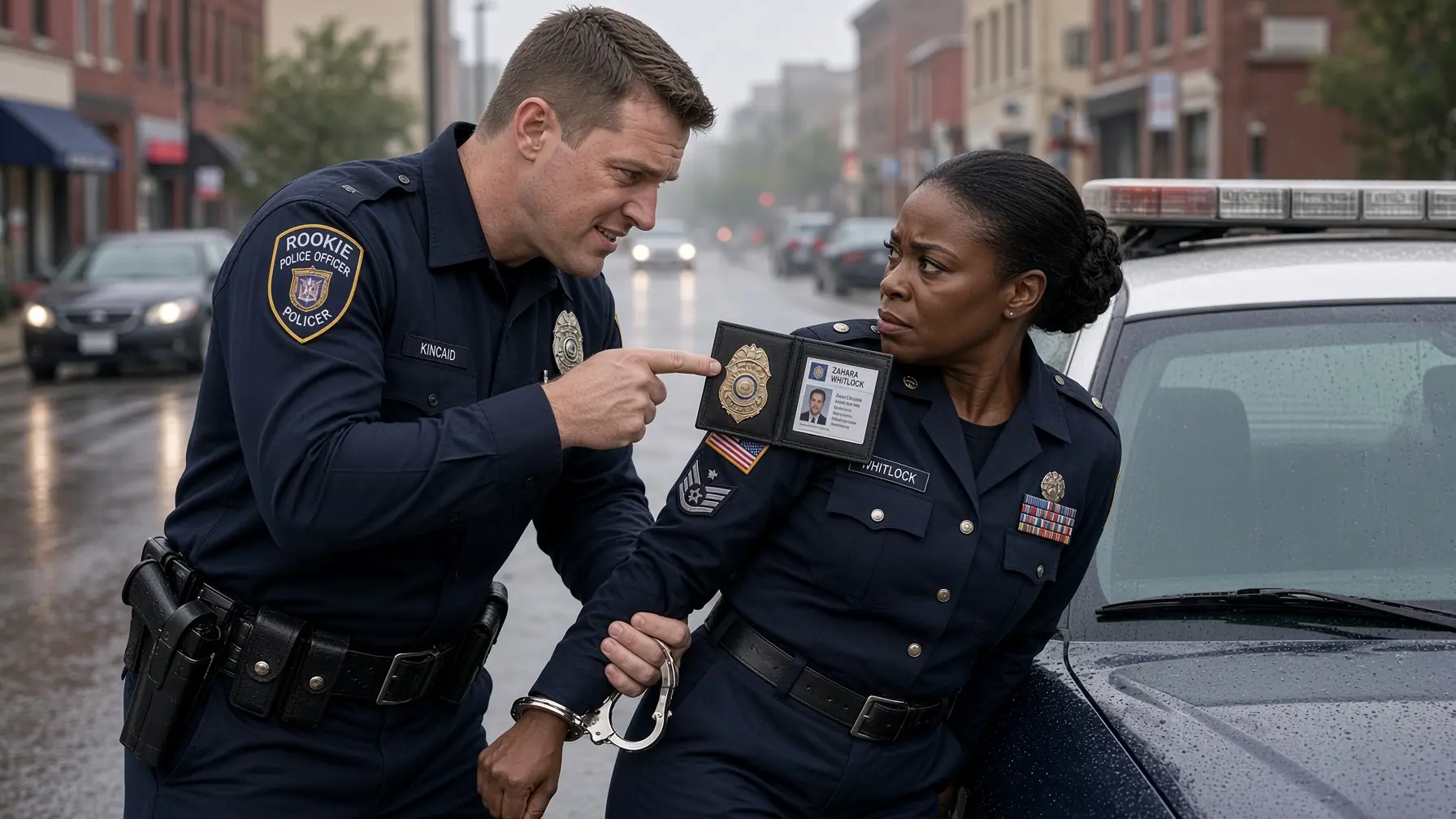
Then the precinct windows rattled, a black SUV burned rubber into the lot, and Colonel Everett Rourke walked through the front doors demanding to know where they were holding Commander Zahara Whitlock.
That should have ended the mistake.
Instead, it proved the arrest had never been a mistake at all.
Someone had used my photograph, my personnel file, and a false order from Rourke’s own office to manufacture a public fraud charge against me—and whoever built the trap knew exactly how little I was allowed to say in my own defense.
“Cuff her. She is impersonating an officer.”
Those words sliced through the humid morning air before I had time to understand why the local police cruiser had stopped beside me.
Officer Darius Kincaid came out fast.
Young.
Broad shoulders.
Buzzed dark hair.
Maybe twenty-six.
His badge looked newer than the leather around it.
His hand was already close to his holster.
I stood beside the entrance to the Harrington Federal Annex carrying one leather document case and a sealed envelope I had been instructed not to open until I reached Security Office Four.
My uniform was correct.
My credentials were correct.
My appointment time was correct.
Everything about that morning had been routine until Kincaid looked at me as though he had been waiting specifically for my face.
“Hands where I can see them.”
I raised them.
“I am Commander Zahara Whitlock, active federal service.”
“Turn around.”
“I can provide identification.”
“I said turn around.”
His voice already carried the certainty of someone who believed the decision had been made before he arrived.
I turned.
The cuffs closed around my wrists.
Metal ratcheted tighter than necessary.
Kincaid pushed me forward until my hip hit the front edge of his cruiser.
“You think this is funny?”
“No.”
“Where did you get the uniform?”
I looked straight ahead.
“Officer, my identification is in the leather wallet inside my left breast pocket. You may retrieve it.”
He did.
He opened the wallet.
Looked at the card.
Then laughed.
Not because anything was funny.
Because he thought the card proved what he already believed.
“This is cute.”
“It is authentic.”
“Sure it is.”
He slapped it onto the hood.
My photograph faced upward.
My name.
My branch identifier.
My clearance stripe.
My credential serial.
Everything exactly as it had been the day I received it.
Kincaid pulled out his phone-sized terminal.
Entered the number.
Waited.
Then turned the screen toward me.
INVALID CREDENTIAL.
I felt the first cold shift in my stomach.
Not fear.
Recognition.
Something was wrong far beyond a rookie officer with too much adrenaline.
Kincaid smiled.
“There it is.”
“My credential is valid.”
“The system says it isn’t.”
“The system you’re using may not have authority to verify my status.”
His expression sharpened.
“Don’t start.”
“I’m not.”
“You’re telling me my system is wrong?”
“I’m telling you that you may be querying a database without the appropriate access layer.”
He stared at me.
Then laughed again.
“That’s what all the fake federal people say.”
I turned my head slightly.
“How many fake federal people do you arrest in this parking lot?”
His smile vanished.
“What?”
“You appear very prepared.”
He stepped closer.
“Lady, I got a bulletin with your photograph on it. Same uniform. Same face. Same fake credentials. It says you’ve been approaching restricted federal sites claiming to be a senior military officer.”
That was the moment I knew.
Not suspected.
Knew.
A bulletin with my photograph existed before he arrived.
“May I see it?”
“No.”
“Then call the security office inside the annex.”
“I already did.”
My pulse shifted.
“What did they say?”
“That nobody named Commander Whitlock has an appointment here.”
I looked at the federal building behind him.
Security cameras above the entrance.
Mirrored windows.
Badge-controlled doors.
A place I had entered more times than I could count.
I had an appointment.
At 0900.
The email had come from Colonel Everett Rourke’s secure office account.
Subject:
CLEARANCE RE-VERIFICATION — IN PERSON.
It referenced an internal compartment number almost no one outside my chain of command would know.
The language was right.
The signature block was right.
The encryption certificate was right.
I had not questioned it.
That bothered me more than the cuffs.
Kincaid leaned near my ear.
“So here’s what’s going to happen. You’re going to tell me where you bought that badge, who made the uniform, and whether anyone else is running this scam with you.”
“I cannot answer operational questions.”
“There are no operational questions.”
“You don’t know that.”
He shoved me harder against the hood.
“You’re not a commander.”
I stared at the windshield.
“You need to contact federal security.”
“I did.”
“Not the number on your bulletin.”
He paused.
Only briefly.
But I felt it.
“What number?”
“The independently published federal operations desk.”
His grip tightened.
“Stop trying to run the investigation.”
“I’m trying to prevent you from becoming part of one.”
His face flushed.
That landed badly.
To him, I had gone from suspect to arrogant suspect.
He took my document case.