The first thing I heard was the dog.
Not voices.
Not keys.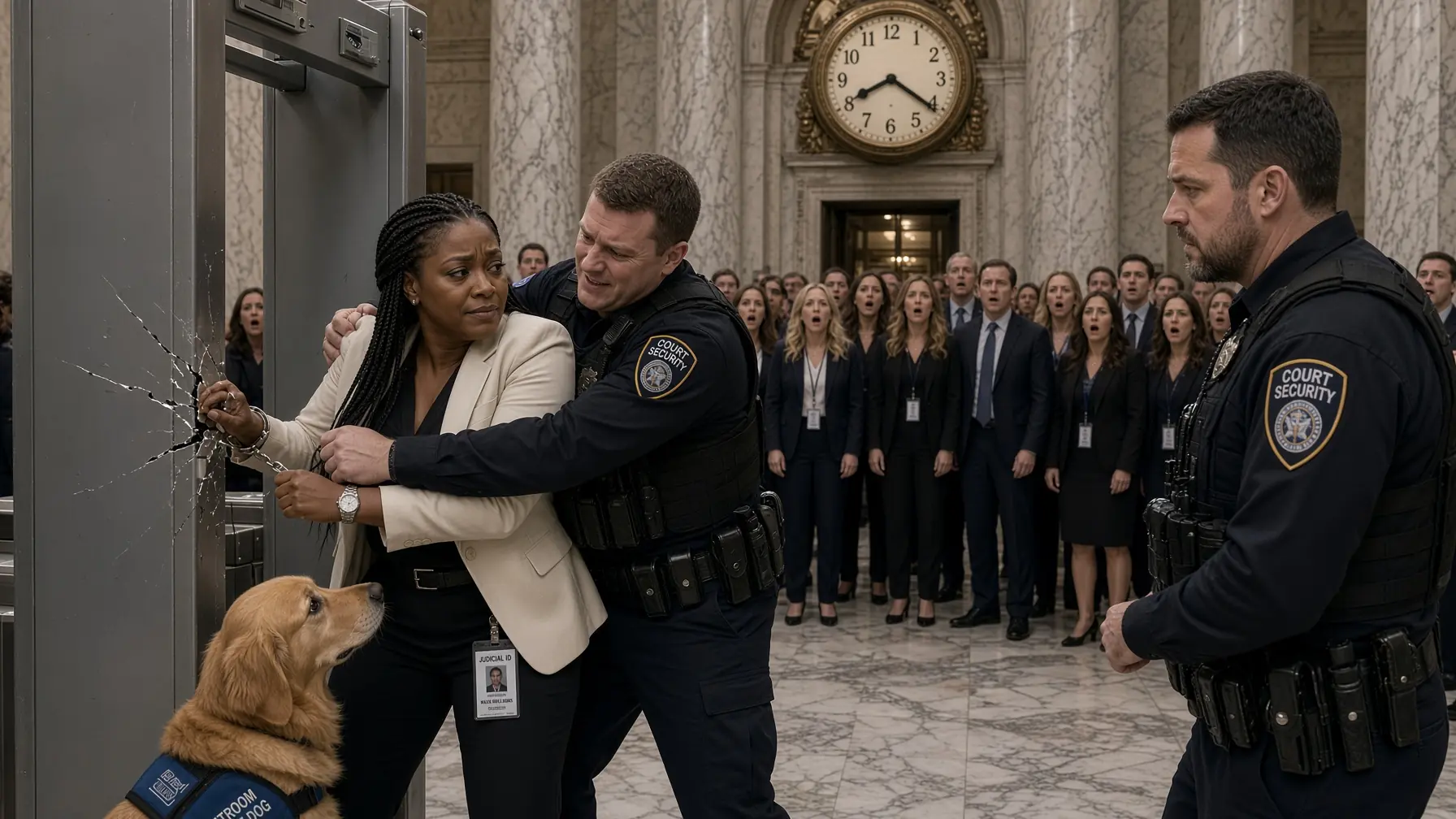
Not another officer coming to fix what Deputy Darren Reed had done.
A dog.
A soft scrape of claws against concrete.
One frightened whimper.
Then a black nose appeared beneath the steel door.
“Buster.”
The golden retriever whined so hard his breath puffed dust toward my fingers.
I dropped to one knee.
“Good boy.”
His nose pressed against my hand.
His tail struck the corridor wall.
Once.
Twice.
Three times.
Then I heard someone running.
“Buster!”
Another voice behind him:
“Where the hell did that dog go?”
Boots stopped outside my door.
Silence.
Then:
“Why is he at Holding Three?”
The other man answered:
“Because he smells somebody.”
My eyes closed.
Finally.
A key scraped against metal.
Then stopped.
“Wait.”
The first voice had changed.
“Who authorized this cell?”
No answer.
“This wing is closed.”
Another pause.
Then:
“Get Sergeant Vale down here.”
The key turned.
The door opened.
Light hit me so suddenly I had to squint.
Two courthouse security officers stood outside.
Behind them was Buster, the courthouse comfort dog, wagging his entire body with relief.
The older officer nearest me was Deputy Marshal Aaron Bell, a man I had known for four years.
He looked at me.
Then at my wrist.
Then at the damaged Omega.
Then at the inside of the condemned cell.
His face went blank.
“Judge Williams?”
I stood.
Straightened my blazer.
Picked up my briefcase.
“Yes.”
Bell stared at me.
“What are you doing in here?”
I looked past him toward the corridor.
“That is an excellent question.”
The younger officer whispered:
“Oh my God.”
Bell’s voice dropped.
“Who put you in this cell?”
I answered with the same calm I had used when Darren Reed twisted my arm behind my back forty minutes earlier.
“Deputy Reed.”
Nobody spoke.
Then Bell asked:
“Darren Reed?”
“Yes.”
The younger officer looked toward the ceiling.
As if he could somehow see through two floors of concrete to Courtroom 4B.
At nine o’clock, Reed was supposed to be sitting in a witness chair upstairs.
Not as a courthouse deputy.
As the officer whose evidence-handling history sat at the center of a sealed federal referral involving eleven narcotics prosecutions.
Bell looked at his watch.
8:46.
Then at me.
“Judge…”
He swallowed.
“Court convenes in fourteen minutes.”
“I know.”
Three hours earlier, Darren Reed had probably believed his biggest problem was a broken identification card.
He was wrong.
The card itself had not even been broken.
At 8:17 that morning, I entered the Fulton Judicial Center through the east rotunda.
I had done that nearly every working morning for seven years.
The building was already awake.
Clerks moving toward elevators.
Attorneys checking files.
Defendants waiting on benches.
Court officers drinking bad coffee.
Sunlight spilling across the marble floor.
I tapped my judicial credential against the access reader.
RED.
I tried again.
RED.
I knew immediately what had happened.
The courthouse had pushed an identity-management update overnight.
We had received an email Friday warning that some credentials might temporarily fail until the morning directory sync completed.
The fix was simple.
Manual lookup.
Name.
Credential number.
Twelve seconds, maybe fifteen.
I reached for the intercom beside the gate.
That was when Reed stepped toward me.
“Ma’am.”
I looked over.
He was young.
Twenty-six, perhaps twenty-seven.
Fresh uniform.
Fresh haircut.
Fresh confidence.
The kind of confidence that comes before experience teaches you how many things you do not know.