Lieutenant General Evelyn Carter returns to Millhaven, Georgia, to bury her mother, but Officer Wade Mercer stops her outside the church and treats her decorated uniform like a costume.
When Evelyn refuses to abandon the funeral procession, Mercer places her in handcuffs before the grieving congregation and transports her to his small-town precinct.
Minutes later, three helicopters appear above Millhaven as a secure command message reveals that the officer has detained someone whose authority reaches far beyond his badge.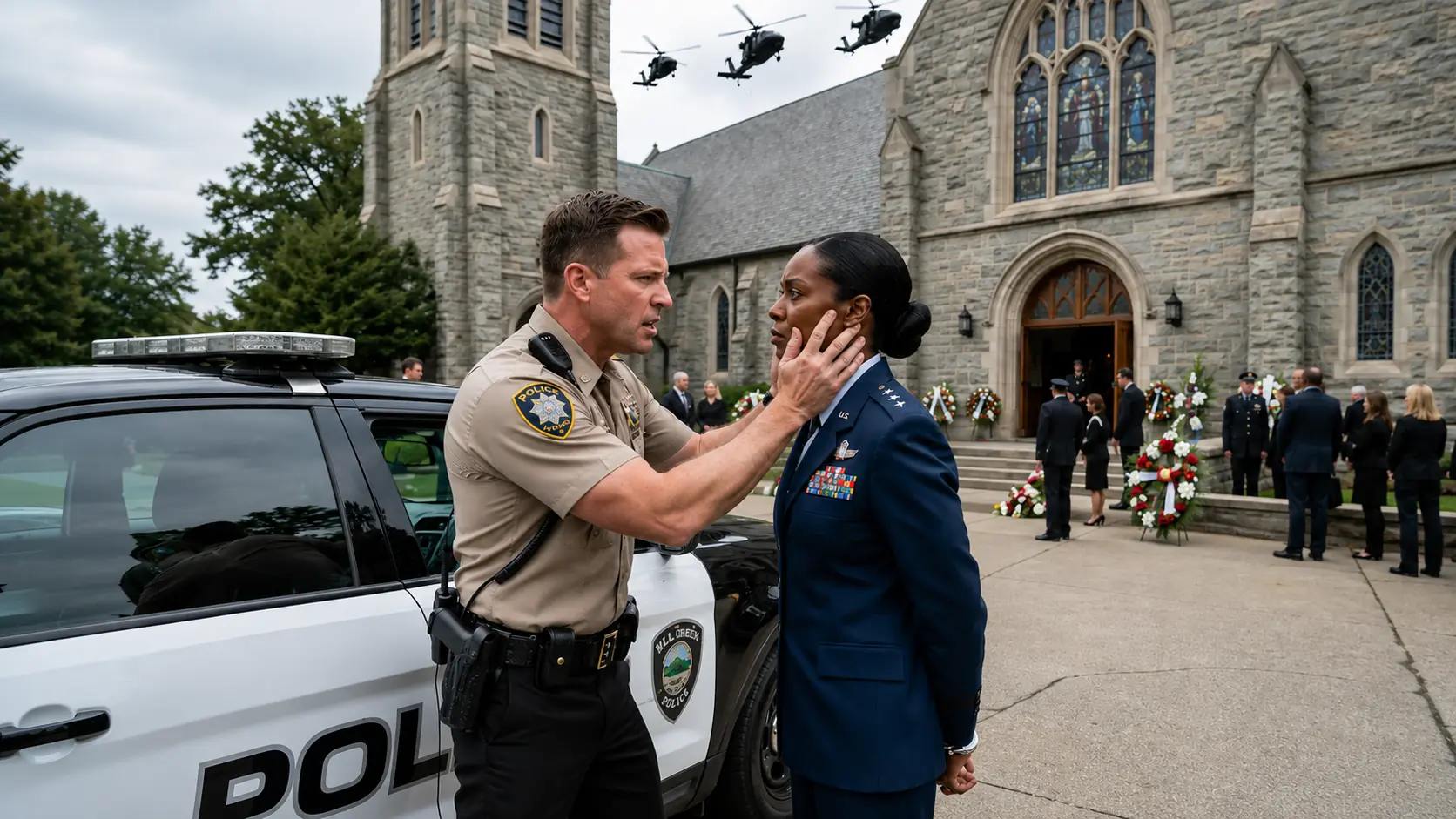
The bells of Saint Matthew’s Church began ringing at 10:00 on a cold Saturday morning in Millhaven, Georgia.
Lieutenant General Evelyn Carter stood beside the black funeral car with her hands folded behind her back, staring at the stone church where her mother had worshipped for fifty-three years. Evelyn was fifty-two, tall and composed, with dark brown skin, calm hazel eyes, and black hair pulled into a precise bun. Her deep-blue formal uniform carried three silver stars on each shoulder, a row of service ribbons across her chest, and the quiet weight of thirty years spent making decisions that affected thousands of people.
Yet on that morning, none of those decorations mattered to her.
She was not a general standing outside a command center.
She was a daughter preparing to bury her mother.
Inside the church, relatives and old neighbors filled the wooden pews. White lilies surrounded the closed casket, and photographs of seventy-eight-year-old Margaret Carter rested beside the altar. One showed Margaret teaching at Millhaven Elementary School. Another showed her holding Evelyn’s hand on the first day of kindergarten.
Evelyn had arrived in town only two hours earlier.
Her staff had offered to accompany her, but she refused. Margaret had disliked attention, formal escorts, and people turning family moments into public ceremonies. Evelyn therefore traveled with one driver and a single aide, Major Lena Brooks, who remained near the church entrance carrying a black leather folder.
The funeral was supposed to begin in ten minutes.
Then a police cruiser stopped beside the curb.
Officer Wade Mercer stepped out before the vehicle had completely settled. He was thirty-nine, broad-shouldered, with short brown hair and an expression that suggested every unfamiliar situation was an insult to his authority. He had served in the Millhaven Police Department for eleven years and often reminded people that his father had once been the town’s sheriff.
Mercer looked at the uniform before looking at Evelyn’s face.
“Ma’am,” he called. “Step away from that vehicle.”
Evelyn slowly turned.
The funeral director, Reverend Thomas Hale, and several mourners looked toward the street.
Evelyn remained calm. “Is there a problem, Officer?”
Mercer approached with one hand resting near his belt.
“I asked you to step away from the car.”
“This vehicle is part of my mother’s funeral procession.”
“I didn’t ask what it was.”
Major Brooks moved forward, but Evelyn lifted one finger, ordering her to remain where she stood.
Mercer stopped several feet from Evelyn and studied her shoulder insignia.
“Where did you get that uniform?”
The question was loud enough for people near the church doors to hear.
Evelyn’s expression barely changed. “It was issued to me.”
“By whom?”
“The United States government.”
Mercer gave a humorless smile.
“You expect me to believe you’re a three-star general?”
Evelyn looked toward the church clock.
“My mother’s service begins in eight minutes. State your reason for stopping me.”
Mercer stepped closer. “We received a report about someone impersonating a senior officer and using an unauthorized government vehicle.”
“No such report was made while I was standing here.”
“You don’t know what calls we receive.”
“You arrived without activating your lights, you did not speak to the funeral director, and you have not requested identification. That suggests you decided what I was before leaving your cruiser.”
Mercer’s face tightened.
People had begun gathering on the church steps.
Reverend Hale approached carefully. “Officer Mercer, this is Margaret Carter’s daughter. The congregation is waiting for her.”
Mercer did not look away from Evelyn.
“Reverend, go back inside.”
“This is a funeral.”
“And this is police business.”
Evelyn removed a leather identification case from the inside pocket of her coat.
Mercer immediately grabbed her wrist.
“Keep your hands where I can see them.”
The movement caused several mourners to gasp.
Evelyn looked down at his hand.
“Release me.”
“You don’t give orders here.”
“I am attempting to show you identification.”
“Place it on the hood.”
Evelyn set the case on the funeral car.
Mercer opened it, glanced at the identification card, and laughed.
“This is fake.”
Major Brooks stepped forward again. “Officer, that credential can be verified through the secure contact number printed on the back.”
Mercer turned toward her. “Who are you?”
“Major Lena Brooks.”
“Another costume?”
Brooks’s jaw tightened.
Evelyn spoke before she could respond. “Major, remain silent.”
Mercer held the credential between two fingers.
“You people picked the wrong town for this performance.”
Evelyn’s grief had been held beneath discipline since the hospital called four days earlier. She had not cried during the flight, during the meeting with the funeral director, or while choosing the blue dress in which her mother would be buried.
Now anger began pressing against that discipline.
“My mother is inside that church,” Evelyn said. “You have verified nothing, yet you are delaying her funeral based entirely on your assumptions.”
Mercer stepped directly into her space.
“You’re not walking into that building dressed like this until I know who you are.”
“You already have the means to know.”
“I said the card is fake.”
“You looked at it for three seconds.”
“I’ve seen enough.”
Evelyn’s voice became colder.
“No, Officer. You decided before you saw anything.”
Mercer pointed toward the cruiser. “Turn around.”
The church steps went silent.
Evelyn did not move.
Mercer reached for her arm.
“Turn around now.”
“On what charge?”
“Failure to obey a lawful order.”
“You have not issued a lawful order.”
Mercer pulled one handcuff from his belt.
Major Brooks opened the leather folder. “Officer Mercer, I strongly advise you to contact your chief before continuing.”
He glanced at the folder but did not read it.
“You threaten me again, and you’ll join her.”
“That was not a threat.”
Evelyn looked directly into Mercer’s eyes.
“You have been given three opportunities to verify my identity. You refused all three. Whatever happens next will be your choice.”
Mercer seized her left wrist.
The first handcuff closed with a metallic snap.
Several mourners shouted at once.
Reverend Hale stepped forward, but another officer had arrived and blocked the church walkway. Evelyn remained still while Mercer pulled her other arm behind her back and secured the second cuff.
Her mother’s church bells continued ringing above them.
Mercer leaned toward her ear.
“Your stars don’t outrank my badge in this town.”
Evelyn turned her head slightly.
“You are about to learn how small this town becomes when the truth arrives.”
Mercer placed her in the back of the cruiser.
Through the window, Evelyn saw Major Brooks holding her phone, Reverend Hale arguing with the second officer, and her mother’s closest friends standing beneath the church doors in disbelief. The funeral director waited beside the casket while the clock passed the scheduled start time.
Mercer climbed behind the wheel.
“You should have cooperated.”
Evelyn looked toward the church as the cruiser pulled away.
“I did.”
“No, you tried to intimidate me.”
“I offered identification.”
“You played a role.”
“I buried people who served under me,” Evelyn said quietly. “Today I was supposed to bury the woman who taught me never to confuse authority with character.”
Mercer looked at her through the mirror.
“Save the speech for the judge.”
The Millhaven Police Department occupied a one-story brick building beside the county courthouse. It contained six offices, two interview rooms, three holding cells, and a dispatch center that rarely handled anything more serious than traffic complaints and property disputes.
Chief Randall Pierce was attending a hunting event thirty miles away.
Sergeant Melissa Grant was the highest-ranking officer inside when Mercer entered with Evelyn in handcuffs.
Grant stood from her desk.
“What happened?”
“Impersonating a senior military official,” Mercer said. “Possible vehicle fraud and refusal to identify.”
Evelyn looked at Grant. “My identification is in Officer Mercer’s pocket.”
Mercer placed the case on the desk.
Grant opened it.
Unlike Mercer, she read every line.
Her expression changed.
“Wade, did you call the verification number?”
“It’s fake.”
“Did you call?”
“I didn’t need to.”
Grant turned the card over and found the secure contact instructions.
“Where did you arrest her?”
“Saint Matthew’s.”
Grant stared at him. “The funeral?”
“She was creating a disturbance.”
Evelyn spoke calmly. “I was standing beside my mother’s funeral car.”
Grant picked up the desk phone.
Mercer reached across and pressed the receiver down.
“Don’t waste your time.”
Grant slowly looked at his hand.
“Move.”
“Melissa, this is an obvious impersonation attempt.”
“Then verification will confirm it.”
Mercer released the phone.
Grant dialed.
The first number transferred her to a secure communications office. She provided her department credentials, Evelyn’s name, the identification number, and the reason for the inquiry.
The person on the other end asked her to hold.
Grant looked toward Evelyn.
“General Carter, I apologize for the delay.”
Mercer scoffed. “Don’t call her that.”
Grant ignored him.
The dispatcher suddenly stood from her console.
“Sergeant?”
“What?”
“I’m receiving calls from county emergency management.”
“About what?”
“They’re asking why restricted air traffic has been authorized over Millhaven.”
Mercer glanced toward the windows.
A low vibration moved through the building.
At first, it sounded like distant thunder.
Then the glass began trembling.
Everyone looked upward.
Three military helicopters crossed above the courthouse in a tight formation. Their engines shook the roof as they circled once and moved toward the abandoned fairground beside the highway.
Mercer’s face lost its color.
Grant’s phone call connected.
A firm voice came through the receiver.
“This is Colonel Andrew Reeves, executive operations officer. Confirm Lieutenant General Evelyn Carter’s condition immediately.”
Grant placed the call on speaker.
“She is standing inside the Millhaven Police Department in handcuffs.”
Silence followed.
Then Colonel Reeves spoke with terrifying calm.
“Remove them.”
Mercer shook his head. “We have procedures.”
The voice hardened.
“Identify yourself.”
“Officer Wade Mercer.”
“Officer Mercer, General Carter was traveling under an approved security movement connected to a classified emergency briefing scheduled after her mother’s funeral. When her biometric security device detected forced restraint and unauthorized transportation, command initiated a protection protocol.”
Mercer stared at Evelyn’s wrist.
A small black device rested beneath her uniform sleeve.
Grant stepped toward her with a key.
Mercer blocked the path.
“Wait. Helicopters don’t change the law.”
Evelyn looked at him.
“No. Evidence changes the law. The helicopters merely brought witnesses.”
The front doors opened.
Chief Pierce entered first, still wearing hunting boots beneath his uniform trousers. Behind him were two federal security officers, Colonel Reeves, and a woman in a dark suit carrying an official investigative credential.
The entire department became silent.
Pierce looked at Evelyn, then at the handcuffs.
“Who authorized this?”
Mercer straightened. “I made a lawful arrest.”
“Did you verify her identification?”
“I determined it was fraudulent.”
Pierce picked up the credential.
“You determined that how?”
“Professional judgment.”
The woman in the dark suit stepped forward.
“My name is Dana Whitaker, Office of Federal Protective Investigations. Your professional judgment has been recorded from the moment you activated your body camera.”
Mercer looked down.
The small red light on his camera was still blinking.
Whitaker continued. “Your dispatch records also show that no report of military impersonation was received this morning.”
Grant turned toward Mercer.
“You lied about the call.”
Mercer’s eyes moved toward the dispatcher.
She shook her head. “There was no call.”
Pierce’s voice dropped.
“Why were you at the church?”
Mercer did not answer.
Reverend Hale entered the building with Major Brooks and several witnesses. Brooks carried a copy of the church’s exterior security footage, while one mourner held a phone containing a complete recording of the confrontation.
Reverend Hale looked at Mercer.
“You drove past the church, saw General Carter, turned around, and came back.”
Mercer pointed toward Evelyn. “She was wearing a uniform I didn’t believe belonged to her.”
Whitaker looked at him.
“So you invented a report.”
“I suspected a crime.”
“You refused authentication.”
“I controlled the scene.”
“You interrupted a funeral.”
“She challenged my authority.”
Evelyn stepped forward after Grant removed the final cuff.
Red marks circled her wrists, but her voice remained steady.
“No, Officer. I challenged your assumption.”
Mercer looked around the room and realized no one stood beside him.
Chief Pierce removed Mercer’s badge.
“You are suspended pending investigation.”
“You can’t do this because helicopters showed up.”
Pierce held the badge in his palm.
“I’m doing it because you made an arrest without probable cause, fabricated a call, ignored valid identification, and placed your pride above the law.”
Mercer turned toward Evelyn.
“This is political pressure.”
Evelyn shook her head.
“My mother spent thirty-five years teaching children in this town. She taught some of the people standing in that church. You saw her funeral, saw my face, saw my uniform, and decided humiliation mattered more than truth.”
Mercer’s anger returned.
“You think those stars make you untouchable?”
“No.”
Evelyn moved closer.
“They make me responsible for answering when power is abused. Today, the power was yours.”
Whitaker instructed officers to secure Mercer’s body-camera footage, radio logs, and previous complaint files. What began as an investigation into one arrest quickly expanded.
Mercer had been the subject of thirteen complaints in six years.
Most involved drivers from outside Millhaven. Several claimed he refused identification, extended stops without cause, or threatened arrest when people questioned him. Chief Pierce had dismissed many complaints because no supervisor considered them serious enough to investigate independently.
Grant opened the archived files.
One complainant was a traveling nurse stopped after midnight.
Another was a college professor visiting family.
A third was a local mechanic who spent four hours in a holding cell after refusing to allow Mercer to search his truck without a warrant.
The complaints formed a pattern.
Mercer did not target crimes.
He targeted people he believed would be unable to challenge him.
Evelyn listened as Whitaker summarized the files.
“I do not want this investigation limited to what happened to me,” Evelyn said.
Pierce lowered his head. “It should never have reached this point.”
“No, Chief. It should not have reached the first complaint.”
Outside, the helicopters remained at the fairground while news vehicles gathered near the courthouse. Evelyn refused every interview.
She looked at the church clock through the window.
Her mother had been waiting for nearly two hours.
“Major Brooks,” she said. “Arrange transportation back to Saint Matthew’s.”
Colonel Reeves stepped forward. “General, the aircraft can transport you.”
Evelyn looked at him.
“My mother disliked noise.”
Reeves nodded.
“We’ll keep them grounded.”
Chief Pierce offered a department escort.
Evelyn refused that too.
She returned to the church in the original funeral vehicle, seated beside Major Brooks. The road was lined with residents who had heard what happened. Some held phones, while others simply stood in silence.
At Saint Matthew’s, the congregation remained inside.
No one had left.
When Evelyn entered, every person rose.
She walked alone toward her mother’s casket, placed one hand on the polished wood, and finally allowed herself to cry.
Reverend Hale waited until she sat beside the family.
Then he began.
Margaret Carter’s service was not about generals, helicopters, police departments, or national authority. It was about a schoolteacher who carried extra lunches for children whose families struggled, who remembered every student’s birthday, and who believed dignity was something people owed one another before it was something they earned.
During the eulogy, Evelyn spoke without notes.
“My mother never wore a uniform,” she said. “She never commanded thousands of people or entered rooms guarded by security. But she understood authority better than many people who carry titles.”
She looked toward the open church doors.
“She taught me that power reveals character. It does not create it.”
Three months later, Wade Mercer appeared in county court.
Body-camera footage proved he had refused repeated opportunities to authenticate Evelyn’s identity. Dispatch records proved he invented the original complaint. Church video showed him turning his cruiser around after seeing her beside the funeral car.
He was convicted of unlawful detention, filing a false report, and misconduct in office.
The investigation into his previous arrests led to several cases being reopened. Two convictions based primarily on his testimony were overturned, and the town paid settlements to multiple people whose complaints had once been ignored.
Chief Pierce resigned.
Sergeant Grant became interim chief and ordered an independent review of department policy. Every officer received new training on identification verification, lawful commands, body-camera compliance, and intervention when another officer acted improperly.
The reforms were not named after Evelyn.
She refused that honor.
Instead, Grant named the program the Margaret Carter Standard.
Its first line read:
Authority must never become an excuse to stop listening.
One year after the funeral, Evelyn returned to Millhaven in ordinary clothes. No helicopters followed her, and no official vehicle waited at the airport.
She visited her mother’s grave carrying white lilies.
Sergeant Grant found her there but remained at a respectful distance.
“The department released its annual report,” Grant said. “Complaints are down. Every detention is now reviewed by a supervisor before the end of the shift.”
Evelyn placed the flowers beneath the headstone.
“And the old cases?”
“Still being examined.”
“Good.”
Grant looked toward Margaret Carter’s name.
“I wish the change had happened without what you endured.”
“So do I.”
“Do you forgive the town?”
Evelyn stood.
“A town is not one officer.”
She looked across the cemetery toward the stone church.
“But a town becomes responsible when good people see a pattern and choose convenience over courage.”
Grant nodded.
The bells of Saint Matthew’s began ringing at noon.
This time, no cruiser interrupted them.
No officer demanded proof that Evelyn belonged where she stood.
No helicopter crossed the sky.
The sound carried quietly across Millhaven, over the police station, courthouse, school, and cemetery where Margaret Carter rested.
A year earlier, Officer Mercer believed his badge gave him complete control of one small street.
He was wrong.
The badge gave him responsibility.
The uniform before him had not been a costume.
The woman wearing it had not needed helicopters to make her identity real.
They came because one arrogant decision triggered a system larger than Mercer could imagine.
But the true consequence was not the aircraft descending over his precinct.
It was the truth descending on the entire town.