The first handcuff closed around my wrist before I had even put down my fork.
Click.
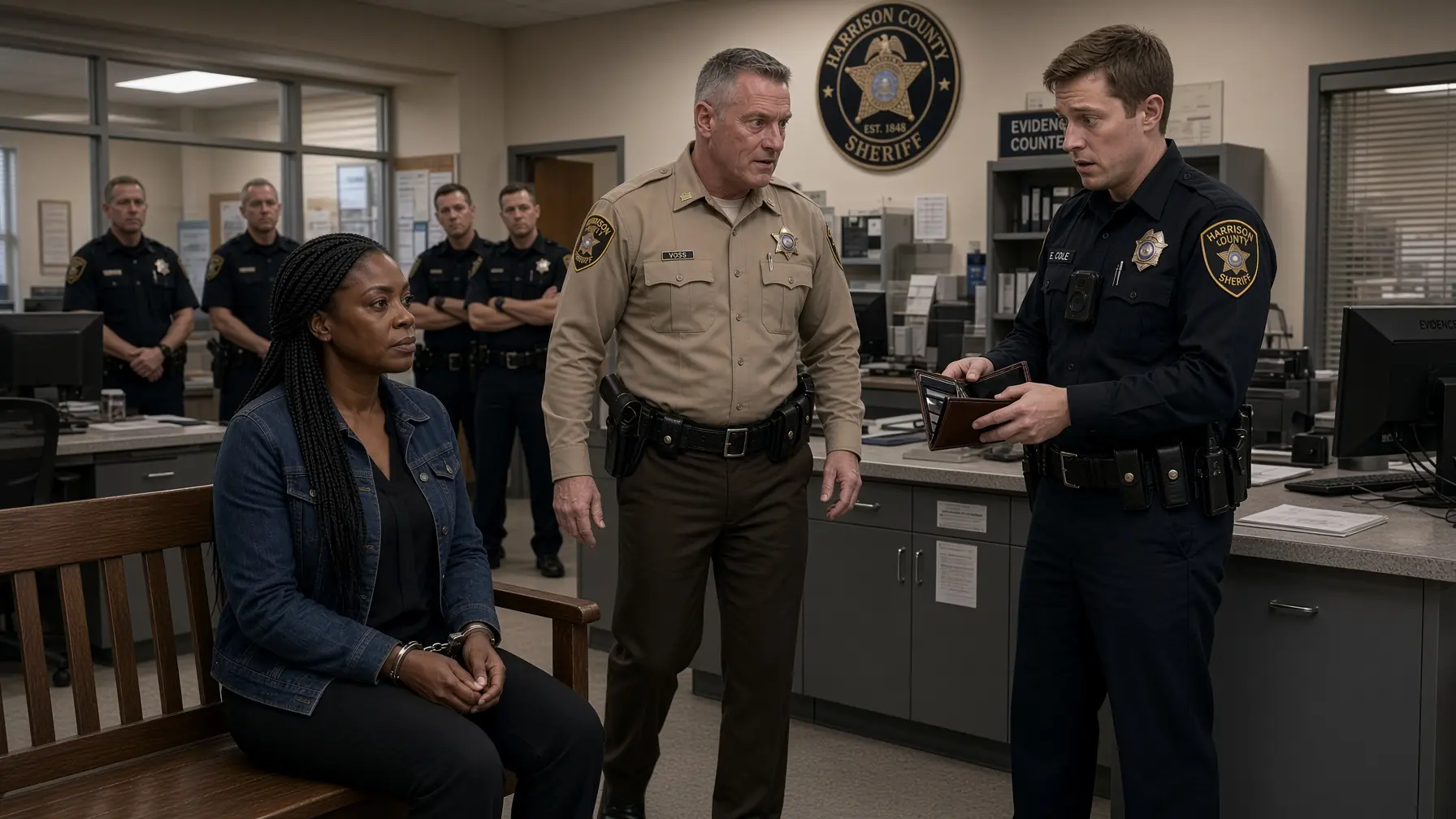
Heavy steel.
Too tight.
Then Sheriff Dalton Voss leaned over the booth and growled:
“Hands behind your back. Now.”
The entire diner went silent.
A spoon hit a plate near the counter.
Someone stopped pouring coffee.
An elderly man in a hunting jacket lowered his newspaper.
Nobody spoke.
Nobody challenged him.
That told me almost as much as the handcuffs did.
My name is Amara Whitlock.
I was forty-four years old.
Born in Georgia.
Educated at Howard and Columbia.
Former federal prosecutor.
And for the previous six years, an appointed United States district judge.
Dalton Voss knew none of that.
That was intentional.
I was wearing a faded denim jacket over a black sweater.
Braided hair pulled loosely behind my shoulders.
Jeans.
Flat boots.
No robe.
No security detail.
No government vehicle outside.
Nothing that announced status.
My federal judicial credential sat deep inside my leather handbag.
And I had made a conscious decision not to reach for it.
Not yet.
Because for nearly six months, complaints had been arriving from Voss County.
Anonymous letters.
Sworn affidavits.
Copies of citations.
Claims of unlawful searches.
Cash seizures with incomplete documentation.
Arrests that somehow disappeared when the accused had political connections.
Arrests that somehow became more serious when the accused was poor, Black, Latino, or passing through town alone.
My chambers did not investigate police departments.
Judges do not operate like detectives.
But some of those complaints had become connected to litigation already moving toward federal court.
Attorneys had requested preservation orders.
Civil-rights counsel had raised questions about recurring conduct.
And I had been scheduled to attend a closed judicial conference in the region that week.
So I did something simple.
I stopped for lunch.
Alone.
No announcement.
No one from the sheriff’s department was supposed to know I was in town.
I wanted to see the courthouse district.
The jail.
The public roads.
The atmosphere.
I did not expect to become part of the evidence.
Then Sheriff Voss walked into the diner.
He was fifty-three.
Thick neck.
Gray beginning in his beard.
Brown uniform stretched tightly across his shoulders.
Gold star pinned high on his chest.
A man who occupied space like he believed every room became his property the moment he entered it.
He saw me almost immediately.
I noticed that.
Three white men sat alone.
A delivery driver was eating near the window.
Two college-aged women shared fries in a corner.
Voss looked at all of them.
Then at me.
And stopped.
He spoke quietly with the waitress.
She looked uncomfortable.
Then he walked toward my booth.
I had ordered grilled chicken, potatoes, and iced tea.
Nothing criminal.
“ID.”
That was his first word to me.
Not hello.
Not excuse me.
I looked up.
“For what?”
His jaw tightened.
“Identification.”
“Why?”
A younger deputy entered behind him.
Maybe twenty-six.
Thin.
Nervous.
His name tag read:
DEPUTY ELI BARNES
Voss planted one hand on the table.
“We've got an armed-theft suspect moving through the area.”
“And?”
“You match the description.”
I looked at myself.
Then at him.
“What description?”
“Black female.”
“That narrows Georgia considerably.”
A man at the counter almost laughed.
He caught himself.
Voss heard anyway.
His face changed.
“Stand up.”
“No.”
The diner seemed to inhale.
Voss stared.
“What did you say?”
“I asked what specific description connects me to the reported suspect.”
He leaned closer.
“You think you're a lawyer?”
I almost smiled.
“Something like that.”
That was when he grabbed me.