“Staff entrance is around back.”
Simone Carter stopped in the center of the marble lobby and looked at the man blocking her path to the private elevators. At thirty-five, she had spent enough time inside expensive corporate buildings to recognize contempt disguised as procedure. Her deep-brown skin, elegant braided bun, tailored ivory suit, and slim leather portfolio should have made her purpose obvious, but the security director had already decided who she was before she spoke. Around them, employees hurried through polished turnstiles beneath the silver logo of Lancaster Whitmore Capital.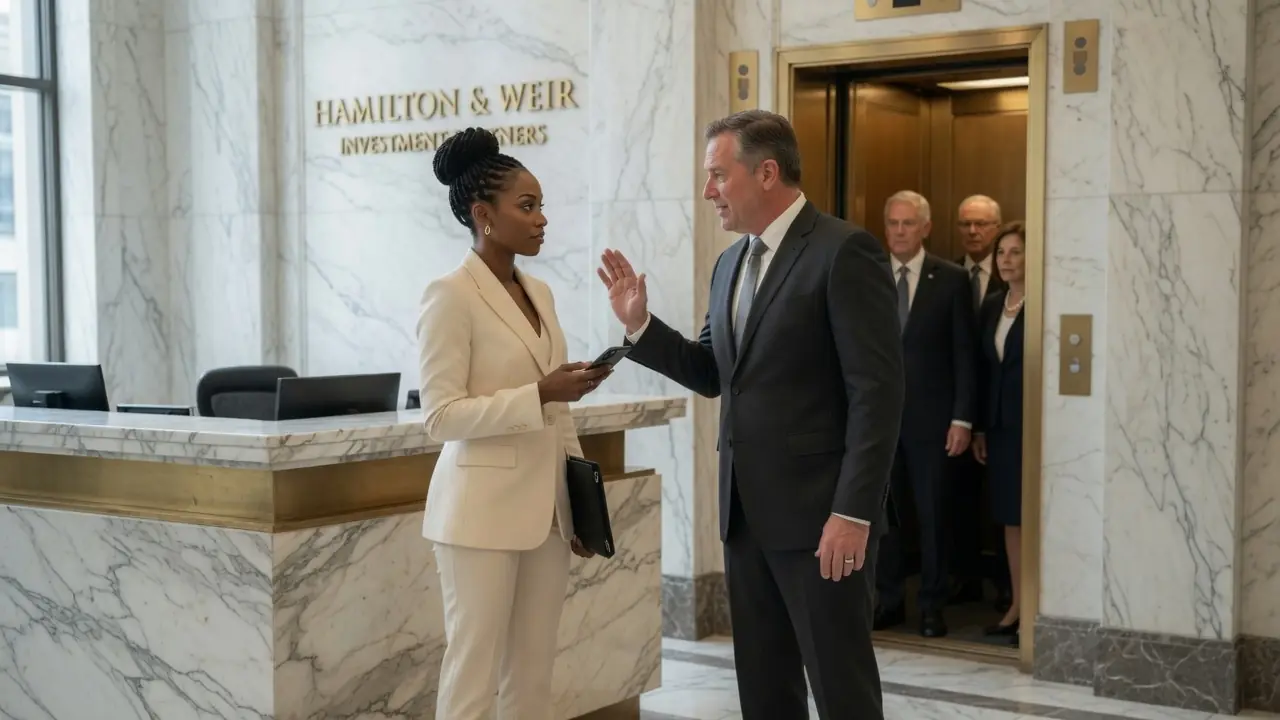
“I have an appointment,” Simone said.
The man glanced at the visitor badge kiosk without moving toward it. His nameplate identified him as Graham Pike, Director of Corporate Security, though the expensive charcoal suit and silver tie suggested he preferred being mistaken for an executive. He was around fifty, with carefully combed gray hair, a broad body, and the relaxed arrogance of someone who had spent years deciding which people belonged near power. “Deliveries, contractors, and temporary staff use the service entrance,” he replied.
“I am not making a delivery.”
“Then give me the employee you’re here to see.”
“The entire board.”
Graham laughed once. It was not loud, but several nearby employees heard it and slowed their steps. “Women like you don’t meet this board. You clean up after it.”
The lobby became quiet.
Simone held his gaze without blinking. “Check the appointment list.”
“I don’t need to.”
“That is an interesting approach to security.”
His mouth tightened. “Do not become difficult.”
Simone had awakened at five that morning inside a hotel suite overlooking Central Park. She reviewed the company’s financial reports, employee complaints, litigation history, and restructuring proposal before breakfast. At eight, the board chair called to confirm that every director would be waiting on the thirty-eighth floor for her official introduction. At nine thirteen, Simone entered the headquarters of Lancaster Whitmore Capital as its newly appointed chief executive.
Only Graham Pike had not received—or had ignored—the announcement.
The firm had recruited Simone after eighteen months of decline. Lancaster Whitmore once managed nearly sixty billion dollars in investments, but bad acquisitions, hidden losses, and a culture of executive intimidation had driven away clients and talented employees. The previous CEO resigned after an internal audit revealed that senior managers had manipulated performance reports to protect their bonuses. The board wanted Simone because she had rescued two companies from similar crises without destroying the people who performed the actual work.
Graham saw none of that when she crossed the lobby.
He saw a Black woman in an ivory suit and decided she must serve someone important rather than be the important person herself.
Simone removed her phone from her handbag. “Board counsel, come down,” she said when the call connected. “The man insulting your new CEO is finished.”
Graham’s expression changed, though only slightly. “Put that phone away.”
Simone continued speaking. “Yes, main lobby. Bring Ms. Lancaster and the chair of the risk committee.”
“You cannot make unauthorized calls from this area,” Graham said.
“I am calling the people waiting for me.”
“I said put it away.”
He reached toward her phone.
Simone moved her hand back before he could touch it. “Try that again, and attempted theft will become the smallest problem in your personnel file.”
A young receptionist behind the marble desk lowered her eyes, clearly frightened. Two guards stationed near the turnstiles looked toward Graham but did not intervene. The silence told Simone that his behavior was not unusual.
Graham stepped closer. “You have thirty seconds to leave before I have you escorted out.”
“Who approved that decision?”
“I do not require approval to remove disruptive individuals.”
“Have I raised my voice?”
“No.”
“Threatened anyone?”
“You are refusing instructions.”
“Instructions based on what?”
Graham looked her up and down. “Based on experience.”
The private elevator chimed behind him.
The doors opened, revealing six senior executives and board directors. At the front stood Evelyn Lancaster, the seventy-year-old granddaughter of the firm’s founder and current chair of the board. Beside her was General Counsel Rebecca Sloan, followed by the chief financial officer, two independent directors, and the head of human resources.
Evelyn crossed the lobby quickly. “Simone, what happened?”
Graham turned so fast that his polished shoe slipped slightly against the marble. “Ms. Lancaster, I was handling an unauthorized visitor.”
Evelyn stared at him. “That is Simone Carter.”
He looked from Evelyn to Simone, as if expecting the identity to change.
“Our new chief executive,” Rebecca added.
The words traveled across the lobby. Employees near the turnstiles stopped pretending not to listen. The receptionist lifted her head, while the two guards exchanged alarmed looks.
Graham forced a professional smile. “There appears to have been a misunderstanding.”
Simone slipped her phone back into her handbag. “There was no misunderstanding. You refused to check my appointment, directed me to the staff entrance, insulted me, threatened to remove me, and attempted to take my phone.”
“I was following security protocol.”
Rebecca’s expression hardened. “Which protocol authorizes racial and gender-based insults?”
“I never mentioned race.”
“You did not need to,” Simone said. “Your assumption spoke clearly enough.”
Graham glanced toward the gathering employees. Public embarrassment had replaced confidence, and he wanted the incident moved behind closed doors before witnesses understood its significance. “Perhaps we should discuss this privately.”
“No,” Simone replied. “You made your judgment publicly.”
Evelyn turned toward the two guards. “Did either of you witness the exchange?”
Both hesitated.
Graham looked at them.
That glance answered more than words could have.
Simone noticed it immediately. “You will not retaliate against anyone who gives an honest statement.”
The younger guard, Officer Malik Benson, stepped forward. “Mr. Pike told her the staff entrance was around back. She asked him to check the appointment list. He refused.”
The second guard, Olivia Chen, nodded. “He also said women like her cleaned up after the board.”
Graham’s face flushed. “You are misrepresenting the context.”
“What context makes that sentence appropriate?” Evelyn asked.
He said nothing.
Rebecca requested Graham’s badge, company phone, and access credentials pending investigation. He refused at first, arguing that his position was too critical to suspend without formal review. Simone listened quietly until he finished defending his importance.
“You are suspended with pay until the investigation concludes,” she said. “That preserves due process while protecting employees and visitors from further misuse of authority.”
Graham looked at Evelyn. “She has not even entered the boardroom yet.”
“She entered this building as CEO,” Evelyn replied. “Her authority did not begin when you recognized her.”
Corporate security escorted Graham through the same lobby he had treated as his private territory. He kept his head high until he passed the reception desk, where the young woman he routinely intimidated watched without hiding her relief. The private elevator doors closed behind him.
Simone turned toward the employees still gathered nearby. “Return to work. No one will be punished for what they witnessed or recorded.”
Several phones lowered.
Evelyn gestured toward the elevator. “The board is waiting.”
Simone looked at the receptionist first. “What is your name?”
“Claire Morrison.”
“How long have you worked here?”
“Eight months.”
“Did Mr. Pike speak to visitors like that often?”
Claire glanced at the executives around Simone. “Sometimes.”
“Did anyone report it?”
“People tried.”
“What happened?”
“The complaints went to his office.”
Rebecca closed her eyes briefly. The security director had apparently controlled the process meant to investigate his own behavior.
Simone nodded. “Preserve every complaint and email. Human resources will contact you today.”
The board meeting began twenty-seven minutes late. Twelve directors sat around a long walnut table overlooking Manhattan, their expressions shifting between embarrassment and concern. A welcome breakfast remained untouched near the windows, beside a silver sign bearing Simone’s name and new title.
Evelyn introduced her formally, though no one needed the ceremony anymore.
Simone stood at the head of the table. “My first experience inside this company exposed three failures before I reached the elevator.”
The directors waited.
“First, an employee used authority to humiliate someone based on assumptions rather than evidence. Second, witnesses were afraid to correct him. Third, complaints against him were routed back to the department he controlled.”
The chair of the compensation committee cleared his throat. “Graham’s conduct was unacceptable, but I hope we do not allow one interaction to distract from the financial emergency.”
“It is part of the financial emergency,” Simone said.
He frowned. “I do not see the connection.”
“A company that silences employees also silences financial warnings. People who fear speaking about discrimination will also fear reporting falsified numbers, unsafe practices, and executive misconduct.”
The chief financial officer, Martin Keller, shifted in his chair. “Our reporting systems are independently audited.”
“So were the performance reports your former CEO manipulated.”
The room became still.
Simone opened her portfolio and distributed a packet to every director. During the previous week, she had reviewed internal exit interviews, ethics complaints, employee surveys, and expense approvals. The pattern extended far beyond Graham Pike.
Junior analysts reported that managers stole credit for their work. Women described being excluded from client meetings after becoming pregnant. Black and Latino employees were promoted at significantly lower rates than colleagues with similar performance scores. Several staff members claimed executives pressured them to alter risk classifications before quarterly presentations.
Most complaints were closed without interviewing witnesses.
“This culture is not an image problem,” Simone said. “It is an operational threat.”
Director Thomas Reed leaned back. “You are making serious claims before conducting an internal review.”
“I am presenting evidence your own systems collected and ignored.”
“Lancaster Whitmore is an investment firm, not a social program.”
“No. It is an institution trusted with other people’s money. Integrity is not charity.”
Martin interrupted. “Before we redesign the company around employee grievances, we should focus on restoring client confidence.”
Simone looked at him. “How much did the firm lose in the Northridge Infrastructure Fund?”
Martin hesitated. “The final number remains under review.”
“Two hundred and twelve million dollars.”
“That includes unrealized adjustments.”
“How many analysts warned that the fund’s energy projections were false?”
No one answered.
“Seven,” Simone said. “Four later resigned. Two filed ethics complaints. One was transferred after refusing to approve the model.”
Martin’s voice sharpened. “Those analysts misunderstood the assumptions.”
“The assumptions included energy contracts that had already expired.”
“That information came from operations.”
“And no executive verified it because challenging senior leadership was considered dangerous.”
Thomas looked down at the packet. “What are you proposing?”
Simone displayed a restructuring plan on the wall screen. Every internal complaint would move to an independent ethics office reporting directly to the board’s audit committee. Managers could not investigate allegations involving themselves or their direct reports. Anonymous reporting channels would be administered by an outside firm, and retaliation would trigger immediate review.
Promotion data, compensation ranges, and performance scores would be audited for unexplained disparities. Senior executives would lose bonuses tied to manipulated or later-restated results. Employees who raised good-faith concerns would receive documented protection.
Several directors disliked the scope.
One warned that transparent salary ranges might increase payroll costs. Another argued that independent complaint review would encourage weak employees to challenge strong managers. Martin suggested waiting until profits stabilized.
Simone listened to each objection without interrupting.
Then she placed a resignation letter on the table.
Evelyn stared at it. “What is this?”
“My condition.”
Thomas frowned. “You have been CEO for less than an hour.”
“And I will remain CEO only if I have authority to repair the company.”
“You would resign over reporting procedures?”
“I would resign if the board wants cosmetic leadership while preserving the system that created this crisis.”
Martin scoffed. “That sounds theatrical.”
Simone turned toward him. “You authorized forty-six million dollars in emergency transfers three weeks before the Northridge collapse.”
His face changed.
The packet included records showing that Martin moved funds from low-risk client accounts to cover margin requirements inside the failing investment vehicle. He described the transfers as temporary liquidity balancing, but the board had never approved them. The movement concealed how close the fund was to default.
“I protected the firm from a panic,” Martin said.
“You protected the quarterly report.”
“The money was returned.”
“After client accounts carried the risk without consent.”
Martin looked toward Evelyn. “This is an ambush.”
“No,” Simone said. “An ambush depends on surprise. You knew what you did.”
The board ordered Martin to leave the room while outside counsel reviewed the evidence. He refused, accusing Simone of using the lobby incident to seize control and remove experienced executives. Evelyn reminded him that his employment agreement required cooperation with board investigations.
When he finally stood, he pointed toward Simone. “You think humiliating people makes you strong?”
Simone’s expression remained calm. “I presented documents. You supplied the humiliation.”
Martin was escorted out.
The remaining directors approved Simone’s reform plan by a vote of nine to two. They also authorized an independent forensic audit of every major transfer made during the previous two years. Simone withdrew the resignation letter and began work immediately.
The investigation into Graham Pike lasted three weeks.
It uncovered thirty-two complaints over six years. Black professionals were repeatedly directed toward service entrances, questioned after presenting valid credentials, or asked to prove they worked in the building. Women reported that Graham commented on their clothing and threatened their jobs when challenged.
One delivery driver suffered a broken wrist after guards restrained him during a dispute Graham initiated. Security footage contradicted Graham’s report, but the video had been removed from the active archive before investigators reviewed the case. Technical records showed Graham ordered the deletion.
He was terminated and later charged with evidence tampering connected to the incident.
Two human-resources managers who routinely forwarded complaints back to him were removed from supervisory roles. One admitted she feared Graham would expose personal information if she challenged him. The other claimed she believed powerful executives wanted complaints contained.
Simone did not accept fear as a complete excuse, but she recognized that accountability had to distinguish between deliberate concealment and survival inside a coercive system. Employees who cooperated received protection. Those who falsified documents faced consequences.
The audit into Martin Keller revealed a larger scheme.
He and three fund managers manipulated risk grades to maintain performance bonuses and prevent clients from withdrawing money. They moved losses between investment vehicles, hid expiring contracts, and threatened analysts who questioned the models. One of those analysts, twenty-seven-year-old Priya Nair, had saved copies of every warning she submitted.
Simone invited Priya back to the firm.
“I am not returning so the company can present me as proof it changed,” Priya said during their meeting.
“I would not ask you to.”
“Then why am I here?”
“To tell the audit committee what happened without your former managers controlling the record.”
Priya agreed to testify. Her evidence helped regulators trace the manipulated reports and recover funds for affected clients. Martin faced criminal charges for fraud and unauthorized transfers, while two managers entered cooperation agreements.
The reforms were not painless.
Lancaster Whitmore lost several senior employees who claimed the company had become hostile to traditional leadership. Two clients withdrew after learning their account managers were under investigation. Financial news outlets described Simone as aggressive, divisive, and obsessed with culture rather than profit.
Within six months, however, the company began stabilizing.
Clients who remained received accurate loss disclosures and revised risk reports. Analysts were allowed to present dissenting models directly to the investment committee. The firm closed two dangerous funds and redirected capital toward transparent investments with measurable assets.
Employee turnover declined.
Internal reporting increased sharply during the first quarter, which critics portrayed as evidence that the company had become more troubled. Simone explained that more reports meant employees finally trusted the system enough to speak.
The number of confirmed violations fell steadily afterward.
Claire Morrison, the receptionist from Simone’s first morning, entered a management-development program after investigators learned she had documented visitor complaints for months. Malik Benson and Olivia Chen became supervisors under the new security director, a former federal courthouse administrator named Helen Ruiz.
Helen’s first policy required every visitor to be treated according to documented behavior, not clothing, race, perceived occupation, or social status. Staff entrances remained available for operational needs, but no one could be directed there as a form of humiliation.
One year after Simone’s appointment, Lancaster Whitmore held its annual client meeting in the same lobby where Graham had stopped her. The marble remained, but the atmosphere felt different. Employees greeted visitors openly, security procedures were displayed clearly, and the founder’s portraits had been joined by a wall explaining the firm’s responsibility to clients and staff.
Evelyn stood beside Simone before the event began. “You nearly resigned during your first board meeting.”
“The letter was real.”
“I know.”
“Would the board have accepted it?”
“Three directors wanted to.”
Simone smiled faintly. “Why didn’t you?”
“Because the man at the lobby believed recognition created your authority. I was not going to let the board make the same mistake.”
Guests began arriving.
Among them was Dr. Malcolm Harris, a Black surgeon representing a hospital pension fund worth nearly nine hundred million dollars. He wore jeans beneath a casual jacket after coming directly from an overnight shift. A newly hired guard checked his invitation, welcomed him by name, and directed him toward the reception area without hesitation.
Simone watched from across the lobby.
Nothing happened.
No confrontation, insult, or public reversal followed. The interaction was so ordinary that almost no one noticed it.
That was the point.
Later that afternoon, Simone addressed employees from a small stage near the elevators. She did not present herself as the heroic new CEO who rescued a broken company. She credited the analysts who saved records, witnesses who finally spoke, and junior employees who continued reporting problems even after leadership ignored them.
“Authority should never depend on whether the person standing before you can destroy your career,” she said. “Respect given only after learning someone’s title is not respect. It is fear wearing good manners.”
Claire stood near the reception desk, listening.
Malik and Olivia remained by the turnstiles.
Evelyn watched from the front row.
Simone glanced toward the private elevator where the directors had appeared one year earlier. Graham Pike believed that the people coming down from the executive floor would protect his judgment. Instead, they revealed how dangerously wrong it was.
His greatest mistake was not failing to recognize the new CEO.
It was believing the woman standing before him needed to be a CEO before she deserved to enter through the front door.