The Security Guard’s palm remained pressed against the elderly man’s chest as the elevator doors slid shut behind them. Employees crossing the marble lobby slowed down, but no one spoke. The guard stood tall in a fitted navy uniform, his square jaw clenched as though stopping an older man from reaching the executive floor were an act of courage. The elderly visitor simply adjusted his thin glasses and stared back without retreating.
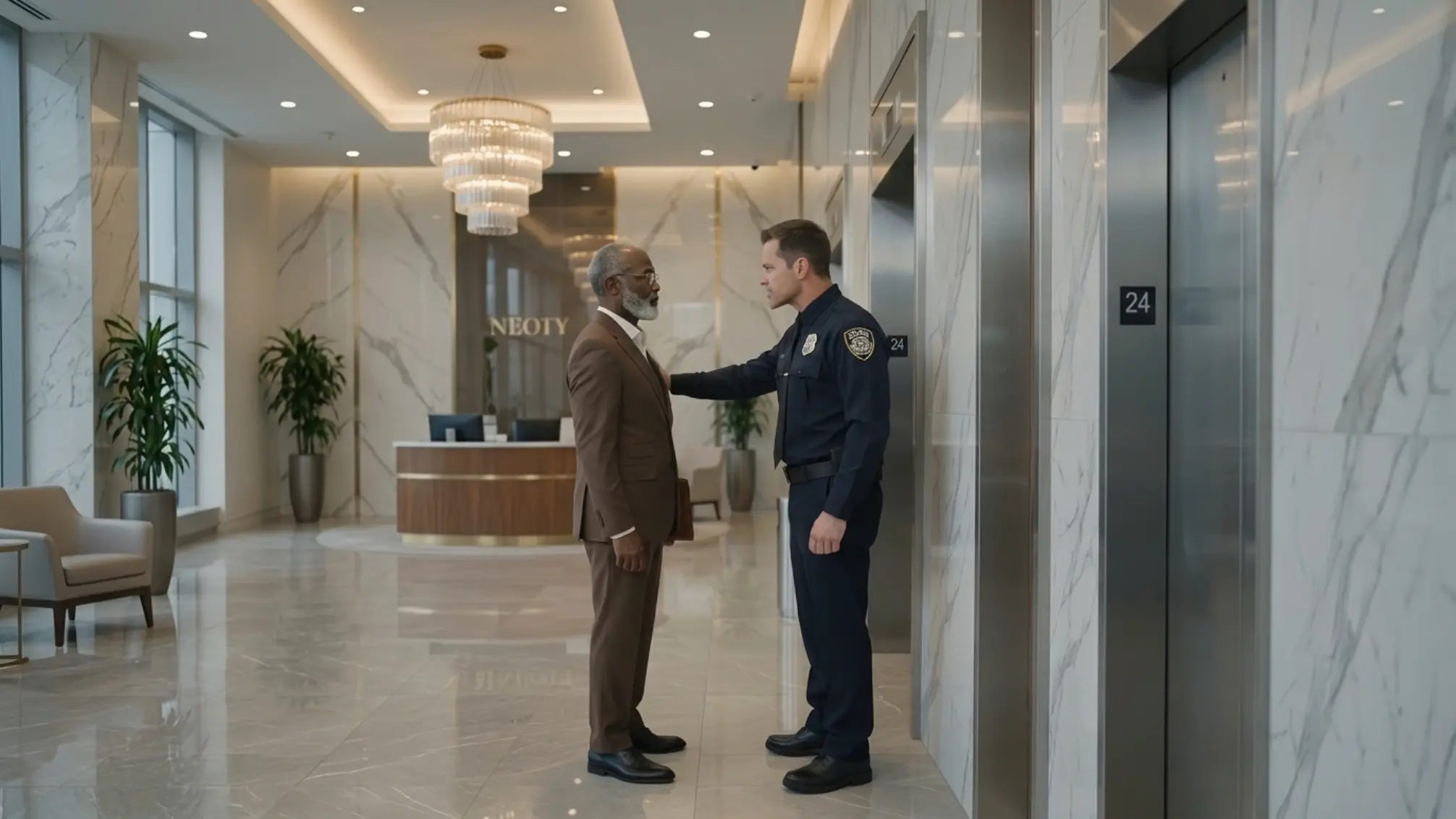
At sixty-seven, Marcus Reed carried himself with the quiet dignity of a man who had spent decades walking into rooms where people underestimated him. His deep brown skin, short silver hair, and full white beard gave him a distinguished appearance, while his tailored brown suit and polished shoes suggested careful professionalism rather than extravagance. Under one arm, he carried a leather portfolio containing contracts, inspection reports, and the signed appointment letter naming him General Manager of Easton Tower. He had deliberately left the official identification badge inside the portfolio.
The thirty-eight-year-old Security Guard, Derek Cole, had already glanced at Marcus’s temporary access card. Instead of scanning it, he decided the card must have been borrowed or forged. Derek had worked in the building for seven years and behaved as though that experience gave him authority over every person who entered. He controlled the elevators, visitor desk, and access gates with the confidence of someone rarely questioned by his supervisors.
“Step away from the elevator,” Derek ordered.
Marcus looked down at the hand pressing against his suit. “Remove your hand.”
“You heard me.”
“I heard you. Now remove it.”
Derek leaned closer until only a few inches separated their faces. “You think a nice suit lets you walk wherever you want?”
Marcus kept his voice level. “I think a valid access card should be scanned before you accuse someone.”
The lobby receptionist watched from behind her desk. She was a young woman named Elena Martinez who had worked in the building for less than six months. Her fingers hovered over the telephone, but she seemed uncertain whether calling Derek’s supervisor would help or make the situation worse. Two other guards stood near the turnstiles, pretending to examine the visitor log.
Marcus noticed all of them.
He had arrived without an escort because Easton Tower’s ownership board had received repeated complaints about the building’s security department. Tenants described guards delaying deliveries, humiliating visitors, rejecting valid access cards, and demanding private information that company policy did not require. Several Black professionals reported being stopped while white visitors walked through with little more than a nod.
The previous General Manager had dismissed most complaints as misunderstandings. Occupancy remained high, the lobby looked immaculate, and security reports showed few official incidents. The board suspected the problem was not a lack of complaints but the disappearance of complaints before they reached management. Marcus had accepted the position on the condition that he could conduct his first inspection without advance notice.
Only the board chair and legal counsel knew the exact time of his arrival.
Derek did not know he was facing the man who would control staffing contracts, building operations, and security oversight by the end of the day. He saw only an older Black man holding a temporary access card and assumed the executive floor could not possibly be his destination. That assumption grew more aggressive each time Marcus refused to appear frightened.
“Last warning,” Derek said. “Leave willingly, or I’ll remove you.”
Marcus opened the leather portfolio.
Derek reached toward it. “Keep your hands where I can see them.”
Marcus stopped. “Are you threatening me?”
“I’m telling you how this works.”
“No. You’re showing me.”
The distinction caused Elena to look up sharply. She recognized that Marcus was not arguing like a confused visitor. He was observing, remembering, and allowing Derek to expose himself through his own words. She quietly pressed a key beneath the reception desk that saved the previous ten minutes of lobby security footage to a protected file.
Derek grabbed the edge of the portfolio.
Marcus tightened his grip. “Do not touch my property.”
“Then put it down.”
“You have no basis to search it.”
“I don’t need your permission.”
One of the other guards shifted uncomfortably. “Derek, maybe scan his card first.”
Derek turned his head. “Stay out of it.”
The younger guard fell silent.
Marcus had seen that kind of silence before. It was not agreement but surrender. Employees learned that challenging Derek meant losing preferred shifts, overtime opportunities, or favorable performance notes. His formal title was Lead Security Officer, but in the lobby he behaved like the building belonged to him.
A middle-aged tenant approached the turnstiles carrying coffee. Derek waved him through without checking his badge. Seconds later, a young Black delivery driver entered with two sealed packages and was immediately stopped by another guard. The contrast happened openly, without embarrassment or hesitation.
Marcus watched the delivery driver produce identification, company records, a delivery code, and the tenant’s phone number. The guard still ordered him to wait against the wall. The tenant with the coffee disappeared into an elevator without showing anything.
Marcus looked back at Derek. “Is that your policy?”
Derek followed his gaze. “Deliveries are screened.”
“I wasn’t asking about the packages.”
“Then mind your own business.”
“It became my business before I entered the building.”
Derek laughed. “You don’t have business here.”
Marcus opened the portfolio fully and removed a single document bearing the Easton Tower letterhead. The board chair’s signature appeared at the bottom beneath the formal appointment. Marcus held it where Derek could read without handing it over.
Derek barely glanced at the page.
“Anyone can print a letter.”
Marcus removed an identification wallet and opened it. Inside was a newly issued executive credential bearing his photograph, name, and title: Marcus Reed — General Manager, Easton Tower.
The younger guards straightened.
Elena rose from her chair.
Derek’s expression changed, but he recovered quickly. “This should have been communicated to security.”
“It was communicated to your director.”
“I wasn’t informed.”
“That explains why you didn’t recognize me. It does not explain your behavior.”
Derek released the portfolio but continued blocking the elevator. His face reddened as employees gathered near the far side of the lobby. He had spent years maintaining authority through certainty, and admitting error in public felt more dangerous to him than continuing the confrontation.
“You arrived using a temporary card,” he said.
Marcus held it up. “A board-issued card with full executive authorization.”
“It could have malfunctioned.”
“You never scanned it.”
“You acted suspiciously.”
“I asked for the elevator.”
“You challenged instructions.”
“I asked you to follow policy.”
Derek’s mouth tightened. “My responsibility is protecting this building.”
“From whom?”
The question remained unanswered.
Elena approached carefully. “Mr. Reed, I can contact Security Director Wallace.”
Marcus nodded. “Please do.”
Derek turned toward her. “Get back to your desk.”
Marcus stepped between them. “She will make the call.”
“You don’t understand our chain of command.”
“I’m about to review it.”
Elena contacted the director. Her voice remained professional, but she looked directly at Marcus while explaining that the new General Manager had been stopped in the lobby and requested immediate assistance. The response on the other end made her eyebrows lift.
“He says he’ll be here in five minutes.”
Marcus checked his watch. “Good.”
Derek lowered his voice. “You came here looking for a confrontation.”
“I came here looking for the truth.”
“You dressed like a visitor and used a temporary card.”
“I followed the same process provided to every authorized executive guest.”
“You should have announced yourself.”
“And then everyone would have behaved differently.”
Derek understood what the unannounced arrival meant. The confrontation was not simply an embarrassing mistake. It had become evidence during an inspection designed to reveal exactly how security treated people without recognizable status.
The delivery driver still stood near the wall holding the packages. Marcus walked toward him and asked whom he was visiting. The driver named a consulting firm on the twenty-second floor and displayed the delivery confirmation. Marcus asked how long he had been waiting.
“Twenty-five minutes.”
“Has anyone called the tenant?”
The driver shook his head.
Marcus turned to the nearest guard. “Call them now.”
Derek stepped forward. “You cannot interfere with active security screening.”
Marcus faced him. “You are delaying a verified delivery without performing any screening.”
“He could be carrying something dangerous.”
“The packages are sealed, logged, and addressed. Your inspection equipment is ten feet away.”
Derek folded his arms. “We decide who gets access.”
Marcus’s tone hardened. “No. You enforce written policy. You do not create policy based on who looks important to you.”
Security Director Wallace entered the lobby at a hurried pace. He was fifty-five, silver-haired, and usually calm, but visible concern marked his face when he saw Marcus standing beside the elevator. He greeted the new General Manager formally and apologized for the confusion.
Marcus did not accept the apology immediately.
“Did you inform your staff that I might arrive today?”
“I informed the shift supervisors that a new executive appointment had been approved.”
“Did you provide my name?”
“Yes.”
Derek looked toward him. “I never received it.”
Wallace’s expression tightened. “It was sent to every lead officer yesterday.”
Derek claimed the email system had failed.
Elena quietly turned the reception monitor toward them. The security distribution message showed Derek’s account had opened the announcement at 7:13 that morning. It included Marcus’s name, photograph, and expected access permissions.
No one spoke for several seconds.
Marcus looked at Derek. “You knew exactly who I was.”
Derek’s face hardened. “I saw the email quickly. I didn’t memorize the picture.”
“You opened it three hours ago.”
“It was one message among dozens.”
“Then why didn’t you scan my card?”
Derek did not answer.
Marcus asked Wallace to preserve all security footage from the morning. He also requested access logs, rejected visitor records, complaint files, and reports involving Derek during the previous two years. Wallace agreed, though his hesitation suggested he already knew the review would uncover more than one incident.
Derek removed his radio from his belt. “This is ridiculous. I made a judgment call.”
Marcus pointed toward the delivery driver. “Was delaying him a judgment call?”
“Yes.”
“Was waving another tenant through without checking his badge another judgment call?”
“He’s known to us.”
“Was threatening to drag me outside a judgment call?”
“You refused a lawful direction.”
“Show me the written policy allowing you to remove a valid executive cardholder without scanning the card.”
Derek looked toward Wallace.
The director said nothing.
Marcus asked Elena whether she had witnessed similar confrontations. She glanced at Derek, then at Wallace. Her fear was obvious, but so was the realization that remaining silent would allow the pattern to continue.
“Yes,” she said.
Derek stepped toward her. “Be careful what you claim.”
Marcus moved between them again. “That sounded like retaliation.”
“I was warning her against exaggerating.”
Elena’s voice became steadier. She explained that Derek frequently stopped Black tenants, service workers, and older visitors for additional questioning. He sometimes held their identification behind the desk while allowing other visitors to proceed. When people complained, he marked them as disruptive and entered notes that made later visits even more difficult.
Wallace looked surprised. “Why wasn’t this reported?”
Elena gave him a painful look. “It was.”
She opened a folder on the reception computer containing messages sent to security management. Several carried Wallace’s address. None had received more than an automated acknowledgement.
The director’s face changed.
Marcus read the first complaint. A law firm partner reported being stopped three times despite holding a permanent tenant badge. Another came from a retired professor visiting his daughter’s office; Derek allegedly ordered him to wait outside because the lobby seating was “for business guests.”
A third complaint involved a home healthcare worker bringing medication to an executive recovering from surgery. Derek refused access for forty minutes, claiming her uniform looked unofficial. The executive later filed a written protest, but the incident was marked resolved after Derek stated that the worker became aggressive.
Marcus requested the related video.
Wallace asked a technician to retrieve it.
The file no longer existed.
The technician found that footage from multiple complaint dates had been manually deleted before the normal retention period expired. The deletions required lead-officer credentials. Derek’s account had authorized all of them.
Derek immediately blamed a shared terminal.
“Anyone could have used my login.”
“Do you share your password?” Marcus asked.
“No.”
“Then explain the deletions.”
“I can’t.”
Wallace ordered Derek to surrender his security access card and radio pending an internal investigation. Derek refused, claiming only the contracted security company could suspend him. Marcus opened the management agreement inside his portfolio and read the clause granting the General Manager immediate authority to remove any contractor from the property when safety, misconduct, or evidence preservation was involved.
“You wanted written policy,” Marcus said. “There it is.”
Derek unhooked the radio but threw it onto the desk rather than handing it over. The sudden movement startled several people. The German Shepherd in the earlier mayor story is not here; irrelevant. Need ignore. Marcus remained calm and directed the other guards to escort Derek to a private office until investigators arrived.
Derek laughed bitterly. “You’re destroying my career because I touched your suit.”
Marcus shook his head. “This stopped being about me when the first civilian told you no one would believe them.”
The review expanded through the afternoon. Easton Tower’s legal team arrived, followed by an independent security auditor retained by the ownership board. They examined access logs, visitor complaints, camera deletions, and emails between Derek and several guards.
The evidence revealed a wider system. Derek marked selected visitors as high-risk and then demanded additional identification, employment details, or tenant confirmation beyond policy. In several cases, he suggested they could avoid delays by purchasing expedited access services from a private concierge company operating in the next building.
The company belonged to Derek’s cousin.
Visitors paid between fifty and two hundred dollars for “pre-clearance documents” that Easton Tower did not require. Derek then approved the same people immediately during their next visit, creating the appearance that the service had solved the problem.
The concierge company shared part of its revenue with him.
Wallace sat inside the conference room reading the financial records. His embarrassment deepened when investigators showed that complaints had been redirected into a category he rarely reviewed. Derek had used administrative permissions granted for emergency incidents to hide reports from standard dashboards.
“You gave him access to change complaint classifications?” Marcus asked.
“He was the lead officer. I trusted him.”
“Did you audit his changes?”
“No.”
“Then you gave him authority without accountability.”
Wallace lowered his head.
The investigation uncovered another troubling pattern involving contractors. Cleaning crews, food delivery workers, home healthcare providers, and maintenance technicians were repeatedly delayed until their companies paid additional “coordination fees.” Derek claimed the charges covered security escorts, but many escorts never occurred.
Tenants had unknowingly reimbursed the fees through service invoices.
The delivery driver stopped that morning had already experienced three similar delays. His company nearly removed him from the Easton Tower route because complaints claimed he arrived late. No one had told the employer that security held him in the lobby long after his scheduled arrival.
Marcus called the delivery company personally. He explained the documented delays and requested that no disciplinary action be taken against the driver. The company agreed to restore the route and remove the warnings from his record.
The driver looked stunned. “You didn’t have to do that.”
Marcus answered, “The building caused the problem. The building corrects it.”
Tenants began coming downstairs after hearing about the investigation. Some had never complained because they assumed individual incidents were too small. Others had complained repeatedly and stopped expecting answers.
A Black financial consultant described being forced to open his briefcase in the lobby while white colleagues entered without searches. An Asian physician said Derek questioned whether her medical credentials were real when she visited an injured tenant. A Latino maintenance supervisor reported that guards called him “the help” and refused to use his name.
Marcus listened without interrupting.
Each account widened the distance between Easton Tower’s polished appearance and the treatment hidden beneath it. The building advertised itself as a prestigious workplace defined by professionalism and respect. Yet the first people many visitors encountered were enforcing private prejudice and profitable inconvenience.
By evening, the board authorized immediate termination of the security contract’s lead personnel and placed Wallace on administrative leave pending review. Marcus did not celebrate. Wallace had not participated in the financial scheme, but his failure to read complaints and audit access decisions allowed it to grow.
“You may return after the board completes its investigation,” Marcus told him. “But leadership requires more than trusting the people below you.”
Wallace nodded. “I understand.”
“Do you?”
The director looked toward the lobby where tenants were still giving statements. “I think I’m beginning to.”
Derek was formally removed from the property. When he attempted to leave through a side entrance carrying a backpack, auditors stopped him because building access cards and visitor records were visible inside. Police investigators later found copied identification documents, private tenant schedules, and cash envelopes connected to the concierge service.
Criminal charges followed for fraud, unauthorized access to personal information, evidence destruction, and conspiracy. Several guards who received payments also faced charges. Those who had remained silent but did not participate were disciplined, retrained, or dismissed depending on what they knew and how long they concealed it.
Elena became a central witness.
She had quietly preserved dozens of emails and written down incident times when complaints disappeared. Derek had threatened to reduce her hours if she continued documenting his conduct. Her records allowed investigators to recover backup footage and identify victims whose reports were otherwise lost.
Marcus promoted her to Visitor Services Coordinator after the investigation, but not as a reward for loyalty to him. She received the position through a formal interview process and demonstrated that she understood both security requirements and respectful public service.
Easton Tower replaced the old contractor with a company selected through an open review. New guards received clear written procedures limiting discretionary demands. Every access denial required a documented reason visible to management and the affected tenant.
Temporary cards had to be scanned before any judgment about validity. Visitor identification could not be held longer than necessary, and searches required written authorization or a genuine emergency. Complaints went to an independent system that security supervisors could not edit or delete.
Marcus also changed how the lobby was evaluated. Success would no longer mean only that no major incident occurred. Reviews would measure waiting times, complaint handling, equal application of screening rules, and whether visitors understood why decisions were made.
For the first time, tenants could compare access data by visitor category. The results made unequal treatment visible before it became another buried pattern. Managers received alerts when specific guards stopped or delayed certain groups at unusually high rates.
Some executives objected that the new system felt overly cautious.
Marcus invited them to spend an hour waiting beside the delivery area during peak traffic. Most changed their opinion after watching workers lose valuable time because someone at a desk considered their urgency unimportant.
The independent investigation lasted seven months. Derek eventually pleaded guilty to fraud and evidence destruction after his cousin agreed to cooperate. Financial records showed the concierge service had collected more than two hundred thousand dollars from visitors and contractors.
Restitution was distributed to affected companies and individuals. Some received only small payments, while others recovered thousands in unnecessary fees. The board also compensated workers who lost wages because of unjustified delays.
Wallace was allowed to return in a reduced role after completing leadership training and accepting responsibility publicly. He never regained full authority over complaint systems. Instead, he worked under a compliance director and spent part of each week reviewing cases with tenant representatives.
His return divided opinions, but Marcus believed accountability could include a path back when someone admitted failure and changed their behavior. Derek had defended the abuse until evidence made denial impossible. Wallace had failed through neglect, then cooperated fully and helped rebuild what he had allowed to break.
One year after his first morning, Marcus entered Easton Tower carrying the same leather portfolio and wearing another brown suit. No announcement preceded him. The lobby remained busy with tenants, visitors, couriers, and contractors moving toward the elevators.
A newly hired guard approached politely.
“Good morning, sir. May I scan your access card?”
Marcus handed over a temporary card issued for testing.
The guard scanned it. The screen displayed full executive authorization, but the guard did not recognize Marcus’s face.
“You’re cleared for every floor,” he said. “The executive elevators are to your right.”
Marcus nodded toward a delivery worker waiting nearby. “How long has he been here?”
The guard checked the system. “Three minutes. His tenant confirmation just arrived, so I’m sending him up now.”
The worker passed through the gate.
Only then did Elena approach and greet Marcus by title. The new guard’s eyes widened when he realized he had been speaking to the General Manager.
Marcus smiled. “You did exactly what you were supposed to do before you knew who I was.”
That mattered more than recognition.
The building did not need guards who became respectful after discovering someone’s title. It needed professionals who understood that dignity was not an executive privilege.
Derek had seen an elderly Black man in a brown suit and decided the executive floor could not belong to him. He ignored the valid access card, covered his mistake with aggression, and threatened to drag the visitor outside rather than admit he had judged him without evidence.
The moment the portfolio opened, Derek learned that the man he blocked was the new General Manager.
But Marcus’s title was only the first surprise.
The greater revelation came from the files, deleted recordings, hidden fees, and silenced employees that followed. One arrogant confrontation exposed a system built on discrimination, intimidation, and profit.
Marcus had entered Easton Tower hoping to inspect a lobby.
Instead, he found people waiting for someone with enough authority to believe what they had been saying for years.