“Executive parking isn’t for drivers. Get back where you belong.”
The words echoed through Level B-3 of the Vesper-Cain Holdings garage as Security Officer Raymond Calder slammed Franklin Moss against the side of a black luxury SUV. One hand clutched the front of Franklin’s charcoal overcoat while the other pressed hard against his chest. Franklin’s rimless glasses shifted slightly, but the distinguished sixty-one-year-old Black man neither struggled nor raised his voice.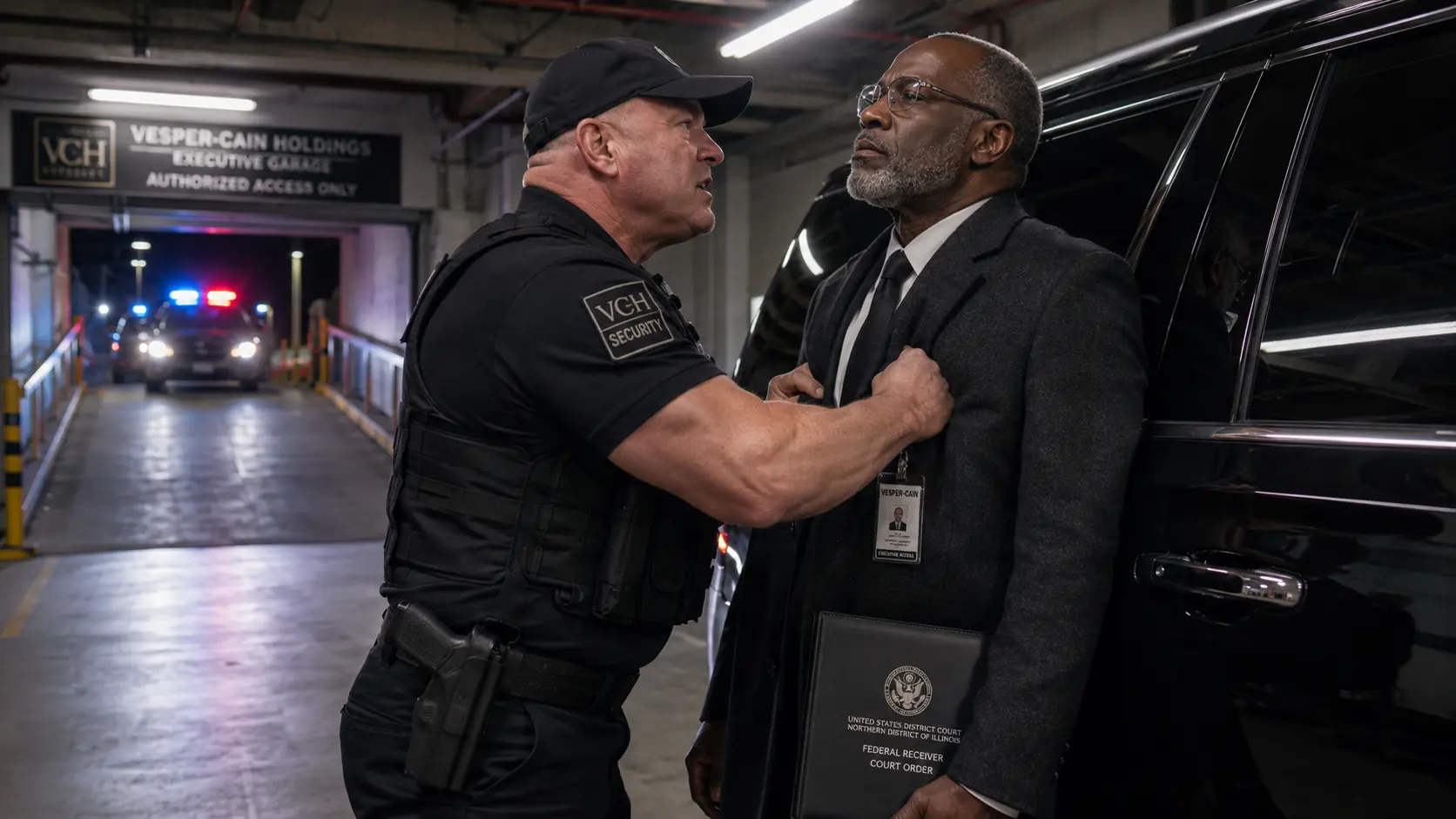
“Remove your hand,” Franklin said. “Then scan my badge.”
A white-and-gold executive access card hung clearly from his coat. Calder had seen it the moment Franklin stepped out of the vehicle, yet he had refused to examine it. He had already decided the expensive SUV belonged to someone upstairs and that Franklin was merely the driver who had become confused about his place.
Calder pushed harder. “Your costume means nothing down here.”
Franklin looked at the hand wrinkling his coat, then slowly lifted his gaze. His eyes were calm, but the security officer standing closest to them suddenly felt the atmosphere change. It was not fear in Franklin’s face.
It was documentation.
“Then call upstairs,” Franklin said, opening the black portfolio beneath his arm. “Tell them their federal receiver is waiting.”
Calder stared at him for half a second before laughing. Behind him, two younger security guards exchanged uncertain looks. A police cruiser rolled down the garage ramp with its red and blue lights reflecting across the wet concrete, giving Calder the audience and reinforcement he believed he deserved.
The cruiser stopped several yards away. Two city officers stepped out, one older with silver at his temples and one younger whose hand rested near his holster. Calder immediately released Franklin and rearranged his uniform as though he had been calmly managing a routine trespassing complaint.
“This man entered executive parking without authorization,” Calder announced. “He became aggressive when I asked him to leave.”
Franklin straightened the front of his coat. “He refused to scan my credential, physically restrained me, and called the police before asking my name.”
The younger officer looked at the black SUV, Franklin’s tailored suit, and the expensive leather portfolio. Doubt crossed his face, but Calder spoke before either officer could ask a question.
“He’s a chauffeur. Probably waiting for one of the executives.”
Franklin opened the portfolio with two fingers and removed a dark identification folder. The older officer accepted it, read the title, and immediately stood straighter.
“Mr. Moss,” he said carefully.
Calder’s smile faded.
The identification named Franklin Moss as a court-appointed federal receiver operating under the authority of the United States District Court for the Northern District of Illinois. The appointment granted him temporary legal control over Vesper-Cain Holdings, its subsidiary corporations, corporate accounts, records, real estate, technology, and contracted security operations.
Franklin removed a thick document carrying a raised federal seal.
“I was ordered to take possession of this company at eight o’clock this morning,” he said. “The order includes this garage, every executive office above us, and the security contract Officer Calder is currently representing.”
No one spoke.
The black SUV belonged to Franklin. The executive space had been reserved for him by the court-appointed transition team. His access card had been activated through Vesper-Cain’s own system at six that morning.
Calder had not interrupted a driver waiting for his employer.
He had assaulted the man legally arriving to take control of the entire building.
The elevator chimed behind them.
Miranda Hargreaves stepped into the garage wearing a fitted navy suit, silver-blond hair pinned tightly behind her head, and an expression trained by twenty years of corporate litigation. As Vesper-Cain’s general counsel, she had built a career protecting the company from regulators, lawsuits, employees, and anyone else threatening the power of its executive board.
She walked quickly until she saw Franklin.
The color left her face.
“Mr. Moss,” she whispered.
Franklin watched Calder turn toward her, desperate for rescue.
“Ms. Hargreaves, tell them this man doesn’t have authority to enter without corporate confirmation.”
Miranda’s eyes dropped to the court order in Franklin’s hand. “He does not need our confirmation.”
Calder swallowed. “You know him?”
“Every executive in this company knows him.”
Franklin placed the federal order back inside his portfolio. “I was expected forty minutes ago.”
Miranda looked toward the security officers. “Why was he stopped?”
Calder answered too quickly. “He failed to identify himself.”
“My access card was visible,” Franklin said. “He refused to scan it.”
The older police officer examined the credential hanging from Franklin’s coat. “It says executive access.”
Calder pointed at the card. “Anyone can print one.”
Franklin turned toward him. “Then why didn’t you test it?”
Calder opened his mouth, but the question had no safe answer. He had not scanned the card because doing so might have disproved the judgment he preferred. Asking Franklin’s name, checking the reservation system, or contacting corporate administration would all have required admitting that the Black man standing beside the SUV might belong there.
He had chosen force because force protected his assumption.
Miranda took a slow breath. “Mr. Moss, perhaps we can discuss this upstairs privately.”
Franklin looked at her. “The receivership is no longer private.”
“It was sealed until this morning.”
“It was sealed to prevent asset transfers. It was not sealed to protect your board from embarrassment.”
The younger officer shifted closer to Calder. “Sir, did you place your hands on Mr. Moss?”
Calder looked toward the nearby surveillance cameras. Several were mounted along the garage beams, their red lights glowing steadily.
“I guided him away from a restricted area.”
Franklin’s voice remained measured. “You drove me into my vehicle with your forearm against my chest.”
“I believed he was resisting.”
“I had not moved.”
One of the junior security guards finally spoke. “He didn’t resist.”
Calder turned sharply. “Stay out of this.”
The young guard stiffened but continued. “Mr. Moss showed his card before Officer Calder touched him.”
Miranda closed her eyes briefly. She understood that the problem had grown beyond a misunderstanding. The garage footage, police witnesses, federal authority, and subordinate testimony created a record no corporate attorney could erase with careful wording.
Franklin looked at the older officer. “I intend to file a formal complaint, but I will not delay the receivership. Please secure the footage and record the names of every witness.”
The officer nodded. “We’ll preserve everything.”
Calder’s face reddened. “You’re going to destroy my career over a parking dispute?”
Franklin adjusted his glasses. “This was never about parking.”
The security officer stared at him.
“It was about what you believed you could do to someone you considered powerless.”
Franklin entered the executive elevator with Miranda while police remained below. The doors closed on Calder standing beside the SUV, his authority suddenly dependent upon the very people he had expected to confirm it automatically.
For forty-one floors, Miranda said nothing.
When the elevator opened, a row of senior executives waited inside Vesper-Cain’s boardroom. Chief Executive Officer Leonard Cain stood at the head of the table, silver-haired and furious, surrounded by the chief financial officer, head of compliance, three board members, and a team of outside attorneys.
No one offered Franklin a seat.
Leonard held up a copy of the receivership order. “This is an outrageous overreach.”
Franklin placed his portfolio on the table. “The court disagrees.”
“You arrived without notice.”
“The court provided notice at six this morning.”
“We were given two hours.”
“You had six months of subpoenas, three years of regulatory warnings, and eleven internal reports. The judge concluded additional time would be used to destroy evidence.”
Leonard’s expression hardened. “You have no understanding of this company.”
“I understand that Vesper-Cain moved approximately $640 million through shell vendors, employee-benefit accounts, and overseas consulting entities. I understand that pension funds were used to secure private executive loans. I understand that three internal auditors were dismissed after identifying false invoices.”
The boardroom became quiet.
Franklin opened the court order to the authority section. “As of eight o’clock, all executive signing privileges are suspended. Corporate accounts are frozen except for payroll and essential operations. No employee may delete, transfer, alter, or remove records.”
The chief financial officer rose. “You cannot freeze our accounts without collapsing the company.”
“I have authorized funds for salaries, health insurance, vendors, and critical contracts. What I have frozen are executive bonuses, acquisition payments, offshore transfers, and severance packages approved after the investigation began.”
Leonard leaned across the table. “This company employs twelve thousand people.”
“That is why the court appointed a receiver instead of allowing your board to continue.”
Miranda remained near the wall, watching Franklin methodically dismantle the authority of the executives she had defended for years. He did not shout, threaten, or perform anger. He simply opened documents, cited account numbers, and announced controls that had already taken legal effect.
Franklin Moss had spent more than three decades restructuring institutions that powerful people had treated as personal property. He had taken control of corrupt hospitals, failed pension trusts, fraud-ridden housing funds, and financial firms whose executives believed complexity could hide theft forever.
He was not the new owner of Vesper-Cain.
He was something the board feared more.
He was the man appointed to discover what still belonged to everyone else.
Franklin ordered the information-technology team to isolate executive servers. Independent forensic accountants entered the building through the loading dock. Federal marshals arrived to secure records, while outside counsel delivered preservation notices to every department.
Within an hour, investigators discovered that someone had attempted to transfer nineteen million dollars from a Vesper-Cain consulting account after the court issued its order.
The authorization originated from Leonard Cain’s office.
Leonard denied approving it.
The digital signature belonged to Miranda.
Franklin requested a private meeting with her.
They sat across from one another inside a conference room overlooking the Chicago River. Miranda maintained the composed posture that had made executives trust her during hostile negotiations, but her fingers tightened around a legal pad.
“Did you authorize the transfer?” Franklin asked.
“No.”
“Your credentials were used.”
“They may have been copied.”
“By whom?”
“I don’t know.”
“Your office accessed the payment system at 6:17 this morning.”
“I was reviewing accounts after receiving the order.”
“The transfer was routed to a foundation controlled by Leonard Cain’s brother.”
Miranda said nothing.
Franklin placed another document before her. It was an internal memorandum she had written fourteen months earlier warning the board that several consulting contracts lacked legitimate services. Her recommendation was to suspend payments and commission an independent investigation.
The board ignored it.
Three weeks later, Miranda signed a revised legal opinion describing the same contracts as commercially reasonable.
“What changed?” Franklin asked.
“The board provided additional information.”
“What information?”
“Business explanations.”
“Where are they?”
“I would have to search the files.”
Franklin studied her. “Did Leonard threaten you?”
Miranda’s gaze shifted toward the window.
“That question assumes facts not in evidence.”
“It assumes you recognized fraud before helping protect it.”
Her composure fractured slightly. “Do you know what happens to lawyers who accuse their own boards without perfect evidence?”
“Yes.”
“They lose clients, firms, careers, and sometimes everything they own.”
“And what happens to employees whose pensions disappear?”
Miranda lowered her eyes.
Franklin did not offer comfort. “Fear can explain a decision. It does not erase its consequences.”
She remained silent for nearly a minute.
Then she gave him the location of a hidden legal archive stored outside the company’s primary network.
The archive contained meeting recordings, draft memoranda, private emails, and documents proving Leonard’s board had intentionally redirected employee pension contributions to support failing private investments. Miranda had preserved the files as protection against becoming the sole scapegoat if the scheme collapsed.
Her fear had made her complicit.
It had also made her careful.
By afternoon, the fraud was larger than federal investigators expected. Vesper-Cain had purchased distressed companies using pension money, inflated their valuations through internal contracts, and borrowed against the artificial gains. Executives received bonuses based on profits that existed only on paper.
When losses emerged, the board shifted them into employee-benefit accounts and vendor obligations.
Thousands of workers had been financing executive wealth without knowing it.
Franklin convened a company-wide broadcast at four o’clock. Employees gathered around conference-room screens, warehouse televisions, and office computers while the distinguished man who had been shoved inside the garage stood behind the chief executive’s podium.
He did not describe the assault.
He did not identify Calder.
“This morning, the federal court placed Vesper-Cain Holdings into receivership,” he said. “The company will continue operating. Employees will be paid. Health coverage and essential benefits remain active.”
Relief moved through offices across the country.
“However, the previous board no longer controls company assets. Executive compensation and discretionary transfers are suspended. An independent investigation is underway into the misuse of pension funds, vendor accounts, and corporate property.”
Leonard watched from a secured conference room with two federal marshals outside.
Franklin continued. “Employees who possess information about misconduct may report directly to the receiver’s office without using the existing management chain. Retaliation will result in immediate suspension and referral to federal authorities.”
Within twenty minutes, the reporting system received more than eight hundred messages.
Some were rumors.
Many were not.
Payroll analysts described altered contributions. Procurement workers identified vendors with no offices or employees. Security guards reported executives removing boxes from private garages at night. Former accountants supplied copies of spreadsheets they had kept after being dismissed.
One message concerned Raymond Calder.
A security supervisor wrote that Calder regularly stopped Black executives, delivery workers, and contractors while allowing white visitors through without proper verification. Five complaints had been filed during the previous eighteen months.
Every one had disappeared.
Franklin requested the complete security contract.
Vesper-Cain did not employ Calder directly. His company, Sentinel Crest Security, held a seven-million-dollar annual agreement approved by Leonard’s board. Calder’s brother-in-law was a senior regional manager for Sentinel Crest, while Leonard owned an undisclosed interest in one of its parent entities.
The contract was not merely a security arrangement.
It was another method of moving company money into private hands.
Franklin suspended Sentinel Crest’s authority before sunset. A temporary security provider took control of the building while every existing guard underwent independent review.
Calder was removed from the property by city police.
He had not been arrested immediately because Franklin wanted investigators to examine the footage and witness statements first. Once the recording confirmed the physical assault, Calder was charged with battery, unlawful restraint, and falsifying an incident report.
His report claimed Franklin became hostile and attempted to enter a restricted elevator after refusing identification.
The video showed Franklin standing beside his own vehicle with his access card displayed while Calder pushed him backward.
Calder’s attorney called the event a stressful misunderstanding.
Franklin declined to speak publicly about it.
Reporters nevertheless discovered the story when courthouse filings became available. Images of Calder pinning the federal receiver against the SUV spread nationally beneath headlines about profiling, corporate corruption, and a security system that protected executives while mistreating the man appointed to investigate them.
Employees recognized something deeper.
Calder had behaved like the company’s board.
He saw something valuable, decided it belonged to people like him, and used force against anyone challenging that assumption.
Three weeks into the receivership, federal agents arrested Leonard Cain, the chief financial officer, and two board members. Miranda accepted a cooperation agreement after providing the hidden archive and testifying about years of pressure, concealed transactions, and manipulated legal opinions.
Her law license was suspended pending disciplinary review.
She did not ask Franklin to defend her.
“I knew,” she told him during their final meeting. “Maybe not everything, but enough.”
“Yes.”
“I kept telling myself that staying inside gave me the chance to limit the damage.”
“Did it?”
“Sometimes.”
“And the rest of the time?”
“I helped them survive.”
Franklin nodded. “Then tell the truth about both.”
Vesper-Cain’s restructuring lasted eighteen months. Fraudulent subsidiaries were sold, offshore accounts recovered, and executive assets seized. More than $410 million returned to employee pension funds through settlements, property sales, and criminal forfeiture.
The company survived under a smaller board with employee representation and independent oversight. Twelve thousand people kept their jobs, though several divisions closed and hundreds of executive positions disappeared.
Franklin refused every offer to remain permanently.
“A receiver should never become another ruler who believes the institution belongs to him,” he told the new board.
On his final morning, he returned to Level B-3.
The black SUV waited inside the same executive space. The security signage had changed. Every entrance now required identical electronic verification, regardless of vehicle, clothing, title, or perceived occupation.
A young Black security officer stood beside the elevator.
“Good morning, Mr. Moss.”
“Good morning.”
“May I scan your badge?”
Franklin held it out.
The device flashed green.
“Thank you. You’re cleared.”
Franklin smiled faintly. “That is how simple it was always supposed to be.”
Before leaving, he noticed a small plaque installed near the elevator doors:
AUTHORITY REQUIRES VERIFICATION. RESPECT REQUIRES NONE.
He had not requested it.
The employees had.
Calder eventually pleaded guilty to a reduced charge after the garage footage destroyed his defense. He lost his security license, served probation, completed community service, and paid damages. Several people who had previously filed complaints against him brought civil claims against Sentinel Crest.
At sentencing, Calder addressed Franklin.
“I made a terrible assumption.”
Franklin looked at him from across the courtroom. “You made a practiced decision.”
Calder lowered his eyes.
The judge asked Franklin whether he wanted to make a victim-impact statement.
He stood.
“What happened in that garage lasted less than three minutes,” Franklin said. “The physical marks disappeared quickly. What matters is not that Officer Calder failed to recognize a federal receiver.”
The courtroom remained silent.
“What matters is that he believed the person he imagined me to be deserved less dignity.”
Franklin returned to his seat.
One year after leaving Vesper-Cain, he received a letter from an employee whose retirement savings had been restored. The writer was a warehouse technician in Indiana who had spent thirty-two years with the company. He thanked Franklin for recovering enough money to keep his home and help his granddaughter attend college.
Franklin placed the letter inside the same black portfolio that had carried the receivership order.
The portfolio still bore a faint scrape from where it struck the SUV during Calder’s shove.
Franklin never repaired it.
The mark reminded him why institutions needed more than rules written by powerful people. They needed systems that worked even when the person standing at the gate looked nothing like the authority the guard expected to see.
Raymond Calder had seen a Black man beside a luxury SUV and imagined a chauffeur who had forgotten his place.
He never considered that Franklin Moss had come to determine whether the executives upstairs deserved theirs.
By the time Calder learned the truth, the federal order had already taken effect.
The garage was under Franklin’s control.
The company was under Franklin’s control.
And the hand crushing his coat belonged to the first man whose authority the new receiver would remove.