The autumn wind swept through Red Hollow like a restless ghost, lifting dead leaves from the dirt and rattling the warped signs above empty storefronts. Sheriff Michael Reyes had ridden through abandoned settlements before, but none had felt as wrong as this one. Red Hollow had once served miners, ranchers, and wagon crews crossing northern New Mexico Territory; now its saloon windows were shattered, its church bell hung silent, and weeds climbed through the steps of houses whose owners had vanished years earlier. Michael had come searching for two missing freight wagons, yet what he found at the far end of the street stopped him colder than any drawn revolver.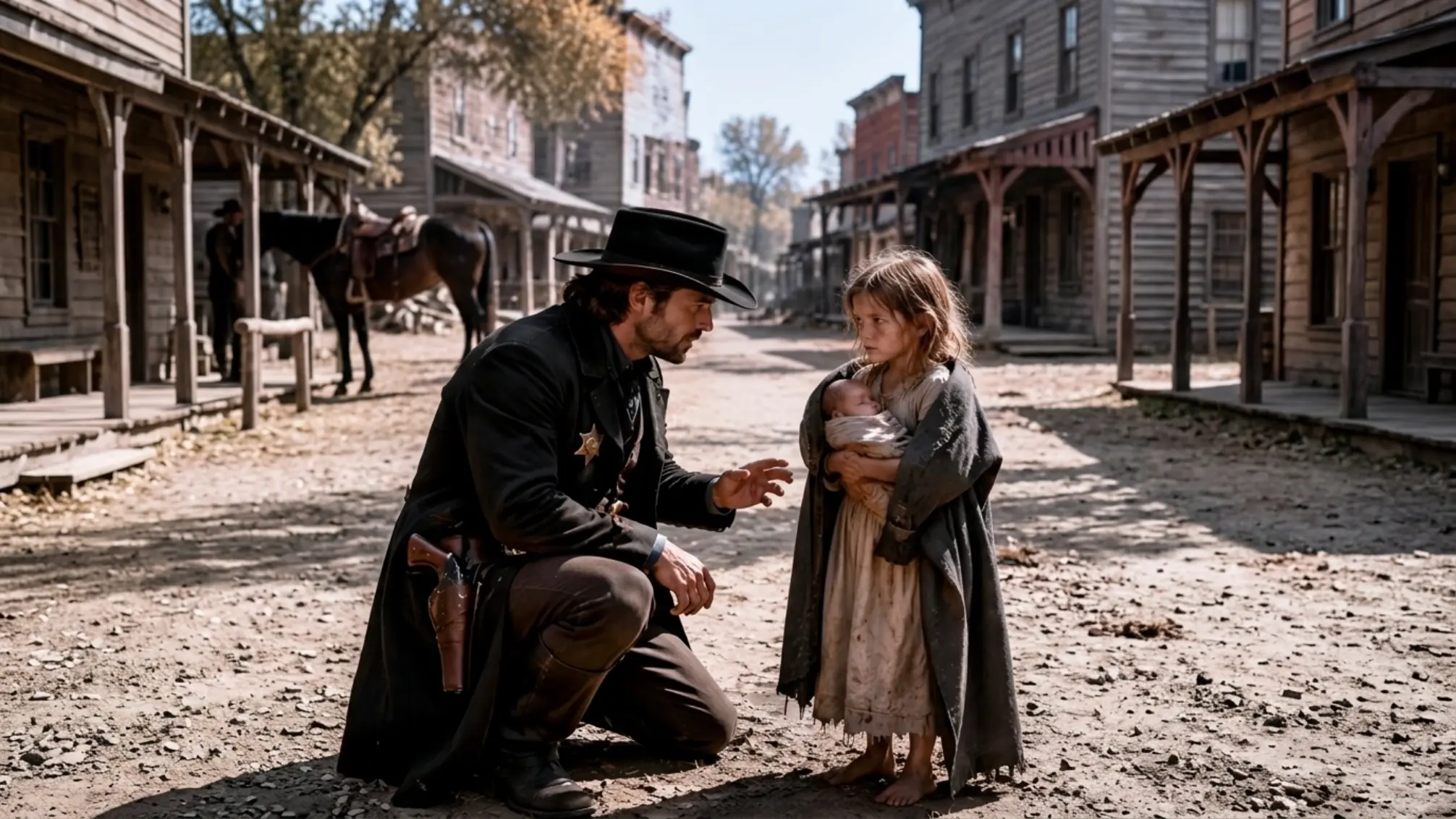
A barefoot little girl was dragging a burlap sack through the dirt while carrying a newborn baby against her chest. She could not have been older than five. Her pale face was streaked with dust, her tangled light-brown hair whipped across frightened blue eyes, and her torn dress hung from shoulders far too small for the burden she carried. Every few steps she stopped, pressed two fingers beneath the baby’s nose, and waited until she felt him breathe.
Michael pulled back on his horse’s reins. The girl had not noticed him yet, and he feared that a sudden movement might send her running into one of the dangerous buildings lining the street. He dismounted quietly and left his rifle in the saddle sheath. His revolver remained at his hip, but he moved both hands where she could see them.
The baby stirred beneath stained cloth.
The little girl turned.
Her gaze went immediately to Michael’s brass badge. Instead of relief, terror crossed her face. She clutched the newborn tighter and stepped backward, placing her fragile body between the sheriff and the child.
Michael lowered himself onto one knee.
“You’re not in trouble,” he said softly. “I’m here to help.”
The girl’s cracked feet shifted against the cold dirt. “Please don’t take my brother.”
“I won’t.”
“You promise?”
Michael removed his wide-brimmed hat so she could see his face clearly. “I promise.”
She continued staring at him, searching for the lie she had apparently learned to expect from adults. After several long seconds, she relaxed enough to stop retreating. Michael removed his heavy black coat and extended it slowly.
“My name is Michael. What’s yours?”
“Annie.”
“How old are you, Annie?”
She lifted five fingers.
Michael’s throat tightened. “And your brother?”
The fear in her face softened for the first time. She looked down at the sleeping infant.
“Ben.”
Michael placed the coat across his open palms. “Let’s get both of you warm.”
Annie approached carefully and took it. Michael expected her to wrap it around her shoulders, but she immediately covered Ben instead. The coat nearly swallowed the baby, leaving Annie exposed to the wind in her torn dress and frayed shawl.
That small act struck Michael harder than anything he had seen during his years wearing the badge.
He had witnessed grown men abandon families to save themselves. Annie had survived alone for days, yet her first instinct was still to give warmth away.
“Where is your mother?” he asked.
Annie looked down at the dirt.
“She went to find food.”
“When?”
Her answer came quietly.
“Three nights ago.”
Michael glanced along the empty street. The temperature had fallen close to freezing each night, and storm clouds were gathering above the distant red hills. A child this young should not have survived outside alone, much less kept a newborn alive.
“Where have you been sleeping?”
Annie pointed toward a crumbling wash house near the edge of town. “Warm air comes from the pipes.”
The building’s roof had partially collapsed, but steam drifted faintly from a broken vent near the foundation. An underground mineral spring must have supplied the old wash house when Red Hollow was populated. Annie had discovered the warmest place available and built a shelter around the pipe.
Michael reached toward her, then stopped. “May I carry Ben?”
She tightened both arms.
“No.”
“All right. You keep him.”
Relief crossed her face.
Michael’s deputy, Thomas Ward, appeared at the entrance to town with Doctor Samuel Reed riding beside him. Michael had ordered them to search the southern trail while he examined Red Hollow. He lifted one hand, signaling them to approach slowly.
Annie immediately stepped closer to Michael.
“They won’t hurt you,” he assured her. “The older man is a doctor. He can make sure Ben is healthy.”
“No one takes him?”
“No one.”
Doctor Reed dismounted and knelt several feet away. He was nearly seventy, with white hair, gentle eyes, and a medical bag that had traveled across more frontier towns than most stagecoaches.
“Hello, Annie,” he said. “May I look at your brother while you hold him?”
She glanced at Michael.
He nodded.
The doctor examined Ben without removing him from her arms. He listened to the baby’s chest, checked his temperature, and inspected the cloth around him. Ben was thin and mildly dehydrated but breathing steadily.
“How have you fed him?” Reed asked.
Annie pointed toward the burlap sack.
Inside were two dented tin cups, a small bottle, a handful of dried corn, and an old cloth bundle containing powdered goat milk. Annie had mixed it with warm water from the wash house pipe and fed Ben through a strip of cloth when the bottle’s broken nipple stopped working.
Doctor Reed looked at Michael in disbelief.
“She kept him alive,” he whispered.
Annie heard him. “Mama said I’m his big sister.”
Michael turned away briefly, pretending to inspect the street so the child would not see the emotion in his face.
Thomas searched the wash house and found a crude sleeping space behind fallen boards. Annie had built a nest from old blankets, dry grass, and pieces of curtain. She had dragged the burlap sack nearly half a mile after finding supplies inside an abandoned kitchen.
No adult had helped her.
Michael returned to her side. “Annie, we need to take you somewhere warm.”
She did not answer.
“There’s food at my house. Doctor Reed has a fire in his office, and my deputy’s wife makes the best biscuits in the territory.”
Annie looked toward the buildings behind him.
Then she slowly raised one hand.
Her finger pointed across the street at an abandoned structure with shattered upper windows and a chained front door. It might once have been a trading warehouse. The wood was gray with age, yet the iron chain across its entrance appeared new.
“Mommy said never go there.”
Michael followed her gaze.
Fresh wagon tracks cut through the dirt behind the building. No dust covered the padlock. Beneath the rear door, a dark stain had soaked deep into the wood.
“When did your mother tell you that?” he asked.
“The night before she left.”
“Did she see someone inside?”
Annie’s lips trembled. “Men came after dark.”
Thomas placed one hand near his revolver.
Michael noticed another detail: several sets of small footprints led toward the warehouse. None returned.
“Take Annie and Ben to Doctor Reed’s wagon,” Michael instructed.
Annie resisted immediately. “No!”
Michael knelt again. “I need to look inside that building.”
Her eyes widened. “The bad men come back.”
“That’s why you need to stay with the doctor.”
She clutched his coat around Ben. “Mommy’s in there.”
Every sound on the street seemed to disappear.
Michael looked at the chained door, then back at Annie.
“How do you know?”
“I heard her.”
“When?”
“Yesterday.”
Thomas stared at the sheriff. “She’s been gone three nights.”
Michael rose and drew his revolver. “Doctor, get these children behind your wagon. If anyone appears, ride south and do not stop until you reach San Miguel.”
Annie grabbed his sleeve. “Bring Mommy back.”
Michael looked down at her thin fingers.
“I’ll do everything I can.”
He and Thomas approached the warehouse from opposite sides. The chain across the front door was locked, so they moved toward the rear, following the fresh wagon tracks. Two horses had recently stood beside the loading platform. A broken lantern rested beneath the steps, and one corner of a bloodstained shawl protruded from under the door.
Michael recognized the fabric.
Annie’s mother, Sarah Whitmore, had been reported missing from a wagon camp four days earlier. Witnesses said she wore a dark-red shawl.
Thomas lifted the cloth carefully. “Could be hers.”
Michael examined the door. “Someone’s inside.”
“How do you know?”
“The mud around the threshold is wet. Door opened this morning.”
They entered through a side window after removing its loose frame. The warehouse smelled of damp wood, old grain, and something metallic. Light passed through holes in the roof, revealing crates stacked across the floor.
The labels claimed the crates contained farm tools.
Michael opened one.
Inside were shackles, rope, and bottles of laudanum.
Along the wall stood a row of children’s shoes.
Thomas went still.
“Dear God.”
Michael crouched beside loose floorboards near the center of the room. A fresh scrape crossed the wood, and one board had been replaced incorrectly. Together, they pulled it aside.
A trapdoor lay beneath.
Then they heard it.
A faint cry rose from below.
Not one child.
Several.
Thomas drew his weapon.
Michael lowered the trapdoor carefully. Stone steps descended into darkness. The smell of sweat and sickness drifted upward.
Before they could enter, Annie’s voice came from behind them.
“That’s where they took Mommy.”
Michael spun around.
She stood inside the warehouse holding Ben, with Doctor Reed close behind.
“I told you to stay outside.”
“She ran,” the doctor explained breathlessly. “I couldn’t leave the infant and chase her.”
Annie stared into the opening.
“Mommy!”
A weak voice answered from below.
“Annie?”
The girl tried to rush forward, but Michael caught her gently before she reached the stairs.
“Sarah!” he called. “This is Sheriff Reyes. Are there armed men down there?”
“No,” the woman answered. “But they’re coming back.”
“How many?”
“Four. Maybe five.”
Michael looked toward Thomas. The deputy moved to the rear window and studied the wagon tracks.
“When?”
“I don’t know. They left before sunrise.”
Michael instructed Doctor Reed to take Annie only as far as the warehouse doorway. The child refused to leave entirely, but she allowed the doctor to hold Ben while Michael and Thomas descended.
The cellar contained seven prisoners.
Sarah Whitmore sat against the wall with a bruised face and rope burns around her wrists. Beside her were four children between six and twelve, a teenage girl, and an injured woman who had worked at a mission school near Santa Fe.
The group behind the kidnappings had been targeting isolated wagon camps and impoverished settlements. Children were taken first. Adults who resisted were captured or killed. The prisoners were transported through abandoned frontier towns before being sold as labor across the border.
Sarah had escaped from the cellar during the first night but refused to flee without the other children. She slipped outside long enough to find Annie and Ben hidden in the wash house.
“I told her to wait,” Sarah explained as Michael cut her ropes. “I said I’d bring food and come back by morning.”
The kidnappers caught Sarah before she reached the road.
She had spent three days believing both her children were dead.
Annie waited at the top of the stairs. The instant Sarah emerged, the girl released a cry so broken that even Thomas looked away. She ran into her mother’s arms, while Doctor Reed carefully placed Ben between them.
Sarah fell to her knees and held both children against her.
“You kept him safe,” she whispered.
“I tried, Mama.”
“You did more than try.”
The reunion lasted only seconds before Thomas called from the rear window.
“Riders coming.”
Five armed men approached from the northern trail with two wagons. They had not expected lawmen. Michael counted rifles and recognized one rider as Silas Crowe, a former freight contractor suspected of raiding isolated homesteads.
Michael ordered everyone into the cellar except Thomas. Sarah resisted, unwilling to be imprisoned again, but Michael promised to keep the trapdoor unlocked.
“Stay with Annie,” he said. “She needs you more than I need another gun.”
Sarah looked toward her daughter and obeyed.
Michael and Thomas positioned themselves behind the stacked crates. Doctor Reed moved to the loft with an old shotgun found inside one wagon. He was not an experienced fighter, but he had served as an Army surgeon and knew how to remain steady under fire.
Crowe entered through the rear door with two men while the others remained outside.
He noticed the broken trapdoor immediately.
“Someone’s been here.”
Michael stepped from cover. “Sheriff’s office. Drop your weapons.”
Crowe fired instead.
The bullet struck a crate beside Michael’s head. Thomas answered from the opposite corner, forcing the gunmen behind the loading table. Outside, two riders opened fire through the windows.
The warehouse exploded with splintering wood and gun smoke.
Michael moved between cover points, refusing to let the men reach the cellar. One outlaw charged with a shotgun, but Thomas shot the weapon from his hands. Crowe attempted to climb through a side window and escaped into the street.
Michael followed.
They exchanged fire between abandoned storefronts. Crowe ran toward the sheriff’s horse, hoping to flee, but Annie’s burlap sack lay across the road where she had dropped it. His boot caught beneath it, and he fell hard.
Michael reached him before he could rise.
Crowe rolled with a hidden knife.
Michael knocked the blade aside and drove him into the dirt. Years of anger seemed to gather behind the sheriff’s fist, but he stopped himself from striking the unarmed man again.
“You stole children,” Michael said.
Crowe laughed through bloodied lips. “No one looks for poor ones.”
Michael pressed the revolver against his shoulder. “She did.”
He looked toward Annie standing in the warehouse doorway with her mother behind her.
A five-year-old girl had survived three nights, protected a newborn, and pointed the law toward the place every adult had overlooked.
Crowe’s operation ended before sunset.
One gunman died during the fight. Two surrendered after Thomas wounded their leader, and the final rider fled south only to encounter a territorial patrol responding to Michael’s earlier message.
Inside the second wagon, authorities discovered ledgers listing names, routes, payments, and settlements used as temporary holding locations. The records connected Crowe to wealthy ranch foremen, mining contractors, and freight operators who purchased vulnerable laborers under false contracts.
The rescue at Red Hollow became the beginning of a much larger investigation.
For Annie, however, none of that mattered yet.
She sat beneath Doctor Reed’s blankets with Ben asleep beside her and her mother’s arm around her shoulders. For the first time in three nights, she did not need to listen constantly for the baby’s breathing.
Sarah watched Michael approach.
“I don’t know how to repay you.”
He shook his head. “Your daughter brought me here.”
“She’s five.”
“She’s the bravest person I’ve met.”
Annie looked up. “Braver than a sheriff?”
“Much braver.”
She considered that seriously, then pointed toward his coat wrapped around Ben.
“He can keep it?”
Michael smiled. “Until he grows into it.”
Red Hollow did not remain abandoned.
The territorial government converted the old warehouse into a supply station for displaced families and travelers. The wash house was repaired, and the warm mineral pipes Annie discovered became part of a small public shelter.
Sarah eventually became its caretaker.
She refused charity but accepted wages, a private room, and the responsibility of helping families who arrived frightened and hungry. Annie greeted every child personally, showing them where the blankets were kept and explaining that nobody would take their siblings away.
Michael visited often.
Ben learned to walk across the floor of the same building where his mother had once been imprisoned. Annie attended school in San Miguel and later helped Doctor Reed deliver supplies to remote settlements.
Years afterward, she asked Michael whether he had truly been frightened that day.
He answered honestly.
“Yes.”
“But you had a gun.”
“Guns don’t stop fear.”
“What does?”
He looked toward the rebuilt warehouse, where Sarah was serving supper to a family rescued from a winter storm.
“Knowing someone needs you more than fear does.”
Annie nodded as though adding the lesson to a private collection.
Michael kept his promise never to separate her from Ben. More importantly, he learned that the badge on his chest did not make frightened children trust him. Trust began only after he lowered himself into the dirt, removed his hat, and spoke without command in his voice.
He had entered Red Hollow searching for missing freight wagons.
Instead, he found a barefoot girl dragging a sack through a dead town while shielding a newborn from the wind.
She did not ask him to punish anyone.
She asked him to bring her mother home.
And because he listened, an abandoned building filled with terror became the place where lost families finally found shelter.