The forty-second floor of Meridian Media had been designed to make ordinary people feel small. Floor-to-ceiling windows looked down on Manhattan, abstract paintings hung beneath sculptural lights, and a black marble table stretched through the executive boardroom like a polished blade. At one end stood Daniel Brooks, a thirty-two-year-old single father in a slightly worn navy suit and the gray tie his seven-year-old daughter had chosen for him. At the other sat twelve directors who had just voted to bury the most important investigation his team had ever produced.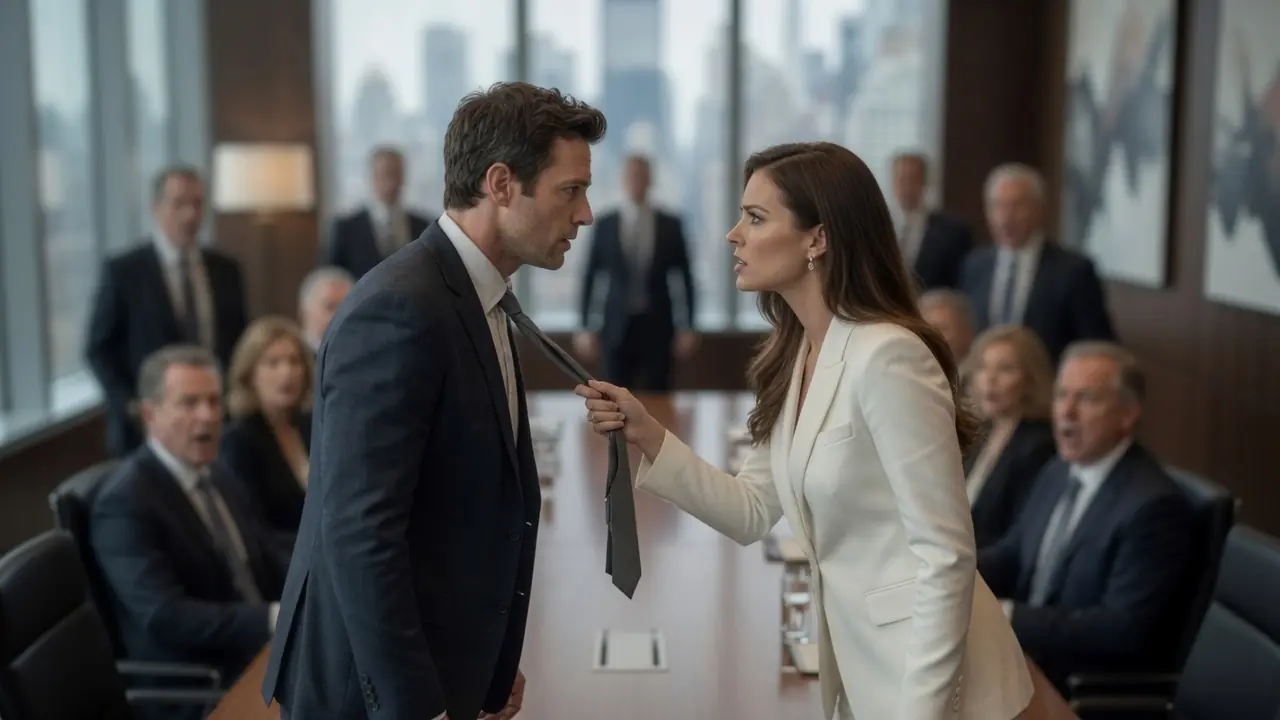
Aurora Vale occupied the chair at the head of the table. At thirty, she was already a billionaire, the founder of a media empire valued at more than four billion dollars, and the most feared executive in the building. Her ivory-white pantsuit was immaculate, her long chestnut-brown hair rested over one shoulder, and her controlled expression revealed nothing as the directors congratulated one another on avoiding an expensive legal battle. Only Daniel noticed how tightly her fingers gripped the silver pen in front of her.
The investigation involved Halcyon Residential Partners, a private-equity company buying apartment buildings through hidden subsidiaries. Daniel’s journalists had uncovered evidence that Halcyon deliberately neglected repairs, displaced low-income tenants, and paid consulting fees to public officials who approved luxury redevelopment plans. The reporting was supported by property records, internal emails, recordings, and testimony from former employees. It was also dangerous because Halcyon controlled nearly ninety million dollars in annual advertising across Meridian’s entertainment, sports, and digital divisions.
The board did not deny the evidence. Instead, they called the timing irresponsible, the legal exposure unacceptable, and the potential advertising loss catastrophic. Steven Park, the director who represented several institutional investors, proposed delaying publication for six months while outside counsel conducted another review. Everyone in the room understood that six months meant never.
Daniel had spent fourteen months building the investigative division that produced the story. He had promised reporters that Meridian would protect work supported by facts, not abandon it when powerful people complained. More personally, he had promised his daughter Mia that courage meant doing the frightening thing when it was also the right thing. Now Aurora remained silent while the board converted cowardice into corporate language.
“Then the decision is final,” Steven said. “The investigation remains unpublished.”
Daniel looked at Aurora. “Is that your decision too?”
Several directors shifted uncomfortably. Employees did not address Aurora in that tone, particularly not in front of the board. She lifted her eyes slowly and said, “This meeting is concluded, Mr. Brooks.”
“No.”
The word landed with a weight that stopped everyone from moving. Daniel’s heart hammered so violently that he could feel it beneath his shirt, but he remained standing. He knew the mortgage payment on his Brooklyn apartment was due in nine days, Mia needed new glasses, and he had less than two months of savings. Speaking again could destroy the only stable career he had ever built.
Aurora’s gaze hardened. “Choose your next sentence very carefully.”
Daniel placed the investigative report on the table. “You built Meridian by telling everyone that truth mattered more than comfort. Now the first time the truth threatens people sitting at this table, you’re letting them bury it.”
Steven leaned forward. “This is not your classroom, Mr. Brooks. You do not get to lecture the company’s owners.”
Daniel did not look away from Aurora. “I’m speaking to the woman who told me safe decisions were killing this company.”
“Enough,” Aurora said.
“No. You hired me because I refused to lie to you, so I’m not starting now.” Daniel’s voice shook once, then steadied. “If you let them kill this investigation, you are not protecting Meridian. You are proving every critic who calls us corporate propaganda correct.”
A director near the windows whispered that security should be called. Another demanded Daniel’s immediate termination. Steven pushed the report away without opening it and declared that no employee was entitled to insult the chief executive. Through all of it, Aurora remained motionless.
Daniel saw the fear beneath her composure because he had learned to recognize it over the previous year. It was not fear of the directors themselves. Aurora feared losing control of the empire she had built from nothing, an empire employing thousands of people whose salaries, insurance, and futures depended on her decisions. Publishing the story could cost hundreds of millions of dollars and trigger a war with one of America’s most powerful investment groups.
He understood the pressure. He simply refused to accept it as an excuse.
“You called me a coward in front of the people who can destroy us both,” Aurora said.
Daniel held her stare. “Because you were about to protect them instead of the truth.”
The boardroom erupted. Steven ordered security to remove Daniel, while Rebecca Singh, Meridian’s chief strategy officer, quietly warned everyone to stop escalating. Two uniformed officers entered through the glass doors and moved toward Daniel. He did not resist or step away from the table.
Aurora rose.
The movement alone silenced half the room. She placed both hands on the marble, looked at the directors one by one, and then walked toward Daniel. Her nude heels struck the floor with measured precision as the security officers stopped several feet away.
Daniel had argued with Aurora many times, but never in front of the entire board. Their disagreements had become legendary inside Meridian because he was the only executive who refused to soften his position merely because she disliked it. Somewhere between those arguments, late-night strategy meetings, and quiet conversations about Mia, professional respect had changed into something neither of them had been willing to name. They had never crossed the line.
Until that moment.
Aurora stopped directly in front of him and gripped the gray tie near his collar. The directors stared, expecting her to pull him toward security or deliver the final threat that ended his career. Daniel could feel the tension in her hand, but she did not move closer immediately. Her eyes searched his face, silently asking a question that had nothing to do with the investigation.
He did not retreat.
Daniel’s expression softened just enough to answer her. Aurora gave him one final second to turn away, then pulled him forward and kissed him. It was brief, deliberate, and unmistakably mutual.
The boardroom became completely silent.
Even the security officers looked away in surprise. Aurora released Daniel’s tie but remained beside him, one hand still resting against his chest. Her carefully constructed executive mask had disappeared, replaced by a woman who had just made the most personal decision of her life in front of the people who believed they controlled her.
She turned toward the board.
“Now that everyone is silent,” Aurora said, “Daniel, name the director who sold my company.”
Steven’s face changed.
Daniel reached for the report. “Steven Park authorized Halcyon’s confidential payments through a consulting company controlled by his brother.”
“That is a lie,” Steven said.
Rebecca closed the boardroom doors. “No one leaves.”
Daniel opened the report to the section his team had not yet shared with the full board. Three days earlier, a former Halcyon finance officer delivered records showing payments to Northbridge Advisory, a consulting firm registered to Steven’s brother. Those payments began two weeks before Steven first pressured Meridian’s legal department to delay the investigation. In return, he provided Halcyon with internal publication schedules, source identities, and preliminary legal findings.
Aurora had received the evidence that morning. She had entered the meeting intending to let the board believe the investigation was dead while outside counsel secured the digital records linking Steven to Halcyon. Her silence was part of the trap, but she had told no one—not even Daniel—because any warning could have caused Steven to destroy evidence. Daniel’s confrontation nearly disrupted the plan.
It also forced her to stop hiding behind it.
Steven stood abruptly. “You cannot detain a director based on allegations from a disgruntled employee.”
Aurora faced him. “Outside counsel obtained a preservation order forty minutes ago. Federal investigators are currently securing Northbridge’s servers.”
His hand moved toward his phone.
One of the security officers stepped between Steven and the door. Rebecca collected every company device from the table while outside counsel joined the meeting by video. The lawyer confirmed that Steven’s board authority had been suspended and warned him against deleting or transferring any records.
Steven looked toward the other directors for support. None came.
“You planned this,” he said to Aurora.
“I gave you a choice,” she replied. “You could have supported an independent review. Instead, you exposed yourself by demanding the story disappear before anyone outside Halcyon knew what it contained.”
Steven pointed at Daniel. “And this performance? Is kissing your employee how you demonstrate corporate independence now?”
The question returned attention to the line Aurora and Daniel had just crossed. Daniel immediately understood the professional consequences. Whatever they felt for each other, she was his chief executive and possessed immense power over his career.
Aurora did not pretend otherwise.
“What happened between Mr. Brooks and me will be disclosed to the board’s ethics committee and human resources today,” she said. “I will remove myself from every decision involving his compensation, promotion, and employment status. An independent committee will determine the appropriate reporting structure.”
Daniel nodded. “And if the committee decides I cannot continue in my role, I will accept that.”
Aurora looked at him, a flash of pain crossing her face, but she did not contradict him. The kiss had silenced the board because it exposed the truth between them, not because it erased professional responsibility. They would not protect their relationship by becoming the kind of people Daniel had just accused the directors of being.
Rebecca asked Daniel to continue presenting the evidence.
The investigation showed that Halcyon deliberately purchased aging apartment buildings through dozens of shell companies. It reduced maintenance spending, allowed elevators and heating systems to fail, and then used the resulting decline to pressure residents into accepting small relocation payments. Once tenants left, political allies approved rezoning requests that transformed affordable housing into luxury developments.
Meridian’s own advertising records revealed another layer. Halcyon increased spending with the company whenever journalists approached one of its properties, effectively purchasing influence without creating an obvious direct payment. Steven ensured the advertising contracts contained cancellation clauses capable of damaging Meridian’s quarterly revenue if unfavorable coverage appeared. He then used those clauses to frighten other directors.
Daniel’s team had documented everything.
When he finished, Aurora returned to her chair but did not ask Daniel to leave. Instead, she called for a new vote on publishing the investigation. Steven was excluded because of the conflict and suspended status.
The directors hesitated.
One warned that Halcyon would cancel every advertisement before the first article finished loading. Another predicted lawsuits, political retaliation, and a stock-price decline. Yet the evidence against Steven had changed the calculation. Voting against publication now looked less like financial caution and more like participation in his concealment.
The motion passed nine to two.
The investigation would be published the following morning.
Steven was escorted from the boardroom without his phone, laptop, or dignity. As he reached the doors, he turned toward Daniel and said, “You think she chose you? She chose the company. The moment you become expensive, she will sacrifice you too.”
Daniel looked toward Aurora.
Her expression remained controlled, but he saw how deeply the words struck. She had spent her entire adult life believing affection became weakness the moment money or power entered the room. Steven was trying to turn that fear against both of them.
Daniel answered calmly. “Then we’ll let our choices prove what this is.”
After Steven left, the remaining directors demanded an explanation for the kiss. Some were concerned about governance, others were plainly curious, and one appeared personally offended by any emotion entering the boardroom. Aurora refused to reduce the moment to a statement crafted for their comfort.
“I care for Daniel Brooks,” she said. “I should have addressed it privately and through the proper channels before acting publicly. I did not, and I will accept the consequences.”
Daniel stepped forward. “The decision was mutual.”
Rebecca sighed. “That will make the ethics paperwork slightly less unbearable.”
The tension broke just enough for several people to breathe. The board established an independent committee that afternoon. Daniel would temporarily report to Rebecca instead of Aurora, and Aurora would have no authority over his salary or role while the review continued.
The kiss did not solve their problems.
It created new ones.
By midnight, rumors had spread through Meridian. Some employees believed Aurora kissed Daniel to protect him from being fired, while others assumed he had manipulated their relationship to gain influence. Anonymous messages accused him of sleeping his way into power, though he had spent four years at the company before anything romantic happened. The same people who once called him ordinary now claimed his success had never belonged to him.
Daniel returned to his Brooklyn apartment shortly after one in the morning. Mia was asleep on the couch beneath a blanket, with Mrs. Chen sitting nearby and pretending not to watch the news alerts on her phone. Daniel thanked her, carried his daughter to bed, and sat beside her until she opened one sleepy eye.
“Did the scary meeting work?” Mia asked.
“The story is publishing tomorrow.”
“Did you get fired?”
“Not yet.”
She studied him. “Did you kiss your boss?”
Daniel closed his eyes.
Mia smiled beneath the blanket. “Mrs. Chen saw it online.”
“Of course she did.”
“Was it romantic or a business kiss?”
“There is no such thing as a business kiss.”
“That means romantic.”
Daniel rubbed his forehead. “Go back to sleep.”
“Do you love her?”
The question removed every easy joke. Daniel thought about Aurora holding his hands before he flew to Portland, protecting his team during the lawsuit, challenging his fear, and admitting that loneliness had become something she wanted to change. He had loved her before the boardroom and avoided naming it because naming it created risk.
“Yes,” he said.
“Does she love you?”
“I think so.”
“Then why do you look worried?”
“Because love does not make complicated things simple.”
Mia yawned. “Maybe it makes them worth figuring out.”
Daniel kissed her forehead. “You are far too wise for seven.”
The Halcyon investigation went live at six the next morning. Within three hours, it became Meridian’s most-read investigative project in company history. Tenant groups organized protests, city officials demanded audits, and federal housing regulators opened an inquiry into Halcyon’s shell companies.
By noon, Halcyon canceled its advertising contracts.
Meridian lost nearly ninety million dollars in projected annual revenue.
The stock price fell eleven percent.
The board called another emergency meeting, but Aurora refused to retract the investigation. She announced that Meridian would replace the lost revenue by cutting executive bonuses, delaying a headquarters renovation, and creating a subscription-supported investigative fund. She reduced her own compensation to one dollar until the company recovered.
Employees expected layoffs.
Aurora ordered none.
Daniel watched her absorb the financial consequences without blaming the reporters who caused them. For the first time, he fully understood that her silence during the original vote had not been cowardice. She had been preparing to protect thousands of employees before triggering a war.
Still, she later admitted that his accusation had not been entirely wrong.
They met in a small conference room under the supervision of Rebecca and the board’s ethics counsel. The setting was awkward by design. No private office, closed-door dinner, or romantic gesture could occur until they discussed boundaries.
“I was going to publish the investigation,” Aurora told Daniel. “But I was also using the strategy to avoid telling you what I felt.”
“You could have warned me enough to stop me from calling you a coward.”
“You would have behaved differently, and Steven might have noticed.”
“I nearly got dragged from the building.”
“You also nearly ruined a federal operation.”
Daniel leaned back. “So we both had a difficult morning.”
Aurora tried not to smile and failed.
The ethics counsel cleared her throat.
They agreed to a formal separation between Daniel’s work and Aurora’s authority. Rebecca would supervise the investigative division, compensation decisions would go through an independent committee, and Daniel could appeal any action he believed was influenced by their relationship. Aurora and Daniel would be free to pursue something personal only after signing disclosures and completing a review.
For six weeks, they did not date.
They attended separate meetings, avoided private contact, and communicated about work through Rebecca. The distance protected both of them professionally, but it also clarified what existed between them. Daniel did not miss the billionaire CEO or the glamorous woman from magazine covers.
He missed the person who argued honestly with him.
Aurora missed the man who looked at her as though power were merely one fact about her rather than the most important one.
The ethics committee eventually found no evidence that Daniel had received improper promotions or compensation. In fact, he had been paid below the market range for his responsibilities. The committee approved a new reporting structure and warned both of them that any retaliation, favoritism, or concealed conflict would result in disciplinary action.
Their first real date took place at a small diner in Brooklyn, far from Meridian’s marble floors. Aurora arrived without an assistant, security detail, or designer coat, though the simple black dress she wore still looked expensive. Mia joined them for dessert because Daniel refused to separate the relationship from the person whose life it would affect most.
Mia questioned Aurora with the seriousness of a board chair.
“Do you always argue with my dad?”
“Yes.”
“Do you like that he argues back?”
“Usually.”
“Would you fire him if he beat you in an argument?”
“No. I would prepare better for the next one.”
Mia considered the answer. “Acceptable.”
Aurora laughed until tears appeared in her eyes.
Over the following year, Meridian recovered much of the lost advertising revenue through subscriptions, licensing, and partnerships with nonprofit journalism organizations. The Halcyon investigation won national awards and led to criminal charges against several executives and public officials. Steven pleaded guilty to fraud, obstruction, and commercial bribery after his brother agreed to testify.
Daniel became executive director of Meridian Investigations, reporting to Rebecca rather than Aurora. His team expanded, but he refused opportunities that would force him to abandon evenings with Mia. He left the office at six whenever possible and learned that important work survived his absence if he trained people to carry it.
Aurora became part of their life slowly.
She attended Mia’s science fair, learned how to cook pancakes without burning them, and discovered that a seven-year-old could defeat a billionaire in every negotiation involving bedtime. She never tried to replace Mia’s absent mother. Instead, she built her own relationship with the child through patience, honesty, and showing up when promised.
A year after the boardroom confrontation, Meridian held an anniversary event for the investigative division. Reporters, executives, tenant advocates, and families affected by Halcyon gathered in the same luxury headquarters where the story had nearly been buried. Aurora stood before the crowd and spoke about the cost of truth.
Then she invited Daniel onto the stage.
People expected a polished corporate speech. Daniel instead described the morning he called her a coward and how easily courage could become arrogance when a person misunderstood what someone else was carrying. He admitted that he had been right about publishing the investigation but wrong about believing Aurora had surrendered.
“She was building a trap,” he said. “I was standing inside it, shouting at the person trying to protect us.”
Aurora stepped beside him. “He was still extremely irritating.”
The room laughed.
Daniel looked at her. “And you still kissed me in front of twelve directors.”
“That was strategic.”
“According to my daughter, business kisses do not exist.”
Aurora smiled. “Your daughter is usually right.”
This time, when she kissed him, there was no crisis, security officer, corrupt director, or threat waiting behind it. The audience applauded, but neither of them needed the noise to understand what the moment meant. Their first public kiss had silenced a room because no one expected a billionaire CEO to choose vulnerability over control.
The second celebrated everything they had built after choosing honesty.
Daniel had once believed success meant earning enough money that Mia would never feel insecure. Aurora had believed it meant constructing an empire no one could take from her. Both learned that security built without trust eventually became another kind of prison.
Meridian remained an empire.
But it became one willing to lose money before selling its conscience.
Daniel remained a single father.
But he was no longer building a life alone.
And Aurora remained the most powerful woman in the room.
The difference was that she no longer needed power to be the only reason anyone stayed.