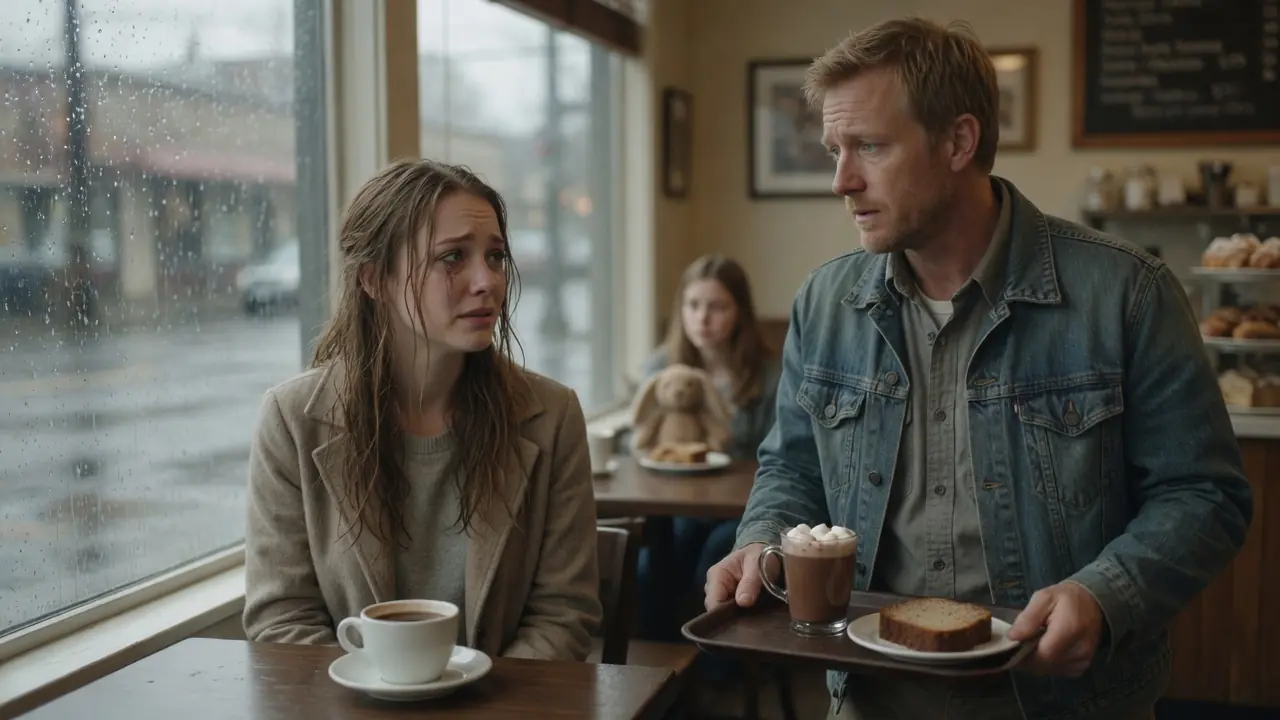
She had tears falling into her untouched coffee.
Mascara bled down her cheeks, dark lines trembling against her pale skin, like pain was pouring straight from her soul.
Everyone else looked away.
Some pretended to check their phones.
Some lowered their voices.
Some glanced once, then quickly turned back to their conversations, their pastries, their laptops, their perfectly normal Wednesday afternoons.
Everyone looked away except him.
A man with tired eyes, calloused hands, a faded work jacket, and a toddler balanced on his hip.
He was not dressed like someone who had time for another person’s pain.
He looked like a man who had barely survived his own.
But he stopped.
He looked at the young woman by the window, at the cold coffee in front of her, at the way her fingers gripped the paper napkin as if it were the only thing holding her together.
Then he walked over slowly, careful not to startle her.
And with a voice as gentle as rain on glass, he asked, “Need someone to talk to?”
What happened next changed both their lives forever.
It was a cloudy Wednesday afternoon in Portland, the kind of afternoon that made the whole city look as though it had been painted in gray watercolor.
The rain had just stopped, leaving behind shimmering sidewalks, damp brick walls, and puddles that reflected passing headlights like broken pieces of silver.
People moved quickly along the street, shoulders hunched, coats pulled tight, cups of coffee clutched in cold hands.
The air smelled of rain, wet leaves, and traffic.
Inside a small corner cafe called Maple & Finch, warmth floated through the room in the form of cinnamon-scented air, fresh banana bread, roasted coffee, and soft jazz playing from old speakers above the counter.
It was the kind of cafe people came to when they needed to feel a little less alone.
Students sat near the back with textbooks open.
Two elderly women shared a slice of lemon cake near the pastry case.
A man in a navy suit typed furiously on his laptop, occasionally checking his watch.
Behind the counter, the barista steamed milk and called out orders in a cheerful voice that seemed too bright for the weather outside.
But at the window seat, a 24-year-old woman sat alone.
Her name was Emma Caldwell.
She was a freelance illustrator, the kind of person who noticed small beautiful things that other people missed.
She noticed the soft curve of steam rising from coffee.
She noticed the way rainy windows turned city lights into halos.
She noticed the nervous habit people had of twisting rings on their fingers when they were hiding something.
That morning, she had noticed too much.
She had noticed her fiancé’s phone buzzing again and again on the kitchen counter.
She had noticed her roommate’s name appearing on the screen with a heart beside it.
She had noticed the messages that followed.
The kind that stole the air from a room.
The kind that made three years of love collapse in less than 30 seconds.
Her fiancé, Ryan, the man who had promised to marry her, the man who had helped her choose the apartment curtains, the man who had once kissed her forehead and said he could not imagine life without her, had been cheating on her.
Not with a stranger.
Not with someone distant enough to blame on weakness or circumstance.
With her roommate.
With Claire.
Her closest friend in Portland.
The person who had helped Emma pick out her wedding dress.
The person who had sat on her bed eating popcorn and talking about bridesmaid colors.
The person who knew Emma’s fears, her dreams, her childhood wounds, her private hopes.
The betrayal was not only romantic.
It was architectural.
It tore down the whole house of trust Emma had built her life inside.
The apartment was no longer home.
The engagement ring on her finger felt like a lie.
Every memory had been contaminated.
The late-night grocery runs.
The Sunday pancakes.
The little notes Ryan used to leave on her sketchpad.
The jokes Claire had made about how lucky Emma was.
All of it folded in on itself like a fragile paper crane crushed in a storm.
Emma had left the apartment without packing properly.
She had grabbed her coat, her sketchbook, her phone, and nothing else.
Ryan had tried to follow her into the hallway.
“Emma, please, let me explain.”
But she had looked at him and seen a stranger wearing the face of the man she loved.
Claire had stood in the kitchen behind him, crying into her hands, saying Emma’s name like saying it softly could make the damage smaller.
Emma had not screamed.
That surprised her later.
She had always thought heartbreak would be loud.
But in that moment, her pain had become strangely quiet.
She had simply walked out.
No coat buttoned.
No umbrella.
No plan.
She had wandered for nearly an hour through the wet streets of Portland until the cold finally reached her bones.
Then she had stepped into Maple & Finch because the windows looked warm and the lights looked kind.
The foam had collapsed.
The cup had gone cold.
Her engagement ring sat on the table beside it.
She had taken it off 20 minutes earlier and placed it there like evidence.
Her shoulders shook quietly as silent sobs escaped her.
She pressed a napkin beneath her eyes, but the mascara had already bled down her cheeks.
She hated crying in public.
She hated being seen like this.
But she could not stop.
Across the cafe, Daniel Hayes was ordering hot chocolate and banana bread for his three-year-old daughter, Lily.
Daniel was 33 years old, a single dad, and a mechanic at a small repair shop on the east side of the city.
He had broad shoulders, tired brown eyes, rough hands marked with small cuts and old grease stains, and the quiet heaviness of a man who had learned to keep going even when every part of him wanted to fall apart.
His work jacket was faded at the elbows.
His boots were worn down at the soles.
His dark hair needed a trim, but he had been too busy with work, bills, laundry, daycare pickup, and bedtime stories to notice.
On his hip, Lily rested her cheek against his shoulder.
She was three years old, with soft curls, round cheeks, and a stuffed bunny tucked tightly under one arm.
Her small pink rain boots swung against Daniel’s side as she looked around the cafe with wide, curious eyes.
“Daddy,” she whispered, pointing at the pastry case. “Banana bread has the little brown dots.”
Daniel smiled.
“That’s how you know it’s good.”
“Mommy liked banana bread?”
The question came softly.
Daniel’s smile faltered for only a second.
Then he kissed the top of Lily’s head.
“Yeah, bug. Mommy loved banana bread.”
Lily nodded as if storing that fact in the sacred place where she kept all the pieces of her mother she was still trying to understand.
Daniel paid for the hot chocolate and bread, then turned to scan the cafe for an empty table.
There were not many.
A few seats at the communal table.
One small table near the bathroom.
One chair by the counter.
Then his eyes landed on Emma.
She was sitting alone by the window, but it was not the empty chair that caught his attention.
It was her face.
Daniel had seen that kind of face before.
He had seen it in the mirror two years earlier, after his wife, Hannah, died of cancer.
He had seen it on the mornings when he made Lily breakfast and then stood in the hallway with one hand pressed against the wall because he did not know how to breathe through another day.
He had seen it in hospital rooms, funeral homes, grocery store aisles, and in his own daughter’s eyes when she asked why Mommy could not come home.
It was the face of someone whose world had just ended while everyone else kept ordering coffee.
Emma looked up for one second.
Their eyes met.
She immediately looked away, embarrassed, wiping her cheeks with fast, panicked movements.
But that one second was enough.
Daniel saw the pain.
And something inside him refused to ignore it.
He could have looked away like everyone else.
He almost did.
He was tired.
Lily was hungry.
He had picked her up from daycare early because she had been crying for her mother again, and he had promised her hot chocolate to make the afternoon feel special.
He had bills waiting at home.
A sink full of dishes.
A broken heater in the apartment that he still had not fixed because the landlord kept delaying.
He had every reason to mind his own business.
But grief had taught Daniel something.
Pain became more dangerous when everyone pretended not to see it.
So he picked up the tray, adjusted Lily on his arm, and walked slowly toward the window table.
Emma sensed him before he spoke.
She stiffened, already preparing to say she was fine.
That was what people expected, wasn’t it?
Say fine.
Smile.
Shrink your pain into something less inconvenient.
But Daniel did not ask if she was fine.
He stood beside the table, keeping a respectful distance, and said gently, “Need someone to talk to?”
Emma froze.
Her fingers tightened around the napkin.
She looked up at him.
At first, instinct told her to be careful.
She was not used to kindness from strangers, especially men.
Not after that morning.
Not after learning that the person she trusted most had been lying to her so easily.
But Daniel’s face held no flirtation.
No curiosity dressed up as concern.
No hidden agenda.
Only a tired kindness.
And beside him, Lily looked at Emma with solemn interest, clutching her stuffed bunny as if it had also been invited into the conversation.
Emma opened her mouth.
Nothing came out.
Daniel gave a small, apologetic smile.
“I’m sorry. I don’t mean to bother you. I just… you look like someone who shouldn’t be sitting alone right now.”
That broke something in her.
Not loudly.
Not dramatically.
Just enough for fresh tears to rise.
“I don’t know,” she whispered. “Maybe. I just…”
Her voice disappeared.
Daniel glanced at the empty chair across from her.
“May we sit?”
Emma nodded slowly.
Daniel pulled the chair out with one hand, settled Lily beside him, and placed the tray down.
He did not move Emma’s ring.
He noticed it, of course.
The little silver band sitting beside the cold coffee.
But he did not mention it.
He simply sat across from her and said, “You don’t have to say anything if you don’t want to. We can just sit here until that coffee doesn’t feel so lonely.”
Emma gave a broken little laugh through her tears.
It was barely a sound.
But it was the first thing in hours that was not pain.
Lily pushed her stuffed bunny onto the table.
“This is Mr. Button,” she announced.
Emma wiped her eyes.
“He’s very handsome.”
Lily nodded seriously.
“He helps when sad things happen.”
Daniel looked at his daughter, then at Emma.
“He’s got a pretty good track record.”
For a few moments, none of them said anything.
Daniel took the lid off Lily’s hot chocolate and blew gently on it.
He broke the banana bread into small pieces.
He wiped a crumb from Lily’s chin.
He was careful and practiced, the way parents become when love has to live inside a thousand tiny tasks.
Emma watched him.
Something about the ordinary tenderness of it made her chest hurt.
She had spent three years imagining a future with Ryan.
A wedding.
A small apartment filled with art and plants.
Maybe children someday.
Maybe Sunday mornings like this.
Now that future felt stolen.
Daniel did not push her to explain.
He did not say, “What happened?”
He did not offer advice before knowing the wound.
He just sat.
And somehow, his silence made room for her words.
“They cheated,” Emma said finally.
Daniel looked up.
His expression changed, not with surprise, but with quiet sadness.
“My fiancé,” she continued, her voice shaking. “And my roommate. My best friend.”
Lily continued sipping her hot chocolate, too young to understand the full meaning, but old enough to feel the sadness in Emma’s voice.
Daniel said nothing.
Emma stared at the ring on the table.
“I found the messages this morning. He left his phone on the counter. I wasn’t even trying to look. It just kept buzzing.”
She swallowed hard.
“I thought maybe it was work. Or his mom. Something normal. Then I saw her name.”
Her hands trembled.
“I still didn’t understand at first. Isn’t that stupid? I saw hearts. I saw words. I saw things no one should say to someone else’s fiancé. And my brain still kept trying to make it innocent.”
Daniel nodded slowly.
“That’s not stupid. That’s your heart trying to protect you.”
Emma looked at him, startled.
Most people would have said she should have known.
That signs were always there.
That she should have been smarter.
Daniel did not.
So she kept talking.
Bit by bit, like water leaking from a cracked dam, her story poured out.
She told him how she had moved to Portland for love.
How Ryan had encouraged her to take the leap into freelance illustration.
How she had built her tiny client list from scratch, drawing book covers, wedding invitations, children’s portraits, little watercolor maps for local shops.
She told him how Claire had become like family when Emma knew almost no one in the city.
How the three of them had eaten dinners together.
How Claire had helped Ryan plan the proposal.
How Emma now wondered whether they had already been lying back then.
Her voice cracked.
“She knew everything. She knew I was scared of being left. She knew my dad walked out when I was little. She knew I had a hard time trusting people.”
Daniel’s jaw tightened, but he stayed quiet.
Emma pressed her palms over her eyes.
“It feels like they didn’t just break my heart. They broke my home. My memories. My ability to believe myself.”
“That part is brutal,” Daniel said softly.
Emma looked at him.
“What part?”
“When someone hurts you like that, it doesn’t just make you doubt them. It makes you doubt your own eyes. Your own judgment. You start replaying everything, wondering how you missed it.”
Emma’s lips trembled.
“Yes.”
Daniel’s eyes lowered for a moment.
“I know a little about replaying things.”
His voice had changed.
Emma noticed it immediately.
The pain in it was older than hers.
“What happened?” she asked carefully.
Daniel looked at Lily, who was now feeding a tiny piece of banana bread to Mr. Button.
“My wife died two years ago,” he said.
Emma’s hand went still.
“I’m so sorry.”
“Her name was Hannah. Cancer. It moved fast. Faster than anything should be allowed to move.”
He rubbed one hand over his jaw.
“For a long time, I replayed everything. Every appointment. Every symptom. Every time she said she was tired and I thought she was just tired. I kept thinking maybe if I’d noticed sooner, pushed harder, asked a better question…”
He stopped.
Lily looked up.
“Mommy is in the clouds,” she said softly.
Daniel’s face softened with a kind of pain that had learned to kneel instead of collapse.
“Yeah, bug. Mommy is in the clouds.”
Emma felt her own grief pause in the presence of his.
Not disappear.
Not shrink.
But become less lonely.
“I’m sorry,” she whispered again.
Daniel shook his head gently.
“You don’t have to be sorry. Today was your day to be sad.”
Emma let out a fragile breath.
“I don’t want to be this person.”
“What person?”
“The woman crying in a cafe while everyone pretends not to see her.”
Daniel looked around the room.
Then he looked back at her.
“You’re not that woman. You’re a person who got hurt and found a warm place to fall apart for a minute.”
Emma’s eyes filled again.
Daniel leaned forward slightly, careful with his words.
“You’re not broken, Emma. You’re just bruised. That means you can still heal.”
The words landed somewhere deep.
Not because they were complicated.
Because they sounded true.
Emma had felt shattered all morning, like there was no version of her that could ever be whole again.
But bruised was different.
Bruised meant pain.
Bruised meant evidence.
Bruised meant time could change the color of the wound.
Lily reached across the table and placed a small piece of banana bread on Emma’s napkin.
“This makes me feel better when I miss Mommy,” she said.
Emma stared at the little piece of bread.
Then she looked at Lily.
“Thank you,” she whispered. “That’s the kindest thing anyone’s done for me in a long time.”
Lily smiled.
“You can have the corner. It’s the best part.”
Emma laughed again, and this time it sounded more alive.
For almost two hours, they stayed at that window table.
The cafe filled and emptied around them.
The jazz changed songs.
The sidewalks outside dried slowly beneath the gray sky.
Emma told Daniel about her illustrations, about how she loved drawing children’s books because she wanted kids to feel less alone inside stories.
Daniel told her about the mechanic shop, about fixing old engines, about the strange satisfaction of bringing something dead and stubborn back to life.
Emma smiled at that.
“You make it sound like healing cars.”
Daniel shrugged.
“Sometimes they just need someone patient enough to listen to the noise.”
“People too,” Emma said.
He looked at her.
“Yeah. People too.”
When it was finally time to leave, the sky outside had darkened.
Lily was sleepy, leaning against Daniel’s arm with Mr. Button tucked under her chin.
Emma picked up the ring from the table and slipped it into her coat pocket instead of putting it back on.
Daniel noticed but did not comment.
At the door, Emma hesitated.
“You didn’t have to do this.”
Daniel adjusted Lily against his shoulder.
“Sometimes we do things not because we have to, but because someone once did it for us, and we promised we’d pay it forward.”
Emma looked at him.
“Who did it for you?”
He looked down for a moment.
“A nurse at the hospital. The night Hannah died. I was sitting in a hallway at 3:00 a.m., holding Lily, and I couldn’t stop shaking. The nurse sat beside me for almost an hour. Didn’t say much. Just stayed. Before she left, she said, ‘One day, you’ll know when someone needs someone to stay.’”
His eyes met Emma’s.
“I guess today was that day.”
Emma swallowed past the ache in her throat.
They exchanged numbers, not as a promise of romance, not as a beginning either of them could name, but as a small rope thrown across the dark.
“If it gets bad tonight,” Daniel said, “text me. You don’t have to suffer in silence.”
Emma nodded.
As she watched the single dad walk away into the damp Portland evening, toddler in tow, she realized kindness still existed in this world.
It was rare.
Quiet.
Easy to miss.
But when it found you at the exact moment you thought the world had become cruel, it could change everything.
That night, Emma did not go back to the apartment right away.
She called her older sister in Seattle and cried for nearly an hour.
Then she booked a cheap room at a small motel and sat on the bed with her sketchbook open in her lap.
For the first time all day, she drew.
Not Ryan.
Not Claire.
Not the apartment.
She drew a cafe window.
A cold cup of coffee.
A little girl offering banana bread.
A man with tired eyes sitting across from a stranger like it was the most natural thing in the world.
She titled it, Someone Stayed.
A week passed.
Emma thought about that cafe meeting every single day.
Not because she had feelings for Daniel.
At least, not in the way people usually meant.
It was something deeper than attraction.
Something quieter.
Hope.
She had forgotten what hope felt like.
The first few days after the betrayal were brutal.
She returned to the apartment with her sister to pack her things.
Ryan cried.
Claire apologized.
Both of them tried to explain.
Their words sounded like furniture scraping across the floor.
Loud.
Ugly.
Useless.
Emma did not scream.
She took her sketchbooks, her clothes, her laptop, her grandmother’s quilt, and the little ceramic mug she had bought the first week she moved to Portland.
She left the engagement ring on the kitchen counter.
Then she walked out again.
This time, she did not look back.
She rented a small studio above a flower shop.
It was not beautiful at first.
The radiator clanked.
The floor slanted near the window.
The bathroom mirror had a crack in one corner.
But it was hers.
No lies lived there yet.
On the fourth night, loneliness hit so hard she almost called Ryan.
Not because she wanted him back.
Because pain sometimes reaches for familiar poison when it cannot find comfort.
Instead, she texted Daniel.
Just two words.
Thank you.
He replied a few minutes later.
Anytime. We all need someone.
She stared at the message longer than she expected.
Then she slept for six straight hours for the first time since the breakup.
Days turned into weeks.
Emma started drawing again.
At first, her work was shaky.
Her hands did not trust themselves.
The colors came out muted.
Faces looked unfinished.
But slowly, line by line, something returned.
She accepted a small commission for a children’s birthday invitation.
Then a bookstore asked her to design a poster for a reading event.
Then an author she had worked with before emailed to ask if she was available for a new picture book project.
Her heartbreak still lingered, but it was less paralyzing.
It became something she carried, not something that carried her.
She started going for walks.
She smiled at strangers.
She helped an elderly woman pick up a dropped grocery bag on the sidewalk.
She bought herself flowers on a Friday because no one else needed to give her permission to have beautiful things.
And eventually, she returned to Maple & Finch.
At first, she went alone.
She sat at the same window table and ordered a latte, this time drinking it before it went cold.
The barista recognized her but said nothing about the crying woman she had been.
Emma appreciated that.
Sometimes kindness was not asking.
Sometimes kindness was letting someone become new without reminding them who they had been.
One rainy afternoon, nearly a month after the first meeting, Emma saw Lily sitting at the same window seat.
Daniel was with her.
Lily had crayons spread across the table and Mr. Button propped beside a muffin like a guest.
Daniel was wearing his work jacket again, and his hair was damp from the rain.
He looked tired.
But when he saw Emma walk in, his face changed.
Not dramatically.
Just enough.
A small grin.
A little surprise.
A warmth that reached his eyes.
“You came back,” he said.
Emma smiled, suddenly nervous.
“Couldn’t stay away from the best banana bread in town.”
Lily gasped.
“Emma!”
She scrambled down from her chair and ran to hug Emma’s legs.
The hug was so unexpected, so pure, that Emma had to blink quickly.
“Hi, Lily.”
“You look not crying today.”
Daniel closed his eyes briefly.
“Lily.”
Emma laughed.
“It’s okay. She’s right.”
Lily took her hand.
“Do you want banana bread? I saved the corner, but I can share.”
“That’s a very generous offer.”
Daniel stood and pulled out a chair.
“Want to sit?”
Emma looked at the empty chair.
This time, sitting down did not feel like falling apart.
It felt like coming back.
They talked for nearly an hour.
This time, there were no tears.
There was laughter.
Quiet at first, then easier.
Daniel told Emma about Lily refusing to wear anything but rain boots for three days straight.
Emma told Daniel about a client who wanted a watercolor portrait of a cat “looking wise but approachable.”
Daniel laughed hard at that.
“What does an approachable wise cat look like?”
“I have no idea. I’m hoping the cat tells me.”
Lily drew a picture of all three of them.
Emma had purple hair in the drawing.
Daniel was taller than the cafe.
Mr. Button was the same size as Lily.
“It’s perfect,” Emma said.
Daniel looked at the drawing longer than necessary.
Something softened in his face.
The weeks that followed formed a gentle pattern.
They started meeting every Sunday afternoon.
At first, it was accidental.
Then convenient.
Then expected.
Emma, Daniel, and Lily at the window table.
Sometimes they brought coloring books.
Sometimes muffins.
Sometimes Emma sketched while Lily colored beside her.
Sometimes Daniel showed up exhausted after an extra shift and mostly listened while Emma told Lily stories about animals who ran bakeries or clouds that forgot how to rain.
They did not talk about the past every time.
That was part of the healing.
Grief and betrayal were not ignored, but they were not allowed to take every seat at the table.
There was room for ordinary things too.
Favorite soups.
Bad weather.
Lily’s daycare art projects.
Emma’s clients.
Daniel’s stubborn old truck.
One Sunday, Daniel arrived quieter than usual.
Emma noticed immediately.
Lily was busy coloring a dragon wearing sunglasses.
Emma waited until Daniel’s coffee had cooled enough to drink.
Then she asked softly, “Hard day?”
Daniel looked at her.
He gave the kind of tired smile people give when they are trying to decide whether they have the energy to be honest.
“Yeah.”
“You don’t have to talk about it.”
“I know.”
That seemed to make him more willing.
He rubbed both hands around his coffee cup.
“Lily asked me this morning if she’s forgetting Hannah’s voice.”
Emma’s chest tightened.
Daniel stared out the window.
“She was crying because she couldn’t remember exactly how her mom sounded when she sang. She’s three. Of course memories are going to blur. But how do you explain that to a child without breaking your own heart?”
Emma did not answer quickly.
She had learned from him that rushing to fix pain could make it feel unseen.
After a moment, she said, “Maybe you don’t have to make the sadness smaller. Maybe you just give her more ways to remember.”
Daniel turned back to her.
“What do you mean?”
Emma hesitated.
“I could draw something for her. Maybe a little memory book. You tell me things about Hannah. Her favorite songs, foods, colors, phrases. I can illustrate them. Not to replace the memories, just to hold them somewhere.”
Daniel’s eyes filled so suddenly that Emma almost regretted offering.
But then he smiled.
A fragile, grateful smile.
“She would love that.”
So they began.
Every Sunday, Daniel brought one memory.
Hannah dancing barefoot in the kitchen while making pancakes.
Hannah singing off-key in the car.
Hannah wearing Daniel’s flannel shirt when she was cold.
Hannah crying the first time Lily laughed.
Emma drew each memory carefully.
Not with the polished distance of professional work.
With tenderness.
With reverence.
Lily helped choose colors.
“Mommy needs yellow here,” she would say.
“Why yellow?” Emma asked once.
“Because Daddy smiles when he says this part.”
Daniel looked away when she said that.
Emma pretended not to see him wipe his eyes.
The memory book became a bridge between them.
For Lily, it made her mother feel less like a fading photograph.
For Daniel, it allowed him to speak Hannah’s name without drowning.
For Emma, it reminded her that love could leave pain behind without becoming a lie.
That mattered.
Because after Ryan, she had feared every happy memory was false.
Daniel’s memories of Hannah taught her otherwise.
A beautiful past could still be real, even if it hurt to remember.
One Saturday in late autumn, Lily asked, “Emma, can you come with us to the zoo tomorrow?”
Emma looked at Daniel, unsure.
His expression was gentle, but careful.
He never pushed.
Never assumed.
Never made her feel cornered by kindness.
“Only if you want to,” he said.
She did.
The zoo trip became the first time they spent a whole day together outside the cafe.
The morning was cold and clear.
Lily wore a yellow coat and insisted Mr. Button needed to see the elephants.
Daniel packed snacks in a backpack because he said zoo food cost as much as car parts.
Emma laughed and brought sketch pencils.
They walked slowly through the exhibits.
Lily ran ahead only a few steps at a time, always turning back to make sure they were still there.
At the penguins, she pressed both hands against the glass and declared them “fancy birds.”
At the giraffes, she asked if their necks got tired.
At the monkeys, she laughed so hard Daniel had to pick her up before she sat down on the wet pavement.
Emma sketched Lily watching the elephants.
Daniel noticed.
“You always draw people when they’re not looking?”
“Only when they’re being themselves.”
“Is that an artist rule?”
“It’s an Emma rule.”
He smiled.
“I like Emma rules.”
Something shifted that day.
Not dramatically.
Not like lightning.
More like a room slowly filling with morning light.
Emma noticed the way Daniel always walked on the street side of the sidewalk without making a show of it.
Daniel noticed how Emma spoke to Lily like her thoughts mattered.
Emma noticed how he still wore his wedding ring on a chain beneath his shirt.
Daniel noticed that she saw it and never asked him to explain.
They were careful with each other.
Maybe that was why it worked.
They were not two lonely people trying to use each other as bandages.
They were two wounded people learning how to sit beside each other without pressing on the bruises.
Winter arrived quietly.
Portland turned colder.
The cafe windows fogged in the afternoons.
Christmas lights appeared in shop windows.
Emma’s studio filled with illustrated pages from Lily’s memory book, which had grown into something beautiful.
On the cover, Emma painted Hannah holding Lily beneath a sky full of soft yellow clouds.
The title was Mommy in the Little Things.
When Emma gave it to Lily, the little girl traced the cover with one finger.
“That’s Mommy?”
Daniel knelt beside her.
“Yeah, bug.”
Lily turned the pages slowly.
There was Mommy making pancakes.
Mommy singing in the car.
Mommy holding baby Lily.
Mommy laughing with Daddy.
Lily hugged the book to her chest.
“Now I can remember with pictures.”
Daniel stood suddenly and walked to the kitchen.
Emma found him there a minute later, one hand braced against the counter, head bowed.
“I’m sorry,” she said softly. “Was it too much?”
He shook his head.
“No. It was everything.”
Then he looked at her.
“You saved me too, you know.”
Emma’s breath caught.
“I didn’t save you.”
“You did.”
He gave a small, almost embarrassed laugh.
“I thought I was just being kind that day in the cafe. But maybe I needed someone to talk to more than you did.”
Emma leaned against the doorway.
“You seemed so steady.”
“I’m not.”
The honesty of it hung between them.
Daniel looked toward the living room, where Lily was turning the pages of the book again.
“I was surviving. Work, daycare, dinner, bedtime, bills. Repeat. I thought that was enough. I thought if Lily was fed and safe, I was doing fine.”
“You were doing more than fine.”
“Maybe. But I wasn’t living. I was scared that if I let anything new in, it meant leaving Hannah behind.”
Emma’s voice softened.
“And now?”
He looked at her for a long moment.
“Now I think love doesn’t work like a room with limited space. Maybe it’s more like a candle. Lighting another one doesn’t put the first one out.”
Emma’s eyes filled.
“That’s beautiful.”
“It took me months to find those words.”
“They were worth waiting for.”
They stood quietly in the kitchen, close but not touching.
Daniel glanced at her hand.
The one that had once worn an engagement ring.
Emma noticed.
“I’m not afraid of being alone anymore,” she said.
Daniel nodded.
“That’s good.”
“But I’m also not as afraid of being cared for.”
His eyes lifted to hers.
The moment was delicate.
Both of them knew it.
Neither wanted to rush it.
Lily called from the living room, “Daddy, Mommy liked pancakes because pancakes are happy!”
Daniel laughed softly and wiped his eyes.
“She’s right.”
Emma smiled.
“She usually is.”
Months passed.
Their friendship became part of daily life.
Daniel fixed a loose shelf in Emma’s studio.
Emma painted stars on Lily’s bedroom wall.
Daniel taught Emma how to check her oil.
Emma taught Lily how to mix colors.
They celebrated Lily’s fourth birthday at Maple & Finch with cupcakes, paper crowns, and a drawing Emma made of Mr. Button riding a dragon.
Emma’s illustration career began to grow.
The memory book she had made for Lily inspired a new project.
She started creating custom memory books for families dealing with loss, separation, adoption, and big life changes.
At first, she only made a few.
Then a grief counselor saw one and asked for her card.
Then a local parenting magazine wrote about her.
Then orders began coming in from people who needed love translated into pictures.
Emma realized her pain had not destroyed her gift.
It had deepened it.
Daniel’s life changed too.
He started laughing more.
He started taking Lily to the park even when he was tired.
He accepted help from neighbors.
He finally let his sister babysit one evening so he could sit in his truck by the river and simply breathe.
And slowly, gently, he allowed himself to imagine a future that did not feel like betrayal.
One snowy December evening, nearly a year after the day in the cafe, Emma stood in Daniel’s small kitchen stirring hot cocoa while Lily slept on the couch beneath a blanket.
Snow in Portland was rare enough to feel magical.
Outside the window, white flakes drifted past the streetlights.
Inside, the fireplace crackled softly.
Daniel stood near the mantel, looking at a framed photo of Hannah.
Emma had seen the photo many times.
Hannah laughing, hair windblown, Lily as a baby in her arms.
Daniel picked up the frame, smiled, and set it back down.
Then he turned to Emma.
“I told her about you today.”
Emma’s heart stilled.
“At the cemetery?”
He nodded.
“I told her Lily loves you. I told her you made the memory book. I told her you helped me remember how to be alive.”
Emma’s eyes filled.
“What do you think she would say?”
Daniel smiled through the ache.
“She’d probably say, ‘It’s about time, Daniel. Stop standing around looking tragic and make the woman some tea.’”
Emma laughed through tears.
“I would’ve liked her.”
“She would’ve loved you.”
The words settled softly between them.
Not replacing.
Not erasing.
Adding.
Daniel stepped closer.
“I don’t want to rush anything.”
“I know.”
“I don’t want you to feel like you’re stepping into someone else’s place.”
“I don’t.”
“I don’t know how to do this perfectly.”
Emma smiled gently.
“Good. Perfect things make me nervous now.”
He laughed under his breath.
Then his face grew serious.
“Emma, that day in the cafe, I thought I was helping a stranger through the worst day of her life. I didn’t know she was going to walk into mine and bring light back with her.”
Emma’s tears slipped down her cheeks, but this time they did not feel like the ones that had fallen into her untouched coffee.
These were different.
Softer.
Fuller.
Alive.
“I thought my life was over that day,” she whispered. “I thought love had made a fool of me. And then you sat down with Lily and banana bread, and you reminded me that love can also be gentle. That it can stay. That it can ask nothing except, ‘Do you need someone?’”
Daniel reached for her hand.
Slowly.
Giving her every chance to pull away.
She did not.
His hand was rough and warm around hers.
“Sometimes healing comes in unexpected ways,” Emma said.
Daniel nodded.
“Sometimes we save each other.”
They stood there in the quiet glow of the fireplace, holding hands while snow softened the world outside.
There was no dramatic confession.
No perfect speech.
No sudden promise that life would never hurt again.
They both knew better than that.
Life would still be hard.
Bills would still come.
Grief would still visit.
Old wounds would still ache on certain days.
But they also knew this.
There would be Sunday afternoons at the cafe.
There would be banana bread corners.
There would be Lily’s laughter and Emma’s sketches and Daniel’s steady hands.
There would be room for Hannah’s memory.
Room for Emma’s scars.
Room for new love to grow carefully beside old pain.
A year earlier, Emma had sat alone by a window with tears falling into her untouched coffee, believing she had lost everything.
But sometimes life does not begin again with a grand miracle.
Sometimes it begins with a stranger noticing that you are not okay.
Sometimes it begins with a chair pulled gently across from yours.
Sometimes it begins with a little girl offering you the best corner of her banana bread.
Sometimes the most powerful moments come from asking a simple question at the right time.
Need someone to talk to?
And sometimes, that question becomes the first step toward a life neither person thought they could still have.