A Saturday afternoon at Vail House always carried a particular kind of light.
Not the soft light of home, or the honest brightness of a small diner with coffee rings on the counter.
This was polished light.
It bounced off marble floors, crystal wall sconces, brass railings, silver trays, and the long glass wine display that ran beside the entrance like a museum case.
Located in a wealthy corner of suburban Chicago, Vail House had grown from a single family restaurant opened in the late 1970s into one of the most respected names in fine dining and hospitality. People drove from the city to eat there. Politicians held private lunches in its upstairs room. Businessmen closed deals over seafood towers and imported wine. Women in tailored coats sat beneath chandeliers, laughing softly over salads that cost more than some families spent on groceries for a week.
To the world outside, Vail House was a destination.
To those who worked inside it, the restaurant had become a stage where appearance was often treated as the first and most important language.
Through the side entrance, the one closest to the small parking lot behind the kitchen, walked a man who did not match the room.
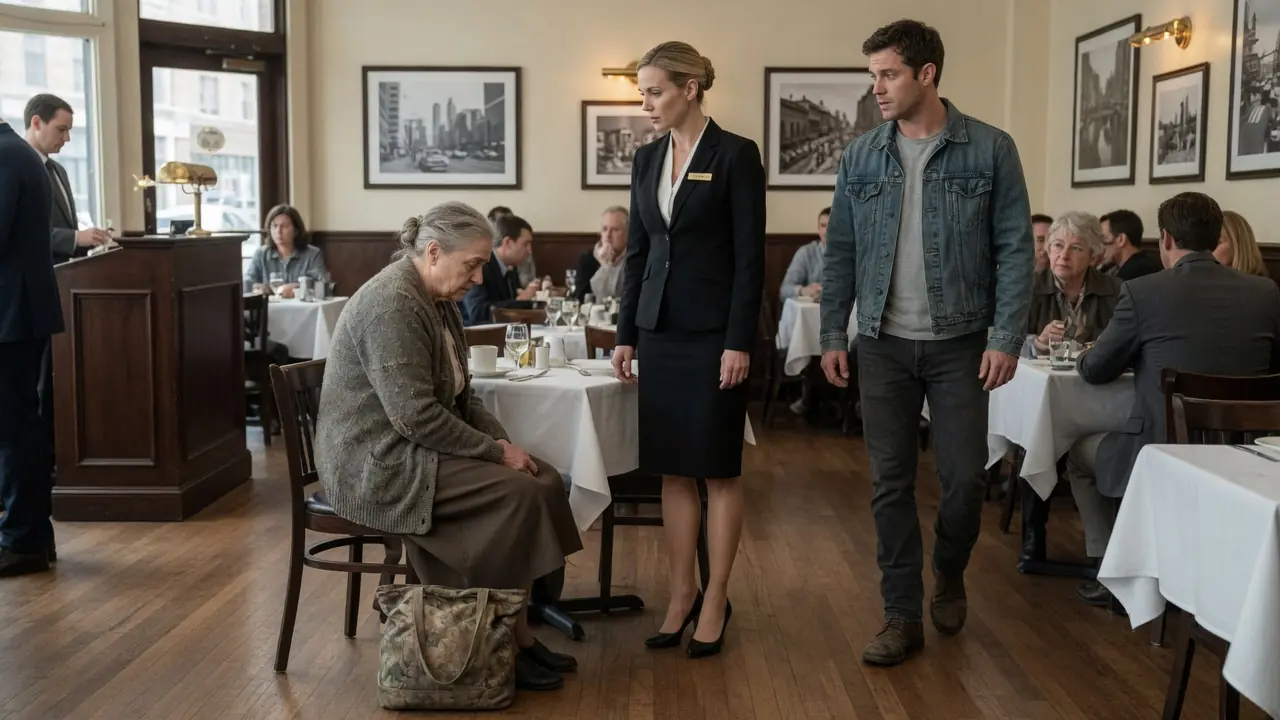
Ethan Carter, twenty-nine years old, kept his daughter’s small hand wrapped in his. He stood just over six feet tall, broad-shouldered from years of hauling tools through crawl spaces, service basements, and mechanical rooms. His dark brown hair was cut close, and his eyes carried the steady tiredness of a man who had worked two extra night shifts just to afford one afternoon that felt special.
His denim jacket had been washed soft.
His jeans were dark but unfashionable.
His brown leather boots had been wiped down that morning, though the soles told the truth of how many roofs, boiler rooms, and wet sidewalks they had crossed.
Beside him, Lily Carter, six years old, kept pace with quick small steps. Her brown hair was pulled into a slightly crooked ponytail because she had insisted on doing it herself. She wore a soft pink cardigan over a white shirt, a small denim skirt, and white sneakers that had grown a little tight around the toes.
She held a stuffed rabbit named Daisy against her chest.
Daisy had one loose ear, a faded pink ribbon, and a tiny stitched heart on one paw. Lily’s late mother had pressed that rabbit into her arms when Lily was three, during the last week she was strong enough to sit up in bed and tell stories.
Ethan had used part of the cash from an emergency repair the night before to bring his daughter to Vail House for one specific reason.
Lily had seen a picture of the restaurant’s famous chocolate cake in a magazine at the dentist’s office. It had three layers, a strawberry on top, and tiny sugar flowers along the edge. For weeks, she had talked about it as if it were something from a palace.
Ethan could not give his daughter many palace things.
But he could give her one slice of cake.
Maybe a bowl of butter noodles.
Maybe lemonade if the price did not make his stomach tighten too much.
As they entered the restaurant’s front lobby, Lily asked in a small, hopeful voice whether they could sit by the window if there was a table open.
Ethan smiled and told her that if they had room for them and the price made sense, they would try.
He did not let her see him glance at the menu board near the host stand.
A woman in a tailored ivory coat walked past them, and her eyes swept over their clothes in one quick motion before looking away.
A young host offered a bright smile to the suited couple two steps behind Ethan, but did not greet Ethan or Lily at all.
None of it surprised him.
He had grown up around that kind of polite indifference.
It was never loud.
It never announced itself.
It simply moved around certain people as if they were part of the furniture.
Vail House was crowded for the afternoon service. The dining room hummed with careful conversation, polished silverware, soft piano music, and the distant rhythm of the kitchen behind swinging doors. Waiters in pressed white shirts moved between tables with practiced grace. At the bar, men in expensive watches leaned over cocktails. Near the front lounge, a few guests waited for tables on velvet chairs.
Then Ethan heard a voice cut clearly through the room, sharp enough to slice through the music.
“Get her out before she makes the guests uncomfortable.”
The words came from the restaurant’s front lounge, near the coat check and reservation desk.
Inside the small ring of onlookers stood a woman who did not belong, at least not by the standards of the people staring.
Helen Vail, seventy-four years old, leaned slightly to one side as a hand closed around her wrist. Her gray hair had been pulled into a low bun. Her gray cardigan, softened with age, hung loose at her shoulders. Her brown skirt was clean but plain. Across her shoulder rested a faded canvas bag with the strap fraying at the seam.
She did not look angry.
She looked tired and ashamed in the particular way old people sometimes look when they realize they are being treated as a thing rather than a person.
The hand on her wrist belonged to Tyler Brooks, thirty-eight years old, the restaurant’s security guard. He was not a cruel man by nature, but he had learned long ago that holding onto his job meant doing what the people in nicer clothes told him to do.
Three feet away stood Amanda Cole, thirty-five years old, Vail House’s front-of-house manager.
Her blonde hair had been pinned into a tight knot, and she wore a fitted black blazer over a white silk blouse and a narrow black skirt. Her heels added another four inches to a frame already used to standing above other people. A silver name badge rested on her lapel, polished until it flashed beneath the lobby lights.
Helen had tried in a small voice to explain that she was waiting for her granddaughter.
She said she only needed to sit somewhere for a few minutes.
Amanda had cut her off.
She told Helen the guests in the lounge were uncomfortable. She told her Vail House was not a shelter for people with nowhere else to spend the afternoon. She said walk-ins without reservations could not loiter near the dining room.
When Helen tried to say she was not without a home, Amanda gave her a thin smile and asked, “Then why do you look like that?”
The question landed harder than any insult.
It was not a question that needed an answer.
It was a verdict.
Tyler tugged at Helen’s wrist, and she stumbled half a step. Her faded canvas bag slipped from her shoulder and struck the marble floor. The seam gave way.
A small pill case, a folded white handkerchief, three old photographs in a paper sleeve, and a slip of paper with handwritten letters spilled across the polished stone.
Helen tried to crouch, but Tyler’s grip kept her upright.
The handkerchief drifted closer to the edge of the crowd, and a man in a charcoal suit stepped over it without looking down, frowning at the inconvenience.
A few onlookers began to lift their phones.
Most were not filming to help.
A server near the reservation desk pressed her hand against her mouth to hide a smile.
Several feet behind Tyler, Ethan and Lily had stopped walking.
Lily pressed herself into the side of her father’s leg, both arms tight around Daisy. Her brightness from a moment earlier was gone. She watched the old woman’s wrist redden under Tyler’s grip. She watched the white handkerchief get a dark scuff across one corner when a passing shoe pressed against it.
Lily lifted her face toward Ethan and asked in the quietest voice she had used all afternoon, “Daddy, why are they hurting her?”
Ethan did not answer right away.
He saw the way Helen’s shoulders curled inward, the way her free hand kept reaching for the bag she could not pick up, the way her chin lifted a little because pride does not die just because a stranger has decided it should.
Then Lily said, softer still, “She looks like Grandma.”
Ethan’s mother had died three years earlier. Lily remembered her only through photographs, old birthday cards, and her father’s stories. That memory had become Lily’s measure of what an old woman was supposed to mean to a family.
Amanda’s voice cut through the lounge again, lower now, more certain.
“Remove her if you have to.”
Tyler tightened his grip.
Ethan’s hand, which had been resting easy on his daughter’s shoulder, eased away from her.
His chest had grown very still.
He let his gaze travel once around the loose ring of onlookers.
There were enough people to fill a small classroom. Some wore tailored coats. A few held menus printed on thick cream paper. There were servers in pressed shirts, a bartender polishing glasses, two hostesses near the reservation stand, a man with a gold watch waiting for his table, and several couples pretending not to stare while staring anyway.
Not one of them stepped forward.
A middle-aged woman in a beige coat shifted her weight as if she were about to act, but the man beside her caught her sleeve and shook his head. He whispered something about not getting involved. Her shoulders lowered, and she turned her gaze toward the floor.
A young busboy looked at Helen with open sympathy, but when Amanda’s eyes swept over him, the young man lowered his head and pretended to adjust water glasses on a tray.
Ethan understood then that the problem was not only one cruel manager or one obedient guard.
The problem was the air.
Every person in that lobby had decided, in the moment they sized Helen up, that her dignity was negotiable because her clothes were old, her bag was thin, and her hair was not styled.
The silence was not an accident.
It was an agreement.
Helen, her free hand trembling, lifted the slip of paper from the floor and offered it forward.
Amanda took it without asking, gave it the briefest look, and smiled the smile of someone who had already decided what to think.
She said any woman could write any name on any piece of paper to justify standing where she did not belong.
Lily, who almost never cried in public, started to.
Not loudly.
Not with sobs.
Just two small tears that escaped without her permission, slipping down her cheeks before she could wipe them away.
Ethan ran through the math in his head.
He could turn away. He could pick his daughter up and leave. He had no lawyer, no money for fines, no patience for a scene that might end badly. If Tyler decided to make this physical, Ethan stood a chance of ending the afternoon in a police report instead of sharing cake with his daughter.
But it was Lily, looking up at him now with two wet tracks down her face, who closed off that option.
She was not watching him to learn how to be safe.
She was watching him to learn what kind of person her father was.
He remembered a sentence his mother had said to him once.
Never let a child see you bow your head in front of cruelty.
Lily, almost in a whisper, asked, “Daddy, aren’t we supposed to help old people?”
Ethan crouched beside her.
“Yes,” he said. “We are.”
He told her to stand right by the marble column near the host stand, where he could see her. He pressed Daisy gently back into her arms so she would have something to hold, and then he stood up.
He walked the way he walked into a mechanical room he did not yet know, with his weight low and his eyes steady.
He came up between Tyler and Helen and turned so that his body slid between them.
He looked Tyler in the face and said three words.
“Let her go.”
Tyler’s head jerked back slightly.
He scanned Ethan from the worn collar of his shirt to the scuffed leather of his boots, and his mouth shaped into a faint sneer.
“Are you family?”
“No.”
“Then step back. This is none of your business.”
“It became my business,” Ethan said, “when you put your hands on an old woman.”
The sentence had the kind of quietness that traveled farther than shouting.
Two more phones rose in the crowd, and this time the people holding them were not smiling.
A woman near the front took half a step closer.
Amanda took three short steps forward, her heels making sharp sounds against the marble. She explained that Vail House had policies, that the restaurant had standards, and that people in the woman’s condition often came into luxury establishments to solicit money from guests.
Ethan asked her, without inflection, whether the woman had asked anyone for money.
Amanda’s eyes flickered.
She did not answer directly.
She said the woman had been a disturbance.
Ethan bent down slowly, gathered the pill case, the photographs, the handkerchief, and the slip of paper from the floor, and held them out to Helen.
Her fingers, when they brushed his, were trembling so badly that he kept his palm near hers a moment longer to steady her.
He asked quietly whether she was hurt.
She told him no, though her wrist was already turning a deep pink under the skin.
Amanda turned her attention fully on Ethan.
She told him he did not understand how fine dining worked, that the restaurant had a clientele to protect, that people came here for a refined experience, not discomfort.
Ethan listened until she was done.
Then he said evenly, “No restaurant worth eating in needs to drag an old woman across a marble floor as if she were trash.”
A murmur rolled through the crowd.
Amanda was now standing in the center of a growing audience that had begun to take sides.
“Security,” she said sharply, “remove him too.”
The second guard, a younger man near the host stand, hesitated.
The hesitation lasted only a moment, but it was long enough for Amanda to see it. And what she saw made her angrier than the original woman she had been trying to throw out.
She looked Ethan up and down with theatrical slowness.
“You probably came in here to stare at a menu you can’t afford,” she said.
Then her gaze slid past him to Lily, still standing by the marble column, both arms wrapped around Daisy.
Amanda’s eyes paused on Lily’s tight white sneakers, and she gave a small smile, the kind a snake gives a mouse.
“Maybe start with a restaurant that serves food in paper baskets,” she said, loud enough for everyone within twenty feet to hear.
Lily’s whole face changed.
She looked down at her own shoes, the ones her father had noticed pinching her toes that morning, and a flush rose into her cheeks that had nothing to do with warmth.
Ethan saw it.
The pulse in his neck moved once, slowly, and he made a conscious decision not to let it move twice.
He understood that the most important person watching was the small girl by the column, and that any anger he showed would become the lesson she carried home.
He turned slightly so Lily could see his face and made sure his expression was steady.
Then he looked at Amanda again.
“My daughter’s shoes,” he said, “have more honesty on them than this whole room has shown so far.”
The line landed in the lobby like a stone dropped into deep water.
A short, surprised laugh broke out from someone near the bar and was quickly smothered. A man in a navy overcoat lowered the phone he had been holding and stared.
Amanda’s lips parted, then pressed together.
Then Ethan asked her, in the same level voice, three questions.
He asked whether Helen had stolen anything.
Amanda did not answer.
He asked whether Helen had threatened anyone.
Amanda did not answer.
He asked whether Helen had damaged the restaurant, disturbed a guest, or refused a direct request to leave after being treated respectfully.
Amanda did not answer.
Into the silence that followed, Ethan said, “Then what you are punishing is not a crime. It is poverty.”
The lobby fell quiet enough that the soft piano music drifting from the dining room became audible again.
A teenage hostess swallowed hard.
A man in a gray suit cleared his throat and stepped a foot backward.
Lily lifted her head.
The small, useless shame Amanda had handed her like a gift began to lift.
“Take them out,” Amanda snapped at Tyler, gesturing at all three of them. “Now.”
Tyler stepped forward and laid a hand on Ethan’s shoulder.
Ethan turned his head slowly and met Tyler’s eyes.
“Think carefully,” he said. “There are cameras everywhere.”
Tyler’s hand stayed a beat longer than was comfortable.
Then it slowly lifted.
Around the lobby, three more figures had drifted into the edge of the circle. They had not come to help Helen. They had come because none of them wanted to be associated with bad publicity on a Saturday afternoon.
Brandon Reed, the restaurant’s wine director, arrived first. He was forty-two, lean, with thinning hair carefully combed and a pocket square folded so sharply it looked like a blade.
Rachel Moore, who managed private events upstairs, came up behind him in a cloud of expensive scent.
Nicole Adams, the guest relations supervisor, joined them a moment later, her tablet clutched against her chest like a shield.
None of them asked Helen what had happened.
None of them asked Ethan.
None of them asked the small girl by the column.
Brandon murmured that Vail House ought to enforce stricter rules about who could linger near the dining room.
Rachel complained that several high-value guests had begun to notice the noise.
Nicole, lowering her voice, reminded everyone that the new chief executive had begun her own internal review of the company’s hospitality culture and that an incident like this could not be allowed to become something the new chief executive might see.
“Clear this,” Amanda murmured to Tyler. “Before Mrs. Vail sees it.”
Helen, standing only a few feet away, gave no obvious reaction to the name.
Her gaze stayed on the marble.
She lifted her chin a little, but only enough to keep her eyes from filling.
Ethan caught the small movement.
Brandon turned his attention to Ethan. He told him he should leave with his daughter, that he was making a fool of himself in front of people who would never remember his face.
Ethan asked him mildly, “What kind of manager helps humiliate an elderly woman because she might inconvenience a wealthier diner?”
Brandon’s mouth opened, then closed.
Rachel tried a different angle. She told Ethan, in a tone meant to be gentle, that he did not understand how a place like Vail House worked.
Ethan let her finish.
He said, after she had run out of words, “The thing that destroys a restaurant is not the guest who arrives in an old sweater. It is the staff who forget that hospitality means nothing if it only applies to people who look expensive.”
Nicole stepped forward as if she had finally found the line she had been rehearsing.
She called Ethan a self-righteous nobody.
The word nobody cracked the air.
Lily heard it.
She moved a little closer to her father.
Helen, sensing what was coming, lifted her face for the first time and spoke directly to Ethan.
“Take your daughter and go,” she said softly. “I will be all right.”
Ethan looked at her.
Then he looked at Lily.
“If I walk away now,” he said, quietly enough that the line carried only to Helen, “I will remember it every time my daughter asks me what kind of man I am.”
The crowd’s attention shifted before they realized it had shifted.
The people in front began to move aside, not because they were ordered to, but because the air had changed.
Madison Vail, twenty-eight years old, stepped through the arched entrance leading from the private dining wing.
She wore a fitted cream-colored dress that fell precisely to her knee. Her chestnut hair fell in a soft wave just past her shoulders. A slender gold watch lay against her wrist, the only piece of jewelry on her body.
She walked the way a woman walks who has spent the last six months reading every customer complaint file at her own company.
Two paces behind her came Henry Brooks, the chief legal officer of Vail Hospitality, a small careful man with a silver beard and a tablet under one arm.
Amanda saw Madison first.
The color in Amanda’s face moved from flush to clay in the space of two heartbeats.
Brandon dropped his eyes to his shoes.
Rachel’s professional smile slid sideways, then off.
Nicole turned her tablet toward herself.
Madison stopped about ten feet from the small ring near the reservation stand and took it in.
She saw the old woman with the reddened wrist.
She saw the smudged handkerchief.
She saw the man in the denim jacket standing between the old woman and the security guard.
She saw the small girl at the marble column.
“What is happening here?”
Amanda’s recovery was instant.
She told Madison there had been a small situation. She said an elderly woman had become disruptive near the dining room and that one of the guests had taken it upon himself to interfere with security.
She mentioned guest comfort.
She mentioned brand image.
She mentioned the importance of maintaining standards.
Madison’s eyes moved to Helen’s wrist.
The skin had darkened to a clear pink that was deepening toward red.
Then Madison’s eyes moved to the floor, where the white handkerchief was still lying, smudged.
“Protecting it from whom?” Madison asked.
Amanda’s mouth opened to answer, then closed.
Ethan, who did not yet know exactly who Madison was, took half a step forward.
“Ma’am,” he said plainly, “they were throwing her out because they didn’t like how she looked.”
Madison’s gaze landed on him then, and for the first time her composure flickered.
Not from weakness.
From recognition.
She had been reading reports for weeks about how her restaurants treated certain kinds of guests.
The man in the denim jacket had just said it in one sentence.
Madison turned her head slowly and looked at Tyler.
“Did you put your hands on her?”
Tyler’s mouth shaped an answer, but no answer came.
Amanda made one last attempt.
She lowered her voice to the soft urgent tone of a woman trying to manage upward. She told Madison the situation was already in hand. She said the older woman fit the profile of persistent panhandlers who sometimes came into high-end restaurants pretending to wait for someone.
Madison did not interrupt her.
She let Amanda speak until she had run out of words.
Then Madison walked past Amanda without looking at her and stopped in front of Helen.
She crouched down slowly, the cream of her dress brushing the marble. She picked up the white handkerchief that had been smudged by a stranger’s shoe. She shook it out gently. She folded it once and pressed it into Helen’s free hand.
Then she rose and slid her palm under the old woman’s forearm as if she were guiding a fragile teacup off a high shelf.
When she spoke next, her voice had changed.
The chief executive’s calm was still in it, but beneath it ran something softer and terrifying.
“Grandma,” she said.
The lobby did not gasp.
It went quiet in the way a room sometimes goes quiet when the temperature drops.
Amanda’s hand rose halfway to her own mouth and stopped in the air.
Brandon stared at Madison as if he had never seen her before.
Rachel’s smile dissolved completely.
Nicole’s tablet slipped down to her thigh.
Tyler let his arm fall to his side.
Madison turned and faced the room.
She did not need to raise her voice.
“This is Helen Vail,” she said. “Founder of the first Vail family restaurant. My grandmother.”
A low sound moved through the lobby.
Half breath.
Half whisper.
Two managers took unconscious steps backward, as if they had been standing too close to a fire.
Madison lifted her free hand and brushed a piece of hair off her grandmother’s temple, the way a granddaughter might do it in a kitchen on a quiet morning.
Helen blinked once, slowly, then lifted her face.
She did not look triumphant.
She looked oddly sad.
It was Helen who explained, in her own quiet voice, what she had been doing there.
She told the room, and she told Madison, that she had asked to come into Vail House that afternoon dressed the way she had dressed every morning during the first ten years of the family restaurant.
She had heard, through letters and phone calls from old friends, that her own restaurant group had begun turning into something she did not recognize.
She had not wanted to set a trap.
She had wanted to see.
She turned then to Amanda, and what she said was not loud and not angry.
It was simply true.
“Forty years ago,” Helen said, “the first Vail restaurant survived because of mothers in old sweaters, fathers in work boots, grandmothers counting coins for birthday dinners, and families who came in to buy one slice of cake because one slice was all they could afford.”
Amanda’s mouth was open.
No sound came out of it.
“I never taught a single employee,” Helen continued, “to push someone out the door because they looked too tired to belong.”
Madison turned her head a fraction toward Henry Brooks.
She did not need to give an instruction in full. He had been with the company long enough to read her face. He lifted his tablet, made two quick selections with his thumb, and spoke into a small earpiece.
Within thirty seconds, the large screen mounted near the private dining entrance went dark.
The screen was usually used to welcome private event guests or show wine dinner menus.
Now it lit again.
This time, it carried the live security archive from the lobby, scrubbed back twenty minutes and slowed to half speed.
The first frame showed Helen Vail stepping carefully into the restaurant lobby, her canvas bag against her hip, her hand brushing once at the marble pillar to steady herself. She leaned briefly against the column, checked the small slip of paper in her hand, and folded it back into her palm.
She did not approach a guest.
She did not touch the reservation desk.
She did not raise her voice or her hand.
Then Amanda walked into the frame.
The screen showed her arms folding, her chin tilting up, her mouth moving in the sharp contained way she used when she had decided to dismiss someone.
It showed Tyler approaching.
Amanda gesturing toward Helen.
Tyler’s hand closing around the old woman’s wrist.
It showed the canvas bag falling.
A server near the reservation desk pressing her hand against her mouth to hide a smile.
A man in a charcoal suit stepping over Helen’s belongings as if they were trash.
Then it showed Ethan.
The screen showed him bend down and gather the photographs and the pill case off the floor. It showed him stand between Tyler and Helen without raising a hand. It showed Lily near the marble column with two small tears running down her cheeks.
Across the lobby, the people who had been filming with their phones lowered them.
The young busboy placed his hand over his mouth, but this time not to hide a smile.
The man in the charcoal suit who had stepped over Helen’s handkerchief turned and walked quickly toward the bar exit.
The guests who had giggled fell silent.
Madison let the feed play to the end.
Then she turned to Amanda.
“Where exactly,” she asked, “was the threat?”
Amanda’s voice came out thin.
She said she had acted in accordance with brand standards.
She said she had been protecting the guest experience.
Madison shook her head once.
“No,” she said. “You acted because you mistook cruelty for class.”
Amanda tried to address Madison directly. She said, in a tone trembling with apology, that she had had no idea the woman was Madison’s grandmother.
She said it again, as if repeating it would change the meaning.
Madison answered her in a voice so level that the listeners had to lean a little to catch it.
“That,” Madison said, “is exactly the problem. You needed her to be someone important before you believed she deserved respect.”
The line hit the lobby like a clean blow.
Madison turned to the second guard and ordered him to escort Tyler to the security office, where he would be suspended pending a formal investigation into the use of physical force against an elderly visitor.
Tyler walked the way a man walks when he is replaying every step of his shift in his head.
Madison then turned to Amanda.
She did not summon her to a back office.
She told her, in front of the restaurant she had been managing, in front of the lobby full of strangers, that she was being relieved of her position effective immediately for abuse of authority, discrimination against a guest, and damage to a brand whose name she had been hired to protect.
She instructed Henry Brooks to coordinate emergency closure of Vail House for the remainder of the day, with mandatory retraining for all front-of-house staff before reopening.
Then she turned to Brandon, Rachel, and Nicole.
She told them an internal audit team would be in contact within the week.
She did not have to add that the audit would be neither brief nor gentle.
Amanda, who only fifteen minutes earlier had ordered an old woman dragged from her restaurant lobby, listened to her dismissal in front of the same crowd that had watched her cruelty.
She did not weep.
She did not argue.
She walked out with two security escorts a few steps behind her, and the click of her heels on the marble was the loudest sound in the room.
Once the lobby cleared, Madison turned and walked back to where Ethan and Helen still stood. She stopped about three feet from Ethan and let a moment pass before she spoke.
“A restaurant with dozens of employees, cameras in every corner, and three layers of management did not protect the dignity of a single elderly visitor today,” Madison said. “But one man with no badge and no reason to benefit walked across the room and did it without being asked.”
Ethan did not flush.
He simply shrugged one shoulder gently, the way a man does when he is trying to push praise back where it came from.
“I didn’t know who she was,” he said. “I just knew she was being hurt.”
The line had no music to it.
It was simply a sentence delivered the way a working man delivers a fact.
Lily, who had been waiting by the column the entire time, came forward in three quick steps and threw both arms around her father’s leg.
Ethan crouched and stroked the back of her ponytail.
“You were brave,” he whispered.
Lily shook her head against his shoulder.
“I was scared.”
“That still counts.”
Helen knelt slowly. She took Lily’s hand in her own thin one and held it like something delicate.
“You have a very good father,” Helen said.
Lily, after a moment of shyness, told Helen that her father always helped people. She said he had once stopped on the side of a road in the rain to change a stranger’s flat tire. She said he had carried groceries up four flights of stairs for Mrs. Alvarez when her elevator broke. She said he fixed the heater at her school one winter night and did not charge because the children were cold.
Lily told Helen this in the matter-of-fact way of a child describing a star she had seen in the sky.
Ethan did not lift his head while she spoke.
He had not realized she had been counting his small acts.
Madison asked Ethan what he did for a living.
He told her he was a maintenance technician, that he handled cooling and electrical systems for commercial buildings and restaurants, mostly on contract, mostly at night.
He said it the way a man states the weather.
Henry Brooks leaned forward and murmured something to Madison. She glanced down at the screen and frowned.
She told Ethan that two years earlier, his name had appeared on a maintenance report from one of their kitchens warning of a refrigeration overload risk. The report had been dismissed because, in the manager’s words, the technician on the form had been only a contractor.
Six months later, that kitchen had been forced to close for nearly two weeks due to the exact failure his report had predicted.
Ethan absorbed the information without surprise.
He did not ask for credit.
He only said, after a beat, “I hope no one got sick from it.”
Madison looked at him for a long moment.
“No,” she said softly. “But we lost thousands of dollars and learned nothing from it. Until now.”
She did not promise him anything in front of the crowd.
She said only, before stepping back, that Vail Hospitality had spent too many years training its employees to bow elegantly to guests who had money, and too few teaching them to stand up for people who did not.
A week later, Ethan received a call from the office of Vail Hospitality asking whether he could come to Vail House that Friday for a meeting with Madison Vail.
He brought Lily because there was nobody to watch her after school.
He did not know whether he was supposed to feel different.
He did not feel different, but the restaurant was different.
A few employees recognized him and nodded, and the nods were not the nods of indulgence. A young woman at the host stand smiled at Lily. The bartender said good afternoon and meant it. A waiter held the door open without making Ethan feel as if he was being examined.
Madison met them in a conference room above the main dining room, the wide window of which looked down over the lobby where the events of the week before had unfolded.
She told him what she was offering, plainly.
She wanted him to take a new position with Vail Hospitality.
The position did not exist before that week.
It would be called Director of Service Conduct and Guest Dignity.
The work would not be done from an office.
It would be done in restaurants.
He would walk dining rooms, kitchens, staff corridors, host stands, bar areas, service entrances, and break rooms. He would audit, in person, the way every category of guest was being treated, with particular care for the elderly, working people, parents with small children, disabled guests, and anyone quietly dismissed for not looking the part.
Ethan told her eventually that he did not have an executive education.
Madison answered that Vail Hospitality already had more diplomas than it had ethics, and that what she could not buy with a search firm was the willingness to say the right thing when no one with power was watching.
He asked her, finally, why she had decided to trust him with it.
She did not look away.
“Because you did the right thing,” she said, “when you thought nobody powerful was watching.”
He told Madison he would take the position, not because he wanted the title, but because he wanted his daughter to grow up in a world where kindness did not make a person smaller.
The afternoon ended downstairs in the restaurant lobby.
Helen sat near the front window at a small round table, a fresh cup of tea in front of her and her old canvas bag at her feet. The bag had been mended at the seam.
She had not stopped using it.
The employees who passed her stopped now to greet her by name.
Lily ran ahead of Ethan to give her a small handkerchief she had picked out at a corner shop with money saved from her allowance. In one corner, stitched in careful blue letters, was one word.
Kind.
Helen took it in both hands and pressed it gently to her cheek.
Madison joined them after a few minutes. She stood beside Ethan without crowding him.
There was nothing to perform.
There was only the marble floor, the soft piano music, the tea cup, the old canvas bag, and a small girl holding a stuffed rabbit on a quiet afternoon.
A waiter approached and placed a plate on the table.
One slice of the famous Vail House chocolate cake.
Three layers.
A strawberry on top.
Tiny sugar flowers around the edge.
Lily looked at Ethan.
He nodded.
She took the first bite slowly, then smiled so brightly that even Helen laughed.
After a while, Lily looked up at her father. Her voice was small, but it carried.
“Daddy,” she said, “did you know she was important?”
Ethan looked at Helen, at the table, at the bag at her feet.
He looked at his daughter, who was waiting for him with the patience of a child who already understood, in her own way, what the answer was going to be.
“No,” he said. “That is why it mattered.”
Inside a restaurant where people had been measured by the labels on their coats, the price of their watches, and the shoes on their feet, a single father had quietly proved the opposite.
The true value of a person did not lie in what they could afford.
It lay in how they treated the ones who could give them nothing in return.
And sometimes, in a building filled with crystal, marble, and silent witnesses, all it took to bring an arrogant system to its knees was one ordinary man willing to step forward when everyone else had decided to look away.