Clare Donovan’s black BMW 760i died twelve minutes before the most important board meeting of her career. The luxury sedan had been gliding through Westfield, Ohio, when every warning light flashed at once, the steering stiffened, and the engine shut down beside a small grocery store. Clare managed to guide the heavy car into the parking lot before it stopped completely. Then the doors unlocked by themselves, the dashboard went black, and her phone lost its connection to the vehicle.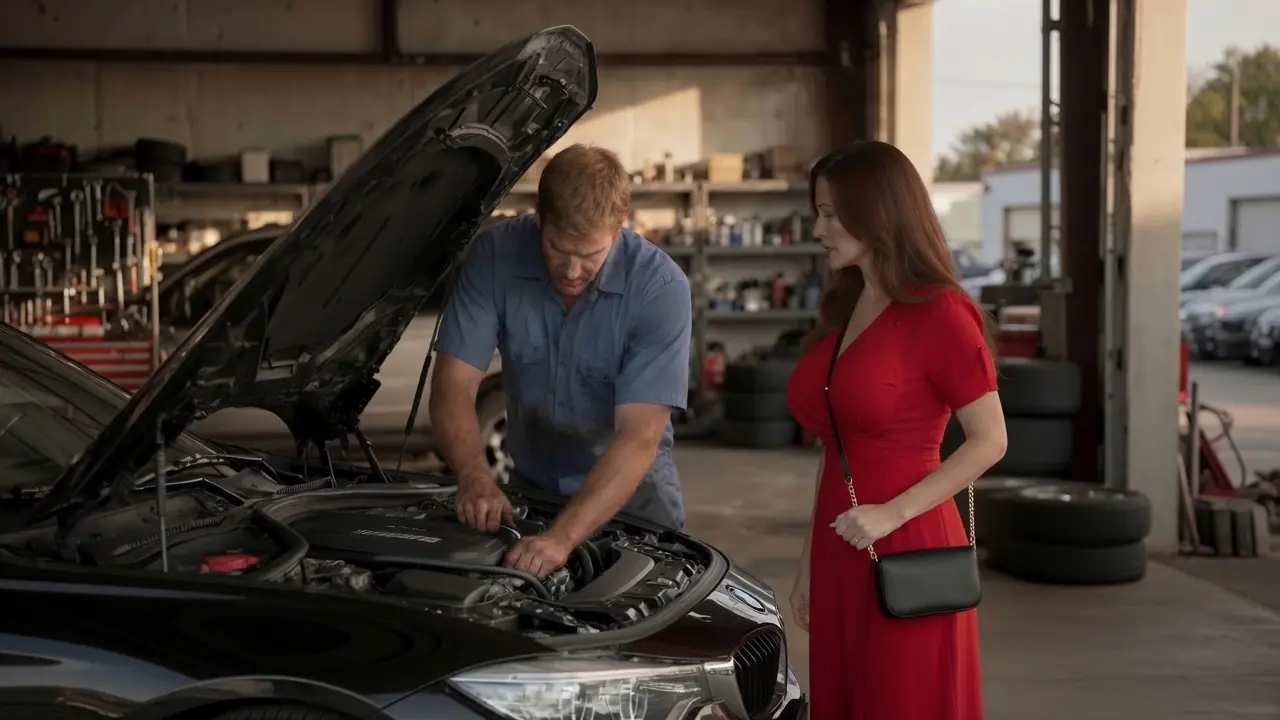
She tried the ignition three times.
Nothing happened.
At thirty-three, Clare was accustomed to solving expensive problems by making one direct phone call. She was the chief executive of Donovan Mobility, a billion-dollar automotive technology company founded by her late father. Her schedule ran in six-minute blocks, her clothes were chosen to move from private aircraft to boardrooms without adjustment, and people usually answered before the second ring.
That morning, roadside assistance placed her on hold.
The company chauffeur was already across the city. Her assistant had been sent to headquarters with documents. A board vote concerning the future of Donovan Mobility’s advanced systems division would begin in twenty-seven minutes, and Clare needed to be inside that room before Victor Lang convinced three undecided directors that she was unprepared to lead.
She stepped out of the BMW and stared beneath the hood without understanding anything she saw.
Across the parking lot, Luke Bennett was loading groceries into an aging blue pickup. He wore a faded mechanic’s shirt with his name stitched above the pocket, work boots, and jeans marked with oil. At thirty-six, he had tousled blond hair, tired blue eyes, and the broad build of a man who spent his days lifting engines rather than weights.
He noticed Clare striking the ignition button again.
“That won’t help if the control system is dead,” he called.
Clare turned. “Roadside assistance is coming.”
“How long?”
“Forty-five minutes.”
Luke glanced at the BMW, then at the clock visible through the grocery-store window. “You’ve checked the time four times since I parked. Forty-five minutes is too long.”
“I have a meeting.”
“Then I can look at it.”
Clare examined his grease-stained hands. “You repair BMWs?”
“I repair machines people say require special technicians.”
“That isn’t an answer.”
Luke pointed across the road. A weathered sign stood above a brick garage.
BENNETT AUTO REPAIR — FAMILY OWNED SINCE 1989
“It’s the only answer I have.”
Clare looked at her phone again. Twenty-three minutes remained.
“Get it running,” she said.
Luke gave her a faint smile. “That usually begins with finding out why it stopped.”
The BMW could not be shifted electronically, so Luke used a manual release hidden beneath the center console. He returned with his pickup, attached a towing strap, and carefully moved the sedan across the road. Clare followed on foot, carrying a brown leather handbag worth more than Luke’s truck.
Inside the garage, an eight-year-old girl sat behind the office window doing homework.
She had dark brown hair pulled into a loose ponytail, serious blue eyes, and a purple pencil tucked behind one ear. She watched the BMW roll inside, then looked at Clare with the careful curiosity of a child accustomed to adults arriving with emergencies.
“That’s Emma,” Luke said. “My daughter.”
Clare nodded without removing her attention from the car.
Luke raised the hood and connected a diagnostic scanner. The device attempted to communicate with the BMW’s electronic control units but returned a complete network failure. He checked the battery, high-current fuses, ignition relay, and main power distribution system.
Every component appeared functional.
“This car was serviced yesterday,” Clare said.
“By whom?”
“Donovan Mobility’s executive fleet technicians.”
Luke stopped.
“Donovan?”
She looked at him impatiently. “Clare Donovan.”
The name struck him with enough force to still his hands.
Four years earlier, after his wife Rachel died in a highway collision, Luke had found a sealed envelope hidden inside a locked steel toolbox. Her handwriting appeared across the front.
For Luke—open only if someone named Donovan brings the system to you.
He had never understood the instruction. He had placed the envelope beneath the bottom drawer of his workbench and tried to forget it existed.
Until now.
Luke removed the BMW’s plastic engine covers, then followed the main wiring harness toward the firewall. The car’s factory design should have contained only standard control modules. Instead, a second device had been hidden beneath the cabin-management computer.
It was secured with nonstandard screws and connected directly to the ignition, electronic steering, braking network, and communications system.
Clare stepped closer. “What is that?”
“I don’t know yet.”
Luke loosened the module carefully. A tiny red light blinked once and died. He turned the device over and wiped dust from its metal casing.
Two initials had been engraved near the edge.
R.B.
Luke’s face changed.
“What?” Clare asked.
“My wife’s name was Rachel Bennett.”
Emma had left the office. She stood several feet away, staring at the module in her father’s hand.
“Is that Mom’s?” she whispered.
Luke nodded slowly.
Clare folded her arms. “Your wife worked for Donovan Mobility?”
“Rachel Bell before we married. Systems engineer.”
“I know our senior engineering records.”
“Then someone removed her.”
Clare’s expression hardened. “Be careful.”
Luke inspected the module again and found a narrow slot hidden behind a rubber seal. Inside was a black memory chip no larger than his thumbnail. He removed it with tweezers and studied the contact points.
“This wasn’t a mechanical breakdown,” he said.
“What was it?”
“Someone sent a shutdown command.”
Clare shook her head. “That BMW has factory cybersecurity.”
“This module bypassed it.”
“And you expect me to trust that?”
Luke held up the casing.
“Trust those initials. My late wife built this, and your company erased her.”
Clare stared at him.
Luke opened the bottom workbench drawer and removed the envelope. The paper had yellowed slightly around the edges, but the seal remained unbroken. He placed it beside the BMW module.
“I’ve had this for four years.”
“Why didn’t you open it?”
“Because she told me not to unless Donovan came first.”
“I didn’t come looking for you.”
Luke looked toward the disabled BMW. “Maybe she knew the car would.”
He opened the envelope.
Inside were a handwritten letter, a photograph, and a small silver key. The photograph showed Rachel standing inside a highly restricted Donovan Mobility laboratory. Behind her was an early version of the module Luke had just removed.
Clare recognized the facility.
“That’s Lab Seven,” she said. “Only executive-development engineers had access.”
Rachel’s company badge was visible in the picture. The name beneath her photograph read RACHEL BELL, but the employee number had been crossed out in red marker.
Luke unfolded the letter.
Rachel had written it eleven days before her death.
Luke, if you are reading this, then the Sentinel system has been activated again, or someone from Donovan has found the vehicle carrying my recorder. I did not resign from the company. I was removed after discovering that an emergency safety platform had been turned into a remote-control weapon.
Luke’s hands tightened around the paper.
Clare moved closer. “Continue.”
Sentinel had been created to protect company executives during theft, kidnapping, or hijacking. Authorized security personnel could locate a vehicle, slow it, disable the engine, or unlock the doors. Rachel discovered that someone had secretly expanded the architecture.
The modified version could interrupt steering assistance, braking commands, communications, and navigation. It could shut down a car while moving and disguise the act as an electrical failure.
Rachel documented unauthorized tests.
One prototype had lost steering on a closed track. Another executive vehicle shut down while an engineer drove home. Internal reports disappeared within hours.
The man controlling the project was Victor Lang.
Clare sat down beside the workbench.
Victor had been her father’s closest executive for twenty years. After Thomas Donovan died, Victor became chief operating officer and presented himself as the guardian of the founder’s legacy. He also challenged nearly every decision Clare made.
That morning’s board meeting would determine whether Victor retained authority over the advanced systems division.
“Victor arranged this BMW for me,” Clare said.
Luke looked at her.
“My driver called in sick. Victor insisted I use my father’s old 760i because it had received a complete security update.”
“Where were you when it shut down?”
“Moving through an intersection.”
“You’re lucky the steering didn’t lock completely.”
Clare’s voice lowered. “Was the system trying to delay me or kill me?”
Luke did not answer.
The letter explained that Rachel created three passive recorder modules. Each would capture the exact source address, authorization code, and command sequence whenever Sentinel was activated.
One module remained with Rachel.
A second was secretly installed inside a vehicle assigned to Thomas Donovan.
The third copy of the evidence had been locked inside a secure archive accessible with the silver key.
The BMW sitting inside Luke’s garage had once belonged to Clare’s father.
Clare looked toward the car.
“Rachel installed this in my father’s BMW.”
“She wanted him protected.”
“Or she believed he was involved.”
Luke continued reading.
Thomas knows something is wrong, but Victor controls his appointments, communications, drivers, and security staff. I cannot tell whether Thomas is part of Sentinel or trapped inside it. If I approach him directly and Victor intercepts the message, Emma and Luke could become targets.
Emma’s name appeared in the letter.
Luke stopped breathing for a moment.
She had been four years old when Rachel died.
Clare read over his shoulder. “She was trying to protect you.”
“She told me she quit because the hours were hurting our marriage.”
“She lied to keep you out of it.”
Luke looked toward his daughter.
Emma stood silently near the office, holding her workbook against her chest. She did not understand every word, but she understood enough to know her mother had been afraid.
Luke moved to an old laptop connected to several diagnostic tools Rachel had designed for the garage. He placed the memory chip into a custom adapter.
The computer requested a password.
He tried Rachel’s birthday.
Rejected.
Their anniversary.
Rejected.
Emma stepped closer. “Try my name.”
Luke entered EMMA.
The directory opened.
Clare closed her eyes briefly.
The files displayed the BMW’s shutdown event at 8:42 that morning. A remote command had entered through the car’s communications unit, disabled the engine, reduced power steering assistance, and interrupted the emergency-call system.
Rachel’s recorder had captured the authorization signature.
VL-EXEC-01
Clare stared at the screen.
“Victor Lang.”
Luke remained cautious. “It proves his credentials were used.”
“He is the only executive with that prefix.”
“Credentials can be stolen.”
“He called me personally and told me to take this car.”
The evidence grew worse when Luke opened a second directory.
The recorder contained years of hidden command logs. Several involved legitimate theft recoveries, but dozens had no matching incident reports. Vehicle systems had been accessed at private homes, highways, company parking structures, and employee residences.
One entry carried Thomas Donovan’s vehicle identification number.
The command had been sent three days before his death.
Clare leaned closer.
The log showed Sentinel locking the BMW’s doors, disabling communication systems, altering the cabin temperature, and activating a high-frequency acoustic alarm for thirty-eight minutes. Thomas was found unconscious inside the vehicle and died later that evening from what doctors called a stress-induced cardiac event.
Clare’s hand covered her mouth.
“My father told me he felt trapped before he died.”
Luke turned toward her.
“He said people were watching him. I thought grief after my mother’s death had made him paranoid.”
“Maybe he was trying to tell you.”
Clare paced once across the garage.
The composed executive disappeared for a moment, replaced by a daughter realizing that the most trusted man in her father’s company might have murdered him. She pressed both hands against the workbench and forced herself to breathe.
“How many minutes until the board meeting?” Luke asked.
“Fourteen.”
“Call the police.”
“If Victor controls our internal security, calling the company will warn him.”
“Federal transportation investigators?”
“My father trusted one woman before he died.”
Clare called Helen Brooks, a senior investigator who had previously examined autonomous-vehicle safety systems. She gave only enough information to secure attention and instructed Helen to meet her at Donovan Mobility headquarters.
Then she called outside corporate counsel.
Luke copied the chip three times.
Clare placed one drive inside her handbag. Luke secured another inside his garage safe. The third went into Emma’s purple pencil case.
Clare raised an eyebrow.
“Nobody searches second-grade fractions,” Luke said.
Emma frowned. “We’re doing multiplication now.”
“Even more secure.”
The BMW was now evidence and could not be trusted.
Luke offered to drive Clare in his old pickup.
She looked at the faded paint, cracked dashboard, and a child’s sweater lying across the seat. “Does that truck reliably reach highway speed?”
“It has no remote shutdown system.”
Clare climbed in.
Emma sat between them because Luke could not leave her alone. As they drove toward the company headquarters, Clare sent encrypted copies of the first files to Helen and outside counsel.
Victor started the meeting without her.
Donovan Mobility’s boardroom occupied the top floor of a glass tower outside Columbus. The directors sat around a long black table while Victor stood beside a presentation titled STABILITY THROUGH EXPERIENCED LEADERSHIP.
He explained that Clare’s absence proved why the company’s advanced systems division needed continuity. Three directors appeared ready to support him.
Then the doors opened.
Clare entered first.
Luke followed in his faded mechanic’s shirt, carrying the hidden module inside a clear evidence bag. Emma walked beside him with her pencil case pressed beneath one arm.
Victor stopped speaking.
“Clare,” he said. “We were concerned.”
“No, you weren’t.”
She placed the BMW module on the table.
Victor’s eyes moved toward it for less than a second.
Luke saw the recognition.
So did Clare.
“What is that?” one director asked.
“The device that remotely disabled my BMW this morning.”
Victor recovered immediately. “It looks like an obsolete fleet-safety controller.”
“You recognized it quickly.”
“I’ve overseen vehicle systems for two decades.”
Clare connected her laptop to the presentation screen. The Sentinel log replaced Victor’s slides. His executive authorization signature appeared across the display.
Board members began whispering.
Victor remained calm. “Credentials can be compromised.”
Luke stepped forward.
“My wife designed the recorder.”
Victor looked at him more carefully.
“Rachel Bell,” Luke said.
The confidence left Victor’s face.
Clare displayed Rachel’s photograph and the letter describing Sentinel. Then she opened the hidden log connected to Thomas Donovan’s BMW.
Victor stood.
“Turn that off.”
Clare looked at him. “Why?”
“Because it contains classified proprietary systems.”
“It contains evidence that my father was trapped inside his car before he died.”
“That procedure prevented a security breach.”
“What security breach?”
Victor looked toward the board. “Thomas’s vehicle may have been compromised.”
“Where is the report?”
“It was handled internally.”
“By you.”
Victor reached for his phone.
The boardroom doors opened again.
Helen Brooks entered with two federal agents, Donovan Mobility’s outside counsel, and an independent cybersecurity specialist. One agent presented a warrant authorizing the seizure of Victor’s devices and records.
Victor’s phone was taken before he could send anything.
“This is a misunderstanding,” he said.
Helen looked at the command log. “Then you’ll have plenty of time to explain it.”
The board meeting ended without a vote.
Victor was escorted from the room while directors watched in stunned silence. Clare remained standing beside her father’s hidden records, but her expression revealed no victory.
Only grief.
The federal investigation lasted months.
Agents recovered deleted Sentinel files from company servers, private devices, and several vehicles. Victor had used the platform to intimidate engineers, disrupt investigations, influence business negotiations, and control executives who threatened his authority.
Rachel had discovered the operation years earlier.
She had been removed from company records, blacklisted within the automotive industry, and monitored after leaving. Investigators found an attempted Sentinel connection to Rachel’s vehicle fifteen minutes before her fatal collision.
Her car had been destroyed too severely to confirm what commands were successfully executed.
Luke received the news inside Bennett Auto Repair.
He sat at the workbench where he first opened Rachel’s letter. Emma slept on the office sofa beneath her mother’s old jacket.
Clare sat beside him.
“For four years, I thought the rain caused the crash,” Luke said.
“It may still have contributed.”
“But someone tried to reach her car.”
“Yes.”
He stared at Rachel’s initials engraved on the module.
“I was angry with her before she left that morning. We argued because she kept secrets and wouldn’t tell me why she was afraid.”
“She was trying to protect you.”
“I know that now.”
Clare looked through the office glass at Emma.
“I inherited my father’s company and believed the danger came from competitors outside it. Victor was sitting beside me during every meeting.”
“You didn’t know.”
“I should have.”
Luke shook his head. “Rachel didn’t build that recorder so you could blame yourself. She built it so someone would act when the truth appeared.”
Clare acted.
Victor and several accomplices were removed from the company. Donovan Mobility opened every Sentinel record to investigators and created a compensation fund for employees who had been threatened, fired, or silenced.
Rachel Bennett’s employment history was restored publicly.
Her patents, engineering credits, and safety reports were returned to her name. The company’s advanced research laboratory was renamed The Rachel Bennett Vehicle Safety Center.
Luke initially refused to attend the dedication.
Emma insisted.
“I want to see where Mom worked.”
At the ceremony, hundreds of employees gathered beneath a large covered sign. Clare stood at the podium and refused to use the cautious language prepared by corporate attorneys.
“Rachel Bennett was not lost in our records,” she said. “She was deliberately erased because she placed human safety above executive power. Our company failed her, her husband, her daughter, and every person who could have been harmed by the system she tried to expose.”
Emma pulled the covering away.
Her mother’s name appeared across the building.
Luke turned his face aside as tears reached his eyes.
After the ceremony, Clare found him near a test track behind the facility.
“I owe your family more than a sign,” she said.
“You gave Rachel her name back.”
“She saved my life.”
“She designed a recorder.”
“You stopped long enough to listen to it.”
Clare smiled faintly. “You also refused to give me the only copy.”
“You arrived wearing expensive shoes and ordering me to hurry.”
“That was reasonable caution.”
“It was extremely reasonable.”
Months passed.
Victor was charged with conspiracy, unlawful interference with motor vehicles, evidence destruction, fraud, and offenses connected to Thomas Donovan’s death. Rachel’s crash was officially reopened.
Clare began visiting Bennett Auto Repair.
At first, every visit had a business purpose. Donovan Mobility hired Luke to train independent mechanics to detect unauthorized vehicle-control systems. Then Clare brought additional company vehicles for inspection.
Eventually, she arrived without a vehicle.
Sometimes she brought coffee. Sometimes she helped Emma with homework while Luke worked beneath a raised car. Once, the CEO of a billion-dollar company spent an entire evening sitting on the garage floor helping Emma build a model bridge from craft sticks.
Luke watched from his toolbox.
“That support beam is crooked,” he said.
Clare looked offended. “Your daughter designed it.”
Emma pointed toward Luke’s side. “Dad’s beam is crooked.”
Clare smiled triumphantly. “The engineer has spoken.”
Luke had avoided relationships after Rachel’s death.
He told himself he was protecting Emma from another loss. The deeper truth was that loving someone new felt like admitting the life he built with Rachel had ended.
Clare never asked him to forget.
She listened when he spoke about Rachel. She preserved her work. She included Emma in every conversation that affected the family and never treated grief like a rival competing for space.
Nearly a year after the BMW stopped, Clare stood outside the garage while evening settled over Westfield.
The repaired 760i waited near the road.
“You kept it,” Luke said.
“It belongs in the company museum eventually.”
“You still drive it?”
“Only after your inspection.”
“That sounds expensive.”
“I own an automotive company.”
“That explains the BMW.”
Clare looked toward him. “You helped me before you knew who I was.”
“I knew you were impatient.”
“And rude?”
“A little.”
She stepped closer. “You still stopped.”
Luke glanced through the office window at Emma sleeping over her workbook.
“Rachel used to say a broken machine never chooses where it stops. The person nearby chooses whether to walk away.”
Clare’s expression softened. “I’m glad you didn’t.”
She kissed him gently.
Luke did not feel as though he were leaving Rachel behind. He felt the opposite. The truth Rachel protected inside the BMW had carried all of them forward—her husband, her daughter, and the woman whose life she saved years after her own ended.
Bennett Auto Repair remained open.
Luke rejected Clare’s offer to replace it with a large corporate facility, but he accepted funding for a national training program based at the garage. Mechanics from across the country learned how to identify hidden control systems, preserve digital evidence, and protect drivers from unauthorized remote access.
Emma kept the original data copy inside her purple pencil case until Luke moved it to a secure archive.
Clare transformed Donovan Mobility’s safety procedures.
No remote command could be issued without multiple independent approvals. Every activation generated an automatic record available to regulators and vehicle owners. Employees received protected channels for reporting misconduct outside executive authority.
Rachel’s design became the safeguard she had intended.
The black BMW was eventually displayed in the lobby of the Rachel Bennett Vehicle Safety Center. Beside it sat the hidden module, her photograph, and a copy of the sealed letter.
Visitors often focused on Victor’s betrayal or the technology inside the car.
Luke remembered something simpler.
A powerful CEO had stood beside his workbench and told him she had no time for stories. Then he lifted a concealed module from beneath the hood of her disabled BMW and found his late wife’s initials engraved into the metal.
The engine failure had never been random.
Rachel built the recorder so the truth could survive even if she did not.
Four years after her death, that truth stopped a killer, cleared her name, protected her daughter, and brought two wounded adults together inside a struggling garage.
Clare’s BMW had broken down beside a grocery store.
But what Luke repaired that morning was far larger than a car.