The phone call came at 6:47 in the morning, before the snowplows had fully cleared the main road and before Thomas Reed had finished his first cup of coffee. He was bent over the open side panel of an old pickup truck, one shoulder pressed against cold metal, his right hand buried near the alternator, when the phone on the workbench began to vibrate. At first, he ignored it. Most calls before seven in the morning were either emergencies he could not afford to refuse or bills he could not afford to answer.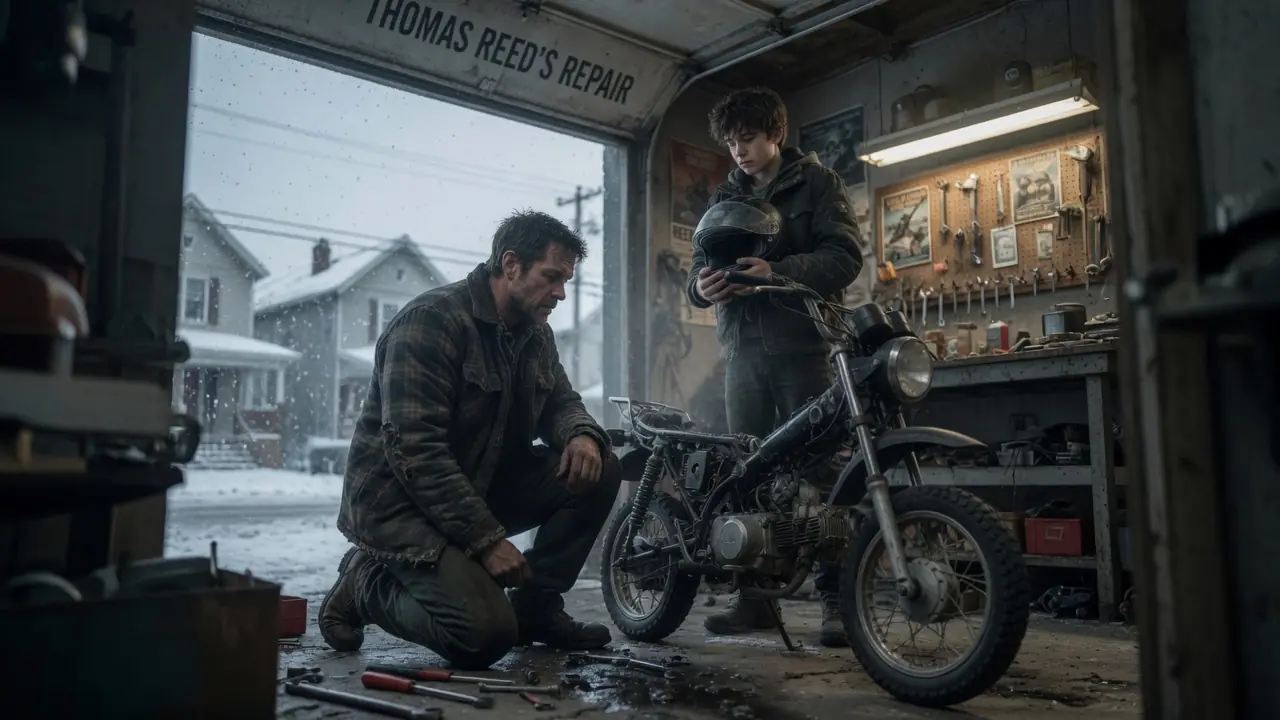
The phone kept buzzing against the scratched wood. Thomas pulled his hand free, wiped grease on a rag, and glanced at the screen. Unknown number. For one long second, he considered letting it ring until silence came back to the garage.
Then he thought of his son upstairs in the tiny apartment above the shop, still asleep under two blankets because the heating bill had already punished them once that winter. Noah was nine years old and believed his father could fix anything. Thomas did not know how to tell him that fixing engines was easier than fixing rent.
He answered. “Reed’s Repair.”
A young voice came through, thin and shaky. “Sir, are you open?”
Thomas looked toward the front window. Outside, Maple Street was still pale with snow, the small brick storefronts half-buried beneath winter quiet. “Not officially.”
“My small motorbike broke down near the old train depot,” the boy said. “I found your number on a sign.”
Thomas straightened. “Are you hurt?”
“No, sir. Just cold.”
“How old are you?”
A pause. “Sixteen.”
Thomas shut his eyes for a moment. Sixteen meant old enough to pretend not to be scared and young enough that fear still showed in the voice. “What’s your name?”
“Ethan Carter.”
“Ethan, stay where you are. Is the bike off the road?”
“Yes, sir.”
“Good. I’ll come get you.”
The boy hesitated. “Sir, I don’t have much money.”
Thomas looked around the garage at the overdue invoices clipped to a board, the leaking coffee maker, the cracked cement floor, and the pickup truck he had been trying to finish before eight. He should have said he could not do charity before breakfast. He should have told the boy to call his parents, a tow service, anyone else.
Instead, he grabbed his coat. “We’ll talk about money after you’re warm.”
By the time Thomas reached the old train depot, Ethan was standing beside a small black motorbike near the curb, holding a scratched helmet against his chest. He was tall but thin, with blond hair falling into his eyes and a denim jacket that was too light for the cold. The motorbike looked like an older city bike, small enough for a teenager, practical rather than powerful, with a frozen chain and a fuel line that clearly needed more care than it had received.
Ethan tried to smile when Thomas pulled up in the tow van, but his lips trembled. “I’m sorry.”
“For what?”
“For calling so early.”
Thomas climbed out and checked the bike. “You did the right thing.”
“My mom is going to be mad.”
“Moms get mad when they’re scared.” Thomas glanced at him. “Did you call her?”
Ethan looked down. “She’s in meetings. She doesn’t answer when it’s unknown.”
Thomas heard something behind the answer. Not disrespect. Loneliness. He knew that tone too well, because Noah sometimes used it when pretending he did not care that his mother had not called in six months.
“Come on,” Thomas said. “Help me load it.”
Ethan moved quickly, eager to be useful. Together they rolled the small motorbike onto the ramp and secured it in the van. Thomas turned the heat higher as they drove back toward the garage, and Ethan held his helmet in both hands like it was the only thing keeping him steady.
“You ride that thing to school?” Thomas asked.
“Sometimes. Mostly to get around.” Ethan glanced out the window. “My mom hates it.”
“Then why ride it?”
“It was my dad’s.”
Thomas said nothing for a few seconds. The road hummed beneath the tires, and the snow along the sidewalks looked untouched. “He around?”
Ethan shook his head. “He died when I was ten.”
“I’m sorry.”
“Thanks.”
Thomas pulled into the garage and lifted the door. The small motorbike rolled in, bringing with it the cold smell of snow, road salt, and gasoline. Ethan stepped inside and looked around at the tools, the old signs, the tires stacked against the wall, and the wooden stairs leading to the apartment above. It was not a fancy place, but it was clean in the way working places are clean when someone respects their own struggle.
Thomas pointed toward a stool near the space heater. “Sit there. Warm up.”
“I can help.”
“You can sit.”
Ethan sat.
Thomas removed the side panel and leaned close to inspect the engine. The bike had been neglected, but not destroyed. The chain was stiff from cold and grime, the spark plug was fouled, and the fuel line had a small crack. Nothing impossible. Nothing expensive if a man had the right parts and enough patience.
Ethan watched nervously. “Is it bad?”
“It’s tired.”
“That sounds bad.”
“No. Tired can be fixed.”
Ethan gave a small smile, the first real one Thomas had seen. Then his face tightened again. “Sir… I really don’t have enough money to fix it.”
Thomas kept his eyes on the engine. “Then we’ll fix the small motorbike first and worry about money later.”
The boy swallowed. “My mom says people don’t help unless they want something.”
Thomas looked up from the bike. “Then tell your mom she hasn’t met the right kind of people yet.”
Ethan stared at him for a moment, as if kindness confused him more than anger would have. Then he looked down at his helmet. “She works a lot.”
“Most parents do.”
“No, I mean… a lot.” Ethan rubbed one thumb across a scratch in the helmet. “She runs a company. Carter Dynamics.”
Thomas’s hand stopped on the wrench.
Carter Dynamics.
The name sat heavily in the garage. Two years earlier, Carter Dynamics had bought the old manufacturing plant outside town and promised jobs, training, and investment. Six months later, after a restructuring decision from corporate, half the plant had been shut down. Thomas had not worked there, but many of his customers had. Men came into his garage with broken trucks and empty eyes, asking if he could wait one more week for payment.
Thomas slowly resumed loosening the bolt. “Your mom is Victoria Carter?”
Ethan’s shoulders tightened. “Yeah.”
Thomas kept his voice even. “CEO Victoria Carter?”
“Yes.”
The space heater clicked softly. Thomas thought of the men who had lost overtime, the families who had moved away, the storefronts that had closed after the plant cutbacks. Then he looked at the boy sitting in his garage with cold hands, carrying a helmet that had belonged to his dead father. Children did not choose corporate decisions.
“You didn’t cause that,” Thomas said.
Ethan looked up, startled. “Cause what?”
“Whatever you’re afraid I’m thinking.”
The boy’s face flushed. “People act different when they know.”
Thomas turned back to the bike. “I’m fixing the motorbike, not your last name.”
For the next hour, Thomas worked while Ethan slowly relaxed. He replaced the spark plug, patched the fuel line, cleaned the chain, and checked the brake cable. Ethan handed him tools when asked, careful not to get in the way. At one point, Noah came downstairs in pajama pants and a sweatshirt, rubbing his eyes.
“Dad?”
Thomas looked up. “Morning, buddy.”
Noah saw Ethan and immediately straightened, trying to look older than nine. “Is that your bike?”
“Small motorbike,” Ethan said. “And hopefully yes, if your dad can save it.”
“My dad can fix anything,” Noah said proudly.
Thomas smiled faintly without looking up. “Your dad can fix some things.”
Noah came closer, fascinated. “Can I watch?”
“From behind the line.”
There was no line on the floor, but Noah knew what it meant. He stood near the tool chest, asking questions until Thomas finally handed him a rag and told him to polish the mirror if he needed a job. Ethan laughed softly, and the sound made the garage feel warmer.
By eight-thirty, the small motorbike started.
It coughed once, sputtered, then settled into a steady sound that made Ethan’s face light up with relief. He stood so quickly the stool scraped behind him. “You fixed it.”
“Told you. Tired can be fixed.”
Ethan reached into his pocket and pulled out folded bills. There were twenty-three dollars total, some of it in ones. He held it out with visible shame. “This is all I have right now.”
Thomas looked at the money, then at the boy. “Keep it.”
Ethan frowned. “No, sir. I can pay something.”
“You can pay attention.” Thomas wiped his hands. “Don’t ride in weather like this without better gloves. Check the chain twice a week. And call your mother before you go anywhere far.”
Ethan’s pride wrestled with gratitude on his face. “I don’t want charity.”
“Good. Then consider it credit.”
“When do I pay you back?”
“When you see somebody stranded and you help them before asking what they’re worth.”
Ethan looked down, then nodded slowly. “I can do that.”
Thomas wrote his number on a scrap of cardboard and handed it over. “If the bike coughs again, call before it quits completely.”
Ethan took it. “Thank you, Mr. Reed.”
Thomas opened the garage door. Snow-bright morning spilled across the floor. Ethan rolled the motorbike out, put on his helmet, and paused before starting it.
“My mom probably won’t believe this,” he said.
Thomas shrugged. “That’s her problem.”
Ethan laughed, then rode carefully down Maple Street, the small motorbike buzzing steadily through the cold. Noah stood beside Thomas and watched him go.
“Was he rich?” Noah asked.
Thomas looked at the empty road. “His mother is.”
“Then why didn’t he pay?”
“Because sometimes money doesn’t reach the place people actually need help.”
Noah seemed to think about that, then nodded like it made sense. “Can we have pancakes?”
Thomas glanced at the clock, the unfinished pickup, and the bills waiting upstairs. “Toast.”
“With cinnamon?”
“If we have any left.”
They had a little.
The rest of the day went the way most days went at Reed’s Repair. Too much work, not enough money, and several customers asking if Thomas could wait until Friday. He said yes to two of them because he knew their situations. He said no to one because kindness without boundaries could drown a man. By closing time, his hands ached and his back felt like it had been tightened with wire.
He thought about Ethan only once after dinner, when Noah asked if the bike kid would come back. Thomas said maybe. Then he helped Noah with math homework, washed dishes, and fell asleep at the kitchen table for seven minutes before his son woke him by placing a blanket over his shoulders.
The next morning, a black SUV stopped in front of the garage at exactly 9:05.
Thomas was under the hood of a van when he heard the engine outside. He looked up through the open garage door and saw a woman step out wearing a dark wool coat, tailored trousers, and the kind of calm that came from being used to people waiting for her to speak. Her hair was pulled back neatly, and her face looked tired in a controlled way. Behind her, the driver remained near the SUV.
Thomas knew who she was before she reached the door.
Victoria Carter.
Ethan’s mother.
She stepped into the garage and looked around. Her eyes took in the tools, the oil stains, the old heater, the half-repaired vehicles, and Thomas standing with grease on his hands. “Mr. Reed?”
“That’s me.”
“I’m Victoria Carter.”
“I figured.”
Her expression shifted slightly. She was used to people smiling too quickly when they heard her name. Thomas did not smile. He did not scowl either. He simply waited.
“My son came here yesterday.”
“He did.”
“He told me you picked him up from the depot.”
“Yes.”
“And fixed his motorbike.”
“Small motorbike,” Thomas corrected automatically.
For the first time, her polished expression cracked with something almost like amusement. “Small motorbike.”
Thomas wiped his hands on a rag. “He tell you he shouldn’t have been riding in that cold?”
“He did.”
“Good.”
Victoria looked toward the stairs, where Noah’s school backpack hung on a hook. “He also told me you refused payment.”
“I refused twenty-three dollars from a freezing teenager.”
Her eyes softened, but only for a moment. “He said you told him to help someone someday.”
“That was the bill.”
Victoria folded her hands in front of her. “My son has not stopped talking about you.”
Thomas did not know what to do with that, so he checked the wrench in his hand though he did not need it. “He’s a good kid.”
“He is.” Her voice lowered. “And he has been angry for a long time.”
Thomas looked at her then.
Victoria took a slow breath. “His father repaired that bike with him before he died. I wanted it gone because I thought it kept Ethan stuck in grief. Yesterday, he told me it was the first thing that made him feel close to his father without feeling alone.”
The garage quieted around them.
Thomas looked toward the small patch of oil on the floor where the bike had stood. “Machines hold memories sometimes.”
“I’m beginning to understand that.”
She opened her handbag and removed an envelope. “I brought payment.”
Thomas shook his head. “No.”
“You don’t even know the amount.”
“I know the answer.”
Her eyes narrowed slightly. CEO eyes now. Negotiation eyes. “Mr. Reed, I don’t accept unpaid debts.”
“Then teach your son the difference between debt and kindness.”
Victoria stared at him. Most men did not speak to her like that. Thomas saw the surprise, then the irritation, then something quieter underneath. Respect, maybe. Or discomfort at not being in control.
She slowly lowered the envelope. “You know who I am.”
“I do.”
“And you still won’t take it?”
“Especially because I know who you are.”
Her face changed. “What does that mean?”
Thomas leaned against the van and crossed his arms. “It means I’ve watched people in this town get crushed by decisions made in rooms they’ll never enter. Carter Dynamics cut jobs two years ago. Maybe you had reasons. Maybe the numbers made sense. But numbers don’t tell you what happens when a man can’t pay to fix the truck he needs to find his next job.”
Victoria did not interrupt.
Thomas continued, “Your son was stranded. I helped him because he was a kid, not because he was a Carter. But if I take a fat envelope from you now, then it becomes a rich woman settling a bill instead of a boy learning that strangers can be decent.”
Victoria’s eyes moved toward the floor.
For a moment, Thomas wondered if he had gone too far. He needed work. He needed money. He needed a hundred things a woman like Victoria Carter could provide with one signature. But he had already swallowed too much pride in life to sell the clean part of yesterday.
Victoria looked up. “You’re right.”
Thomas blinked.
“I had reasons for the plant restructuring,” she said. “Some were valid. Some were incomplete.” Her voice tightened. “I looked at reports, not repair shops. I saw labor numbers, not the trucks people couldn’t fix after layoffs.”
Thomas said nothing.
“My board is meeting next week about reopening part of the regional service division. I came to thank you. But perhaps I also came because Ethan asked me a question last night that I could not answer.”
“What question?”
Victoria’s mouth trembled slightly. “He asked why a stranger with less money treated him more gently than the company with our name treated this town.”
Thomas exhaled slowly.
The words hung in the garage, heavier than anger. Noah’s footsteps sounded on the stairs above, then stopped. Thomas knew his son was listening. He always listened when grown-up voices changed.
Victoria noticed too. “Is that your son?”
“Yes.”
“What’s his name?”
“Noah.”
She looked toward the stairs but did not call out. “Ethan said Noah believes you can fix anything.”
Thomas smiled faintly. “Noah exaggerates.”
“Children often tell the truth in the wrong size.”
That made Thomas look at her differently.
Victoria set the envelope on the workbench anyway. Thomas frowned, but she held up a hand. “Not payment for yesterday. A proposal.”
“I don’t need charity.”
“I’m not offering charity.” She opened the envelope and removed a printed document. “Carter Dynamics is rebuilding its regional vendor network. We need independent repair contractors for small engines, fleet vehicles, and employee transportation support. I want Reed’s Repair evaluated for a contract.”
Thomas stared at the paper. “You want my garage?”
“I want your standards.”
He gave a dry laugh. “My standards include a heater that only works when it feels guilty.”
“Equipment can be upgraded.”
“I don’t have the staff for a corporate contract.”
“Then hire.”
“With what money?”
Victoria turned one page. “The proposal includes startup support, training funds, and guaranteed monthly service minimums.”
Thomas did not touch the document. It looked too large for his hands, too clean for the garage. “Why?”
Victoria met his eyes. “Because my son came home safe on a small motorbike that should have left him stranded. Because you helped him without knowing his mother could help you. And because this town deserves contracts that go to people who actually live inside its consequences.”
Thomas looked down.
Upstairs, Noah whispered, “Dad?”
Thomas closed his eyes briefly. “Come down, buddy.”
Noah appeared on the stairs in a hoodie and socks, his hair sticking up in the back. He looked at Victoria with wide eyes, then at the envelope. “Are we in trouble?”
Victoria’s face softened. “No. Your father helped my son.”
Noah came to stand beside Thomas. “The bike kid?”
“Yes,” she said. “Ethan.”
“Is he okay?”
“He is.”
Noah nodded seriously. “Good. Dad said cold makes bikes tired.”
For the first time, Victoria Carter laughed. Not the polite laugh of boardrooms or investor dinners. A real laugh, brief and surprised. “Your dad seems to understand tired things.”
Thomas looked at his son. “Go brush your teeth.”
“But—”
“Teeth.”
Noah sighed and went back upstairs.
Victoria watched him go, and something in her face changed again. “Ethan used to talk like that. Before his father died.”
“He still can.”
“I hope so.”
Thomas finally picked up the proposal. He read the first page slowly, then the second. Numbers stared back at him. Monthly service guarantees that would cover rent, utilities, parts, and maybe even the cracked window in Noah’s room. Training funds. A possible second lift. A pathway to hire two mechanics.
It was not a miracle. It was work.
That made it more believable.
“I need time,” he said.
“Of course.”
“I need someone to look this over.”
“I expected that.” Victoria removed a card from her pocket. “My legal team can send a plain-language version, but you should have your own advisor review it.”
Thomas almost smiled. “You trying to make sure I don’t get cheated by you?”
“I am trying to make sure you trust the signature if you choose to put your name beside mine.”
He studied her for a moment. “You really came here because Ethan asked you to?”
“Yes.”
“Does he know?”
“No. He thinks I came to pay you and probably embarrass him.”
“That sounds like sixteen.”
Victoria smiled faintly. “It does.”
Before leaving, she paused near the garage door. “Mr. Reed.”
“Thomas.”
“Thomas.” She seemed to test the name carefully. “Would it be all right if Ethan came by again? Not for repairs. To learn, maybe.”
Thomas looked toward the space where the small motorbike had been. “If he shows up on that thing in snow again, I’m taking the keys.”
“I would support that.”
“But yes. He can come by.”
“Thank you.”
After she left, Thomas stood for a long time holding the proposal. The garage felt the same and not the same. The heater rattled. The van waited with its hood open. A customer’s sedan still needed brakes. But a door had appeared in the middle of his life, and he did not know yet whether walking through it would save him or scare him.
Noah came back downstairs. “Is she rich?”
“Yes.”
“Nice rich or scary rich?”
Thomas thought about it. “Both, maybe.”
“Are we going to be okay?”
Thomas looked at the proposal again. “We might be more okay than yesterday.”
That afternoon, Ethan returned. He walked the small motorbike beside him instead of riding it, which Thomas appreciated. He looked nervous when he entered the garage, helmet under one arm.
“My mom came here.”
“She did.”
“I told her not to be weird.”
Thomas lifted an eyebrow. “She mostly managed.”
Ethan looked relieved. “Did she try to pay too much?”
“Yes.”
“Did you let her?”
“No.”
A grin broke across Ethan’s face. “I knew it.”
Thomas pointed toward the bike. “You here because it’s acting up?”
“No. I wanted to check the chain like you said.” He hesitated. “And maybe learn how to do it right.”
Thomas tossed him a rag. “Then put the helmet down and get your hands dirty.”
Ethan did.
Over the next few weeks, Ethan came by twice a week after school. Sometimes Noah joined them, standing behind the invisible line until Thomas let him hand over tools. Ethan learned to clean the chain, check tire pressure, inspect cables, and listen for engine sounds that meant trouble. He was clumsy at first, then careful, then proud when Thomas let him tighten bolts without help.
Victoria stopped by once, then again. At first, she came to pick up Ethan. Then she stayed for coffee from the old machine, which Thomas warned her tasted like regret. She drank it anyway. Slowly, the woman who had entered the garage as a CEO became a mother asking how to talk to her son about grief without turning every conversation into a command.
Thomas did not have polished answers. He only had honest ones.
“Stop trying to remove his father from the bike,” he told her one evening while Ethan and Noah argued over a socket size. “Help him keep the memory from turning into a cage.”
Victoria looked through the garage window at her son. “I thought letting him keep it would make the loss worse.”
“Loss doesn’t get worse because we touch what mattered. It gets worse when nobody lets us speak its name.”
Her eyes filled, but she blinked the tears back. “You say things like someone who has been hurt.”
Thomas gave a humorless smile. “Most useful people have.”
The contract was signed in March.
Thomas hired one mechanic first, then another. Carter Dynamics sent fleet vehicles, small equipment, and employee transport bikes for service. The old garage did not become fancy, but it became steady. The cracked window in Noah’s room was replaced. The heating bill was paid on time. Thomas bought a secondhand lift that changed the whole rhythm of the shop.
But more important than the money was what happened in town. Carter Dynamics reopened part of the service division with local hiring. Victoria held a town meeting and stood in front of people who had every reason to distrust her. She did not hide behind charts. She admitted the company had failed to measure human damage properly.
Some forgave her quickly. Some did not. Thomas respected both.
At the meeting, Ethan stood near the back beside Noah. When Victoria mentioned local repair partnerships, Ethan looked at Thomas with a small proud smile. He knew where that had started. Not in a boardroom, not in a press release, but beside a broken small motorbike in a cold garage.
One year later, Reed’s Repair had a new sign above the door. Not bigger than the old one, just cleaner. Thomas refused anything too shiny. Under the name, in smaller letters, Noah had insisted they add: Tired Can Be Fixed.
Victoria laughed when she saw it. Ethan pretended not to get emotional. Thomas pretended not to notice.
On the anniversary of the morning phone call, Ethan rode to the garage carefully in clear weather, wearing proper gloves. The small motorbike was running well now, its engine steady and clean. He parked outside, removed his helmet, and carried in a box of donuts.
Thomas looked up from a workbench. “Payment finally?”
Ethan smiled. “For the debt.”
Thomas opened the box. “You still think donuts cover a fuel line?”
“No.” Ethan reached into his jacket and pulled out a folded paper. “This does.”
Thomas took it. It was a printed flyer for a weekend roadside repair program Ethan had started at school, connecting student volunteers with elderly residents who needed help with bikes, scooters, lawn equipment, and small repairs. At the bottom was a line that made Thomas go quiet.
First lesson: fix the problem before asking what someone is worth.
Thomas looked at Ethan.
The boy’s face was older now, not by much, but enough. “I paid attention,” he said.
Thomas swallowed. “Yeah. You did.”
Noah, now ten and still convinced his father could fix most things, grabbed a donut and asked if he could join the repair program when he was older. Ethan told him he could start by cleaning tools. Noah complained, but he did it anyway.
Later that day, Victoria arrived at the garage in the same black SUV, though she no longer seemed as distant when she stepped out. She watched Ethan and Noah working together, then came to stand beside Thomas.
“You changed him,” she said.
Thomas shook his head. “No. I gave him a place to be useful.”
“That changes people.”
He looked at her. “You changed too.”
Victoria watched her son laugh at something Noah said. “I had to decide whether I wanted to be obeyed or trusted.”
“Hard choice?”
“For a CEO, yes.” She smiled faintly. “For a mother, it should have been easier.”
Thomas leaned against the garage doorframe. Snow still lay in patches along the street, but the air felt less bitter than the year before. Inside the shop, tools clinked, the heater worked properly, and a small motorbike that once arrived broken now stood like a witness to everything that had followed.
Victoria turned to him. “Do you ever wonder what would have happened if you hadn’t answered the phone?”
Thomas looked at Ethan, then Noah, then the busy garage. “All the time.”
“And?”
“I figure the phone rang for a reason.”
Victoria nodded. “Ethan says you don’t believe in luck.”
“I believe in choices.”
“Then thank you for making that one.”
Thomas did not answer right away. He thought of the morning he almost ignored the call, the bills on the board, the cold street, the boy with the helmet, and the words that had started the change.
Sir… I don’t have enough money to fix it.
He had heard poverty in that sentence, but also fear, grief, and a child trying not to ask for help too loudly. He had answered the way he hoped someone would answer Noah if his son ever stood stranded in the cold. That was all.
A small choice.
A repaired bike.
A mother forced to look beyond her own boardroom.
A garage saved not by charity, but by dignity meeting opportunity.
Thomas finally looked at Victoria. “Tell your son to keep checking the chain.”
She laughed softly. “That’s your answer?”
“That’s my answer.”
Inside the garage, Ethan called out, “Mr. Reed, Noah says he can rebuild a carburetor.”
Thomas turned sharply. “Noah Reed, step away from anything with screws.”
Noah groaned. Ethan laughed. Victoria smiled in a way that made her look less like a CEO and more like a mother who had found her son again.
And outside, on Maple Street, the little black motorbike waited in the clean cold air, no longer stranded, no longer tired, no longer just a machine.
It had become the reason two families crossed paths.
And the proof that sometimes the smallest repair opens the largest door.