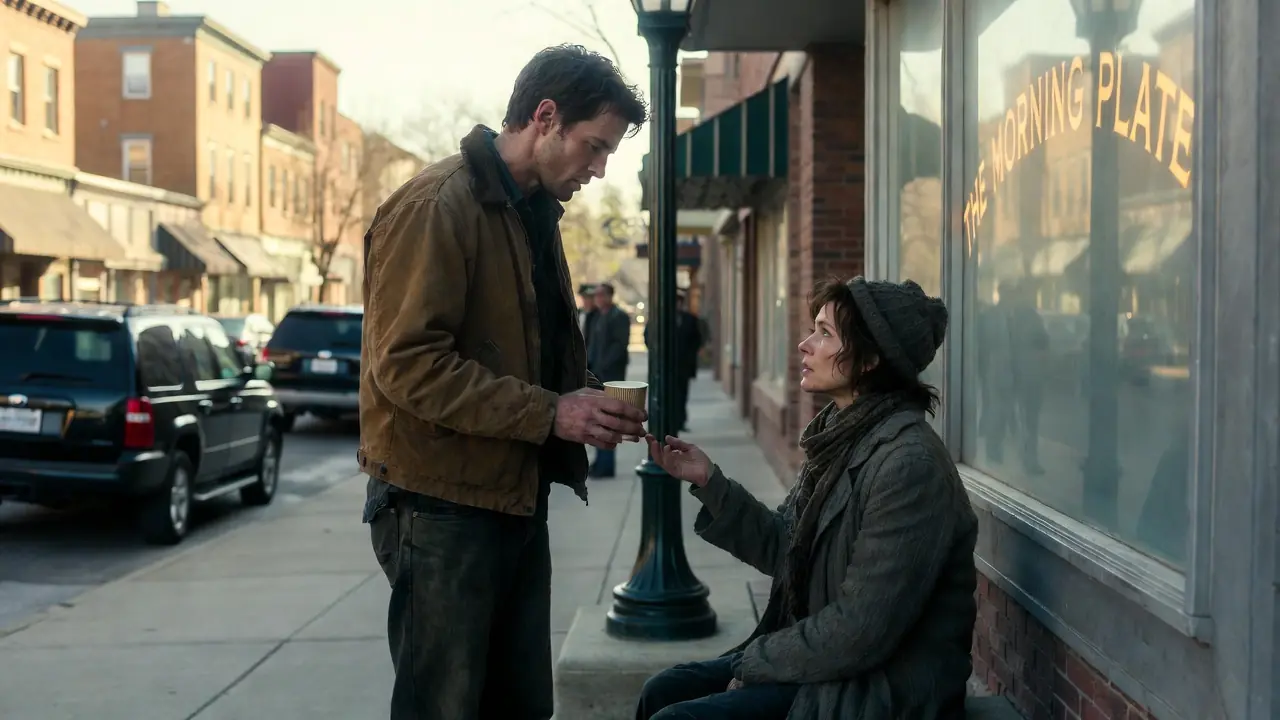
Every morning at exactly 6:40, Silas Turner placed a warm cup of coffee into the trembling hands of the homeless woman who sat outside his diner.
No questions.
No pity.
Just quiet kindness.
For months, almost no one noticed.
The people of Denton Falls were too busy rushing to work, too busy staring at their phones, too busy avoiding things that made them uncomfortable.
They stepped around her, looked through her, whispered about her, or pretended she was part of the sidewalk.
But Silas saw her.
Every morning, before he unlocked the front door of The Morning Plate, before the first customer came in, before the grill warmed and the coffee machine began its tired mechanical groan, he filled one paper cup with fresh coffee, added two sugars, snapped a lid over the top, and carried it outside.
She was always there.
Sitting on the low concrete step beside the lamp post at the corner of his building, wrapped in the same worn gray coat, her hands tucked into her sleeves, her head lowered as if she had learned that making eye contact with the world only invited trouble.
Silas never asked her why she was there.
He never asked where she slept.
He never asked what had happened to her.
He simply held out the cup.
And every morning, she lifted her eyes, accepted it with both hands, and gave him the smallest nod.
That was their routine.
A cup of coffee.
A quiet nod.
A man going back inside.
A woman staying outside.
For months, that was all.
Until one cold morning in December, three black SUVs pulled onto Callaway Street and stopped directly in front of Silas’s diner.
The vehicles moved with slow, deliberate control, their dark windows reflecting the gray winter sky. One after another, they lined the curb, engines humming softly in the sharp morning air.
Then the doors opened.
Men in tailored dark suits stepped out, scanning the street with sharp, methodical eyes. Their polished shoes touched the cracked sidewalk like they did not belong there. Two wore earpieces. One carried a black leather folder. Another spoke quietly into his sleeve.
People stopped walking.
A delivery man froze with a crate in his arms.
The owner of the hardware store two doors down stepped outside and stared.
Inside The Morning Plate, Silas’s eight-year-old daughter, Lily, pressed both hands to the window.
And the homeless woman on the sidewalk slowly stood up.
No longer shaking.
No longer bent beneath the weight of the cold.
She stood straight, steady, and calm, as though the woman everyone had ignored for months had only been a shadow of the person beneath.
What happened next made the entire city realize they had been watching the wrong person all along.
Silas Turner was thirty-eight years old, but life had put older lines into his face.
Not from vanity.
Not from neglect.
But from the particular exhaustion of a man who had carried too much for too long without anyone offering to help.
He owned The Morning Plate, a narrow, slightly run-down diner on Callaway Street in the working-class neighborhood of Denton Falls. The sign above the door was hand-painted, faded by three summers of sun and never repainted because repainting signs cost money, and money had become something Silas counted carefully.
Inside, the diner had nine small tables, one cracked vinyl booth in the back corner, a counter with six stools, and a coffee machine that made a grinding sound every morning before six but somehow never fully broke down.
Silas had bought the diner eight years earlier with every dollar he had, two small personal loans, and one bank loan he had spent every day since trying to repay.
Back then, he had a wife and a plan.
Now, he had a daughter and a different kind of plan.
One built entirely around making sure she never felt the weight of what they were missing.
His daughter’s name was Lily. She had dark eyes like his and her mother’s habit of tilting her head slightly whenever she was thinking carefully. She noticed things other children missed: the way people’s smiles changed when they were pretending, the way an old man counted coins before ordering coffee, the way stray leaves gathered in the same corner of the sidewalk every morning.
Lily was also relentlessly hopeful.
Silas did not know whether that was a miracle or proof that children understood something about the world that grown-ups had forgotten.
Every morning before school, Lily sat at the counter with a bowl of oatmeal while Silas opened the diner.
She watched him turn on the lights.
She watched him wipe down counters that had already been wiped the night before.
She watched him check the register, count small bills, scan invoices, and hide worry behind a calm face.
And every morning, she watched him prepare the paper cup of coffee.
Strong.
Two sugars.
Lid snapped tight.
At first, Lily asked nothing.
Then one morning in October, while the sky outside was still pale blue and the street was damp from overnight rain, she looked through the window as Silas handed the cup to the woman outside.
“Daddy,” she asked, “why do you give her coffee every day?”
Silas came back inside, rubbed his hands together for warmth, and stepped behind the counter.
“Because she’s out there every morning,” he said.
Lily waited, sensing there was more.
“And nobody else does,” Silas added.
Lily looked back through the glass.
The woman had both hands wrapped around the coffee cup. She was not drinking yet. She was only holding it, letting the warmth settle into her fingers.
“Does she have family?” Lily asked.
“I don’t know.”
“Does she have a name?”
Silas paused.
For the first few weeks, he had not known. The woman had barely spoken at all. Then one morning, after he had handed her coffee and started turning away, she had said, very quietly, “Clara.”
Just that.
One word.
A name offered like something fragile.
“Clara,” Silas said. “Her name is Clara.”
Lily nodded with great seriousness.
“Clara,” she repeated, as if placing the name somewhere safe in her mind.
The first time Silas had noticed Clara Hayes, she had been sitting in the rain.
It was early September, one of those gray mornings when summer had not fully left but fall had begun pressing its cold fingers into the edges of the day. Silas had arrived at 5:30, parked behind the diner, and entered through the back door carrying a crate of eggs and a head full of unpaid bills.
When he came out front to unlock the door, he saw her.
She was sitting beside the lamp post, knees pulled close to her chest, wearing a gray coat that looked too thin for the weather. Her hair was dark and tangled. Her shoes were cracked at the seams. Her hands trembled slightly, though Silas could not tell if it was from cold, hunger, fear, or habit.
For a moment, he hesitated.
He was not a wealthy man. He was barely staying afloat. He had a daughter to feed, a diner to save, and a future that seemed to shrink every time he opened the mail.
Still, he went back inside and poured a cup of coffee.
He carried it out.
“Here,” he said.
The woman looked up slowly.
Her eyes surprised him.
They did not look empty. They did not look confused. They looked tired, yes, and guarded, but also sharp. Observant. As if she had been watching the world very carefully and keeping her conclusions to herself.
She accepted the cup.
“Thank you,” she said.
Her voice was low, controlled, and educated in a way that did not match her coat, her shoes, or the concrete step where she sat.
Silas noticed.
But he did not comment.
The next morning, she was there again.
So he brought coffee again.
By the end of the week, he no longer thought about it. It became part of his opening routine.
Coffee for the machine.
Oatmeal for Lily.
Coffee for Clara.
Some mornings, Clara spoke.
Most mornings, she did not.
When the weather turned colder, Silas gave her a biscuit in a paper bag.
When November rain came down hard enough to flood the gutter, he brought her an old umbrella from the storage closet.
When December winds sharpened, he gave her a spare scarf that had belonged to his late wife, Maren.
He almost did not give that away.
He stood in the back room for five full minutes holding the scarf in both hands.
Maren had worn it during their last winter together.
Red wool.
Soft.
Still faintly smelling of lavender if he imagined hard enough.
Giving it away felt like letting go of something he had no right to release.
But then he looked through the front window and saw Clara’s hands shaking around the coffee cup, her shoulders hunched against the cold, and he heard Maren’s voice in his memory.
“Kindness that costs nothing is easy, Silas. The kind that hurts a little is the one that matters.”
He brought out the scarf.
Clara looked at it for a long moment before taking it.
“This is too nice,” she said.
“It was sitting in a box.”
“That doesn’t mean it wasn’t loved.”
Silas did not answer.
Clara wrapped it around her neck with careful hands.
From that day forward, she wore it every morning.
Not everyone appreciated Silas’s quiet routine.
Marcus Reed owned the hardware supply store two doors down. His shop had new paint, clean windows, a bright sign, and a sidewalk that was swept every morning before 7:00. Marcus believed appearances were the difference between success and failure.
He applied this belief to window displays, product shelves, property values, and people.
Especially people.
One morning in early December, as Silas was setting chairs down from the tables, Marcus came into the diner with the stiff posture of a man carrying judgment like a briefcase.
“You know you’re hurting business, right?” Marcus said.
Silas looked up.
“Good morning to you, too.”
“I’m serious, Turner.”
“I can tell.”
Marcus glanced toward the window, where Clara sat outside with coffee in her hands.
“People see her sitting there and keep walking.”
“People who won’t enter a diner because a woman is sitting quietly outside probably weren’t coming in for breakfast anyway.”
Marcus exhaled sharply.
“You always do this.”
“Do what?”
“Act like kindness is a business plan.”
Silas placed a chair down carefully.
“No. I act like people are people.”
Marcus leaned closer.
“You are running a business, not a shelter.”
“I know what I’m running.”
“Do you?” Marcus looked around the diner. His eyes moved over the cracked booth, the old counter, the faded menu board. “Because from where I’m standing, you can’t afford to save anyone.”
Silas felt the words hit a place he tried not to touch.
But he kept his face still.
Marcus lowered his voice.
“I’m saying this as a neighbor. You need to think about your daughter. You keep encouraging that woman to sit out there, customers will stay away. The new breakfast place down the street is already eating half your traffic. Don’t make it worse.”
Silas looked out the window.
Clara was staring at the street, not at them.
“I’ll think about it,” he said.
Marcus nodded, satisfied.
But Silas did not think about moving Clara.
He thought about how easily people dressed selfishness as concern.
Business was declining.
That part Marcus had not invented.
The Morning Plate was struggling badly.
A new breakfast chain had opened at the far end of Callaway Street in September. It had exposed brick walls, clean white plates, oat milk, avocado toast, and a menu printed on reclaimed wood. Younger customers flocked there. Office workers took photos of their lattes. The place had a name that sounded less like a diner and more like a lifestyle.
Silas could not compete with that.
His customers were older men who wanted black coffee, nurses coming off night shifts, parents grabbing cheap pancakes for kids before school, and people who cared more about being remembered than being impressed.
But even they were coming less often.
Prices had risen. Eggs cost more. Bacon cost more. Coffee cost more. Electricity cost more.
Everything cost more except the breakfast special, because Silas refused to raise it beyond what his regulars could pay.
At night, after Lily slept, he sat at the kitchen table in their small apartment above the diner and did math on napkins.
Rent.
Supplier bills.
Loan payments.
Payroll for his one part-time waitress, Rosa.
School expenses.
Insurance.
Repairs.
The numbers never came out right.
Some nights, he rested his head in his hands and wondered what Maren would say if she were still alive.
She had died two years earlier, suddenly and quietly, from an undiagnosed heart condition that took her in her sleep.
One day she had been helping Lily braid ribbons into her hair.
The next morning, she was gone.
There had been no warning.
No chance to bargain.
No final conversation.
After Maren died, Silas learned there were different kinds of silence.
There was peaceful silence.
There was tired silence.
There was the silence of a sleeping child.
And then there was the silence of a room missing the one voice that had made it home.
He lived in that silence every night.
The diner became the only place where he could still feel useful.
So he opened it every morning.
And every morning at 6:40, he brought Clara coffee.
As the months passed, Clara began to speak more.
Not much.
Never enough to become familiar.
But enough that Silas understood she noticed everything.
“You changed the booth cushion,” she said one morning.
Silas glanced back through the window.
“The corner booth?”
“Yes.”
“Had to. Spring was poking through.”
“You picked brown instead of red.”
“It was cheaper.”
“It looks better.”
He smiled faintly.
“Don’t let the booth hear you. It was attached to red.”
Another morning, Clara watched a young man in an expensive coat step over a piece of trash and keep walking.
“Most people don’t mean to be cruel,” she said.
Silas handed her coffee.
“No?”
“No. They are simply trained not to look too closely at anything that might require something from them.”
Silas considered that.
“You think looking properly always requires something?”
“Yes,” Clara said. “Attention. Honesty. Sometimes action.”
He looked at her.
“That sounds expensive.”
“It is.”
She lifted the coffee cup.
“That’s why most people avoid it.”
Silas thought about those words all day.
Lily liked Clara in the way children sometimes like people they barely know but understand instinctively.
One Friday morning, Lily drew a small picture on a napkin: a coffee cup with steam rising from it and a red scarf around it like a person.
She folded it carefully and handed it to Silas.
“Give this to Clara.”
Silas raised an eyebrow.
“You want me to give her a picture of coffee wearing a scarf?”
“It’s not coffee wearing a scarf,” Lily said seriously. “It’s warm.”
He nodded, accepting the correction.
“Of course.”
When he gave Clara the napkin, she unfolded it slowly.
For the first time, Silas saw her smile.
It was small and brief, but real.
“She’s observant,” Clara said.
“She’s eight.”
“That is not a contradiction.”
Silas laughed softly.
“No. I guess it isn’t.”
The worst morning came on a Thursday.
The sky was low and white, and cold moved through the street with a hard edge. Silas was inside serving two regulars when he heard raised voices outside.
He looked up.
A private security guard from the new development three blocks over stood near Clara’s usual spot. He was large, with a black jacket, a radio on his shoulder, and the self-importance of someone who had been given just enough authority to become dangerous.
“You need to move,” the guard said.
Clara remained seated.
“I’m not on your property.”
“You’re loitering.”
“I’m sitting.”
“You think this is funny?”
“No.”
Silas came out from behind the counter.
Lily, who had been eating oatmeal, turned toward the window.
Outside, the guard reached down and gripped Clara’s arm.
Silas was through the door before he fully realized he had moved.
“Let her go,” he said.
The guard looked at him.
“This doesn’t concern you.”
“She’s outside my diner.”
“She’s blocking the sidewalk.”
“She’s sitting beside a lamp post.”
The guard tightened his grip.
Clara’s face changed only slightly, but Silas saw pain flicker across it.
He stepped closer.
“I said let her go.”
The guard released Clara and shoved Silas backward with one hand.
Not hard enough to knock him down, but hard enough to send him stumbling against the diner wall.
Inside, Lily pressed both hands against the glass.
Her face went very still.
Silas straightened slowly.
The guard looked him up and down.
“You people always want trouble.”
Silas’s jaw tightened.
Behind him, Clara rose to her feet.
“Enough,” she said.
The guard looked at her then, truly looked at her, and for reasons Silas did not understand, something in Clara’s tone made him hesitate.
She stepped closer, her gray coat moving in the wind.
“Walk away,” she said quietly.
The guard’s face hardened, but he did step back.
“This street’s going downhill anyway,” he muttered.
Then he left.
Silas stood there, heart pounding.
Clara looked at him.
“You shouldn’t have done that.”
“Probably.”
“He could have hurt you.”
“He was hurting you.”
Something unreadable moved through her eyes.
“Most people would have watched.”
“I’m not most people.”
“No,”