The night Victoria Hale lost everything, the snow would not stop falling.
From the top floor of her glass tower in Chicago, she watched her empire collapse in real time. Headlines burned across every screen.
Assets frozen. Federal investigations launched. Investors vanished.
Just hours ago, she had been the youngest self-made billionaire in the Midwest. Now, she was branded a fraud.
The board forced her out before midnight. As she stepped into the silent marble lobby, heels slipping on melting snow, the last person she expected to catch her was the night janitor.
And that was the moment everything changed.
The screens in the boardroom had been relentless.
Her own face stared back at her from a dozen monitors, framed by words that felt like ice picks to the chest.
Tech mogul under investigation.
Hale Industries stock plummets 87%.
Billions evaporate overnight.
Victoria stood at the floor-to-ceiling windows, watching snow swirl forty stories above Michigan Avenue. The flakes looked like static, like her entire world was breaking down into pixels and disappearing.
Behind her, the board members she had handpicked were taking turns explaining why she had to go.
Immediately.
“Before the markets open in Asia, the optics are catastrophic,” Gerald Myers said, his voice hollow.
She had made him wealthy. He would not meet her eyes.
“Shareholders are demanding action,” added Patricia Chen, the CFO who had once called Victoria a visionary.
Victoria’s phone buzzed against the glass table.
Fifty-three missed calls.
Her attorney. Her publicist. Her mother.
She ignored them all.
Outside, Chicago was turning into a snow globe, beautiful and suffocating. The January wind howled through some invisible gap in the architecture, a high-pitched whistle that sounded like the building itself was screaming.
“We need your resignation letter by midnight,” Gerald said. “Security will escort you out.”
She had built this company from a dorm room idea. Twelve years of eighteen-hour days, three successful pivots, and seventeen acquisitions. Barack Obama had quoted her at a tech summit.
And now, because of trading irregularities she did not authorize and transactions she did not approve, they wanted her gone in ninety minutes.
Victoria turned from the window.
The boardroom felt smaller than it had that morning. The walls were closing in, or maybe she was shrinking.
For the first time in her adult life, she had no plan, no strategy, and no move to make.
“I’ll be out in an hour,” she said quietly.
No one argued.
No one defended her.
They had already moved on to damage control, discussing press releases and interim leadership. She was a problem being managed, not a person being supported.
Victoria gathered her tablet and walked out without another word.
The executive floor was empty. Everyone had gone home early, afraid of association.
Her assistant’s desk was cleared. The motivational posters she had hung, “Fail fast, learn faster,” now felt like cruel jokes.
Her corner office looked staged and impersonal, like a museum exhibit of someone else’s life.
Victoria did not pack anything.
What was the point?
The life those objects represented no longer existed.
She grabbed her coat and walked to the elevator.
The descent from the fortieth floor to the lobby felt longer than it should have. Her ears popped. Her reflection in the polished steel doors showed a woman she barely recognized.
Hair perfect.
Suit immaculate.
Eyes completely hollow.
The elevator chimed.
The doors opened onto the grand marble lobby she had designed herself.
Minimalist. Powerful. Cold.
The floor was slick with melted snow tracked in by the last employees leaving for the night. Victoria stepped out carefully, but her heel caught a patch of water, and she felt herself tilting, falling, the ground rushing up to meet her.
A hand caught her elbow.
Firm.
Steady.
She looked up into the face of a man in a gray maintenance uniform. A mop bucket on wheels stood beside him.
“Easy there,” he said.
Victoria straightened, pulling her arm back instinctively.
“I’m fine.”
The janitor did not argue. He simply held her gaze for a moment, not with pity, not with judgment, just acknowledgment.
Then he went back to mopping, pushing the water toward a drain in deliberate, practiced strokes.
She should have walked away, called her driver, and disappeared into the storm. But something about that moment, the steadiness of his hands, the quiet competence, the complete absence of performance in his eyes, made her stop.
Through the glass walls, she could see the snow coming down harder.
The streets were empty.
The city looked abandoned, frozen in place.
And for the first time that day, Victoria Hale felt the full weight of what had just happened.
She had nowhere to go.
Ethan Cole had been cleaning office buildings for three years.
He knew the rhythm of corporate crisis: the hurried exits, the boxes carried out after hours, the way executives stopped seeing service workers entirely when their worlds were falling apart.
He had expected this woman to brush past him, phone pressed to her ear, already moving on to whatever came next.
Instead, she just stood there.
He kept mopping, giving her space.
The TV mounted in the lobby was playing the news with the sound off. He could see her face on the screen, split with another shot of federal agents entering a building. The headline read:
Disgraced CEO forced out.
“Headlines aren’t always the truth,” Ethan said, wringing out his mop.
Victoria’s head snapped toward him. Her expression shifted from blank shock to something sharper.
“Excuse me?”
“The news,” Ethan said. “They’re already calling you guilty. Haven’t even investigated yet.”
“You wouldn’t understand,” she said, her voice cold and controlled.
It was the voice of someone used to ending conversations.
Ethan shrugged and pushed the bucket toward the next section of floor.
“Maybe not billions, but I understand losing everything.”
He did not elaborate.
He did not need to.
The lobby fell quiet except for the sound of water sloshing and the distant howl of wind. Victoria stood frozen, her expensive coat buttoned to her throat, her breath visible in the drafty space.
“It’s going to be a bad one tonight,” Ethan continued, nodding toward the windows. “They’re saying ten inches by morning. Roads are already a mess.”
“I don’t care about the weather.”
“You will when you try to get home.”
Victoria pulled out her phone.
No signal.
The storm must have been interfering with the tower.
She walked toward the front doors, heels clicking sharply on marble, and pushed outside into the blast of snow and wind.
It hit her like a physical force, stealing her breath.
The cold was shocking, painful.
She retreated back inside, snow dusting her shoulders.
Ethan had moved to the security desk, wiping down the granite counter.
“Like I said,” he said. “Bad one.”
“My driver probably turned around.”
“Smart people aren’t on the roads right now.”
Victoria felt something crack inside her chest, the last thread of control she had been holding.
She walked to one of the modern benches, more art installation than furniture, and sat down heavily. The marble was cold even through her wool coat.
For several minutes, neither of them spoke.
Ethan worked methodically, moving through his routine with practiced efficiency. Victoria watched him in her peripheral vision. He was probably late thirties, maybe forty. Lean build. There was something deliberate about the way he moved, like a man who had learned to waste no motion.
The TV screen changed to a financial analyst explaining the collapse.
Victoria watched her life being dissected by strangers. They were talking about her like she was not a person, just a data point in a market correction.
She saw her own face flash again, a photo from last year’s shareholders meeting, where she had been laughing at something the CFO said.
She looked confident.
Untouchable.
That woman felt like a stranger now.
“They can’t hurt you worse than you’re already hurt,” Ethan said quietly, not looking up from his work.
“You have no idea what they can do.”
“True. But I know what you can survive.”
He paused, then added, “Most people think rock bottom is the end. It’s not. It’s just the first day of something different.”
Victoria turned to look at him directly for the first time.
Really look.
There were lines around his eyes, the kind that came from stress, not age. His hands were rough and scarred, but his voice was educated. His phrasing was too precise for the job he was doing.
“Who are you?” she asked.
“Ethan Cole. Night maintenance. Buildings three through seven.”
He offered a slight smile.
“And before you ask, yes, I know who you are. But that’s not why I’m talking to you.”
“Then why?”
“Because three years ago, I was sitting where you’re sitting. Different building. Same look on my face. And someone told me something I didn’t want to hear.”
He met her eyes.
“You’re still here. That means something.”
The simple observation hit harder than any of the board’s accusations.
Victoria felt her throat tighten. She looked away, back toward the storm, blinking hard.
“What did they tell you?” she asked quietly.
Ethan finished wiping the desk and leaned against it, arms crossed.
“They told me my son didn’t care what I lost. He cared that I showed up.”
Victoria nodded slowly, not trusting herself to speak.
Outside, the wind drove snow against the glass in waves, making the entire lobby feel like it was underwater. Somewhere in the building, a pipe creaked.
The storm was settling in for the night.
And so, apparently, was she.
Ethan pulled a folding chair from the security closet and set it across from the bench where Victoria sat. He lowered himself into it with a slight wince.
“Old injury,” he said. “Lower back.”
The building’s heating system hummed in the background, fighting a losing battle against the cold seeping through the glass walls.
“You don’t have to tell me anything,” Victoria said. “I don’t need a pep talk.”
“Good. I wasn’t planning on giving one.”
Ethan leaned back, the chair creaking under his weight.
“But we’re both stuck here until this storm passes. Might as well talk.”
Victoria considered leaving, finding somewhere else to wait.
But the lobby was warm, and the idea of going back out into that wind made her bones ache. She pulled her coat tighter.
“Three years ago,” Ethan began, his voice steady and matter-of-fact, “I had a different life. Mechanical engineering degree from Illinois Tech. Good job at an aerospace firm. Wife named Rachel. We had just found out she was pregnant.”
He paused, looking past Victoria toward the windows, but his eyes were seeing something else entirely.
“December nineteenth. She was driving home from her parents’ place. Black ice on the Kennedy Expressway. An SUV lost control and crossed the median.”
He said it the way someone recites facts they have repeated too many times to feel anymore.
“She was eight months pregnant. They did an emergency cesarean. Baby was fine. Rachel didn’t make it.”
Victoria felt the air leave her lungs.
“I’m sorry.”
“Yeah,” Ethan said. “Me too.”
He rubbed his jaw, a gesture that seemed automatic.
“Hospital bills came first. Even with insurance, the NICU stay, the surgery, the funeral, it added up fast. Then I found out Rachel had co-signed for her brother’s business loan. He defaulted. I was liable. Lost the house in six months.”
“You couldn’t fight it?”
“Could have. Didn’t have the energy. I had a two-month-old baby who wouldn’t stop crying and a job I couldn’t focus on. Made mistakes. Got let go. By February, I was sleeping in my car with my son in a parking garage, running the engine for heat in ten-minute intervals so we didn’t freeze.”
Victoria had thought she understood loss: the collapse of her company, the betrayal of her board, the destruction of her reputation.
But this was different.
This was a man who had lost everything that truly mattered.
“How did you...” she started, then stopped, unsure what she was even asking.
“Survive?” Ethan supplied. “Honestly, most days I didn’t think I would. But every morning, I’d look at my son, Marcus, and he’d smile at me. Didn’t matter that we were homeless. Didn’t matter that I was washing him with bottled water in a gas station bathroom. He just cared that I was there.”
He stood and walked to the window, his reflection ghostlike against the falling snow.
“Eventually, I found a shelter that took fathers with kids. Got us stable. Took this job because the hours worked, ten p.m. to six a.m., so I could be with Marcus during the day. Found a daycare that opened early. Started rebuilding.”
“Just like that?”
“Not just like that. It took two years before I felt human again. Three before I stopped waking up expecting to find her next to me.”
He turned back to Victoria.
“But here’s what I learned. You can lose your job, your house, your savings, your reputation, all of it. And you’re still you. The skills that got you there the first time don’t disappear. They’re just frozen, waiting for you to thaw them out.”
Victoria absorbed this in silence.
The comparison was humbling. She had lost her company, her money, her status. But she had not lost a person. She had not lost what this man had lost.
And yet he was standing here, working a night shift, raising a son, functioning.
While she was falling apart over money and reputation.
“Your son?” she asked. “How old is he now?”
“Three and a half. Smart as hell. Obsessed with trains.”
Ethan’s whole demeanor changed when he talked about Marcus. His shoulders relaxed. His voice softened.
“He doesn’t know what I used to be. To him, I’m just Dad. The guy who makes grilled cheese and does train sounds.”
“Do you regret it?” Victoria asked. “Losing your career?”
Ethan considered this.
“Some days, yes. I loved that work. Designing components. Solving problems. But I got something else instead. Time with my kid that most fathers miss. He knows me. Really knows me. That’s not nothing.”
Victoria stood and joined him at the window.
The city beyond was barely visible now. Just white sheets of snow and the occasional blur of headlights moving at walking speed. She caught sight of her own reflection: designer coat, pearls, perfect hair.
She looked like a woman playing dress-up as someone important.
“They can freeze your accounts,” Ethan said quietly, still looking at the storm. “They can freeze your stock, your assets, your access. But they can’t freeze your skills. What’s in your head, what you know how to build, that’s yours. No court order can touch it.”
Victoria turned to look at him.
“That’s the second time you’ve referenced freezing. The weather metaphor is a bit heavy-handed.”
For the first time, Ethan laughed.
“Yeah, all right. But it’s true. Winter doesn’t last forever. This storm will pass. Your storm will too. Question is what you do while you’re in it.”
She wanted to argue.
To tell him it was different. That he did not understand the complexity of her situation, the legal ramifications, the federal investigation.
But standing there in the empty lobby with snow piling against the doors, those differences felt smaller than they had an hour ago.
“I don’t know how to be anything except a CEO,” Victoria admitted.
“Then I guess you’re about to find out who you are underneath the title.”
Victoria walked back to the bench and sat down, suddenly exhausted. The adrenaline that had carried her through the board meeting was gone, leaving only a hollow ache.
She pulled out her phone.
Still no signal.
Good.
She did not want to talk to anyone anyway.
“If I’m not a CEO,” she said, more to herself than Ethan, “who am I?”
Ethan dragged his chair closer and sat back down.
“That’s the question, isn’t it? Took me a year to figure out I wasn’t an engineer anymore. Had to become something else. Father, night worker, guy who knows which diaper brand doesn’t leak at three a.m.”
He smiled slightly.
“Not glamorous, but real.”
Victoria’s phone buzzed a notification, finally breaking through.
She glanced at it.
Her bank had sent an automated message.
Your account access has been restricted pending investigation.
She stared at the words until they blurred.
“They froze it,” she said flatly. “Expected that intellectually, but seeing it is different.”
She opened her banking app. Red error messages appeared across every account: checking, savings, investment portfolios, even her personal credit cards.
All locked.
“I have two hundred dollars in my wallet. That’s it. That’s all I can access.”
“Two hundred is more than I had,” Ethan said. “I had thirty-seven and a baby.”
The comparison should have felt dismissive, but somehow it grounded her.
Victoria set her phone face down on the bench.
“My attorney is going to call. My publicist. My investors. They’re all going to want answers I don’t have.”
“Then don’t answer. Not tonight.”
“That’s not how this works.”
“Tonight it is. Tonight you just sit with it. Feel it. Tomorrow you start figuring out the next move.”
Ethan leaned forward, elbows on his knees.
“You know what the worst part was for me? Not the money, not the house. It was looking in the mirror and not recognizing myself. I was Ethan the engineer, Ethan the husband. Suddenly I was just Ethan the guy in a shelter. Took me months to realize I’d been confusing my roles with my identity.”
Victoria understood that more than she wanted to admit.
She had been Victoria Hale, tech founder.
Victoria Hale, Forbes cover.
Victoria Hale, youngest female billionaire.
Strip those away, and what was left?
She genuinely did not know.
“I built that company from nothing,” she said. “Dorm room, student loans, eighty-hour weeks. It was my whole twenties. I missed weddings, funerals, my sister’s graduation, all for this. And now they’re saying I’m a fraud.”
“Are you?”
“No.”
“Then prove it. But not tonight. Tonight you just survive.”
The simplicity of that directive was almost offensive.
Victoria had spent twelve years playing three-dimensional chess with investors, competitors, and market forces. Survival felt too basic, too primitive.
But maybe that was the point.
Maybe she had been playing the wrong game.
Her phone buzzed again.
This time, it was a text from her mother.
Just saw the news. Are you safe? Call me.
Victoria typed back:
I’m fine.
Then she put the phone away.
She was not fine.
But she was safe.
That was something.
“Your friends?” Ethan asked. “The ones you made rich? They reaching out?”
Victoria laughed, a bitter sound.
“I’ve had fifty-three calls. You want to guess how many were from people asking if I was okay versus people asking how to protect their investments?”
“None to one?”
“Zero to fifty-three.”
Ethan nodded as if this confirmed something he already knew.
“Yeah. That’s the thing about building an empire. You collect people who love the empire. When it falls, they scatter. But the people who stay, if anyone stays, those are the ones who actually knew you.”
“No one’s staying.”
“I’m here.”
“You’re paid to be here.”
“I’m paid to mop floors. I’m talking to you for free.”
He stood and walked to his supply closet, returning with two bottles of water and a vending machine granola bar. He handed them to Victoria.
“Dinner. On the house.”
She accepted them because refusing felt petty.
The granola bar was stale. The water was room temperature.
It was the most honest meal she had eaten in years. No wine pairing, no Michelin stars, no servers calling her Miss Hale.
Just food.
Just survival.
They sat in silence for a while, listening to the storm. The wind had a rhythm to it, building and releasing like breath.
Victoria ate slowly, tasting nothing. Just chewing and swallowing because her body needed fuel.
“What do I do tomorrow?” she asked eventually.
“Wake up.”
“After that?”
“Whatever comes next. One hour at a time. You can’t plan your comeback when you’re still in the collapse. First, you stop falling.”
Victoria looked at him.
This janitor in a maintenance uniform somehow understood her situation better than any of her high-powered contacts.
“Why are you helping me?”
Ethan thought about it.
“Because three years ago, a woman named Denise at the shelter didn’t have to give me extra time with Marcus during visiting hours. She didn’t have to let me use the office phone to call potential employers. She just did. Said she’d been where I was. Different circumstances, same feeling. I told her I’d pay it forward.”
He met Victoria’s eyes.
“This is me paying it forward.”
“I’m not sure I deserve it.”
“Probably not. But I didn’t either. That’s how grace works. It shows up when you need it, not when you’ve earned it.”
Outside, a snowplow rumbled past, its yellow lights flashing weakly through the whiteout. The blade scraped against asphalt, a harsh metallic sound that echoed in the empty street.
Victoria watched it disappear into the storm, pushing snow aside that would be replaced within minutes.
Pointless, exhausting work.
She understood it completely.
“I’m scared,” she said quietly.
“Good,” Ethan said. “Means you’re still alive.”
Ethan’s phone alarm went off at 11:30. Time for his scheduled security sweep of the upper floors.
He silenced it and glanced at Victoria, who was staring at the news ticker running across the bottom of the TV screen.
More headlines about her.
Speculation about charges.
Market impact projections.
“I need to do my rounds,” he said. “You’re welcome to stay here. Heat’s on. Bathrooms are on the second floor if you need them.”
Victoria stood.
“I’ll come with you. I can’t look at that screen anymore.”
They took the elevator to the tenth floor. The executive level had been sealed off by security, so Ethan worked his way down from the top accessible floor. He moved through each space, methodically checking windows, adjusting thermostats, and emptying trash bins that were already mostly empty.
Victoria followed, her heels clicking on tile, echoing in the vacant offices.
“You’re very systematic,” she observed.
“Engineering training. Process matters.”
“You said you went to Illinois Tech. What was your focus?”
“Aerospace structural analysis. Stress calculations. Failure point predictions. Basically, figuring out how much force something can take before it breaks.”
Victoria stopped walking.
“That’s not a janitor’s background.”
“No. But it’s a janitor’s current reality.”
Ethan finished checking an office and moved to the next.
“Knowledge doesn’t disappear just because you’re not using it. I still think like an engineer. I just apply it to different problems now.”
“Like what?”
He gestured around the floor.
“Building systems, heating efficiency, water pressure issues. Last month, I diagnosed a ventilation problem that the maintenance company had been chasing for weeks. Saved the property manager fifteen grand.”
“Did they pay you for that?”
“Gave me a fifty-dollar gift card to Starbucks.”
Victoria felt a flash of anger on his behalf.
“That’s insulting. You saved them fifteen thousand dollars.”
Ethan shrugged.
“Wasn’t doing it for money. Did it because the problem bothered me. That’s the thing about being an engineer. You see systems. You see inefficiencies. You can’t help but want to fix them.”
They continued through the floor.
Victoria found herself watching how Ethan worked: the economy of motion, the attention to detail, the quiet competence. It reminded her of her own early days coding, lost in problems that only she seemed to see.
“Can I ask you something?” Ethan said, emptying a recycling bin.
“Sure.”
“This company collapse. You really didn’t see it coming?”
Victoria bristled automatically, then stopped herself.
The question was not accusatory. It was analytical.
“No. The trading irregularities started six weeks ago. Small enough that our compliance team flagged them but didn’t escalate. Then they accelerated. By the time I saw the pattern, the SEC was already investigating.”
“But you’re the CEO. Doesn’t everything flow through you?”
“Should. But when you have eight thousand employees across fourteen countries, you have to delegate. I had a CFO, a compliance officer, a trading desk full of people I trusted.”
She paused.
“I was wrong to trust them.”
Ethan pushed his cart to the next office suite.
“Or you were right to trust them, and someone betrayed that trust. There’s a difference.”
“The end result is the same.”
“Maybe. But the recovery is different. If you failed, you learn from failure. If you were betrayed, you learn to build better systems.”
He looked at her.
“Which one is it?”
Victoria thought about the timeline. The unusual trading patterns, the timing of the investigation, the speed with which the board had turned on her.
“I think I was set up.”
“That’s a big claim.”
“I know. But look at it systemically. Someone had to initiate those trades. Someone had to time them precisely to trigger SEC attention. Someone had to ensure the board learned about it before I could investigate internally.”
She felt her mind engaging again after hours of shutdown.
Ethan nodded slowly.
“So the question becomes, who benefits?”
“Exactly.”
They reached the end of the hallway. Through the window, the city was invisible beneath the storm. But in the reflection, Victoria could see herself standing straighter, eyes sharper.
The shock was wearing off.
The engineer in Ethan had activated the builder in her.
“I need to see the trading data,” she said.
“Don’t you have access?”
“Had. Past tense. But I backed everything up to a private server. It’s at my apartment.”
“The apartment you can’t get to because of the storm.”
“Right.”
Victoria pulled out her phone.
Still no signal.
“And even if I could, they might have frozen access to my devices by now.”
Ethan wheeled his cart toward the elevator.
“What if you didn’t need your device? What if you just needed the data architecture? Could you reconstruct the pattern from memory?”
“Maybe parts of it. But I’d need something to write on, something to chart the timeline.”
They rode the elevator back down to the lobby.
Ethan pushed his cart to the security desk and pulled out a rolling whiteboard from the storage closet, the kind used for presentations. He found a box of dry-erase markers and handed them to Victoria.
“Not exactly high-tech,” he said. “But it’s something.”
Victoria took the markers and stared at the blank board.
For the first time in hours, she felt something other than despair.
She felt purpose.
“All right,” she said. “Let’s figure out who destroyed my company.”
They worked on the floor.
The whiteboard was not tall enough to stand, so Ethan lowered it to ground level. Victoria sat cross-legged on the marble, her designer coat shed and draped over the bench, working in her silk blouse and wool slacks.
She started sketching a timeline.
“The first irregular trade was January third,” she said, writing the date. “A block sale of company stock. Two million shares. Below market value.”
“Who authorized it?”
“According to the system, I did. But I was in Tokyo that day. Signed approval remotely.”
“Digital signature?”
“Yes. Which means someone either had my password or spoofed my credentials.”
“Your CFO would have those credentials.”
“Patricia Chen. Maybe. But she’d also know the forensics would trace back to her immediately.”
Victoria drew a second line.
“January seventh. Another block sale. Three million shares. Same pattern. I was in London. Signed remotely.”
“So someone knew your travel schedule.”
“Everyone knew my travel schedule. It was public. Investor meetings, conferences. I was out of the country twelve days in December, nine days in January.”
Ethan leaned forward.
“But not everyone knew which days you’d be approving transactions remotely versus in person.”
Victoria stopped writing.
“That’s internal information. Finance team would know. Executive assistants. Maybe IT.”
“Start listing names.”
She wrote them out.
“Patricia Chen, CFO. David Rosenberg, chief compliance officer. Three executive assistants. The head of IT security. Eight people total.”
“All of whom you trusted completely.”
“Yes.”
“Any of them have motive?” Ethan asked.
“Define motive.”
“Money?”
“They were all well compensated.”
“Power?”
“They already had significant authority.”
“What about outside the company? Who benefits if Hale Industries collapses?”
Victoria sat back, thinking.
“Competitors. We were dominating three major markets: cloud infrastructure, AI development platforms, and enterprise security. A dozen companies would benefit if we went under.”
“Could they get to someone inside your organization?”
“With enough money, probably.”
Ethan stood and walked to the windows, hands in his pockets. The snow was still coming down, maybe harder than before. The streets were buried under drifts that reached the parking meters.
“Here’s what I don’t get,” he said. “If someone wanted to destroy you, why not just embezzle? Why set up this elaborate trading scheme?”
“Because embezzlement can be isolated. One bad actor, contained damage. But market manipulation, trading irregularities, that implicates the entire leadership structure. It forces a complete teardown. Which means whoever did this didn’t just want to steal. They wanted to destroy.”
Victoria felt a chill that had nothing to do with the temperature.
“Personal vendetta,” Ethan said, “or business elimination.”
“Hostile takeover.”
She stood and grabbed her phone, frustrated again by the lack of signal.
“I need to see who’s been buying our stock during the collapse. If someone’s accumulating shares while the price tanks, they’d have controlling interest for pennies on the dollar.”
“Exactly.”
Ethan walked back to the whiteboard. He picked up a marker and drew a flowchart, boxes and arrows showing potential paths from initial trade to board removal to stock acquisition.
His hand moved with practiced confidence, the kind that came from years of drafting and diagramming. Within minutes, he had created a structural map of a corporate coup.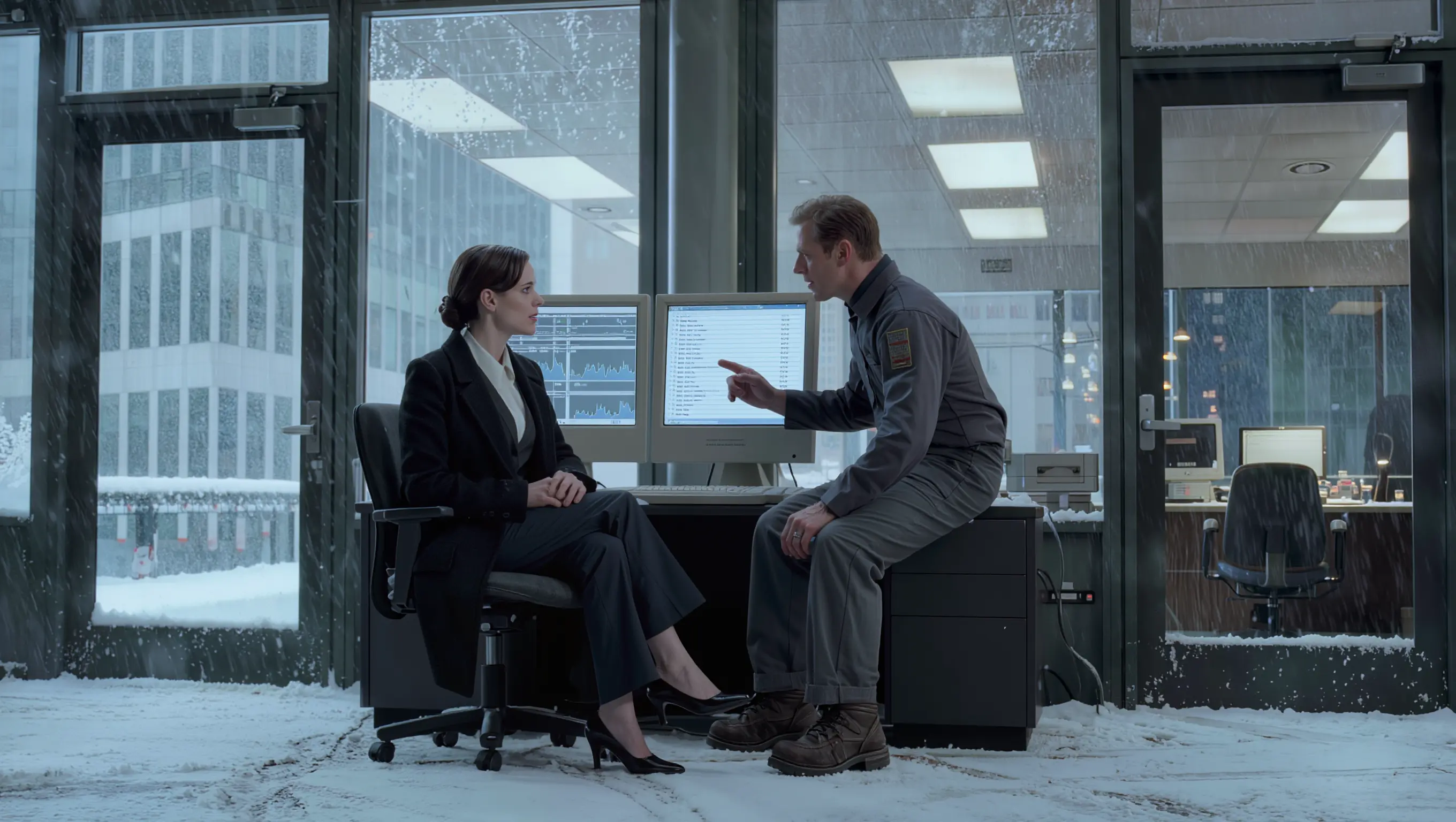
“Your CFO reports to the board,” he said, tapping the marker on Patricia’s name. “If she’s compromised, who on the board would know?”
“The audit committee. Gerald Myers chairs it.”
“Same Gerald who led the charge to force you out tonight?”
Victoria felt something click into place.
“He pushed hardest. Wanted me gone immediately. Didn’t want to wait for investigation results.”
“Because investigation results might clear you.”
Ethan drew another arrow.
“If Gerald is part of this, he’d want you removed before you could defend yourself. Once you’re out, the narrative becomes disgraced CEO. And any defense you mount sounds like desperation.”
“But Gerald has been with me from the start. Series A investor. He believed in the company when no one else did.”
“People change.”
“Or maybe he didn’t change,” Ethan said. “Maybe he was always planning this. Patient predator. Wait until the company is valuable enough, then take it.”
Victoria looked at the diagram Ethan had drawn.
It was frighteningly plausible.
A long plan, years in the making.
She had been so focused on building, on growing, on innovating, that she had never considered someone might be building a trap around her.
“I sound paranoid,” she said.
“You sound analytical. There’s a difference.”
She sat back down on the floor, suddenly exhausted again. The brief surge of purpose was fading, replaced by the overwhelming scale of what she was up against.
“Even if I’m right, how do I prove it? They have the company, the resources, the lawyers. I have a whiteboard and two hundred dollars.”
Ethan sat down across from her.
“You also have expertise they don’t know you’ll use. They think you’re broken, in hiding, probably drunk in some hotel room. They’re not expecting you to fight back.”
“I’m not sure I have the energy to fight back.”
“You do. You just used the last hour building a case. That’s not the behavior of someone who has given up.”
Victoria looked at the whiteboard, at the timeline, names, and arrows. It looked like the kind of investigative work she used to do in the early days, piecing together market opportunities, finding patterns in chaos.
She had forgotten she could think like this.
“Help me,” she said quietly.
Ethan met her eyes.
“What?”
“Help me investigate this. You see patterns. You think structurally. I need that.”
“I’m a janitor, Victoria. I push a mop. I’m not a forensic analyst.”
“You were an aerospace engineer who analyzed structural failures. This is the same thing, just applied to corporate structure instead of airplane wings. Please.”
Ethan was quiet for a long moment.
Outside, the wind rattled the windows. The building creaked.
Finally, he extended his hand.
“Okay. But I’m not doing this for you.”
“Then who?”
“For every person who ever got destroyed by someone more powerful and didn’t have the resources to fight back. For my wife, who died while her brother’s creditors came after me. For everyone who got hurt by a system that protects the people at the top.”
He held her gaze.
“I’m doing this because I want to see the powerful held accountable for once.”
Victoria took his hand and shook it.
His grip was firm, calloused, real.
They had an alliance.
Unlikely.
Unequal.
Unstoppable.
They worked through the night.
Ethan set a phone timer for his rounds. He still had a job to do, and between sweeps of the building, they reconstructed Victoria’s last six months. She talked through every major decision, every board meeting, every transaction she could remember.
Ethan took notes on cleaning supplies inventory sheets, the only paper available, organizing information into categories.
Around one a.m., Victoria’s phone finally regained signal. It immediately exploded with notifications, texts, voicemails, and emails.
She scrolled through them with growing detachment.
“Anything useful?” Ethan asked, returning from his two a.m. floor check.
“My lawyer wants fifty thousand dollars as a retainer. My publicist wants to schedule a crisis management session at three thousand per hour. My accountant says the IRS is freezing additional assets.”
She set the phone down.
“Everyone wants money I don’t have to solve problems I didn’t create.”
“What about friends? Real ones?”
Victoria scrolled through her contacts.
Hundreds of names.
Business contacts. Investors. Conference connections.
She could not remember the last time she had called someone just to talk. The last time someone had called her for a reason other than business.
“I don’t think I have friends,” she admitted. “I have networks.”
“Networks fail,” Ethan said. “Friends don’t.”
“Easy to say when you have them.”
Ethan pulled out his own phone and showed her his contacts.
Maybe thirty names.
“My son’s daycare. The guy at the corner store who lets me buy diapers on credit when I’m short. The woman at the shelter who still checks in on Marcus. The maintenance supervisor who gave me this job. That’s my network. Small but real.”
Victoria felt something twist in her chest.
Envy, maybe, or grief for something she had never built.
She had been so focused on professional connections that she had forgotten to build personal ones. And now, in her moment of crisis, she was utterly alone.
Ethan must have seen it on her face.
“Hey,” he said. “You’re building one right now. Networks start with one person. Right here. Whiteboard and bad coffee in a snowstorm. This is how it begins.”
She nodded, not trusting herself to speak.
They returned to the investigation.
Ethan found an old laptop in the lost and found, unclaimed for six months, which meant it was technically salvage. He booted it up. Basic model, slow but functional.
Victoria logged into a backup email account she had created years ago and rarely used. From there, she accessed a document storage system the investigators probably did not know about.
“I’ve got financial statements,” she said, downloading files.
They spread papers across the lobby floor, creating a timeline of trades, board meetings, and stock movements. Ethan cross-referenced the dates with Victoria’s travel calendar.
A pattern emerged.
Every suspicious trade had been authorized while Victoria was out of the country, always on days when she had scheduled calls with the CFO.
“Patricia knew exactly when you’d be signing documents remotely,” Ethan said. “She probably sent you legitimate approvals mixed with fraudulent ones. You’re reviewing twenty documents at midnight after a fifteen-hour flight. You’re not going to catch one fake transaction.”
“But my digital signature should require two-factor authentication.”
“Unless someone in IT disabled it for efficiency. Happens all the time in corporations. Security versus convenience. Convenience usually wins.”
Victoria pulled up her IT request history.
There it was.
A ticket from November filed by Patricia Chen requesting streamlined approval processes for executive transactions, approved by David Rosenberg, the chief compliance officer.
“They coordinated this,” Victoria said.
“Looks like it. But why? What’s their endgame?”
Victoria kept digging. She found board meeting minutes from December, a closed session she had not been invited to.
The topic: leadership succession planning.
Her stomach dropped.
“They were planning this before the trades even started. They were building a case for my removal.”
Ethan read over her shoulder.
“Based on what? Erratic behavior? Poor judgment? Emotional instability?”
Victoria felt rage building.
“They manufactured evidence. Every decision I made that they questioned, every strategic pivot they disagreed with, they documented it all as proof of incompetence.”
“While simultaneously undermining you with fraudulent trades,” Ethan said. “A two-pronged attack.”
“Destroy my credibility internally with the board. Destroy the company’s value externally with market manipulation. By the time it all came together, I had no defense.”
She kept scrolling through documents.
Then she found it.
A stock purchase agreement dated three weeks earlier.
Gerald Myers and Patricia Chen, along with three other board members, had formed an investment group. They had secured a credit line from a hedge fund, two billion dollars to acquire Hale Industries stock in the event of a market disruption.
“They’re buying the company,” Victoria whispered. “They tanked the stock price, forced me out, and now they’re buying controlling interest for a fraction of what it’s worth.”
Ethan let out a low whistle.
“That’s not just fraud. That’s corporate piracy.”
Victoria felt light-headed.
The scope of the betrayal was staggering.
People she had made wealthy. People she had trusted. People she had considered mentors.
They had been planning her destruction for months, maybe years, and she had never seen it coming.
“I need to report this to the SEC,” she said.
“With what evidence? Documents you accessed from a personal backup that they’ll claim you fabricated? You’re already under investigation. This could look like you’re deflecting.”
“Then what do I do?”
Ethan stood and walked to the window. Dawn was maybe two hours away, though the sky was still black with storm clouds.
“You need someone with credibility to verify this independently. Someone who can’t be accused of being in your pocket.”
“Like who?”
“A forensic accountant who doesn’t work for any party involved. Or a cybersecurity firm that can trace the digital signatures and prove they were spoofed. Someone neutral.”
“That costs money I don’t have and time I definitely don’t have. They’re probably moving to finalize the purchase right now.”
Ethan turned back to her.
“Then we need to make noise. Loud enough that someone with authority pays attention before it’s too late.”
“The media?”
“Risky. They’ve already painted you as guilty. Going to them now could backfire.”
Victoria felt the walls closing in again. Every path forward seemed blocked. She had evidence but no credibility. She had truth but no platform. She had rage but no power.
Then she remembered something.
A card in her wallet.
A woman she had met at a conference eight months ago: Sarah Brennan, investigative journalist for the Chicago Tribune. They had talked about corporate accountability, about the way white-collar crime got buried in complexity.
Sarah had said, “If you ever see something that needs exposing, call me.”
Victoria had kept the card because Sarah had been real, unimpressed by wealth or status.
At the time, she had thought she would never need it.
Now it might be her only option.
She pulled out her wallet and found the card.
“You trust her?” Ethan asked.
“I trust that she wants the truth. Right now, that’s the best I’ve got.”
Victoria pulled out her phone and drafted an email. She attached the stock purchase agreement, the IT request timeline, and the board minutes.
She wrote a single line.
They destroyed my company to steal it. I have proof. Will you investigate?
She hit send before she could second-guess herself.
“Now what?” Ethan asked.
“Now we wait for dawn.”
The snow stopped at 5:47 a.m.
Victoria knew because she had been watching the clock on the lobby wall, watching each minute pass with excruciating slowness. The silence when the wind finally died was startling. After hours of howling, the sudden stillness felt unnatural.
Ethan had finished his shift at six but stayed.
They had moved from the floor to the benches, backs against the cold marble, papers and notes spread around them like debris from a shipwreck.
Victoria’s phone was at three percent battery. She turned off everything except email, waiting for Sarah Brennan to respond.
“You should go home,” Victoria said.
“Daycare doesn’t open until seven. Marcus is with my neighbor until then. I’ve got time.”
“Your neighbor watches him all night?”
“She’s a nurse. Works days. I watch her daughter after school. We trade off.”
Victoria thought about the complexity of that arrangement. The trust required. The mutual dependence. It was so far from her experience of hiring full-time nannies and household staff that it might as well have been a foreign country.
“That sounds hard,” she said.
“It’s efficient. And her daughter and Marcus are good together. They’re building a network.”
He smiled slightly.
“Starts young.”
Through the windows, the city was emerging from the whiteout. The snow had stopped, but what it left behind was staggering. Drifts reached halfway up parked cars. The street was invisible beneath a smooth blanket of white.
A few early plows were out, blades scraping, but it would be hours before the roads were passable.
Victoria’s phone buzzed.
Email notification.
She grabbed it.
Sarah Brennan.
Holy hell. I’m looking at this now. Can you verify authenticity of these documents? Need on-record confirmation before I run anything. Call me.
Victoria stood, suddenly energized.
“What did she say?” Ethan asked.
“She wants verification. She’s interested.”
“That’s good. That’s a start.”
Victoria dialed the number on Sarah’s card. It rang three times, then connected.
“This is Sarah.”
“It’s Victoria Hale. You got my email.”
“I did. And if these documents are authentic, this is one of the biggest corporate fraud stories I’ve ever seen. But I need to verify. Can you give me access to the original files?”
“They’re on a secure server. I can grant you temporary access, but you need to move fast. Once they realize I’m investigating back, they’ll lock everything down.”
“Send me the credentials. I’ll have our tech team pull everything within the hour. But Victoria, I need you to understand. If this goes to print, you’re going to be in the center of a firestorm. Federal investigations, lawsuits, media circus. Are you prepared for that?”
Victoria looked at Ethan.
He nodded.
“I’m already in a firestorm,” she said. “Might as well be the one who started it.”
“Okay,” Sarah said. “Send me everything you have. I’m calling my editor now.”
The call ended.
Victoria sent the server credentials and her access passwords.
She was burning her last bridge, but bridges to nowhere were not worth preserving.
“Now we really wait,” Ethan said.
The sun started to rise around seven. Not a dramatic sunrise. The sky simply shifted from black to gray to pale blue. But the light on the snow was blinding, turning the city into a landscape of diamonds.
Victoria walked to the window and pressed her hand against the glass. It was cold enough to sting.
Behind her, Ethan’s phone rang.
He answered, spoke quietly, then hung up.
“I need to go get Marcus,” he said. “Are you going to be okay here?”
“I don’t know where else to go. My apartment is twenty blocks. The roads aren’t clear.”
“You could come with me. It’s not far. Walking distance.”
Victoria hesitated.
The idea of meeting his son, of intruding on his real life, felt like crossing a line. But staying alone in this lobby felt worse.
“Are you sure?”
“Yeah. Come on. You need real coffee anyway. The vending machine stuff is toxic.”
They bundled into their coats and stepped outside. The cold hit like a wall, stealing breath. The snow was knee-deep in places. They walked slowly, deliberately, Ethan breaking trail and Victoria following.
The city was eerily quiet. A few people were out digging cars from drifts, but mostly it was empty.
Peaceful.
Post-apocalyptic.
“When I was at my lowest,” Ethan said as they walked, “I used to imagine what it would feel like to just disappear. Drive somewhere no one knew me. Start over completely.”
“Why didn’t you?”
“Because Marcus deserved better than a father who ran away. And because I realized I wasn’t trying to escape my circumstances. I was trying to escape myself. That doesn’t work. Wherever you go, you bring yourself with you.”
They turned a corner.
A small apartment building came into view. Old brick. Three stories. Iron fire escapes.
Ethan led her to the side entrance and up two flights of stairs. The hallway smelled like coffee and something baking.
He knocked on a door marked 2C.
A woman in scrubs answered. Late fifties. Kind eyes. Tired smile.
“Right on time,” she said. “He’s been asking for you.”
A small boy appeared behind her, dark hair sticking up, wearing dinosaur pajamas. He launched himself at Ethan’s legs.
“Daddy!”
Ethan scooped him up, and Victoria watched his entire being transform.
The careful janitor, the analytical engineer, the wounded widower, all of it melted away, leaving just a father who had been away from his son too long.
“Hey, buddy. You have a good night?”
“We made pancakes and Miss Rose read three books.”
“Three whole books? That’s a lot.”
Marcus noticed Victoria for the first time.
“Who’s that?”
“This is my friend Victoria. She’s had a hard night. We’re going to have some coffee and talk. Can you play trains for a bit?”
Marcus considered this seriously, then nodded.
“Okay. But can we go to the park after? The snow looks really good.”
“We’ll see. Let’s get inside first.”
They thanked Rose and entered Ethan’s apartment.
It was small: one bedroom, living room, kitchenette. But it was warm, clean, and organized. Children’s drawings covered the refrigerator. A basket of toys sat in the corner. Books were stacked on every surface.
Marcus settled on the floor with a wooden train set.
Ethan made coffee in a French press, the ritual slow and deliberate. He handed Victoria a mug.
“It’s not fancy.”
“It’s perfect.”
They sat at a small table by the window. From there, Victoria could see the neighborhood: working-class, diverse, alive. People were emerging now, helping each other dig out, sharing shovels.
It was so different from her sterile high-rise, where she had lived for five years and never learned her neighbors’ names.
“I don’t know how to do this,” Victoria said quietly, so Marcus would not hear.
“Do what?”
“Survive without the structure. Without the title and the company and the identity I built. I feel like I’m falling, and I don’t know where the bottom is.”
Ethan sipped his coffee.
“The bottom is wherever you decide to stop. For me, it was the day Marcus smiled at me in that parking garage. I realized I could either keep falling or plant my feet. So I planted them.”
“And if I can’t find solid ground?”
“Then you build it. One decision at a time. You’ve already started. You investigated. You reached out to a journalist. You’re fighting back. That’s not falling. That’s climbing.”
Marcus brought over a train.
“Can you fix this? The wheel is stuck.”
Ethan took the train and examined it with the same focus he had applied to the corporate structure investigation. He found the issue, a piece of dust caught in the axle, and cleaned it out. The wheel spun freely.
“There you go. Good as new.”
“Thanks, Daddy.”
Marcus zoomed the train across the floor, making engine sounds.
Victoria watched this exchange and felt something shift inside her.
For twelve years, she had measured success in valuations, market share, and revenue growth. But this, a father fixing a toy for his son while morning light streamed through the window, was success too.
Different.
Quieter.
But no less real.
Her phone buzzed.
Sarah Brennan.
Documents verified. Story runs tomorrow morning. Front page. Brace yourself.
Victoria showed Ethan the message.
“You did it,” he said.
“We did it. I couldn’t have pieced this together without you.”
“So what happens now?”
“I don’t know. The story might change everything or nothing. But at least the truth is out there.”
They sat in comfortable silence, drinking coffee and watching Marcus play.
Outside, the neighborhood was coming back to life. People reclaiming their city from the storm. Victoria realized she was warmer than she had been in hours.
Not because of the apartment’s heat, but because of the presence of people who saw her as human, not as a scandal or a stock price.
“Thank you,” she said to Ethan. “For tonight. For this. For not looking away.”
“We don’t look away in this neighborhood,” he replied. “We show up for each other. That’s how we survive.”
Victoria stayed until Marcus’s daycare opened at 7:30. She helped Ethan get the boy dressed, watched him pack a lunch of string cheese and apple slices, and observed the morning routine of a single father.
It was choreographed chaos: shoes on, coat zipped, backpack checked.
But there was love in every gesture.
“Can Victoria come to the park later?” Marcus asked as they prepared to leave.
Ethan looked at her.
“That’s up to Victoria. She has some important things to do today.”
Victoria knelt to Marcus’s level.
“Maybe another time. But thank you for sharing your trains with me.”
Marcus hugged her spontaneously, a three-year-old’s enthusiastic embrace.
Victoria froze for a second, then hugged him back.
When had someone last hugged her without wanting something?
After they left for daycare, Victoria sat alone in the apartment.
She should go home and face whatever was waiting there.
But she was not ready yet.
Instead, she opened her laptop. Ethan had told her his Wi-Fi password and told her to take what she needed.
First, she drafted a statement for Sarah’s article. Clear, factual, unemotional. She outlined the fraud, the coordinated attack, the evidence. She did not play victim. She did not ask for sympathy.
She simply laid out the facts.
Then she started making a list.
What came next?
She could not run Hale Industries anymore. Even if the article cleared her name, that ship had sailed. But she had skills, experience, knowledge.
She could build something new.
Smaller, maybe.
But hers.
Around nine, her phone rang.
Her attorney finally getting through.
“Victoria, where the hell have you been? I’ve been trying to reach you all night.”
“I was busy.”
“What’s the status?”
“The SEC is expanding their investigation based on new information. Someone leaked documents about coordinated trading activity. Do you know anything about that?”
Victoria smiled.
“I might have shared some files with a journalist.”
“Jesus Christ, Victoria. That could be seen as obstruction.”
“Or it could be seen as whistleblowing. Depends on what the documents show.”
Her attorney was silent for a moment.
“What are we dealing with here?”
“Corporate conspiracy. Stock manipulation. Coordinated fraud by board members and executives. It’s all going to come out tomorrow.”
“You should have consulted with me first.”
“I should have done a lot of things differently,” Victoria said. “But I’m done asking permission. I’m going on offense.”
She hung up before he could argue.
Her phone rang again immediately.
A number she did not recognize.
She answered.
“Miss Hale? This is Detective Raymond Park with the FBI’s white-collar crime division. We’d like to speak with you about some documents that came to our attention this morning. Would you be willing to come in for an interview?”
Victoria’s heart raced.
“Am I under arrest?”
“No, ma’am. We’re just gathering information. But if you have evidence relevant to our investigation, we’d like to hear from you directly.”
“I’ll come in. But I want immunity for cooperation.”
“I can’t promise that right now. But if what you’re saying is true, we’ll work with you.”
They scheduled a meeting for that afternoon.
Victoria hung up and sat back, processing.
The FBI was involved now. This had escalated beyond a corporate scandal. People were going to face serious consequences, possibly including her, if they decided she had been complicit, even unknowingly.
But she had the truth.
And for the first time in her career, she was willing to bet everything on the truth being enough.
She borrowed a coat from Ethan’s closet and ventured back outside.
The walk to her apartment took forty minutes through snow-clogged streets. By the time she arrived, she was exhausted, freezing, and more determined than she had ever been.
Her apartment looked exactly as she had left it twelve hours earlier.
Spotless.
Expensive.
Empty.
She packed a bag with clothes and documents, grabbed her backup hard drives, and left.
She could not stay there.
Too many ghosts. Too much of the person she used to be.
Instead, she checked into a small hotel three blocks from Ethan’s apartment. Nothing fancy. Clean room, functional Wi-Fi, coffee maker. It cost sixty dollars a night, a fraction of what she used to spend without thinking.
But it felt right.
Appropriate for who she was becoming.
She spent the afternoon with the FBI, walking them through everything she had discovered. They recorded her statement, copied her files, asked detailed questions.
Detective Park was sharp, thorough, skeptical of everyone.
Victoria appreciated that.
“If this checks out,” he said at the end, “you might have just handed us the biggest corporate fraud case in Illinois in a decade. But I need to be clear. You’re not off the hook yet. We’ll need to verify your claims independently.”
“I understand. I’ll cooperate fully.”
That evening, back at the hotel, Victoria’s phone exploded with calls.
Her story was leaking ahead of the official publication. Business networks were picking it up. Social media was lighting up. The narrative was shifting from disgraced CEO to CEO whistleblower exposes board conspiracy.
One call stood out.
A venture capitalist she had met years earlier, someone who had passed on investing in her company initially.
“Victoria. I just heard. I’m sorry I didn’t reach out sooner. I should have known something was off.”
“It’s fine. I didn’t know either.”
“Listen, I know you’re in the middle of a storm, but when the dust settles, if you want to build something new, call me. Whatever you create next, I want in.”
Victoria was surprised to find the offer did not excite her.
A week ago, it would have validated everything.
Now it felt like noise.
“I appreciate that. Let me get through the investigation first.”
She hung up and looked out the hotel window.
The city glowed in twilight, lights reflecting off the snow. Somewhere out there, Ethan was probably making dinner for Marcus, reading bedtime stories, being present for the small moments that mattered.
Victoria realized she had spent twelve years chasing big moments: product launches, funding rounds, acquisition deals.
She had missed the small moments entirely.
And those were the ones that actually built a life.
She picked up her phone and texted Ethan.
Thank you for last night. For showing me what solid ground looks like. I’m going to build something on it.
His response came a minute later.
You already are.
The article ran two days later, front page, above the fold, with a headline that made Victoria’s chest tighten.
Tech billionaire exposes corporate coup. How board members orchestrated multi-billion-dollar theft.
Sarah Brennan had done thorough work. She verified every document, interviewed anonymous sources within Hale Industries, and traced the money flow from the hedge fund to the conspirators.
The story was devastating.
By noon, three board members had resigned. By evening, the SEC had frozen the stock purchase and launched a formal investigation into Gerald Myers and Patricia Chen.
Victoria watched it unfold from her hotel room, eating takeout Chinese food and fielding calls from attorneys, journalists, and former colleagues.
Some apologized.
Some asked for comment.
Some only wanted to be on the right side of history now that the narrative had shifted.
She ignored most of them.
She had a different focus now.
Three weeks later, serious charges were filed. Gerald Myers, Patricia Chen, David Rosenberg, and two other board members were indicted on securities fraud, conspiracy, and wire fraud.
The evidence was overwhelming: emails, financial transfers, time-stamped access logs showing Patricia had used Victoria’s credentials to authorize fraudulent trades.
The trial would take months, maybe years.
But the public vindication was immediate.
Headlines now read:
Hale vindicated.
Board betrayal exposed.
Victoria’s frozen assets were released. Her reputation, while damaged, was being rebuilt.
But Victoria did not go back to Hale Industries.
The board offered.
The investors begged.
The employees petitioned.
She declined everything.
“I built that company once,” she told a reporter who asked why. “I don’t need to prove I can do it again. I need to prove I can build something different.”
What she built was smaller: a consulting firm that helped other companies identify internal fraud and structural vulnerabilities.
She hired Ethan as her first full-time engineer.
He was reluctant at first. He had grown comfortable with the janitor job, the predictable hours, the careful life he had rebuilt. But she convinced him.
“You told me skills don’t disappear,” she said. “Time to use them.”
They worked out of a shared office space in Ethan’s neighborhood. Marcus came by after daycare sometimes, doing drawings at a corner desk while Victoria and Ethan analyzed corporate structures for clients.
It was not glamorous.
The revenue was a fraction of what Victoria used to manage.
But it was real.
It was hers.
It was built on truth.
Six months after the snowstorm, Victoria sold her high-rise apartment and bought a three-bedroom townhouse two blocks from Ethan’s place.
She learned her neighbors’ names.
She helped shovel sidewalks after storms.
She started showing up to block parties, school fundraisers, and community meetings.
One Saturday morning, she met Ethan and Marcus at the park, the same park Marcus had wanted to visit the morning after the storm. It was spring now, snow long melted, flowers blooming in the beds along the path.
Marcus ran ahead to the playground. Victoria and Ethan walked slowly, coffee in hand, watching him play.
“You ever regret it?” Ethan asked. “Giving up the empire?”
Victoria thought about it.
“No. I regret building something that could be stolen that easily, but I don’t regret losing it. Turns out I needed to lose it to find this.”
“This?”
She gestured around: the park, the neighborhood, the ordinary Saturday morning.
“A life that is actually mine. Not a performance. Not a brand. Just real.”
Ethan nodded.
“Marcus asked me yesterday when you’re coming over for dinner again. He wants to show you his new train set.”
“Tell him tomorrow. I’ll bring dessert.”
They sat on a bench watching Marcus navigate the jungle gym with the careful concentration of a three-year-old testing his limits.
Victoria felt the sun on her face, warm after the long winter.
She thought about that night in the lobby, falling on ice, being caught by a man who had every reason to ignore her but chose to help instead.
“Can I ask you something?” Victoria said.
“Sure.”
“That night in the lobby, why did you really help me? You said it was paying forward what someone did for you, but there’s more to it, isn’t there?”
Ethan smiled slightly.
“You want the real answer?”
“Always.”
“I helped you because I saw someone who had forgotten she was human. You were so wrapped up in being a CEO, being a billionaire, being this public figure, that you had lost track of the person underneath. And I know what that’s like. After Rachel died, I got so consumed by grief and logistics and survival that I forgot I was still Ethan, not just a widower, not just a father. Still me.”
He looked at her.
“I thought maybe if I could remind you that you were still Victoria, you’d remember how to save yourself.”
Victoria felt tears prick her eyes.
“I think it worked.”
“Yeah,” Ethan said softly. “I think it did.”
Marcus ran over, demanding they come see how high he could swing.
They followed him, laughing, and Victoria pushed him on the swing while Ethan stood nearby, ready in case the little boy leaned too far.
It was so ordinary.
So small.
So perfect.
That evening, back at her townhouse, Victoria opened her laptop.
She had been working on something for weeks, a framework for identifying corporate fraud early, before it spread too deeply to control. She would be presenting it at a conference next month, not as a disgraced CEO making a comeback, but simply as Victoria Hale: consultant, survivor, human.
Her phone buzzed.
A text from Ethan.
Marcus wants pancakes tomorrow. You in?
She smiled and typed back:
I’m in.
Outside her window, the neighborhood was settling into evening. Lights came on in windows. People came home. Dogs were walked. Children were called in for dinner.
It was the rhythm of ordinary life, the kind Victoria had spent twelve years missing while she chased extraordinary success.
She had learned something in that snowstorm, in that lobby, on the worst night of her professional life.
Success was not never falling.
It was rising when the world thought you were finished.
It was knowing the difference between an empire and a foundation.
It was understanding that the people who catch you when you slip on ice are worth more than the people who only know you at the top.
Winter does not last forever.
But the lessons learned in the coldest nights stay.
They build you.
They become the foundation for everything that comes after.
Victoria closed her laptop and looked around her small townhouse.
No marble lobby.
No glass tower.
No empire.
Just a home.
Just a life.
Just enough.
And for the first time in twelve years, that felt like everything.