The morning sun came softly through the front windows of Maple & Finch Café, turning the wooden tables gold and warming the edges of a day that had barely begun.
Outside, the streets of Portland were already awake. Cars rolled through wet intersections. Bicycles flashed past in bright jackets. Office workers hurried beneath umbrellas with paper cups in hand, their eyes on the clock and their minds somewhere ahead of their bodies.
Inside the café, everything moved quickly.
Steam rose from the espresso machine. Cups clicked against saucers. The line stretched nearly to the door. People spoke over one another, shifting forward inch by inch, eager for caffeine and convenience.
Emily Hart stood at the back of that line with both hands wrapped around the strap of her purse.
She was twenty-eight years old, and she had spent most of her life learning how to appear calm in places that were not built for her.
Her silence was not the problem.
Emily had been deaf since she was three, after a fever left the world around her muted and distant. She had grown up with sign language, written notes, facial expressions, lips, gestures, and the careful observation of a woman who learned early that people often revealed their impatience before they revealed their kindness.
Being deaf was not her weakness.
Other people’s impatience was.
She had ordered coffee hundreds of times before. She knew how to do it. She kept a note typed on her phone in case the barista did not understand her voice or her signs. She knew how to point to the menu, smile politely, and make the transaction as simple as possible for everyone involved.
But some mornings, the world moved too fast.
Some mornings, courage wore thin.
That morning was one of them.
Emily had barely slept the night before. A freelance design project had kept her up past midnight. Then an email from a client arrived at dawn, full of last-minute changes and the kind of vague criticism that made her feel as if she had failed without knowing how. She left her apartment late, forgot her umbrella, and arrived at the café damp, tired, and already holding herself together by habit.
When it was finally her turn at the counter, the barista looked up quickly.
His lips moved.
Emily caught only part of it.
Something about “for here” or “to go.”
She lifted one finger, asking him to wait, then reached for her phone.
The phone slipped from her damp hand and hit the counter.
The people behind her shifted.
Someone sighed.
The barista glanced over her shoulder at the growing line. His mouth moved again, faster this time.
Emily’s heart began to pound.
She signed slowly.
I’m deaf. Please wait.
The barista’s face tightened in confusion.
“I’m sorry?” he said, louder.
Emily could read that much.
Louder did not help.
It never helped.
She tried to smile, but her mouth felt stiff. She unlocked her phone, opened the note with her coffee order, and turned the screen toward him.
Before he could read it, another customer leaned around her and said something to the barista. The barista looked from Emily to the customer, then back again, his expression caught between embarrassment and irritation.
The line behind her grew restless.
Emily felt every pair of eyes.
She knew those eyes.
Not cruel, exactly.
But heavy.
People wanted the inconvenience to move. They wanted the problem handled. They wanted her to become easy.
Her fingers tightened around the phone.
For one terrible second, the room blurred.
She was no longer twenty-eight in a Portland café. She was twelve years old at a school lunch counter while a cafeteria worker shouted a question she could not hear. She was seventeen at a job interview where the manager spoke slowly, exaggeratedly, as if deafness meant stupidity. She was twenty-four at a doctor’s office where the receptionist kept talking to her mother instead of to her.
The old ache rose.
The wish, small and shameful, that just once someone would see her struggle and not make her feel like she had caused it.
Emily lowered her hands.
She was about to step out of line and leave without ordering when she felt a gentle tug on her coat.
She turned.
A little girl stood beside her.
She could not have been more than eight years old. She had a bright pink backpack, rain boots with yellow ducks on them, and curly brown hair escaping from two uneven braids. Her face was full of open concern, the kind children have before the world teaches them to hide it.
The girl looked at Emily.
Then at the barista.
Then she turned and tugged on the apron of the man standing beside the pickup counter.
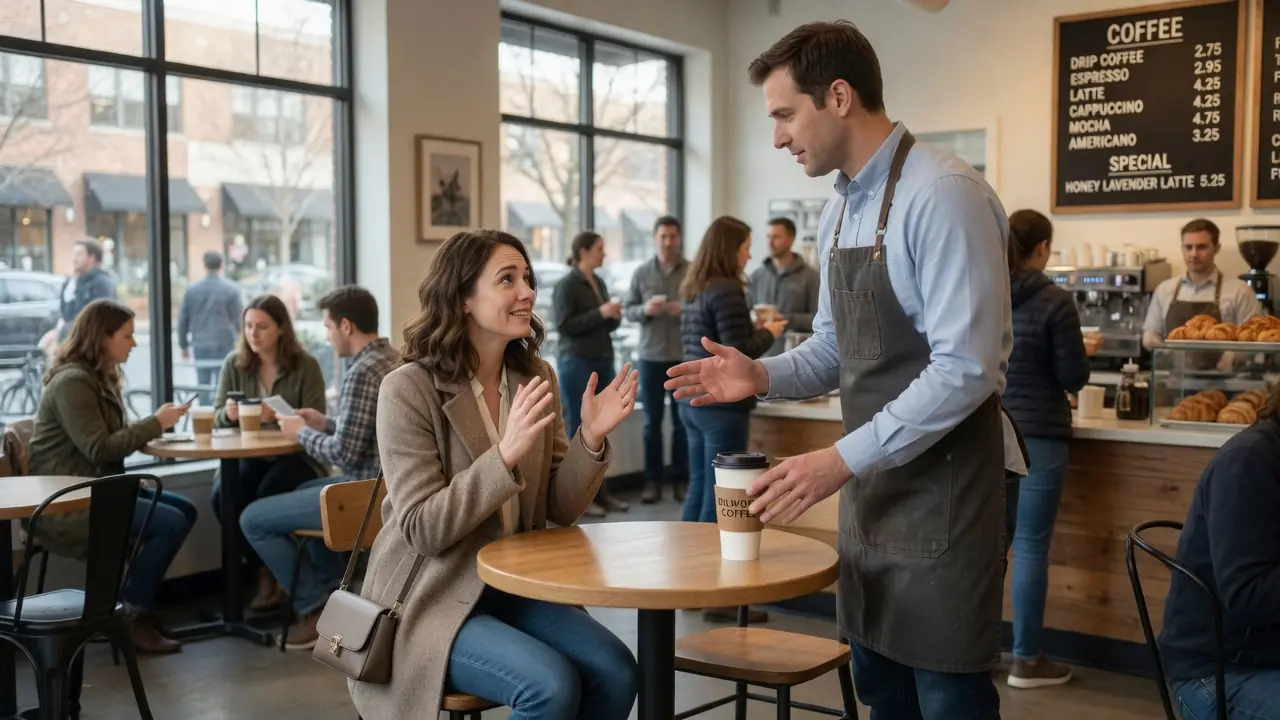
He was tall, perhaps mid-thirties, with kind brown eyes, rolled-up sleeves, and a gray café apron tied at his waist. His dark hair was slightly messy, and there was flour on one shoulder, as if he had come from the kitchen instead of the counter.
The little girl pointed toward Emily.
The man’s eyes followed.
Emily braced herself.
But he did not look annoyed.
He did not look confused.
He simply stepped closer, gently moved beside the barista, and lifted his hands.
His fingers moved slowly.
Clearly.
Gracefully.
Good morning. What would you like to order?
Emily stopped breathing.
For a moment, she wondered if exhaustion had made her imagine it.
Then he signed again.
It’s okay. Take your time.
Her chest tightened so suddenly that she nearly forgot how to answer.
She signed back with trembling hands.
Iced vanilla latte. Oat milk. Medium. Thank you.
The man nodded, then turned to the barista and spoke the order aloud.
“Medium iced vanilla latte with oat milk.”
The barista blinked, then hurried to enter it.
Emily signed, Thank you.
The man smiled.
Not the big, self-congratulatory smile of someone pleased to be seen helping.
A quiet smile.
You’re welcome.
The little girl beamed as if she had just helped rescue a kingdom.
Emily looked at her and signed, Thank you too.
The girl’s eyes widened.
Then, clumsily but enthusiastically, she signed back.
You’re welcome.
The movement was not perfect.
It was beautiful anyway.
The man noticed Emily’s expression and smiled a little more.
“She’s learning,” he signed. “She corrects me more than I correct her.”
The girl pointed at herself proudly.
Emily felt something warm press behind her eyes.
Not sadness.
Relief.
The relief of being understood before she had to explain why she deserved patience.
The man tapped his chest lightly.
I’m Noah.
Then he touched the little girl’s shoulder.
This is Lily.
Emily signed her own name.
Emily.
Lily repeated it with her fingers, careful and serious.
Emily.
The barista set the drink on the counter a minute later. Noah picked it up, checked the label, and handed it to her himself.
Have a good day, he signed.
Emily wanted to say more.
She wanted to tell him that he had changed something heavy inside her morning. That she had been about to leave. That a simple order had begun to feel like proof she did not belong in the world, and then he had stepped forward and opened a door.
But there were people behind her.
And sometimes gratitude was too large to fit into a public moment.
So she signed only, Thank you. Really.
Noah’s expression softened.
I understand.
Emily left the café with her coffee warming her hand and her shoulders lighter than they had been when she walked in.
Outside, the rain had stopped.
The sidewalk shone silver beneath the morning light. People hurried past her in both directions, unaware that something important had happened inside a little café with fogged windows and wooden tables.
Emily walked two blocks, then stopped at a bench beneath a maple tree.
She sat down and took a slow sip of her drink.
It tasted ordinary.
Sweet.
Cold.
Exactly what she had ordered.
That was the miracle of it.
She watched the café doors from across the street. A few minutes later, Noah came out with Lily beside him. Lily skipped over puddles while holding his hand. Noah carried a paper bag and looked down every few steps to make sure her boots landed safely.
Emily wondered how he had learned sign language.
Maybe someone in his family was deaf.
Maybe he had taken classes.
Maybe he had simply cared enough to learn something that most people ignored.
Whatever the reason, he had not treated it like a performance.
That stayed with her.
For the rest of the day, she kept thinking about Lily’s small hand tugging on his apron.
A child had seen her.
Before anyone else did.
Three days later, Emily went back to Maple & Finch.
She told herself it was only because the coffee had been good.
That was not entirely true.
This time, Noah was behind the counter, arranging pastries in the display case. When he looked up and saw her, recognition lit his face.
Emily, he signed.
The fact that he remembered her name struck her harder than expected.
Noah, she signed back. Lily?
School, he signed. She was very sad to miss you.
Emily smiled.
The morning rush had not started yet, so there was no line behind her. Noah came around the counter and gestured toward a table near the window.
Coffee?
Yes, please.
Same order?
She laughed silently.
Yes. You remember?
He signed with a straight face, I’m a professional.
Emily took a seat while he made the drink himself.
When he brought it over, he set it down carefully.
On the cup, written in black marker, was her name.
EMILY
No misspelling.
No awkward label.
Just her name.
She touched the cup with her fingertips.
Then she looked up and signed, Your sign is very good.
Noah sat across from her, though he glanced toward the counter to make sure the other barista had things handled.
Thank you. My sister was deaf.
Emily’s smile softened.
Was?
Noah looked down briefly.
She passed away six years ago.
Emily’s hands stilled.
I’m sorry.
His fingers moved slower now.
Her name was Anna. She hated when people ignored her. I hated it too. So I learned.
Emily nodded.
What happened?
Noah hesitated, not because he seemed unwilling to answer, but because the answer still had weight.
Cancer, he signed. Fast. Lily was only two. Anna was her mother.
Emily looked toward the pastry case, then back at him.
Your daughter?
My niece, he signed. But yes. My daughter now.
That explained something.
The tenderness.
The tiredness around his eyes.
The way Lily had looked at him not just as a parent, but as a safe place.
Noah continued.
Anna made me promise Lily would know sign. She said even if Lily could hear, she should grow up knowing silence isn’t empty.
Emily swallowed.
Your sister was right.
He smiled sadly.
She usually was.
Customers began coming in then, and Noah stood.
I should work.
Emily nodded.
Thank you for telling me.
He looked at her for a moment.
Thank you for listening.
After that, Emily returned often.
At first, once a week.
Then twice.
Sometimes Lily was there before school, sitting at a corner table with crayons and a muffin, practicing signs from a children’s book. Whenever she saw Emily, she waved wildly.
Emily began teaching her little phrases.
Good morning.
Purple backpack.
Too much sugar.
Lily loved that one and used it constantly, especially when Noah gave her hot chocolate.
Noah and Emily’s conversations grew slowly, in the spaces between customers and quiet mornings.
He learned that she was a graphic designer who worked mostly from home. She learned that he owned Maple & Finch with a friend but ran most of the morning shifts himself because he liked knowing the people who came in. He learned that she loved old movie posters, rainy walks, and bookstores. She learned that he burned toast when distracted, hated olives, and carried guilt like some men carry wallets, always present even when hidden.
One morning, Emily arrived to find a small chalkboard near the register.
It read:
WE KNOW BASIC ASL. PLEASE FEEL WELCOME TO SIGN, POINT, WRITE, OR TAKE YOUR TIME.
Beneath the words was a small drawing of two hands forming the sign for coffee.
Emily stared at it.
Noah came from behind the counter, suddenly looking shy.
“Too much?” he signed.
Emily shook her head quickly.
Who made the drawing?
Lily.
The letters?
Me. But she supervised.
Emily pressed one hand to her mouth.
Noah’s expression changed.
Good or bad tears?
Good, she signed. Very good.
The sign changed the café.
Not overnight.
Not loudly.
But people noticed.
A college student came in and signed her order with shaking hands. An older man pointed to the board and wrote on his phone that his wife had lost most of her hearing and he wanted to learn. A teenage boy brought his younger brother, who was deaf, and for the first time the boy ordered his own cookie instead of having someone do it for him.
Noah asked Emily if she would be willing to teach a basic sign class at the café once a month.
She almost said no.
The old fear rose first.
Standing in front of people.
Being watched.
Being misunderstood.
But Lily sat across from her that afternoon, coloring a picture of three people under a sign that said Quiet Hands, Kind Hearts. One person had curly hair. One had an apron. One had dark hair like Emily.
When Emily pointed to the third person, Lily grinned.
That’s you.
Emily looked at the drawing for a long time.
Then she signed to Noah, I’ll teach one class.
One became three.
Three became every Thursday evening.
They pushed the tables together after closing. Noah brewed coffee. Lily handed out printed sheets. Emily stood at the front, nervous at first, then steadier, teaching signs for hello, thank you, help, patient, coffee, friend.
People came.
Not huge crowds.
Enough.
A mother with a deaf toddler.
Two nurses.
A librarian.
A bus driver.
A group of teenagers who wanted to learn because one of their classmates used sign language and they were tired of making him do all the work.
Emily watched hands move awkwardly, imperfectly, earnestly.
She watched people laugh at their mistakes and try again.
She watched a room become less impossible.
At the end of the fourth class, an older woman came to her with tears in her eyes. She signed slowly, haltingly.
Thank you. My husband deaf. I want talk.
Emily signed back, He will be happy.
The woman nodded, crying harder.
Noah watched from behind the counter.
Later, after everyone left and Lily had fallen asleep in a booth with her coat under her cheek, he handed Emily a cup of tea.
You changed this place, he signed.
She shook her head.
You started it.
Lily started it, he corrected.
Emily looked at the sleeping girl.
Yes. She did.
Noah leaned against the counter.
Anna would have loved you.
The words landed softly and deeply.
Emily looked at him.
I would have liked to meet her.
She would have asked too many questions.
Emily smiled.
I like questions.
Then she would have loved you more.
For a moment, neither moved.
The café was quiet around them. Rain tapped gently against the windows. The chalkboard sign glowed under the soft overhead lights.
Noah’s hands lifted, then hesitated.
Emily waited.
He signed slowly.
Would you have dinner with us Sunday? Lily has asked me five times. I have only wanted to ask once, but for much longer.
Emily felt warmth rise in her face.
With us?
With us, he confirmed. But also with me.
She looked at Lily asleep in the booth, then back at Noah.
Yes.
His smile came slowly.
Thank goodness. Lily made me promise not to be awkward.
Emily laughed.
You failed a little.
I know.
Sunday dinner became a regular thing.
Noah cooked badly but enthusiastically. Emily brought dessert. Lily set the table with mismatched plates and insisted everyone sign at dinner, even when speaking would have been faster.
Especially when speaking would have been faster.
Over time, Emily learned the shape of their home.
The shelf of Anna’s old books.
The framed photo of Lily’s mother near the hallway.
The kitchen drawer that stuck.
The little collection of seashells Lily believed were lucky.
She also learned that grief, in Noah’s house, had not been hidden away. Anna’s name was spoken. Her stories were kept alive. Lily knew she had been loved before and was loved still.
That mattered to Emily.
She had known too many people who treated loss like a room to lock.
Noah treated it like a table where everyone was allowed to sit.
Months passed.
Spring came to Portland with wet sidewalks, blooming trees, and longer evenings. Emily’s freelance work improved after Noah quietly recommended her to a friend who owned a nonprofit. She designed a full accessibility campaign, then another, then another.
Her confidence changed slowly.
Not because Noah saved her.
He did not.
But because he made room for her to stop bracing all the time.
One afternoon, almost a year after that first morning, Emily walked into Maple & Finch during the busiest hour of the day.
The line was long.
The café was loud.
The espresso machine hissed. Customers talked. Chairs scraped. Orders moved quickly across the counter.
Emily stepped into line.
Her heart still beat a little faster. Some old feelings never disappear completely.
But this time, when she reached the counter, the new barista looked up, smiled, and signed, Good morning. What would you like?
Emily blinked.
Across the room, Noah watched from behind the pastry case.
Lily, now nine, stood beside him wearing a tiny apron and a proud expression.
Emily ordered without typing.
Without pointing.
Without shrinking.
When she finished, the barista signed, Thank you.
Emily turned toward Noah.
He lifted one hand slightly.
Not taking credit.
Just present.
That evening, after closing, Noah walked Emily to the door. Lily was in the back, packing leftover muffins into a box for a neighbor.
Noah stopped beneath the café awning.
Rain fell softly beyond it, silver in the streetlights.
“This feels familiar,” Emily signed.
Noah smiled.
“Better weather than the first day.”
“Less panic.”
“Much less panic.”
He grew quiet.
Then he signed, I’m glad Lily saw you.
Emily’s throat tightened.
I’m glad too.
“I’m glad I learned to listen with my hands,” he signed. “But I’m more glad you let us know you.”
Emily looked through the café window.
At the chalkboard.
At the tables where people had learned to sign.
At the counter where she had once frozen, humiliated and ready to disappear.
That place no longer felt impossible.
It felt like proof.
A little girl had tugged her father’s apron.
A man had stepped forward.
A cup of coffee had become a doorway.
Emily turned back to Noah.
You didn’t just help me order coffee.
I know, he signed.
She raised an eyebrow.
He smiled.
I hoped.
She laughed silently, the kind of laugh that filled her whole face.
Noah reached for her hand slowly, giving her time to choose.
She chose.
Their fingers met beneath the awning while rain softened the city around them.
A year earlier, Emily had walked into that café feeling invisible. She had stood at the counter with trembling hands, surrounded by sound she could not enter, wishing someone would see her struggle and not simply stare.
Now, inside that same café, a child was packing muffins, a chalkboard welcomed people in more than one language, and a room full of strangers had learned that kindness did not need to be loud to be understood.
Sometimes the smallest gesture changes a life.
A hand tugging an apron.
A father stepping closer.
A sentence signed slowly.
Take your time.
That was where it began.
Not with grand speeches.
Not with rescue.
With patience.
With attention.
With one person meeting another halfway.
And in a noisy world, that was the kind of kindness Emily could hear clearly.