Fate rarely announces itself.
It arrives in ordinary moments that transform lives forever.
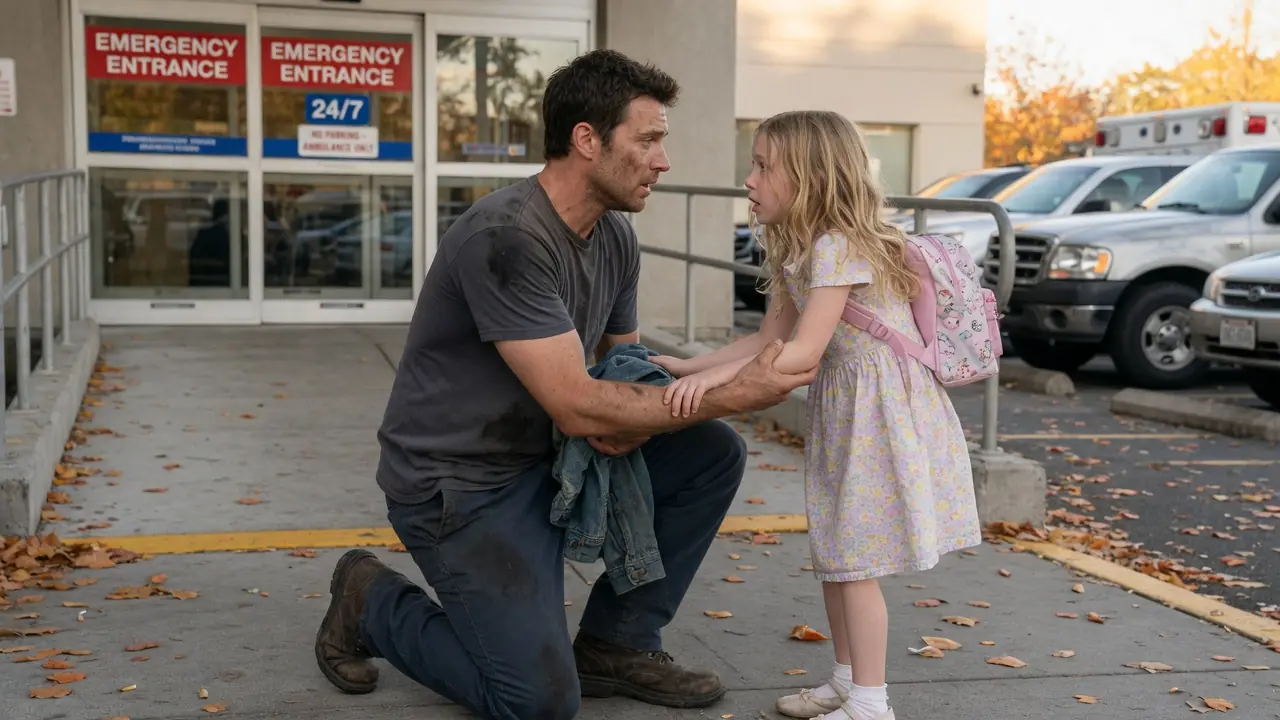
The moment Wesley Grant saw the little girl stumble outside the hospital entrance, something inside him shifted.
There was no time to think, only act.
His hands, calloused from years fixing engines, moved with the precision of his military medic days as he caught her slight frame before it hit the pavement.
The child’s blonde hair fell across her pale face, her breath coming in desperate, shallow gasps.
“Hey there, sweetheart,” he whispered, his voice steady despite the racing of his heart. “I’ve got you.”
As he lifted her into his arms and rushed through the hospital doors, Wesley could not have known that this single act of instinct would reconnect him with a forgotten past.
Or that the girl’s mother would soon recognize him from a night years ago that neither of them had truly forgotten.
The afternoon sun cast long shadows across the hospital parking lot as Wesley leaned against his weathered pickup truck.
His shift at the auto repair shop had ended early, grease still staining his dark gray T-shirt and work pants.
He checked his watch for the third time in five minutes, scanning the hospital entrance for any sign of his eight-year-old daughter, Maisie.
She was attending her monthly art therapy session inside, one of the few constants in their lives since her mother had walked out three years ago.
The autumn breeze carried the scent of antiseptic from the hospital’s ventilation system, mingling with the earthy smell of fallen leaves.
Wesley took a deep breath, savoring the moment of quiet before his evening of homework help, dinner preparation, and bedtime stories would begin.
It was then that he noticed her.
A small figure in a pastel floral dress, no more than seven or eight years old, struggling to walk along the pathway leading to the hospital entrance.
Something about her movements caught his attention.
The way her shoulders hunched forward.
Her hand clutching at her chest.
Her steps becoming increasingly unsteady.
Years of military medical training kicked in before conscious thought could form.
The little girl’s knees buckled, and Wesley was already sprinting toward her, covering the distance in seconds.
He reached her just as she began to collapse, catching her gently before she hit the ground.
Her skin felt cool and clammy against his arms, her breathing rapid and labored.
The small backpack she carried slipped from her shoulder, landing beside them on the concrete.
“Hey, sweetie, can you hear me?” Wesley asked, his voice calm despite the urgency of the situation.
The girl’s eyelids fluttered, but she could not seem to focus.
Wesley immediately recognized the signs of respiratory distress.
Without hesitation, he scooped her into his arms and rushed toward the emergency entrance, calling out as he pushed through the sliding doors.
“I need help here! Child in respiratory distress!”
The hospital staff responded instantly.
A nurse directed him to a treatment room while another grabbed an oxygen mask.
Wesley placed the girl gently on the gurney, explaining what he had observed.
“She collapsed outside. Breathing is shallow and rapid. Possible asthma attack. No ID on her that I could see.”
As medical professionals swarmed around the small patient, Wesley stepped back, his heart still pounding in his chest.
Pulling out his phone, he quickly sent a message telling her to wait in the lobby where they usually met.
His daughter would understand.
She always did.
Too much understanding for a child her age, he sometimes thought.
Sometimes her fright ate at her sense of safety, and sometimes the way she said good things turned heavy.
As he watched the doctors work on the little girl, he wondered who she belonged to, why she had been alone.
Was there a frantic parent somewhere nearby, unaware that their daughter was fighting for breath?
He could not leave.
Not until he knew she would be all right.
The emergency room doors burst open, and a woman rushed in, her heels clicking rapidly against the linoleum floor.
Even in her obvious distress, she commanded attention.
Tall.
Elegant.
Dressed in an impeccable white blazer and trousers that stood out starkly against the muted colors of the hospital.
Her blonde hair was pulled back in a tight bun, but a few strands had escaped, softening the sharp angles of her face.
“Clara!” she called out, her voice controlled but edged with panic. “My daughter was walking to her piano lesson. Someone called and said she was brought here.”
Wesley watched as a nurse directed the woman toward the treatment room where the little girl, Clara, was being attended to.
There was something familiar about her, though he could not place it.
Perhaps he had seen her picture in the local paper.
Or maybe she reminded him of someone from his past.
It was not until she turned slightly, her profile catching the fluorescent light, that recognition dawned.
Vivian Black.
The Vivian Black.
The CEO of the health care group that owned this very hospital.
Her face occasionally appeared on the local news when the hospital announced new initiatives or expansions.
But there was something else, something tugging at the edges of his memory that he could not quite grasp.
Their eyes met briefly across the busy emergency room, and for a moment, Wesley thought he saw a flicker of recognition in her gaze as well.
But it vanished as quickly as it had appeared, replaced by immediate concern for her daughter.
She disappeared into the treatment room, and Wesley found himself standing alone, suddenly aware of the grease stains on his clothes and the stubble on his jaw.
He felt distinctly out of place in the sterile environment, yet he could not bring himself to leave.
Not until he knew the little girl would be all right.
Twenty minutes later, Maisie found him still waiting in the emergency room.
His daughter’s curly hair bounced as she approached, her pink hoodie a splash of color against the drab hospital walls.
“Dad, what happened? You look worried.”
Her perceptive eyes scanned his face, reading the concern there as easily as she read her favorite books.
Wesley placed a hand on her shoulder, squeezing gently.
“There was a little girl who needed help, pumpkin. I just wanted to make sure she was okay before we left.”
Maisie nodded solemnly, accepting this explanation without question.
She had inherited his instinct to care for others, a quality that made him prouder than she would ever know.
As they turned to leave, the treatment room door opened and Vivian Black emerged, her posture noticeably more relaxed than when she had entered.
She paused when she saw Wesley, her professional mask slipping just enough to reveal genuine gratitude.
“The nurse told me what you did,” she said, her voice softer than he had expected. “Thank you for helping Clara. If you hadn’t been there…”
She left the sentence unfinished, the implications hanging in the air between them.
Wesley shrugged, uncomfortable with the praise.
“Anyone would have done the same,” he replied, though they both knew that was not necessarily true.
In a world where people often looked away from others in distress, his immediate response had been to help.
Vivian’s gaze shifted to Maisie, who was watching the exchange with curious eyes.
“Your daughter?” she asked.
Wesley nodded, placing a protective hand on Maisie’s shoulder.
“Yes, this is Maisie. We were just heading home.”
Something unreadable crossed Vivian’s face as she looked at the girl, a fleeting expression Wesley could not interpret.
“Clara has had asthma since birth,” she explained, as if feeling the need to offer some context. “She was supposed to wait for her driver to take her to her piano lesson, but she decided to walk on her own today. The doctor says she’ll be fine, but they’re keeping her overnight for observation.”
There was an awkward pause.
Neither adult quite sure how to end the conversation.
It was Maisie who broke the silence, looking up at Vivian with open curiosity.
“Is your daughter okay now? Does she like to draw? I go to art therapy here every month.”
The simple questions, asked with a child’s directness, seemed to soften something in Vivian’s demeanor.
“She’s feeling much better, thank you. And yes, Clara loves to draw. She’s quite talented, actually.”
Another pause.
Then Vivian extended her hand formally to Wesley.
“I’m Vivian Black. I don’t believe I caught your name.”
“Wesley Grant,” he replied, his calloused hand briefly enveloping her smooth one. “And we should get going. I’m glad your daughter is going to be okay.”
He gently guided Maisie toward the exit, feeling Vivian’s gaze following them until the automatic doors closed behind them.
As they walked to the truck, Maisie bombarded him with questions about Clara and her mother.
But Wesley found his thoughts drifting back to the strange sense of familiarity he had felt.
There was something about Vivian Black that nagged at his memory, something beyond her public persona as a successful CEO.
But for the life of him, he could not figure out what it was.
The following afternoon, Wesley was surprised to receive a call from the hospital.
Clara Black wanted to thank him personally for his help, and her mother was extending an invitation for dinner that evening.
Maisie, overhearing the conversation, immediately began pleading to go along.
“Please, Dad, I want to see if she likes the same books I do.”
Her enthusiasm was hard to resist.
And besides, Wesley was curious about the lingering sense of recognition he had felt.
Perhaps spending more time with Vivian would help him place the memory that kept dancing just beyond his reach.
The Black residence was not what Wesley had expected.
Located in an upscale neighborhood on the outskirts of town, the house was certainly impressive, a modern, two-story structure with clean lines and large windows.
But it lacked the ostentatious display of wealth he had anticipated.
As he and Maisie approached the front door, Wesley felt a nervous tightening in his stomach.
He had changed into his least-worn jeans and a button-down shirt that Maisie assured him looked “really nice, Dad,” but he still felt underdressed for the occasion.
Clara opened the door before they could ring the bell, her face lighting up at the sight of Maisie.
“You came!” she exclaimed, the enthusiasm in her voice a stark contrast to her pale appearance the day before.
She wore a light blue dress that made her look even more delicate, but her eyes sparkled with life.
Beside her stood Vivian, transformed from the harried mother of yesterday into a gracious host.
She had exchanged her power suit for a simple cream sweater and dark jeans, her hair loose around her shoulders.
The change made her seem younger, more approachable, and that nagging sense of familiarity grew stronger in Wesley’s mind.
Dinner was a surprisingly relaxed affair.
Wesley had expected formal dining and uncomfortable silences, but instead found himself seated at a kitchen island, watching as Vivian prepared a simple meal of pasta and salad.
The kitchen, like the rest of the house, was beautiful, but somehow lacking in warmth, as if it were a stage set rather than a lived-in space.
No children’s artwork adorned the refrigerator.
No family photos lined the walls.
The only personal touch was a single framed photograph on a side table showing Clara sitting at a piano, her small fingers poised above the keys.
While the adults prepared dinner, Clara led Maisie to her room to show her a collection of art supplies that would have made any child envious.
Their laughter drifted down the stairs, the sound seemingly out of place in the quiet house.
“Your daughter is very kind,” Vivian remarked, slicing tomatoes with precise movements. “She made Clara feel comfortable immediately.”
Wesley smiled, pride warming his chest.
“She’s always been good with people. Gets it from her mother, I guess.”
The moment the words left his mouth, he regretted them.
He rarely spoke of his ex-wife, especially to strangers.
But Vivian did not press for details.
Instead, she asked about his work, listening with genuine interest as he described his transition from military medic to auto mechanic.
“It’s not glamorous,” he admitted, “but it pays the bills and gives me the flexibility to be there for Maisie. After her mom left, that became my priority.”
Vivian nodded, her expression thoughtful.
“I understand. Clara is my priority too, though I don’t always manage the balance as well as I should.”
There was regret in her voice, a vulnerability that seemed at odds with her composed exterior.
As they sat down to eat, the girls chattered excitedly about a shared interest in astronomy.
Wesley found himself studying Vivian when she was not looking.
The way she tucked her hair behind her ear.
The slight furrow between her brows when she concentrated.
These gestures triggered something in his memory, like an echo from a distant canyon.
It was not until she mentioned her humanitarian work that the pieces began to fall into place.
“Before I joined the healthcare group, I spent some time with Doctors Without Borders in East Africa,” she said, responding to a question about her career path.
The words hit Wesley like a physical blow.
East Africa.
Seven years ago, he had been there too, serving as a medic with a military humanitarian mission.
The memories came flooding back.
A makeshift medical camp.
The relentless heat.
The desperate need that surrounded them.
And there had been a young doctor, blonde hair always pulled back in a practical ponytail, who worked tirelessly alongside them for several weeks.
He had admired her dedication, her quiet competence in the face of overwhelming challenges.
And then, one night…
“You were there,” he said quietly, the realization dawning in his eyes. “In Sudan, at the refugee camp outside Khartoum.”
Vivian’s hand froze midway to her glass, her eyes widening slightly.
“You were a military medic,” she replied, her voice barely above a whisper. “Staff Sergeant Grant. I remember now.”
The kitchen fell silent, the children’s chatter suddenly distant background noise as the adults stared at each other across the table, shared memories unspooling between them like an invisible thread.
They had shared one night together, a brief connection in the midst of chaos and suffering.
Neither had expected anything more.
Both understood the transient nature of their presence in that place, the unlikelihood of their paths ever crossing again.
The next morning, Wesley’s unit had been unexpectedly reassigned, and he had left without a proper goodbye.
In the years that followed, the memory had faded, buried beneath the layers of his subsequent life.
His marriage.
Fatherhood.
Divorce.
The daily struggle to rebuild a life centered around his daughter.
The meal continued, conversation turning to safer topics, but an undercurrent of tension now flowed beneath the surface.
After dinner, when the girls disappeared upstairs again, Wesley found himself drawn to the photographs on the living room wall.
Most were of Clara at various ages.
As a newborn.
Taking her first steps.
Sitting at a piano.
But one photograph, partially hidden behind the others, caught his eye.
It showed a group of medical volunteers standing outside a tent hospital, the dusty landscape of Sudan stretching behind them.
And there, side by side, though not touching, stood younger versions of himself and Vivian.
“I kept it as a reminder of that time,” Vivian said quietly, appearing beside him. “It was formative for me, in more ways than one.”
There was weight to her words, a significance that made Wesley turn to look at her directly.
The question must have been evident in his expression because she continued, her voice steady despite the emotion behind it.
“After that night, after you left, I discovered I was pregnant. Clara was born seven months later.”
The revelation hit him with the force of a physical blow.
Wesley staggered slightly, his hand reaching out to steady himself against the wall.
Clara was his daughter.
His child.
A daughter he had never known existed.
His mind raced through calculations.
The timing was right.
Clara was seven.
It had been just over eight years since his deployment to Sudan.
“Why didn’t you try to find me?” he asked, his voice hoarse with emotion.
Vivian’s laugh held no humor, only a tired resignation.
“With what information? I knew your first name, your rank, and that you were from somewhere in the Midwest. You were gone before I even knew I was pregnant. By the time I realized, your unit had been deployed elsewhere, and all my inquiries hit dead ends.”
She gestured toward the photograph.
“This was the only tangible proof I had that you even existed, that you weren’t just someone I had invented in the middle of that chaos.”
Wesley felt as though the room were spinning around him.
A daughter.
He had another daughter, and she had been right there in front of him, her small body cradled in his arms as he carried her into the emergency room.
Had some part of him sensed the connection?
Was that why he had been unable to leave until he knew she would be all right?
“Does she know?” he asked, the question barely audible.
Vivian shook her head.
“I’ve always told her that her father was a brave man who helped people, but that he couldn’t be with us. It wasn’t a lie. I just didn’t have the whole truth to give her.”
Upstairs, they could hear the girls laughing, the sound a stark counterpoint to the heavy silence that had fallen between the adults.
Maisie and Clara.
Half-sisters who had met by chance, drawn to each other without knowing the blood they shared.
The realization was overwhelming.
Wesley’s knees felt weak, and he sank onto the nearest chair, his head in his hands.
“I have a daughter,” he whispered, the words both a statement and a question. “I have a daughter I never knew about.”
Vivian sat beside him, her posture rigid despite the emotion in her eyes.
“I’m not expecting anything from you, Wesley. Clara and I have managed fine on our own. But when I saw you yesterday, when I realized who you were, I couldn’t let you walk away without knowing. It didn’t seem right.”
Her words were measured, controlled, but Wesley could sense the vulnerability beneath them.
She had built a life for herself and Clara, a successful one by any measure.
His sudden appearance threatened the careful equilibrium she had maintained.
“I would never have, if I had known…”
Wesley struggled to find the words.
Emotions tumbled over each other.
Anger at not being told.
Grief for the years lost.
Fear of what this meant for his life with Maisie.
And beneath it all, a strange growing sense of wonder.
Another daughter.
A child who carried his blood, his genes, a piece of himself in the world that he had not known existed.
“I want to be part of her life,” he said finally, the words emerging with certainty despite the chaos of his thoughts. “I don’t know how or what that looks like, but I can’t just walk away now that I know.”
Vivian nodded slowly, as if she had expected this response.
“We’ll need to be careful. Clara is sensitive, and there’s Maisie to consider as well. This affects her too.”
The mention of his daughter, his first daughter, the one he had raised from birth, brought Wesley back to the present reality.
How would Maisie feel about sharing him?
About suddenly having a half-sister?
The situation was complicated, fraught with potential for hurt feelings and confusion.
As if summoned by their thoughts, the girls appeared at the bottom of the stairs, Clara holding a drawing they had created together.
“Look, Mom. Maisie helped me draw a constellation map for my science project.”
The joy in her voice, the unconscious trust in her expression as she looked at her mother, made Wesley’s heart ache.
This child, his child, had grown up without him.
Had taken her first steps, spoken her first words, faced her first challenges, all without his presence or knowledge.
The loss felt tangible, a physical pain in his chest.
The evening ended with promises to meet again, careful words exchanged between the adults while the girls made plans for future playdates with the easy adaptability of childhood.
As Wesley drove home, Maisie chattering excitedly beside him about her new friend, he felt as though his life had split into a before and after.
Before, a single father doing his best to raise his daughter alone, finding his way day by day.
After, a man with two children.
One who knew him as her beloved father.
One who was a stranger to him, connected by blood but separated by years of absence.
Over the following weeks, Wesley struggled with the knowledge of Clara’s existence.
He met with Vivian several times, always in neutral locations, coffee shops, parks, to discuss how to proceed.
Maisie continued to develop a friendship with Clara, though neither girl knew yet of their true connection.
The more time Wesley spent around his newfound daughter, the more he saw himself in her.
The shape of her eyes.
The way she tilted her head when she was thinking.
Her quiet determination when faced with challenges.
Each similarity was both a gift and a reminder of what he had missed.
Vivian, for her part, maintained a careful distance.
She was unfailingly polite, even warm at times, but Wesley sensed her reservations.
She had built a life without him, had shaped Clara’s world according to her own vision.
His presence threatened to disrupt that carefully constructed reality.
“She asks about you,” Vivian admitted during one of their meetings. “She wants to know why you keep coming around. She’s perceptive. Always has been.”
The comment hung between them, an implicit question about their next steps.
Wesley sighed, running a hand through his hair.
“I think we need to tell them. Both of them. It’s not fair to keep this from Maisie either.”
The thought of that conversation filled him with dread.
How would his sensitive, sometimes insecure daughter react to learning she had to share her father?
Would she feel betrayed, replaced?
The possibility of hurting her was almost enough to make him reconsider his decision to be part of Clara’s life.
But the alternative?
Walking away from a child who was his responsibility, regardless of the circumstances of her conception, was unthinkable.
He was not that kind of man.
Could not be that kind of father.
“We’ll do it together,” Vivian agreed, surprising him with her solidarity. “This weekend. We’ll tell them together, and then we’ll answer whatever questions they have.”
As a united front.
The phrase stirred something in Wesley’s chest, a longing for connection, for partnership in the often lonely journey of parenthood.
The day of revelation arrived with clear skies and mild temperatures, a beautiful autumn day that belied the emotional storm brewing.
They gathered in Vivian’s backyard, the girls playing on a swing set while the adults prepared themselves for the conversation ahead.
When Vivian called them over, both children approached with curious expressions, sensing the importance of the moment.
Wesley found himself studying Clara’s face, seeing with new clarity the features she had inherited from him.
The shape of her chin.
The set of her shoulders.
“We have something important to tell you both,” Vivian began, her voice steady despite the tension evident in her posture. “It’s about how our families are connected.”
She looked to Wesley, inviting him to continue.
He swallowed hard, searching for words that would make sense to an eight-year-old and a seven-year-old.
Words that would cause the least pain.
“A long time ago, before either of you were born, Vivian Black and I met while we were both helping people in Africa. I was a medic in the army, and she was a doctor.”
The girls listened attentively, though Maisie’s brow furrowed in confusion.
“What does that have to do with us?” she asked, always direct, always cutting to the heart of matters.
Wesley took a deep breath, reaching for his daughter’s hand.
“Well, pumpkin, it turns out that Clara is my daughter too, which means the two of you are sisters. Half-sisters.”
The words hung in the air, momentous and irreversible.
Clara’s eyes widened, her gaze darting between the adults as if searching for confirmation.
“You’re my dad?” she asked Wesley, her voice small but steady. “The one who helps people?”
Wesley nodded, emotion closing his throat.
“Yes, I am. I just didn’t know it until recently. If I had known, I would have been here for you. I promise.”
The sincerity in his voice seemed to reach her, and she nodded slowly, processing this new reality with remarkable composure for a child her age.
Maisie’s reaction was less accepting.
She pulled her hand from Wesley’s, her expression shuddering.
“You’re her dad too? Does that mean you’re going to be with them now? Are you going to leave me like Mom did?”
The fear in her voice broke Wesley’s heart.
He reached for her again, but she stepped back, crossing her arms protectively over her chest.
“No, Maisie. Never. You are my daughter, and nothing will ever change that. I’m not going anywhere. We’re just expanding our family a little bit.”
The explanation did little to reassure her.
Tears welled in her eyes, and she turned and ran back to the house, slamming the door behind her.
Wesley moved to follow, but Vivian placed a gentle hand on his arm.
“Give her a minute,” she advised softly. “This is a lot to process.”
She turned to Clara, who was watching the scene with solemn eyes.
“How are you feeling, sweetheart? I know this is a big surprise.”
Clara’s response was thoughtful, measured in a way that reminded Wesley of her mother.
“I always wanted a dad,” she said simply. “And I like Maisie. But I don’t want her to be sad.”
The empathy in her voice, the concern for a girl she had just learned was her sister, touched something deep in Wesley’s heart.
This was his daughter.
Compassionate.
Thoughtful.
Brave in the face of change.
Pride mingled with regret as he realized all he had missed in her early years.
Inside the house, they found Maisie curled in a corner of the living room, her face buried in her knees.
Wesley approached carefully, sitting beside her without touching her.
“I know this is hard, pumpkin. And it’s okay to be upset or confused or angry. But I need you to know something important.”
He waited until she looked up, her eyes red-rimmed but dry now.
“You are the best thing that ever happened to me. You are my heart walking around outside my body. Nothing, not Clara, not anything, will ever change that.”
Slowly, cautiously, Maisie uncurled herself.
“Promise?” she whispered.
Wesley nodded, opening his arms.
She crawled into his embrace, small and vulnerable and trusting despite her fears.
Over her head, he met Vivian’s gaze.
She stood in the doorway, Clara’s hand in hers, watching the father-daughter reunion with an unreadable expression.
This was just the beginning, Wesley knew.
There would be more difficult conversations, more tears, more adjustments as they all learned to navigate this new, complex family dynamic.
In the weeks that followed, they established a tentative routine.
Clara and Maisie spent time together on weekends, sometimes at Wesley’s modest home, sometimes at Vivian’s more elegant residence.
The girls’ relationship evolved in fits and starts, moments of sisterly camaraderie interspersed with flashes of jealousy and uncertainty.
Maisie struggled with sharing her father’s attention, while Clara sometimes seemed overwhelmed by the emotional intensity of her newfound family connections.
Wesley and Vivian maintained a careful distance from each other, their interactions focused solely on the children.
Yet beneath the surface, an undeniable current flowed between them, a connection forged by shared responsibility, mutual respect, and the memory of a night long ago when, in the midst of suffering and hardship, they had found brief solace in each other’s arms.
Neither mentioned it.
Both were too concerned with managing the present situation to explore what might exist between them.
Then came the day that changed everything.
Vivian was in the middle of a critical board meeting when her phone rang.
Clara’s school was calling to report that her daughter was having a severe asthma attack.
The school nurse had administered her emergency inhaler, but it was not helping.
An ambulance had been called, but Clara was asking for her mother.
For the first time in her career, Vivian walked out of a meeting without explanation, her heart pounding with fear as she raced to her car.
In her panic, she found herself calling Wesley, her fingers dialing his number before conscious thought could intervene.
He answered on the first ring, and something in her voice must have conveyed the urgency of the situation because he did not waste time with questions.
“Where is she?” he asked, his voice calm and steady, a counterpoint to her rising fear. “I’ll meet you there.”
The simple assurance, “I’ll meet you there,” acted like an anchor in the stormy sea of her anxiety.
She was not alone in this.
For the first time since Clara’s birth, she was not carrying the weight of parenthood entirely on her own shoulders.
Wesley arrived at the hospital before the ambulance, his experience as a medic granting him a composure that Vivian envied as they waited together in the emergency room.
When Clara was finally wheeled in, small and frighteningly still on the stretcher, both adults moved forward simultaneously, each reaching for one of her hands.
“We’re here, sweetheart,” Vivian whispered, tears finally gathering in her eyes.