The ballroom went silent.
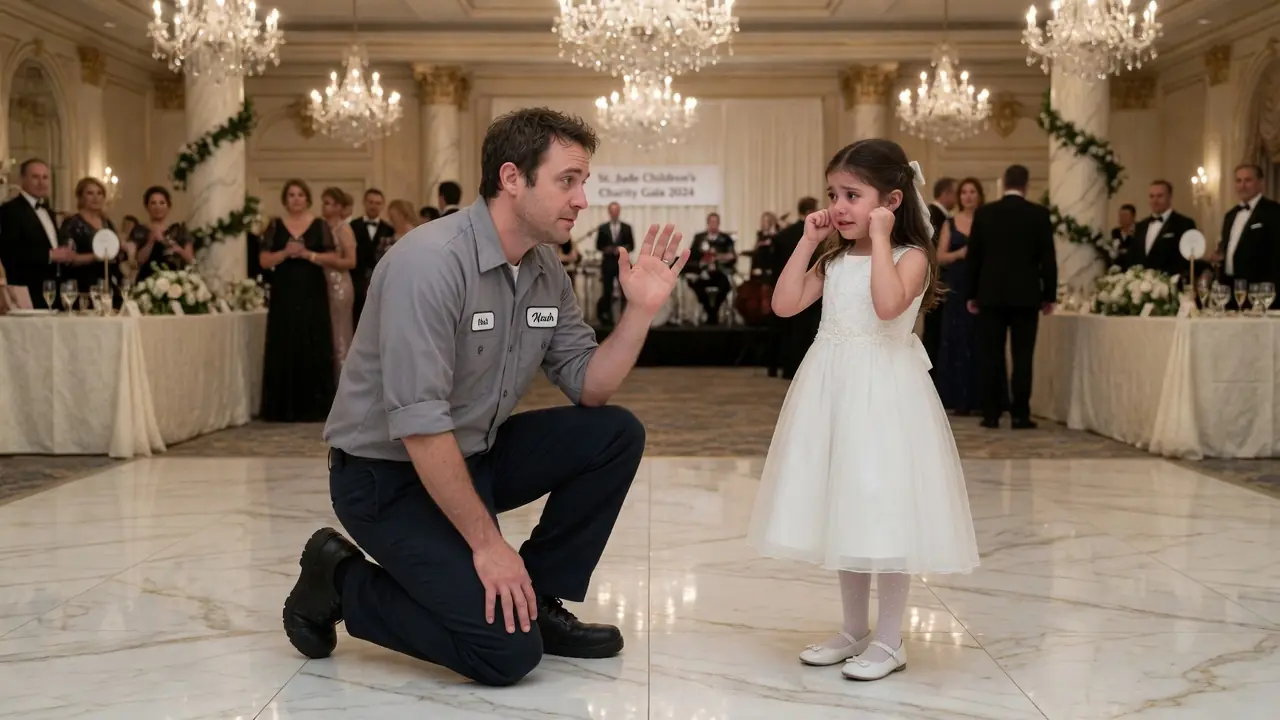
A little girl stood frozen in the corner, hands over her ears, eyes squeezed shut.
The music was too loud.
The lights were too bright.
The room was too crowded.
She was only eight years old, and she was terrified.
Her mother, Maya Solari, the CEO of Solari Corporation, rushed toward her in a silver evening gown, her face tight with panic.
Maya had faced investors, board members, hostile negotiations, and billion-dollar decisions without trembling.
But now, standing in front of her frightened daughter, she looked helpless.
“Ari, sweetheart,” Maya whispered, reaching out carefully. “Look at me, baby. It’s okay.”
But Ari pulled away.
Her small body shook.
Her hands pressed harder over her ears, and her breathing came fast and uneven.
Around them, guests began to whisper.
Crystal chandeliers glittered above polished marble floors.
Cameras flashed near the stage.
Investors in tailored suits stood with champagne glasses in their hands, pretending not to stare while staring anyway.
Nobody knew what to do.
Then a janitor stepped forward.
Noah Carter had been cleaning near the far side of the ballroom, invisible to everyone.
His gray uniform blended into the walls.
His cleaning cart sat beside a marble column.
His hands still smelled faintly of soap and floor polish.
To the guests, he was part of the background.
A man who pushed a mop.
A man who disappeared after the wealthy people finished celebrating.
But Noah saw what nobody else saw.
He saw a child drowning in sound, light, pressure, and fear.
He saw the rhythm of her rocking.
The way her feet tapped against the floor.
The way her eyes searched for the darkest corner of the room.
He had seen that look before.
His son Max used to do the same thing.
When the world became too loud.
When every noise felt like thunder.
When every stranger’s stare felt like a threat.
Noah set down his mop.
He did not walk straight toward Ari.
That would have scared her more.
Instead, he moved slowly to the side, staying where she could see him without feeling trapped.
Then he knelt on the marble floor.
A few guests gasped.
A janitor was kneeling in the middle of the company’s most important charity gala.
But Noah did not look at them.
His attention stayed on Ari.
He began to rock gently.
Left.
Right.
Left.
Right.
He matched Ari’s rhythm exactly.
Ari’s crying faltered for one second.
She noticed him.
Noah kept going.
He did not speak at first.
He did not demand that she calm down.
He did not reach for her.
He simply matched her rhythm, showing her without words that he understood.
Maya stood nearby, frozen between fear and hope.
She had spent years trying to protect Ari from moments like this.
Years arranging quiet rooms, avoiding noisy places, explaining her daughter’s needs to people who nodded politely and understood nothing.
But tonight, she had made a mistake.
She had brought Ari into the center of a crowded gala, hoping it would be fine.
Hoping her daughter could manage one important evening.
Hoping the world would be gentle.
It had not been gentle.
The DJ switched to a faster song.
The bass pounded through the speakers.
Colored lights flashed across the walls as part of the performance.
Ari screamed again.
It was not a tantrum.
It was not misbehavior.
It was a raw sound of terror.
A woman in diamonds whispered to her husband, “Why would Maya bring her here?”
Another voice said, “Clearly not equipped for public events.”
Maya’s face burned.
She kept one hand lifted toward Ari, but she did not dare touch her.
When Ari was overwhelmed like this, touch could make everything worse.
Maya knew that.
But knowing what not to do did not help her know what to do.
Ari dropped lower, curling against the wall.
One of the security guards stepped forward.
Maya turned sharply.
“Don’t touch her.”
The guard froze.
Richard Morrison, one of Solari Corporation’s most powerful investors, stood near the front of the crowd with a cold expression.
He had gray hair, sharp eyes, and the confident cruelty of a man used to being obeyed.
He leaned toward another board member and said loudly enough for others to hear, “If she cannot manage her family, how can we trust her with our investments?”
Maya went still.
Her jaw tightened.
The words struck harder than she wanted to admit.
She had fought so long to be respected.
Fought to be seen as more than a woman in power.
Fought to prove that motherhood did not make her weak.
And now, in one humiliating moment, Ari’s fear had become a weapon others could use against her.
Noah heard Morrison’s comment.
His chest tightened.
He knew that kind of judgment too.
He had heard strangers say similar things about Max in grocery stores, school offices, restaurants, and playgrounds.
Control your kid.
Teach him manners.
What kind of parent lets a child act that way?
Noah had once believed those voices.
That was the part that still hurt him.
Years ago, before he understood Max, he had thought discipline could fix everything.
He had tried harder rules, stricter routines, louder corrections.
He had tried to force Max into places Max was not ready to enter.
And every time, his son had suffered more.
It took Noah years to understand that Max was not refusing the world.
The world was overwhelming him.
Ari’s feet tapped faster now.
Her breathing turned shallow.
Her eyes darted toward the service hallway.
Noah noticed.
That hallway would be quieter.
Dimmer.
Fewer people.
But first, he had to help Ari trust him enough to move.
He lifted one hand slowly.
Up.
Down.
Up.
Down.
A smooth, predictable wave.
Not sudden.
Not demanding.
Just a visual rhythm she could follow.
Ari’s eyes fixed on his hand.
Her crying softened by a fraction.
Noah’s voice came barely above a whisper.
“You’re okay. The noise is loud, but you’re okay.”
He kept his tone steady.
Gentle.
Safe.
Ari uncurled slightly.
Noah extended his other hand, palm up.
An invitation.
Not a command.
He did not move closer.
He let the choice belong to her.
“You can follow me,” he whispered. “We’ll find quiet.”
The entire ballroom seemed to stop breathing.
Ari stared at his open hand.
At the calluses.
At the small scars.
At the hands of a man who worked for a living.
Then, slowly, her tiny fingers reached out.
They touched his palm.
Barely.
Like a bird landing on a branch.
Maya covered her mouth as tears spilled down her cheeks.
Ari did not let people touch her during meltdowns.
Not doctors.
Not therapists.
Not even Maya.
But this janitor, this stranger, had reached her.
Noah closed his fingers gently around Ari’s hand.
Carefully.
As if holding glass.
“There you go,” he said softly. “You’re safe. I’ve got you.”
He rose slowly, giving Ari time to adjust.
She stood with him.
Still crying.
Still overwhelmed.
But no longer alone.
Noah glanced at Maya and then toward the service hallway.
It was a silent question.
Maya nodded quickly.
She could not speak.
Noah led Ari toward the exit.
Her small hand stayed in his.
The crowd parted.
No one said a word.
Richard Morrison stood frozen, his mouth slightly open.
All the wealth, status, education, and influence in the room had failed to help one frightened child.
A janitor had done it.
Because he had seen Ari as a child, not a problem.
Maya followed behind them, her heart pounding.
She did not know who Noah Carter really was.
But she knew one thing.
He had just saved her daughter from a room full of people who had only known how to stare.
The service hallway was dim and quiet.
The thick door muffled the ballroom noise until it became a distant throb.
Ari’s breathing slowed.
Her grip on Noah’s hand loosened slightly.
Maya stood a few steps behind them, afraid to move too quickly.
Afraid to break whatever fragile connection had formed.
Noah knelt again, bringing himself to Ari’s level.
“The music was too loud, wasn’t it?” he asked softly.
Ari did not answer.
She did not look at him.
But she nodded.
Barely.
“That’s okay,” Noah said. “Sometimes the world is too loud. Too bright. Too much.”
His voice stayed low and steady.
Like a heartbeat.
“My son is like you. His name is Max. When things get too loud, he needs quiet. When things are too bright, he needs somewhere calm.”
Ari’s eyes flickered toward him.
Only for a second.
But Noah saw it.
“Max taught me something,” he continued. “He taught me that everyone has their own rhythm. Their own way of being in the world.”
He lifted his hand again and moved it in the same slow wave pattern.
“Some people like fast rhythms. Loud music. Big rooms. Lots of people.”
His hand moved a little faster, then slowed again.
“But some people need slower rhythms. Gentler sounds. Smaller spaces.”
Ari watched his hand.
Then one of her fingers moved.
She copied the pattern.
Noah smiled.
“That’s it. You’ve got your own rhythm, and it’s perfect.”
Maya pressed a hand against her chest.
For years, she had tried to help Ari fit into the world’s rhythm.
She had never considered that Ari’s rhythm might already be worthy.
Exactly as it was.
Noah stood slowly.
“Can I show you something?”
Ari looked uncertain.
But she did not pull away.
Noah began moving his feet in a simple pattern.
Left.
Right.
Left.
Right.
Nothing fancy.
Nothing fast.
Then he moved his hands up and down, matching the steps.
It was not exactly dancing.
It was more like a sequence.
Predictable.
Repeating.
Safe.
“This is how Max and I move together,” Noah explained. “We don’t dance like other people. We make our own dance.”
He extended his hand again, palm up.
“Want to try?”
Ari stared at his hand for a long moment.
Then she placed her hand in his.
Noah’s smile widened.
“Okay. Just follow my feet.”
Left.
Right.
Left.
Right.
He moved slowly.
Each step clear before he made it.
Ari watched his feet, then tried to copy.
Her movements were stiff at first.
Uncertain.
But she was trying.
“Perfect,” Noah said. “Now the hands.”
Up.
Down.
Up.
Down.
He raised their joined hands, lowered them, then raised them again.
Ari followed.
Her face became focused.
Concentrating.
They moved together in the quiet hallway to no music at all.
Just rhythm.
Just pattern.
Just connection.
Maya’s tears came freely now.
She had hired specialists.
Therapists.
Behavioral analysts.
Consultants with framed degrees and impressive offices.
She had spent hundreds of thousands of dollars trying to help her daughter.
And this man, who cleaned floors for a living, understood in five minutes what so many experts had missed.
Ari did not need to be fixed.
She needed to be met where she was.
After a few minutes, Ari’s movements became smoother.
More confident.
Then she smiled.
It was tiny.
Fleeting.
But real.
Noah saw it, and his heart swelled.
“You’re a natural,” he said. “Max would love to dance with you.”
Ari looked up at him.
“Max?”
It was the first word she had spoken all night.
Quiet.
Hesitant.
But there.
“My son,” Noah said gently. “He’s nine. He loves building patterns with blocks, drawing maps, and doing this exact dance we’re doing right now.”
Ari stared at him.
“Is he like me?”
Noah nodded.
“Yeah. Like you.”
Something shifted in Ari’s expression.
A small spark of recognition.
Maybe even hope.
She was not the only child in the world who felt too much.
There was another kid out there who understood.
Someone who moved through life in a similar rhythm.
Maya stepped forward slowly.
“Ari, sweetheart.”
Ari turned.
She saw her mother’s tear-streaked face.
For the first time that night, she did not pull away.
Instead, she let go of Noah’s hand and wrapped her arms around Maya’s waist.
Maya dropped to her knees and held her daughter tightly.
“I’m sorry,” Maya whispered. “I’m so sorry. I should never have brought you in there without preparing better.”
“Too loud,” Ari said against her mother’s shoulder.
“I know, baby. I know.”
Maya looked up at Noah through her tears.
“How did you know what to do?”
Noah’s expression softened.
“Because I’ve been where you are. Standing in a crowded place, watching my son suffer, not knowing how to help.”
He paused, remembering.
“Max was diagnosed with sensory processing disorder when he was four. His mother left us a year later. She said she couldn’t handle it.”
Maya’s heart ached for him.
“So it was just me and Max,” Noah continued. “And I had no idea what I was doing.”
He looked down at his hands.
“I tried everything. I forced him into social situations. Punished him for meltdowns. Thought I could discipline it out of him.”
His voice cracked slightly.
“I was wrong. I hurt him. I made everything worse.”
Maya listened without interrupting.
Noah looked at Ari, then back at Maya.
“Then one day, I stopped trying to change him. I started watching him instead.”
“Really watching.”
“Learning his signals. His patterns. His language.”
He swallowed.
“And I realized he had been trying to communicate with me all along. I just wasn’t listening.”
Maya wiped her eyes.
“How long did it take to learn?”
“Years,” Noah admitted. “I’m still learning every day.”
Then he smiled faintly.
“But the moment I stopped seeing his differences as problems and started seeing them as his way of being, everything changed.”
“Max is happy now. He has teachers who understand him, friends who understand him, and a dad who finally gets it.”
Maya stood slowly, keeping one arm around Ari.
“You’re not just a janitor, are you?”
Noah shrugged.
“I clean floors. That’s what my paycheck says.”
Then he smiled.
“But I’m also a dad. And that’s the job that taught me everything that matters.”
Behind them, the hallway door opened.
Richard Morrison stepped through.
His expression was unreadable.
Noah tensed, expecting criticism.
Expecting to be told to get back to work.
Expecting to be reminded that men like him did not interrupt men like Morrison.
But Morrison surprised him.
“Mr. Carter,” he said stiffly.
Noah straightened.
“Yes, sir?”
“I owe you an apology.”
Maya looked at him in surprise.
Morrison turned toward her.
“And Miss Solari, I owe you one as well.”
He looked at Ari, then lowered his gaze.
“I spoke without understanding. I judged without knowledge. That was wrong.”
Maya nodded once.
She still did not trust herself to speak.
Morrison cleared his throat.
“My grandson was just diagnosed with autism.”
The words seemed difficult for him.
“I have been struggling with it. Not wanting to accept it. Not knowing what to do.”
His voice roughened.
“But watching you with this child, the patience, the understanding, perhaps there is hope for him too.”
Noah met his eyes.
“There is always hope. It just has to look different than what you expected.”
Morrison nodded slowly.
For once, he had no sharp answer.
He turned and walked back toward the ballroom.
Maya watched him leave, then looked at Noah again.
Really looked at him.
“I want to hire you,” she said.
Noah blinked.
“I already work here.”
“Not as a janitor.”
Maya’s voice became firm.
“As a consultant.”
Noah gave a short laugh, startled.
“I’m not qualified for that.”
“You are the most qualified person I have ever met.”
Maya glanced down at Ari, who was still holding onto her dress.
“You just saved my daughter. You saved me from humiliating her further. You showed me what I failed to see.”
Noah shook his head.
“I only did what I would do for Max.”
“That is exactly why I need you.”
Maya took a breath.
“I want to create a program. For parents like us. Parents who love their children but don’t know how to reach them. Parents who are ashamed because the world tells them they should be. Parents who need someone to tell them their children are not broken.”
Noah stared at her.
The idea felt too large.
Too impossible.
He was a man who cleaned floors at night and packed school lunches in the morning.
He was not the kind of person people hired to teach programs.
But Maya was still looking at him.
Not like he was staff.
Not like he was invisible.
Like he mattered.
“I don’t know if I can do that,” he said quietly.
“You already did,” Maya answered.
Ari tugged her mother’s sleeve.
“Can Max come dance with me?”
Maya laughed through her tears.
A real laugh.
“Absolutely, sweetheart. Absolutely.”
Three months later, Maya’s boardroom looked completely different.
The long mahogany table was gone.
In its place were smaller round tables, comfortable chairs, softer lighting, and quiet corners.
Noise-dampening panels lined the walls.
A small table near the door held sensory toys, visual cards, headphones, water bottles, and snacks.
This was no longer a room for investors.
It was a room for families.
Maya named the program the Quiet Hearts Initiative.
It was designed for parents raising children with autism, sensory processing disorders, and other neurodivergent conditions.
The idea was simple.
Families did not need judgment.
They needed tools.
They needed language.
They needed hope.
Noah stood at the front of the room during the first workshop, wearing a clean button-down shirt Maya had insisted he buy, though he still looked uncomfortable without his janitor uniform.
Twenty parents sat before him.
Some looked exhausted.
Some looked skeptical.
Some looked desperate for answers.
Maya stood quietly near the back with Ari.
Ari wore soft blue headphones and held a small notebook in her hands.
Beside her stood Max, Noah’s nine-year-old son.
He had sandy brown hair, serious eyes, and a backpack covered in map patches.
He held Ari’s hand as though they had known each other forever.
“I’m not a therapist,” Noah began.
“I’m not a doctor.”
He looked around the room.
“I’m just a dad who learned the hard way.”
A few parents leaned forward.
Noah clicked to the first slide.
A photo of Max appeared on the screen.
He was smiling proudly beside an intricate tower made of blocks.
“This is my son, Max. He is nine now. He is happy. He is brilliant. He is kind.”
Noah paused.
“But it was not always easy.”
He told them about the early years.
The grocery store meltdowns.
The school calls.
The birthday parties they had to leave after five minutes.
The loneliness of watching other families seem to move through the world with ease.
He told them about the mistakes he made.
How he once believed Max needed to be corrected instead of understood.
Some parents began to cry.
Not loudly.
Just quietly, with the painful relief of hearing their own guilt spoken aloud by someone who understood.
“The biggest thing I learned,” Noah said, “was this. Stop trying to translate your child into the world’s language. Learn to speak theirs.”
He demonstrated the hand movements he had used with Ari.
The slow wave pattern.
The rhythm matching.
The grounding sequence.
“These are not cures,” he explained. “They are bridges.”
“Ways to connect when words fail.”
A mother raised her hand.
Her voice trembled.
“My daughter won’t let anyone touch her. Not even me. I keep thinking she doesn’t love me.”
Noah nodded gently.
“Max was the same.”
He took a breath.
“I spent a long time learning his touch tolerance. Where contact felt safe. Where it felt painful. What pressure helped. What pressure scared him.”
He looked directly at the mother.
“It is not rejection. It is sensory.”
The mother covered her mouth as tears filled her eyes.
“Thank you,” she whispered. “I needed to hear that.”
After the session, parents stayed behind.
They asked questions.
They shared stories.
They cried.
They laughed.
For the first time in a long time, some of them looked less alone.
Maya approached Noah after the room emptied.
Ari and Max were sitting at one of the tables, drawing a shared map of an imaginary city made entirely of quiet places.
“How did it go?” Maya asked.
Noah let out a breath.
“Good. Really good.”
He looked around the room.
“These parents just need to know they are not alone.”
“You’re giving them that,” Maya said.
“And more.”
She handed him a folder.
Noah opened it.
“What is this?”
“Our first partnership offer. Seattle Children’s Hospital wants to implement Quiet Hearts in their neurodevelopmental clinic.”
Noah stared at the papers.
“Seriously?”
“Seriously.”
Maya smiled.
“And we have seventeen other organizations asking for information.”
Noah shook his head, stunned.
“This is bigger than I ever imagined.”
“It became bigger the moment people saw what you did for Ari.”
Someone at the gala had recorded the moment Noah helped her.
The video had been posted online.
At first, Maya had been horrified.
She thought it would expose Ari to ridicule.
But the response had been different.
Millions of people watched in silence.
Then they shared their own stories.
Parents wrote about children who hated loud rooms.
Teachers wrote about students who needed rhythm instead of punishment.
Adults with sensory processing disorders wrote about how Noah’s gentle approach made them feel seen.
The video had passed thirty million views.
People called Noah the janitor who spoke a child’s language.
Noah hated the attention.
But he loved the outcome.
Families were talking.
Schools were asking questions.
Hospitals were listening.
Maya watched him read the folder, his brow furrowed in disbelief.
“You started a movement,” she said.
“No,” Noah said softly. “Max started it. Ari continued it. I just paid attention.”
Ari came over then and tugged Noah’s sleeve.
“Dance?”
Noah smiled.
“Always.”
Max joined them.
The three moved together in the same simple pattern.
Left.
Right.
Up.
Down.
Maya pulled out her phone and captured the moment.
Not for social media.
For herself.
This was her family now.
Not traditional.
Not expected.
But real.
Ari was changing, slowly and beautifully.
Not because she was being forced to become someone else.
Because she was finally being allowed to become herself.
She and Max had become inseparable.
They created their own language, a mix of hand signals, drawings, short phrases, and rhythmic movement.
When Ari became overwhelmed, Max knew how to sit beside her without speaking.
When Max froze during transitions, Ari handed him picture cards to help him move through the next step.
They understood each other in ways adults often could not.
And somewhere between parent workshops, hospital meetings, school visits, and long evenings watching their children build block cities on the carpet, Maya and Noah became something more than coworkers.
It happened slowly.
Respect came first.
Then friendship.
Then trust.
Maya began visiting Noah’s apartment because Ari wanted to see Max.
At first, she felt out of place there.
Noah’s apartment was small, with mismatched furniture, hand-drawn schedules taped to the fridge, sensory bins stacked beside the couch, and Max’s maps covering half the walls.
It was nothing like Maya’s penthouse.
But the strange thing was, Noah’s apartment felt warmer.
Her penthouse had floor-to-ceiling windows, expensive art, and empty rooms that echoed when Ari was asleep.
Noah’s apartment had laughter.
Crayon drawings.
Ari’s growing collection of visual communication cards.
A small kitchen table where they ate pasta, sandwiches, or whatever Noah could cook after a long day.
It felt like home in a way Maya had forgotten home could feel.
One evening, after Ari and Max fell asleep on the couch beneath two separate weighted blankets, Maya stood by the kitchen sink helping Noah wash dishes.
“You know,” she said, “I used to think success meant being untouchable.”
Noah handed her a plate.
“And now?”
She looked toward the living room, where Ari’s small hand rested inches from Max’s.
“Now I think success is watching my daughter feel safe.”
Noah smiled softly.
“That’s a good kind of success.”
Maya looked at him then.
Really looked at him.
At the tired lines around his eyes.
At the hands that had calmed her daughter when no one else could.
At the man who had once been invisible to everyone in her company.
“You were never invisible,” she said quietly.
Noah glanced at her.
“I was to most people.”
“Not to me.”
He did not answer right away.
But something shifted between them in the quiet kitchen.
Something tender.
Something neither of them rushed to name.
One year after the gala, the Quiet Hearts Initiative had expanded to fourteen cities.
It had helped more than three thousand families.
Noah’s favorite moments were still the small ones.
A father learning to sit beside his son instead of grabbing him.
A mother realizing her daughter’s silence was not rejection.
A teacher replacing punishment with a quiet corner and visual supports.
A child smiling for the first time in a room where nobody demanded eye contact.
That was what mattered.
Not the headlines.
Not the viral video.
Not the interviews Maya kept politely declining on Noah’s behalf.
Then came the national conference.
Five hundred people filled the auditorium.
Parents.
Teachers.
Therapists.
Doctors.
Advocates.
The stage had been carefully prepared.
Soft blue lighting.
No loud music.
No sudden sounds.
A quiet room nearby for anyone who needed a break.
Max and Ari stood backstage, hand in hand.
Both wore noise-canceling headphones.
Ari wore a pale blue dress with soft fabric.
Max wore a button-up shirt with tiny map symbols printed across it.
Noah knelt in front of them.
“You don’t have to do this if you don’t want to,” he reminded them.
Max nodded seriously.
“We want to.”
Ari signed the same thing.
We want to.
Maya stood beside Noah, her eyes already wet.
When Max and Ari walked onto the stage, the auditorium went completely silent.
Not the cruel silence of the ballroom.
Not the shocked silence of judgment.
This silence was different.
Respectful.
Patient.
Open.
The children began their dance.
The one Noah had created in the hallway during Ari’s worst moment.
Left.
Right.
Up.
Down.
Hands drawing patterns in the air.
Feet stepping in rhythm.
No loud music.
No spotlight too bright.
No pressure to perform like anyone else.
It was not traditional dance.
But it was beautiful.
The audience watched with tears in their eyes.
They understood what they were seeing.
Two children who experienced the world differently had built a bridge.
And they were inviting everyone else to cross it with them.
When the dance ended, the applause was gentle.
Soft hands.
No shouting.
No sudden noise.
Just a wave of quiet appreciation filling the room.
Ari smiled.
Max bowed awkwardly.
The audience laughed softly, then applauded again.
Backstage, Maya reached for Noah’s hand.
“A janitor saved my company’s reputation,” she whispered.
Noah smiled.
“I just mopped floors.”
“You saved my daughter’s world.”
Her fingers tightened around his.
“You saved me too.”
Noah looked at their joined hands.
After a year of working side by side, of sharing school meetings and hospital visits, of watching Max and Ari bloom together, it felt natural.
A year ago, he had cleaned floors after midnight.
Invisible to almost everyone.
Now he stood backstage at a national conference, helping families he had never met find hope.
But that was not the best part.
The best part was that Maya saw him.
Not as a charity case.
Not as a useful consultant.
Not as the janitor from the viral video.
As Noah.
A father.
A man.
A person worth loving.
“I used to be invisible,” he said.
Maya turned toward him.
“Not anymore.”
He smiled faintly.
“The best part is, I’m not invisible to you.”
Maya’s eyes softened.
“You never were. From the moment you helped Ari, I saw you.”
Ari ran toward them, with Max close behind.
“We did it,” Ari signed.
Her verbal speech had improved, but she still preferred signing when emotions were too big.
Maya knelt and signed back.
You were perfect.
Max tugged Noah’s sleeve.
“Dad, more families want to learn our dance.”
“Then we’ll teach them,” Noah said. “As many as want to learn.”
Because that was what this was about.
Not fame.
Not programs.
Not viral videos.
It was about children who experienced the world differently.
And adults willing to step into their rhythm instead of forcing them into ours.
Noah looked at his growing family.
At Max, who no longer felt alone.
At Ari, who had found a friend who understood her.
At Maya, who had learned that being powerful meant nothing if she could not be present for her child.
At all the families waiting beyond the stage doors, hoping someone could show them a new way.
One moment of compassion had created ripples that would never stop spreading.
Later that evening, after the conference ended, the four of them walked through the quiet hotel garden.
The sky was clear.
The air was cool.
Ari and Max moved ahead, stepping in their familiar rhythm.
Left.
Right.
Up.
Down.
Maya and Noah followed behind them.
For a long while, no one spoke.
Then Maya slipped her hand into Noah’s.
He looked down, surprised.
She smiled.
“Is this okay?”
Noah squeezed her hand gently.
“Yeah. It’s okay.”
Ahead of them, Ari turned around.
“Dance again?”
Noah laughed.
“Always.”
The four of them moved together beneath the soft garden lights.
Their rhythm.
Their language.
Their family.
Sometimes the smallest gesture creates the biggest change.
Sometimes connection is the only cure we need.
And sometimes the person everyone overlooks sees more clearly than anyone else.
Children do not need someone to teach them how to fit in.
They need someone willing to step into their rhythm.
And dance.