On a freezing night, as billionaire Thomas Hartwell waited for his car to take him home, he suddenly noticed an elderly woman hunched against a brick wall, clutching a tiny boy whose body trembled violently from the cold.
And when she turned toward the streetlights, Thomas’s chest dropped.
It was the woman who had once fed him when he was a starving, invisible teenager.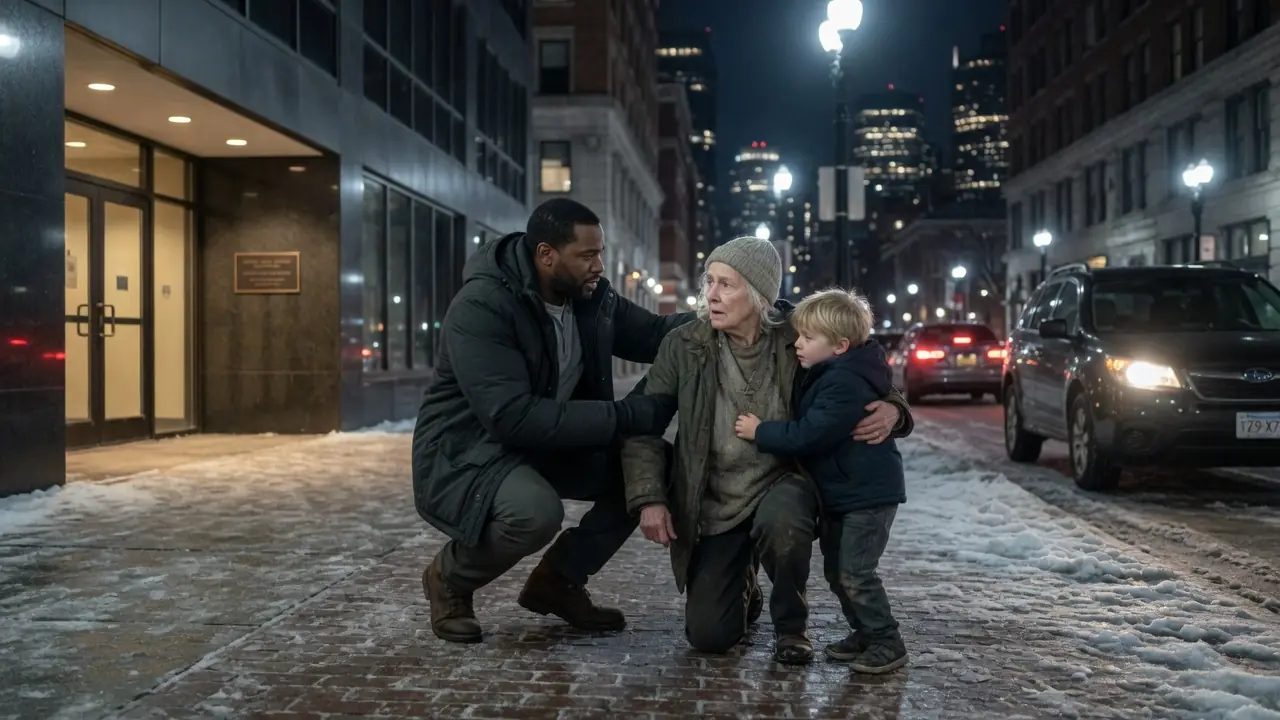
Now she was out here, homeless, forgotten, and freezing.
Immediately, he rushed to them. He helped them to their feet, sheltered them with his coat, and took them home.
What happened next would bring him to tears.
It was the kind of cold that crept past expensive wool coats and tailored suits. The kind that settled into your bones and reminded you that no amount of wealth could shield you from a Boston winter.
Thomas Hartwell had just stepped out of the Meridian Tower, a gleaming glass-clad building that bore his architectural fingerprints on every floor. Everything about the building reflected him: clean lines, purposeful design, quiet strength.
He adjusted the collar of his charcoal overcoat as the automatic doors whispered shut behind him. His driver was already approaching with the sedan. It had been a long day of contract negotiations and design reviews, and he was ready to sink into his study with a glass of bourbon and the blueprints that had been occupying his mind for weeks.
But as he stood at the curb, something caught his eye across Commonwealth Avenue.
Near the mouth of an alley, where the wind seemed crueler and the concrete dirtier, sat an elderly woman huddled against a brick wall. Her coat was torn at the shoulder, her silver hair escaping from beneath a faded wool cap. Her pale skin was reddened from the cold.
Beside her, pressed against her side like a frightened animal, was a boy no older than six. His light complexion was nearly blue from the freezing temperature. The child was crying softly, wiping his nose with the back of a dirt-streaked sleeve.
A faint ache tightened in Thomas’s chest.
The sight of them, so small against the winter, pulled at him in a way he was not prepared for. Almost without thinking, he felt himself incline forward, already considering crossing the street, already wondering how he could help.
His eyes narrowed.
There was something about the woman’s profile that snagged at a memory buried deep, faint but persistent.
He tilted his head, trying to make out her features beneath the grime and exhaustion.
When she reached down to adjust the boy’s scarf, her hand trembling from cold or age or both, she looked up briefly.
For a split second, their eyes met.
Everything clicked.
Margaret Sullivan.
The name hit him like a punch to the sternum.
He had not thought of her in over thirty years.
Senior year. November.
The cafeteria had been loud with the usual chaos of lunchtime, but Thomas had sat alone at the corner table, pretending to read his geometry textbook.
His stomach had been growling. It had been growling all day, but he had learned to ignore it.
There was no money for lunch that week. His mother’s medication had taken priority.
He had been acutely aware of how he stood out. One of the few students in a predominantly white school, wearing clothes that did not quite fit, sitting alone while everyone else gathered in their comfortable groups.
“Thomas.”
Mrs. Sullivan’s voice had been gentle.
She had sat down across from him, setting a brown paper bag on the table. Her warm smile had made him feel seen in a way he was not used to.
“I made way too much lunch this morning,” she said. “My eyes are always bigger than my stomach. Would you mind helping me out? I hate to waste food.”
He had looked at her, then at the bag.
Inside were two sandwiches, an apple, a bag of chips, and homemade cookies.
His throat had tightened.
“Mrs. Sullivan, I can’t.”
“You’d be doing me a favor,” she had said, her voice warm but firm. “Please, I insist.”
That had been the first time, but not the last.
Months later, a Tuesday evening in March, Thomas had been packing up his books after their tutoring session. She had been staying late twice a week to help him with calculus and physics, subjects he needed to master if he wanted any chance at college.
“Thomas, wait,” she had said. “I’ve been meaning to talk to you about something.”
His heart had sunk.
She was going to say she could not tutor him anymore. That it was too much. That he was a lost cause.
“The school has a program,” she continued, pulling out a form. “It provides meal assistance for students who qualify. I’d like you to apply for it.”
“I don’t need…”
“Thomas.”
Her voice had been gentle but unyielding.
“You’re brilliant. You have a real future ahead of you. But you can’t learn if you’re hungry. Please, let me help you with this just for the rest of the year.”
He had filled out the form, believing it was some kind of scholarship program. The next day, the cafeteria manager had told him his meals were covered through graduation.
It was not until years later, after he had finished college, after he had started his firm, that he ran into Mr. Patterson, the old school administrator, who let it slip.
“That Mrs. Sullivan, she was something special,” Mr. Patterson had said. “Paid for your meals herself, you know. Three hundred and forty dollars. Said it was an anonymous scholarship, but we all knew.”
Thomas blinked back to the present.
The woman sitting on that frozen sidewalk was Margaret Sullivan.
Not the confident teacher who had seen something in him when no one else had, but a shadow of that person.
And beside her was a child, cold, frightened, depending on her the way Thomas had once depended on his own mother.
The irony was almost cruel.
The woman who had fed him when he was hungry now sat on a street corner, unable to feed herself.
For several long seconds, Thomas did not move. His hand clenched around his gloves. His jaw tightened.
He could have walked away. Part of him, the part that remembered every humiliation of poverty, every sting of being the poor kid in a white school, wanted to.
But his feet would not budge.
He took a breath and thought about the brown paper bag she had placed on his cafeteria table thirty years ago. The sandwiches, the cookies, the quiet dignity she had given him by calling it a favor.
She had never seen his skin color or his poverty as reasons to look away.
She had seen him.
Just him.
He stepped off the curb and crossed the street.
Traffic rushed past behind him, muffled and distant. The wind sliced through his coat, but he barely noticed.
With each step closer, the woman’s features became clearer. Older, worn, but unmistakably Margaret Sullivan.
She did not recognize him at first. She was too busy trying to comfort the boy, whispering something Thomas could not hear. Her voice was cracked and strained.
He stopped a few feet away and spoke her name, low but firm.
“Mrs. Sullivan.”
Her head snapped up.
The boy flinched.
She looked at him directly for the first time, confusion flickering in her pale blue eyes.
Then shock.
Her mouth parted slightly, but no words came. Thomas could see the realization wash over her like a wave, her entire body recoiling slightly, as if seeing him like this, successful, well-dressed, whole, hurt more than the cold.
“Thomas,” her voice was barely a whisper. “Thomas Hartwell.”
They stared at each other, suspended in a silence heavy with unfinished thoughts and decades of distance around them.
The city went on. Footsteps, horns, people passing by without noticing the tiny collision happening on this sidewalk.
“I didn’t think I’d ever see you again,” she finally said, her voice breaking. “And certainly not like this.”
He glanced down at the boy.
The child was watching him with cautious eyes, one small hand clutching his grandmother’s sleeve. There were no gloves on his hands, no proper shoes on his feet. His light skin was mottled with cold.
Thomas crouched slowly, careful not to startle the child.
“Is he yours?”
Margaret nodded once, eyes lowered.
“My grandson, Daniel.”
The words carried weight, as if she had not had to say them aloud in a long time. There was shame in her tone, but also something else, the fierce protectiveness of someone who had nothing left but love.
Thomas did not ask the next question that rose in his mind. He did not ask where the parents were.
Not yet.
“You shouldn’t be out here,” he said instead. “It’s too cold, especially for him.”
“We don’t have anywhere else,” she replied quietly, her voice thick with humiliation. “I’m doing what I can.”
He could have turned then, said he was sorry, and left. He could have justified it a thousand ways.
But there was a tightening in his chest, a debt so old and so deep that it had shaped the entire course of his life.
“I’m going to help you because I believe in you,” she had told him once, sitting in that empty classroom after everyone else had gone home. “And someday, when you’re in a position to help someone else, I trust you’ll do the same. That’s how we build a better world, one act of kindness at a time.”
“You’re coming with me,” he said finally, his voice firm but gentle.
“No,” she said immediately, shaking her head. “No, Thomas, I can’t. You don’t owe me anything.”
He stood back up and looked her in the eye.
“Mrs. Sullivan, with all due respect, you’re wrong. I owe you everything. And I’m not going to leave you and your grandson freezing on the sidewalk. You don’t get to argue.”
“I don’t want your pity,” she whispered, tears forming in her tired eyes.
“It’s not pity.”
He reached into his coat, pulled out his phone, and called his driver.
“It’s gratitude. It’s respect. And it’s the right thing to do. Something you taught me a long time ago.”
That made her breath catch. She looked away, unable to meet his eyes.
“I don’t know if I can accept this,” she said, her voice breaking.
“You don’t have to decide anything now,” he said. “Just stand up. Let’s get him warm. Then we’ll talk.”
Thomas offered his hand to help Margaret, and this time she took it, her pale fingers cold and trembling in his dark ones.
When the sedan pulled up, the driver stepped out and opened the rear door without a word, his face professionally neutral.
Margaret slid in first, pulling Daniel onto her lap.
Thomas followed.
The warmth of the car was instant, wrapping around them like a blanket.
For the first time since crossing the street, Thomas let out a quiet breath.
The boy was silent, exhausted. Margaret sat stiffly, her hands clenched around Daniel, her eyes staring at nothing. Tears rolled silently down her weathered cheeks.
Thomas did not press. He did not look at her directly. He focused on the road, on the city blurring past, on the questions that could wait.
But deep down, beneath the silence, he knew this was just the beginning.
The woman who had once saved him now needed saving herself.
And there was no question, none at all, about whether he would do it.
The drive to Thomas’s home passed in silence, save for the soft hum of the tires and the quiet breathing of an exhausted child.
Margaret sat rigid, her back barely touching the seat, her weathered hands wrapped protectively around Daniel. She kept her eyes fixed on the window, but she did not really see anything outside.
Her mind was a whirlwind of shame, disbelief, and a grief so profound it felt like drowning.
This was not supposed to happen.
Not to her.
Not after a lifetime of service, of giving, of doing everything right.
She had been a teacher for thirty-seven years. She had spent countless unpaid hours helping students who struggled, buying supplies with her own money, staying late to make sure no child was left behind.
She had believed that goodness mattered. That kindness would be returned. That if you lived your life with integrity, the universe would not abandon you.
But life had other plans.
And now she sat in a luxury car, being driven to the home of a man she had once tutored for free, a boy who had become successful while she had fallen as far as a person could fall.
The car turned into a long private driveway lined with manicured hedges and quiet trees. The house ahead loomed in the distance, its lights warm and steady against the gray dusk.
It was beautiful, immaculate, painfully so. The kind of place that felt like a museum, not a home.
And she was about to walk into it like a beggar.
Her chest tightened. Her throat felt raw.
When the driver stopped the car, Thomas stepped out first. He did not speak. He opened the door on her side and held it, his eyes kind but not pitying.
Margaret hesitated, every fiber of her pride screaming at her to refuse, to walk away, to preserve what little dignity she had left.
But then Daniel stirred against her, shivering despite the car’s warmth.
And she knew she did not have the luxury of pride.
She slid out carefully and gathered Daniel in her arms. The little boy had fallen asleep, his blonde hair falling across his pale forehead.
The front doors opened before they reached them.
A woman stood there, older, with kind eyes and a quiet authority in her posture. She looked from Thomas to Margaret to the child, then back to Thomas.
She said nothing at first, just nodded once and stepped aside.
“This is Mrs. Davies,” Thomas said. “She manages the house. She’ll show you to a room.”
Margaret’s voice caught in her throat, so she nodded instead. She kept her eyes down, too aware of the dirt on her worn sneakers, the smell clinging to her coat, the sharp contrast between who she was and where she now stood.
She heard the soft click of the door closing behind them.
No turning back now.
Inside, everything was polished wood, soft lighting, and warmth that seeped into your bones. Margaret’s eyes flicked to the high ceilings, the art-lined walls, the plush carpets.
None of it belonged to her.
She felt like a stain in the middle of a clean canvas.
Mrs. Davies did not say much as she led her down the hall, only, “It’s a quiet wing. No one will bother you here.”
The room was large, larger than any place Margaret had lived in for the past eighteen months. A queen bed sat under the window with crisp sheets and blankets that looked impossibly clean. A smaller daybed was positioned near the wall for Daniel. A dresser, a soft rug, a reading lamp already glowing in the corner.
She did not move past the doorway at first.
It was too much.
Too soft.
Too far from where she had been just hours earlier.
“Do you need anything for the boy tonight?” Mrs. Davies asked gently.
She was not judging. Her voice had the tone of someone who had seen things, someone who did not flinch at broken people.
Margaret shook her head quickly.
“No, thank you. We’re… we’re fine.”
Mrs. Davies gave a slow nod, then stepped back toward the door.
“If you change your mind, I’ll be in the kitchen. There’s a bathroom through that door. Clean towels are in the cabinet.”
The door closed with a quiet click.
Margaret stood there for a long time.
She did not set Daniel down right away. She just stood staring at the room, the carpet, the light switch, all of it too much.
Her heart thudded like it did not trust where she was. Her feet did not know if they should run or collapse.
When she finally laid Daniel on the daybed and pulled the blanket over him, the boy shifted, mumbled something, and sighed.
His face, dirty but peaceful, looked so innocent, so trusting.
She had failed him.
Failed to provide.
Failed to protect him from hunger and cold and fear.
Margaret sat on the edge of the larger bed after that, her hands in her lap. The heat from the radiator wrapped around her, but the cold inside remained.
Her thoughts were loud.
Too loud.
I taught him. I helped him. And now he has to rescue me like some charity case.
The humiliation was unbearable.
The weight of shame crushed down on her shoulders. She had once stood in front of classrooms with authority, had shaped young minds, had been respected.
And now she was homeless, helpless, dependent on the charity of a former student, a man who had overcome far more obstacles than she ever had, who had succeeded despite a system stacked against him.
There was a knock, not loud, just enough to make her jump.
She did not answer.
The door creaked open anyway, and Thomas stepped in, still wearing his coat, a small duffel bag in one hand.
“I thought you might want something warmer for tonight,” he said. “There are clothes for Daniel too. Some food is in the fridge if you get hungry. Mrs. Davies left soup. Your recipe, actually. The one you used to bring me.”
Margaret looked up sharply.
“You remember that?”
“Mrs. Sullivan, I remember everything.”
His voice was soft.
“I remember you staying late every Tuesday and Thursday. I remember the sandwiches you’d bring with some excuse about making too much. I remember the day you told me the school was covering my meals, and I believed you.”
She closed her eyes, tears spilling over.
“Thomas…”
“I found out later,” he continued. “Years later, that you had paid for it yourself. A full year of meals out of your own pocket. Three hundred and forty dollars, which was probably a month’s salary for you back then.”
“You were hungry,” she whispered. “You were brilliant and kind, and you were going hungry. What was I supposed to do?”
“You saved my life,” he said simply. “Not just by feeding me. By believing in me. By treating me like I mattered when everyone else looked right through me.”
She shook her head, unable to speak.
He set the bag down on the dresser and turned to face her.
“You don’t belong out there, Mrs. Sullivan. You never did. And I’m not going to let you stay there.”
“I don’t want your pity,” she managed to say.
“It’s not pity.” His voice was firm. “It’s reciprocity. It’s honor. It’s me finally being able to give back a fraction of what you gave me.”
She looked at him then. Really looked.
The boy who had sat in her classroom struggling with geometry, barely speaking above a whisper, had become this confident, successful, kind man.
“I’m so proud of you,” she whispered. “Even in all this shame, I’m so proud.”
“Then let me help you,” he said. “Please. You taught me that accepting help isn’t weakness. It’s wisdom. You told me that once when I tried to refuse your sandwiches.”
She nodded, unable to find words.
Thomas turned to go, but paused at the doorway.
“We’ll talk tomorrow. Rest tonight. You’re safe here.”
When he left and the silence returned, it was not as heavy as before.
She sat still for a while longer, then slowly rose, walked to the bathroom, and washed her hands with soap that smelled like lavender.
She caught her reflection in the mirror. Her face looked older than she remembered, worn by weather and worry, not a trace of the woman who used to stand confidently before a classroom.
Back in the bedroom, she slipped off her coat, sat on the bed beside her sleeping grandson, and watched him breathe. His fair skin looked healthier already in the warmth, the blue tinge fading.
She had once given freely, expecting nothing in return.
And now, in her darkest hour, that gift had returned to her in ways she never could have imagined.
She whispered something to the sleeping child, though she was not sure what it was.
Maybe a promise that things would get better.
Maybe a prayer of gratitude.
Then, for the first time in months, Margaret closed her eyes in a place where no one was yelling, where no one expected her to move, and where the heat worked.
She did not feel worthy yet.
But she was not cold.
And that, for tonight, was enough.
The morning light crept in softly through the tall windows, stretching across the hardwood floors of the quiet guest room.
Margaret opened her eyes, not to the sound of sirens or angry voices, but to something she had not heard in what felt like forever: the gentle breathing of a child sleeping peacefully.
For a second, she did not move. She let herself just lie there, eyes half open, trying to remember where she was and why her body did not ache quite as much.
Then it all returned.
The night before.
The mansion.
Thomas.
The impossible kindness.
She sat up slowly, her muscles still sore from months of sleeping on hard ground or sitting upright against walls. Across the room, Daniel was still asleep on the daybed. His small face was relaxed in a way she had not seen in over a year.
The clock on the nightstand read 7:15.
Margaret carefully slid out of bed, pulled on the clean sweater that had been left for her, and padded quietly to the bathroom.
When she looked in the mirror, she barely recognized herself. Her face was gaunt, her silver hair matted despite her attempts to clean it last night. Her hands trembled as she turned on the faucet.
But the water was hot.
Gloriously, impossibly hot.
She washed her face, her hands, her arms, scrubbing away layers of grime and shame. When she finished, she felt marginally more human, though the exhaustion in her eyes remained.
Downstairs, the scent of warm toast and brewed coffee met her before she even stepped into the kitchen. It was the kind of smell that made her heart tighten because it reminded her of Saturday mornings long ago, when life was simple and full of hope.
Mrs. Davies was already busy setting the table in the sunlit breakfast nook. When she saw Margaret, she smiled warmly, not with pity, but with genuine kindness.
“Good morning. I hope you slept well.”
“Better than I have in a long time,” Margaret admitted quietly.
“Sit, please. Breakfast is ready. Should I check on the little one?”
“He’s still sleeping. I’ll bring him down when he wakes.”
Mrs. Davies nodded and gestured to the table.
“Thomas asked me to let you know he’ll be back this afternoon. He had meetings, but he didn’t want to leave without making sure you had everything you needed.”
Margaret sat slowly, her eyes taking in the spread.
Fresh fruit. Oatmeal. Toast. Butter. Jam.
More food than she and Daniel had seen in weeks.
“This is too much,” she whispered.
“It’s exactly enough,” Mrs. Davies replied firmly. “Eat. You need your strength.”
As Margaret picked up a piece of toast, her hands shaking slightly, Mrs. Davies poured her a cup of coffee and sat down across from her.
“I’ve worked for Mr. Hartwell for twelve years,” Mrs. Davies said quietly. “He’s a good man. A man who remembers where he came from and who helped him along the way.”
Margaret looked up, tears already forming.
“He mentioned you once,” Mrs. Davies continued. “Years ago, when we were talking about gratitude. He said there was a teacher who changed his life, who saw him when no one else did. I’m guessing that was you.”
Margaret nodded, unable to speak.
“Then you should know he’s been waiting for a chance to return what you gave him. This isn’t charity. This is him honoring a debt he’s carried for thirty years.”
Before Margaret could respond, small footsteps sounded on the stairs.
Daniel appeared in the doorway, his eyes wide, his blonde hair sticking up in all directions.
“Grandma,” his voice was uncertain.
“I’m here, sweetheart. Come have breakfast.”
The boy approached cautiously, as if afraid this might all disappear.
When he saw the food, his eyes went even wider.
“Is this all for us?”
Margaret’s heart broke.
“Yes, baby. Sit down.”
As Daniel climbed into a chair and reached for an orange slice with both hands, Mrs. Davies discreetly excused herself, leaving them alone.
They ate in silence for a few minutes. Daniel devoured food like he might never see it again. Margaret ate slowly, her appetite still small from months of deprivation.
Then the boy spoke.
“Grandma, can we stay here?”
The question was so simple, so hopeful, that Margaret had to look away to hide her tears.
“For now, sweetheart. We’re very lucky to be here.”
“I like it here,” Daniel said quietly. “It’s warm and nobody yells.”
That last sentence broke something in Margaret.
Nobody yells.
That was his measure of safety now.
The absence of anger.
The presence of warmth.
What had she put this child through?
Later that afternoon, after Daniel had been settled in the living room with some books Mrs. Davies had found, Thomas returned home.
Margaret heard the front door open, heard him speaking quietly with Mrs. Davies, and then his footsteps approaching.
He appeared in the doorway of the small study where Margaret had retreated, trying to stay out of the way.
“Mrs. Sullivan, how are you feeling?”
She stood quickly.
“Thomas, I… I don’t know how to thank you.”
“You don’t need to thank me. Please sit.”
They both sat, awkward silence filling the space between them.
Thomas broke it first.
“I need you to tell me what happened. Not because I’m judging. Because I need to understand how someone like you ended up out there. And because I might be able to help in ways beyond just providing shelter.”
Margaret took a long breath, her hands twisting in her lap.
She had been dreading this conversation, but she owed him the truth.
But before she could speak, Thomas leaned forward, his eyes distant, remembering.
“Before you tell me,” he said softly, “I want you to know something. I want you to understand why this matters so much to me.”
He paused, collecting his thoughts.
“It was February,” Thomas began. “My senior year. I was working on a college application, just one, because I could only afford one application fee. It was for a state school, and even then I wasn’t sure I could go. But I was trying.”
Margaret watched him quietly.
“You were staying late that night,” he continued. “You’d been helping me with my essay. It was past seven, maybe eight o’clock. Everyone else had gone home, and I broke down.”
Margaret’s eyes widened slightly, but she did not interrupt.
“I told you everything about my mother’s illness, about the medical bills, about how I’d been skipping meals to save money, about how I’d been thinking of dropping out to work full-time at the warehouse.”
Thomas’s voice grew thick with emotion.
“I was seventeen years old, and I was so tired, so hopeless. And I told you something else.”
He continued, his dark eyes meeting hers.
“I told you that sometimes I felt invisible. That being one of the few students in a white school, wearing secondhand clothes, sitting alone at lunch, I felt like people looked right through me. Like I didn’t matter.”
He swallowed.
“You didn’t say much at first. You just listened. And then you asked me one question. ‘Thomas, what do you want your life to be?’”
Margaret’s lips parted, but no words came.
“I said I wanted to be an architect. To design buildings that people could live in, work in, feel safe in. Buildings where everyone belonged.”
He looked down at his hands for a moment.
“And you know what you told me?”
Margaret shook her head, tears streaming down her face.
“You said, ‘Then that’s what you’ll do, because I’m going to help you and you’re going to let me. Not because you owe me anything, but because that’s what people do. We help each other. And someday, when you’re in a position to help someone else, I trust you’ll do the same. That’s how we build a better world, one act of kindness at a time.’”
Thomas’s voice cracked.
“The next week, you told me about the school program for meal assistance. You made it sound so official, so impersonal. I believed it was some kind of scholarship. I didn’t know until years later that you paid for my meals yourself. Three hundred and forty dollars. That was probably more than you could afford.”
“And the tutoring,” he continued. “You stayed late twice a week for eight months. You never asked for payment. You never made me feel like charity. You treated me like I was worth the investment.”
He met her eyes.
“You didn’t just feed me, Mrs. Sullivan. You didn’t just tutor me. You gave me something I’d never had before. Someone who believed I could be more than my circumstances. Someone who saw past my skin color and my poverty to the person underneath. You saw potential in a kid everyone else had written off.”
Margaret was sobbing now, her hands covering her face.
“I didn’t… I was just doing what any teacher should do,” she managed to say.
“No,” Thomas said firmly. “You did what a great teacher does. What a great human being does. You saw someone in need and you acted without hesitation, without asking for recognition, without keeping score.”
He took a breath.
“So when I saw you on that sidewalk last night, sitting in the cold with your grandson, do you know what I thought?”
Margaret shook her head.
“I thought, there’s the woman who saved my life, and now I finally get to return what she gave me.”
He smiled through his own tears.
“This isn’t charity, Mrs. Sullivan. This is reciprocity. This is the world working the way you taught me it should.”
They sat in silence for a moment, both of them crying, both of them feeling the weight of three decades of distance collapsing into a single point of connection.
Finally, Thomas spoke again.
“Now, please tell me what happened. Tell me how you got here, because I can’t help you properly unless I understand.”
And so Margaret told him.
She told him about her husband Richard’s illness, the Parkinson’s that drained their savings over three agonizing years.
She told him about Richard’s death five years ago, and how she had thought she could rebuild.
Then came the hardest part.
“My son David,” she said, her voice barely above a whisper. “He died in a construction accident two years ago. He left behind a wife, Rachel, and Daniel, who was only four at the time.”
Thomas listened without interrupting, his face grave.
“Rachel and I had never gotten along,” Margaret continued. “She thought I was too involved, too controlling. After David died, she fell apart, started drinking, and then six months after the funeral, she showed up at my door and said she couldn’t do it anymore. Said I could take Daniel or she’d put him in foster care.”
She paused, her hands trembling.
“But she wouldn’t give me legal custody. She said if I tried to file for it, she’d fight me out of spite and take him back. So I took him without paperwork. I’ve been raising him for almost two years now, but legally I have no rights. Rachel has custody, but she disappeared. Changed her number, left no address. I haven’t heard from her in almost two years.”
Thomas leaned forward, his expression serious.
“So you can’t access any services for Daniel because you’re not his legal guardian.”
“Exactly,” Margaret said. “I couldn’t enroll him in school properly. Couldn’t get him medical care without Rachel’s signature. Couldn’t apply for assistance. And I lived in constant fear that someone would figure it out and take him away from me.”
“Where is Rachel now?”
“I don’t know. For all I know, she’s…”
Margaret trailed off.
“Dead,” Thomas finished quietly. “Or she might as well be.”
Margaret nodded.
“My pension barely covered rent. And at seventy-two, no one wanted to hire me. I applied everywhere. Grocery stores, libraries, anywhere. No one calls you back when you’re my age.”
She paused, swallowing hard.
“Then my landlord sold the building. The new owner wanted to renovate, convert it to luxury apartments. He evicted everyone. I couldn’t find anything I could afford. We stayed with a friend for a while, but her situation changed. Then we were in shelters, but they were dangerous, and Daniel was terrified. And I was always afraid someone would ask questions about custody. So we… we ended up out there.”
“For how long?” Thomas asked gently.
“Eighteen months. Some nights in shelters when we could get in. Some nights on the street. Always trying to keep Daniel safe. Always trying to stay invisible so no one would separate us.”
Her voice broke on the last word.
Thomas was quiet for a long moment.
When he spoke, his voice was firm with resolve.
“We’re going to fix this, Mrs. Sullivan. All of it.”
“Thomas, I don’t see how.”
“I have a lawyer,” he interrupted. “One of the best family law attorneys in Boston. We’re going to find Rachel. And if we can’t find her, we’re going to petition for emergency custody based on abandonment. You’ve been Daniel’s primary caregiver for two years. You have rights, even if Rachel won’t acknowledge them.”
Margaret stared at him.
“That could take months. Years. And it’s expensive.”
“I don’t care how long it takes or what it costs,” Thomas said. “That boy deserves stability. He deserves to be legally protected. And you deserve to not live in fear that someone will take away the child you’ve sacrificed everything for.”
Tears streamed down Margaret’s face.
“Why would you do this?”
“Because you once told me that every child deserves an advocate,” Thomas replied. “That every child deserves someone who will fight for them. You were my advocate, Mrs. Sullivan. Let me be Daniel’s.”
She could not speak, could only nod through her tears.
“There’s something else,” Thomas continued. “Your pension. I want my lawyer to look into it. Sometimes when people leave the system early or have life changes, there are benefits that go unclaimed. It’s worth investigating.”
“I can’t ask you to pay for all this legal work,” Margaret protested weakly.
“You’re not asking. I’m offering.”
His voice was gentle but unyielding.
“Mrs. Sullivan, Margaret, you gave me a year of your time, your money, and your belief. You invested in me when I had nothing to offer in return. This is compound interest. This is the return on the kindness you planted thirty years ago.”
Margaret looked at him, this man she had once known as a struggling teenager, now successful and kind and offering her not just shelter, but hope.
“I don’t deserve this,” she whispered.
“You deserve so much more than this,” Thomas replied. “And I’m going to spend as long as it takes proving that to you.”
That evening, after Daniel was asleep, Margaret sat alone in the guest room holding a photograph she had managed to keep through everything. David as a little boy, smiling at the camera, missing his two front teeth.
“I’m going to make sure your son is safe,” she whispered to the photo. “I promise. No matter what it takes.”
And for the first time since that terrible day when Rachel had thrust Daniel into her arms and walked away, Margaret allowed herself to believe that maybe, just maybe, she could keep that promise.
Because she was not alone anymore.
She had an advocate, too.
Just as she had once been for a struggling boy named Thomas Hartwell, the circle was beginning to close.
Three weeks had passed since that first night, and life had settled into a careful rhythm.
Daniel had adjusted to the house with the resilience of childhood. He no longer startled at every sound or hoarded food under his pillow.
Margaret moved through the days with a mixture of gratitude and lingering disbelief, still half expecting to wake up on that frozen sidewalk and discover this had all been a dream.
Thomas had been true to his word.
Within a week, he connected Margaret with his attorney, a sharp woman in her fifties named Patricia Morrison. Patricia had listened to Margaret’s story without judgment, taking notes and asking pointed questions about Rachel, about Daniel, about the lack of documentation.
“This is more common than you’d think,” Patricia had said. “Grandparents raising grandchildren without legal authority. The system fails families in crisis every single day.”
Now, on a gray Thursday afternoon, Margaret sat in Patricia’s downtown office, Thomas beside her for moral support as the attorney laid out their options.
“I’ve done some digging,” Patricia said, pulling up files on her computer. “Rachel Elizabeth Hartley, her maiden name, hasn’t been heard from in approximately twenty months. Her last known address was an apartment in Quincy, which she was evicted from for nonpayment. Her phone has been disconnected. Her social media accounts went dark around the same time.”
“So we can’t find her,” Margaret said, her heart sinking.
“Not yet,” Patricia corrected. “But we have enough evidence of abandonment to file for emergency guardianship. You’ve been Daniel’s primary caregiver for almost two years. As his grandmother, you’d be seeking legal guardianship, which would give you the same rights as a parent.”
“What are our chances?” Thomas asked.
“Good,” Patricia said confidently. “Massachusetts courts prioritize the child’s best interest. Daniel is thriving with Margaret, or he will be once we get him properly enrolled in school and stabilized. The fact that Rachel essentially abandoned him with his grandmother and then disappeared is strong evidence that she’s unfit.”
Margaret’s hands twisted in her lap.
“What if she comes back? What if she fights us?”
“Then we fight back,” Patricia said simply. “But Margaret, I need you to understand something. You’re not taking Daniel away from a loving mother. You’re protecting him from a woman who abandoned her responsibilities. There’s a difference.”
Margaret nodded slowly, wanting to believe it.
“How long will this take?” Thomas asked.
“If Rachel doesn’t contest, and given that we can’t locate her, she probably won’t, we could have emergency temporary guardianship in six to eight weeks. Full permanent guardianship might take four to six months.”
“And the costs?” Margaret’s voice was small.
“Already taken care of,” Thomas said before Patricia could answer.
“Thomas.”
“Margaret.” His voice was firm but kind. “Let me do this, please.”
She looked at him. This man who had already given her so much.
Slowly, she nodded.
What choice did she have?
Daniel’s future was at stake.
Patricia pulled out another file.
“Now, about your pension. I had one of our financial specialists look into your retirement account. Margaret, when you retired at sixty-seven, there was a clerical error. You were entitled to additional widow’s benefits after Richard passed, but they were never activated. And there’s an adjustment for the years you went back to substitute teaching that was never calculated into your final pension amount.”
Margaret’s breath caught.
“What does that mean?”
“It means you’re owed approximately thirty-eight thousand dollars in back payments, plus an increase in your monthly pension of about four hundred and twenty dollars.”
The room tilted slightly.
Margaret gripped the arms of her chair.
“Thirty-eight thousand dollars,” she whispered.
“Give or take,” Patricia confirmed. “We’re filing the paperwork today. The state has ninety days to process it, but given the clear documentation error, they’ll likely settle quickly.”
Margaret could not speak.
Thirty-eight thousand dollars.
It was not a fortune, but it was stability. It was Daniel’s future. It was proof that she had not been forgotten entirely by the system she had served for thirty-seven years.
“There’s one more thing,” Thomas said quietly.
He pulled out a folder. He always had folders, and handed it to Margaret.
“I bought a property last spring, a small house in Brookline near where you used to teach. I was going to renovate and rent it, but I have a different idea now.”
Margaret opened the folder to find photos of a charming two-story house with a front porch and a small yard.
“Thomas, no.”
“Hear me out,” he interrupted gently. “You need a permanent address to establish legal custody of Daniel. You need stability to show the court you can provide for him. This house can be that stability.”
“I can’t accept…”
“You’d be renting from me,” Thomas continued. “At a rate based on what you can afford once your pension is straightened out. It’s a business arrangement, Margaret. I own the property. You pay rent. It’s that simple.”
Patricia nodded.
“He’s right, Margaret. Having stable housing will significantly strengthen your custody case. The court needs to see that you can provide a safe, permanent home for Daniel.”
Margaret stared at the photos, her vision blurring with tears.
A home.
A real home.
Not temporary shelter.
Not charity.
A place where she and Daniel could build a life.
“The house has three bedrooms,” Thomas said. “One for you, one for Daniel, and one you could use however you want. There’s a yard where he can play. It’s a ten-minute walk from here, so we’re still close. And it’s yours, Margaret. A real home.”
She could not stop the tears now.
They fell freely as she looked at the photos, at this impossible gift that was not quite a gift, that came with just enough structure to let her accept it with dignity.
“Why?” she whispered. “Why are you doing all this?”
Thomas was quiet for a moment. Then he said, “Do you remember what you told me that night in February when I was ready to give up?”
Margaret shook her head, unable to speak.
“You said, ‘I’m going to help you because I believe in you. And someday, when you’re in a position to help someone else, I trust you’ll do the same. That’s how we build a better world, one act of kindness at a time.’”
Margaret’s hand flew to her mouth.
She had said that.
She remembered now.
“You gave me more than meals and tutoring, Margaret. You gave me a blueprint for how to live. You showed me that success means nothing if you can’t use it to lift others up.”
He gestured to the photos of the house.
“This isn’t charity. This is me following your blueprint. This is me trying to build the better world you taught me was possible.”
Margaret broke down completely, sobbing into her hands.
All the shame, all the fear, all the months of believing she was worthless poured out of her.
Thomas moved to sit beside her, his hand on her shoulder, saying nothing, just being present the way she had once been present for him.
Patricia quietly excused herself, giving them privacy.
When Margaret finally composed herself, she looked at Thomas with red, swollen eyes.
“I don’t know how to accept this much kindness.”
“The same way I accepted yours,” Thomas said. “With gratitude. With the understanding that it’s not about deserving. It’s about community. It’s about caring for each other. And with the knowledge that someday, when you’re able, you’ll pass it forward to someone else who needs it.”
She nodded slowly, clutching the folder like a lifeline.
“Can I see it?” she asked. “The house?”
Thomas grinned.
“I was hoping you’d ask. Daniel’s with Mrs. Davies learning to make cookies. Perfect timing.”
They drove through familiar streets, past Riverside High, where Margaret had taught for so many years, past the park where she used to take David as a child.
When they turned onto Prescott Avenue, Margaret’s breath caught.
The house was perfect.
Not too big, not too small. The porch had a swing. The yard had old maple trees. Through the windows, she could see hardwood floors and built-in bookshelves.
“The previous owner was a retired teacher too,” Thomas said as he unlocked the door. “She left some furniture that you’re welcome to use or replace. I’ve had the place cleaned, and the utilities are already on.”
They walked through together.
The living room had good light. The kitchen was updated, but cozy. Upstairs, the bedrooms were spacious, and the smaller one had a window seat that Daniel would love.
Margaret stood in what would be her bedroom, looking out at the neighborhood where she had spent most of her career, and felt something she had not felt in years.
Hope.
Real, tangible hope.
“I could have a garden,” she said softly. “Teach Daniel to plant vegetables like I did with David when he was little.”
“That sounds perfect,” Thomas said.
She turned to him, and for the first time since he had found her on that sidewalk, she smiled.
Really smiled.
“I’ll pay you back for everything. The legal fees, the house costs, all of it.”
“Margaret, no.”
“I mean it.” Her voice was firm now. “Not because I don’t appreciate it, but because you taught me something these past few weeks.”
“What’s that?”
“That accepting help isn’t the same as being helpless. That letting people care for you doesn’t make you weak.”
She looked around the room.
“You let me help you once, even though it was hard for you. You let me give you something because you understood that I needed to give it. That it wasn’t about you deserving it. It was about me expressing who I wanted to be.”
Thomas nodded slowly, understanding.
“So let me do the same,” Margaret continued. “Once I’m on my feet, once my pension is settled and I have stable income, let me pay fair rent. Let me contribute. Not because you need it, but because I need to. Because it helps me feel whole again.”
“Okay,” Thomas said simply. “We’ll figure out a plan that works for both of us.”
They stood in the empty bedroom, sunlight streaming through the windows, both of them feeling the weight of new beginnings.
“You know what I’m most grateful for?” Margaret said quietly.
“What?”
“That you didn’t just give me charity. You gave me a chance to rebuild. To be a provider again, not just a recipient. That’s the real gift. Treating me like someone who still has value to offer, not just someone who needs saving.”
Thomas smiled.
“That’s because it’s true. You do have value. You always have. You just needed reminding.”
They drove back to pick up Daniel, both of them lighter than they had been in a long time.
When they told the boy about the new house, he literally jumped up and down with excitement.
“Do I get my own room? Can I pick the paint color? Grandma, can we plant tomatoes like Daddy used to grow?”
Margaret laughed.
Really laughed.
“For the first time in years, we can plant whatever you want, sweetheart.”
That night, after Daniel was asleep, Margaret sat in the study with a notebook, planning.
Planning furniture arrangements.
Planning gardens.
Planning Daniel’s new bedroom.
Planning a life that felt real and solid.
And planning how she would one day pass this kindness forward, how she would use whatever stability she rebuilt to help others the way Thomas was helping her now.
Because that was the lesson she had taught him thirty years ago.
And the lesson he was now teaching her in return.
Kindness was not a one-time transaction.
It was a current that flowed through lives, through generations, building something better with each act of grace.
The move happened three weeks later, in mid-December, just as the first real snows began to fall.
Margaret had insisted on doing most of the packing herself, though there was little to pack beyond clothing and a few precious photographs.
Daniel was beside himself with excitement. His new room had the window seat, which Mrs. Davies had outfitted with cushions and pillows before Margaret could protest. Margaret’s room overlooked the backyard where spring would bring the garden she had been planning in her notebook.
On moving day, something unexpected happened.
People showed up to help.
Mrs. Davies arrived with her husband carrying boxes of kitchen supplies. Thomas’s project manager showed up with his truck.
And then, most surprisingly, a group of former students began appearing.
“Mrs. Sullivan?”
A woman in her forties stood on the porch holding a casserole.
“I don’t know if you remember me. Jennifer Martinez. You taught me freshman English in 1994.”
Margaret stared.
“Jennifer? Little Jennifer who loved poetry?”
“Not so little anymore.” Jennifer smiled. “Thomas reached out to some of us from your old classes. When we heard what you were going through and what you’re doing now, we wanted to help.”
More kept coming.
Michael Torres, who was now a lawyer.
Sarah Henderson, a nurse.
David Kim, who owned a restaurant.
Students Margaret had taught decades ago, now adults with lives and careers, all coming back to help the teacher who had helped them.
By afternoon, the house was furnished, the kitchen was stocked, and Daniel was racing through rooms, showing his new friends, the children of Margaret’s former students, his toy collection.
Margaret stood in the middle of her new living room, overwhelmed.
Thomas found her there, tears streaming down her face.
“You okay?” he asked gently.
“I didn’t know,” she whispered. “I didn’t know any of them remembered me.”
“Margaret, you changed their lives. Of course they remember.”
Sarah approached, carrying a photo album.
“Mrs. Sullivan, we put this together. Pictures and letters from people you taught over the years. We thought you might like to have it.”
Margaret opened the album with shaking hands.
Page after page of photos. Students at graduations, weddings, with their own children.
And letters.
Mrs. Sullivan taught me that reading could be an escape when home was hard.
She stayed after school to help me with my college essays. I was the first in my family to go to college.
When my father lost his job, Mrs. Sullivan brought me lunch every day for six months. She said it was extra, but I knew better.
She believed in me when no one else did.
Margaret could not stop crying.
Thomas put his arm around her shoulders.
“This is what you built,” he said quietly. “This is your legacy.”
The custody hearing was scheduled for a Tuesday morning in early March, ten weeks after Margaret and Daniel had moved into the house on Prescott Avenue.
Those ten weeks had been a whirlwind of paperwork, documentation, and slow, steady healing.
Thanks to emergency provisions Patricia had arranged, Daniel had started at the local elementary school under temporary enrollment. The boy was thriving.
His teacher reported that while he was behind academically, he was catching up quickly and making friends. The school counselor noted that he was showing signs of past trauma, but was responding well to the stable environment.
Now, sitting in the family courtroom with Patricia on one side and Thomas on the other, who had insisted on coming for moral support, Margaret felt her hands trembling.
“It’s going to be fine,” Patricia whispered. “We have everything we need.”
The judge, a woman in her sixties named Sandra Brennan, reviewed the documents before her with a thoughtful expression.
She looked up at Margaret.
“Mrs. Sullivan, I’ve read your petition for emergency custody. I’ve also read the social worker’s report from the home visit and Daniel’s school records. Before I make my decision, I’d like to hear from you directly. Can you tell me in your own words why you’re seeking legal custody of your grandson?”
Margaret stood, her legs unsteady.
She had practiced this with Patricia, but now her mind felt blank.
Then she thought of Daniel.
His smile when he came home from school. His excitement about planting seeds in the garden. The way he no longer flinched at loud noises.
“Your Honor,” she began, her voice gaining strength as she spoke. “I’m seeking legal guardianship because Daniel is my grandson, and I love him. As his grandmother, I’m asking this court to grant me the legal authority to make decisions for him that his mother cannot or will not make.”
Judge Brennan nodded.
“And you haven’t heard from Miss Hartley since?”
“Not in almost two years, Your Honor. Before Mr. Hartwell found us, Daniel and I were homeless for eighteen months without legal guardianship, without court-recognized authority to make decisions for him. I couldn’t properly access services. I couldn’t enroll him in school. I couldn’t get him consistent medical care. We were invisible to the system.”
She paused, taking a breath.
“Thanks to Mr. Hartwell and his attorney, Miss Morrison, we were able to arrange emergency enrollment while we pursued legal custody. But before that, I lived in constant fear that someone would discover our situation and take Daniel from me. Not because I was unfit, but because I had no legal paperwork. Rachel has custody on paper, but she abandoned us. Her phone was disconnected. Her last known address was an apartment she was evicted from. I don’t know where she is or even if she’s still alive.”
“And your current situation?”
“I have stable housing now. My pension has been corrected, so I have reliable income. Daniel is enrolled in school and doing well. I can provide for him financially, emotionally, and physically. All I’m asking for is the legal right to do what I’ve already been doing for two years. Raise my grandson and keep him safe.”
Judge Brennan turned to the social worker who had conducted the home visit.
“Miss Jennifer Park, your assessment?”
The court-appointed social worker stood.
“Your Honor, I visited the home on Prescott Avenue twice. The house is clean, safe, and appropriate for a child. Mrs. Sullivan has established a stable routine. Daniel is clearly bonded with his grandmother. He told me, and I quote, ‘Grandma keeps me safe.’ In my professional opinion, Mrs. Sullivan is providing excellent care, and legal custody is in the child’s best interest.”
“And there’s been no contact from the biological mother?”
“No, Your Honor. We’ve attempted to locate Miss Hartley through every available channel. She appears to have completely disengaged from her son’s life.”
The judge reviewed her notes again, then looked at Margaret.
“Mrs. Sullivan, I’m troubled by the fact that you and your grandson spent eighteen months homeless because the system failed you. A woman who devoted thirty-seven years to teaching our children shouldn’t have been on the street. That’s a failure of the Commonwealth, and I apologize on behalf of our institutions.”
Margaret’s eyes filled with tears.
“However,” Judge Brennan continued, “I’m pleased to see that you’ve established stability. The evidence before me is clear. Daniel is thriving in your care. You have the means to support him, and his biological mother has effectively abandoned him.”
She picked up her gavel.
“Therefore, I’m granting emergency temporary guardianship to Margaret Anne Sullivan, effective immediately. This grants you, as Daniel’s grandmother, full legal guardian authority to make decisions regarding Daniel’s education, health care, and welfare. While his mother, Rachel Hartley, retains parental rights on paper, you now have the legal standing to act in her place given her abandonment and disappearance.”
The gavel came down.
Margaret could not breathe.
She had won.
Daniel was legally hers.
Patricia squeezed her hand.
“Congratulations.”
Thomas, sitting in the gallery, was smiling broadly.
As they left the courtroom, Margaret felt lighter than she had in years, maybe decades.
The weight of fear, of illegitimacy, of constantly looking over her shoulder had finally lifted.
Outside the courthouse, Patricia shook her hand professionally.
“I’ll file the permanent custody petition immediately. Given today’s ruling and the continued lack of contact from Rachel, I expect it to be granted without issue.”
“Thank you,” Margaret said, her voice thick with emotion. “For everything.”
“Thank Thomas,” Patricia replied with a knowing smile. “He’s the one who made this happen.”
After Patricia left, Thomas and Margaret stood on the courthouse steps, the early March sun warming their faces despite the lingering chill.
“You did it,” Thomas said.
“We did it,” Margaret corrected. “I couldn’t have done this without you.”
“You would have found a way,” Thomas said. “You always do.”
Margaret shook her head.
“No, I was drowning, Thomas. You threw me a lifeline. There’s no shame in admitting that I needed help. And you gave it.”
She looked at him seriously.
“But now it’s my turn to start building something. Not just for Daniel and me, but for others who are where I was.”
“What do you mean?”
“I’ve been thinking,” Margaret said as they walked toward his car. “Once I’m fully on my feet, I want to volunteer. Maybe at the family court, helping other grandparents navigate the system. Or at the shelter, working with families in crisis. I know what it’s like to fall through the cracks. I can help others avoid that.”
Thomas smiled.
“That sounds like the Margaret Sullivan I remember. Always teaching, always helping.”
“It’s who I am,” she said simply. “These past few months, I lost sight of that. I started to believe that being in need meant I had nothing to offer. But you showed me that’s not true. Even when we’re struggling, we still have value. We still have knowledge and experience to share.”
They drove back to Prescott Avenue, where Mrs. Davies had been watching Daniel.
When they arrived, the boy was in the front yard, carefully watering the early crocuses that were pushing up through the last patches of snow.
“Grandma!” he shouted when he saw her. “Look, the flowers are coming.”
Margaret knelt beside him, her pale skin glowing in the sunlight, examining the tiny purple blooms.
“They certainly are. Spring is almost here.”
“Mr. Thomas, want to see?” Daniel grabbed Thomas’s hand, his small pale fingers wrapping around Thomas’s dark ones, pulling him toward the garden bed.
As Margaret watched them together, her grandson chattering excitedly, Thomas listening with genuine interest, she felt a profound sense of rightness.
This was family.
Not defined by blood alone, but by choice, by commitment, by showing up day after day.
That evening, after Thomas had left and Daniel was in bed, Margaret sat at her kitchen table with the official custody documents spread before her.
She ran her fingers over the judge’s signature, still hardly believing it was real.
She was Daniel’s legal guardian now.
No one could take him from her.
He was safe.
Her phone rang.
An unknown number.
She answered cautiously.
“Margaret, it’s Sarah Henderson from your English class in 2002.”
Margaret’s face brightened.
“Sarah, of course I remember you.”
“I heard you got custody today. Congratulations. I’m actually a social worker now at the family services center downtown. I was wondering if you’d be interested in doing some volunteer work with us. We desperately need people who understand the system and can advocate for families in crisis.”
Margaret smiled.
The universe worked in mysterious ways.
“Sarah, I’d be honored. When can I start?”
As she hung up the phone, Margaret looked around her small, cozy kitchen, so different from where she had been just four months ago, and felt a deep sense of gratitude.
She had fallen as far as a person could fall.
And she had been lifted up, not by her own strength alone, but by the kindness she had planted decades ago, returned to her when she needed it most.
Now it was time to plant new seeds.
To help others the way she had been helped.
To prove that the cycle of kindness could continue, growing stronger with each passing generation.
Outside her window, the crocuses bloomed purple against the melting snow.
Soon there would be daffodils and tulips, and then the garden she planned to plant with Daniel.
Inside her home, a different kind of growth was happening.
A grandmother and grandson, both scarred by loss, but healing together.
Building a life.
Building a future.
And somewhere in the foundation of it all was a simple truth that Margaret had taught a struggling teenager thirty years ago.
We build a better world, one act of kindness at a time.
Now, finally, she was learning to accept that kindness could flow both ways.
It was late April on a Tuesday morning thick with humidity when Thomas received the call that would shake the foundations of his career and reveal just how much Margaret still had to offer.
He was in his office downtown, reviewing final calculations for his signature project: a sustainable, affordable housing development that would provide homes for sixty working families.
It was personal, this project.
It represented everything he believed in. Dignified housing for people who worked hard but still struggled. Built with environmental consciousness and community support.
But then his chief engineer, Robert Williams, knocked on his door with a face pale with worry.
“Thomas, we have a problem. A serious one.”
The structural calculations were wrong.
Not slightly off.
Catastrophically wrong.
Someone had made an error in the load-bearing formulas, and it had propagated through every single document. The foundations currently being poured were based on faulty mathematics.
Within two hours, Thomas was in an emergency meeting with his engineering team, his construction manager, and the project’s financial backers.
The news was devastating.
“We have to stop construction immediately,” Robert said. “Tear out what we’ve built and start over. We’re looking at a six-month delay minimum and approximately two million seven hundred thousand dollars in additional costs.”
One of the primary investors, a stern man named Howard Fredericks, slammed his hand on the table.
“This is unacceptable. We invested in your reputation, Hartwell. Your precision. Your attention to detail. This is the opposite of that.”
“I understand your frustration,” Thomas began.
“Do you? Because we’re pulling our funding. Effective immediately.”
“Wait,” Thomas started.
But two other investors nodded in agreement.
By the end of the day, Thomas had lost three major investors, faced potential lawsuits from the others, and was staring at the collapse of his signature project, the one that meant more to him than any skyscraper or luxury development ever could.
He drove home in a daze, his mind racing through scenarios, none of them good.
How had this happened? He had personally overseen every stage of planning, and somehow it had all gone catastrophically wrong.
When he pulled into his driveway, he noticed a light on at Margaret’s house down the street.
On impulse, he walked over and knocked.
Margaret opened the door, took one look at his face, and said, “Come in. Tell me what happened.”
Over tea at her kitchen table, Thomas poured out the whole story. The error in the calculations. The lost investors. The project that represented his life’s work crumbling before his eyes.
“I don’t know how to fix this,” he admitted, his voice raw. “The mathematics are wrong at the foundational level. Without the investors, I can’t afford to rebuild. And even if I could, I don’t know where the error originated.”
Margaret was quiet for a long moment, her fingers drumming thoughtfully on the table.
“Do you still have the original calculations?” she asked.
“Yes, but Margaret, they’re complex structural engineering equations. It would take…”
“Bring them to me,” she interrupted firmly.
Thomas blinked.
“What?”
“Bring me the calculations. All of them.”
“Margaret, I appreciate the offer, but this is advanced applied mathematics. It’s not…”
She fixed him with a look that took him right back to senior year of high school.
“Thomas Hartwell. I taught mathematics for fifteen years before I switched to English literature. I have a master’s degree in applied mathematics from Boston University. I may not be an engineer, but I certainly know how to check calculations.”
Thomas had completely forgotten.
Or maybe he had never known about her mathematics background.
“It could take days to go through all this,” he said weakly.
“Then we’d better get started,” Margaret replied. “Daniel’s in bed. I have time. Go get the files.”
Two hours later, Thomas returned with three large boxes of documents.
Margaret had cleared off her dining room table and had graph paper, multiple calculators, and a set of sharp pencils arranged like surgical instruments.
“Before we begin,” Margaret said, her voice suddenly uncertain, “I need to be honest with you. I haven’t done this kind of advanced work in over twenty years. What if I make a mistake? What if my analysis is wrong and I make things worse?”
Thomas met her eyes steadily.
“Then we’ll catch it together. But I trust your mind, Margaret. I always have.”
That trust steadied her.
She took a deep breath and nodded.
“All right. But you’ll need to check my work. I’ll show you every step, and we’ll verify everything together.”
“Deal,” Thomas agreed.
As she opened the first folder, Margaret stared at the first page of calculations, her confidence wavering.
The formulas looked familiar, but distant, like faces she had known long ago but could not quite place.
What if she had forgotten more than she realized?
What if the decades away from mathematics had dulled her skills beyond recovery?
She closed her eyes and took a slow breath.
In her mind, she returned to her classroom at Riverside High. The smell of chalk dust. The sound of students puzzling through problems. The satisfaction of watching understanding dawn on a confused face.
She had done this for fifteen years.
She had taught hundreds of students to think mathematically, to see patterns, to check their work methodically.
The knowledge did not disappear just because she had not used it recently.
It was like a language learned young. It might take a moment to find the right words, but the grammar was still there.
When she opened her eyes, the numbers began to make sense again.
She saw the structure behind the equations. Recognized the logic flow.
This was something she knew how to do.
Her trembling hands steadied.
She picked up her pencil and began to work.
Thomas watched the transformation. He saw the uncertainty fade from her face, replaced by the focused concentration of someone doing what they were meant to do.
This was the teacher he remembered.
This was Margaret Sullivan finding herself again.
They worked until past midnight that first night. Margaret methodically went through each calculation, checking the formulas, verifying the conversions, tracing the logic from step to step.
Thomas sat beside her, explaining the engineering principles when she asked questions, watching in amazement as she filled page after page with neat, precise notations.
“This is wrong,” she said suddenly around 10:30.
“What?”
“This conversion factor. Look, it’s converting square meters to square feet, but the decimal placement is off by one position. It should be 10.76, but someone entered 1.076.”
Thomas leaned over, his heart racing.
“If that’s wrong at the source, then every subsequent calculation that depends on it would be wrong in a consistent, predictable way.”
“Potentially correctable without tearing everything out,” Margaret finished.
They worked for six more days.
Margaret took over the dining room completely, creating a system of color-coded pages and detailed notations. She worked while Daniel was at school and again in the evenings after Thomas had played with the boy for an hour, something that had become routine.
On the sixth day, Margaret called Thomas over to look at a spreadsheet she had created.
“I’ve traced the error through every affected calculation,” she said. “The good news is that it’s consistent. The bad news is that it impacts approximately sixty percent of your structural specifications.”
“So we do have to tear everything out,” Thomas said, his hope dying.
“No,” Margaret said firmly. “Listen to me. The error makes everything appear weaker than it actually needs to be. Your structures, as currently designed, are overengineered by approximately fifteen percent.”
Thomas stared at her.
“What?”
“You don’t need to rebuild. You need to recalculate and verify that what you’ve built is actually sufficient, which I believe it is. Then make minor adjustments to the remaining work to account for the corrected formulas. You might actually save money compared to the original design.”
Thomas grabbed the spreadsheet, his engineering mind racing through the implications.
If she was right, if the error made them build stronger rather than weaker, then the existing work might not only be salvageable, but actually better than originally planned.
He called Robert Williams at home.
“I need you to come to Margaret Sullivan’s house right now. Bring the senior engineering team.”
Within an hour, Margaret’s dining room was full of engineers, all poring over her calculations.
Robert checked her work. Then checked it again. Then ran it through specialized software.
Finally, he looked up, his face showing wonder and relief.
“She’s right. The source error made us overbuild by an average of fourteen point seven percent. What we’ve constructed is not only safe, it exceeds our specifications. We can continue with the corrected formulas for the remaining work and actually come in under budget.”
Thomas felt his knees go weak with relief.
The project was saved.
One of the younger engineers, a woman named Lisa Park, looked at Margaret with awe.
“Ma’am, this is brilliant work. Where did you study engineering?”
“I didn’t,” Margaret replied modestly. “I taught mathematics at Riverside High for fifteen years. But numbers are numbers, whether you’re teaching geometry or checking structural calculations.”
Over the next two weeks, Thomas implemented Margaret’s corrections.
He presented the revised plans to his remaining investors, showing them not only that the project was saved, but that it would actually be completed under budget with stronger structural integrity than originally designed.
The three investors who had left came back.
Two new investors joined when they heard about the innovative solution.
On a warm Friday evening in mid-May, Thomas showed up at Margaret’s house with an envelope.
“What’s this?” she asked, eyeing it suspiciously.
“Open it.”
Inside was a check for fifteen thousand dollars.
“Thomas, no.”
“Margaret, that’s the standard consulting fee for the work you did. I would have paid any structural engineer twenty thousand dollars to identify and solve this problem. You saved my project. You saved my reputation. You saved sixty families from losing their chance at affordable housing.”
Margaret stared at the check, tears forming.
“I didn’t do it for money.”
“I know,” Thomas said gently. “But your expertise has value. Your time has value. You spent seven days doing complex mathematical analysis that would have cost me far more if I’d hired a consulting firm. This isn’t charity, Margaret. This is compensation for professional work.”
She looked up at him, emotions warring across her face.
“Do you know what this means to me? Not the money, though that helps. But being reminded that I’m still capable. That my education and experience still matter. That I’m not just someone to be helped, but someone who can help.”
“You were never just someone to be helped,” Thomas said firmly. “You’re one of the most capable people I’ve ever known. You just needed an opportunity to prove it to yourself again.”
Margaret carefully folded the check and placed it in her pocket.
“Half of this goes into Daniel’s education fund. The rest… I think I know what to do with it.”
Over the next several weeks, Margaret used that money in ways that rippled through the community.
She donated three thousand dollars to Riverside High’s emergency fund for students in crisis anonymously, though Thomas knew. She sponsored two scholarships for graduating seniors planning to study education. She paid for repairs at the local food bank where she had started volunteering twice a week.
And she began meeting with other grandparents who were raising grandchildren in legal gray areas, helping them navigate the system, sharing what she had learned, becoming an advocate for families in crisis.
One evening in early June, Thomas found her in her backyard planting tomatoes and cucumbers with Daniel.
“You seem happy,” he observed.
“I am,” Margaret replied simply. “I’m useful again. I have purpose beyond just surviving. I’m contributing.”
Daniel carefully patted soil around a tomato plant, his light skin smudged with dirt.
“Grandma’s the smartest person I know. She helped Mr. Thomas with really hard math.”
Margaret smiled.
“Mr. Thomas is pretty smart himself.”
“But you’re smarter,” Daniel said with the absolute certainty of a six-year-old.
Thomas laughed, his warm brown eyes crinkling.
“You know what, buddy? Your grandma taught me everything important I know. So yeah, she’s definitely the smartest.”
After Daniel ran off to check on the cucumber seeds, Margaret and Thomas stood together in the garden, the evening sun warm on their faces.
“I spent so long feeling worthless,” Margaret said quietly. “Believing that because I couldn’t provide basic shelter, I had nothing to offer. That my education didn’t matter. That my experience was irrelevant.”
“And now?” Thomas asked.
“Now I know that worth isn’t measured by circumstances. That knowledge doesn’t expire. That we all have something to contribute, even in our darkest moments.”
She looked at him.
“You taught me that by treating me as an equal, as someone capable, not just someone needy.”
“You taught me that first,” Thomas replied. “Thirty years ago, you saw a struggling kid and treated him like someone with potential. I’m just returning the lesson.”
They stood in comfortable silence, watching Daniel chase butterflies between the garden rows, a small blonde boy full of life and hope.
“You know what the best part is?” Margaret said.
“What’s that?”
“That boy right there. He’s growing up seeing that people help each other. That when someone falls, others lift them up. That success means using what you have to make other people’s lives better.”
She smiled.
“He’s learning the same lessons you learned from me. The cycle continues.”
Thomas nodded.
“That’s how we change the world. One generation teaching the next what matters most.”
As the sun set over Brookline, painting the sky in shades of orange and purple, Thomas thought about the strange journey that had brought them here.
A teacher and a student, separated by decades, reunited by chance, or maybe by something deeper than chance.
He had crossed that street on a frozen November evening because he owed a debt.
But somewhere along the way, it had stopped being about debt and become about something deeper, about proving that kindness given freely always finds its way home, transformed and multiplying.
And Margaret, working soil between her fingers, feeling the warmth of the sun and the satisfaction of growth, understood that she had come full circle.
From teacher to student.
From provider to recipient.
And now to teacher again, but with new lessons learned from her own fall and rise.
The garden would produce food by summer’s end.
The seeds they were planting in soil, in a child’s mind, in the community, would keep growing long after this season passed.
That was the real harvest.
Not vegetables, but values.
Not just survival, but a legacy of kindness that would outlive them both.
The phone call came on a humid afternoon in early July, just as Margaret was returning from her volunteer shift at the family services center.
She did not recognize the number, but something made her answer.
“Is this Margaret Sullivan?”
The voice was female. Official sounding.
“Yes, this is she.”
“Mrs. Sullivan, this is Detective Maria Gonzalez with the Boston Police Department. I’m calling about Rachel Hartley. I understand she’s your daughter-in-law.”
Margaret’s heart stopped.
“Yes. Has something happened?”
“Ma’am, I’m afraid I have difficult news. Miss Hartley was found deceased in a rooming house in Worcester three days ago. It appears to have been an overdose. I’m very sorry for your loss.”
Margaret sank into the nearest chair, her mind reeling.
Rachel was dead.
She felt a complicated swirl of emotions.
Grief for the woman Rachel had once been.
Relief that the legal uncertainty was finally over.
Guilt for feeling that relief.
“Mrs. Sullivan, are you still there?”
“Yes, I’m here. Does this… I have custody of her son, Daniel, my grandson. Does this change anything legally?”
“Actually, that’s why I’m calling. Among Miss Hartley’s effects, we found some documents. Letters, actually, addressed to you. And there’s something else. She had apparently been working with a legal aid attorney about terminating her parental rights. The papers were drawn up, but never filed.”
Margaret could not breathe.
“She was going to… legally give him to me.”
“It appears so. The attorney’s name is on the documents. You may want to contact them. I can provide that information.”
After the call ended, Margaret sat motionless for a long time.
Daniel was at a friend’s house for a playdate. The house was silent around her.
Rachel was gone.
That angry, broken woman who had thrust her son at Margaret and walked away was gone.
And apparently, at the very end, she had been trying to do the right thing.
Margaret called Thomas.
He was there within fifteen minutes.
“I don’t know what to feel,” Margaret admitted as they sat in her living room. “I should be sad. She was my son’s wife, Daniel’s mother. But all I feel is complicated.”
“That’s normal,” Thomas said gently. “She hurt you. She abandoned her son. You’re allowed to have complicated feelings.”
“But she was going to sign away her rights,” Margaret said. “She was trying to make it legal. Maybe she knew she was… maybe she wanted to make sure Daniel was protected before…”
“You’ll never know,” Thomas said. “And that’s okay. What matters now is what you do going forward.”
Margaret called Patricia Morrison that evening.
The attorney’s response was immediate and clear.
“This changes everything, Margaret. With Rachel deceased and no other parent in the picture, David is gone, obviously. You’re the sole remaining family. I can file for permanent guardianship immediately, and it should be granted within weeks. There won’t be anyone to contest it.”
“What about the papers she had drawn up? The termination of rights?”
“They were never filed, so legally they’re meaningless, but they demonstrate her intent, which could be helpful if we needed to show a pattern of abandonment. In this case, though, we won’t need it. Her death simplifies the legal situation considerably.”
Two weeks later, Margaret stood once again before Judge Sandra Brennan.
This time, the hearing was brief and straightforward.
“Mrs. Sullivan,” the judge said, “I’ve reviewed the amended petition for permanent guardianship in light of Rachel Hartley’s death. The social worker’s follow-up report indicates that Daniel continues to thrive in your care. His school performance is excellent. His emotional well-being has improved markedly, and you’ve demonstrated stable housing and income.”
Judge Brennan looked at Margaret with warmth.
“I’m granting permanent full legal guardianship. Daniel Ryan Hartley is now legally and permanently in your care. With both biological parents deceased, you, Margaret Sullivan, now hold all parental rights and responsibilities as his legal guardian until he reaches the age of majority. Congratulations, Mrs. Sullivan.”
The gavel came down.
Margaret felt a weight she had not even fully acknowledged lift from her shoulders.
Daniel was hers.
Completely.
Legally.
Permanently.
No one could take him away. No absent mother could reappear and claim him. No system could separate them.
Outside the courthouse, Thomas was waiting.
When Margaret emerged, tears streaming down her face, he pulled her into a hug.
“It’s over,” she whispered. “He’s really mine.”
“He always was,” Thomas replied. “Now it’s just official.”
That evening, Margaret sat Daniel down for a conversation she had been dreading.
“Sweetheart, I need to talk to you about your mother.”
Daniel looked up from his coloring book, his expression neutral. At almost seven now, he had vague memories of Rachel, but they were not happy ones.
“Okay, Grandma.”
Margaret took his small hands in hers.
“Your mother… she was very sick. Not sick like when you have a cold, but sick in her heart and her mind. She was very sad after your daddy died, and she couldn’t take care of you the way you deserved.”
Daniel nodded. He had heard some version of this before.
“She passed away a few weeks ago, sweetheart. That means she’s with your daddy now. And it means that I’m going to take care of you forever. Legally, I’m your guardian. You’re my boy, and nothing will ever change that.”
Daniel was quiet for a moment, processing.
Then he asked, “Does that mean you’re like my mom now?”
Margaret’s eyes filled with tears.
“I’ll always be your grandma. But yes, I’ll do everything a mom does. I’ll take care of you and love you and keep you safe, always.”
“Good,” Daniel said simply. “Then can I still call you Grandma? I like Grandma.”
She laughed through her tears.
“Of course you can call me Grandma.”
He went back to coloring, apparently satisfied.
Margaret marveled at his resilience, at how children could accept and adapt to things that would break an adult.
Later that week, Margaret organized a small gathering at her house. Just Thomas, Mrs. Davies and her husband, Patricia Morrison, and a few of Margaret’s former students who had become friends again.
It was not exactly a celebration. Rachel’s death was too recent, too complicated for that.
But it was an acknowledgement. A marking of new beginnings.
Sarah Henderson, Margaret’s former student who now worked in social services, pulled her aside.
“Mrs. Sullivan, I have a proposition for you.”
“Oh?”
“The Family Services Center wants to start a support group for kinship caregivers, grandparents and other relatives raising children who aren’t legally their own. We need someone to facilitate it who really understands what these families are going through.”
Sarah smiled.
“I immediately thought of you.”
Margaret’s heart leaped.
“I’d love to. When would this start?”
“September, probably. We’d pay a small stipend. It’s not much, but it’s something. And more importantly, I think you could really help people who are where you were nine months ago.”
Nine months ago.
Had it really been less than nine months since that frozen November evening when Thomas had found her on the sidewalk?
It felt like a lifetime ago and yesterday all at once.
“I’ll do it,” Margaret said firmly. “And I don’t need the stipend. Donate it to the families who need emergency support.”
Sarah shook her head, smiling.
“Still teaching. Still giving. Some things never change.”
As the gathering wound down and guests began to leave, Thomas helped Margaret clean up in the kitchen.
“You’ve come a long way,” he observed.
“We’ve come a long way,” she corrected. “I couldn’t have done any of this without you.”
“Maybe,” Thomas said. “But you’re the one who did the work. Who showed up every day. Who fought for Daniel. Who rebuilt your life piece by piece.”
Margaret dried a plate thoughtfully.
“You know what I’ve learned through all this?”
“What’s that?”
“That falling doesn’t define you. Getting back up does.”
She looked at him.
“I fell about as far as a person can fall. I lost everything. My home, my dignity, my sense of self. But I got back up. And the getting up is what matters.”
Thomas nodded.
“You taught me that a long time ago. You told me that everyone stumbles, but character is what you do after the stumble.”
“I wish I’d remembered my own advice when I was on those streets,” Margaret said softly.
“You were surviving,” Thomas replied. “That takes all your energy. There’s nothing left over for philosophy or hope. But you never gave up on Daniel. Even when you had given up on yourself, you kept him safe. That’s character, Margaret.”
She smiled.
“We’re quite the mutual admiration society, aren’t we?”
“We’re family,” Thomas said simply. “That’s what families do. Remind each other of their strength when they’ve forgotten it themselves.”
Later that night, after Thomas had gone home and Daniel was asleep in his room, Margaret sat in her small backyard garden.
The tomatoes were coming in now, heavy and red on their vines. The cucumbers were producing faster than she and Daniel could eat them. She had been taking the extras to the food bank.
She thought about the months behind her.
The fear.
The cold.
The hunger.
The shame of being invisible.
The terror of losing Daniel.
And then the miracle.
Thomas crossing the street, extending a hand, pulling her back into the world of the living.
But it was not just Thomas who had saved her.
She had saved herself too, in a way.
By accepting help.
By doing the work.
By remembering that even at her lowest, she still had value.
She picked a ripe tomato, warm from the sun, and bit into it.
The taste was sweet and bright, the taste of summer, of growth, of things planted in darkness and brought into light.
Her phone buzzed.
A text from Thomas.
Breakfast tomorrow? Got some news about the housing project.
She smiled and replied.
Of course. 8:00. I’ll bring tomatoes.
As she went inside to sleep, Margaret thought about cycles.
How kindness circles back.
How teachers become students and students become teachers.
How falling and rising are both parts of the same story.
She had fallen.
She had been lifted.
And now she was helping others climb.
The cycle continued, growing stronger with each turn.
And that, she thought as she locked her door and turned off the lights, was exactly how it should be.
The breakfast meeting turned out to be more significant than Margaret had anticipated.
She arrived at Thomas’s house at eight sharp, carrying a basket of tomatoes and cucumbers from her garden.
Mrs. Davies greeted her warmly.
“He’s in the dining room with his laptop. Go ahead in.”
Thomas looked up when Margaret entered, his face showing barely contained excitement.
“Good morning. Thanks for coming.”
“You look like a kid on Christmas,” Margaret observed, setting down the basket. “What’s going on?”
Thomas turned his laptop to face her. On the screen were architectural renderings of a beautiful modern building complex.
“Remember the affordable housing project I was working on? The one you saved with your mathematical analysis?”
“Of course.”
“It’s finished. Two months ahead of schedule and under budget, thanks to the corrected calculations. We’re having the dedication ceremony next month.”
He paused, his eyes warm.
“And I want you there as an honored guest.”
Margaret felt her cheeks warm.
“Thomas, I just checked some math. You don’t need to…”
“You did more than check math,” he interrupted gently. “You saved a project that will house sixty families. That’s sixty households, maybe two hundred people, who will have safe, affordable housing because you spent seven days poring over calculations.”
He pulled up another image, a plaque design.
“We’re putting this in the main courtyard.”
Margaret leaned forward to read.
Sullivan Housing Commons.
Dedicated August 2024.
Building communities where everyone belongs.
In honor of Margaret A. Sullivan, whose dedication to lifting others has touched generations.
Margaret’s hand flew to her mouth.
“Thomas, no. You can’t name it after me.”
“Too late,” he said, smiling. “The board unanimously approved it. And honestly, Margaret, it’s perfect. You’ve spent your whole life building communities in classrooms, in neighborhoods, and now through your volunteer work. This project represents everything you believe in.”
She could not speak.
Tears streamed down her face.
“There’s more,” Thomas continued. “The project generated savings of approximately three hundred and forty thousand dollars. The board has voted to establish the Sullivan Family Stability Fund with those savings. It’ll provide emergency assistance to families in the complex who face temporary crises. Medical bills, job loss, that kind of thing.”
Margaret shook her head in wonder.
“Three hundred and forty thousand.”
“That number came from the three hundred and forty dollars you paid for my meals when I was in high school,” Thomas said. “I thought you’d appreciate the symmetry.”
She wiped her eyes.
“I don’t know what to say.”
“Say you’ll come to the dedication. Bring Daniel. Let people thank you.”
Margaret hesitated. She had spent so long being invisible, being ashamed. The idea of being publicly acknowledged made her uncomfortable.
But then she thought about the families who would live in Sullivan Housing Commons, about the children who would grow up safe and warm, about the message it would send.
That people who fall can rise again.
That teachers matter.
That kindness compounds.
“I’ll come,” she said finally. “But only if I can say a few words.”
“I’d be disappointed if you didn’t,” Thomas replied.
The dedication ceremony was scheduled for the first Saturday in August.
Margaret spent weeks preparing her remarks, writing and rewriting, trying to capture what this all meant.
Daniel helped her pick out a dress. Nothing fancy, but nice.
“You look like a grandma who’s also a hero,” he said seriously, which made her laugh.
The morning of the dedication was hot and bright.
Thomas picked them up early, and they drove to the complex in Dorchester.
As they approached, Margaret saw the buildings for the first time in person. They were beautiful, modern but warm, with large windows and community green spaces.
Children were already playing in the courtyard while their parents toured the units.
A crowd had gathered for the ceremony. City officials, board members, future residents, and dozens of people Margaret did not recognize.
When she and Daniel arrived, several people approached to shake her hand.
“Mrs. Sullivan, I’m Jennifer Martinez. I’m moving into unit three with my two kids next week. I just wanted to say thank you. We’ve been in a shelter for eight months. This place, it’s going to change our lives.”
Margaret squeezed her hand.
“You’re going to do wonderfully here. I can already tell.”
The ceremony began.
There were speeches from the mayor, from board members, from Thomas.
And then Thomas introduced Margaret.
“Our final speaker needs no introduction to those of us who grew up in this city. Margaret Sullivan taught at Riverside High for fifteen years in mathematics and twenty-two years in English literature. She touched literally thousands of lives during her career. But more importantly, she taught us that everyone matters, that everyone deserves dignity and a chance.”
He looked directly at her.
“She taught me that. And when I had the opportunity to help her during a difficult time, I learned that the kindness we give away always comes back, often when we need it most. Ladies and gentlemen, Margaret Sullivan.”
Margaret stood on shaky legs and walked to the microphone.
She looked out at the crowd, at the families who would live here, at Thomas watching with pride, at Daniel in the front row holding Mrs. Davies’s hand.
“Thank you all for being here,” she began. “When Thomas told me he wanted to name this complex after me, my first reaction was to say no. I’m not special. I’m just someone who tried to live by a simple principle. We take care of each other.”
She paused, collecting her thoughts.
“Nine months ago, I was homeless. My grandson and I were living on the streets, and I had lost hope. I thought I had failed at everything that mattered. But then something miraculous happened. A former student found me and reminded me that the kindness I had given years ago hadn’t been forgotten.”
Several people in the crowd were crying now.
“This building represents more than affordable housing,” Margaret continued. “It represents the truth that no one is disposable. That everyone deserves a safe place to call home. That when we invest in people, they flourish.”
She looked at the families gathered.
“To those of you who will live here, your circumstances don’t define you. Your worth isn’t measured by your bank account or your past struggles. You are valuable. You matter. And this community is lucky to have you.”
Her voice strengthened.
“And to everyone else, look around. These are our neighbors, our fellow community members. When we build places like this, we’re not just building housing. We’re building a better world, one family at a time.”
She stepped back from the microphone to thunderous applause.
Daniel was jumping up and down, clapping.
Thomas was beaming.
After the ceremony, as people toured the complex and enjoyed refreshments, Margaret found herself surrounded by well-wishers, former students, current volunteers from the family services center, and families who would be moving in.
An older woman approached, leaning on a walker.
“Mrs. Sullivan, I’m Beatrice Washington. I’m moving into unit 1A with my grandson. He’s nine. His mother, well, it’s a similar story to yours.”
Margaret took her hand.
“I understand. It’s not easy, is it?”
“No,” Beatrice said. “But seeing you up there, knowing you went through it and came out the other side, it gives me hope.”
“You’re stronger than you know,” Margaret said. “And you’re not alone. There are resources, people who can help. Let me give you my number.”
As the afternoon wore on and the crowd thinned, Margaret stood in the courtyard looking at the plaque.
Sullivan Housing Commons.
Her name on a building representing everything she believed in.
Thomas came to stand beside her.
“How does it feel?”
“Surreal,” she admitted. “Humbling. And deeply, deeply meaningful.”
“You’ve come full circle,” Thomas observed. “From teacher to homeless to honored community member. That’s quite a journey.”
Margaret shook her head.
“No. I never stopped being a teacher. Even when I was on those streets, I was teaching Daniel how to be resilient, how to be kind. The setting changed, but the essence didn’t.”
She turned to face Thomas.
“And you. You’ve taken what I taught you and multiplied it a hundredfold. This building will be here for generations, providing stability for thousands of people over time. That’s the compound interest on kindness.”
“You taught me that,” Thomas said. “You told me once that the best investments don’t pay financial dividends. They pay human ones.”
Daniel ran up, breathless and excited.
“Grandma, Mr. Thomas, there’s a kid moving in who’s in my grade at school. Can we be friends? Can I show him around the neighborhood?”
Margaret laughed.
“Of course, sweetheart.”
As Daniel ran off again, his energy seemingly endless, Thomas and Margaret stood together in the courtyard of Sullivan Housing Commons, watching families explore their new homes.
Families of all colors and backgrounds finding shelter and hope together.
“You know what the best part of this is?” Margaret said.
“What?”
“That these families will never know my lowest moment. They’ll never know I was homeless. They’ll just know that someone cared enough to build them a place where they could thrive.”
She smiled.
“That’s exactly how it should be. The help should outlive the need.”
Thomas nodded.
“That’s the kind of legacy that matters. Not buildings with names on them, but changed lives. Generations of changed lives.”
As the sun began to set, painting the new buildings in shades of gold, Margaret felt a profound sense of peace.
She had fallen so far.
She had been lifted up.
And now she was helping others climb.
The cycle continued.
The kindness compounded.
The world became, piece by piece, a little bit better.
And in the end, that was all any teacher could ask for.
To know that the lessons took root and kept growing long after the classroom was empty.