At thirty-two, Caleb Donovan had learned that rain in eastern Kentucky did not ask permission before it changed your life.
It simply arrived.
Hard.
Cold.
Relentless.
It covered the windshield, swallowed the yellow lines, filled ditches, blurred headlights, and turned familiar highways into shining rivers of danger.
Caleb ran a small roadside diner called Millie’s Diner, named after his late mother.
It sat along Highway 47, eighteen miles outside the nearest town, surrounded by wet fields, low hills, and long stretches of road that looked peaceful in daylight but lonely after dark.
In summer, people called the view beautiful.
In a storm, nobody called it anything.
They just tried to get through it.
Caleb was a single father with a six-year-old son named Eli. He had dark blond hair he usually pushed back with one hand, tired blue eyes, and shoulders that seemed permanently shaped by work. His hands always smelled faintly of coffee, dish soap, frying oil, and the cheap lemon cleaner he used on the counter every night.
He had not dreamed of owning a diner.
When he was younger, he wanted to fix old trucks, maybe open a small repair shop, maybe leave Cedar Ridge County altogether and see what the rest of the country looked like from behind a windshield.
But life had a way of taking a man’s plans, folding them in half, and handing him something heavier.
His wife, Laura, left when Eli was three.
She did not slam doors or make speeches. She simply said she was tired of small-town life, tired of bills, tired of being needed every minute of every day. She kissed Eli goodbye, promised to call often, and then called less and less until even Eli stopped asking when Mommy was coming back.
Six months after that, Caleb’s mother, Millie, passed away.
The diner was what she left behind.
A narrow building with a red roof, fogged windows, a hand-painted sign, twelve booths, a long counter, and a kitchen where the grill was older than Caleb and twice as stubborn.
Millie had opened the place after Caleb’s father died. She had raised him behind that counter, teaching him how to pour coffee before he was tall enough to reach the cups, how to count change, how to scrub pans, and how to spot the difference between a hungry customer and a lonely one.
“A diner is not just a place that sells food,” she used to say. “It is a place that keeps people from feeling forgotten.”
Caleb had heard that sentence so many times as a boy that he used to roll his eyes.
Now, every time he unlocked the front door before sunrise, he understood it a little more.
The evening everything changed started with clouds.
By noon, a gray wall had gathered over the hills.
By three o’clock, the first rain began tapping against the diner windows.
By five, it was falling hard.
By six, it was no longer rain.
It was a curtain.
Caleb stood behind the counter watching water race across the parking lot. The diner’s neon sign flickered red in the rain, the word MILLIE’S reflecting in the puddles like something trying to stay bright underwater.
Outside, trucks moved slowly along the highway, their headlights smeared into glowing streaks. Every few minutes, tires hissed through standing water. The drainage ditch near the road was already rising.
Eli sat in the back booth, coloring on a paper placemat with a green crayon. His backpack sat beside him. One shoe was untied. A half-eaten grilled cheese sandwich rested on a plate near his elbow.
“Dad,” Eli said without looking up, “is this a big rain?”
Caleb glanced toward the window again.
“Yeah, buddy. It’s a big one.”
“Bigger than the one that took Mr. Harris’s trash cans?”
“Maybe.”
Eli considered that seriously.
“Do big rains get hungry?”
Caleb looked at him.
“What?”
“Because it looks like it’s eating the road.”
Caleb smiled despite himself.
“It’s not eating the road. It’s just covering it.”
“That sounds like eating.”
“Eat your sandwich before you start defending the rain.”
Eli picked up the sandwich and took a dramatic bite.
Caleb wiped the counter for the fourth time even though it was already clean.
In quiet moments, motion helped him keep worry away.
Millie’s Diner had been struggling for months. The highway had been rerouted slightly the previous year, taking some regular traffic with it. Food costs had gone up. The roof needed repair near the storage room. One of the refrigerators made a rattling sound that Caleb pretended not to hear because hearing it would make it expensive.
He had one part-time cook, Earl, who was sixty-eight, stubborn, and convinced retirement was a disease invented by lazy men. Earl had gone home at five because his knee was hurting and the weather report was ugly.
That left Caleb alone with Eli and a diner that should have been closed already.
He looked at the rain again.
The sensible thing would be to shut down.
Lock the door.
Turn off the sign.
Take Eli home before the road worsened.
But roadside diners did not close early during storms unless they had no choice.
People out there might need light.
His mother had taught him that.
At 6:43 p.m., the first driver came in.
The bell above the door rang hard as the wind pushed the door open behind him. He was a truck driver in a soaked jacket, red beard dripping water, cap pulled low over his eyes.
“Road’s flooding east of here,” he said before Caleb could greet him.
Caleb straightened.
“How bad?”
“Bad enough I’m not pushing through it. State patrol’s got flares out near the low bridge. A delivery van nearly went sideways.”
Eli looked up from his placemat.
“Dad?”
Caleb gave him a calm look.
“You’re okay. Stay in the booth.”
The driver removed his cap and shook water from it near the mat.
“Coffee?”
“On the house,” Caleb said.
The man looked grateful enough to argue, then too tired to bother.
Five minutes later, another vehicle pulled in.
Then two more.
Then a long-haul semi rolled slowly into the lot, brakes groaning, water spraying around its tires.
By 7:15, Millie’s parking lot was full of headlights.
Trucks.
Two SUVs.
A delivery van.
A school maintenance pickup.
A small sedan with a young couple inside.
A silver minivan carrying a grandmother, her daughter, and two sleepy children.
Drivers entered one after another, soaked through, windburned, frustrated, relieved, and scared in that careful adult way people try to hide from strangers.
Caleb moved fast.
“Coffee’s on,” he called. “There’s hot soup. Towels by the counter. If you’re dripping, drip near the door. If you’re freezing, sit anywhere.”
A woman in a blue raincoat stood near the entrance, holding a child’s backpack to her chest.
“Do you have a phone charger?”
“Outlet by booth six,” Caleb said.
A man in a work vest asked, “Any word on the highway?”
“Nothing official yet. Sit down. I’ll turn on the emergency radio.”
Eli watched from the back booth, eyes wide.
“Dad, why are so many people here?”
“They got stuck in the rain.”
“Like lost?”
Caleb paused, then smiled faintly.
“Like paused.”
Eli nodded.
“Paused is better than lost.”
“Usually.”
The emergency radio behind the counter crackled at 7:38.
A steady voice cut through the static.
“Highway 47 eastbound and westbound temporarily closed between Mile Marker 82 and 106 due to severe flooding and low visibility. Drivers are advised to shelter in place. Do not attempt to cross flooded sections of roadway.”
The diner went silent.
Caleb felt every eye turn toward him.
He looked around.
Twenty-three people.
Maybe more.
Most had nowhere to go.
The nearest motel was thirty miles west, unreachable now. The nearest town east was cut off by flooding. Outside, the rain slammed against the glass so hard it sounded like gravel.
Caleb took one slow breath.
Then he stepped onto the small raised platform behind the counter, the one where his mother used to stand when she announced the pie special.
“Okay,” he said clearly. “Everybody listen for a second.”
The room quieted completely.
“This diner is staying open tonight.”
A few people exhaled at once.
“You’re safe here. We have heat, food, coffee, and enough floor space if we organize it right. I cannot promise comfort, but I can promise nobody has to sit in their car in that rain.”
The red-bearded trucker raised a hand.
“You serious?”
“Yes.”
Another driver said, “You got staff coming?”
Caleb gave a short laugh.
“You’re looking at the staff.”
That earned a few tired smiles.
“So I need help,” he continued. “Tables need to be cleared. Chairs stacked near the wall. Anyone with blankets, coats, sleeping bags, bring them in. If someone has medical training, tell me. If anyone knows how to check a generator, I need you. And everybody stays calm because my son is six and still thinks adults know what they’re doing.”
That broke the tension.
A few people laughed softly.
The grandmother from the minivan raised her hand.
“I’m a retired nurse.”
“Good,” Caleb said. “You just became important.”
A young man near the door said, “I’m a mechanic. I can look at the generator.”
“Even better.”
A woman in a black hoodie said, “I’ve got two blankets and a first-aid kit in my SUV.”
“Bring them.”
Eli slid out of the booth.
“Dad, can I help?”
Caleb looked at his son.
The boy was small, serious, and already trying to become useful because that was what children of single parents often learned too early.
Caleb softened his voice.
“You can be in charge of cookies.”
Eli’s eyes widened.
“All cookies?”
“All cookies.”
“That’s a big job.”
“I know. I believe in you.”
Eli stood straighter.
The next hours became quiet chaos.
Not panic.
Not fear.
Something else.
Something like temporary community.
Drivers pushed tables together. A trucker mopped water near the entrance. The retired nurse, whose name was Carol, checked on an elderly man who looked pale and shaky. The mechanic, Ben, went out with a flashlight and returned soaked but satisfied that the generator would hold if the power failed.
Caleb kept soup simmering on the stove.
Chicken noodle first.
Then vegetable beef.
Then chili from the freezer that was supposed to be for the weekend special.
Coffee pots ran nonstop.
Eli handed out napkins and cookies like he was managing disaster relief for the federal government.
“Only two cookies first,” he told a man twice his size. “Dad says supplies matter.”
The man accepted the rule solemnly.
“Yes, sir.”
Eli nodded like this was appropriate respect.
Rain hammered the roof.
Wind shook the windows.
Water rushed along the edges of the parking lot, carrying leaves, gravel, and one floating plastic cup that Eli watched with great concern until it vanished into the ditch.
At 9:20 p.m., the power flickered.
The room froze.
The lights blinked once.
Twice.
Then steadied.
A little girl near the window began crying.
Eli looked at her, then at the cookie tray.
He selected one carefully, walked over, and handed it to her.
“Storm cookies help,” he said.
She sniffled.
“Do they?”
“Yes. But only chocolate chip.”
She took it.
Caleb watched from behind the counter, his heart squeezing in a way that had nothing to do with fear.
His son had lost more than a child should have to lose. A mother who left. A grandmother who died. A father always tired, always counting bills, always trying to make enough time out of too little day.
And yet Eli still believed cookies could help.
Maybe that was why Caleb kept the diner open.
Not just for drivers.
For Eli.
So the boy could see that when trouble came, people did not have to turn away from each other.
At around 10:30, Caleb noticed a man sitting alone near the far booth.
He had come in quietly with the second group. Late fifties, maybe early sixties. Dark coat soaked at the shoulders. Gray hair flattened by rain. A worn duffel bag rested between his feet. He had accepted coffee but barely touched it.
Something about him felt different.
Not unsafe.
Just tired in a deeper way.
Caleb walked over with the coffee pot.
“Warm-up?”
The man shook his head.
“No, thank you.”
“You doing okay?”
The man gave a small nod.
“I will be.”
That answer made Caleb pause.
He slid into the seat across from him.
“You were heading somewhere important.”
The man looked toward the window.
“My wife is in the hospital in Lexington.”
Caleb’s chest tightened.
“I’m sorry.”
“They called this afternoon. Her surgery got moved up. I promised her I’d be there before midnight.”
He looked at his hands.
“Name’s Russell. Russell Keane.”
“Caleb Donovan.”
“I know. Saw it on the certificate by the register.”
Caleb glanced back toward the wall. The old framed business license still listed his mother’s name beneath his.
“Millie was my mother.”
Russell nodded.
“She raised you right if tonight is any indication.”
Caleb looked away, uncomfortable with praise.
“I just didn’t lock the door.”
“That’s not as small as you think.”
Caleb sat back.
“Can you call your wife?”
“Phone died. Charger’s in my car, but I don’t want to go out there unless I have to.”
“I’ve got one behind the counter.”
Russell’s face changed.
Hope was painful when it arrived too quickly.
“Would you mind?”
“Not at all.”
Caleb brought the charger and plugged Russell’s phone into the outlet near the booth. It took several minutes before the screen lit up. Russell stared at it like a man waiting for a verdict.
When the phone finally turned on, he dialed with shaking fingers.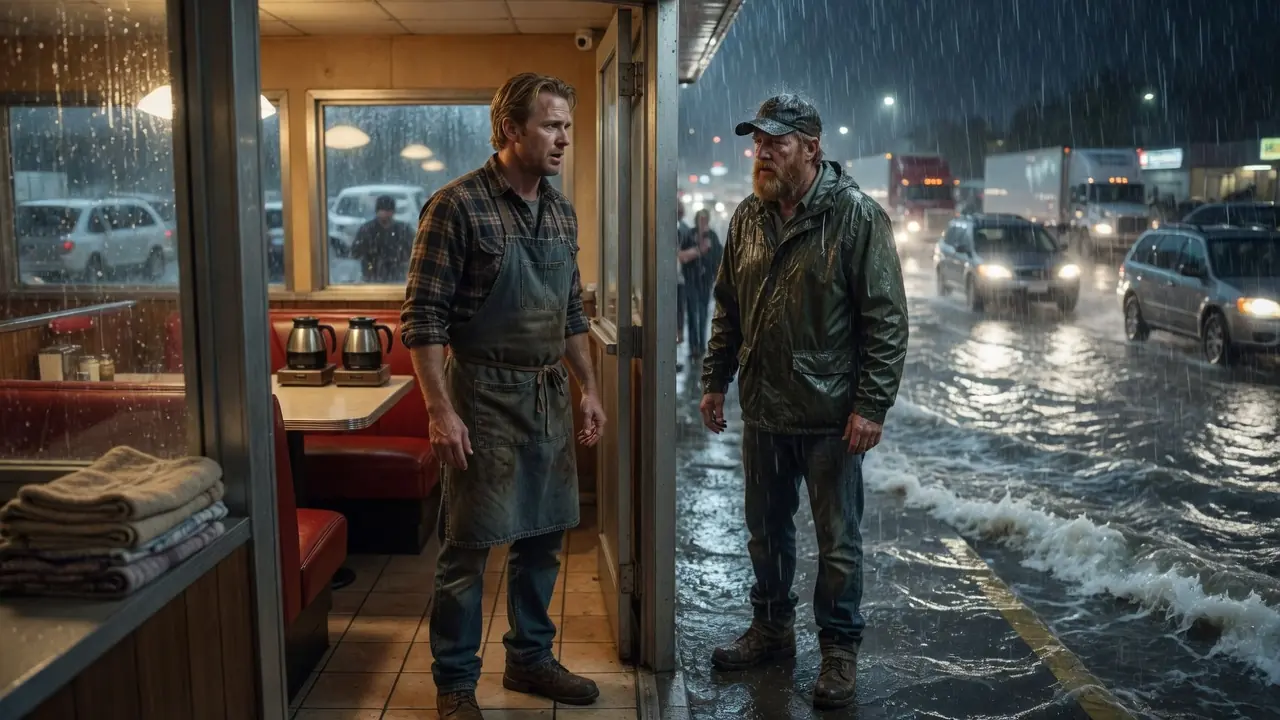
Caleb gave him space but stayed close enough to help if needed.
Russell spoke softly when someone answered.
“Marjorie? It’s me. I’m all right. I’m at a diner off 47. Road’s closed.”
A pause.
His face tightened.
“I tried, honey. I’m still trying.”
Another pause.
His eyes filled.
“I know. I love you too.”
Caleb looked down at the counter, pretending not to hear.
When Russell ended the call, he kept the phone in both hands.
“She told me not to be foolish,” he said.
“Sounds like a smart woman.”
“She is. Smarter than me. Meaner too, when she needs to be.”
Caleb smiled.
“That helps in marriage, I hear.”
Russell studied him.
“You married?”
“Was.”
“Sorry.”
Caleb shrugged, but not casually enough.
“She left three years ago.”
“And your boy?”
“With me.”
Russell looked toward Eli, who was now distributing cookies to three stranded drivers while explaining that oatmeal raisin counted as a warning, not dessert.
“Good boy.”
“Best thing in my life.”
“Then you’re richer than you look.”
Caleb laughed softly.
“That wouldn’t take much.”
The rain grew worse after midnight.
The highway remained closed.
Most people found places to rest: booths, chairs, the floor near the back wall, even the hallway near the storage room. Blankets appeared from vehicles. Coats became pillows. The retired nurse helped an older woman settle near the heater. Someone found a deck of cards and started a quiet game at the counter until exhaustion ended it.
Eli fell asleep in the back booth under a pile of coats.
Caleb covered him with his own jacket.
The diner settled into a strange, fragile peace.
Rain roared outside.
Inside, warmth held.
At 1:40 a.m., Caleb sat behind the counter with a cup of coffee he no longer wanted. His eyes burned. His feet hurt. His shirt smelled like soup and rainwater.
Russell was still awake near the window.
Caleb walked over.
“You should rest.”
“I can’t.”
“Worried about Marjorie?”
Russell nodded.
“Waiting feels like the only thing I can do that still counts as doing something.”
Caleb understood that more than he wanted to.
He had waited for Laura to call after she left.
Waited for his mother’s test results.
Waited for the bank to approve a small loan.
Waited for the diner to have a good month.
Waiting could feel like work when there was nothing else left.
“Tell me about her,” Caleb said.
Russell looked surprised.
“My wife?”
“Yes.”
The man’s face softened.
“She corrects people’s grammar when she’s nervous. She laughs at the wrong moments. She rearranged her hospital room yesterday because she said it felt too sad. She once made me turn around fifteen miles into a road trip because she forgot to say goodbye to the cat.”
Caleb smiled.
“She sounds strong.”
“She is.”
Russell looked down at his wedding band.
“She got sick last year. We thought it was one thing, then another, then something bigger. I kept telling her we’d handle it. She said I only use that phrase when I’m scared.”
“Was she right?”
“Always.”
The emergency radio crackled at 2:16 a.m.
Caleb stood so quickly his chair scraped the floor.
“Emergency update. Highway 47 remains closed to general traffic. Limited escorted travel may be available for medical necessity between Mile Marker 88 and Lexington route access. Contact state patrol for clearance.”
Russell looked up.
Caleb was already reaching for the phone.
He called the number from the radio. It took six minutes, two transfers, and one moment where he nearly lost patience with a dispatcher who sounded half-asleep.
Then he said, “I have a man here whose wife is in the hospital in Lexington. Surgery moved up. He’s stranded at Millie’s Diner near Mile Marker 91. If medical escort is open, he needs it.”
Russell stood slowly.
He looked afraid to hope.
Caleb gave the dispatcher Russell’s name, hospital details, and phone number. The retired nurse helped verify the situation. Twenty minutes later, a state patrol vehicle pulled into the lot, lights flashing through the rain.
Russell gripped his duffel bag.
“I can’t ask you to—”
“You didn’t ask,” Caleb said. “The road opened for people like you.”
Russell reached for his wallet.
Caleb raised a hand.
“No.”
“I need to pay for the coffee, the charger, the—”
“No,” Caleb repeated gently. “Just go.”
Russell looked at him for a long moment.
“Your name again?”
“Caleb.”
“Caleb Donovan,” Russell said. “I won’t forget this.”
Then he walked into the rain.
Caleb watched him climb into the patrol vehicle. The car pulled away slowly, red and blue lights dissolving into the storm.
Morning came gray and wet.
The rain softened around dawn but did not stop. Plows were not needed, but road crews were. Creeks had flooded, ditches overflowed, and sections of highway were covered with mud and debris.
By 8:30, emergency crews reopened one direction of Highway 47.
Travelers began leaving in small groups.
Some thanked Caleb.
Some pressed cash into the tip jar even after he said they did not need to.
Some wrote notes on napkins.
One little girl gave Eli a sticker shaped like a unicorn and told him his cookies had helped.
Eli accepted with great dignity.
By ten, the diner was nearly empty.
The floor was wet.
The trash cans were full.
The soup pots were empty.
The coffee machine looked exhausted.
Caleb stood behind the counter, hair messy, eyes heavy, back aching from a night without rest.
Eli slept in the booth again, one hand tucked under his cheek.
The bell rang.
Caleb looked up, expecting one more traveler or a local checking road conditions.
Instead, Russell Keane stepped inside.
He was soaked again but standing taller.
Beside him was a woman in a hospital coat beneath a heavy rain jacket, moving slowly but steadily with one hand on his arm.
Marjorie.
Caleb froze.
Russell smiled.
“She made it.”
Caleb came around the counter.
Marjorie reached him before he knew what to say.
Her voice was soft but steady.
“You kept my husband safe when he could not get to me.”
Caleb shook his head.
“I just kept the door open.”
Marjorie looked around the diner.
At the booths filled with folded blankets.
At the empty soup pots.
At the sleeping child in the corner.
At the wet floor and tired father behind the counter.
“No,” she said. “You kept more than a door open.”
Behind them, more vehicles pulled into the lot.
State transport trucks.
A community service van.
A county emergency management SUV.
A sheriff’s cruiser.
Caleb stared through the window.
“What is all this?”
Russell removed his wet cap.
“I made some calls from the hospital.”
Marjorie smiled faintly.
“And I made more. He leaves out the part where I am better at calls.”
A man in a county jacket entered carrying a clipboard.
“Mr. Donovan?”
Caleb nodded slowly.
“I’m Aaron Wells with county emergency management. We heard what happened here last night. Multiple drivers reported that this diner functioned as the only safe shelter point along this stretch of highway.”
Caleb blinked.
“It was just a storm.”
Aaron looked around.
“Storms are exactly when safe points matter.”
Another woman stepped forward.
“We’re putting together a severe weather response map for Highway 47. Your location is critical. If you’re willing, we’d like to designate Millie’s Diner as an emergency rain and storm shelter stop.”
Caleb glanced toward Eli.
“My diner is barely staying open.”
“That’s part of why we’re here,” Aaron said.
Russell placed a folder on the counter.
“I sit on the board of Keane Family Trust. We fund rural infrastructure and emergency access projects. Mostly boring things like generators, radio systems, roof repairs, and flood barriers.”
Marjorie touched the folder.
“Boring things that save lives.”
Caleb stared at it.
Russell continued.
“We want to fund upgrades for Millie’s Diner. A better generator. Roof repair. Emergency supply storage. Drainage improvements for the parking lot. A proper radio setup. Food support during declared weather emergencies.”
Caleb could not speak.
For months, he had been trying to figure out how to keep the refrigerator alive. Now strangers were talking about generators and flood barriers like miracles could arrive wearing county badges and rain jackets.
“I don’t understand,” he said finally.
Russell’s expression softened.
“Last night, you helped drivers in the rain. You helped me reach my wife. You gave my fear somewhere warm to sit until the road opened.”
Marjorie stepped closer.
“People think shelter has to be a big building with official signs. Sometimes it is a tired single father with soup, coffee, and enough courage not to lock the door.”
Caleb looked down.
His throat tightened.
“My mother would have liked that.”
“What was she like?” Marjorie asked.
Caleb looked toward the old photograph near the register. Millie Donovan stood there in a red apron, one hand on her hip, smiling like she had just won an argument.
“She believed nobody should feel forgotten if there was coffee left in the pot.”
Russell nodded.
“Then let’s make sure her diner keeps the pot full.”
The next months changed Millie’s Diner.
Not into something fancy.
Caleb refused that.
The red booths stayed.
The counter stayed.
The old photograph of Millie stayed by the register.
But the roof was repaired. The parking lot drainage was improved. A new generator was installed behind the building. Emergency shelves were added in the storage room with blankets, bottled water, flashlights, basic medical supplies, phone chargers, and shelf-stable food.
A county radio sat behind the counter.
The neon sign was rewired, and for the first time in years, it glowed steady through the rain.
A new sign appeared near the entrance:
MILLIE’S DINER
Highway 47 Storm Safe Stop
Coffee, Warmth, Phone Access, Emergency Coordination
Eli read it out loud the day it was installed.
“Storm safe stop,” he said proudly. “Dad, does that mean we’re official?”
Caleb looked at the sign.
“I guess it does.”
“Grandma Millie would like it.”
Caleb swallowed.
“Yeah, buddy. She would.”
Earl returned to work part-time and immediately complained about the new shelves taking up “perfectly good complaining space.” The retired nurse, Carol, began volunteering during major weather warnings. Ben the mechanic stopped by twice a month to inspect the generator. The red-bearded trucker became a regular and brought a box of donated blankets from his company.
Russell and Marjorie visited often.
Marjorie recovered slowly, but she recovered. She and Eli became friends after she taught him a card game and let him win twice before admitting she was “ethically flexible with children.”
Russell always paid for coffee, even when Caleb told him not to.
“You got the first night,” Russell said. “I get the rest.”
The story spread along the highway.
Drivers learned that if the rain got bad near Mile Marker 91, Millie’s was the place with lights on.
Some came in during storms.
Some came in on clear days just to thank Caleb because they had heard.
A year later, another heavy rain moved across eastern Kentucky.
The emergency radio warned of flooding before sunset.
Caleb stood behind the counter, listening.
Eli sat in the back booth doing homework, older now, still losing one shoe somehow even while sitting still.
The first truck pulled in at 6:52.
Then another.
Then a family in a minivan.
Then a young delivery driver with shaking hands who said water had come over the road near the bridge.
Caleb looked around the diner.
The generator was ready.
The soup was hot.
The shelves were stocked.
The sign glowed steady through the rain.
He stepped behind the counter and raised his voice.
“Coffee’s on. Towels by the door. If you’re cold, sit anywhere. If you’re scared, that’s allowed too.”
Eli looked up.
“Dad?”
“Yeah?”
“Am I in charge of cookies again?”
Caleb smiled.
“You always were.”
The boy grinned and reached for the tray.
Outside, rain covered the highway.
Inside, Millie’s Diner stayed open.
Not because it was big.
Not because it was perfect.
Not because Caleb Donovan had planned to become anyone’s hero.
He was just a single father trying to keep a diner alive, raise a good son, and honor the mother who taught him that people needed more than food when the world turned hard.
They needed light.
They needed warmth.
They needed a place where someone looked at them and said, “You made it.”
Years later, when people told the story, they often said Caleb saved those drivers in the rain.
Caleb always shook his head.
“I didn’t save anyone,” he would say. “I just didn’t close the door.”
But everyone who had been there knew the truth.
Sometimes not closing the door is the whole miracle.
Sometimes a warm place does not need to be large.
It only needs to stay open when everything else shuts down.
And sometimes, one exhausted father with a pot of coffee, a sleeping child, and a stubborn heart can turn a roadside diner into shelter for everyone trying to make it home through the storm.