The rain hammered downtown Seattle as if the sky had decided the city deserved punishment.
It came down in hard silver sheets, bouncing off taxi roofs, flooding gutters, soaking the hems of expensive coats, and turning every crosswalk into a shallow river.
Office workers ran beneath umbrellas. Delivery riders cursed under their breath. Buses hissed at curbs, sending dirty water over the sidewalks.
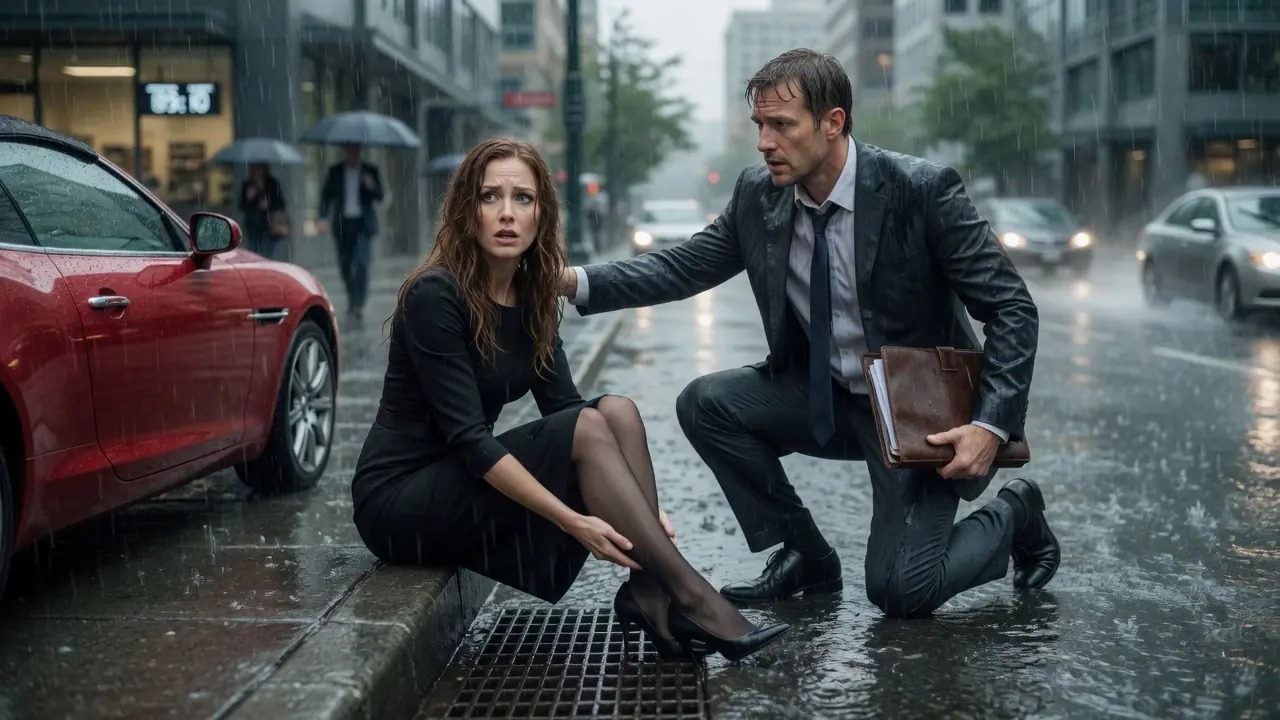
James Carter ran through all of it.
His only suit was already soaked through.
The navy jacket clung to his shoulders. His white shirt stuck cold against his skin. His tie had gone crooked somewhere near Third Avenue, and his shoes made wet, humiliating sounds every time they hit the pavement.
He kept running anyway.
Seventeen minutes.
That was all he had left.
Seventeen minutes until the most important interview of his life.
Seventeen minutes until he sat across from a hiring panel at Halden Aerospace Systems and tried to explain why a man who had once been one of Boeing’s most promising engineers had spent the last four years driving Uber, stocking shelves, and writing technical manuals at two in the morning.
Seventeen minutes until he tried to turn his entire life around.
For himself.
For his son.
For Liam.
James checked his watch again as he reached the corner of Madison and Fifth.
The rain blurred the glass face.
He wiped it with his sleeve.
1:43 p.m.
His interview was at 2:00.
The building was only eight blocks away.
If he kept running, he could still make it.
Late, maybe.
Wet, definitely.
But present.
And in James Carter’s life, present had become a form of victory.
He pushed forward, lowering his head against the wind.
Then, from the curb ahead, a red Mercedes jerked crookedly into view.
It rolled halfway into a loading zone, its hazard lights blinking through the downpour. The driver’s door opened, and a woman stepped out.
The first thing James noticed was the black dress.
Not because he had time to notice fashion, but because everything about her looked violently out of place in the storm. The dress was sleek, expensive, and perfectly cut, the kind of black dress that belonged beneath gallery lights or in a private boardroom, not beside a flooded Seattle curb at one forty-three in the afternoon. It fell just below her knees, elegant and severe, with a narrow belt at her waist and a tailored black coat hanging open over it.
She stepped down too quickly.
Her heel caught in the metal grate of a storm drain.
Her ankle twisted.
She went down hard.
James stopped running.
Only for half a second.
The woman hit the sidewalk with one hand out, her shoulder striking the wet concrete. Her phone skidded toward the curb. The Mercedes door hung open. Rain immediately soaked her hair, her coat, the black dress, everything.
Cars splashed past.
Nobody stopped.
A man under a large umbrella glanced over, then looked away.
A cyclist swerved around her with irritation.
A woman in a tan trench coat slowed just long enough to make sure someone else would surely handle it.
No one did.
James checked his watch.
Sixteen minutes.
He looked toward the towers ahead, where his future might still be waiting inside an interview room.
Then he looked back at the woman struggling to sit up in the rain.
She tried to stand and gasped, her face going pale.
James closed his eyes.
He already knew what this would cost him.
He turned around and ran back.
“Don’t move,” he called over the rain. “You’re going to make it worse.”
The woman looked up sharply.
Even in pain, she had the kind of face that seemed trained never to ask for help. Sharp cheekbones. Dark hair plastered against her jaw. Gray eyes narrowed against rain and embarrassment. Her mouth tightened as if she resented the weakness of having fallen.
“I’m fine,” she said.
“You are absolutely not fine.”
“I said I’m—”
She tried to push herself up again.
Pain cut the sentence from her mouth.
James dropped to one knee beside her, rainwater soaking instantly through his pants.
“Your heel caught in the drain,” he said. “Your ankle rolled inward. Don’t put weight on it until we know how bad it is.”
She stared at him.
“You a doctor?”
“No.”
“Then how do you know that?”
“My son believes furniture is a climbing system designed by cowards,” James said, gently reaching for her fallen phone. “I’ve gotten very good at sprains.”
Despite the pain, one corner of her mouth moved slightly.
Almost a smile.
Almost.
James handed her phone back, then looked toward the coffee shop on the corner.
“There’s a Starbucks twenty feet away. Can you lean on me?”
“I can call my driver.”
“Great. Call him from inside where your ankle isn’t sitting in freezing rain.”
She hesitated.
That hesitation told James more than she probably meant it to.
This woman was used to control.
Used to giving orders.
Used to being obeyed.
She was not used to needing a stranger’s arm to cross a sidewalk.
James softened his voice.
“I’m not trying to take over. I’m trying to get you out of the street before a delivery truck turns you into a headline.”
She looked at him again.
Then at the water running along the curb.
Then at the cars rushing by.
Finally, she nodded once.
“Fine.”
James helped her up carefully.
The moment she put weight on the injured foot, her body folded toward him. He caught her around the waist with one arm and took most of her weight.
She was trembling.
From cold.
From pain.
Maybe from humiliation.
Maybe from the fact that twenty people had walked past her and only one soaked stranger had stopped.
“You’re lighter than my son’s backpack,” James said, trying to distract her.
“That sounds impossible.”
“He packs rocks.”
“Why?”
“He says they’re important rocks.”
“Are they?”
“To him, yes.”
She gave a breathless laugh, then winced as they reached the curb.
James shifted his hold.
“Sorry.”
“It’s fine.”
“No, it isn’t. But we’re almost there.”
They moved slowly, step by painful step, toward the Starbucks. James opened the door with his shoulder, guided her inside, and helped her into the nearest chair.
Warm air washed over them.
The woman’s face had gone white beneath the rain.
James knelt in front of her and gently lifted her injured foot just enough to loosen the strap of her shoe.
She looked down at him.
“You’re getting your suit ruined.”
“It was already losing the fight.”
“Were you going somewhere?”
He did not answer immediately.
That told her enough.
“An interview?” she asked.
James glanced at his watch.
1:48.
Twelve minutes.
“Yes.”
Her expression changed.
“Go.”
“You need ice.”
“I can get ice.”
“You almost fell trying to stand on it.”
“I can call someone.”
“Then call someone after I get the swelling under control.”
She stared at him as if he were a problem she had not decided how to categorize.
“You don’t even know me.”
James looked up.
“No. But I saw you fall.”
“That’s enough?”
“It should be.”
For some reason, that made her quiet.
James turned toward the counter.
“Can I get a bag of ice and a towel, please?”
The barista, a young man with anxious eyes, nodded quickly.
“Yeah. Of course.”
When James turned back, the woman was studying him.
Not casually.
Not the way strangers look at each other.
She was taking inventory.
Cheap suit.
Wet tie.
Calloused hands.
A face tired in the specific way of someone who never got enough sleep.
“You should go,” she said again, softer this time. “Your interview matters.”
James took the towel and bag of ice from the barista, wrapped the ice, and set it carefully against her ankle.
“It did.”
“Did?”
He looked at the clock behind the counter.
1:51.
“Nine minutes away. Eight blocks. In this rain.” He gave a short, resigned laugh. “They were very clear. Late arrivals are not considered.”
Her eyes sharpened.
“What company?”
“Halden Aerospace.”
Her expression flickered, but she controlled it quickly.
“Important?”
“For me, yes.”
“Then why are you still here?”
James looked at her ankle, then at the rain running down the window.
Because Sarah would have stopped.
Because Liam was watching every choice he made, even when Liam was not present.
Because a job built on walking past someone in pain would not be the fresh start he wanted.
Because once, years ago, James had chosen truth over career, and he had lost everything except his ability to sleep at night.
He said only, “Because you’re hurt.”
For the first time, the woman looked away.
The barista came over with another towel.
James thanked him and gently placed it around the woman’s shoulders.
“You should call your driver,” he said.
She looked at the phone in her hand, then seemed to realize she had not actually done it yet.
“Yes.”
She made the call with a tone so calm and precise that James understood she was someone important before she said a single revealing word.
“Graham, I’m at the Starbucks on Madison and Fifth. I fell. I need the car brought around and someone to help me inside. No, do not send a press notice. Just come.”
She hung up and looked at James.
“Thank you.”
“You’re welcome.”
“What’s your name?”
James stood, grimacing as his wet knees complained.
“James Carter.”
Something crossed her face.
Something very quick.
Recognition, maybe.
Or just the way rich people remembered names as tools.
“I’m Victoria Lane.”
James nodded politely.
He had heard the name, of course.
Everyone in Seattle had heard the name.
Victoria Lane.
CEO of Lane Dynamics.
The woman who inherited a defense contracting empire during a federal scandal and somehow kept it from collapsing. The business press called her brilliant. Employees called her terrifying. Online articles called her the Ice Queen of Seattle, which always seemed like a cruel thing to say about someone no one actually knew.
James looked at the woman in the black dress sitting in front of him, soaked and shivering, one ankle swelling beneath a towel full of ice.
She did not look like a queen.
She looked lonely.
He did not say that.
“Well, Ms. Lane,” he said, “try not to stand until your driver gets here. And if the swelling gets worse, urgent care.”
“You’re leaving?”
“I’ve officially missed the interview. But I still need to pick up my son from school in a few hours, and I need time to figure out how to explain why Daddy came home looking like he wrestled a rain gutter.”
She watched him reach for his messenger bag.
“James.”
He turned.
“Give me your phone number.”
That made him pause.
“Why?”
“So I can make sure you didn’t lose an opportunity because of me.”
“I didn’t do it for repayment.”
“I know.”
The way she said it was quiet.
Almost sad.
“That is why I’m asking.”
James hesitated.
Then he wrote his number on a napkin with a borrowed pen.
Victoria took it carefully, as if it mattered more than paper should.
Her driver arrived three minutes later with an umbrella, a security aide, and the kind of controlled panic that rich people’s staff displayed when something had gone wrong but nobody wanted to be blamed for noticing.
By then, James was already walking back into the rain.
Victoria watched him disappear through the wet window.
His suit was ruined.
His interview was gone.
His shoulders were squared anyway.
She had built an entire life around people who calculated advantage before kindness.
James Carter had chosen kindness when it cost him.
Victoria kept looking at the napkin long after his figure vanished into the storm.
James Carter had not always been the kind of man who ran through downtown Seattle in a soaked suit for a job interview that could decide whether his son got new shoes that winter.
Five years earlier, he had been lead engineer at Boeing’s experimental propulsion division, working on systems that could have changed commercial aviation.
He had an office with a window that overlooked Mount Rainier on clear days, which in Seattle meant maybe twice a month. But when the mountain appeared through the clouds, James would stop whatever he was doing and stare.
It reminded him that some things were worth waiting for.
Worth working toward.
Even when they seemed impossibly distant.
Back then, he was thirty-one, married, hopeful, and still naive enough to believe competence and integrity could protect a person.
He had met Sarah at a conference on sustainable aviation in Denver.
She was presenting a paper on biofuel stability when the projector failed. Her slides disappeared right as she reached the most technical portion of her presentation, leaving her standing before three hundred researchers with a dead screen and panic rising visibly in her cheeks.
James had been sitting in the third row.
He stood without thinking.
“May I?”
Sarah blinked.
“Yes. Please.”
He walked to the front, crouched beside the projector, checked the cable, reset the display source, and fixed the problem in thirty seconds.
Her slides flashed back onto the screen.
The room applauded politely.
Sarah looked at him with such gratitude that he forgot how to walk back to his seat properly. He bumped into two chairs and nearly knocked over someone’s coffee.
After the presentation, she found him at the coffee station.
“My hero,” she said.
James spilled sugar all over his shoes trying to play it cool.
They were married fourteen months later in her parents’ backyard in Spokane.
Sarah wore her grandmother’s dress, altered to fit, but still faintly smelling of lavender and age. James had written his vows, but forgot them completely the moment he saw her walking toward him.
So instead, he promised to love her, fix all her projectors, and try not to spill things whenever she made him nervous.
The crowd laughed.
Sarah cried.
Her father clapped him on the shoulder afterward and said, “Take care of her.”
As if James could imagine doing anything else.
Their house in Queen Anne was a 1942 Craftsman that needed everything fixed.
James spent weekends learning plumbing from YouTube videos, rewiring outlets with the power off while Sarah stood in the doorway holding a flashlight and saying, “Are you sure you know what you’re doing?”
“No,” he would answer.
“Good. I appreciate honesty.”
She painted every room a different color.
Forest green in the bedroom.
Deep purple in the bathroom.
A shade of yellow in the kitchen she insisted was butterscotch dream, though James maintained until the day he moved out that it was mustard.
He loved it all because she loved it.
When Sarah got pregnant, she documented everything in a journal that would later become James’s most treasured possession.
Every craving.
Every kick.
Every strange dream.
Every three a.m. moment when she would wake him, place his hand against her stomach, and whisper, “Feel that? He’s either dancing or trying to install shelves.”
James thought their child would be an engineer because the baby seemed incapable of stillness.
Sarah disagreed.
“This little one is going to be an artist,” she wrote. “He moves when I sing. He kicks when it rains. He knows beauty already.”
Liam arrived during a thunderstorm, two weeks early and apparently offended by scheduling.
The birth was complicated.
Sarah hemorrhaged badly enough that they rushed her into emergency surgery.
James stood in a hallway holding his minutes-old son, watching through a small window while doctors fought to save his wife.
A nurse found him there an hour later, still standing, still holding Liam, tears streaming silently down his face.
“She’s okay,” the nurse said. “She’s asking for both of you.”
James ran so fast that another nurse shouted at him.
The first two years of Liam’s life blurred together in James’s memory like watercolor in rain.
Sarah singing him to sleep with made-up songs about elephants who wore fancy hats.
James building elaborate block towers for Liam to demolish with prehistoric glee.
Sunday mornings at Pike Place Market, Liam strapped to James’s chest, Sarah buying too many flowers because she could never choose one bouquet.
She had been teaching kindergarten then, coming home covered in finger paint, glitter, and stories about children who believed butterflies were fancy moths and marriage meant someone who shared fruit snacks.
The day Sarah died, it had also been raining.
James remembered that detail with painful clarity.
She kissed him goodbye that morning tasting of coffee and cinnamon toast, complaining that her umbrella had broken and she would have to run from the school parking lot.
He offered her his.
She refused.
“You need it for your big presentation.”
“I can handle rain.”
“So can I.”
“Sarah.”
“Go change the world, engineer man.” She pushed him playfully toward the door. “I’ll just go change some five-year-old’s pants when they have an accident.”
Those were her last words to him.
About pants.
The call came at 2:47 p.m.
James knew the exact time because he had been checking his watch, waiting for his turn to present to the board.
Sarah had collapsed during story time.
By the time the ambulance reached the school, she was gone.
Brain aneurysm.
Instant.
Painless.
The doctors kept saying painless as if it were a gift.
As if Liam growing up without his mother hurt less because she had not suffered.
As if James waking up alone for the rest of his life in their mustard-yellow kitchen could be softened by medical efficiency.
The funeral was a blur.
Sarah’s parents took Liam for a week while James sat in the house surrounded by her colors, her dying flowers, her coffee mug still in the sink with lipstick on the rim.
He tried to return to work.
But meetings about profit margins and production schedules felt obscene.
His boss offered extended leave.
HR sent flowers.
His team lead told him to take all the time he needed.
What James needed was to be a father fully and completely.
Without distraction.
Without divided loyalty.
But grief was not the only reason he left Boeing.
The darker reason was buried in sealed files, whispered conversations, and one report that had nearly destroyed him.
Three months before Sarah’s death, James discovered critical safety flaws in a new 787 production line. Specific stress points in the fuselage could cause catastrophic failure under rare but possible flight conditions.
He ran the simulations dozens of times, hoping he was wrong.
He was not.
He reported it through proper channels, expecting immediate action.
Instead, his supervisor, Thomas Marshall, buried the report.
“Hypothetical risks,” Marshall said.
“Critical risk under specific load conditions,” James corrected.
“The planes are already sold.”
“That doesn’t make them safe.”
“The contracts are signed.”
“That doesn’t make them safe.”
“The stock price cannot take this kind of hit right now.”
James stared at him.
“You’re talking about stock price. I’m talking about people falling out of the sky.”
Marshall’s eyes went cold.
“Careful, James.”
James was careful.
For exactly two days.
Then he threatened to go to the FAA directly.
That was when the machine turned on him.
Suddenly, there were discrepancies in his expense reports from years earlier, small amounts easily explained but arranged to look like a pattern. There were questions about his mental state after Sarah died, though the accusations had begun before her death and continued after it because grief made him easier to discredit. There were suggestions that he had become paranoid, unstable, untrustworthy.
Marshall offered him a choice.
Resign quietly with a modest severance and keep his reputation intact, or be fired for embezzlement and blacklisted across the industry.
James had Liam to think about.
A two-year-old son.
Medical bills from Sarah’s death.
A mortgage.
No emotional strength left for war.
So he took the deal.
Six months later, he heard through former colleagues that the safety issues had been quietly fixed after a near disaster during a test flight.
No one admitted James had been right.
No one apologized.
His official resignation letter was two sentences.
I appreciate the opportunities Boeing has provided.
My son needs me more.
The house sold quickly in Seattle’s hot market.
James found a two-bedroom apartment in Northgate near a decent elementary school. He drove Uber during school hours in a ten-year-old Camry that smelled perpetually of other people’s coffee. He stocked shelves at Target overnight when Liam stayed with Sarah’s parents. He did freelance technical writing at the kitchen table, translating engineering specifications into plain English while Liam slept down the hall.
Every month became arithmetic.
Rent.
Groceries.
Utilities.
Preschool fees.
Gas.
Medical insurance.
Shoes because Liam kept growing.
Emergency savings that never quite became savings because emergencies kept happening.
James did not complain.
Complaining did not pay bills.
He had Liam.
Liam was everything.
Victoria Lane had been groomed for greatness since birth, though no one had ever asked if greatness was what she wanted.
Her father, Marcus Lane, started Lane Dynamics in a garage in Tacoma with a laptop, a Navy background, and a talent for making powerful men believe he could make them more powerful.
By the time Victoria was five, the company had its first Pentagon contract.
By the time she was ten, they had moved to a mansion in Medina with gates, guards, and a view of Lake Washington that cost more than most families’ entire homes.
Marcus raised Victoria like a successor, not a daughter.
Dinner conversations were about market strategies, political risk, hostile takeovers, supply chains, and contract leverage.
Bedtime stories were annual reports and acquisition proposals.
When other girls played with dolls, Victoria sat in board meetings, silent and absorbing.
She learned to read people’s faces during negotiations.
She learned to spot weakness in a contract clause.
She learned that power was not money.
Power was information and the will to use it.
Her mother, Evelyn, left when Victoria was twelve.
The divorce was quiet and sealed behind lawyers, nondisclosure agreements, and the kind of money that made private pain disappear from public record.
Victoria learned from a gossip blog that her mother had moved to Italy with an art dealer.
Marcus’s only comment was, “She lacked focus.”
Victoria learned not to lack focus.
She learned to be perfect.
Controlled.
Necessary.
Everything except happy.
Wharton at eighteen had been Marcus’s idea, but Victoria threw herself into it with desperate intensity. She graduated in three years, summa cum laude, with a thesis on emerging defense technologies that received attention from people whose names never appeared in newspapers.
Her professors called her brilliant.
Her classmates called her terrifying.
Both were true.
She returned to Seattle at twenty-one and stepped directly into a vice president role at Lane Dynamics that everyone knew had been created for her.
The company became her entire world.
She lived in a penthouse ten minutes from the office, though she often slept on the couch in her executive suite. She knew every major contract, every department head, every budget line, and every weakness in the company’s competitors.
When Marcus had his first heart attack at sixty-two, Victoria took over seamlessly.
When he returned four months later, he found she had increased profits by eighteen percent and secured three new government contracts.
“Good,” he said.
Nothing more.
She had tried relationships in the same clinical way she approached corporate strategy.
Men from appropriate backgrounds with appropriate portfolios and appropriate ambitions.
David, the investment banker who spoke four languages but could not discuss anything except money.
Richard, the tech founder who brought his laptop to bed and checked stock prices during intimate moments.
Thomas, the senator’s son, who proposed on their sixth date with a ring worth more than most houses and a prenuptial agreement already drafted.
Victoria said yes to Thomas because it made sense.
Marcus approved.
The merger of families, money, influence, and political access was clean.
Strategic.
Logical.
The engagement lasted four months.
She found Thomas with her best friend in his apartment, in the bed where Victoria had tried very hard to feel something beyond mild satisfaction and a sense of checking off a box marked intimacy.
The betrayal should have hurt more than it did.
Instead, she felt relief.
She did not have to pretend anymore.
At least not about that.
Marcus Lane’s death came suddenly.
Unlike everything else in his calculated life.
The FBI raid on Lane Dynamics headquarters was for charges Victoria had not seen coming.
Twenty years of systematic bribery.
Defense officials bought and sold like assets.
Consultants acting as middlemen.
Contracts steered.
Audits buried.
Marcus had built his empire on a foundation of corruption so deep, so carefully hidden, that Victoria had not known where to look.
Or maybe, in the most private corner of herself, she had not wanted to look.
When federal agents entered the building, Marcus was crossing the lobby after lunch.
The stress triggered a massive coronary.
Victoria ran from her office, heels clicking over marble, reaching him just as he collapsed.
She held him on that cold floor while federal agents stood around them with guns, warrants, and careful expressions.
Marcus grabbed her wrist hard enough to leave bruises for weeks.
“Don’t let them take it,” he gasped. “Don’t let them win.”
Those were his last words.
Not I love you.
Not I’m sorry.
Just business.
Even dying.
The aftermath nearly destroyed the company.
The stock price collapsed sixty percent in three days. The board called emergency meeting after emergency meeting, half of them demanding Victoria’s resignation. The media painted her as complicit or incompetent, neither option leaving room for the truth.
She had been so desperate for her father’s approval that she had made herself blind to his methods.
Federal investigators combed through everything.
They found no evidence of her involvement because there was none.
Victoria had been many things to Marcus Lane.
But never trusted.
Not enough to be included in his crimes.
She saved the company through force of will and strategic brutality.
She fired every executive tied to the bribery network.
She brought in an independent compliance team and gave them power no one at Lane Dynamics had ever held.
She testified before Congress for twelve hours, answering every question with precision so cold the clips went viral.
One paper called her The Ice Queen of Seattle.
She cut out the article and framed it in her office.
Not because she liked it.
Because survival sometimes meant becoming exactly what people claimed you were.
But at night, in her glass penthouse thirty floors above the city, Victoria fell apart.
She had panic attacks in the bathroom, sitting on Italian marble that cost more than most people’s monthly rent, sobbing until she could not breathe.
She stood on her balcony at three in the morning and wondered what it would feel like to step off.
Not because she wanted death exactly.
Because she wanted stillness.
She never did it.
Not because she wanted to live.
Because dying felt like letting them win.
And Marcus had taught her never to let anyone win.
The morning she met James, she had been driving to another emergency board meeting.
Richard Donnelly, her largest individual shareholder and most vocal critic, had called it to discuss leadership concerns.
Victoria knew what that meant.
He wanted her removed.
Replaced with someone easier to steer.
Someone who would smile more, question less, and let shareholders treat the company like prey.
She had been strategizing her counterattack while driving through downtown Seattle, one hand on the wheel, one ear listening to her legal counsel through the car speakers.
Then the rain started.
Sudden.
Violent.
Obliteration.
The kind of Seattle storm that made the streetlights blur and the road disappear.
She pulled over to end the call and compose herself before the meeting. She had stepped out of the Mercedes because sitting still in the car felt like suffocating.
Then her heel caught.
She fell.
Hard.
For a second, Victoria lay on the sidewalk with rain soaking her black dress and thought:
This is my life.
I could collapse right here and the only people who would care would be the ones afraid of losing their jobs.
Then James appeared.
Running the wrong direction.
And everything changed.
He did not know who she was.
She could tell.
There was no calculation in his face.
No recognition.
No sudden performance of respect.
To him, she was simply a woman in a black dress who had fallen in the rain.
The simplicity of that almost broke her.
By the time her driver arrived and helped her into the back of the Mercedes, Victoria was no longer thinking about Richard Donnelly’s board meeting.
She was thinking about James Carter.
The man who had ruined his suit, missed his interview, knelt in dirty rainwater, and said, “It should be,” when she asked if seeing someone fall was enough reason to help.
That evening, her security team found him using traffic cameras and public records.
James Carter.
Thirty-five.
Widowed.
One son.
Former lead engineer at Boeing.
Multiple patents.
Current income from rideshare driving, overnight retail stocking, and freelance technical writing.
Residence: Northgate.
No criminal record.
No outstanding debts except medical debt that had been paid down slowly over four years.
The Boeing file came later.
It took Victoria’s head of security three hours to discover what official records did not say.
The safety report.
The buried simulations.
The supervisor.
The blacklisting.
Victoria read everything twice.
Then a third time.
James Carter had already sacrificed his career once for doing the right thing.
Then he had done it again, in the rain, for her.
She made a decision that went against every professional instinct her father had carved into her.
She was going to make this right.
Three days later, Victoria knocked on James’s apartment door at seven in the evening.
The building was tired-looking, one of those complexes renovated just enough to justify higher rent but not enough to remove the smell of old carpet from the hallway.
The hallway smelled like someone’s dinner, something with garlic and onions. Children’s voices echoed from above. A baby cried behind a closed door somewhere nearby.
Victoria almost turned around.
This was not her world.
That was exactly why she stayed.
She knocked.
James opened the door with a dish towel over one shoulder and surprise on his face.
He looked different in jeans and a faded T-shirt.
Younger.
Warmer.
Still tired.
Behind him, a small boy sat at a kitchen table, tongue poking from the corner of his mouth as he worked carefully with crayons.
“Ms. Lane,” James said. “How did you find me?”
“I’m very good at finding people.”
“That sounded less reassuring than you probably intended.”
“Yes,” she admitted. “May I come in?”
He hesitated.
Then stepped aside.
The apartment was small but meticulously clean. Toys were organized into labeled bins. Children’s artwork covered the walls like gallery pieces. The couch had a blanket folded neatly over one arm. The furniture was old but well cared for. Everything had a place because there was not enough room for anything not to.
It smelled like laundry detergent, crayons, apples, and something Victoria would later recognize as peace.
“Liam,” James said, “this is Ms. Lane. She’s someone from Daddy’s work.”
The boy looked up.
“You don’t have work today.”
James coughed.
“Potential work.”
Liam studied Victoria with serious eyes.
“Are you the lady with the hurt foot?”
Victoria blinked.
“How did you know?”
“Dad said he helped a lady with a hurt foot and that’s why he was late to his meeting and they said he couldn’t have the job, but it was okay because helping people is more important than jobs.”
He delivered the entire explanation in one breath, then added, “Do you want to see my dinosaur collection?”
“Maybe later, buddy,” James said quickly. “Why don’t you finish your picture?”
Liam returned to coloring, though he kept glancing at Victoria with open curiosity.
Victoria placed a leather folder on the coffee table.
“I want to hire you.”
James looked at the folder.
“For what?”
“Technical consulting for Lane Dynamics. Aerospace contract review. Systems integrity. Safety compliance. Quality control. Preventing the kind of disaster Boeing tried to hide.”
James’s face went carefully blank.
“You looked me up.”
“I look everyone up.”
“That’s unsettling.”
“It’s efficient.”
“Those are not always different things.”
Despite herself, she almost smiled.
Then she became serious.
“I know what happened at Boeing. I know your report was right. I know they buried it. I know they forced you out.”
James’s jaw tightened.
“That file is sealed.”
“Badly.”
“Victoria.”
It was the first time he had used her first name.
She felt it.
“I also know,” she continued, softer now, “that you deserve better than working three jobs while men who lied about safety keep getting promoted.”
“I’m not in a position to take a traditional job,” James said. “My son needs routine. I can’t work sixty-hour weeks. I can’t travel. I can’t pretend my life is structured around a company anymore.”
“I’m not offering a traditional job.”
He said nothing.
She opened the folder.
“Remote work. Flexible hours. You work when Liam is at school or asleep. No office requirement unless you choose it. No travel unless approved by you first. Full benefits, including dependent medical coverage. Salary is on the second page.”
James picked up the offer.
His eyes widened despite his effort to hide it.
The number was not just generous.
It was life-changing.
He stared at it too long.
Then he set the paper down.
“Why?”
Victoria looked toward Liam, who was now drawing what appeared to be a dinosaur wearing glasses.
Then back at James.
“You turned back.”
“That’s not enough reason to hire someone.”
“It is enough reason to listen. Your qualifications are why I’m hiring you.”
“You don’t know if I’m as good as I used to be.”
“I do.”
“How?”
“Because people who care enough to stop in the rain do not stop caring when they open an engineering file.”
James looked away.
That landed somewhere he did not want it to.
Victoria stood.
“Take time to think. My number is in the folder. Call when you decide.”
At the door, she paused.
“One more thing. Thomas Marshall now consults for Apex Dynamics. My largest competitor.”
James went still.
Victoria said, “Helping me means beating him.”
Then she left.
Two days later, James accepted.
His first report was on a drone guidance contract.
He found seventeen flaws in the first hour.
By midnight, he had written a thirty-two-page analysis so precise and readable that Victoria forwarded it to the board with one sentence:
This is why we hire people who care more about safety than schedules.
The calls started professionally.
Victoria would phone James to discuss a contract issue. He would answer from his kitchen table, where Liam sometimes asked questions in the background.
“Dad, what’s torque?”
“Rotational force.”
“Can dinosaurs have torque?”
“Only if they spin.”
Victoria would listen despite herself.
A five-minute call became twenty minutes.
Then forty.
Then an hour.
She learned that James sang Beatles songs in the shower, badly but sincerely.
He learned that Victoria had never learned to ride a bike because Marcus considered it an inefficient use of time.
She learned he read Liam three stories every night and did different voices for each character even when exhausted.
He learned she had panic attacks in bathrooms and counted backward in French because it gave her brain something structured to hold.
She learned he still wore his wedding ring on a chain under his shirt.
He learned she slept with every light off because she could not stand seeing her own reflection in the penthouse windows at night.
They were not flirting.
Not exactly.
They were simply telling the truth in pieces.
And somehow that was more intimate.
Six weeks after the offer, Victoria appeared at James’s apartment on a Saturday morning with pastries from a French bakery downtown.
“I was nearby,” she said when he opened the door.
James looked behind her at the very un-nearby neighborhood.
“No, you weren’t.”
“No,” she admitted. “I wasn’t.”
Liam ran from the kitchen in dinosaur pajamas.
“The foot lady!”
“Liam.”
“She brought food.”
“That part is more important,” James said.
Victoria stepped inside.
The kitchen was a disaster.
A pan smoked on the stove. Eggs clung stubbornly to the bottom. James wore an apron that said Dad’s Kitchen in Liam’s handwriting. His hair was a mess. His expression suggested a man betrayed by breakfast.
“I was trying to make omelets,” he said.
Victoria stared at the pan.
“This is not an omelet. This is evidence.”
“Helpful.”
“Move.”
“I didn’t know you cooked.”
“I don’t.”
“Then why are you taking over?”
“Because your eggs are suffering.”
She rescued what she could. The omelets became scrambled eggs with cheese and vegetables, and Liam declared them “fancy breakfast pieces.”
They ate at the small table.
Liam talked about school, dinosaurs, his friend Marcus who could burp the alphabet, and his teacher, Mrs. Chen, who said caterpillars did not become butterflies because of magic even though Liam remained suspicious.
Victoria listened.
Actually listened.
She asked questions.
Liam lit up every time she did.
“Do you have kids?” Liam asked suddenly.
James froze.
“Liam.”
Victoria placed her coffee down.
“No.”
“Why not?”
“Liam,” James warned again.
“It’s okay,” Victoria said quietly.
She thought about the penthouse. The boardrooms. The men who proposed mergers instead of love. The years she had given to a company that could not hug her back.
“I guess I was too busy working to have a family.”
Liam considered that with grave sadness.
“That’s bad.”
Victoria blinked.
“Is it?”
“Yeah. Everyone should have family. Me and Dad are small, but we’re good.”
Victoria’s eyes burned.
“Yes,” she said softly. “You are.”
Visits became a pattern no one acknowledged.
Victoria came with contracts.
Then reports.
Then pastries.
Then soup because James mentioned a cold.
Then a children’s engineering kit she saw in a store window and bought for Liam, only to discover it required adult supervision and three hours of patience.
She learned their routines.
Breakfast at seven.
School drop-off at 8:15.
Work until pickup.
Dinner at six.
Bath at seven.
Three stories at 7:30.
Lights out at eight, though Liam always asked one question from bed that required philosophical consideration.
“Dad, if clouds are water, does rain mean the cloud is falling apart?”
“Dad, do worms know they’re underground?”
“Victoria, if you’re a CEO, can you make broccoli illegal?”
She learned that James checked on Liam twice every night.
That Liam pretended not to be afraid of the vacuum.
That Friday was pizza night because Sarah had started it and James could not bear to stop.
She learned that the apartment was small, but nothing inside it was meaningless.
In return, she revealed pieces of herself she had never intended to show.
One night, after Liam had fallen asleep on the couch during a movie, James found her in the kitchen gripping the counter.
“Victoria?”
“I’m fine.”
“You’re not.”
She wanted to snap at him.
Instead, she whispered, “Panic attack.”
He did not crowd her.
Did not touch her without asking.
“Tell me what helps.”
“Counting. Cold water. Breathing.”
He filled a glass with ice water and set it beside her.
“Count the blue things in the room.”
“What?”
“Blue things.”
“James—”
“Blue things.”
She forced herself to look.
“Liam’s cup. The dish towel. That magnet. Your son’s sock.”
“Good. Four. Keep going.”
By the time she reached eleven, she could breathe again.
She hated that he had seen her like that.
She loved that he did not look afraid of her afterward.
Another night, she told him about Thomas, the engagement, and the humiliation of finding him with her only friend.
James listened.
When she finished, he said, “That must have hurt.”
She shrugged.
“It mostly relieved me.”
“That can hurt too.”
No one had ever said that to her.
The night everything shifted, rain tapped softly against the apartment windows.
Victoria had come over to review quarterly projections. Instead, she ended up helping Liam build a pillow fort that consumed the entire living room.
Liam declared it a dragon embassy.
Victoria, who had negotiated defense contracts worth billions, spent twenty minutes drafting a treaty between dragons and stuffed animals.
James sat on the floor, watching as she argued seriously with his five-year-old about whether dragons paid taxes.
“They breathe fire,” Liam said. “That’s their job.”
“Taxes fund roads.”
“Dragons fly.”
“Public libraries.”
Liam paused.
“Okay, dragons pay taxes.”
James laughed so hard he had to cover his face.
Victoria crawled out from the blanket entrance, hair messy, blouse untucked, makeup smudged at one corner.
She looked up and found James watching her.
“What?”
“You’re different here,” he said.
She became self-conscious instantly.
“Different bad?”
“No.” His voice softened. “Different real.”
Her breath caught.
The moment stretched between them.
Fragile.
Terrifying.
Right.
Then Liam announced, “I need to pee immediately or the dragon embassy is doomed,” and ran down the hall.
The moment broke.
But not completely.
Victoria left soon after.
James walked her to the door.
Neither mentioned what had almost happened.
Neither slept much that night.
The crisis came from Richard Donnelly.
He had been maneuvering against Victoria since Marcus Lane died, but she had always stayed ahead of him. Donnelly was wealthy, entitled, patient, and convinced Lane Dynamics needed a man at the helm because he called it stability instead of sexism.
This time, he thought he had found his weapon.
The board meeting was scheduled for Tuesday morning.
Victoria entered the conference room and knew immediately something was wrong.
Every board member was present.
Several major shareholders.
Three attorneys.
Richard Donnelly sat near the head of the table wearing the relaxed smile of a man who had rehearsed victory.
He placed a folder in front of each board member.
“Before we discuss quarterly projections,” Donnelly said, “we need to discuss a severe security breach.”
Victoria opened the folder.
James’s Boeing file stared back at her.
Fabricated embezzlement allegations.
Internal memos questioning his mental health after Sarah’s death.
Photos of Victoria entering James’s apartment building.
A timeline of his consulting access to Lane Dynamics contracts.
Donnelly leaned back.
“You hired a disgraced engineer with documented financial misconduct and psychological instability. He has access to sensitive aerospace contracts. Worse, you appear to be personally involved with him.”
Victoria’s face remained still.
Inside, rage unfolded with surgical calm.
Donnelly continued.
“Fire him immediately and submit to an independent review of your leadership, or resign.”
Victoria closed the folder.
“You have twenty-four hours.”
Donnelly smiled.
“Actually, I believe the board needs an answer now.”
“No,” Victoria said. “You want an answer now because you think surprise is leverage. You will get my answer tomorrow.”
She stood.
“Meeting adjourned.”
No one moved until she left.
Victoria drove straight to James’s apartment.
He knew something was wrong the moment he opened the door.
She told him everything.
His face went pale, then hard.
“I’ll resign.”
“No.”
“Yes. Distance yourself. Say I misrepresented my qualifications.”
“Absolutely not.”
“Victoria, this is exactly what they did at Boeing. They’ll use me to destroy you.”
“I don’t care.”
“I do.”
They argued until midnight.
James’s voice stayed calm, which made it worse.
“This isn’t about pride,” he said. “It’s about Liam. It’s about your company. It’s about thousands of employees who depend on you. I won’t be the reason Donnelly wins.”
“And I won’t let another powerful man use lies to erase you.”
But James had lived through corporate destruction once.
He knew the shape of it.
The next morning, he sent his resignation letter.
Victoria called.
He did not answer.
She texted.
He did not reply.
She came to the apartment.
He did not open the door.
He stood on the other side with his forehead against the wood while Liam watched him from the hallway.
“Dad?” Liam whispered.
James closed his eyes.
“Go brush your teeth, buddy.”
“Are you sad?”
“Yes.”
“Because of Victoria?”
James could not answer.
Twenty-four hours after Donnelly’s ultimatum, Victoria stood before the board.
Donnelly looked delighted.
“Well?”
Victoria placed a folder on the table.
“Mr. Carter has resigned.”
Donnelly smiled.
“Smart choice.”
“I wasn’t finished.”
She connected her laptop to the boardroom screen.
“You built your attack on a fabricated Boeing file provided through Thomas Marshall, former Boeing supervisor and current executive consultant to Apex Dynamics.”
Donnelly’s smile weakened.
Victoria clicked once.
Emails appeared.
“Thomas Marshall is also your brother-in-law.”
The room shifted.
Another click.
Financial transfers.
Encrypted messages.
Meeting dates.
Contract bid details.
“You’ve been receiving confidential Lane Dynamics information through Marshall and passing it to Apex Dynamics through two shell advisory accounts.”
Donnelly’s face drained of color.
Victoria’s voice remained calm.
“The FBI received a full packet this morning. So did the SEC. So did our legal department.”
Donnelly stood.
“This is absurd.”
“No,” Victoria said. “This is documented.”
She turned to the board.
“James Carter was blacklisted for refusing to bury safety concerns. Richard Donnelly attempted to use those same lies to remove me while feeding confidential information to our competitor.”
She looked back at Donnelly.
“You have two options. Resign immediately and divest under board supervision, or remain seated until federal investigators arrive.”
Donnelly’s mouth opened.
No sound came out.
The vote took seven minutes.
Donnelly was removed.
An internal investigation began.
James Carter was formally vindicated by Lane Dynamics before noon.
Victoria did not wait for congratulations.
She drove to Northgate in a storm that reminded her too much of the day they met.
When James opened the door, she pushed past him into the apartment.
“It’s done.”
He stared at her.
“What?”
“Donnelly’s gone. Marshall is under investigation. Your record has been formally reviewed and cleared for our purposes. The board wants you back.”
James gripped the doorframe.
“You shouldn’t have—”
“Do not finish that sentence.”
“Victoria—”
“You tried to sacrifice yourself again because powerful men taught you the truth always loses.” Her voice broke. “I needed you to see it win.”
Liam appeared behind James.
“Dad, why is Victoria crying?”
Victoria wiped her face quickly.
“Because your dad is an idiot.”
Liam nodded solemnly.
“He does forget where he puts his keys a lot.”
James let out a broken laugh.
Victoria looked at him.
“I love you,” she said. “And I am tired of pretending that is not affecting every decision I make.”
James stared at her.
Then, quietly, “I love you too.”
Liam gasped.
“Finally.”
James looked down.
“What?”
“You both look at each other like people in movies before they kiss, and it’s very obvious.”
Victoria laughed through tears.
James pulled her into his arms.
The apartment smelled like pasta sauce, crayons, and home.
For the first time in years, Victoria stopped feeling like she was surviving a life built for someone else.
She simply stood there and let herself be held.
Six months later, Victoria sold her penthouse.
The real estate agent looked personally offended.
“But the view,” he said.
Victoria looked through the glass at the city below.
For years, she had believed the view was proof she had made it.
Now it looked like distance.
“I’m done living above everything,” she said.
She bought a house in Wallingford with a yard large enough for the treehouse Liam had always wanted. James insisted she not buy something outrageous. Victoria insisted structural integrity mattered. They compromised on a warm, old house with good bones, too many windows, and a kitchen painted a yellow suspiciously close to mustard.
James noticed.
Victoria only smiled.
The night before they moved in together, James found her standing in the empty living room holding a framed photo of Sarah.
“I don’t want to replace her,” Victoria said.
James came to stand beside her.
“You’re not.”
“She should be here.”
“Yes,” James said. “She should.”
The honesty hurt.
It also healed.
He touched the frame gently.
“She would have liked you. Sarah had a way of seeing through people to the part they were trying to protect.”
Victoria looked down.
“What would she have seen in me?”
James smiled.
“Someone worth stopping for.”
The proposal came from Liam first.
One Saturday morning, he approached Victoria wearing dinosaur pajamas and a serious expression. In one hand, he held a Ring Pop. Behind him, James stood with a real ring box and the terrified look of a man ambushed by his own child.
Liam held out the candy ring.
“Will you marry me and Dad?”
Victoria froze.
James closed his eyes.
“Buddy, we discussed letting me ask first.”
“You were taking too long.”
Victoria covered her mouth.
Liam continued, “I want you to be my mom officially. Not instead of Mommy Sarah. Like also. Because Dad says hearts can grow more rooms.”
Victoria looked at James.
His eyes were wet.
He opened the real ring box.
“Victoria Lane,” James said, voice trembling, “you helped me believe my life wasn’t over. You saw the truth when everyone else saw a ruined career. You loved my son with your whole heart. You made room for Sarah instead of trying to erase her. Will you marry us?”
Victoria sank to her knees so she was eye-level with Liam.
“Yes,” she whispered. “To both proposals.”
Liam pushed the Ring Pop onto her finger first.
James placed the real ring beside it.
Victoria cried so hard Liam had to pat her shoulder.
“It’s okay,” he said. “People cry when they’re happy. Dad does it during commercials sometimes.”
“I do not.”
“You do.”
“I do,” James admitted.
They married the following spring in their backyard.
It rained.
Of course it did.
Not violently like the day they met, but softly, tenderly, a Seattle drizzle that made the garden smell alive.
A white awning covered the guests. String lights hung from the trees. Sarah’s parents sat in the front row beside Victoria’s compliance chief, James’s old Boeing colleagues who had quietly supported him, and Lane Dynamics employees who cried far more than they expected to.
Liam served as ring bearer and best man.
He took both roles seriously.
In his speech, he climbed onto a chair and said, “If Dad hadn’t stopped in the rain, he would have gotten that job. But then we wouldn’t have Victoria. So I’m glad Dad missed his interview. Sometimes the best things happen when stuff goes wrong.”
Everyone laughed.
James cried.
Victoria cried.
Liam looked satisfied.
During their vows, James promised to love Victoria in boardrooms and grocery stores, in storms and quiet mornings, on days when she felt powerful and days when she felt broken.
Victoria promised to stop pretending she did not need anyone. She promised to love Liam without trying to replace the mother who gave him life. She promised James that she would never ask him to choose ambition over conscience.
When the ceremony ended, Liam threw both arms around them and declared, “Now we are officially a team.”
That evening, after the guests left and Liam fell asleep on James’s lap, Victoria stood on the porch watching rain fall through the garden lights.
James came up beside her.
“Thinking about the day we met?”
She nodded.
“I was wearing that black dress,” she said. “The one I nearly destroyed in the rain.”
“I remember.”
“You looked terrible.”
“I was trying to get a job.”
“You missed it because of me.”
James looked toward the living room, where Liam slept wrapped in a blanket, one hand still clutching a toy airplane.
“No,” he said. “I missed it because of who I wanted my son to see me become.”
Victoria leaned her head against his shoulder.
“Thank you for stopping.”
He kissed her hair.
“Thank you for being worth stopping for.”
The rain continued, soft as a promise.
Years later, people would tell the story in different ways.
Some would say Victoria Lane saved James Carter’s career.
Some would say James saved Victoria from the loneliness money had built around her.
Some would say Liam was the true mastermind because he had proposed before his father could overthink it.
All of those versions were partly true.
But the real beginning was simpler.
A single father ran through the rain toward the interview that could change his life.
A CEO in a sleek black dress fell beside a storm drain.
The world kept walking.
He turned back.
And because he did, three lonely lives slowly became one family.
Sometimes the future does not arrive through the door you prepared for.
Sometimes it slips, falls, and waits in the rain.
Sometimes you lose the opportunity you wanted and find the life you needed.
And sometimes the most important interview of your life is not with the people waiting in a boardroom.
It is with your own conscience, asking what kind of person you will be when nobody is paying you to do the right thing.