Mason Hale found Nora Cullen on a cold Tuesday morning beside Miller’s Creek, sitting at the edge of the old wooden pier with her arms wrapped around herself.
The sky was gray, the water was restless, and the wind moved through the reeds with a sound like whispering.
Mason had just dropped his seven-year-old daughter, Ellie, at school and was driving toward his workshop when he saw Nora sitting there alone.
Something about the way she stared at the water made him slow his truck.
He was a single dad, thirty-seven years old, with sawdust on his sleeves and worry permanently tucked behind his eyes.
His wife had left three years earlier, tired of small-town life, unfinished bills, and a husband who spent more time fixing furniture than chasing big dreams.
Mason never hated her for leaving, but he had hated the look on Ellie’s face the morning she realized her mother was not coming back.
Since then, he had built his whole world around breakfast before school, bedtime stories, and keeping his daughter safe from promises that could break.
Nora looked like someone who had already been broken by too many promises.
Her clothes were soaked through, her hair clung to her cheeks, and one hand gripped the pier railing like she was afraid the world might pull her under.
Mason parked near the grass and stepped out slowly, careful not to move too fast.
“Ma’am,” he called gently, “are you all right?”
Nora did not answer at first.
She only turned her head a little, just enough for him to see the fear in her eyes.
There was a bruise near her collarbone, half hidden under her torn sweater, and another dark mark around her ankle.
Mason felt his stomach tighten, but he kept his voice quiet.
“I’m not here to bother you,” he said.
“I just want to know if you need help.”
Nora looked at him for a long moment, as if deciding whether kindness was another kind of trap.
Then she whispered, “Do you have a phone?”
Her voice was dry, thin, and almost gone.
Mason handed her his phone without asking questions.
She stared at the screen but did not dial.
Her fingers trembled so badly that the phone almost slipped from her hand.
After several seconds, she gave it back and looked away.
“I don’t know who to call,” she said.
That sentence stayed with Mason.
It was not just loneliness.
It was the sound of someone reaching the end of every safe place she had ever known.
He offered her his jacket, and when she tried to stand, she winced so sharply that he stepped forward by instinct.
She flinched before he touched her.
Mason stopped immediately and lifted both hands.
“I won’t grab you,” he said.
“You’re safe.”
Nora swallowed hard and nodded, but her eyes still searched his face for danger.
It broke something in him to see a person so trained to expect pain.
He called a cab first.
When the driver arrived and learned Nora had no money, he refused to take her and drove away with a shrug.
Mason stood in the drizzle, watching the taillights disappear, and felt a quiet anger rise in his chest.
Nora lowered her head like she had expected nothing better.
“My workshop is close,” Mason said.
“There’s a couch, hot soup, a shower, and a phone you can use whenever you’re ready.”
Nora looked up quickly, fear flashing again.
Mason understood and pointed to his truck.
“You can sit near the door. I’ll keep my distance. You can leave anytime.”
She studied him for nearly a minute.
Then she nodded once.
Mason’s place was a small cabin behind his workshop, with a porch full of firewood and a yard scattered with half-finished chair legs.
Inside, the air smelled of cedar, coffee, and the vegetable soup he had made the night before for Ellie.
Nora stood just inside the doorway, dripping onto the mat, scanning every corner like a frightened animal searching for exits.
Mason placed a towel on the chair and stepped back.
“Bathroom’s through there,” he said.
“I’ll wait in the workshop.”
She looked at him, surprised by the distance he gave her.
“Why?”
“Because you look like someone who has had too many people come too close.”
Nora’s face changed, but she said nothing.
She took the towel and disappeared into the bathroom.
A few minutes later, Mason heard the shower running, and he let out a breath he had not realized he was holding.
He went into the workshop and sanded the same chair leg for ten minutes without doing any useful work.
When Nora came out, she was wearing one of his old shirts, a faded blue button-up that hung loose around her frame.
Her wet clothes were folded in her hands, and her hair fell damp around her face.
She looked embarrassed, fragile, and strangely peaceful, like warmth itself felt unfamiliar.
Mason lowered his eyes quickly so she would not feel exposed.
“I’ll wash those,” he said softly.
“You don’t have to,” she replied.
“I know.”
He reached for a laundry basket and set it near her instead of taking the clothes from her hands.
“Only if you want me to.”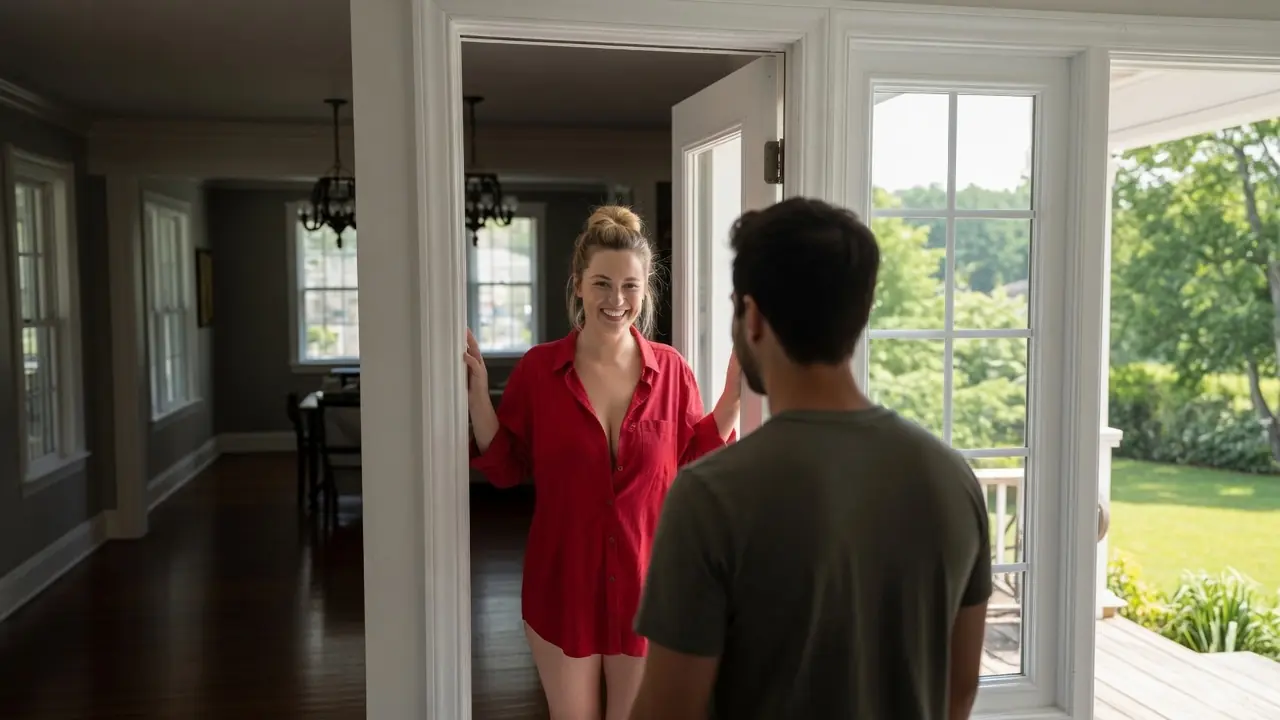
Nora placed the clothes inside.
Then she sat on the edge of the couch and wrapped her arms around herself.
Mason warmed soup on the stove and set a bowl on the table, then moved to the opposite side of the room.
She ate slowly, carefully, as if someone might still take it away.
Every spoonful seemed to ask permission.
At three o’clock, Mason left to pick up Ellie from school.
Before going, he wrote his phone number, the neighbor’s number, and the sheriff’s non-emergency line on a piece of paper.
He placed it on the table beside Nora.
“I’ll be back with my daughter,” he said.
“She’s seven. Her name is Ellie. She talks a lot when she’s nervous.”
Nora looked toward the door.
“I should go.”
“You don’t have to run because a child is coming home,” Mason said.
Then he added gently, “But you can if that feels safer.”
Nora touched the sleeve of his shirt and whispered, “I don’t know what safe feels like anymore.”
Mason carried those words all the way to the school.
Ellie climbed into the truck with a drawing of a purple horse and a complaint about cafeteria peas.
Mason told her there was a woman at the cabin who was having a hard day and needed quiet.
Ellie listened seriously because, at seven, she already understood more about sadness than Mason wished she did.
“Is she like when I cried because Mom forgot my birthday?” Ellie asked.
Mason’s throat tightened. “A little like that.”
When they got home, Ellie stepped inside carefully.
Nora was still on the couch, shoulders tense, ready to disappear if the child looked frightened.
Ellie stared at the oversized shirt, the damp hair, the tired eyes, and the bowl of soup on the table.
Then she walked to the kitchen, opened the drawer, and brought Nora a clean spoon even though Nora already had one.
“This one is better,” Ellie said.
“It has flowers on it.”
Nora looked at the spoon, then at Ellie.
For the first time, her face softened.
“Thank you.”
That evening was quiet.
Mason worked at the kitchen table while Ellie colored beside him, and Nora sat near the window wrapped in a blanket.
No one asked her who hurt her.
No one asked where she came from.
Mason had learned from fatherhood that sometimes the deepest kindness was not demanding answers from someone still trying to breathe.
After Ellie fell asleep, Mason offered Nora the bed and took the couch.
She tried to refuse, but he shook his head.
“My daughter will yell at me if I let a guest sleep on the couch with a hurt ankle.”
That almost made Nora smile.
He left the bedroom door open because she asked him to, and he slept lightly, listening for fear in the dark.
Around midnight, he heard her crying.
Not loud.
Not openly.
It was the kind of crying people do when they have spent years learning not to be heard.
Mason stayed on the couch and did not move toward her.
Every instinct in him wanted to help, but he understood that rushing toward pain could feel like another invasion.
So he sat awake in the dark and let her know, through silence, that she did not have to hide.
The next morning, Nora was gone.
The bed was neatly made.
His blue shirt was folded on the pillow.
The window was open, letting in cold air and the smell of wet leaves.
For a second, Mason felt panic rise in his chest.
Then he saw a note on the nightstand.
“Thank you for not asking me who hurt me.”
Mason sat on the edge of the bed and held the note for a long time.
Ellie found him there, still in her pajamas, rubbing sleep from her eyes.
“Did the sad lady leave?”
Mason nodded.
“Is she okay?” Ellie asked.
“I hope so,” Mason said.
Days passed, but Nora stayed in the cabin like a song that kept playing after the radio was turned off.
Mason went back to building tables and repairing chairs for local shops.
He packed Ellie’s lunches, read bedtime stories, and drove past Miller’s Creek more often than he needed to.
Each time, he looked toward the pier.
Each time, it was empty.
Two weeks later, he saw her across the street from his workshop.
She was standing in front of Langford’s Bakery, holding a tray of muffins while Mrs. Langford adjusted the window display.
Her hair was tied back, her face was thinner, and her smile was small but real.
Mason stopped walking so abruptly that Ellie bumped into his leg.
“That’s her,” Ellie whispered.
Nora looked up and saw them.
For a moment, fear moved across her face, then recognition, then something warmer.
Mason crossed the street slowly.
“You look better,” he said.
“I’m trying,” Nora replied.
Mrs. Langford, a round woman with silver hair and sharp eyes, looked between them.
“You two know each other?”
Nora nodded.
“He helped me when I had nowhere to go.”
Mason looked down, uncomfortable with being named as something better than he felt.
Ellie stepped forward and smiled. “I gave you the flower spoon.”
Nora laughed then.
It was quiet, but it was laughter.
That little sound changed the morning.
Mrs. Langford offered Mason coffee, and somehow stopping by the bakery became part of his routine.
Sometimes he came for bread, sometimes for muffins, and sometimes because he needed to see with his own eyes that Nora was still safe.
Nora opened slowly, like a door swollen by rain.
She told him small things first.
She liked painting, but had not touched a brush in two years.
She hated loud engines.
She loved cinnamon but pretended not to because it felt childish.
She had once wanted to open a tiny art studio near the water.
Weeks later, she told him the bigger truth.
She had been married to a man named Colin, a man who had seemed charming until marriage gave him permission, in his own mind, to become cruel.
He controlled her money, mocked her paintings, cut her off from friends, and made her believe leaving would prove she was weak.
The night Mason found her, she had run after a fight that left her too afraid to go back and too ashamed to ask anyone else for help.
She ended up at Miller’s Creek because it was the only place quiet enough to think.
Mason listened without interrupting.
His hands curled around his coffee cup, but he kept his anger out of his voice because Nora did not need another man’s anger filling the room.
When she finished, she looked at him like she expected judgment.
Instead, Mason said, “I’m sorry no one opened a door sooner.”
Nora’s eyes filled.
“You didn’t ask why I was broken,” she whispered.
“You just let me be human.”
Mason looked through the bakery window at Ellie drawing hearts in the fogged glass.
“I know what it’s like to watch someone you love stop believing they are worth staying for,” he said.
Nora followed his gaze.
“Her mother?”
Mason nodded once.
Their friendship grew in ordinary moments.
Mason fixed a loose shelf in the bakery.
Nora helped Ellie paint a cardboard castle for school.
Ellie began saving the corner piece of every brownie for Nora because she said Nora smiled bigger when chocolate was involved.
Mrs. Langford watched all of it with the secret satisfaction of someone old enough to recognize love before the people inside it did.
One rainy afternoon, Mrs. Langford collapsed behind the bakery counter.
Nora found her and called for help, her voice shaking but clear.
Mason arrived at the hospital an hour later with Ellie, and he found Nora pacing the hallway with flour still on her cheek.
When she saw him, she broke.
“I can’t lose her,” Nora said.
Mason stepped close but stopped short, letting her choose.
She reached for him first.
He held her while she cried into his shirt, and Ellie wrapped both arms around Nora’s waist from the side.
For the first time in years, Nora did not apologize for needing comfort.
Mrs. Langford survived.
The doctors said she needed rest and less stress, which made her laugh bitterly because bakeries were made of stress and butter.
Two months later, she called Nora, Mason, and Ellie into the bakery before opening.
She placed the keys on the counter in front of Nora.
“I’m retiring,” she said.
Nora stared at the keys. “I can’t buy this place.”
“I didn’t ask you to buy it today,” Mrs. Langford said.
“You’ll pay me monthly when you can. I want someone with heart behind this counter.”
Nora’s hands began to tremble.
Mrs. Langford pushed the keys closer.
“You know what hungry people look like, child. That means you know how to feed more than their stomachs.”
Nora cried openly then.
The bakery flourished under her care.
She painted small watercolor labels for every pastry, added a corner table for lonely customers, and kept a basket of day-old bread near the door with a sign that said, “Take what you need.”
Mason built her new shelves from reclaimed oak.
Ellie helped paint the children’s corner bright yellow.
For the first time, Nora’s name was attached to something alive instead of something painful.
Six months after the morning at Miller’s Creek, Mason came to the bakery before opening.
Nora stood behind the counter wearing a red shirt, her hair pulled into a messy bun, flour dusted across her cheek like a pale star.
She smiled when she saw him in the doorway.
“You’re early.”
“I wanted to show you something,” Mason said.
He placed a small wooden box on the counter.
Inside was a silver pendant shaped like a tiny folded shirt, polished and delicate.
On the back, he had engraved her name.
Nora touched it with one finger, and her eyes filled before she spoke.
“You remembered.”
“I never forgot,” Mason said.
“You were wearing my shirt that first morning.”
Nora laughed softly through her tears.
“I was so embarrassed.”
“You looked like someone who had survived the storm and didn’t know it yet.”
She put the pendant on right there.
Her hands shook, so Mason helped fasten the clasp, careful and gentle, while Ellie watched from a table with both hands under her chin.
When Nora turned around, the pendant rested against her heart.
For a moment, the bakery was silent except for the oven humming in the back.
Nora looked at Mason as if seeing him fully for the first time.
“You saved me,” she said.
Mason shook his head.
“No, Nora. You saved yourself.”
He glanced at Ellie, then back at her.
“I just opened the door.”
Nora’s smile trembled. “Sometimes an open door is the difference between dying inside and learning to live.”
A year later, Nora moved into the small house beside the bakery.
Two years later, Mason asked her to marry him on the pier where he had first found her.
Ellie held the ring box and cried before Nora even answered.
Nora said yes with both hands covering her mouth, then laughed because she was crying too hard to sound graceful.
Mason told her grace had never been the point.
Their life was not a fairy tale.
Nora still had difficult nights.
Mason still worried too much.
Ellie still asked hard questions about why some people leave and why some people stay.
But the house above the bakery filled with warm bread, sawdust, paint, bedtime stories, and a kind of peace none of them took for granted.
Years later, Nora kept the blue shirt folded in a cedar box.
Beside it lay the note she had left Mason that first morning.
When customers asked about the tiny shirt pendant she always wore, she would smile and say it reminded her of the day someone helped her without demanding the right to own her pain.
Then she would look across the bakery at Mason and Ellie, and her eyes would soften.
Love, Nora learned, was not the hand that pulled you before you were ready.
It was the door left open, the soup kept warm, the child offering a flowered spoon, and the man sleeping on the couch so you could rest without fear.
It was not a rescue that erased the past.
It was a second chance that helped you believe the future could still be kind.