Every Friday at exactly 6:15 in the evening, Ethan Cole entered Harlow’s Diner and sat at the same booth beside the front window. He always ordered two meals: chicken pot pie with black coffee on one side of the table, meatloaf with mashed potatoes on the other. The servers stopped asking whether someone would be joining him because the second seat always remained empty. Ethan ate slowly, checked the time once, and left both the untouched meal and a generous tip behind.
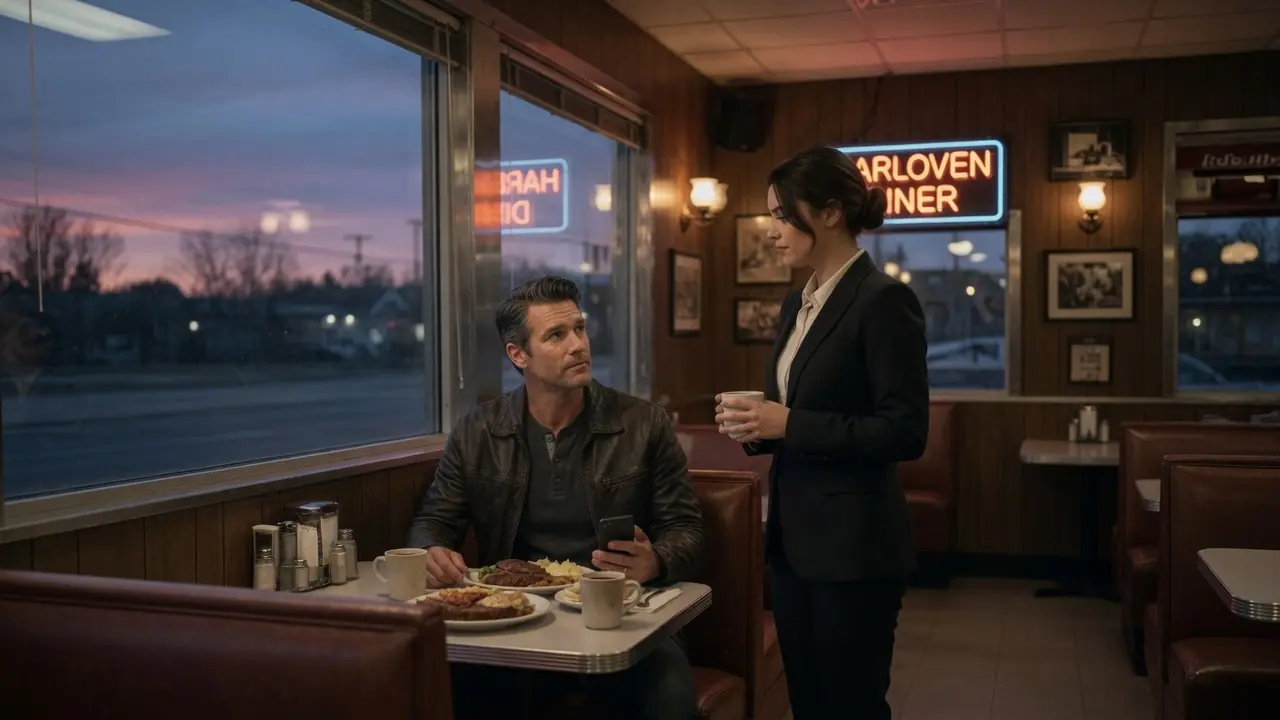
At thirty-six, Ethan was the sort of man strangers noticed without understanding why he appeared so tired. He had a strong jaw, neatly styled dark hair with faint silver at the temples, clear blue-gray eyes, and an athletic build shaped by long hours repairing trucks at a neighborhood garage. On Fridays, he replaced his stained work clothes with a fitted charcoal shirt, a dark leather jacket, clean jeans, and polished brown boots. It was the closest he came to dressing for a date.
The staff had created several explanations for his strange ritual. One waitress believed a woman had abandoned him and that he still expected her to return. The cook thought Ethan was honoring someone who had died, while a regular customer insisted he was meeting an informant who never appeared. No one had the courage to ask after seeing the quiet grief that crossed his face whenever the diner door opened.
Ethan never corrected their guesses. He arrived, ordered, waited, and returned home before nine to relieve his older neighbor, Mrs. Donnelly, who watched his eight-year-old daughter while he was away. Lily knew where he went every Friday, though she did not fully understand why he continued. She only knew the diner had once mattered to her mother.
On a cold Friday in early February, Sophia Lauron entered Harlow’s alone. She had spent the day inside a glass conference room listening to investors explain why closing the diner would improve the value of the surrounding property. At thirty-three, Sophia was the chief executive of Lauron Development, a company she had rebuilt after her father’s death. She was elegant, strikingly beautiful, and deeply exhausted by being the person everyone expected to make decisions without feeling their cost.
Sophia wore a tailored black suit over a white silk blouse, her long dark-brown hair arranged in a neat low bun. She had entered Harlow’s partly because the building belonged to one of her company’s recent acquisitions and partly because she needed an hour away from executives who discussed neighborhoods as if no one lived in them. Her board wanted the aging diner demolished and replaced with a luxury retail complex. Sophia had agreed to review the numbers before making the final decision.
A waitress led her toward a booth near the back, but Sophia noticed Ethan beside the window. Two steaming plates sat across from each other, and he kept glancing toward the entrance as though expecting someone. His expression was not impatient. It was hopeful in a way that seemed painful.
Sophia ordered coffee and tried to focus on the redevelopment proposal open on her tablet. She read the same paragraph four times while watching Ethan through the reflection in the window. He finished his meatloaf, but the chicken pot pie remained untouched. When the server offered to pack it, he declined and asked her to leave it until he was gone.
Curiosity was not usually one of Sophia’s weaknesses. In business, unanswered questions became leverage, and she had trained herself not to enter other people’s lives without permission. Yet something about Ethan’s empty place setting made the diner feel less like an old building and more like a room holding someone’s unfinished promise. Before she could reconsider, Sophia carried her coffee toward his booth.
“Excuse me,” she said gently. “I hope I’m not disturbing you.”
Ethan looked up, guarded but polite. “That depends.”
Sophia glanced at the empty seat. “Are you waiting for someone?”
His eyes moved toward the untouched meal. “I used to be.”
The answer should have ended the conversation, but Sophia remained beside the table. “May I sit down?”
Ethan hesitated before gesturing toward the empty side. “Not there.”
She understood immediately and slid into the seat beside him instead. For several seconds, neither spoke. Rain pressed against the window, blurring the headlights moving along the street.
“My name is Sophia,” she said.
“Ethan.”
She looked at the second plate. “Who did you used to meet here?”
“My wife.”
The words carried no bitterness, only an ache that had become familiar. Ethan explained that Claire had worked as a school librarian and loved Harlow’s chicken pot pie. During the years when they were struggling to pay rent and raise a baby, Friday dinner at the diner had been their only tradition. Even when they could afford something better, Claire refused to change it.
“She said expensive places made her feel like she had to whisper,” Ethan recalled. “Here, she could laugh.”
Sophia asked where Claire was now, though she already understood. Ethan looked through the window.
“Four years ago, she was driving here after work. A truck crossed the center line six blocks away.”
Sophia lowered her eyes. “I’m sorry.”
“Everyone says that.”
“I imagine there isn’t a better sentence.”
“No,” Ethan admitted. “There really isn’t.”
Claire had been thirty-one when she died. Lily was four, too young to understand why her mother had left for work and never come home. Ethan spent the following years learning how to braid hair, attend parent conferences, repair a leaking roof, and grieve only after his daughter fell asleep. Fridays became the one hour when he allowed himself to remember being a husband rather than only a father.
“Why order her meal?” Sophia asked.
“Because the last message she sent said, ‘Order for me. I’m almost there.’”
Ethan removed an old phone from his jacket and showed her the message. The screen was cracked, and the device no longer connected to any network, but Claire’s words remained preserved inside it. Beneath them was Ethan’s final reply.
Already did. Drive carefully.
Sophia felt something tighten in her throat. “You’ve been coming here every Friday for four years?”
“Not the first three months. I couldn’t walk through the door.”
“What changed?”
“Lily asked why I had stopped doing something her mother loved.”
Sophia studied his face. “Does coming here help?”
“Some weeks.”
“And the others?”
“It reminds me I’m still waiting for someone who can’t arrive.”
The waitress brought Sophia’s coffee refill and looked surprised to see her beside Ethan. She said nothing, but her expression softened. When she walked away, Sophia noticed an elderly couple near the counter watching them with gentle curiosity.
Sophia stayed until Ethan paid. They spoke about ordinary things after that: his work at Cole Street Garage, Lily’s obsession with astronomy, and Sophia’s inability to cook anything more complicated than pasta. Ethan did not ask what kind of company she ran, and Sophia did not volunteer the information. For once, she enjoyed being only a woman drinking coffee beside a stranger.
Before leaving, Ethan asked why she had approached him.
“You looked lonely,” Sophia said.
“So did you.”
She smiled faintly. “Maybe that was why.”
The following Friday, Sophia returned at 6:15. Ethan was already seated with two meals in front of him. She ordered coffee, then waited until he gave a small nod before sitting beside him.
“You came back,” he said.
“I wanted to know whether the meatloaf was as terrible as it looks.”
“It is worse.”
“Then why order it every week?”
“Claire hated it. She enjoyed watching me complain.”
Sophia laughed, and Ethan’s expression changed at the sound. It was not romance, not yet. It was simply the surprise of discovering that a painful room could hold something new without erasing what had been there before.
Over the next month, Sophia joined Ethan every Friday. She never sat in Claire’s place and never touched the second meal. Sometimes Ethan spoke about his wife, while other evenings they discussed Sophia’s company, though she described her role vaguely as property management. Ethan sensed she was leaving something out but did not push.
Sophia learned that Ethan had once dreamed of owning the garage where he worked. Its elderly owner, Frank Miller, wanted to retire, but the bank refused Ethan’s loan application because his income barely covered his mortgage and childcare costs. Ethan accepted the decision without resentment. His priority was stability for Lily, not proving himself through risk.
Ethan learned that Sophia’s father had spent his life buying neglected buildings and rebuilding them. When he died, the company was close to collapse, and several board members expected Sophia to sell. She spent five years repairing its finances and another three proving that her success was not an accident of inheritance.
“Does winning ever become enough?” Ethan asked one Friday.
Sophia stared into her coffee. “People move the finish line whenever I reach it.”
“Then stop running toward theirs.”
“That sounds simple when you repair engines.”
“Engines are simple. People are expensive and badly designed.”
She smiled. “You are surprisingly philosophical for a mechanic.”
“You are surprisingly tolerable for a property manager.”
Their friendship soon moved beyond the diner. Sophia met Lily when Ethan’s babysitter canceled one Friday. The child arrived wearing a navy coat decorated with stars and carried a notebook filled with drawings of planets. She regarded Sophia with the careful suspicion of a daughter who had seen adults enter and leave her father’s life.
“You sit with Dad on Fridays,” Lily said.
“Sometimes.”
“Do you sit in Mom’s seat?”
“No.”
Lily appeared relieved. “Good.”
Sophia spent the evening helping Lily construct a model of Saturn from paper plates. She did not try to impress her or behave like a replacement mother. She simply listened as Lily explained that Saturn could float in water if anyone found a bathtub large enough.
When they left the diner, Lily whispered something to Ethan. Sophia pretended not to notice.
“What did she say?” Sophia asked once Lily climbed into the truck.
“She said you can come again.”
“That sounds like a difficult approval process.”
“You passed the first interview.”
Sophia’s smile lasted until she reached home.
Her apartment occupied the top floor of a modern tower and offered a view of Boston that appeared on architecture websites. Yet after evenings with Ethan and Lily, it felt less impressive and more empty. She began noticing how rarely anyone entered except her housekeeper, her assistant, and people attending business dinners.
Two months after meeting Ethan, Sophia’s board scheduled the final vote on the Harlow’s redevelopment project. The proposal included demolishing the diner, three neighboring stores, and an apartment building above a laundromat. The new complex promised significant profits, but local tenants would receive only the minimum compensation required by law.
Sophia stared at the rendering projected across the conference room. The windows were beautiful. The sidewalks were clean. No trace of Harlow’s remained.
“We can begin evictions within sixty days,” the regional director said.
Sophia’s attention caught on the word.
“Evictions?”
“Lease terminations,” he corrected.
She requested another month to review community impact. Several board members objected, warning that delays might cost the company its primary investor. Sophia insisted.
That Friday, she entered the diner carrying knowledge that made every familiar detail painful. The cracked red booths, the elderly couple near the counter, the photographs of local baseball teams, and Claire’s empty seat all belonged to a building Sophia’s signature could erase. Ethan noticed her silence immediately.
“What happened?” he asked.
“Work.”
“You say that every time you don’t want to tell the truth.”
Sophia looked across the table. “The company I work for owns this property.”
Ethan waited.
“It plans to redevelop the block.”
His face changed. “Redevelop means tear it down.”
“Yes.”
“And you knew?”
“Not when we met. Not the details.”
“When did you learn?”
“Several weeks ago.”
Ethan leaned back. “You let me keep telling you what this place meant.”
“I was trying to stop the project.”
“You should have told me.”
“I wanted time to find another solution.”
“No. You wanted to avoid seeing my reaction.”
The accusation was accurate, which made it harder to answer. Ethan stood and placed cash beside his plate. For the first time since Sophia met him, he left Claire’s meal untouched without waiting until the usual time.
“Ethan, please.”
He looked at her with disappointment rather than anger. “You asked who I was waiting for. I should have asked why you were here.”
For two weeks, Ethan did not return to Harlow’s. He worked late on Fridays and told Lily that the diner was temporarily closed, though she knew he was lying. Sophia continued arriving at 6:15, sitting alone in another booth because she still refused to take Claire’s seat.
She spent those weeks investigating the project. The financial model depended on tax incentives that had been presented as guaranteed but were not. Several board members had personal investments in the luxury retail operator chosen for the site. More importantly, the development could remain profitable if the existing businesses were incorporated rather than removed.
Sophia proposed a new design preserving Harlow’s, relocating the laundromat temporarily during construction, and allowing current tenants to purchase cooperative shares in the completed property. The revised plan produced smaller immediate profits but created stable long-term revenue. Her board rejected it.
“They are not partners,” one investor said. “They are tenants.”
Sophia looked around the table. “That distinction is the problem.”
The largest investor threatened to withdraw. Sophia allowed him to.
For three days, financial news reported that Lauron Development’s expansion plan was collapsing. Her board called emergency meetings, and several directors demanded that she reconsider. Sophia refused to save the project by destroying the people already living there.
She approached a community credit union, negotiated a smaller financing package, and converted the development into a mixed-use cooperative. Harlow’s owner, Margaret Harlow, received funding to renovate the kitchen while retaining control of the diner. Existing tenants received protected leases, and part of the new building was reserved for affordable apartments.
Sophia did not contact Ethan until every agreement had been signed. She wanted to offer facts rather than another promise.
On the fourth Friday after their argument, Ethan returned to Harlow’s. He sat at the window table, ordered two meals, and placed Claire’s phone beside her coffee cup. At 6:20, Sophia entered wearing no business suit, only a cream sweater, dark coat, jeans, and nervousness she could not disguise.
“Excuse me,” she said softly. “I hope I’m not disturbing you.”
Ethan looked up. The repeated words brought back their first evening.
“That depends,” he said.
Sophia handed him a folder. Inside were the preservation agreement, renovation plans, and tenant protections. Ethan read silently while she remained standing.
“You stopped the demolition,” he said.
“I changed the project.”
“Why?”
“Because a company should not call itself successful when its profit begins with erasing someone else’s life.”
Ethan closed the folder. “Did you do this for me?”
“You made me look directly at what I was about to approve. But no, I did it because it was right.”
He studied her for a long moment. “You still should have told me earlier.”
“I know.”
“I don’t trust people easily.”
“I know that too.”
Sophia looked at Claire’s empty seat. “I don’t want to take anything from you, Ethan. Not this place. Not your memories. Not her.”
His expression softened.
“Sit down,” he said.
Sophia moved toward her usual place beside him, but Ethan stopped her.
“Not there.”
He lifted Claire’s untouched plate and moved it gently to the center of the table beside the old phone. Then he nodded toward the seat across from him.
Sophia did not sit immediately. “Are you certain?”
“No,” Ethan answered honestly. “But I think certainty has kept me alone long enough.”
She lowered herself into the booth.
That evening, Ethan told Sophia something he had never admitted aloud. He had not only been waiting for Claire. He had been waiting for permission to keep living without betraying her.
Sophia reached across the table but stopped before touching his hand. Ethan closed the distance himself.
Their relationship changed gradually. Sophia did not become Lily’s mother, and Ethan never asked her to. She became Sophia—someone who attended science fairs, forgot how much sugar belonged in pancake batter, and listened when Lily wanted to talk about Claire.
A year later, Harlow’s reopened after renovation. The red booths had been restored rather than replaced, and the original window table remained in its exact position. A small brass plaque beneath it honored Claire Cole, describing her as a librarian, mother, loyal customer, and woman whose laughter had once filled the room.
Ethan purchased Cole Street Garage through a financing program created by the same community credit union supporting the development. Sophia offered advice but no secret investment. Ethan wanted to build the business through fair terms, and she respected that boundary.
On the first Friday after Harlow’s reopening, Ethan arrived at 6:15 with Lily. He ordered three meals.
One was chicken pot pie for Claire’s memory.
One was meatloaf for himself.
The third was pasta for Sophia, who arrived ten minutes late after a board meeting and apologized before removing her coat.
“You ordered for me,” she said.
“You said you were almost here.”
Sophia looked at Claire’s old phone beside the untouched plate. “Does this feel wrong?”
Ethan considered the question.
“No,” he said. “It feels different.”
Lily slid across the booth to make space. Sophia sat beside her, and the three of them ate while snow began falling beyond the window.
Years later, customers still told stories about the handsome single father who once ordered two meals every Friday and waited beside an empty seat. Some believed the lonely CEO had saved him. Others insisted Ethan had changed Sophia’s life first.
Both versions missed the truth.
Neither person rescued the other.
Ethan showed Sophia that buildings held memories no financial report could measure. Sophia showed Ethan that moving forward did not require abandoning the people who could no longer walk beside him.
For four years, he had sat at the same table waiting for a woman who would never return.
Then another woman asked who he was waiting for.
And for the first time, Ethan realized the answer did not have to remain the same forever.