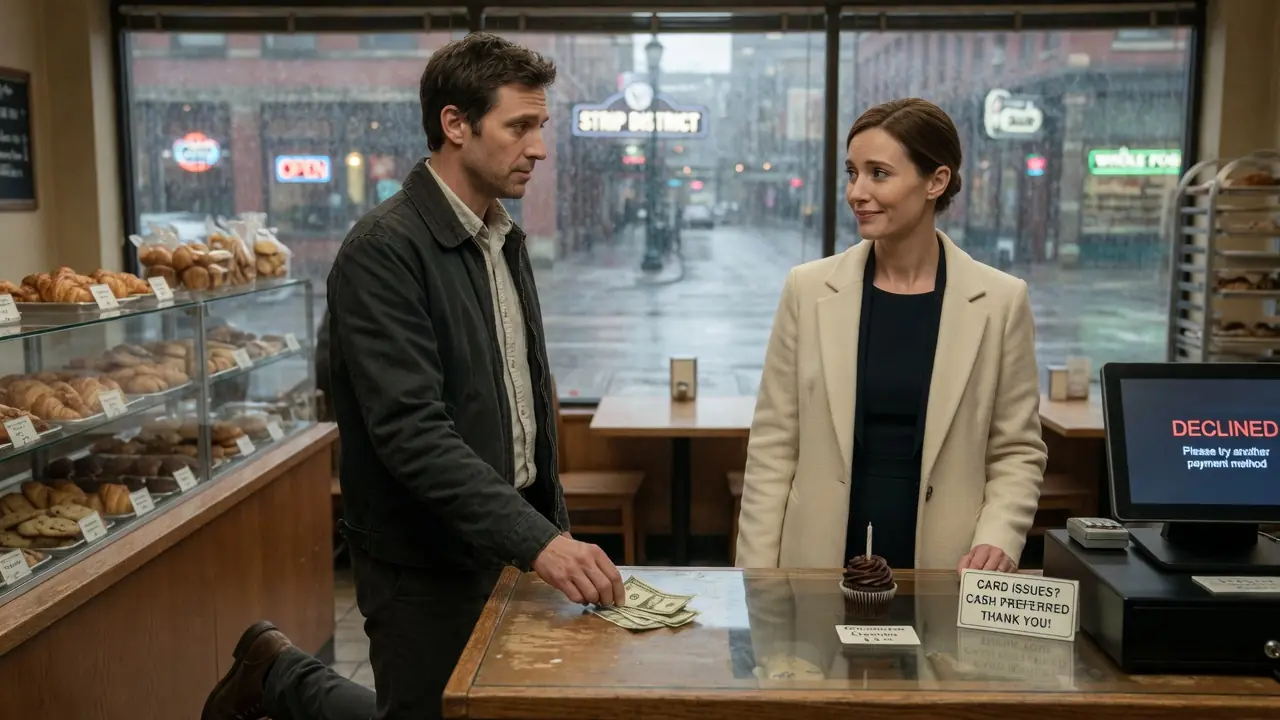
A small bakery sat on Smallman Street in Pittsburgh’s Strip District, glowing softly beneath the gray Tuesday rain.
Inside, warm yellow light spilled across the glass display case, touching rows of cinnamon rolls, danishes, and cupcakes arranged with careful hands.
Rain tapped against the window in a steady, gentle rhythm, blurring the trucks, umbrellas, and wet sidewalks outside.
A woman stood at the counter with one chocolate cupcake in front of her.
Just one.
Dark frosting. White paper wrapper. One small white candle pressed into the top.
The cashier ran her card.
The machine beeped.
Declined.
The woman’s face did not change much. She only lowered her eyes and gave a faint, practiced smile.
“Could you try it again, please?” she asked quietly.
The cashier tried again.
Declined.
A third time.
Declined.
The little machine made the same sad sound, sharp and final.
The woman reached for the cupcake, ready to slide it back across the counter.
“It’s all right,” she said softly. “I’ll leave it.”
Behind her, Daniel Hayes stood in line with his coat still damp from the rain. He had a folded set of drawings under one arm and two dollars in quarters in his pocket for the parking meter.
He did not know the woman.
He did not know her name.
He barely saw her face.
He only saw the cupcake.
The candle.
The way she tried to smile like it did not matter.
Daniel reached into his wallet, pulled out three crumpled one-dollar bills, and placed them on the counter without looking at her.
Then he said one sentence.
“Everyone deserves a birthday cake.”
The woman froze.
For one second, the bakery seemed to go completely still. Even the rain on the window sounded softer.
She turned slightly toward him, her eyes bright with emotion she was clearly trying to hold back.
“Thank you,” she whispered.
Her voice broke on the second word.
Daniel only nodded toward Mike, the bakery owner, who had already begun boxing the cupcake.
Daniel picked up the second cupcake Mike had bagged for him, tucked it carefully into his coat, and stepped back out into the Pittsburgh rain.
He had no idea that the woman he had just helped was Claire Whitmore.
Chief executive officer of Whitmore Capital.
And by the next morning, she would be sitting across from him in the boardroom that could decide whether his wife’s dream lived or disappeared forever.
Two years earlier, Sarah Hayes had passed away on a Thursday morning at Allegheny General Hospital.
She had been a social worker at the Hill District Women’s Shelter for eleven years. She knew the names of women who had nowhere safe to sleep. She knew the birthdays of children who had learned too young to pack quickly. She knew which bus routes ran late, which landlords answered calls, which caseworkers cared, and which promises were only paperwork.
Her illness took ten months.
No longer.
Daniel had watched the woman who once carried three grocery bags up two flights of stairs without complaining grow smaller beneath hospital blankets. He had watched her hands, once always busy, become still.
The week before she stopped writing, Sarah wrote him a letter.
Daniel kept it folded in his wallet.
The last line read:
Don’t stop building for people who can’t build for themselves.
That sentence changed the course of his life.
Daniel left his principal architect position at Hartwell & Reed that same month. The senior partners offered him a sabbatical. Then a part-time arrangement. Then a remote role with flexible hours.
He thanked them and turned each one down.
Lily was six then.
She needed her father at four o’clock every day.
Now Daniel and Lily lived in a two-bedroom apartment in Lawrenceville, above a hardware store on Butler Street. The radiator clanked through the winter. The windows fogged whenever it rained. Lily had a corner of the living room for her drawings. Daniel had the kitchen table for his work.
Tuesday night, the night before the pitch, the table held half-finished pasta, a chipped mug of coffee, and a stack of bound documents two inches thick.
Sarah’s Place.
One hundred units of affordable housing on the corner of Centre and Roberts.
A courtyard.
Community rooms.
East-facing windows.
Ground-floor support offices.
A children’s room near the laundry area so mothers could wash clothes without losing sight of their kids.
Ten million dollars.
Daniel’s last shot.
If Whitmore Capital said no, the house he had inherited from his mother, the one she had left him in 1978, would have to go on the market in January. That house was the last piece of security he had. Selling it would keep him and Lily afloat for a while, but it would also mean admitting that Sarah’s Place had failed before a single brick was laid.
Lily was eight now.
She sat across from him at the kitchen table, swinging her legs beneath the chair as she told him about a girl at school who had said her drawing of a horse looked like a dog.
Daniel laughed at the right moments.
When Lily got up to put her plate in the sink, he turned and looked at the pitch deck again.
Sarah’s Place.
“Daddy?”
He looked up.
Lily stood at the sink, watching him.
“Are you worried?”
Daniel closed the folder gently.
“A little.”
“Mom used to say worried means you care.”
He smiled.
“She did say that.”
“So it’s okay.”
Daniel looked at his daughter, at her serious brown eyes, at the way she still carried Sarah’s softness in her face.
“Yes,” he said quietly. “It’s okay.”
That night, after Lily fell asleep, Daniel stood on the small back balcony with Sarah’s letter in his hands. Rain dripped from the fire escape above him. The city smelled of wet brick and cold pavement.
He unfolded the letter carefully.
Don’t stop building for people who can’t build for themselves.
“I’m trying,” he whispered.
The next morning, Daniel stopped at the bakery on Smallman Street.
He had been going there for two years, since the week after Sarah passed, when Mike had handed him a coffee on the house and asked no questions.
Today, Daniel wanted to buy Lily a cupcake to find in her lunch the next day.
That was when he saw the woman at the counter.
The declined card.
The one candle.
The faint smile.
The decision to walk away from something small that clearly meant more than she wanted anyone to see.
He paid for the cupcake without thinking.
Because Sarah would have.
Because Lily would have asked him why he did not.
Because sometimes three dollars was not three dollars.
Sometimes it was dignity.
Daniel left the bakery and drove through the rain toward downtown Pittsburgh with the pitch deck on the passenger seat and Lily’s cupcake carefully tucked in a white paper bag beside it.
At Whitmore Capital, the receptionist sent him up to the fourteenth floor.
The waiting area smelled like coffee and new carpet. Daniel sat with the pitch deck on his knees, watching rain bead and slide down the tall windows.
In the breast pocket of his jacket, folded into a small square, was a card Lily had made for him at breakfast.
Crayon stick figures of him and her holding hands.
Good luck, Daddy, written in green letters.
He touched it through the fabric.
The double doors opened.
Daniel stood.
The first man through was tall, gray at the temples, smiling the kind of corporate smile that did not reach the eyes.
Marcus Cole.
Daniel knew the name. Everyone who had worked in Pittsburgh development knew the name. Marcus had been at Whitmore Capital almost since its founding. He carried himself like a man who had helped build the room and expected everyone else to remember it.
Behind him, one step back, was the woman from the bakery.
She stopped.
Not completely.
Only half a second.
But Daniel saw it.
Claire Whitmore saw him, too.
The man who had paid three dollars for her birthday cupcake stood in the waiting area with a worn leather portfolio under one arm and rain still darkening the shoulders of his coat.
Marcus did not notice.
“Mr. Hayes,” Marcus said smoothly. “Please.”
The boardroom had twelve chairs and a long walnut table. The blinds were half drawn against the rain. Coffee steamed from a sideboard no one touched.
Daniel opened with the slides he had rehearsed for a month.
He did not waste time on himself.
Thirty seconds on his firm.
Three minutes on the Hill District.
Two minutes on what the neighborhood had lost over the decades.
Then the rest on the design.
He showed them the unit layouts.
The east-facing windows.
The shared courtyard.
The community room on the ground floor with doors that could open onto the street in summer.
He showed the laundry rooms placed deliberately near gathering spaces, because women waiting for machines often became women sharing information.
He showed the children’s area.
The counseling offices.
The mailboxes visible from the entrance, because Sarah had once told him that for a woman rebuilding her life, receiving mail under her own name could feel like proof she still existed.
He saved the financials for the end.
Cost per square foot.
Projected occupancy.
Construction timeline.
Risk management.
Return on investment: modest, but real.
Eight percent over fifteen years.
Better than the municipal bond they were holding.
Claire Whitmore sat at the head of the table.
Her hands were folded in her lap beneath the wood, where no one could see how tightly she held them.
The man speaking ten feet from her was the same man who had put three singles on a bakery counter the day before.
He had not looked at her then.
He was not really looking at her now.
He was looking at his slides, at the older board members, and at the rain-streaked city through the half-drawn blinds.
Marcus took the question and answer portion.
The questions sounded reasonable.
They were not.
How many units of this scale had Daniel personally delivered as lead architect in the last sixty months?
What was the firm’s bonding capacity?
What contingency did he have if the city revised the zoning overlay during construction?
Each question was designed to make the answer sound thin.
Daniel answered every one without raising his voice.
He did not flinch.
He did not oversell.
Then Harold Pemberton, the oldest man at the table, set down his pen.
“Wait,” Pemberton said.
The room went still.
“Daniel Hayes.”
He looked over the top of his reading glasses.
“Hartwell & Reed. You designed the Riverside Pavilion in Boston in 2017. AIA Honor Award. The community center in Roxbury the year after.”
He paused.
“I sat on a jury that nearly gave you something for that one, too.”
The boardroom went quiet.
Claire looked up.
Marcus’s face did one thing for half a second, then did another thing on purpose.
He laughed lightly.
“Mr. Hayes is currently working as an independent consultant,” Marcus said. “The scale of his recent portfolio is the concern here. Not what he did at a firm five years ago.”
Daniel did not contradict him.
He looked at Pemberton and nodded once.
“That was a long time ago, sir. Thank you for remembering.”
Claire understood three things in the same second.
The man at the end of her boardroom was not what Marcus had told her he was.
Daniel had spent forty-five minutes in this room without using a single credential to impress them.
And Marcus had known.
But Claire also knew none of that mattered yet.
The board pack had been circulated five days earlier. Six members had already filled out their opinion sheets. She had no leverage to overturn anything from the chair at that moment.
So she signed the rejection decision the firm’s legal counsel slid across to her.
She kept her hands steady.
Daniel thanked the board.
He gathered his materials.
When he reached the door, he passed within two feet of Claire’s chair.
He paused just long enough for her to hear him.
“Happy birthday, ma’am.”
He did not look at her face.
Then he stepped out.
The room emptied.
Claire stayed in her chair.
After a minute, she opened the manila folder of rejection paperwork. At the back, behind the last signed page, something thin was wedged inside.
A folded card.
Stick figures.
Good luck, Daddy, written in green crayon.
Claire looked at it for a long time.
The rain came harder on Daniel’s drive back to Lawrenceville.
He parked behind the hardware store and sat with the engine running for ten minutes.
The bank had called twice while he was in the boardroom.
He did not return the call.
He turned the engine off and listened to rain ticking against the roof of the truck.
Lily was at the apartment door when he came up the stairs.
She had been waiting at the window.
“Did you get it, Daddy?”
Daniel set down his bag and knelt.
He had practiced this on the drive.
He had not practiced it long enough.
He pulled her against his shoulder.
“Not yet, sweetheart,” he said softly. “We’re still trying.”
Lily did not ask anything else.
She was eight, not five.
She understood the shape of her father’s quiet now.
She took his hand and led him inside, then showed him the math problem she had finished on her own.
Across the city, on the fourteenth floor of Whitmore Capital, Claire sat at her desk with a different folder open in front of her.
Rachel Bennett, her assistant, had brought it in within an hour of the rejection vote.
It was Daniel Hayes’s full resume.
The version that had not been in the board pack.
Riverside Pavilion.
The Roxbury Center.
The AIA Honor Award.
A pro bono affordable housing project in Detroit in 2019: eighty-four units completed under budget.
Master of Architecture, MIT, 2008.
Wife, Sarah Hayes, deceased.
One daughter, Lily, age eight.
Claire stared at the line about the daughter longer than she needed to.
Then she called Marcus into her office.
She did not stand when he entered.
“Why wasn’t his full portfolio in the board pack?”
Marcus arranged his face.
He took the seat across from her without being asked.
“We standardize submissions to the last five years of active firm work, Claire.”
“He hasn’t been at a firm.”
“It’s procedural.”
“He uses a sole proprietorship. There is no rule against listing prior work.”
“There is no rule for it, either. We applied the same standard we apply to every consultant.”
Claire looked at him for a long beat.
She did not trust the answer.
She also did not yet have the leverage to push past it.
Eight months into the chair her father had held for thirty years, Marcus’s name still carried weight. It sat on the founding documents next to Richard Whitmore’s. The board listened to Marcus because the board had known Marcus longer than they had known her.
Claire nodded once.
“That will be all.”
Marcus left.
Rachel came in with tea about twenty minutes later. She set the cup down on the coaster.
She did not retreat.
She stood there until Claire looked up.
“Ms. Whitmore,” Rachel said quietly. “Happy birthday.”
Claire blinked.
“How did you know?”
“HR records,” Rachel said. “I won’t tell anyone.”
Claire opened her mouth.
Closed it.
Then nodded.
Rachel walked out and shut the door behind her.
That night, in Lawrenceville, Lily fell asleep on the couch under a blanket Sarah had knitted the year she got engaged.
Daniel carried her to bed.
He kissed her forehead and stood in the doorway of her room for a minute, watching her breathe.
Then he went out onto the small back balcony with a glass of water.
He pulled Sarah’s letter from his wallet.
The paper was soft from being opened and folded so many times.
He read the last line again.
Don’t stop building for people who can’t build for themselves.
He looked down at his phone.
He had a photograph of Lily’s card.
The original was somewhere in a manila folder on the fourteenth floor of a building downtown.
He did not know how to get it back.
He did not know it was already sitting on Claire Whitmore’s desk, three inches from a woman who was no longer sure of anything.
Thursday morning, Daniel was at the bakery before seven.
Mike paid him twenty dollars an hour to unload the flour delivery on slow mornings.
In a bad month, twenty dollars an hour mattered.
Daniel had been having a long string of bad months.
He was bent over a fifty-pound sack of bread flour when the door chimed.
He straightened.
Claire Whitmore stood in the doorway.
She wore none of what she had worn in the boardroom. No sharp suit. No CEO armor. Just a dark coat, simple trousers, and eyes that looked tired in a way that had little to do with sleep.
She walked to the counter.
She set something down on the wood.
Lily’s card.
Flat, protected in a clear plastic sleeve.
Daniel had imagined many ways it might come back to him.
This was not one of them.
“You left this,” Claire said. “I thought she might want it back.”
Daniel wiped his hands on his apron. He came around the counter and took the card.
He held it in both hands for a long moment.
Mike, sensing what he did not understand, slipped through the swinging door to the kitchen.
Daniel gestured toward the small table by the window.
They sat.
The rain had not started yet, but the sky over Smallman Street looked like it had already decided.
“Why did you come?” Daniel asked.
He said it without heat.
He was a man who had run out of energy for heat.
“Because I rejected something I did not actually read,” Claire said.
She did not say, “I’m sorry.”
She did not say, “I made a mistake.”
She did not perform anything for him.
She had run that sentence in her head on the drive over three times and decided it was the version that was true.
“Tell me about it,” she said. “Not the pitch. Just tell me.”
So Daniel told her.
He told her about Sarah.
About the shelter on Wylie Avenue.
About the women Sarah had spent eleven years trying to help find permanent housing. He told her how most of them ended up back at the shelter within a year because there was nothing in the city in their price range that was safe, stable, and dignified.
He told her why every unit faced east.
Sarah had once read a study that morning light helped people regulate their days after long periods of instability. Daniel had never forgotten that. He had designed every floor plan around the idea that a person rebuilding her life deserved to wake to light, not brick walls.
Claire listened.
She did not take notes.
She did not interrupt.
When he finished, she sat for a moment looking at the empty table between them.
“I need to look at the real numbers,” she said. “Not the ones I was given.”
Daniel nodded.
She stood.
She did not offer her hand.
At the door, she turned once.
“Mr. Hayes,” she said, “yesterday in the bakery, did you know who I was?”
He looked at her, honest about it.
“No, ma’am. I still don’t really.”
For a fraction of a second, something moved across her face.
It was the first time in seven months she had smiled and meant it.
She walked out into the gray morning.
Daniel stood by the window and watched her cross Smallman Street and get into a black sedan.
The driver pulled away.
The bakery was very quiet.
He looked down at Lily’s card in his hand.
Mike pushed back through the swinging door.
“Friend of yours?” he asked.
Daniel did not answer for a moment.
“I’m not sure yet,” he said.
Saturday afternoon, the sky over Lawrenceville was the bright low gray that meant snow was possible by Monday.
Daniel was making grilled cheese for Lily and reading the Post-Gazette when the buzzer rang.
He went to the intercom.
It was Claire.
He held the buzzer down.
“Fourteen,” he said. “Apartment B.”
She came up the stairs with a folder under her arm and her hair damp from the walk between her car and the entrance.
The folder was an inch thick.
He took her coat.
The apartment was small enough that there was nowhere for her to look without seeing something personal.
A photograph of Sarah on the mantel.
Architecture monographs lined along the floor against the wall.
A wooden box of Lily’s colored pencils on the coffee table.
A chipped mug by the sink.
A grocery list written in crayon because they had run out of pens.
Daniel cleared the kitchen table.
He brought her water.
They sat.
Claire opened the folder.
The first page was Marcus’s financial model for Sarah’s Place.
The margins were red with her own handwriting.
“The materials cost is from 2019,” Daniel said before she asked.
He had not even looked at the page yet.
He was looking at her notes.
“Steel was a different number then. He used it because steel was at a low. If you run it with current numbers, it changes the internal rate of return by about seventy basis points.”
Claire looked up.
“In your favor,” he added.
She turned the page.
“Occupancy assumption,” he said. “Sixty-five percent.”
He shook his head.
“Detroit ran at ninety-one. Cleveland ran at eighty-eight. Cincinnati ran at eighty-six. There is no comparable project anywhere in the Midwest that ran below eighty.”
She wrote that down.
He gave her his sketchbook.
The hand-drawn version.
Marcus had never seen this one.
Claire turned the pages slowly.
The east-facing windows.
The placement of laundry rooms on the second and fifth floors so they doubled as informal gathering spaces.
The retaining wall along the back lot that became bench seating for the playground.
The mailbox wall visible from the lobby.
The courtyard designed so every apartment window looked toward life.
They worked for two hours.
He did not flirt with her.
She did not flirt with him.
They moved through the document together the way two surgeons might move through a chart, deliberate and focused.
The impersonality of it became its own kind of intimacy.
Then the door opened.
Lily came in from her Saturday painting class, smelling of acrylic and rain.
She stopped when she saw the woman at the table.
“Daddy, who is she?”
Daniel looked up.
“Her name is Claire,” he said. “She’s a friend.”
Lily considered this.
Then she walked over and placed the picture she had made that afternoon in front of Claire.
It was a house with a heart-shaped window.
“For you,” Lily said, “because friends.”
Claire did not say anything.
She picked it up carefully.
She folded it along a single seam and slid it into the inner pocket of her coat.
Around six o’clock, Claire’s phone vibrated against the table.
She glanced at it.
Her face did not move, but her shoulders set.
She stood.
She put on her coat.
At the door, she said, “I’ll see you Monday morning.”
Daniel did not ask what the message was.
He walked her down the stairs.
She drove away into the wet dark.
He stood on the sidewalk in front of the hardware store until the taillights were gone.
The text on her phone had been from Rachel.
Marcus is filing an emergency motion to remove you Monday. He has the votes lined up.
Claire had not let it show.
Sunday morning was cold and clear, and the bakery was almost empty.
Mike opened at seven on Sundays and got maybe four customers before nine.
Daniel was at the back table with coffee when Rachel Bennett walked in.
He had never met her.
He knew her because Claire had mentioned her name twice.
He knew it was her because she was the kind of woman who, when she entered a room, checked the windows before she sat down.
She set a laptop on the table.
She did not order anything.
“I have about twenty minutes,” Rachel said. “I told my husband I was getting bagels. I’m sorry to do this here. I can’t go to her office, and I can’t go to her apartment. This was the safest place I could think of.”
Daniel did not interrupt.
She opened the laptop and turned it toward him.
“Three things,” she said.
The first was an email chain between Marcus Cole and a man named David Cole.
The dates ran from June through the week before Daniel’s pitch.
The subject line was about the Hill District parcel.
The body of the messages discussed a luxury condominium project to be built on the same lot.
One sentence in David Cole’s reply stood out.
As soon as the Hayes thing dies, we move on it.
The second document was a side-by-side scan.
Daniel’s original pitch financials with his signature on the cover sheet.
Beside it, Marcus’s edited version, the one the board had received.
The numbers Daniel had given for materials, occupancy, and absorption rate had been changed in eleven places.
None of the changes were small.
The third was an internal email Marcus had sent in 2020 to a senior partner who had since retired.
There was a single line about Daniel.
Hayes turned me down on the Riverdeck Casino five years ago. Sent a holier-than-thou rejection letter. I haven’t forgotten.
“David Cole is his cousin,” Rachel said. “He didn’t disclose it on the conflict of interest form. I pulled the form last night. It’s blank.”
Daniel did not speak for a while.
He read each document a second time.
Then he looked up.
“Why are you bringing this to me?” he asked. “Why not to her?”
Rachel had the answer prepared.
“Because if I bring it to Claire, Marcus has the security badge logs of me walking into her office. He’ll say I leaked it under her instruction. It poisons her in front of the board. If I bring it to you, and you bring it to her with your name on the chain of custody, it’s a whistleblower tip from an external party. That is a different legal posture.”
Daniel understood.
He also understood that this woman had spent her entire weekend thinking about chains of custody.
“Your mother,” he said.
Rachel nodded once.
“He hinted he had friends on the board at her care facility. I moved her Tuesday. My brother’s paying. I don’t have anything left for Marcus to use against me.”
She closed the laptop.
She did not ask Daniel what he would do.
She stood and walked out into the cold sun on Smallman Street.
Daniel sat for ten minutes.
Then he picked up his phone and called Claire.
They met that afternoon at a coffee shop in Squirrel Hill, three miles from anywhere either of them usually went.
He handed her the laptop.
She read for twenty minutes.
Her face did not change.
When she finally closed it, her eyes were dry.
Whatever lived in them was not grief.
It was resolve.
“Monday,” she said. “Board meeting. Be there.”
“I’m not on the agenda.”
“You will be.”
Monday morning at nine, the boardroom of Whitmore Capital was already full.
Marcus had spent the weekend on the phone. He had six votes pinned down to remove Claire as CEO, with the formal motion to be raised under new business at the bottom of the agenda.
He was not nervous.
He was annoyed at having to do it.
The double doors opened at nine sharp.
Claire walked in.
Behind her, two steps back, came Daniel Hayes.
Behind Daniel, also two steps back, came Harold Pemberton.
Marcus stood.
“This is a closed session,” he said. “Claire, what is this?”
“Mr. Hayes is here as a material witness,” Claire said. “By law 7.3.”
She set three bound documents on the table and slid one to each side.
The board members opened them.
For the next twenty-five minutes, Claire spoke.
She did not raise her voice.
She did not perform.
She walked the board through the financial model that had been altered before it reached them. She showed the original signature page next to the doctored second version. She showed the eleven changes one by one.
She read three of the emails between Marcus and David Cole aloud, slowly, including the sentence about how “the Hayes thing” needed to die.
She showed the blank conflict of interest form.
Then she read the 2020 email about the casino.
Marcus did not interrupt for the first eight minutes.
He interrupted at the ninth.
“These documents are stolen,” he said. “This is a coup by a CEO who is about to be removed for incompetence. You all know what’s on the agenda. You all know what we’re here to do.”
He looked at the men he had counted as his own.
“Tom. Bill. You know my record.”
He named a third.
“James, your father and I built half of this firm.”
Two of the three did not meet his eyes.
The third, Tom, looked down at the documents in front of him and did not look up.
Daniel had not spoken.
He waited until the room was quiet.
Then he spoke once.
“Sir,” he said, looking at Pemberton, not Marcus. “I did not bring these documents to be vindicated. The project is the project. It either gets built or it doesn’t. I brought them because there are sixty-eight women on the waiting list at the shelter on Wylie Avenue, and they deserve to know the truth about why a project meant to house them was killed. That is all I came here for.”
He did not step out.
No one asked him to.
Pemberton set both palms flat on the table.
“I move that Mr. Cole be suspended from his position pending an independent forensic audit conducted by a firm not on our existing list of vendors,” he said. “I further move that the Sarah’s Place review be reopened immediately under Ms. Whitmore’s direct oversight, with the original financials restored.”
The motion was seconded.
The vote was seven to four, with one abstention.
Marcus’s six had become four.
Marcus stood.
He took his time.
He buttoned his jacket.
When he walked past Daniel on his way to the door, he stopped for half a second and spoke to him alone.
“You don’t know what you’ve done.”
Then he walked out.
The board did not adjourn for almost an hour.
When they finally did, the room emptied in twos and threes.
Claire stayed in her chair.
Her hands beneath the table were shaking.
She let them shake for one second.
Then she made them stop.
Daniel went down the hall to the small kitchen and came back with a glass of water.
He set it in front of her.
He did not say anything.
She did not thank him with words.
They sat next to each other in the empty boardroom for three minutes.
Outside, the rain had started again.
Two weeks later, on a Friday afternoon, an independent forensic accounting firm out of Cleveland delivered a one-hundred-forty-page report to the Whitmore Capital board.
The report confirmed every allegation in the documents Daniel had brought to the Monday meeting.
Marcus Cole’s stock options were voided.
His severance was withheld pending the outcome of the federal inquiry that had opened the previous Wednesday.
David Cole’s firm, Crestmont Development, withdrew its bid for the Hill District parcel that same Friday afternoon, four hours before the report was made public.
Sarah’s Place was formally approved by the board the following Monday at ten million dollars, with the original financials restored and a development timeline of twenty-six months.
Claire did not hold a press conference.
She signed the papers in her office alone with Rachel as the witness.
The next afternoon, Daniel sat across from her at the long walnut desk on the fourteenth floor.
He was not pitching.
He was not in an emergency.
He was reading a contract.
The terms were clean.
Architect of record.
Full design authority.
No clawback.
No morality clause.
Payment schedule front-weighted, because Claire knew what kind of cash flow a sole proprietor lived on.
She had thought about every line.
Daniel signed it.
He set the pen down.
Claire spoke without looking up from the document on her own side of the desk.
“We have a principal architect position opening,” she said. “The salary is good. There is a benefits package that would cover Lily. I’d like you to consider it.”
Daniel picked up the pen again.
He turned it between his fingers.
Then he set it down.
“Ms. Whitmore.”
“Claire.”
He let the name sit in the room.
“I appreciate that more than I can say,” he said. “But I left a firm to be home for Lily at four o’clock every day. I’m not ready to leave that again. Not yet.”
Claire nodded.
She did not push.
She had not expected him to say yes.
She had needed to make the offer because anything less would have been a kind of dishonesty.
Daniel stood.
He picked up his coat from the back of the chair and walked to the door.
His hand was on the knob when Claire spoke again.
“The Sarah’s Place groundbreaking is October seventeenth,” she said.
She was looking at the papers on her desk.
Not at him.
“I’d like Lily to turn the first shovel of dirt, if that’s all right with you.”
Daniel’s hand stayed on the knob.
He did not turn around.
He understood that she had not looked up on purpose. She had given him room to answer in whatever shape his face made without needing to perform it for her.
“She’d love that,” he said.
He opened the door, stepped through, and closed it quietly behind him.
Claire did not look up for another full minute after the door closed.
Then she did.
The folder on her desk was the original board pack from the day of the rejection.
She had been keeping it.
She did not know why exactly.
She slid it across her desk and dropped it into the recycling bin beneath her credenza.
Then she walked to the window.
The fourteenth floor looked north across the Allegheny River. The water was the color of slate. A barge moved slowly downstream.
She did not smile.
She did not need to.
There was nobody in the room.
October seventeenth was a Saturday.
The Hill District morning was cold enough for breath to show.
The trees on Centre Avenue had not turned all the way yet, but the maples by the school across the street had gone red at the tips.
About eighty people came.
Future residents from the Wylie shelter waiting list.
The City Council member for District Six.
A reporter from the Post-Gazette.
Mike from the bakery, wearing a coat Daniel had never seen before.
Harold Pemberton in a gray scarf, leaning on a cane he had not been using two months earlier.
Daniel wore his black wool coat, the same one he had worn to the boardroom in September.
Lily stood at his side in a red parka, holding a child-sized ceremonial shovel Mike had carved a handle for the night before.
She had been practicing what to do with it for three days.
Claire stood at the front of the small gathered crowd.
She had no podium.
Only a single sheet of paper she did not look at.
She spoke for less than thirty seconds.
“This project was almost lost,” she said, “because someone forgot what we are supposed to build. Daniel Hayes never forgot. That is why we are standing here.”
She did not look at him while she spoke.
He did not look at her while he listened.
Claire gestured to Lily.
Lily walked to the bare patch of soil marked with stakes. She put her small boot on the lip of the shovel the way her father had practiced with her all week on the apartment balcony.
She pushed.
The dirt turned.
She lifted it out, set it carefully on the tarp beside the hole, and turned around with her whole face open in a grin.
The crowd clapped.
Daniel went to her, crouched, and pulled her against his coat for a moment.
The crowd thinned slowly over the next half hour.
People shook Daniel’s hand.
People who had not known him three months earlier shook his hand.
Pemberton clapped him on the shoulder and told him to do this again somewhere else soon.
The reporter asked for a quote, and Daniel gave her the same line he had given Claire in the bakery.
“We’re trying to make sure the morning light hits the right side of the building.”
Claire walked over after most of the others had gone.
She was holding a small white bakery box.
She crouched in front of Lily and held it out.
Lily took it and looked up at her father for permission.
Daniel nodded.
Lily opened the box.
A chocolate cupcake.
One white candle.
Lily looked up at Claire.
“Is it your birthday?”
“It was,” Claire said. “A while ago.”
Lily considered that with the serious expression an eight-year-old uses for important matters.
Then she lifted her finger to the candle and tapped the tip like she was lighting it with her own hand.
“Make a wish,” she said.
Claire closed her eyes for two seconds.
She was not pretending for the child.
She was making one.
When she opened them, her gaze went by accident across the cupcake and met Daniel’s.
They both looked away in the same instant.
Lily did not notice.
The wind moved through the empty lot.
Somewhere three blocks away, a hammer struck wood on a roof.
Six months later, on a Saturday morning in April, the framing on the first building of Sarah’s Place stood thirty feet above the sidewalk on Centre Avenue.
The bones of three more buildings were laid.
The neighborhood had started to expect them.
A coffee cart had begun to set up across the street on weekends because the construction crew tipped well.
Daniel was still freelance.
He had not changed his arrangement.
But the Post-Gazette had run a long piece on the project and the boardroom story behind it, and his phone had not stopped ringing since.
Three other affordable housing developments in Cleveland and Akron, and one back in Detroit, were waiting for him to give them dates.
He had not given them dates yet.
He liked having Saturday mornings free.
That Saturday morning, he took Lily down to the Strip District.
They parked behind the produce terminal and walked the four blocks to Smallman Street.
The bakery had a new awning.
Mike had had a good year.
Lily ran ahead to the counter.
She pointed at the case.
A chocolate cupcake with one white candle.
Mike, who had been waiting, slid it onto a small plate without ringing it up first.
Daniel laid three singles on the counter and pushed them across.
Mike picked them up without comment and went to the register.
The bell over the door rang.
Claire stepped inside.
She stopped in the doorway when she saw them.
Lily was already running.
Claire bent down to meet her hug.
Daniel had not turned around yet.
He picked up the plate with the cupcake, walked over, and held it out.
“Happy birthday, Miss Whitmore.”
She looked at the cupcake.
Then at him.
“It’s not my birthday.”
“I know,” Daniel said. “But I never got to celebrate the last one with you properly.”
She took the plate.
Lily tugged her sleeve.
“Sit with us.”
The three of them went to the table by the window, the same table from September.
The rain was light and warm, and the April light had begun to lengthen the way April light does.
They did not talk much.
Lily ate half the cupcake.
Daniel drank coffee.
Claire looked out the window for a long time at the corner of Smallman and Twenty-First, at the wet asphalt reflecting the soft gray sky.
Then she set her hand on the table.
Daniel’s was already there.
Their little fingers touched.
Not held.
Not gripped.
Just touched.
The way two pieces of paper rest against each other.
Neither of them moved.
Lily was telling them something about a girl in her class.
Neither of them was fully tracking the words.
Both of them nodded in the right places.
Claire’s right pinky and Daniel’s left pinky stayed where they were.
Outside the window, the April rain fell softly.
And in the boardroom on the fourteenth floor, somewhere in a stack of approved project files marked Sarah’s Place, there was a folded crayon card with stick figures and the words Good luck, Daddy written in green.
It had been placed there by hand.
Not Marcus’s hand.
Neither Daniel nor Claire had been looking for this.
That was the only reason they could trust that it was real.