The boy stood at register four with his head down, one hand gripping a small grocery bag and the other clutching a handful of coins.
Behind him, the line was getting longer.
A woman sighed loudly.
A man checked his watch.
The cashier looked uncomfortable.
The screen showed the total.
Twenty-three dollars and forty-eight cents.
The boy had fourteen dollars and eleven cents.
Matthew Callaway saw the boy’s shoulders tighten as if the number itself had struck him.
He saw the way the boy stared at the milk, the bread, the can of soup, and the small bottle of children’s cough syrup like he was trying to decide which need could be sacrificed first.
Matthew did not ask too many questions.
He did not make the boy explain his poverty in front of strangers.
He simply stepped forward, placed a ten-dollar bill on the counter, and said, “Add it to mine.”
The boy looked up.
His eyes were wide, embarrassed, and afraid to hope.
Matthew gave him a small nod.
“You’ve got food in that bag. Don’t make it a problem.”
The boy swallowed hard.
“What’s your name, sir?”
“Matthew.”
The boy held the grocery bag with both hands now.
“I’ll pay you back.”
Matthew almost smiled.
“Eat dinner first.”
The boy disappeared into the cold November afternoon.
Matthew thought that was the end of it.
A small kindness.
A ten-dollar loss.
One more quiet decision made by a tired single father who knew too well what it felt like to come up short.
But many years later, when a polished car stopped outside Matthew’s apartment building and a young man in a tailored suit stepped out holding an old grocery receipt, Matthew would learn that no act of mercy ever truly disappears.
It waits.
It grows.
And sometimes, it comes back carrying a future you never imagined.
Matthew Callaway was thirty-four years old, and he had long since stopped expecting life to be fair.
He only expected it to be manageable.
That was a different thing entirely, and one he had become very skilled at.
Manageable meant the rent was paid before the late fee appeared.
Manageable meant his son had clean clothes for school, even if Matthew’s own shirts were wearing thin at the collar.
Manageable meant there was enough food in the apartment to make dinner look like a choice instead of a calculation.
He worked the morning shift at Dalton Fresh Market, a mid-sized grocery store in the outer ring of Columbus, Ohio.
The store smelled like refrigerant, floor wax, and cardboard.
It sat between a tire shop and a pharmacy on a block that had seen better decades.
Matthew worked register four, the one farthest from the entrance, where the light fixture overhead had been flickering for three weeks and the conveyor belt moved a half beat slower than the others.
He had been assigned to register four for three years.
He had requested maintenance on the light fixture twice.
After the second request disappeared into silence, he accepted that the light would probably flicker forever.
Seventeen dollars an hour.
Morning shift.
7:30 to 3:30.
Monday through Saturday.
He never requested Friday evening overtime because Friday evenings were pizza night, and pizza night was not negotiable.
He was a widower.
His wife, Dana, had died when their son, Theodore, was three years old.
Matthew did not talk about it much.
Not at work.
Not with neighbors.
Not even with himself, unless the night was too quiet and his mind turned cruel.
At his locker, there was a small photo of Theodore at the beach at age five, squinting into the sun with both arms thrown out like he was trying to hug the horizon.
Dana was not in the picture, but she had been the one who took it.
Matthew had never replaced it.
He had never looked at it while clocked in.
That was a line he kept, the way careful men keep the lines that hold everything else in place.
The logistics of his life required considerable engineering.
He rented a two-bedroom apartment two miles from the store, in a building that kept its heating inconsistent from November through March.
His neighbor, Margaret Ellis, was sixty-eight years old, patient, practical, and capable of making soup out of whatever was left in a cabinet.
She watched Theodore after school in exchange for Matthew doing her grocery run every week and carrying the heavy bags up the stairs.
It was an arrangement that required no paperwork and no long conversation.
Just consistency.
Matthew provided that without fail.
Every weekday followed the same rhythm.
Up at 6:00.
Breakfast made by 6:25.
Lunches packed by 6:45.
Theodore dropped at school by 7:10.
Matthew at register four by 7:25.
After school, Theodore walked with two other children to the apartment building and stayed with Margaret until Matthew came home.
It was a system with no slack.
A school delay, a missed bus, a sick day without backup, or one unexpected bill could send everything sideways.
Matthew knew this.
He managed it with the precision of a man who had learned that discipline is just another word for keeping the things you love from falling apart.
What they did not know was that Matthew had once been a sophomore at Ohio State, studying accounting.
He had left when Dana became pregnant.
He had made peace with that decision many times, and what that peace looked like now was a small spiral notebook he kept in his breast pocket every shift.
Inside it were columns of numbers.
Cost-per-unit calculations.
Margin notes.
Inventory patterns.
Questions about waste.
He had been adding to it quietly for two years, in pencil, in the gaps between customers.
He told himself he would do something with it eventually.
But eventually, in the life of a man managing on seventeen dollars an hour with no safety net, had a way of stretching thin.
Long.
Distant.
Not quite here.
On that Tuesday in November, Matthew arrived seven minutes early, unlocked his register, checked the receipt paper, and began what he thought would be an unremarkable day.
He was wrong.
The morning had started with Theodore.
The boy had woken up with a bruise on his left knee from falling off his bicycle the day before. Matthew crouched beside the bathroom sink, turned his son’s leg gently under the light, and ran his thumb along the edge of the mark with the focused attention of a man who had gotten very good at assessing damage.
“Does it hurt when I press here?”
Theodore looked at him with the patience children reserve for parents who worry too much.
“You worry more than I need you to.”
“That’s not an answer.”
“It doesn’t hurt.”
Matthew made oatmeal.
The milk carton was empty.
He discovered this after he had already poured the oats.
He typed a reminder into his phone.
Buy milk today.
Then he scrambled an egg instead, which Theodore accepted without complaint.
Theodore had a class presentation that morning and needed a tie.
Matthew knotted it for him at the kitchen table, a dark blue one that had belonged to Dana’s father and had been cut down to a child’s length before Theodore was born.
While he adjusted the knot, Matthew caught a glimpse of himself in the reflective surface of the microwave door and noticed, not for the first time, that his shirt collar was fraying at the left edge.
He folded the collar inward and smoothed it flat.
It would hold.
“Dad,” Theodore said.
“Hold still.”
“If you had a lot of money, what would you buy first?”
Matthew finished the knot and looked at his son.
“New clothes for you.”
Theodore shook his head with quiet certainty.
“Wrong answer. You should buy something for yourself first. You never buy anything for yourself.”
Matthew looked at him for a moment.
Then he picked up both their bags from the hook by the door and said it was time to go.
He did not answer the question.
He rarely answered the ones that were actually about him.
By 10:00, Dalton Fresh Market was quiet.
A few retirees moved slowly through produce.
A woman with a double stroller compared cereal prices.
A man in work boots bought coffee, bananas, and a protein bar.
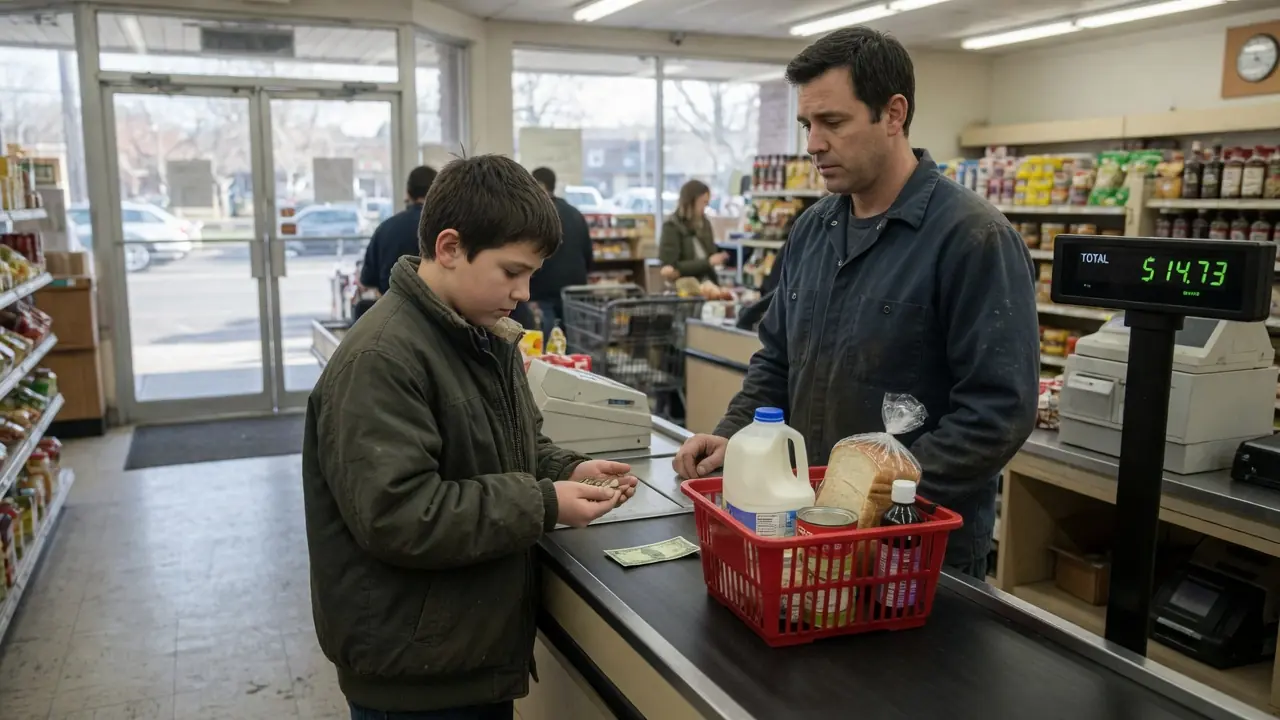
Matthew had just finished scanning a small order when he noticed the boy at the end of the checkout lane.
He was around eleven or twelve.
Thin, with a jacket too light for November and sleeves that stopped a little short at his wrists.
His hair was dark and damp from the mist outside.
His shoes were worn at the toes but carefully tied.
He carried a red plastic shopping basket with both hands, though there were only five items inside.
A carton of milk.
A loaf of bread.
Two cans of soup.
A small bottle of children’s cough syrup.
The boy waited until the customer ahead of him left, then placed each item on the belt with careful attention.
Matthew knew that kind of careful.
It was the way people handled things when they had already counted the money twice before reaching the register.
“Morning,” Matthew said.
The boy nodded.
“Morning, sir.”
Matthew scanned the items.
Twenty-three dollars and forty-eight cents.
The boy’s face changed.
Not dramatically.
Not enough for everyone else to notice.
But Matthew noticed.
The slight tightening around the mouth.
The quick blink.
The way his shoulders rose like he was bracing for impact.
The boy opened his hand.
A ten-dollar bill.
Four ones.
A few coins.
He counted them carefully on the counter.
Fourteen dollars and eleven cents.
The people behind him grew restless.
Someone sighed.
The boy’s ears turned red.
“I can put something back,” he whispered.
Matthew did not ask where his mother was.
He did not ask why a child was buying cough syrup alone.
He did not ask what had gone wrong at home.
He simply looked at the items.
Milk.
Bread.
Soup.
Medicine.
Nothing in that basket was extra.
“What do you want to put back?” Matthew asked quietly.
The boy stared at the items.
His fingers hovered over the cough syrup.
Then the milk.
Then the bread.
He looked defeated before he even chose.
Matthew reached into his pocket and took out his wallet.
There was not much inside.
A ten-dollar bill.
A five.
A few receipts.
The ten was supposed to be his lunch money for the next two days and part of the milk he needed to buy for Theodore.
He took it out anyway.
The boy noticed immediately.
“No, sir. I can’t.”
Matthew placed the ten on the counter.
“Add it to mine,” he told the cashier beside him, because Grace from register three had stepped over to help with the growing line.
The boy shook his head.
“I can’t take that.”
“You’re not taking it,” Matthew said. “I’m paying it.”
“That’s the same thing.”
“Not today.”
The boy’s eyes filled, but he held himself together with fierce discipline.
“What’s your name?” Matthew asked.
“Caleb.”
“Caleb what?”
“Caleb Turner.”
Matthew nodded.
“Well, Caleb Turner, you’ve got milk and medicine in that bag. It’s cold outside. Don’t make it a problem.”
The boy swallowed.
“I’ll pay you back.”
Matthew almost smiled.
“Eat dinner first.”
Grace finished the transaction.
Matthew bagged the groceries himself, double-bagging the milk so it would not split on the walk home.
Caleb took the bag with both hands.
He looked at Matthew like he was trying to memorize him.
Then he reached into his pocket, pulled out the receipt, and carefully folded it.
“I’ll remember,” he said.
Then he left.
Matthew watched him cross the parking lot through the front window.
The boy walked quickly, shoulders hunched against the cold, grocery bag held close.
No car waited.
No adult came.
He disappeared around the corner near the pharmacy.
Grace looked at Matthew.
“You okay?”
“Fine.”
“That was your lunch money.”
“I’ve got a granola bar.”
“You always say that like granola bars are meals.”
“They are if you eat them with confidence.”
Grace shook her head.
But she smiled.
The day continued.
Customers came and went.
Receipts printed.
The light above register four flickered.
Matthew bought milk after his shift using the remaining five-dollar bill and a little change from his jacket pocket.
When Theodore asked why dinner was toast and eggs, Matthew told him breakfast for dinner was a luxury.
Theodore accepted this.
Children believe many things when they are loved well enough.
That night, after Theodore fell asleep, Matthew sat at the kitchen table with his spiral notebook open.
He tried to work on inventory numbers, but his mind kept returning to Caleb Turner.
The too-small jacket.
The cough syrup.
The way he had almost put back medicine.
Matthew wondered who was sick at home.
A mother.
A younger sibling.
A grandmother.
He wondered if the boy made it home before the rain started.
He wondered whether helping had truly helped, or if it had only patched one small hole in a life full of larger ones.
Then he closed the notebook.
Some questions could not be solved in pencil.
A week passed.
Then a month.
Then winter folded itself over Columbus.
Matthew saw Caleb once more in December.
The boy came into Dalton Fresh Market near closing time and walked past register four twice before gathering the courage to approach.
He had no basket.
No groceries.
Just a folded piece of paper in one hand.
Matthew looked up.
“Caleb.”
The boy seemed surprised he remembered.
“I brought this.”
He placed two dollars and twenty-five cents on the counter.
Coins mostly.
Matthew looked at the money.
Then at the boy.
“You didn’t have to do that.”
“I said I would pay you back.”
“You owed me nine dollars and thirty-seven cents.”
Caleb flushed.
“I know. This is part.”
Matthew studied him.
There was pride in the boy’s face.
Fragile, but real.
Matthew understood that refusing the money outright would wound him.
So he picked up one quarter and slid the rest back.
“I’ll take this as a first payment.”
Caleb frowned.
“One quarter?”
“Interest-free arrangement.”
“That doesn’t make sense.”
“Most generous payment plans don’t.”
Caleb looked at the coins.
Then at Matthew.
For the first time, he smiled.
Small.
Brief.
But unmistakable.
“Thank you,” he said.
Matthew nodded.
“Everything all right at home?”
The smile vanished, but not completely.
“My mom got better. The cough syrup helped.”
“I’m glad.”
“She works nights. She was sick and couldn’t go in. We were short that week.”
Matthew nodded.
He did not say he understood.
He did not need to.
Caleb picked up the coins, leaving the quarter on the counter.
“I’m going to pay all of it back one day.”
“I believe you.”
Matthew did.
Caleb came in every few weeks after that.
Sometimes to buy something small.
Sometimes just to pass by register four and say hello.
He brought coins twice more.
Thirty-eight cents.
Then a dollar.
Matthew took one coin each time and told him the account was progressing nicely.
By spring, Caleb stopped coming.
Matthew asked Grace if she had seen him.
She had not.
Summer arrived.
Then another school year.
Life moved forward the way it does for people who cannot afford to stand still.
Matthew kept working.
Theodore grew taller.
Margaret’s knees got worse, so Matthew began doing her laundry along with groceries.
His spiral notebook filled, then another began.
Every so often, he thought about Caleb Turner.
He wondered if the boy’s mother was still working nights.
He wondered if Caleb had stayed in school.
He wondered if the one-quarter debt would remain forever in the strange little account between them.
Years passed.
Theodore turned ten.
Then twelve.
Matthew’s hair began to gray at the temples.
Dalton Fresh Market changed managers twice.
The flickering light above register four was finally replaced by a new fixture that buzzed instead.
Grace left to work at a clinic.
Margaret moved in with her sister after a fall made the apartment stairs impossible.
Matthew stayed.
He became the kind of employee new hires went to with questions.
He knew which customers needed help reading labels.
He knew who counted change before the total appeared.
He knew which parents were choosing between diapers and dinner because their eyes always moved the same way when prices appeared on screen.
Whenever he could, quietly and without turning kindness into spectacle, he helped.
A dollar here.
A coupon there.
A reminder that the store brand was cheaper and just as good.
He never made anyone feel watched while struggling.
That was his rule.
Theodore noticed.
Of course he did.
One night when Theodore was fourteen, he stood in the kitchen watching Matthew sort receipts.
“Dad,” he said.
“Yeah?”
“Do you ever get tired of helping people when nobody helps you back?”
Matthew looked up.
Theodore was taller now, his face changing from boy to young man, but his eyes were still Dana’s.
Matthew considered lying.
Then didn’t.
“Yes.”
Theodore looked surprised.
“You do?”
“Sometimes.”
“Then why keep doing it?”
Matthew leaned back in his chair.
“Because needing help is hard enough. Nobody should have to feel ashamed on top of it.”
Theodore was quiet for a moment.
Then he nodded.
“That sounds like Mom.”
Matthew’s chest tightened.
“Yes,” he said softly. “It does.”
Twelve years after the morning Caleb first appeared at register four, Matthew was still at Dalton Fresh Market.
Not because he lacked ambition.
Because life had required him to prioritize steadiness over risk.
Theodore was in his second year of community college, studying engineering while working part-time at a warehouse.
Matthew was proud of him in a way that sometimes made speaking difficult.
He had not saved much for himself.
He had not bought new furniture.
He had not gone back to school.
But Theodore had made it further than Matthew had, and that felt like a victory large enough to live inside.
On a cold Thursday morning in November, Matthew was restocking reusable bags near his register when a man in a navy suit walked into the store.
He was in his mid-twenties.
Tall, composed, with neatly cut dark hair and the quiet confidence of someone used to walking into rooms where people listened.
He did not take a basket.
He did not browse.
He walked straight toward register four.
Matthew looked up.
For a moment, he saw only a well-dressed stranger.
Then the man smiled.
Not broadly.
Just enough.
And something in the shape of that smile pulled a memory from twelve years earlier.
A boy with a too-small jacket.
A grocery bag held close.
A folded receipt.
Matthew’s hand stilled.
“Caleb?”
The man’s eyes softened.
“Yes, sir.”
Matthew stared at him.
“Caleb Turner.”
Caleb nodded.
“I was hoping you’d remember.”
Matthew gave a breath that was almost a laugh.
“You still owe me a quarter.”
Caleb laughed then.
A real laugh.
He reached into his jacket pocket and pulled out a small envelope.
“I brought more than that.”
Matthew looked at the envelope but did not take it.
“Caleb.”
“Please,” Caleb said. “Just let me explain first.”
There was something in his voice that made Matthew stop.
Caleb looked around the store.
The buzzing light.
The conveyor belt.
The same register.
“I came here twelve years ago with fourteen dollars and eleven cents,” Caleb said. “My mother had been sick for a week. She worked nights cleaning offices downtown. If she missed one more shift, we were going to lose the room we were renting.”
Matthew remembered the cough syrup.
“She needed medicine,” Caleb continued. “And we needed food. I thought I could buy everything. I counted wrong.”
“You were a child.”
“I was a child who thought if I failed at the register, my whole family failed with me.”
Matthew said nothing.
Caleb’s voice stayed steady, but his eyes shone.
“People behind me were sighing. I was trying not to cry. I was about to put back the medicine.”
Matthew looked down.
“You paid the difference,” Caleb said. “But that wasn’t all you did. You didn’t embarrass me. You didn’t ask me to explain. You didn’t make me feel like a charity case.”
He pulled a folded paper from his wallet.
It was old.
Soft at the creases.
Yellowed slightly.
A grocery receipt.
Matthew recognized the Dalton Fresh Market logo at the top.
Caleb unfolded it carefully.
“I kept this.”
Matthew swallowed.
“For twelve years?”
“Yes.”
“Why?”
“Because that was the first time I understood that a stranger could help you without wanting to own your shame.”
The words settled between them.
Matthew felt the store around him fade slightly.
Customers moved somewhere in the distance.
A scanner beeped.
The automatic doors opened and closed.
But register four had become, for a moment, a place outside time.
Caleb continued.
“My mom got better. She kept working. I stayed in school. I got scholarships. Went to Ohio State.”
Matthew’s eyebrows lifted.
“Accounting?”
Caleb smiled.
“Finance. Then law.”
“Law?”
“I work with a foundation now. We fund emergency aid programs for families who are one small bill away from losing everything.”
Matthew stared at him.
Caleb tapped the receipt gently.
“This is why.”
Matthew had no answer.
Caleb opened the envelope and placed something on the counter.
Not cash.
A formal letter.
Matthew did not touch it yet.
“What is this?”
“A job offer.”
Matthew blinked.
Caleb smiled slightly.
“Not from me personally. From the Turner Family Relief Foundation. I’m program director. We’re opening a Columbus office focused on emergency grocery, medicine, and utility assistance.”
Matthew looked at the letter.
Caleb continued.
“We need someone to manage community outreach. Someone who understands what people look like when they’re too proud to ask. Someone who knows the difference between helping and humiliating.”
Matthew let out a slow breath.
“Caleb, I’m a grocery cashier.”
“No,” Caleb said. “You’re the man who taught me how help should feel.”
Matthew looked away.
The words were too much.
Caleb softened his voice.
“The position has a salary, benefits, and flexible hours. It also includes tuition support if you ever want to finish your accounting degree.”
Matthew’s eyes moved back to him sharply.
“How did you know about that?”
Caleb smiled.
“I did my homework. Also, I spoke with Grace.”
Matthew stared.
“Grace from register three?”
“She works at a clinic partnered with our foundation. She remembered you. She remembered the notebook.”
Matthew closed his eyes briefly.
Of course Grace remembered.
Some people had long memories for quiet kindness.
Caleb pointed gently to the letter.
“There’s something else.”
Matthew opened it.
The first page described the job.
The second outlined benefits.
The third page made his hands stop.
It was a scholarship fund.
Named the Callaway Quiet Mercy Fund.
Created to help children and single parents cover emergency grocery and medicine shortfalls without public embarrassment.
Matthew read the name once.
Then again.
He looked up.
“No.”
Caleb’s expression did not change.
“Yes.”
“You don’t name funds after people for ten dollars.”
“It wasn’t ten dollars.”
“It was groceries.”
“It was dignity.”
Matthew’s throat tightened.
Caleb leaned forward slightly.
“Mr. Callaway, that morning changed the way I saw the world. I built my life around the idea that help should arrive before shame has time to settle. That came from you.”
Matthew looked down at the letter.
The store around him felt suddenly too bright.
Too ordinary.
Too small for the weight of what had returned.
“I don’t know what to say.”
Caleb smiled.
“You told me to eat dinner first. So I’ll tell you to read the offer first.”
Despite himself, Matthew laughed.
Caleb reached into his pocket and pulled out a quarter.
He placed it beside the letter.
“And this,” he said, “settles the account.”
Matthew picked up the coin.
It was not old.
Not the same one.
Of course it wasn’t.
But it felt heavy anyway.
“Interest-free?” Matthew asked.
Caleb grinned.
“Generous payment plan.”
Matthew shook his head.
For a moment, he could not see clearly.
He turned slightly, pretending to adjust the receipt printer.
Caleb gave him that privacy.
The way Matthew had once given privacy to a boy counting coins.
That afternoon, Matthew called Theodore.
His son answered between classes.
“Dad? Everything okay?”
Matthew looked at the letter on the break room table.
“I think so.”
“You sound weird.”
“I got a job offer.”
“What? From where?”
“A foundation.”
There was a pause.
“A what?”
Matthew laughed softly.
“I’ll explain tonight.”
“Is it good?”
Matthew looked at the salary again.
The benefits.
The tuition support.
The name of the fund.
“Yes,” he said. “It’s good.”
Theodore was quiet for a moment.
Then he said, “Mom would be proud.”
Matthew closed his eyes.
“I hope so.”
“I know so.”
That evening, Matthew sat at the kitchen table with Theodore, reading every page of the offer.
Theodore read faster.
He always had.
“Dad,” he said, looking up, “this is life-changing.”
Matthew nodded slowly.
“It might be.”
“No. It is.”
Matthew picked up the quarter Caleb had given him and rolled it between his fingers.
“I helped him once,” he said. “I didn’t think about it after that. Not really.”
Theodore looked at him.
“Maybe he did.”
Matthew thought about Caleb keeping the receipt for twelve years.
The boy becoming a man.
The man building a career around the feeling of being helped without being shamed.
A ten-dollar decision had walked through twelve years and returned wearing a suit.
Not as repayment.
As proof.
The next week, Matthew accepted the offer.
He finished his final shifts at Dalton Fresh Market quietly.
No big announcement.
No dramatic farewell.
Grace came by on his last day and hugged him hard enough to hurt.
“I knew that notebook was going somewhere,” she said.
Matthew smiled.
“You kept secrets too well.”
“I kept the right ones.”
On his last afternoon at register four, a young mother came through his line with two children and a cart full of careful choices.
When her card declined, her face went pale.
Matthew saw the old familiar tightening.
The silent calculation.
The shame rising before anyone had even said a word.
He reached into his pocket.
Then stopped.
Not because he would not help.
Because now there was a better way.
He called the assistant manager over and quietly used the store’s new emergency assistance code, a small pilot program Dalton had recently started after partnering with Caleb’s foundation.
No announcement.
No scene.
Just a few keystrokes.
The receipt printed.
The woman blinked.
“It went through?”
Matthew nodded.
“You’re all set.”
Her eyes filled.
“Thank you.”
He smiled gently.
“Have a good night.”
She left with groceries.
Her children skipped beside the cart.
Matthew watched them go.
Then he looked at register four.
The light still buzzed.
The belt still moved too slowly.
But something had changed.
Not the store.
The structure around the moment.
Kindness no longer had to sneak through as a personal sacrifice.
There was room for it now.
On Matthew’s first day at the Turner Family Relief Foundation, Caleb met him in the lobby.
No suit jacket this time.
Sleeves rolled up.
Coffee in one hand.
A stack of files in the other.
“You ready?” Caleb asked.
Matthew looked around.
The office was modest.
Bright.
Busy.
A wall near the entrance displayed the foundation’s mission statement.
Help before shame.
Matthew read it twice.
Then looked at Caleb.
“Nice phrase.”
Caleb smiled.
“I stole it from you.”
“I never said that.”
“No,” Caleb said. “You lived it.”
The work was not easy.
It was not sentimental.
Matthew quickly learned that need came with paperwork, restrictions, funding cycles, eligibility rules, and more heartbreak than any one office could hold.
A mother short on rent because her hours were cut.
A grandfather choosing between medication and heat.
A teenager buying groceries for younger siblings.
A warehouse worker whose car repair meant the difference between employment and eviction.
Matthew recognized them all.
Not their names.
Their posture.
The way they apologized before asking.
The way they explained too much because they expected disbelief.
The way their eyes moved toward exits when conversations became too formal.
Matthew trained the staff carefully.
“Don’t make people perform suffering,” he told them. “Ask what you need to ask. No more.”
He helped design the grocery assistance process.
Short forms.
Fast approval.
No public identification.
No humiliating interviews.
Local partnerships.
Emergency codes at participating stores.
Small amounts, delivered quickly.
Five dollars.
Ten.
Twenty-three.
Enough to stop one bad moment from becoming a collapse.
The Callaway Quiet Mercy Fund helped 300 families in its first six months.
By the end of the first year, it had helped over 2,000.
Most grants were small.
That was the point.
A small shortage could carry enormous consequences.
A missed meal.
A missed dose.
A child watching a parent’s face fall at a register.
Matthew knew that sometimes saving dignity was as important as saving money.
Caleb knew it too.
They worked well together.
Not like father and son exactly.
Not like strangers either.
Something else.
A bond built from one brief moment at a grocery store and strengthened by the years that followed.
One evening, after a long day of reviewing emergency cases, Caleb stood in Matthew’s office doorway.
On Matthew’s desk sat the old spiral notebook.
Still used.
Still pencil-marked.
Still practical.
Caleb nodded toward it.
“You ever think about finishing the degree?”
Matthew looked up.
Sometimes.
Often.
Never aloud.
“I’m too old.”
Caleb gave him a look.
“You told an eleven-year-old with no money to eat dinner first. I’m telling a forty-six-year-old with tuition support to enroll first.”
Matthew laughed.
“That’s different.”
“Not really.”
Theodore, now nearly finished with his own studies, pushed harder.
“Dad, you made me keep going,” he said one night. “You don’t get to stop just because it’s your turn.”
So Matthew enrolled part-time.
Accounting.
Online and evening classes.
He was nervous the first week.
Then annoyed.
Then engaged.
Then alive in a way he had not felt in years.
Numbers returned to him like an old language.
Theodore helped him set up his student portal.
Matthew pretended not to need help.
Theodore pretended to believe him.
Two years later, Matthew graduated with a bachelor’s degree in accounting.
The ceremony was held in a large auditorium with uncomfortable seats and too much noise.
Theodore sat in the front row.
Caleb sat beside him.
Grace came.
Margaret came with her sister, using a cane and complaining that the parking was ridiculous.
When Matthew’s name was called, he walked across the stage slowly.
Not because he was unsure.
Because he wanted to feel every step.
Afterward, Theodore hugged him first.
“I told you,” his son said.
Matthew laughed into his shoulder.
“You did.”
Caleb stood nearby, holding a small wrapped box.
Matthew looked at him.
“What’s that?”
“Graduation gift.”
Inside was a framed copy of the old grocery receipt.
The original.
The one Caleb had kept for twelve years.
Beside it, mounted carefully, was the quarter.
The final payment.
Matthew stared at it for a long time.
Then at Caleb.
“You kept the receipt all this time.”
Caleb nodded.
“I needed to remember where everything started.”
Matthew’s voice softened.
“And now?”
“Now you keep it.”
Matthew shook his head.
“No. We’ll hang it at the office.”
Caleb smiled.
“Where?”
Matthew thought about it.
Then said, “Near the mission statement.”
The receipt went up the next week.
Visitors noticed it sometimes.
A faded grocery receipt.
A quarter.
A small plaque beneath it.
A boy came up short.
A stranger helped quietly.
A foundation began years later.
Help before shame.
Years after that, Matthew no longer wondered whether the ten dollars had mattered.
He saw the answer every day.
In grocery bags carried home without embarrassment.
In prescriptions picked up on time.
In parents who left assistance appointments standing a little straighter than when they entered.
In teenagers who learned that one hard week did not have to define the rest of their lives.
And sometimes, late in the evening, when the office emptied and the lights softened, Matthew would stand before the framed receipt and remember the boy at register four.
Fourteen dollars and eleven cents.
Milk.
Bread.
Soup.
Cough syrup.
A line of impatient customers.
A child trying not to cry.
He had not saved the world that morning.
He had not fixed poverty.
He had not changed policy.
He had simply paid the difference.
But sometimes, the difference is where the future begins.
The world often tells tired people to protect what little they have.
Count every dollar.
Guard every margin.
Trust no one.
And sometimes, that advice is practical.
But there are moments when mercy asks for something more than practicality.
A tired single father with his own bills and his own hungry lunch hour saw a boy trying to choose between food and medicine.
He did not ask for a story.
He did not ask for proof.
He did not make the child feel small.
He paid the difference.
Years later, that boy came back not to repay ten dollars, but to return the dignity he had been given.
And together, they built something that helped thousands of others walk through their hardest moments without shame.
That is how quiet kindness works.
It does not always echo immediately.
Sometimes it disappears around a corner in a child’s hand.
Sometimes it folds itself into an old receipt.
Sometimes it grows for twelve years in the heart of someone who never forgot.
Then one day, it comes back.
Not as charity.
Not as luck.
But as proof that nothing good given with love is ever truly lost.