The old man was lost in the snow when Jerome Washington saw him.
Chicago had disappeared beneath a brutal white storm, the kind of blizzard that swallowed streetlights, erased sidewalks, and turned every breath into pain.
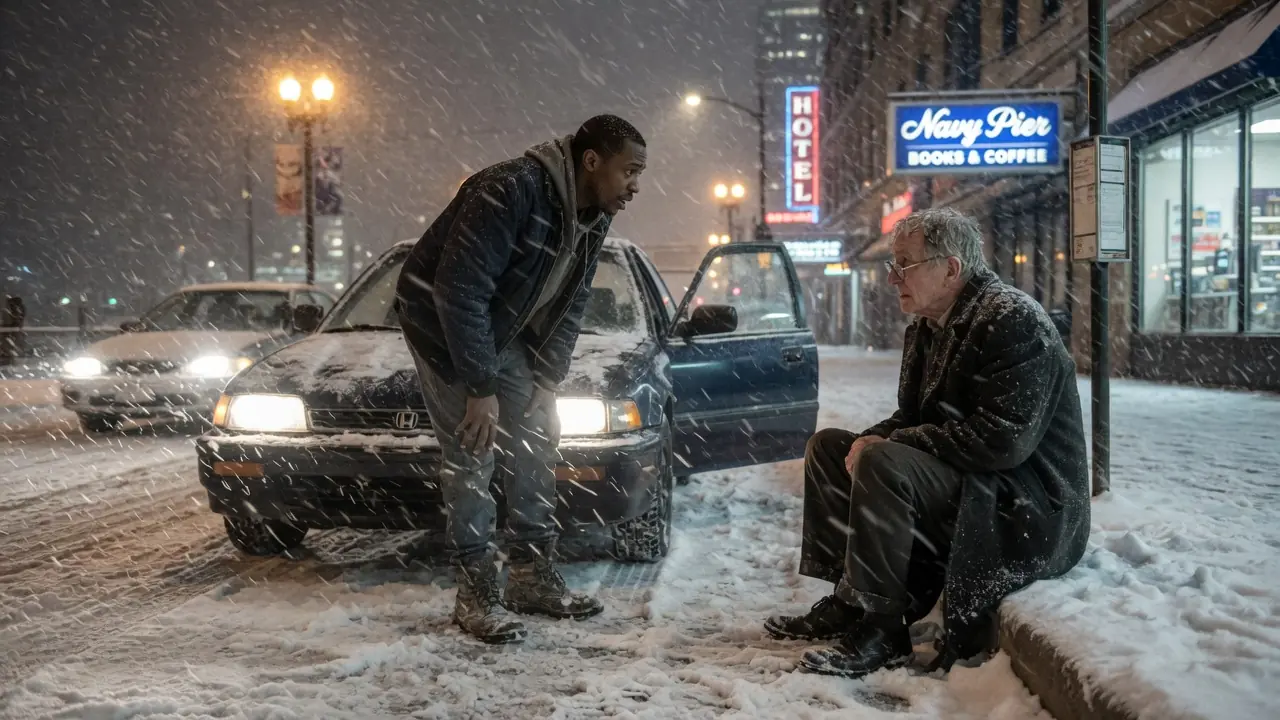
Wind slammed against Jerome’s aging Honda as he pulled near the curb, his hands locked around the steering wheel, his gas gauge hovering dangerously close to empty.
He should have kept driving.
He should have gone home.
He should have been beside his seven-year-old daughter, Elena, who was asleep back at their small apartment with only three heart pills left in the bottle and no guarantee of more after tomorrow.
But across the street, half-buried near a bus stop, an elderly man collapsed into the snow and did not move.
Jerome froze for one second.
Only one.
Then the single father inside him, the man who knew what it meant for a life to hang by a thread, pushed the door open and ran into the blizzard.
“Sir!” he shouted over the wind. “Sir, can you hear me?”
The old man’s lips were blue. His face was pale, almost gray beneath the snow. His body was stiff from cold, and when Jerome pressed two fingers against his neck, the pulse beneath the skin was barely there.
Slow.
Too slow.
Jerome’s old medical training came rushing back like a door being kicked open.
Hypothermia.
Severe.
Maybe minutes from death.
“Come on,” Jerome whispered, gripping the man beneath the arms. “Not here. You’re not dying out here.”
The man was heavier than he looked, and Jerome’s back screamed as he dragged him through the snow toward the Honda. The wind fought him with every step. Ice struck his face. His shoes slipped twice, and once he nearly fell with the old man in his arms.
But he did not let go.
He couldn’t.
Because when you were a single father to a sick child, you learned that life was fragile. You learned that a person could be there in the morning and gone by night. You learned that if someone still had a heartbeat, you fought for it.
Jerome got the stranger into the passenger seat, shut the door against the storm, and cranked the heat to maximum.
“We’re getting you to a hospital,” he said, though the old man could barely hear him.
The man’s head tilted weakly against the seat.
His eyes fluttered open for half a second.
“Cold,” he whispered.
“I know,” Jerome said. “Stay with me.”
The Honda shuddered as Jerome pulled away from the curb.
His gas tank was almost empty.
His wallet held exactly twenty dollars, money meant for Elena’s heart medicine.
He knew that if the car ran out of gas before he reached the hospital, both he and this stranger might be trapped in the storm.
He knew that if he used his last money tonight, Elena’s prescription might have to wait until morning.
He knew all of it.
And still, he drove.
Because the man beside him was dying.
And Jerome Washington had never known how to abandon someone who still had a chance.
What he did not know was that this old man was worth two billion dollars.
He did not know that the man in his passenger seat owned buildings Jerome had driven past a thousand times without ever looking up.
He did not know that the decision he made in that storm would soon change not only his daughter’s future, but the lives of thousands of strangers he had never met.
All he knew was that someone needed help.
And that was enough.
But to understand why Jerome’s last twenty dollars mattered so much, you have to understand how he had ended up with only twenty dollars in the first place.
That morning began before sunrise.
Not because of an alarm clock.
The alarm clock on Jerome’s nightstand had stopped working six months earlier, and he had never replaced it. Every dollar had somewhere more urgent to go.
This morning, it was Elena’s coughing that woke him.
“Daddy,” she whispered from the small bed across the room. “It hurts again.”
Jerome sat up instantly.
His body was exhausted, but fear made him fast.
He crossed the room and knelt beside her. Elena’s small hand was pressed against her chest. Her curls were damp at her forehead, and her eyes, bright even in pain, searched his face for reassurance.
Jerome placed two fingers gently against her wrist.
Her pulse was too fast.
Too uneven.
He forced himself to stay calm.
“All right, baby girl,” he said softly. “Let’s get your medicine.”
He opened the orange pill bottle on the dresser.
Three tablets remained.
Three days of steadier breathing.
Three days of a heartbeat that behaved almost normally.
Three days between his daughter and the kind of danger no father should have to count in pills.
Jerome took out one tablet, placed it in Elena’s palm, and held a cup of water to her lips.
She swallowed carefully.
“Is it bad today?” she asked.
“No,” Jerome lied gently. “Just a little rough. The medicine will help.”
Elena watched him as he picked up his wallet.
He tried to turn away before counting the money, but she was too observant. Children raised by struggle often learned numbers before they learned peace.
One ten.
Two fives.
Three ones.
A few coins.
Twenty-three dollars and change.
Elena’s prescription refill cost nineteen dollars and fifty cents at the discount pharmacy.
That would leave him less than four dollars for gas, food, and anything else life decided to demand before Friday.
Elena’s voice came quietly.
Jerome closed the wallet.
Then he turned back with a smile he had practiced too many times.
“We’re rich in love,” he said. “That’s the most important kind.”
Elena looked unconvinced, but she smiled because she loved him enough to accept the answer.
Jerome hated himself for how often he gave her hope when what she needed was surgery.
Real surgery.
A complete cardiac reconstruction.
Cost: two hundred thousand dollars.
To Jerome, it might as well have been two billion.
He had once been close to a different life.
Before Elena was born, before her mother disappeared, before hospital bills and sleepless nights and prescription refills consumed everything, Jerome had been a medical student at Northwestern University.
Top of his class.
Focused.
Driven.
The kind of student professors remembered.
He had loved medicine not because of prestige, but because he understood bodies as stories. Symptoms were sentences. Pain was language. Healing was the act of listening closely enough to understand what the body was trying to say.
Then Elena came early.
Her mother left three weeks after the birth, unable or unwilling to face the endless appointments, the monitors, the bills, the fear.
Jerome never chased her.
There had been no time.
He dropped out of medical school and traded textbooks for car keys.
Uber.
Lyft.
Airport runs.
Drunk passengers.
Quiet passengers.
Passengers who treated him like furniture.
Passengers who complained about the temperature, the route, the music, the weather, the existence of traffic itself.
Jerome drove eighteen-hour days when he could.
He slept in pieces.
He raised Elena alone.
And every night, no matter how tired he was, he told her she was safe.
Even when he wasn’t sure he believed it.
That morning, after giving Elena her medicine, he made breakfast from what they had left.
Toast.
Half a banana.
Water.
He gave her the larger half without making it obvious.
Elena noticed anyway.
“You’re not hungry?”
“I ate earlier,” Jerome said.
“You always say that.”
“That’s because I’m always prepared.”
She smiled faintly.
“You’re not a very good liar, Daddy.”
He kissed the top of her head.
“Then don’t become one.”
At school, Jerome watched Elena walk toward the entrance in boots two sizes too big, donated from a charity bin. Her coat had duct tape over a tear near the sleeve. Her backpack was faded, and one zipper didn’t work.
But she walked with pride.
That was what broke him most.
She turned at the door and waved.
“Make lots of money today, okay?”
Jerome lifted his hand.
“I’ll try my best.”
She disappeared inside.
Only then did his smile fall.
The morning rides were bad.
Three passengers.
Twelve dollars total.
One woman spilled coffee across his back seat, muttered something about being late, and left no tip.
By noon, Jerome had made eighteen dollars.
His gas tank sat at one quarter.
His stomach ached, but hunger had become background noise.
He parked near Children’s Hospital, not because he had a ride there, but because he sometimes found himself drawn to it. Ambulances came and went through the emergency bay. Doctors in white coats crossed the entrance. Nurses moved with purpose.
Once, that had been the life waiting for him.
Now he sat outside in a dying Honda, checking ride requests and calculating how long his daughter’s heart could wait for help.
His phone buzzed.
A text from Elena’s teacher, Miss Johnson.
Jerome, Elena had another episode during recess. She’s stable now, but she’s resting in the nurse’s office.
Jerome’s fingers went cold.
He typed quickly.
Should I come get her? Is she conscious?
The reply came a minute later.
She’s awake. We’re watching her closely. But I think you should speak with her cardiologist again soon.
Jerome closed his eyes.
Again soon meant worse.
Again soon meant time was shrinking.
He called Dr. Martinez from the parking lot.
The cardiologist answered between appointments, her voice kind but careful, which scared him more than urgency would have.
“Jerome,” she said. “I’m glad you called.”
“How bad is it?”
There was a pause.
“Her latest tests show progression. The medication is helping, but not enough. We need to move toward surgery.”
“How much time?”
Another pause.
“Three months. Maybe four.”
Jerome looked through the windshield at the hospital doors.
“And the programs?”
“We can apply again. There are hospital charity funds, Medicaid appeals, private foundations.”
“How long?”
“Approval can take twelve to eighteen months.”
He laughed once, but there was no humor in it.
“Twelve to eighteen months.”
“I know,” Dr. Martinez said softly. “I’m sorry.”
Jerome pressed his hand against his forehead.
“My daughter has three months, and help takes eighteen.”
“We’re going to keep trying.”
Trying.
That word felt both noble and useless.
By the time he picked Elena up from school, she looked pale but proud.
She climbed carefully into the passenger seat and handed him a folded piece of paper.
“I drew something.”
Jerome opened it.
Two stick figures in white coats.
One tall.
One small.
Both smiling.
“That’s you and me,” Elena said. “When we’re both doctors.”
Jerome’s throat tightened until he could barely speak.
“It’s beautiful, sweetheart.”
“Miss Johnson says smart kids can be anything.”
“She’s right.”
“Even if they’re sick?”
Jerome gripped the steering wheel.
“Especially then.”
Elena fell asleep before they reached the apartment.
Jerome carried her upstairs, careful not to wake her, and tucked her beneath the blanket. Their apartment was small, poorly heated, and old enough that the walls seemed tired. The radiator clanked but barely warmed the room. Wind slipped through the window frame in thin whispers.
He counted his money again.
Twenty dollars and thirty-seven cents.
Tomorrow’s medicine.
Tonight’s gas.
Food.
Rent.
Everything that mattered seemed to be waiting with an open hand.
By evening, snow began falling harder.
Then harder still.
The weather service called it a dangerous blizzard.
By eight o’clock, the city was nearly white.
Jerome should have stayed home.
Elena was asleep, curled under two blankets. Mrs. Alvarez from downstairs had agreed to listen for her through the baby monitor while Jerome tried to get one more ride.
“One hour,” Jerome promised. “Just one.”
Mrs. Alvarez looked at him with sad eyes.
“You work too much, Jerome.”
“I don’t work enough.”
He kissed Elena’s forehead before leaving.
“Daddy?” she murmured half-asleep.
“I’m here.”
“You’re going to make money?”
“I’m going to try.”
“Be careful.”
“I always am.”
Another lie.
Outside, the storm hit him like a wall.
His Honda started on the third try.
The engine coughed, then caught.
Jerome drove slowly into downtown Chicago, squinting through the snow. Ride requests were almost nonexistent. No one wanted to be outside. No one wanted to risk the roads.
Then his phone buzzed.
Ride request.
Navy Pier.
Twenty-five dollar minimum fare.
Jerome accepted instantly.
Twenty-five dollars meant Elena’s prescription and enough gas to get through tomorrow. Maybe even milk. Maybe soup. Maybe one small moment of breathing room.
He drove through the storm toward a high-end restaurant called The Windsor.
The kind of place where people spent more on wine than Jerome spent on groceries in a week.
He pulled up with his hazards blinking.
Five minutes passed.
No passenger.
He called.
Voicemail.
Ten more minutes passed.
The car idled, burning gas he couldn’t afford to lose.
Then the ride canceled.
A message appeared.
Sorry, weather is too crazy. Staying inside.
Jerome stared at the screen.
No fare.
No tip.
No gas reimbursement.
Just wasted time and fuel.
He closed his eyes, breathing through anger because anger didn’t help Elena.
He was about to pull away when movement across the street caught his attention.
A figure near the bus stop.
Dark coat.
Unsteady steps.
The person stumbled.
Then fell face-first into the snow.
And did not move.
Jerome sat frozen.
The storm slammed against his windshield.
Another car passed without slowing.
Then another.
No one stopped.
Jerome thought of Elena.
The medicine.
The gas.
The empty wallet.
The doctor’s warning.
He thought of his daughter’s small hand pressed against her chest.
Then he thought of the man lying in the snow.
Still.
Silent.
Dying.
Jerome pulled over.
Ran.
“Sir!” he shouted. “Sir, can you hear me?”
The old man did not respond.
Jerome rolled him carefully onto his back. He was white, around sixty-five or seventy, with silver hair matted by snow and expensive glasses cracked across one lens. His coat had once been fine, maybe cashmere, but now it was torn and soaked through.
His lips were blue.
His skin was icy.
His pulse was weak.
Jerome’s training took over.
“Hypothermia,” he muttered.
He dragged the man toward the Honda, fighting the wind with every step.
“Stay with me,” Jerome said. “You hear me? Stay with me.”
He got him into the passenger seat and blasted the heater.
The old man’s breathing was shallow.
Jerome looked toward the hospital lights somewhere beyond the storm.
Then at his gas gauge.
Nearly empty.
He had twenty dollars.
Elena’s medicine money.
The old man’s pulse weakened beneath his fingers.
Jerome made his choice.
He drove.
The streets were almost impossible.
Snow erased lane markings. Tires slipped. Wind shoved the Honda sideways at intersections. More than once, Jerome felt the car lose traction and whispered prayers he hadn’t spoken in years.
The old man drifted in and out of consciousness.
“What’s your name?” Jerome asked.
The old man’s eyes fluttered.
“I… I don’t know.”
“Do you know where you live?”
“No.”
“Do you have family?”
The man shivered violently.
“I can’t remember.”
Jerome’s phone rang.
He almost ignored it.
Then saw the school number.
His heart stopped.
He answered on speaker.
“Mr. Washington?” Miss Johnson’s voice shook. “Elena had another episode. A bad one. We called an ambulance. She’s being taken to Northwestern Memorial.”
Jerome gripped the wheel.
“I’m on my way there now.”
“Is she conscious?”
“She was when they left. Please hurry.”
The call ended.
Jerome looked at the old man beside him.
Then at the road.
Both lives.
Same hospital.
Same storm.
He pressed harder on the gas.
“Hold on,” he whispered. “Both of you, just hold on.”
At Northwestern Memorial, emergency staff rushed the old man inside.
Jerome barely had time to explain.
“Severe hypothermia. Pulse was around forty. Confused, unknown identity.”
A nurse looked at him sharply.
“You found him?”
“Yes.”
“You may have saved his life.”
Jerome didn’t answer.
“My daughter was brought in. Elena Washington. Pediatric cardiac.”
The nurse pointed down the hall.
“Pediatric ICU. Go.”
Jerome ran.
Elena was stable but weak. Dr. Martinez stood beside her bed, exhaustion etched across her face.
“She’s resting now,” the doctor said.
“How bad?”
“Serious.”
The word landed like a sentence.
“She needs surgery sooner than we thought.”
“How soon?”
“Six weeks. Maybe eight.”
Jerome gripped the bed rail.
The world narrowed to the sound of Elena’s heart monitor.
Six weeks.
Two hundred thousand dollars.
Twenty dollars gone into a gas tank and a stranger’s survival.
For one terrible second, guilt tried to rise.
Then Elena opened her eyes.
“Daddy?”
He leaned close.
“I’m here, baby.”
“Did you make money?”
Jerome nearly broke.
“No,” he whispered. “But I helped someone.”
Elena smiled weakly.
“That’s good.”
Even sick, she understood.
Maybe better than anyone.
The old man was admitted under the name John Doe.
By midnight, he was awake.
Confused, but alive.
He asked for Jerome.
Jerome entered the hospital room slowly, still wearing his wet jacket.
The old man looked smaller beneath the hospital blankets.
“You’re the man who found me,” he said.
“Yes.”
“You saved my life.”
“I did what anyone should do.”
The old man studied him.
“No,” he said quietly. “Most people don’t do what they should.”
Jerome didn’t know how to answer.
“What should I call you?” he asked.
The man looked toward the window.
“I don’t remember my name.”
“Then we’ll use something simple until you do.”
The old man gave a faint smile.
“Bill,” he said after a moment. “Call me Bill.”
A nurse later explained that Bill’s memory loss might be temporary. Hypothermia, trauma, shock, exhaustion, any of it could have contributed. He had no identification. No phone. No wallet.
He also had nowhere to go.
That was the part Jerome couldn’t ignore.
The hospital could not keep him forever.
Shelters were full because of the storm.
Police had no missing-person report yet.
Jerome knew what came next.
He also knew he had no food, barely any gas, and a daughter who needed surgery.
Still, when the discharge nurse asked if there was anyone Bill could stay with, Jerome heard himself say, “He can stay with me.”
The nurse blinked.
“Are you sure?”
No.
He wasn’t sure.
But he nodded.
“Yes.”
Bill looked at him with stunned eyes.
“I can’t impose.”
Jerome helped him stand.
“You’re not imposing. You’re recovering.”
Three days later, Bill was sleeping on Jerome’s couch, helping Elena with her homework, and making the apartment feel less empty than it had in years.
He was strange for a homeless man.
Not suspicious.
Just strange.
He spoke with polished grammar. He understood medical terms when Jerome discussed Elena’s condition with Dr. Martinez. He knew things about business, architecture, finance, and city planning that no ordinary man without memory should casually know.
Elena adored him almost immediately.
“Bill is smarter than my math teacher,” she announced one night.
Bill smiled from the couch.
“I am absolutely not smarter than your math teacher.”
“Yes, you are,” Elena said. “But you explain fractions better.”
Jerome watched them from the kitchen, stirring canned soup that had been stretched with extra water.
Bill noticed.
He always noticed.
“You didn’t eat,” Bill said later, after Elena had gone to bed.
“I ate earlier.”
“Elena says that means you didn’t.”
Jerome sighed.
“My daughter talks too much.”
“She worries about you.”
“I worry about her.”
Bill looked toward the small bedroom.
“She has tricuspid atresia, doesn’t she?”
Jerome froze.
“What did you say?”
Bill blinked, startled by his own words.
“I… I don’t know. That’s just what it sounded like from what you’ve described.”
Jerome sat across from him.
“How do you know that?”
Bill pressed a hand to his temple.
“I don’t know.”
“Were you a doctor?”
“I don’t think so.”
“A medical investor? Hospital administrator?”
Bill’s face tightened.
“I see rooms sometimes. Large rooms. Men in suits. Charts. Buildings. I hear someone calling me Mr. Morrison.”
Jerome’s eyes narrowed.
“Morrison?”
Bill went still.
The name hung between them.
Then pain crossed his face.
“A boy,” he whispered.
“What boy?”
“My son.”
His breathing grew uneven.
“Michael. His name was Michael.”
The next morning, Bill remembered everything.
Jerome found him sitting on the couch at sunrise, staring at his hands like they belonged to a stranger.
“Bill?”
The old man looked up.
Tears ran down his face.
“My name is William Morrison.”
Jerome stared.
The name hit him slowly.
Morrison Development.
Morrison Tower.
Morrison Children’s Cardiac Wing at Northwestern Memorial.
A billionaire.
A man whose face had been in newspapers Jerome never had time to read.
“You’re William Morrison?”
Bill nodded.
“I own half the skyline.”
Jerome sat down hard.
“You were homeless?”
“No,” William said quietly. “I was pretending to be.”
The room went silent.
Then Jerome stood.
“Pretending?”
William flinched.
“I need to explain.”
“You let me bring you into my home. You let my daughter share food with you. You let us think you had nothing.”
“I didn’t know who I was when you found me. The memory loss was real. The hypothermia was real.”
“But before that?”
William closed his eyes.
“My son died eighteen months ago. Michael. He was in a car accident. He called me from the wreck. He told me cars were passing. He told me nobody was stopping.”
Jerome’s anger faltered.
William’s voice broke.
“He died before help reached him. Surrounded by people who could have stopped and didn’t.”
Jerome sat back down slowly.
“I lost faith in everyone,” William said. “I began going out dressed like a homeless man. Sometimes hungry. Sometimes cold. Sometimes asking for small help. I wanted to know if anyone would stop when there was no reward.”
Jerome stared at him.
“How many did?”
William looked at him.
“You.”
The answer landed heavily.
“You were the only one who stopped when I was actually dying.”
Jerome rubbed both hands over his face.
“This is insane.”
“Yes,” William whispered. “Grief often is.”
Jerome looked toward Elena’s bedroom.
“You made my daughter care about you.”
“I care about her too.”
“You lied.”
“I did.”
“Why should I trust anything you say now?”
William bowed his head.
“You shouldn’t. Not yet.”
For a long time, neither man spoke.
Then Elena’s bedroom door opened.
She stepped out, holding her blanket around her shoulders.
“Daddy?” she asked softly. “Why is Bill crying?”
Jerome closed his eyes.
William looked at the little girl.
Then at Jerome.
And something in his face shifted from shame to decision.
“I’m going to help her,” William said.
Jerome’s jaw tightened.
“No.”
“Jerome—”
“No. You don’t get to buy forgiveness.”
“This isn’t forgiveness. This is survival.”
“My daughter is not a transaction.”
“She’s a child who needs surgery.”
“And you don’t get to use her as a way to feel better about what happened to your son.”
William went pale.
The words were cruel.
But they were true enough to hurt.
Jerome regretted them immediately, but did not take them back.
William nodded slowly.
“You’re right,” he said. “Then not as charity. Not as guilt. Let me offer you work.”
Jerome looked up.
“What?”
“I have a foundation. It was supposed to be Michael’s. He wanted to help people who had talent but no access. People like you. People like Elena. People the world overlooks until it is too late.”
Jerome said nothing.
William continued.
“I don’t want to hand you money. I want to hire you.”
“To do what?”
“To help build the programs Michael dreamed of. Medical scholarships. emergency health grants, support for single parents, funding for children who need surgery before bureaucracy catches up.”
Jerome stared at him.
“You barely know me.”
“I know enough.”
“No, you don’t.”
“I watched you give away your last chance at comfort to save a stranger.”
Jerome’s face hardened.
“You were watching me?”
William hesitated.
“Yes.”
That answer reopened the anger.
But before Jerome could speak, William lifted a hand.
“Not in your home. Not privately. Public acts only. Drivers. Workers. People in situations where kindness costs something. I had investigators identify people who repeatedly chose decency when no one praised them for it.”
Jerome stood again.
“You studied me like an experiment.”
“At first,” William said. “Yes.”
Jerome looked ready to throw him out.
William’s voice softened.
“And then you became the answer.”
The words stopped him.
William continued.
“I don’t deserve your trust. I know that. But Elena deserves every chance available, and you deserve the opportunity you were forced to abandon.”
Jerome looked toward his daughter.
Elena stood silently, watching both men.
Too young for the full truth.
Old enough to understand pain.
“What kind of job?” Jerome asked.
William opened a leather folder he had recovered from his hotel suite that morning.
“Executive director of the Morrison Foundation’s new medical access program.”
Jerome almost laughed.
“I drive rideshare.”
“You were a medical student.”
“I dropped out.”
“To raise your daughter.”
“I don’t have business experience.”
“You have something better.”
“What?”
William looked at him steadily.
“You know what desperation looks like before it becomes tragedy.”
That silenced Jerome.
William slid a document across the table.
“Salary. Full benefits. Elena’s surgery covered immediately through the foundation’s emergency medical fund. Not as personal charity. As the first official case of the program you will help lead.”
Jerome stared at the document.
Two hundred thousand dollars for Elena’s surgery.
Paid through a program designed to help children like her.
A salary larger than anything he had imagined earning again.
Medical benefits.
Tuition assistance if he chose to return to school.
It was too much.
Too sudden.
Too impossible.
He pushed the paper back.
“I can’t accept this today.”
William nodded.
“Then don’t. Take time.”
“I don’t have time.”
“No,” William said quietly. “Elena doesn’t.”
That was the truth neither could soften.
Jerome looked at his daughter.
Elena walked to him and placed her small hand in his.
“Daddy,” she whispered, “is this help?”
He knelt in front of her.
“I think so.”
“Then maybe we should let him help too.”
Jerome closed his eyes.
His daughter, who had almost nothing, still understood grace better than he did.
The surgery happened the next week.
Dr. Martinez performed it personally.
William sat in the waiting room, not as a billionaire, not as a benefactor, but as an old man who had once lost a child and now sat silently beside a father who might lose his.
Jerome paced until his legs shook.
William said very little.
But once, around the fourth hour, he spoke.
“Michael used to tap his fingers when he was nervous.”
Jerome looked at him.
“Elena hums.”
William nodded.
“Children leave pieces of themselves in everything.”
Jerome sat beside him.
For the first time, he did not move away.
After eight hours, Dr. Martinez came out.
The surgery had worked.
Elena’s heart was stable.
Jerome cried so hard he nearly fell.
William held him up.
No cameras captured that moment.
No headline told it.
But it was the moment Jerome stopped seeing William only as the man who had lied.
And began seeing him as a father who had broken in a different way.
Recovery was slow.
Elena hated the hospital food.
Complained about the monitors.
Asked when she could go back to school.
That was how Jerome knew she was getting better.
The Morrison Foundation officially launched the Medical Access Initiative six weeks later.
Jerome did not accept the position immediately.
He made William rewrite the offer.
“No title I haven’t earned,” Jerome said.
William agreed.
They started him as director of community screening and emergency medical outreach.
Still a powerful position.
Still better pay than Jerome had ever had.
But tied to work he understood.
Finding families trapped between medical urgency and slow systems.
Children who needed surgery now.
Parents who could not afford prescriptions.
Single fathers and mothers choosing between rent and treatment.
Jerome knew those choices intimately.
That was why he was good at the job.
He reviewed every case like a doctor-in-training and a desperate father at the same time.
He asked questions administrators didn’t ask.
How many pills are left?
Who watches the child while you work?
Can you afford gas to appointments?
Who is telling you to wait?
How long is too long?
The first fifty cases were approved within two months.
A toddler in Detroit received emergency heart treatment.
A teenager in Milwaukee got insulin support after his mother’s insurance lapsed.
A single father in Cleveland received transportation funds to get his son to chemotherapy appointments.
A grandmother in Chicago got medication assistance after raising three grandchildren alone.
Every approval carried Michael Morrison’s name.
And underneath it, a sentence Jerome insisted on adding.
Help should arrive before hope runs out.
William cried when he saw it.
“That sounds like him,” he said.
“No,” Jerome replied. “It sounds like what he deserved.”
William grew weaker over time.
The cancer he had hidden from the world was no longer willing to stay quiet.
He had six months.
Maybe less.
But those months were full.
He visited foundation sites.
Met families.
Sat with Elena while she recovered.
Listened as she explained her dream of becoming a doctor.
“You’ll be a better one than I ever funded,” he told her.
Elena grinned.
“Were you a doctor?”
“No.”
“Then that’s not hard.”
William laughed so hard he had to wipe his eyes.
Jerome watched from the doorway.
His daughter was alive.
The old man was dying.
Life had a cruel sense of balance.
Before William passed, he did one final thing.
He amended the foundation charter.
Not to give Jerome private wealth.
Jerome had refused that repeatedly.
Instead, William created the Michael Morrison and Elena Washington Emergency Care Fund, dedicated to children whose medical needs could not wait for slow approval systems.
The fund began with five hundred million dollars.
Jerome tried to object.
William stopped him.
“This is not for you,” he said.
“I know.”
“And it is not to ease my guilt.”
Jerome looked at him carefully.
“No?”
William’s eyes were tired but clear.
“No. It is because no child should die waiting for someone to stop.”
Jerome had no answer to that.
William died in early spring.
Elena placed a drawing in his casket.
Three figures in white coats.
Herself.
Jerome.
And William, though he had never been a doctor.
When Jerome asked why, she said, “He helped people get better too.”
The foundation grew.
Not because of publicity, though publicity came.
Not because of money, though there was plenty now.
It grew because Jerome understood something systems often forgot.
People did not only need funding.
They needed someone to believe urgency before paperwork proved it.
He built programs around that truth.
Rapid-response grants.
Emergency prescription cards.
Transportation support.
Medical school scholarships for single parents.
Training programs for former caregivers who wanted healthcare careers.
Community clinics staffed by people who knew what it meant to be poor before they knew what it meant to be professional.
Jerome eventually returned to medical school part-time.
Not because he needed status.
Because Elena kept reminding him.
“You said still, Daddy.”
“What?”
“You told me you were still going to be a doctor.”
He smiled.
“I did say that.”
“So don’t lie.”
He finished.
Years later, Dr. Jerome Washington stood in the lobby of a new pediatric cardiac wing funded by the foundation.
Elena, now older and strong enough to run up stairs just to prove she could, stood beside him.
On the wall was a plaque.
In memory of Michael Morrison.
In honor of every person who stops in the storm.
Below it was another line.
The first life saved by this work was not saved by money. It was saved by a single father who chose compassion when he had nothing left to spare.
Jerome stared at the words for a long time.
Elena squeezed his hand.
“Are you crying?”
“No.”
“You are.”
“A little.”
She leaned against his side.
“I’m glad you stopped for him.”
Jerome looked down at her.
“So am I.”
Outside, Chicago moved fast.
Cars passed.
People hurried.
Storms came and went.
But somewhere in the city, every day, someone received help before hope ran out.
A child got medicine.
A parent got transportation.
A student got tuition.
A stranger got a second chance.
All because one freezing night, a single dad with twenty dollars, an empty gas tank, and a sick daughter waiting for him chose not to drive past a man dying in the snow.
He thought he was losing his last dollar.
But what he really gave was proof.
Proof that kindness could survive poverty.
Proof that grief could become purpose.
Proof that one act of mercy, done with no audience and no reward in mind, could become the beginning of thousands more.
And Jerome never forgot the lesson.
You do not need to have enough to help.
Sometimes, helping begins when you have almost nothing.
Sometimes, the smallest mercy becomes the foundation of a new life.
And sometimes, when a single father stops in the storm to save a stranger, the world changes direction with him.