“Can I sit here?”
Victoria Hale lifted her face from the papers spread across the diner table. Her long chestnut-brown hair framed tear-reddened hazel eyes, and her elegant navy blazer looked painfully out of place among the scratched booths and laminated menus. Across the final page before her waited a blank signature line beneath the words Petition for Dissolution of Marriage. The tired man standing beside the booth carried a tray containing a plain sandwich, fries, and a paper cup of coffee.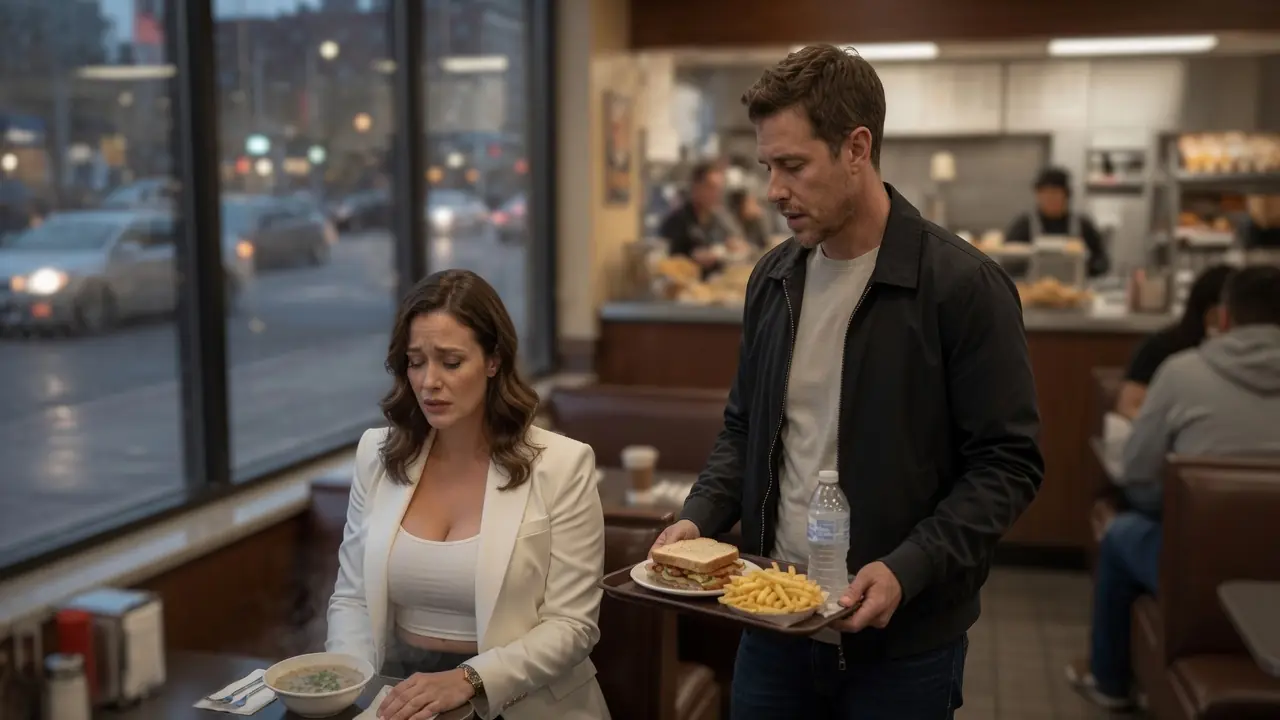
Every other table in the crowded Columbus diner was occupied.
Victoria quickly wiped beneath her eyes. “Of course.”
“Thank you.” The stranger slid into the opposite seat, careful not to disturb her documents. “I have twenty-five minutes before my shift starts again, and apparently half the city decided to eat lunch here.”
He wore a black work jacket marked with faded oil stains, heavy boots, and a gray shirt that had been washed so many times its original color was impossible to guess. He appeared to be in his mid-thirties, with short dark hair, tired blue eyes, and the broad hands of a man who repaired things for a living. A small lunch bag decorated with purple stars rested beside his tray. The name Emma Reed had been written across it in a child’s uneven handwriting.
Victoria looked at the bag. “That doesn’t seem like yours.”
The man smiled faintly. “My daughter and I switched lunches by accident. She probably opened mine at school and discovered enough turkey sandwiches to feed a construction crew.”
“How old is she?”
“Seven.”
Victoria’s expression softened despite herself. “Will she be upset?”
“She’ll be delighted. She believes eating my lunch counts as winning.”
The man unwrapped the sandwich and looked discreetly toward the papers. He clearly recognized what they were, but he did not ask questions or offer the automatic sympathy strangers often used to satisfy their curiosity. Instead, he pushed the small packet of napkins across the table toward her.
Victoria stared at them.
“For the coffee,” he said, nodding toward the untouched cup she had spilled near one page.
“Of course.”
She used one napkin on the coffee and another beneath her eyes. The stranger focused on his meal, allowing her the dignity of pretending he had noticed nothing. That quiet courtesy hurt more than pity would have.
Her husband had never given her silence without using it as punishment.
His name was Grant Mercer, a polished investment executive who knew how to transform every conversation into a negotiation. For eight years, he had stood beside Victoria at charity events, shareholder meetings, and magazine interviews, presenting them as the perfect corporate couple. Six months earlier, she had discovered he was sleeping with his communications director and using confidential information from Hale Manufacturing to benefit one of his investment funds.
The affair had destroyed her trust.
The financial betrayal had nearly destroyed her company.
Still, the finality of the papers frightened her. Once she signed, the marriage she had defended for years would become evidence that she had misjudged the person closest to her. She would have to admit that the beautiful house, carefully staged photographs, and anniversary interviews had been nothing more than decorations surrounding an empty life.
The man checked the time on his phone. His lock screen showed him kneeling beside a smiling girl with curly brown hair and missing front teeth. Both wore paper crowns, and the child had painted a bright blue streak across his cheek.
“She looks happy,” Victoria said.
“She works hard at it.”
“Children usually don’t have to work at being happy.”
“Emma does sometimes.”
The answer carried more weight than the words themselves. Victoria hesitated before asking, “Where is her mother?”
The stranger lowered his sandwich.
“She died four years ago.”
“I’m sorry.”
“So am I.”
His voice held no invitation for further questions, and Victoria respected it. Outside the diner’s large windows, traffic crawled through the afternoon streets. Across the intersection stood Hale Tower, the headquarters carrying her family’s name in silver letters thirty floors above the city.
The man noticed her looking at it.
“You work over there?” he asked.
“Something like that.”
“I’m with Hale Manufacturing too. West Assembly.”
Victoria’s fingers tightened around the napkin. “What do you do there?”
“Maintenance technician. I repair the machines corporate keeps telling us are too expensive to replace.”
He smiled, but she heard the bitterness beneath it.
West Assembly employed more than eight hundred workers. The board was scheduled to vote the next morning on a restructuring plan that would eliminate six hundred and forty positions. Victoria had spent the previous week reviewing the numbers, but Grant’s divorce demand had arrived at the same time, leaving her emotionally exhausted and professionally uncertain.
The settlement he proposed contained a dangerous condition. In exchange for ending the marriage quietly, Grant wanted Victoria to transfer part of her voting authority into a trust controlled by both of them. His attorneys described it as protection for their combined financial interests.
Victoria knew it was an attempt to keep his hands inside Hale Manufacturing after she removed him from her life.
“You don’t look like someone going back to a job she enjoys,” the man said.
“I don’t know whether I enjoy anything anymore.”
“That sounds expensive.”
She looked at him in surprise.
He lifted his coffee. “People with ordinary problems say they had a bad morning. People with expensive problems say they’ve forgotten how happiness works.”
Despite everything, Victoria laughed.
It was a brief sound, but it loosened something inside her chest. “Do you always analyze strangers during lunch?”
“Only the ones crying over legal documents while pretending their soup is interesting.”
Victoria glanced at the bowl before her. It had gone cold.
“My husband wants a divorce,” she said.
The stranger did not look shocked. “Do you?”
“I wanted the marriage I thought we had.”
“That wasn’t my question.”
Victoria studied him. Most people softened their voices around her, afraid of offending the Hale name even when they did not recognize her face. This man spoke with the calm directness of someone whose life had already taught him that truth delayed became pain multiplied.
“Yes,” she admitted. “I want the divorce.”
“Then what frightens you about signing?”
“Everything it means.”
“It means the marriage ends.”
“It means I failed.”
The stranger leaned back. “Did you betray him?”
“No.”
“Did you lie?”
“No.”
“Did you stop trying first?”
Victoria thought of the counseling appointments Grant skipped, the late nights she waited for him, and the apologies she accepted without believing. “No.”
“Then the marriage failed. That doesn’t mean you did.”
Her eyes filled again.
He lowered his voice. “Signing a paper doesn’t erase the years you meant your promises. It only stops someone else from using those promises to keep hurting you.”
Victoria looked down at the blank line.
Grant had repeatedly accused her of destroying their marriage by investigating the company transactions he arranged. He said a loyal wife would have protected him, and a loving partner would never embarrass him before the board. Until this moment, part of her had wondered whether he was right.
“What’s your name?” she asked.
“Daniel Reed.”
“I’m Victoria.”
He nodded, not recognizing her surname because she had not offered it. “Are there children involved?”
“No.”
“Did you want them?”
The question found the wound she had hidden most carefully.
“Yes.”
Grant always insisted there would be time after the next acquisition, the next expansion, or the next election to a corporate board. Two years earlier, Victoria discovered he had privately scheduled a procedure to ensure children would never interrupt the life he wanted. He told her only after she confronted him with the medical bill.
Daniel saw the answer in her face.
“I’m sorry,” he said.
“I’m thirty-three. People keep telling me I still have time, as though time were the only thing I lost.”
“You lost the future he promised.”
Victoria nodded.
Daniel’s expression softened. “After my wife died, people kept telling me I was young enough to marry again. They meant well, but it sounded like they were offering a replacement part for a life that had broken.”
“What did you do?”
“I stopped listening.”
“And now?”
“I raise Emma. I work. I occasionally sit with strangers who ask difficult questions during lunch.”
Victoria smiled through her tears.
Daniel checked his phone again. “I need to leave in eight minutes.”
The thought of him walking away unexpectedly unsettled her. For the first time in months, someone had spoken to her without wanting money, power, access, or reassurance. Daniel did not know who she was, which meant his kindness belonged entirely to the frightened woman sitting before him.
She turned the divorce papers around.
Grant’s proposal included twelve pages of restrictions, confidentiality clauses, and financial traps. Victoria knew enough law to recognize most of them, but she no longer trusted her judgment where he was concerned.
“Would you sign this?” she asked.
Daniel barely glanced at the pages. “I repair hydraulic presses. My legal advice could ruin both our lives.”
“Then answer as a stranger.”
He looked at the signature line. “Does signing free you, or give him another way to control you?”
Victoria’s hand moved toward the clause transferring voting authority.
“The second one,” she admitted.
“Then don’t sign this version.”
“He said if I refuse, he’ll leak private messages, photographs, and company information.”
Daniel’s expression hardened. “That isn’t a divorce. It’s blackmail.”
Victoria quickly looked around.
“No one is listening,” he said.
“You cannot know that.”
“You’ve checked every reflection in the windows since I sat down. You chose a booth facing both exits. Whatever your husband did, he taught you to expect danger in ordinary rooms.”
The observation left her speechless.
Daniel folded his napkin. “Take the papers to someone who works for you, not for him. Sign a fair agreement when you’re ready. But don’t put your name beneath a threat just because the person making it once said he loved you.”
Victoria slowly closed the folder.
“You make it sound simple.”
“It isn’t simple. It’s just clear.”
His phone rang.
Daniel answered immediately. “Hello, Mrs. Alvarez.”
His face changed as he listened.
“How high is the fever?”
Victoria watched him stand, his entire body sharpening with concern.
“I’ll call the school. Keep her there until I arrive.” He ended the call and began gathering his things. “Emma is sick.”
“You have to leave work?”
“I haven’t returned yet.”
“Will your supervisor allow it?”
Daniel gave her a tired look. “Allowing it and punishing me for it are different things.”
“What happens?”
“I lose half a shift. Maybe I get written up.”
“For collecting your sick daughter?”
“The new attendance policy doesn’t care why.”
Victoria knew that policy.
She had approved it four months earlier after executives claimed absenteeism was reducing West Assembly’s productivity. The report described stricter penalties as a necessary step toward operational discipline. It did not mention fathers racing to collect feverish children.
“I’m sorry,” she said.
Daniel lifted Emma’s lunch bag. “You didn’t write the policy.”
Victoria could not answer.
He paused beside the booth. “Don’t sign those papers today.”
“Daniel—”
“You asked what I would do. I’d walk away until the document stopped sounding like his threat and started sounding like your choice.”
Victoria looked up at him. “Will I see you again?”
He appeared surprised.
“The diner is usually crowded,” he said. “You may need to share a booth.”
Then he left.
Victoria remained seated, watching him hurry across the street toward the bus stop. He had forgotten the tray containing his untouched fries, but he carried Emma’s lunch bag close to his chest.
She opened the folder again.
For ten minutes, she read every clause as though hearing Daniel’s question beneath each one. Did it free her, or give Grant another way to control her?
The answer became unmistakable.
Victoria tore the signature page in half.
Then she called her private attorney.
“Cancel today’s signing,” she said. “File a separate petition based on financial misconduct, preserve every communication, and remove Grant’s attorneys from all negotiations involving Hale Manufacturing.”
Her attorney hesitated. “He may retaliate.”
“He already has.”
Victoria ended the call and stared at Hale Tower through the window. Daniel believed she was merely another employee inside that building. He had no idea that she had approved the policy threatening his job or that the layoff proposal on her desk could destroy his daughter’s security.
The shame she felt was different from the shame Grant had used against her.
This shame required action.
Victoria paid for Daniel’s abandoned meal and returned to Hale Tower through the public entrance. Employees stepped aside when they recognized her, voices lowering as she crossed the lobby. She suddenly wondered how many people had learned to become silent whenever she appeared.
Her chief financial officer, Malcolm Pierce, was waiting outside her office.
“The board needs your final approval on the West Assembly closure,” he said. “Grant’s investment group is prepared to purchase the property once operations end.”
Victoria stopped walking.
“Grant’s group?”
Malcolm’s expression barely changed. “One of his affiliated funds.”
The restructuring proposal had always been presented as an independent operational decision. No one had disclosed that her husband’s company planned to profit from the closure.
“Bring me every document connected to the sale,” Victoria said.
“The board meeting is tomorrow.”
“Then you have until tonight.”
Malcolm followed her into the office. “Victoria, personal emotions cannot interfere with corporate strategy.”
“My husband is trying to seize company assets through our divorce while his fund purchases a factory you claim has become worthless.”
“That is an unfair characterization.”
“Then the documents will prove it.”
He placed a hand on the back of a chair. “Your father trusted my judgment.”
“My father also trusted Grant.”
Malcolm’s face tightened.
Victoria saw it then—the quiet alliance she had overlooked. Grant had not acted alone. The divorce, the voting trust, and the factory purchase were parts of the same plan.
“Leave my office,” she said.
“Think carefully.”
“I finally am.”
Victoria worked through the night with outside auditors and independent counsel. They discovered that West Assembly’s losses had been deliberately exaggerated through inflated maintenance costs and supplier contracts connected to Grant’s investment fund. Equipment replacement requests had been denied so repeated breakdowns would make the plant appear unsustainable.
Daniel and his coworkers had not failed.
They had been placed inside a system designed to fail around them.
At seven the next morning, Victoria called the West Assembly supervisor.
“I need Daniel Reed at Hale Tower before nine.”
“He left early yesterday without authorization.”
“His daughter was ill.”
“He still violated policy.”
Victoria looked at the attendance rule bearing her electronic approval. “Remove the violation.”
“Ms. Hale?”
“Tell him the CEO requests his presence.”
Daniel arrived at Hale Tower wearing the same oil-stained jacket. He had barely slept because Emma’s fever remained high through the night. Mrs. Alvarez had stayed with the child so he could attend what he assumed was a disciplinary meeting.
When Victoria entered the lobby, he stared at her.
Her chestnut hair was arranged neatly over the shoulders of a fitted white blouse, and the navy blazer from the diner had been replaced by a tailored suit. Two attorneys and the company’s head of security walked behind her.
“Victoria Hale,” Daniel said.
She stopped before him. “I should have told you.”
“You’re the Victoria Hale.”
“Yes.”
“The woman who approved the attendance policy.”
“Yes.”
“And the CEO preparing to close my plant.”
Victoria held his gaze. “Yes.”
Daniel’s disappointment hurt more than anger would have.
“You sat there while I told you about Emma.”
“I didn’t know who you were when I sat down.”
“But once you knew I worked for Hale, you let me keep talking.”
“I needed to hear what my reports erased.”
“You used me.”
“No.” Her voice broke slightly. “But I understand why it feels that way.”
He stepped back. “What do you want?”
“For you to come into the boardroom and tell the truth.”
“Your executives don’t care about my truth.”
“Then make them hear it.”
Daniel looked toward the elevators. “And if they refuse?”
Victoria extended a folder containing the investigation’s preliminary findings. “Then I stop them myself.”
Inside the boardroom, Malcolm sat beside Grant.
Victoria had not expected her husband to attend. He wore a charcoal suit and the confident smile he used whenever he believed he controlled the outcome. The unsigned divorce agreement rested beside his hand.
“Victoria,” Grant said. “You missed our appointment.”
She placed the torn signature page on the table.
“I chose a different future.”
His smile disappeared.
Daniel remained near the door, suddenly understanding the full reason for her tears. Victoria had not been crying only over a failed marriage. She had been preparing to sign away control of the company he depended on.
Grant looked at Daniel’s jacket. “Who is this?”
“The father your plan intended to erase.”
Malcolm objected immediately. “Operational employees have no place in this meeting.”
Victoria took her chair at the head of the table. “Daniel Reed has repaired West Assembly equipment for eleven years. He understands the plant better than anyone who recommended closing it.”
Grant leaned toward her. “You are embarrassing yourself over a stranger from a diner.”
Daniel’s eyes moved to Victoria.
She showed no surprise that Grant knew where they met.
“You had me followed,” she said.
“I was protecting our interests.”
“No. You were monitoring the woman you believed still belonged to you.”
Victoria activated the boardroom screen.
The first slide showed supplier payments linked to Grant’s fund. The next displayed denied machinery requests, inflated emergency-repair invoices, and plans to purchase the West Assembly property at a fraction of its value.
Board members began whispering.
Daniel stepped forward with maintenance records saved on his personal laptop. He showed photographs of worn equipment, documented warnings, and emails ordering workers to continue production despite known defects. His voice initially trembled, but it strengthened as he spoke about the employees who kept the factory operating while executives prepared to blame them for its collapse.
Grant laughed coldly. “He is a maintenance worker, Victoria. You’re risking your marriage and your company on the word of a man who cannot even keep grease off his clothes.”
Daniel’s jaw tightened.
Victoria rose.
“My marriage ended when you used love as permission to steal from me,” she said. “And this company began losing its soul when men in clean suits decided oil on a worker’s jacket meant his voice had no value.”
Grant stood too. “Without my connections, the board will remove you.”
The lead independent director closed the report before him. “After reviewing the evidence, the board is suspending Malcolm and referring both financial matters to federal investigators.”
Security approached Grant.
His face drained of color. “Victoria, think about what you’re doing.”
“I am.”
“You’ll be alone.”
Victoria glanced at Daniel.
“No,” she said. “I’ll finally be free.”
Grant and Malcolm were escorted from the room.
The West Assembly closure was canceled that morning. Victoria approved an independent rehabilitation plan based on measurable repairs, transparent supplier contracts, and direct input from maintenance workers. Daniel accepted a ninety-day paid trial coordinating the equipment-restoration program, with his performance evaluated by an outside engineering team rather than Victoria.
The position was earned, not given as repayment.
Three months later, West Assembly reduced downtime by thirty-eight percent. Daniel’s restoration plan saved more money than outsourcing would have produced during the first year. Workers who expected unemployment received technical training, and the attendance policy was rewritten to include emergency family leave.
Victoria’s divorce took longer.
Grant challenged every filing, leaked old photographs, and tried to portray her as emotionally unstable. Each attempt failed under documented evidence of financial coercion. When the judge finally granted the divorce without surrendering Victoria’s voting control, she stood outside the courthouse holding the signed order with steady hands.
Daniel waited near the steps.
“You came,” she said.
“You looked like you might need someone to share a bench.”
Victoria laughed.
Emma stood beside him, now healthy and wearing a purple coat. She carried two paper cups of hot chocolate and offered one to Victoria.
“My dad says signing this paper was good,” Emma said.
“It was.”
“Then why are you crying?”
Victoria crouched beside her. “Because good things can still hurt when they close a door you once hoped would lead somewhere beautiful.”
Emma considered this carefully. “You can use our door.”
Daniel looked embarrassed. “She means you’re welcome at our house.”
“I understood.”
Over the following months, Victoria became part of their lives slowly and carefully. She attended Emma’s school play, learned how to make pancakes shaped like stars, and discovered that Daniel sang badly while washing dishes.
Daniel never treated her as fragile.
When she became controlling, he challenged her. When he withdrew behind his responsibilities as a father, she reminded him that strength did not require loneliness. Their feelings grew after his trial position became permanent and his role was transferred outside her direct authority.
One evening, they returned to the diner where they first met.
The booth beside the window was empty.
Daniel placed two sandwiches on the table while Victoria unfolded a single document. It was the final order legally restoring every share Grant had tried to claim.
“No threats hidden inside?” Daniel asked.
“None.”
“Then sign it.”
Victoria wrote her name.
When she looked up, Daniel was watching her with the same steady kindness he had shown before knowing her surname.
“The last time I sat here,” she said, “I thought signing a document would prove my entire life had failed.”
“What do you think now?”
“That sometimes a signature is not the end of a family.” She reached across the table and took his hand. “Sometimes it creates room for the right one to begin.”
Daniel’s expression softened.
Emma appeared from the neighboring booth, where Mrs. Alvarez had been unsuccessfully keeping her hidden. She held a small box containing a ring Daniel had chosen without Victoria’s knowledge.
Victoria covered her mouth.
Daniel moved beside her.
“The first time I asked to sit here, I only needed a place to eat,” he said. “But you became the woman who protected my coworkers, listened to my daughter, and taught me that loving someone again doesn’t betray the life I had before.”
He opened the box.
“Victoria Hale, can Emma and I sit beside you for every chapter that comes next?”
Tears filled her hazel eyes, but this time she did not lower her face or apologize for them.
“Yes.”
Emma wrapped both arms around Victoria before Daniel could place the ring on her finger. The diner continued around them—dishes clattering, servers calling orders, traffic passing outside the window.
Across the street, Hale Tower still carried Victoria’s name.
But inside the small booth, she finally understood that her most important future would never be measured by buildings, shares, or signatures.
It would be measured by the people who chose to stay.
And it had begun with four simple words.
“Can I sit here?”