My daughter tugged on my sleeve inside the diner and whispered, “She looks like a princess.”
I looked through the rain-streaked window and saw the woman standing beneath the broken awning outside. She wore a low-cut navy dress under a loose black coat, her damp hair clinging to her cheeks, one hand gripping a pair of expensive heels like she had walked too far in them. Rain poured over the sidewalk, shining beneath the streetlights, while taxis hissed past without slowing down. The woman stood perfectly still, except for the slight tremble in her shoulders.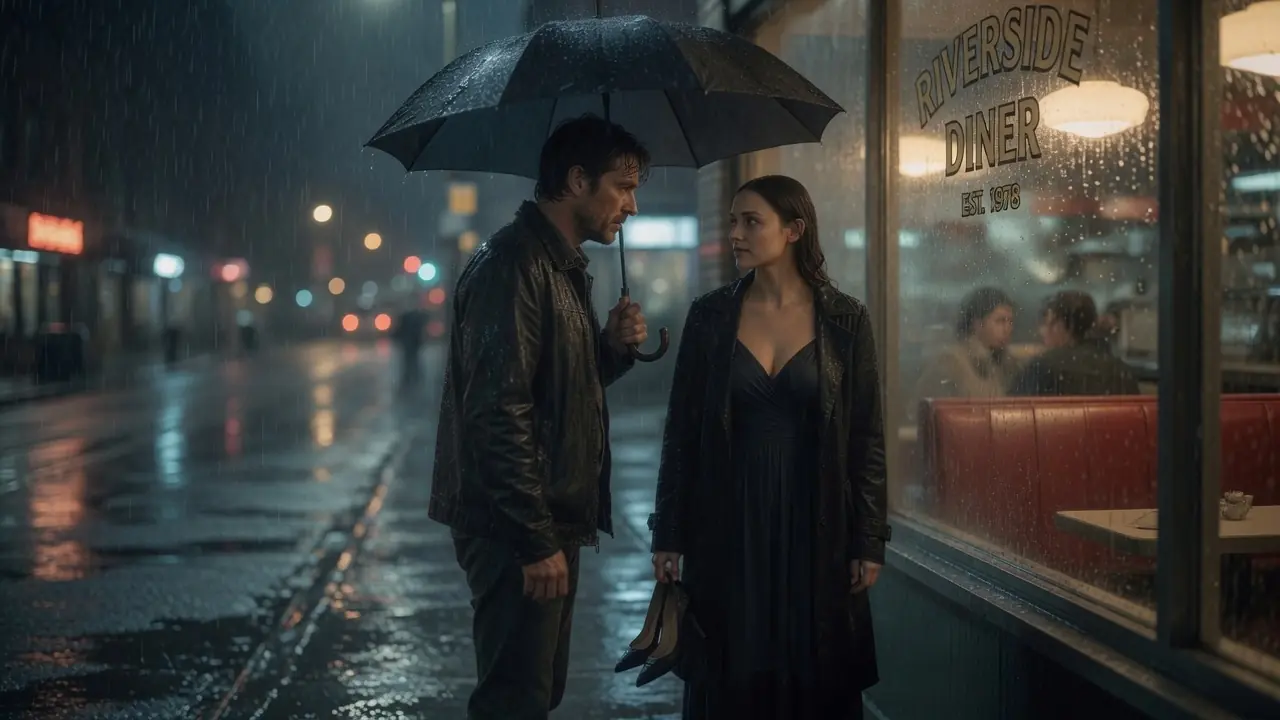
“Maybe more like a queen,” I told Lily.
But queens, I thought, did not usually stand alone in the rain looking like their whole kingdom had betrayed them. Lily pressed her small hand against the diner glass, her face full of worry. She was eight years old, old enough to notice sadness but still young enough to believe someone should always help. I had tried to teach her that without making her think the world was safe every time.
I was not dressed for rescuing anyone. My name was Jason Miller, and I was wearing a soaked work jacket over an old gray hoodie, with grease still under one fingernail from fixing a delivery truck before dinner. I was thirty-five, a single father, and most days my life was held together by duct tape, overtime, and Lily’s faith in me. We had stopped at Marcy’s Diner because I had promised her pancakes after parent-teacher night, even though I knew pancakes meant moving another bill to Friday.
Outside, the woman shifted her weight and nearly stumbled. That was enough.
“Stay here,” I told Lily.
She looked up quickly. “Daddy.”
“I’m just going to check on her.”
“Take the umbrella.”
The black umbrella leaned beside our booth, dripping into a plastic tray. I picked it up, pushed open the diner door, and stepped into the rain. Cold water hit my face immediately, and the city noise swallowed the bell behind me. The woman looked at me as I approached, her eyes red and unfocused, not from weakness, but from someone fighting too hard not to fall apart.
“Ma’am,” I said gently. “Are you okay?”
She gave a small laugh that sounded nothing like humor. “That is a dangerous question.”
“It can be.”
She looked past me toward the diner window. Lily was still watching, both hands on the glass. The woman’s expression softened for one second when she saw her.
“Your daughter?” she asked.
“Yes.”
“She has kind eyes.”
“She gets that from her mother,” I said automatically, then wished I had not. Talking about Lily’s mother always opened a door I preferred to keep locked in public.
The woman swayed slightly. I moved the umbrella farther over her, and she seemed to notice only then that rain was no longer hitting her face. Her black coat had slipped off one shoulder, revealing the elegant cut of the navy dress beneath it. She looked like she had walked out of a gala and into the wrong ending.
“You should come inside,” I said.
“No.” She shook her head too quickly. “I can’t go back in there.”
“Back where?”
She pointed vaguely down the block, where the lights of the Grand Hartwell Hotel glowed through rain and traffic. “Charity dinner. Board members. Cameras. Smiling knives.”
I did not know what that meant, but I understood enough. “Did you drink?”
“Two glasses of wine,” she said, then closed her eyes. “Maybe three. Mostly betrayal.”
“That one hits harder.”
Her mouth trembled like she almost smiled. Then her face crumpled again, and she turned away as if ashamed to be seen crying by a stranger.
“You don’t even know who I am,” she whispered.
“No,” I said. “But I know you shouldn’t be alone on this sidewalk.”
She looked at me then, really looked, rain shining on her lashes. “Why are you helping me?”
“Because tonight you don’t need a name,” I said quietly. “You need someone who won’t walk away.”
For a moment, the city seemed to fall silent between us. Then she lowered her head and nodded once.
I led her into the diner. Every head turned as the bell rang above the door. Marcy, the owner, stood behind the counter with a coffee pot in one hand and one eyebrow raised. She had seen every kind of person come through her door, but even she paused at the sight of a soaked woman in a designer dress walking beside a mechanic with a child waving nervously from a booth.
Lily slid over to make room before I asked. “You can sit here,” she said.
The woman looked at her like the words had cost more kindness than she deserved. “Thank you.”
“What’s your name?” Lily asked.
The woman hesitated. “Victoria.”
“I’m Lily. My dad fixes engines.”
“Does he?”
“Almost everything,” Lily said proudly.
I coughed. “Some things.”
Victoria sat carefully, placing her heels beside her feet. Marcy brought coffee without being asked and set a stack of napkins on the table. She looked at me, then at Victoria, then at Lily. “Nobody drives anywhere until that coffee is gone.”
“Yes, ma’am,” I said.
Victoria wrapped both hands around the mug. They were elegant hands, but shaking badly. A diamond bracelet circled one wrist, and water dripped from her hair onto the collar of her coat. Lily pushed her pancake plate toward the middle.
“Do princesses eat pancakes?” she asked.
Victoria looked at the plate and gave the smallest smile. “Only when queens are too tired to argue.”
That made Lily beam.
For ten minutes, we said very little. Victoria drank coffee slowly. Lily colored the back of a kids’ menu. I sat across from them, trying not to stare and trying harder not to wonder what kind of life brought a woman like that to a diner window looking destroyed.
Finally, Victoria reached into her coat pocket for her phone. Her expression changed when she saw the screen. Dozens of missed calls. Texts piling up. She turned the phone face down.
“Someone looking for you?” I asked.
“Everyone,” she said. “And no one.”
That was not an answer, but it was honest in its own way.
“You have someone safe to call?”
She stared at the coffee. “My driver. But if I call him, he calls my assistant. My assistant calls the board. The board calls the press team. By morning, they will all agree I had an episode.”
“Did you?”
She looked up sharply. “No.”
“Then don’t let them name it for you.”
Something in her face shifted. She studied me with sudden focus, like she had heard something familiar in my voice.
“What did you say your name was?”
“I didn’t.”
“Then what is it?”
“Jason Miller.”
The coffee cup stopped halfway to her mouth.
Her eyes changed so quickly I felt it before I understood it. She sat straighter, the fog clearing from her face for one strange second. “Jason Miller?”
“Yes.”
“From East Dayton?”
My hand tightened around my water glass. “Originally.”
“You worked at Blake Industries. Assembly maintenance. Line Seven.”
The diner seemed to tilt.
I looked at her more carefully. “How do you know that?”
Victoria’s lips parted, but no answer came at first. Lily looked between us, sensing the air had changed.
I knew Blake Industries. Everybody in my old town knew Blake Industries. It had been the factory that promised stability, then cut shifts, then closed two divisions, then blamed market conditions while executives still smiled in magazines. I had worked there six years until the night I wrote a letter I thought no one would read.
A letter about unsafe overtime, missing parts, ignored warnings, and a machine failure that almost hurt one of my crew. I had sent it to corporate after my supervisor buried the report. Two weeks later, I was let go for “attendance inconsistency,” which was a polite phrase for becoming inconvenient. After that, I moved to Columbus with Lily and started over with less than nothing.
Victoria swallowed. “I read your letter.”
My chest tightened. “Who are you?”
She closed her eyes briefly.
Then she opened them and said, “Victoria Blake.”
Even Marcy, who had been pretending not to listen near the counter, froze.
Victoria Blake. CEO of Blake Industries. Her face had been on articles, annual reports, and town hall videos watched by people who hoped the company would remember they were human. She had been younger then, polished and unreadable, always standing in front of flags, charts, and slogans about family values.
I pulled my hand back from the table. “You’re Victoria Blake.”
“Yes.”
Lily whispered, “Is that bad?”
I did not answer right away.
Victoria looked at me with a kind of shame no expensive dress could cover. “I came to Columbus tonight because I was looking for you.”
I laughed once, quiet and bitter. “You found me in a diner because you were standing drunk in the rain.”
“Dizzy,” she said softly. “Not drunk enough to forget. Unfortunately.”
“Why were you looking for me?”
She opened her mouth, then closed it as if the answer weighed too much. “Because your letter was buried before it reached me three years ago. I found it last week in an internal archive connected to a wrongful termination review.”
I stared at her.
She continued, voice trembling. “The machine failure you warned about happened again last month at another facility. This time, someone was badly hurt.”
I felt Lily’s hand slip into mine under the table. I squeezed it gently.
Victoria looked down. “After the incident, I demanded old safety complaints. Your letter was there. So were notes from managers calling you difficult, emotional, not aligned with leadership. Then I found your termination file.”
I said nothing.
“I spent the last week trying to find you,” she said. “Your old number was dead. Your address changed. The only lead we had was a repair garage that said you sometimes ate here after work.”
“So you came from a charity dinner to find a fired mechanic?”
“I came from a dinner where the board told me to suppress the review, settle quietly, and protect the stock price.” Her voice broke. “Then I walked out.”
The anger in me did not disappear. It had lived too long for that. But it shifted, making room for something else. She looked less like the woman from the corporate videos and more like someone who had finally seen the machine she was sitting on top of.
Lily looked at Victoria. “Did my daddy do something wrong?”
Victoria’s eyes filled. “No, sweetheart. Your daddy tried to protect people.”
I looked away.
Three years of swallowing that truth alone had made it hard to hear.
Victoria reached for her phone but did not pick it up. “I owe you an apology.”
“You owe a lot more than that.”
“Yes,” she said. “I do.”
The directness surprised me.
Marcy came over and refilled the coffee. “Sounds like this conversation needs pie.”
Nobody argued.
Victoria stayed at the diner for another hour. Not because she was helpless, but because she was finally speaking like someone whose walls had cracked. She told me about the board, the hidden reports, the safety failures, and the injured worker whose family had forced the truth into daylight. She admitted that she had trusted people who rewarded silence and punished warnings.
I told her about the night shift. About the worn belt on Line Seven, the pressure to keep production moving, the supervisor who said downtime cost too much. I told her about losing my job, losing our apartment, and telling Lily we were moving like it was an adventure because I could not bear to say we had no choice. I did not soften it for her.
She listened.
That mattered more than I wanted it to.
When Lily fell asleep against my side, Victoria finally called her driver. This time, she spoke clearly. “No press team. No board calls. I’m safe. I’ll be home in twenty minutes.”
Then she looked at me. “Will you meet me tomorrow?”
“No.”
She flinched.
“I have work tomorrow.”
“After work?”
I looked at Lily sleeping beside me. “Why?”
“Because I want to put your report back on the record. Publicly. And I want you in the room when I do.”
I shook my head. “I’m not your symbol.”
“No,” she said. “You’re the man who was right.”
That sentence almost broke me.
I looked down at my daughter, at the syrup on her sleeve, at her small fingers curled around my jacket. “I’ll think about it.”
Victoria nodded. “That is more than I deserve tonight.”
The next morning, I woke up to fourteen missed calls from an unknown number and one text from Victoria Blake.
I meant what I said. No cameras unless you agree. No settlement language. Truth first.
I stared at the message for a long time while Lily ate cereal at the kitchen counter.
“Is it the queen?” she asked.
“Maybe.”
“She was sad.”
“Yes.”
“Are you still mad at her?”
I leaned against the counter. “Yes.”
Lily nodded thoughtfully. “You can be mad and still help someone, right?”
I looked at my eight-year-old daughter and wondered how children managed to walk directly into the center of things adults tried to avoid.
“Yes,” I said. “Sometimes.”
After work, I went to Blake Industries’ regional office in the same jacket I had worn the night before. I did not own a suit anymore, and I was not buying one to make a boardroom comfortable. Victoria met me in the lobby wearing a dark suit, hair pulled back, no sunglasses, no jewelry except a plain watch. She looked sober, exhausted, and ready for war.
The security guard greeted her as Ms. Blake, then looked at me uncertainly. Victoria noticed.
“This is Jason Miller,” she said. “He is my guest.”
The guard straightened. “Yes, ma’am.”
Upstairs, the boardroom was full of men and women who looked like they had been interrupted in the middle of protecting themselves. Legal counsel sat near the far end. A communications director whispered into a phone. At the head of the table was a gray-haired board chairman named Russell Vane, whose smile had no warmth at all.
“Victoria,” he said. “This is highly irregular.”
“No,” she replied. “What happened to him was irregular. This is overdue.”
Every face turned toward me.
I hated it immediately.
Victoria placed a folder on the table. “Three years ago, Jason Miller submitted a safety complaint regarding Line Seven at our East Dayton facility. That complaint was buried. Two weeks later, he was terminated. Last month, a similar failure injured an employee in our Pennsylvania plant.”
Russell’s jaw tightened. “We have not completed the investigation.”
“That is why we are beginning with the complaint you ignored.”
A lawyer leaned forward. “We should be careful with wording.”
Victoria looked at him. “We were careful with wording for three years. A man still got hurt.”
Silence.
Then Russell looked at me. “Mr. Miller, I’m sorry for any hardship you may believe you experienced.”
I laughed before I could stop myself. “May believe?”
Victoria’s eyes turned cold. “Try again, Russell.”
The chairman flushed. “Excuse me?”
“You heard me.”
The room went still.
Victoria turned to me. “Jason, if you are willing, tell them what happened.”
I almost refused. My hands were damp. My throat felt tight. For three years, I had told the story only in pieces, mostly to myself, mostly when bills were bad and anger needed somewhere to go. But then I thought of Lily asking if I had done something wrong.
So I told them.
I told them about the belt slipping. The heat in the motor housing. The warning light that had been bypassed with a temporary workaround. I told them about the shift supervisor saying the order had to ship by morning. I told them about the sound the machine made before it seized, the way one worker nearly had his hand caught, and the report that disappeared after I refused to sign off on normal operation.
Nobody interrupted me after the first minute.
When I finished, Victoria opened another folder. “The Pennsylvania incident report matches his description.”
Legal counsel closed his eyes.
Russell said, “What exactly are you proposing?”
Victoria stood. “A public safety review. Reinstatement offer for Mr. Miller if he wants it. Full compensation for wrongful termination. Direct relief to affected workers. Removal of leadership involved in suppressing safety complaints. And a worker reporting system independent of local management.”
The board erupted.
Too expensive. Too risky. Too public. Too damaging.
Victoria let them speak until their fear had shown itself fully. Then she placed both hands on the table and looked at each one of them.
“You are all worried about damage to the company,” she said. “I am telling you the company was damaged when it chose silence over people.”
Russell leaned back. “And if the board refuses?”
Victoria’s voice was calm. “Then I release everything under whistleblower protection and resign publicly by noon.”
The room died.
That was the moment I realized she had not brought me there as decoration. She had brought me there because she had already chosen a side and wanted the truth to have a witness.
Three hours later, the board approved the review.
Not because they suddenly grew hearts. Because Victoria Blake had finally decided that power meant nothing if she only used it to protect the powerful.
The next weeks changed my life in ways I did not trust at first. Blake Industries issued a public statement admitting the suppressed complaints. Two managers were fired. The injured worker’s family received support. A safety fund was created. I was offered reinstatement, but I declined because I had built a new life in Columbus and did not want to return to the place that had taught me how disposable a man could feel.
Instead, Victoria offered something else.
A contract for the repair shop where I worked. Then, when she learned the owner planned to retire, she helped structure a loan that allowed me to buy into the business without taking charity. I signed every paper with my own lawyer present because trust, once broken by a company, does not return because its CEO has kind eyes.
Victoria respected that.
She never rushed me. She never asked me to forgive her on command. She came by the shop once a week at first for official reasons, then sometimes with Lily’s favorite blueberry muffins from Marcy’s Diner. She and Lily formed a strange little friendship built around pancakes, business vocabulary, and the fact that Lily still called her “the queen” when she thought I could not hear.
One evening, three months after the rain, Victoria stood outside the diner again. This time, she was not crying. She wore a simple black coat over another navy dress, lower cut than the business world would have approved of, but she carried herself differently now. Not broken. Not armored. Just tired and real.
I stood under the same umbrella, though it was barely raining.
“You found me,” I said.
She smiled softly. “Technically, your daughter found me first.”
“She said you looked like a princess.”
“You said queen.”
“I was being generous.”
She laughed, and the sound no longer hurt.
For a moment, we looked through the diner window at Lily coloring in the booth where everything had started. Marcy waved from behind the counter. The city lights blurred against the wet glass, just like that first night.
Victoria’s voice softened. “Do you ever wish you had walked away?”
I thought about it.
If I had walked away, she would still have found me eventually, maybe. The board might still have been forced open by the Pennsylvania accident. I might still have gotten compensation years later through a lawyer’s letter. But something about that night had changed more than paperwork. It had changed the way both of us understood mercy.
“No,” I said. “But I’m glad Lily told me to take the umbrella.”
Victoria looked at me. “So am I.”
Life did not turn into a fairy tale. I did not marry a CEO by Christmas or move into a penthouse with Lily and forget how rent once felt. Real healing does not move that fast. But the repair shop grew steady, Lily got the braces she needed, and I stopped waking every morning feeling like one bad week could swallow us whole.
Victoria changed too. Blake Industries became louder in its honesty and less polished in its excuses. Workers began reporting safety problems without fear. Some investors complained. Victoria told them safe workers were not a public relations strategy. They were the reason the company deserved to exist.
And every year after that, on the night of the safety fund ceremony, Victoria made one private stop before the cameras.
Marcy’s Diner.
She would sit in the corner booth, order soup she never finished, and wait for me and Lily to arrive. Lily would ask for pancakes. I would order grilled cheese and fries. Victoria would steal one fry and pretend she had not.
Sometimes she still looked sad. Sometimes I still felt angry about the years we lost. But we learned that two things could sit at the same table without destroying each other. Hurt and respect. Anger and gratitude. Past and possibility.
One rainy night, much like the first one, Lily looked across the booth and asked Victoria, “Were you really searching for my dad?”
Victoria smiled at me, then at her. “Yes.”
“Why?”
Victoria thought carefully before answering. “Because he told the truth when everyone else wanted silence.”
Lily nodded, satisfied. “Daddy does that.”
I laughed. “Not always.”
“Yes, you do,” she said firmly.
Victoria looked at me with warmth that no longer needed to hide behind power. “She’s right.”
Outside, rain tapped softly against the glass. The city moved on, unaware that one corner booth held the remains of a corporate scandal, a single father, a little girl, and a CEO who had once stood crying in a low-cut navy dress outside a diner because her whole world had finally cracked open.
I looked at the umbrella leaning beside the booth.
It was still the same one.
Bent at one rib, patched with tape, not fancy enough for anyone to notice.
But it had covered someone in the rain when she needed it.
And somehow, that had been enough to begin changing everything.