The fiercest snowstorm in thirty years swept through Asheville, North Carolina, on a night when Marcus Brooks had already decided the world was too tired to be kind.
He stood behind the counter of the Cedar Table Diner, wiping the same clean spot for the third time while snow buried the street outside in a white, merciless silence.
The windows rattled every time the wind hit them, and the neon sign over the door flickered as if even electricity was losing courage.
Marcus was thirty-seven years old, a Black single father with broad shoulders, tired eyes, and hands that had learned both gentleness and survival. He ran the diner six days a week, sometimes seven, and lived in the small apartment above it with his nine-year-old son, Caleb.
Caleb was upstairs asleep beneath a dinosaur comforter, or at least Marcus hoped he was asleep. The boy had tried to stay awake during the storm, insisting he was old enough to help his dad close, but Marcus had carried him upstairs at eight and told him heroes needed rest too.
Downstairs, the restaurant was warm.
Soft amber lights glowed over cedar tables. A pot of vegetable soup simmered on the stove. The smell of coffee, garlic, onions, and old wood filled the room with the kind of comfort Marcus had spent years trying to build.
Only one customer remained.
Clarence Whitaker sat in his usual corner booth, both hands wrapped around a coffee mug. He was seventy-two, a retired bus driver with silver hair, kind eyes, and a voice that always sounded like he had seen the worst of life and still chosen patience.
“You’re too good, Marcus,” Clarence said.
Marcus glanced back at him and gave a faint smile.
“Somebody has to be.”
“That’s what worries me,” Clarence replied.
He set down his mug and looked toward the window, where snow was moving sideways through the streetlight.
“Being good in this world when everybody else is looking out for themselves,” Clarence said, “that’s the coldest place a man can be.”
Marcus did not answer right away.
He turned back to the counter, wiping it again though it was already spotless. His hands needed something to do whenever his mind wandered into places he had spent three years trying to seal shut.
He had not always owned a diner.
Once, Marcus Brooks wore suits, carried a leather portfolio, and worked in risk analysis for a powerful investment firm in New York. He had been good with numbers, good with patterns, good at seeing trouble before trouble announced itself.
Then he saw something he was not supposed to see.
False valuations.
Manipulated reports.
Investors being misled by people who smiled through polished conference rooms while moving money through hidden channels.
Marcus reported it.
He believed truth mattered.
Two weeks later, the company accused him of creating the false reports himself.
His reputation shattered before he had time to defend it.
His wife Tasha had already died the year before from a sudden illness, leaving him alone with Caleb and a grief so large he could barely breathe around it. Losing his career after that felt like being pushed from a cliff while already broken.
So he took what little severance he could get, signed papers he hated, and left New York.
He came to Asheville with his son, bought a failing diner with borrowed money, and started over.
Small.
Quiet.
Honest.
“I can handle the cold,” Marcus said at last.
Clarence studied him for a long moment.
“That’s what people say before the cold gets into their bones.”
Marcus looked toward the ceiling, thinking of Caleb asleep upstairs.
“I’ve got a boy to keep warm,” he said. “So I don’t get the luxury of freezing.”
Clarence’s expression softened.
He pushed himself up slowly from the booth, joints creaking, and reached for his coat.
“Well, I should head out before the roads get any worse.”
Marcus frowned.
“You sure? You can wait it out here.”
Clarence shook his head.
“If I stay too late, my daughter will call every hospital in Buncombe County.”
“Drive slow.”
“At my age, that’s the only speed left.”
Marcus laughed softly.
Clarence buttoned his coat, wrapped a scarf around his neck, and moved toward the door with the careful steps of a man who knew his body did not forgive falls anymore.
His hand had just reached the doorknob when it happened.
The door burst open.
Wind screamed into the restaurant, carrying snow, ice, and the sharp smell of winter.
A woman stumbled through the threshold.
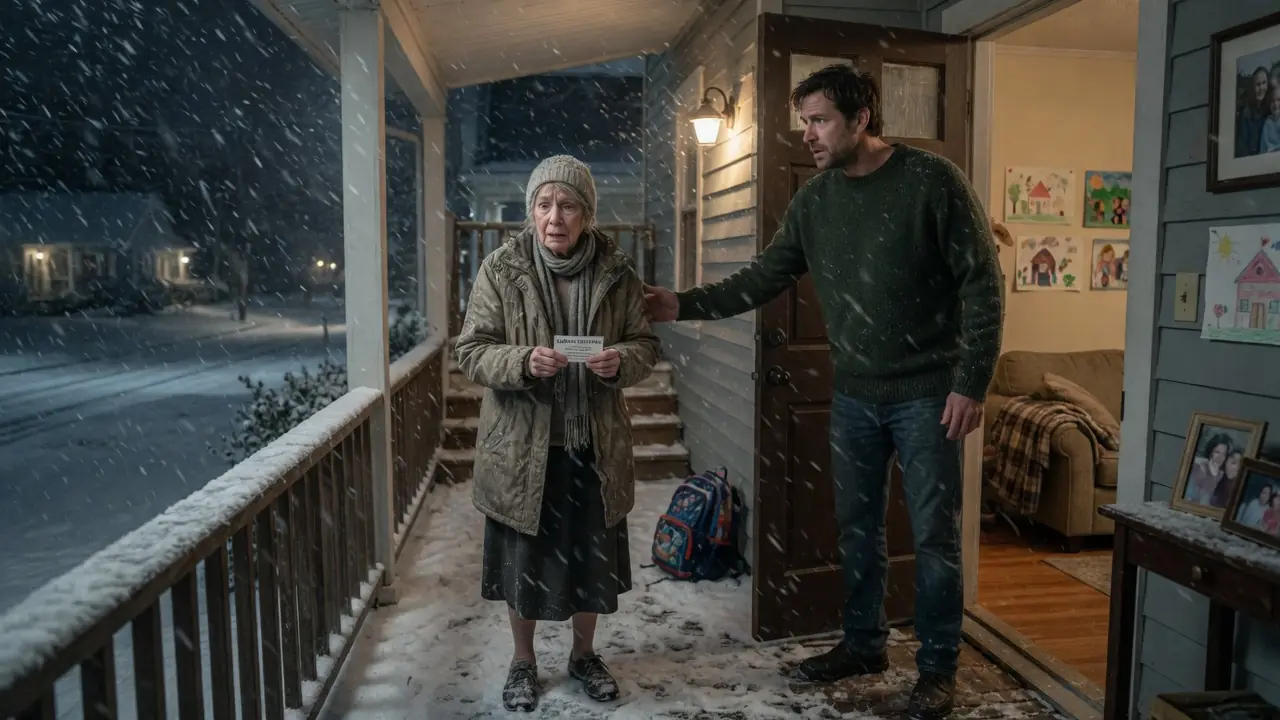
She was elderly, thin, and soaked through. Her gray hair was plastered to her face, her coat was white with snow, and her lips were pale enough to frighten Marcus before she even spoke.
She took one shaking step.
Then her legs gave out.
Clarence caught her before she hit the floor.
“Marcus!”
Marcus was already moving.
He came around the counter in seconds, crossing the diner fast enough that the towel slipped from his hand and fell behind him. Together, he and Clarence lowered the woman into the nearest booth.
She was trembling violently.
Her fingers were stiff, her skin cold under Marcus’s touch.
“Caleb,” Marcus called instinctively, then stopped himself.
His son was upstairs.
The boy did not need to see this yet.
Marcus turned to Clarence.
“Back room, top shelf. Blankets. Grab every one.”
Clarence moved quickly, all traces of age forgotten in the emergency.
Marcus knelt beside the woman, pressing two fingers gently against her neck.
A pulse.
Faint but steady.
He let out a breath.
“Ma’am,” he said softly. “Can you hear me? You’re safe now. You’re inside.”
The woman’s eyes fluttered open.
They were gray, almost the color of the storm outside. Confusion moved through them first, then fear, then a fragile awareness of the man kneeling beside her.
“I need to find my son,” she whispered.
Her voice was barely more than air.
Marcus leaned closer.
“We’ll figure that out. First, we need to get you warm.”
Clarence returned with blankets.
Marcus wrapped one around her shoulders, then another around her lap. He took her cold hands between his own and rubbed them gently, careful not to hurt her stiff fingers.
“Small breaths,” he said. “In through your nose if you can. You’re safe.”
The woman tried to nod.
Her teeth chattered too hard.
Marcus looked at Clarence.
“Lock the door. Wind’s coming in.”
Clarence pushed the door shut and turned the lock.
The diner grew warmer again, but the storm still screamed outside as if angry at being denied entry.
Marcus went to the kitchen, moving on instinct.
Kettle on.
Soup pot uncovered.
Clean mug.
Tea leaves.
Honey.
He had learned practical care from his mother, who had worked as a nursing aide for thirty years and believed no crisis was helped by panic. Marcus still heard her voice sometimes when trouble entered a room.
Warm the hands.
Warm the belly.
Keep the voice calm.
Do not make fear bigger by naming it too loudly.
He brought the tea and soup back to the booth.
Clarence had moved beside the woman, his coat now hanging over the back of the booth, his sleeves rolled up as he tucked the blankets around her legs.
“Here we go,” Marcus said.
He lifted the mug carefully.
“Just a small sip. Not too fast.”
The woman’s hands shook too badly to hold it, so Marcus held it for her.
She sipped.
Then closed her eyes.
The steam rose between them, soft and fragrant.
After a few minutes, some color returned to her cheeks. The violent shaking eased into smaller tremors.
“Thank you,” she whispered.
“What’s your name?” Marcus asked gently.
The woman hesitated, as if the answer had to travel a long distance.
Then she said, “Margaret. Margaret Leighton.”
Across the room, Clarence froze.
Marcus kept his face neutral, but the name caught in his mind.
Leighton.
That name meant something in North Carolina.
Power.
Hospitals.
Research centers.
Glass buildings with private security.
The kind of name that appeared in business journals and on university wings.
“Margaret,” Marcus said carefully, “where does your son live?”
“Hawthorne Hill,” she said.
Her fingers tightened around the blanket.
“The estates.”
Clarence muttered, “Lord have mercy.”
Marcus glanced at him.
Clarence looked troubled.
Hawthorne Hill was not a neighborhood people wandered into by accident. It was old money and new money sitting on top of a mountain behind iron gates.
Margaret looked toward the window, her eyes wet.
“I have to see him,” she said. “I have to fix something I did wrong.”
She reached clumsily into her coat pocket.
Her fingers were still too numb, and a card slipped out, landing face up on the table.
Marcus picked it up.
Leighton Biotech Systems.
The logo was clean, sharp, expensive.
Below it, embossed in silver letters, was the name Nathan Leighton.
Chief Executive Officer.
A voice came from the counter.
“Wait.”
Marcus turned.
A truck driver named Ray, who had been quiet in the back booth so long Marcus had nearly forgotten him, was staring at the card.
“You mean Nathan Leighton?” Ray asked. “The CEO?”
Margaret closed her eyes.
A tear slid down her weathered cheek.
Ray shook his head slowly.
“I delivered equipment to one of his facilities once,” he said. “That man is cold as steel. Walked past people like they were furniture.”
Clarence shot him a warning look, but Ray kept going.
“I heard he turned away a family whose car broke down outside his estate during the last cold snap. They had a kid with them.”
The words settled over the diner like heavy snow.
Margaret’s hands started shaking again.
But this time, it was not from cold.
“He wasn’t always like that,” she said.
Her voice was so quiet that Marcus had to lean closer.
“When he was little, Nathan had the softest heart. He brought home injured birds. Stray cats. Once, he cried for three days because a neighbor cut down an old oak tree.”
She looked down at the tea.
“Somewhere along the way, he forgot his own heart.”
Marcus felt something tighten in his chest.
He knew what it meant to lose pieces of yourself. He knew what it meant to harden because the world had punished softness too many times.
He also knew hardness could become a prison.
“Mrs. Leighton,” Marcus said, “why were you walking in the storm? Why not call your son?”
Margaret gave a sad smile.
“Because he wouldn’t answer.”
Marcus said nothing.
“He has not answered my calls in eight months,” she continued. “Not since I told him he was becoming someone I did not recognize.”
She drew the blanket closer.
“So I thought if I showed up, if he saw me standing there, maybe then he would remember. Maybe then he would see me.”
Desperation made people do dangerous things.
Marcus knew that too.
It made mothers walk through blizzards.
It made fathers move across states with a child and no plan.
It made honest men sign away pieces of their silence just to keep a roof over their son’s head.
“How did you even get here?” Clarence asked.
“Taxi,” Margaret said. “He dropped me near the bottom of Hawthorne Hill. Said the roads were too dangerous to go farther.”
Clarence’s face tightened.
“That’s nearly three miles uphill.”
“I thought I could walk it.”
“In this weather?” Ray said. “You could have died.”
Margaret looked at him with a calm that silenced the room.
“I know.”
Then she whispered, “But some things are worth dying for.”
The silence that followed was absolute.
Marcus made his decision.
“You are not going anywhere tonight.”
Margaret looked up sharply.
“No, I have to—”
“No,” Marcus said.
His voice stayed gentle, but it carried the firmness he used with Caleb when fear made the boy unreasonable.
“The roads are impossible. You can barely stand. Your son can wait until morning.”
Margaret’s lips trembled.
“He might not listen tomorrow.”
“Then we make sure he listens,” Marcus said. “But you need to be alive for that.”
Her fight weakened.
For a moment, she looked very small under the blankets.
“Okay,” she whispered. “Okay.”
Marcus helped her stand.
She leaned heavily against him, her body light and fragile as paper. He could feel her trembling through the blanket.
“I have an apartment upstairs,” he said. “You can sleep there.”
Clarence frowned.
“Marcus.”
Marcus understood the warning.
He had a child upstairs.
A stranger was still a stranger, no matter how frail.
“I know,” he said quietly. “I’ll handle it.”
He looked at Margaret.
“My son is sleeping upstairs. You’ll be in the living room, near the heater. I’ll keep the door open and check on you. I’ve already called this in with emergency services.”
That last part was not true yet.
But it would be as soon as he got upstairs and found signal.
Margaret nodded weakly.
They moved slowly toward the back staircase.
Each step was an effort.
Marcus bore most of her weight while Clarence followed with the tea and blankets. Ray stayed downstairs, promising to watch the front.
At the top of the stairs, Marcus paused outside Caleb’s bedroom.
The door was partly open.
His son was sitting up in bed.
Of course he was.
Caleb had his dinosaur blanket pulled to his chin, eyes wide.
“Dad?” he whispered.
“It’s okay,” Marcus said softly. “An old lady got lost in the storm. I’m helping her get warm.”
Caleb looked at Margaret.
His face changed immediately.
Not fear.
Concern.
“She’s freezing.”
“I know.”
Caleb slid out of bed and grabbed an extra fleece blanket from his chair.
“Use this one,” he said. “It’s the warmest.”
Marcus felt something ache in his chest.
“You sure, buddy?”
Caleb nodded.
“She needs it more.”
Margaret looked at the boy, and tears filled her eyes again.
“Your father is raising you well,” she whispered.
Caleb looked at Marcus.
“He tries.”
Despite everything, Marcus laughed softly.
The apartment was small but warm.
One bedroom for Caleb, one bedroom for Marcus, and a narrow living space with a couch, a small table, a bookshelf, and a heater that made soft clicking sounds when it worked too hard.
Marcus settled Margaret on the couch.
He layered blankets around her, including Caleb’s fleece one, then brought a pillow from his own room.
Caleb stood nearby, still sleepy, watching seriously.
“Can I make her hot chocolate?” he asked.
Marcus shook his head.
“Tea is better right now.”
“I can sit with her.”
“No, you need sleep.”
Caleb looked like he wanted to argue, then remembered his father’s face and did not.
“Okay.”
He turned to Margaret.
“Good night, ma’am.”
Margaret smiled faintly.
“Good night, young man.”
After Caleb returned to bed, Marcus made a quick call to the non-emergency line. The dispatcher told him roads were badly blocked, response times were delayed, and if Margaret was safe, warm, and stable, keeping her inside was the best option until morning.
Marcus gave his name, address, and Margaret’s name.
Then he returned to the living room.
Margaret was staring at the bookshelf.
A photo of Tasha sat on the middle shelf, smiling in a yellow dress with Caleb as a toddler in her arms.
“Your wife?” Margaret asked softly.
Marcus followed her gaze.
“Yes.”
“Is she here?”
He looked down.
“No. She passed away four years ago.”
Margaret closed her eyes.
“I’m sorry.”
“Thank you.”
He went into the small kitchen area and made grilled cheese because soup downstairs had not been enough. He cut the sandwich into small triangles, the way he did for Caleb, then placed it beside Margaret with another cup of tea.
She ate slowly.
Like someone who had forgotten hunger until warmth brought it back.
When she finished, she looked at him.
“Do you believe good people still have a place in this world?”
The question caught him off guard.
He could have given her something easy.
Something comforting.
But Margaret deserved better.
“If I didn’t believe that,” Marcus said slowly, “I wouldn’t have kept the diner open tonight.”
Margaret studied him.
“You’ve been hurt.”
It was not a question.
It was recognition.
Marcus did not answer.
Some wounds were visible even when you kept them covered.
Margaret pulled Caleb’s blanket closer.
“We are similar, you and I,” she said softly. “Still trying to believe love matters after people proved it can fail.”
The words landed harder than they should have.
Marcus felt something inside his chest open slightly.
Not break.
Open.
“Yeah,” he said quietly. “Maybe we are.”
Outside, the wind screamed.
The storm showed no signs of stopping.
Marcus helped Margaret lie down, made sure she had water, tea, and the call bell Caleb used when he was sick. He watched her eyes close and her breathing slow into sleep.
For a moment, he stood there looking at her.
This stranger had walked into a deadly storm to reach a son who would not answer the phone.
This mother still believed love could thaw a frozen heart.
Marcus turned off the brightest lamp and left the small nightlight on.
Downstairs, Clarence was putting on his coat again.
“You sure you’re going out in that?” Marcus asked.
Clarence gave him a dry look.
“I drove buses through weather that made this look polite.”
Marcus walked him to the door.
“She going to be all right?” Clarence asked.
“Physically, I think so.”
“And the rest?”
Marcus shook his head.
“That’s harder to fix.”
Clarence nodded toward the stairs.
“You did a good thing tonight.”
Marcus looked away.
“I gave someone shelter.”
“That’s more than her own son did.”
Clarence opened the door, then paused.
“Be careful, Marcus. Men like Nathan Leighton don’t like strangers getting involved in family business, even when the stranger is doing what they should have done.”
“I’ll be fine.”
Clarence did not look convinced, but he nodded and stepped into the storm.
Marcus locked the door behind him.
Then he stood alone in the diner, listening to the wind and the silence.
He should have gone upstairs.
He should have checked on Margaret once more and tried to sleep before Caleb woke early.
But something kept him at the window.
A feeling.
Irrational.
Insistent.
The night was not over yet.
Then he saw headlights.
They cut through the snow like knives.
A black SUV, massive and expensive, pushed through drifts that would have stopped most vehicles. It moved with confidence, with power, carving a path through the impossible.
It pulled up directly in front of the Cedar Table.
Stopped.
Engine running.
Exhaust billowing white in the frozen air.
Marcus’s heart began beating faster.
The driver’s door opened.
A man stepped out.
Tall.
Dark coat.
Polished shoes.
The kind of man who looked untouched even by a blizzard.
He stood for a moment, looking at the diner, looking directly at the window where Marcus stood.
Then he started walking toward the door.
The door opened with control.
Not violently.
Deliberately.
The man stepped inside, and somehow the room seemed colder though the heat still ran.
He was around forty, maybe a little older, with dark hair touched by gray at the temples, a sharp jawline, and eyes that assessed everything in one sweep.
The empty tables.
The counter.
The stairs.
Marcus.
Snow clung to his shoulders, but he did not brush it off.
“We’re closed,” Marcus said.
The man’s gaze settled on him.
“I’m looking for someone.”
His voice was smooth, educated, and used to being obeyed.
“An elderly woman. Gray hair. About five-three. She would have been on foot.”
Marcus rested both hands on the counter.
“Lot of people are in trouble tonight.”
“That is not what I asked.”
Marcus held his gaze.
“No one’s been here.”
It was a lie.
He knew it.
But something in his gut told him this man had not come to listen.
He had come to retrieve.
The man studied Marcus for a long moment.
Then his eyes moved past him, scanning for evidence.
“I have reason to believe she came this direction,” he said. “Her phone’s last signal was near this block.”
“Then maybe she found shelter somewhere else.”
“There is nowhere else open.”
His gaze sharpened.
“Except this place.”
Marcus did not move.
“Like I said, no one’s been here.”
The man reached into his coat and pulled out his phone. He tapped the screen, then turned it toward Marcus.
A photo appeared.
Margaret.
Younger.
Smiling in a garden.
“This is my mother,” the man said. “Margaret Leighton. She has early-stage cognitive decline. She gets confused, wanders off sometimes.”
His voice softened just enough to sound human.
“She could be in serious danger out there.”
There it was.
The reasonable explanation.
The concerned son.
The medical condition that made everything tidy.
Except Marcus had listened to Margaret.
He had watched her speak clearly, remember names, express regret, explain choices, and speak with grief too precise to be dismissed as confusion.
Whatever she was running toward, or away from, it was not simply fog in her mind.
“I haven’t seen her,” Marcus said again.
The man’s jaw tightened.
“You’re lying.”
“I’m telling you what I know.”
“No,” he said, stepping closer. “You’re protecting her, which means she’s here.”
Marcus stood taller.
“You need to leave.”
“I’m not leaving without my mother.”
“Then you’re not leaving, because she’s not here.”
They stared at each other.
The heater hummed.
Wind threw snow hard against the windows.
Then, from upstairs, came a faint cough.
The man’s eyes snapped toward the ceiling.
Then back to Marcus.
“She’s upstairs.”
“That’s my apartment,” Marcus said. “My son is up there.”
“And my mother.”
The man moved toward the back of the diner.
Marcus stepped out from behind the counter and placed himself between him and the staircase.
“You can’t go up there.”
The man stopped.
For the first time, irritation broke through his controlled expression.
“Move.”
“No.”
“I don’t think you understand who I am.”
“I don’t care who you are.”
Marcus’s voice stayed low.
“This is my property. My child is upstairs. You do not have permission to go up there.”
The man’s expression changed.
It did not become angrier.
It became colder.
“My name is Nathan Leighton,” he said. “I own Leighton Biotech Systems. Perhaps you’ve heard of it.”
“I have.”
“Then you know I have the resources to make this very simple or very complicated.”
Marcus nodded slowly.
“Is that a threat?”
“It is a fact.”
“My answer is still no.”
Nathan stared at him as if unused to hearing the word from someone in work jeans and a diner apron.
“My mother needs medical attention.”
“She is warm, fed, resting, and reported safe to emergency services.”
Nathan’s eyes narrowed.
“You called emergency services?”
“Yes.”
Something flickered in Nathan’s face.
Control interrupted by procedure.
Good.
“She needs to be home,” Nathan said.
“She came here instead,” Marcus replied. “Maybe you should ask yourself why.”
The words landed like a slap.
For the first time, a crack appeared in Nathan’s polished face. Pain, guilt, or anger moved through his eyes too fast to name.
“You don’t know anything about my family,” he said.
“I know your mother walked three miles in a blizzard because you stopped answering her calls.”
Nathan’s face hardened.
“I know she nearly froze,” Marcus continued. “And I know she looked more afraid of being dismissed than she was of the storm.”
Nathan said nothing.
His phone rang.
He glanced at the screen, then turned away.
“Leighton,” he answered.
Marcus could not hear the other side, but he heard Nathan shift into another voice. Corporate. Controlled. Hard.
“I understand, but that can wait until morning.”
A pause.
“No, I’m dealing with a family matter.”
Another pause.
“It is under control.”
Marcus almost laughed at that.
The storm did not care about control.
Neither did grief.
Nathan ended the call and stood with his back to Marcus for a moment.
When he turned, something in his expression had dulled.
Maybe fatigue.
Maybe a sliver of humility.
“Look,” Nathan said. “I just want my mother safe.”
“She is safe.”
“Not in some stranger’s apartment.”
“Better than alone in a mansion with locked doors.”
Nathan flinched.
Small.
Visible.
Before he could respond, the lights flickered.
Once.
Twice.
Then the diner went dark.
The heater died mid-hum.
The refrigerator went silent.
Only gray light from the snow-covered windows remained.
“Perfect,” Nathan muttered.
Marcus moved by memory.
Behind the counter.
Bottom shelf.
Emergency candles.
Matches.
He struck one, and warm light flared in the darkness. He lit three candles and placed them around the diner.
The room became smaller.
More human.
Nathan stood in the middle of it, suddenly out of place.
Without electricity, signal, assistants, drivers, schedules, or boardrooms, he looked like a man who did not know where to put his hands.
“How long do outages usually last?” he asked.
“In weather like this?” Marcus said. “Could be hours. Could be days.”
Nathan pulled out his phone.
“No signal.”
“Tower’s probably down.”
“I need to call someone.”
“With what?”
Nathan looked at him.
Marcus pointed toward the windows.
“And even if your phone worked, nobody’s driving up here now. Not even for you.”
Nathan hated that.
Marcus could see it.
A man who controlled thousands of employees and millions of dollars was standing helpless in a diner because snow, ice, and a failed power grid had refused to respect his name.
“You can’t drive in this,” Marcus said. “Even with that tank outside.”
Nathan looked toward the door.
Then back at Marcus.
“So what do you suggest?”
“I suggest you accept you’re stuck here for the night.”
Nathan gave a short, humorless laugh.
“And since you’re stuck,” Marcus continued, “you might as well make yourself useful.”
“Useful?”
Marcus picked up a flashlight.
“Breaker box is in the storage room. You know how to hold a flashlight?”
“I’m not incompetent.”
“I didn’t say you were. I asked if you could hold a flashlight.”
For a moment, Nathan looked offended enough to leave out of pride.
Then he took the flashlight.
In the storage room, Marcus opened the breaker panel. Nathan held the beam steady while Marcus checked each switch.
Everything was in place.
“Grid’s down,” Marcus said.
Nathan stared at the box like it had betrayed him personally.
Back in the diner, Marcus assessed what they had.
Gas stove.
Soup.
Coffee.
Candles.
Blankets.
A couch upstairs already occupied by Margaret.
A sleeping son.
And one CEO with nowhere to go.
“You can sleep in a booth,” Marcus said. “Or you can try the SUV and see how fast cold makes you humble.”
“I’m not leaving without my mother.”
“She’s sleeping. She’s exhausted. And she is not going anywhere until morning.”
Nathan’s jaw tightened.
“I want to see her.”
Marcus considered it.
“You can look in on her quietly. If you wake her, argue with her, or scare my son, I will put you back outside.”
Nathan stared.
“You are very comfortable giving orders.”
Marcus lifted the lantern.
“This is my building. Tonight, yes.”
They went upstairs.
Marcus pushed open the apartment door quietly.
Caleb’s bedroom remained closed. Good.
Margaret was asleep on the couch, wrapped in blankets, Caleb’s fleece one tucked around her shoulders. Her breathing was steady. Her face looked peaceful in a way it had not when she arrived.
Nathan stood in the doorway.
He did not enter.
For a moment, all the sharpness left him.
He looked like a son.
Not a CEO.
Not a wealthy man.
Just a scared child in an expensive coat.
“She’s fine,” Marcus whispered.
Nathan nodded.
No words came.
Maybe he could not trust them.
Downstairs, Marcus heated water on the gas stove and made strong black tea.
Nathan sat at the counter, coat off now, hair slightly damp, face tired.
“Why did you lie?” Nathan asked.
Marcus slid a mug toward him.
“Because I didn’t know if you were here to help her or control her.”
“She is my mother.”
“That does not answer the question.”
Nathan looked into the tea.
“She has good days and bad days.”
“She seemed clear to me.”
“You met her for one hour.”
“And she walked through a blizzard because eight months of phone calls did not work.”
Nathan’s eyes snapped up.
“She told you that?”
“Yes.”
He looked away.
Marcus leaned against the counter.
“You can call it confusion if that makes it easier. But sometimes people do desperate things because no one listens while they’re calm.”
Nathan said nothing.
The storm pressed against the diner.
For the first time, neither man tried to fill the silence.
Morning came slowly.
The storm exhausted itself near dawn, leaving Asheville buried beneath heavy snow. The world outside the diner was quiet in the way only storms can make it, as if every street, tree, and roof were holding its breath.
Marcus woke in a booth near the kitchen.
His neck ached.
His back hurt.
A blanket had slipped to the floor sometime in the night.
Across the room, Nathan was asleep in another booth. His expensive shirt was wrinkled, his hair out of place, one arm folded beneath his head.
In sleep, he looked younger.
Softer.
Human.
Marcus sat up.
The candles had burned low. Gray morning light pushed through the windows. The power was still out, and the world remained silent.
He moved into the kitchen and lit the gas stove.
The small blue flame felt like victory.
Coffee grounds.
Boiling water.
Slow pour.
Routine had saved Marcus more times than pride ever had.
He had just lifted his cup when he heard footsteps on the stairs.
Margaret appeared in the doorway, one hand brushing the wall for balance.
She looked better. Color had returned to her cheeks, and her eyes were clear again. Her gray hair was wild, but she had made the effort to smooth it with her fingers.
“Good morning, Marcus,” she said softly.
“Good morning, Mrs. Leighton.”
“Margaret, please.”
He nodded.
“Storm’s over, mostly.”
“That is something.”
She looked toward the dining room.
“And my son?”
“In a booth. He showed up last night looking for you.”
Margaret’s smile thinned.
“Of course he did. Always tracking. Always managing. Never simply being present.”
Before Marcus could answer, a voice came from behind them.
“I can hear you.”
Nathan stood in the doorway, rumpled and tired.
Margaret turned to him.
“Good morning.”
“Don’t good morning me,” Nathan said, but the heat was missing from his voice. “You could have died.”
“But I did not.”
“Because you got lucky.”
“Maybe,” Margaret said. “Or maybe grace found me a diner.”
Nathan rubbed his face with both hands.
“Mom.”
“No,” she said. “Not yet. Not until we talk.”
Nathan glanced at Marcus, as if expecting him to leave.
Margaret noticed.
“Marcus stays.”
Nathan frowned.
“This is family business.”
“And last night, this man acted more like family than you have in months.”
The words cut cleanly through the room.
Nathan’s face tightened.
Marcus shifted uncomfortably.
“Maybe I should check on Caleb.”
“No,” Margaret said gently. “Please stay. Men like Nathan sometimes need a witness.”
Nathan gave a dry, humorless laugh.
“Fine. What do you want me to say?”
“The truth.”
“I was worried.”
“You were angry.”
“Because you were in danger.”
Margaret stepped closer.
“No, sweetheart. You were angry because I left the place you assigned me.”
Nathan’s mouth closed.
Marcus watched him.
The CEO mask tried to return, but exhaustion made it hard to hold.
“When did you become this?” Margaret asked softly. “Someone who values control more than connection.”
Nathan looked down at the floor.
“I have responsibilities.”
“Yes,” she said. “Employees. Investors. Patients. A company. A board. A reputation.”
She paused.
“And one mother.”
That landed.
Nathan’s face shifted.
Margaret’s voice trembled now, but she remained steady.
“When was the last time you called just to talk? Not about medication. Not about schedules. Not about home care or legal forms. Just to hear my voice.”
Nathan stared at his coffee.
“I’ve been busy.”
“No,” she said. “You’ve been hiding.”
Silence filled the room.
The words were not loud.
They did not need to be.
“I’m aging, Nathan,” Margaret continued. “That is true. My memory is not perfect. That is true too. But support is not a cage.”
“I never meant to cage you.”
“You moved me into that sterile apartment beside the estate with nurses I did not choose, schedules I did not write, meals I did not request, and doors I could not leave without someone knowing.”
“I was trying to keep you safe.”
“You were trying to keep from being afraid.”
Nathan looked up sharply.
Margaret stepped closer.
“I know fear when I see it. You are not cruel because you do not love me. You are cruel because you do not know what to do with the possibility of losing me.”
Nathan turned away.
His shoulders rose and fell.
For a moment, Marcus thought he might leave.
Then Nathan spoke.
“I am scared.”
The room went completely still.
Margaret’s face softened.
“Of what, sweetheart?”
Nathan did not turn around.
“Of watching you disappear. Of you waking up one day and not knowing me. Of finding out you wandered somewhere and I did not stop it. Of becoming an orphan at forty and realizing I spent all my time in boardrooms instead of with you.”
His voice cracked on the last words.
Margaret reached for him.
“Nathan.”
He finally turned.
His eyes were wet.
“I thought if I controlled enough, I could stop it,” he said. “The doctors, the staff, the apartment, the schedule. I thought I could build a system strong enough that nothing could happen to you.”
Margaret placed one hand against his cheek.
“You cannot system your way out of grief.”
Nathan closed his eyes.
“No,” he whispered. “Apparently not.”
“You will not lose all of me at once,” she said. “And you do not have to grieve me before I am gone.”
“But what if the disease comes?”
“Then stay close enough that love has a chance to remain when memory fails.”
Nathan made a sound that was almost a sob.
Margaret pulled him into her arms.
For the first time since he had entered the diner, Nathan Leighton looked powerless in a way that healed rather than humiliated him.
Marcus turned slightly, giving them privacy without leaving.
From the staircase, Caleb whispered, “Dad?”
Marcus looked up.
His son stood there in pajamas, hair sticking up, eyes wide.
“You okay?” Marcus asked softly.
Caleb nodded.
“Is she okay?”
Margaret looked toward him and smiled through tears.
“I am now.”
Caleb came down slowly.
Nathan looked at him, then at Marcus.
“This is your son?”
“Yes. Caleb.”
Caleb stopped beside his father.
“You were loud last night,” he told Nathan.
Nathan blinked.
Then, unexpectedly, laughed.
“I am sorry.”
“You should be,” Caleb said. “She needed sleep.”
Marcus closed his eyes briefly.
“Caleb.”
Margaret laughed softly.
“No, he is right.”
Nathan looked at the boy and nodded with surprising seriousness.
“I’ll do better.”
Caleb studied him.
“Good.”
Then he went to the kitchen and asked if there were pancakes.
The power came back around noon.
The lights flickered on.
The heater groaned to life.
The refrigerator hummed.
Nathan’s phone immediately started buzzing with missed calls, emails, messages, and the accumulated panic of twelve hours offline.
He looked at the screen.
Then deliberately turned it off.
“That can wait,” he said.
Margaret smiled.
Marcus raised an eyebrow.
“That looked painful for you.”
“It was,” Nathan admitted.
Marcus made lunch.
Real food.
Pasta with vegetables, garlic, herbs, and leftover chicken from the previous day. Nathan stood near the counter like a guest who wanted to help but did not know how to ask.
Finally, he said, “Can I do something?”
Marcus looked at him.
“You cook?”
“I used to.”
“Before?”
Nathan smiled faintly.
“Before I became too busy for things like eating like a normal person.”
Marcus slid an onion and a knife toward him.
“Small pieces.”
Nathan picked up the knife awkwardly at first.
Then he found a rhythm.
Caleb watched from the table.
“You’re slow,” the boy said.
Nathan looked over.
“I am being careful.”
“My dad says careful is slow until it saves you.”
Nathan glanced at Marcus.
“Smart kid.”
“His mother gave him the brains,” Marcus said.
“And my dad gave me pancakes,” Caleb added.
Margaret laughed.
The sound warmed the room more than the heater.
As Nathan chopped vegetables, he began speaking without being asked.
“In college, I delivered pizzas,” he said.
Marcus looked up.
“Seriously?”
Nathan nodded.
“Terrible pay. Long nights. But people were always happy to see me. I would knock, hand them dinner, and for thirty seconds, I was the best part of someone’s evening.”
He smiled at the memory.
“What changed?” Marcus asked.
“Business school,” Nathan said. “Consulting. Investors. Leadership training. I learned that success meant distance. Control. Strategy. Never showing uncertainty.”
He looked down at the onion.
“I was good at it.”
Margaret spoke from the table.
“You became your father.”
Nathan’s knife stopped.
Marcus saw his face tighten.
“My late husband,” Margaret said gently. “Brilliant. Driven. Successful. He built so much and died alone in his office at sixty-two because he forgot how to be anything except useful to a company.”
Nathan swallowed.
“You think I’m him?”
“I think you are walking his road.”
Silence settled again.
Not cruel silence.
Truthful silence.
Marcus added the vegetables to the pan, letting garlic and onion bloom in oil.
The smell filled the room.
After a while, Marcus said, “My father died when I was fourteen.”
Nathan looked up.
“Heart attack,” Marcus continued. “Sudden. One day he was there, fixing the back porch. Next day, he was gone.”
Caleb went quiet.
Marcus glanced at him, then softened his tone.
“My mother and I found a notebook after he died. Just little notes. Grocery lists, measurements, reminders. On one page, he wrote, Marcus is trying so hard to be strong. Need to tell him I’m proud of him tomorrow.”
He stirred the pan.
“He did not get tomorrow.”
Margaret’s eyes filled.
Marcus kept his voice steady.
“So I learned something. You don’t wait forever to say what matters. You say it when you can.”
Nathan looked at his mother.
Margaret looked back at him.
Something passed between them.
A bridge beginning.
After lunch, Nathan asked Marcus what had brought him to Asheville.
Marcus considered lying.
He had told the safe version so many times.
Widowed father starts over.
Needed a quieter life.
Opened a diner.
All true.
Not complete.
But something about the storm, the candlelight, the woman on his couch, and the CEO chopping onions in his kitchen made Marcus tired of protecting other people’s lies.
“I worked for Northbridge Capital,” he said.
Nathan’s expression changed.
“New York?”
“Yes.”
“In risk analysis?”
Marcus paused.
“You know the firm?”
“I know people who came from there.”
Marcus set down his fork.
“I found fraud.”
Margaret leaned forward.
“At the company?”
Marcus nodded.
“Manipulated investor reports. False valuations. A pattern designed to make returns look better than they were.”
“What did you do?” Nathan asked.
“Reported it.”
“And?”
“Two weeks later, the evidence had been rearranged to point at me.”
The room went still.
Caleb looked down at his plate.
He knew parts of this story.
Not all.
Marcus continued.
“They said I had access. My signatures appeared on documents. Files were moved under my login. I had the truth, but they had better lawyers.”
Nathan’s face grew serious.
“Who was your supervisor?”
Marcus hesitated.
“Jackson Carter.”
Nathan went very still.
Margaret noticed.
“What is it?”
Nathan’s voice was quiet.
“Jackson Carter works for me.”
Marcus felt the room shift beneath him.
“He has been at Leighton Biotech for three years,” Nathan said. “Senior strategy executive. I recruited him from Northbridge.”
Marcus’s hand tightened around his glass.
“Of course you did.”
“I did not know.”
“No one ever does until he needs a scapegoat.”
Nathan stood and paced to the window.
Snow covered the street outside.
The world looked clean.
Inside, old corruption had stepped into the light.
“He has been pushing a major acquisition,” Nathan said. “Biogenesis Research. A pharmaceutical startup. Numbers look excellent. Almost too excellent.”
Marcus gave a humorless laugh.
“Then they probably are.”
Nathan turned.
“Can you look?”
Marcus stared at him.
“What?”
“At the files. The projections. The investor structure. You saw what he did before. If he is doing something similar now, you might catch it.”
Marcus shook his head.
“I signed an NDA.”
“NDAs do not protect fraud.”
“I know that now.”
Nathan looked at him carefully.
“I am not asking you as a favor to me. If Jackson is manipulating a biotech acquisition, patients, employees, investors, and families could be hurt.”
Marcus heard the old pull.
Numbers.
Patterns.
Truth.
He had buried that part of himself, but it had not died.
Caleb watched his father.
“You always know when bills are wrong,” the boy said softly.
Marcus looked at him.
Then at Margaret.
Then at Nathan.
“If I look,” Marcus said, “we do it right. Legally. Transparently. No cover-ups. No scapegoats. If the truth damages your company, it damages your company.”
Nathan held his gaze.
“Agreed.”
They spent the afternoon working at a diner table.
Nathan retrieved his laptop from the SUV once the snow eased. Marcus sat beside him, scanning spreadsheets, projections, ownership structures, financial disclosures, and investor records.
It took less than an hour for Marcus to find the first crack.
“Clearwater Holdings,” he said, pointing at the screen. “Primary investor in Biogenesis.”
Nathan nodded.
“Venture capital group.”
Marcus shook his head.
“No. Shell entity. Eighteen months old. Cayman address. No operational footprint.”
Nathan leaned closer.
“How do you know?”
“Because I spent years tracking money people wanted hidden.”
Marcus dug deeper.
Corporate filings.
Ownership records.
Linked addresses.
Director names.
Then he found it.
“Marcus Reeves,” he said.
Nathan’s face hardened.
“Jackson’s brother-in-law.”
Margaret whispered, “Oh.”
Marcus sat back.
“If Jackson pushed this acquisition without disclosing family ties to the primary investor, that is conflict of interest at minimum. If the numbers are inflated, it is fraud.”
Nathan’s jaw tightened.
“Can you prove inflation?”
“Maybe. I need internal books, original source files, emails, version history, and independent verification from Biogenesis.”
Nathan did not hesitate.
“You’ll have access.”
Marcus looked at him.
“All access?”
“All access.”
“Even executive files?”
“Yes.”
Marcus studied him.
This was the test.
Not the apology.
Not the onions.
Not the tears.
Access meant exposure.
“If you are hiding something,” Marcus said, “I will find it.”
Nathan nodded.
“Then find it.”
They worked until evening.
Margaret fell asleep upstairs, emotionally exhausted but peaceful. Caleb did homework at the next table, occasionally asking questions no one had time to answer properly.
At seven, Marcus closed the laptop and rubbed his eyes.
“There is something here,” he said. “Not enough yet, but enough to stop the Monday approval.”
Nathan nodded.
“I will call an emergency board review.”
“Jackson will fight.”
“I know.”
Marcus looked at him.
“Are you ready for what truth costs?”
Nathan looked toward the staircase, where his mother slept.
Then toward Caleb, who was drawing a dinosaur in the margin of his math paper.
“Yes,” he said. “For once, I think I am.”
The next morning, the town began waking from the storm.
Plows cleared the main roads. The radio crackled with closures and delays. People emerged slowly, shoveling sidewalks and checking on neighbors.
The Cedar Table reopened at noon.
Clarence came in first.
He looked at Nathan sitting at the counter and froze.
“Well,” Clarence said. “Guess the mountain dragged in expensive trouble.”
Nathan looked at Marcus.
“Is everyone here like this?”
“Yes.”
Clarence took his usual booth.
“Good.”
At two, the back door opened.
No knock.
No hesitation.
Just confident footsteps on tile.
Marcus turned.
Jackson Carter stood in the doorway.
Six feet tall.
Silver hair.
Tailored charcoal coat.
A smile like polished steel.
For a split second, surprise flashed across his face when he saw Marcus.
Then it vanished.
“Well,” Jackson said. “This is unexpected.”
Marcus set down the coffee pot.
“Jackson.”
“Marcus Brooks,” Jackson said. “It has been what, three years?”
“Not long enough.”
Jackson laughed.
“Still bitter, I see.”
“Still guilty, I see.”
The smile thinned.
Before Jackson could respond, Nathan came from the back office.
“Jackson.”
“Nathan,” Jackson said warmly, turning on charm like a lamp. “Thank God. We were worried. You vanished during a major weather event, missed calls, no updates.”
“I turned my phone off.”
Jackson blinked.
“On purpose?”
“Yes.”
“Well, I suppose family matters can be stressful.” His eyes moved toward Margaret, who had come downstairs behind Nathan. “Mrs. Leighton, I am glad you’re safe.”
Margaret looked at him coolly.
“How generous of you.”
Jackson’s smile tightened.
Then his gaze returned to Marcus.
“I did not realize you knew the owner of this establishment.”
“We met during the storm,” Nathan said.
“Interesting circumstances.”
“Very.”
Jackson looked uneasy now.
Not frightened yet.
But calculating.
“I hate to intrude,” he said, “but the Biogenesis acquisition meeting is Monday. I need final approval materials reviewed.”
“I have been reviewing them,” Nathan said.
Jackson’s smile froze.
“I have questions.”
“Of course,” Jackson said quickly. “We can address those in the meeting.”
“No. We address them now.”
The diner grew quiet.
Clarence looked over from his booth.
Caleb, who had been stacking napkins near the register, froze.
Marcus stepped closer to the counter.
Nathan’s voice remained calm.
“Clearwater Holdings. Tell me about them.”
Jackson did not blink.
“Standard venture investor. Focused on biotech startups.”
“Eighteen months old,” Marcus said. “Cayman registration. No real operating history.”
Jackson’s eyes snapped to him.
“I’m sorry,” he said coldly. “Who are you to comment on our business dealings?”
“Someone who knows how to read filings.”
Jackson’s expression hardened.
Nathan spoke next.
“Clearwater’s listed director is Marcus Reeves.”
Silence.
Jackson recovered quickly, but not fast enough.
“That is public information.”
“He is your brother-in-law,” Nathan said.
“No law prevents my relatives from investing in startups.”
“No,” Marcus said. “But disclosure rules prevent you from hiding that connection while pushing your company to acquire that startup.”
Jackson turned fully toward him.
“You should be careful.”
Marcus almost smiled.
“I heard that from better cowards.”
The room went still.
Jackson’s face sharpened.
“You have no idea what you are involving yourself in.”
“Yes,” Marcus said. “I do. You taught me.”
Nathan looked between them.
“Marcus told me about Northbridge.”
Jackson’s mouth twitched.
“Whatever he told you is fiction from a disgruntled former employee.”
Marcus stepped forward.
“I have the original reports.”
Jackson went still.
“The timestamped ones,” Marcus said. “The reports I submitted before you altered the files and attached my name to your false numbers.”
Jackson’s eyes flickered.
For the first time, fear appeared.
Small.
Brief.
But real.
“You signed an NDA,” Jackson said.
Marcus nodded.
“To protect confidential business information. Not criminal fraud.”
Nathan’s voice cut through the room.
“You will return to the office and submit your resignation by Monday morning.”
Jackson’s head snapped toward him.
“You cannot be serious.”
“I am.”
“You are risking a deal worth hundreds of millions.”
“I am stopping a deal built on deception.”
Jackson’s mask dropped.
“This diner owner has been in your life for two days, and you are letting him influence corporate strategy?”
Nathan looked at Marcus.
Then at his mother.
Then back to Jackson.
“No. I am letting the truth influence it. Something I should have done sooner.”
Jackson looked to Margaret.
“Mrs. Leighton, surely you can talk sense into your son.”
Margaret lifted her chin.
“My son is making perfect sense for the first time in years.”
Jackson stared at her.
Then at Marcus.
“You will regret this.”
Marcus said nothing.
Jackson walked out, slamming the door behind him hard enough to rattle the windows.
Caleb exhaled loudly.
“I don’t like that guy.”
Clarence raised his coffee mug.
“Good instincts, kid.”
The investigation began that afternoon.
Nathan called the board.
Then outside counsel.
Then independent auditors.
Marcus provided analysis but insisted everything go through proper channels. No shortcuts. No quiet cover-ups. No convenient scapegoats.
It took three months.
They found everything.
Jackson’s financial ties to Clearwater.
Manipulated projections from Biogenesis.
Hidden email chains.
Altered due diligence reports.
A pattern of inflated valuations going back years.
They also reopened questions around Northbridge.
With Nathan’s legal resources and Marcus’s original documents, the old case finally drew attention. Northbridge could no longer hide behind reputation and paperwork. Jackson’s name began appearing in places he could not control.
He was fired from Leighton Biotech.
Then sued.
Then investigated.
Marcus did not celebrate.
He only sat in his diner one evening after closing, reading the news on Nathan’s tablet while Caleb did homework beside him.
“Dad,” Caleb said, “does this mean they know you didn’t do it?”
Marcus looked at his son.
For years, he had carried that shame like a heavy coat.
Now, at last, it was being lifted.
“Yeah,” he said softly. “It means they know.”
Caleb smiled.
“I always knew.”
Marcus reached across the table and squeezed his hand.
“I know you did.”
Six months later, the Cedar Table had a new sign.
Open Hearts Cafe.
The wooden tables remained. The warm lights remained. The soup still simmered on cold days, and Clarence still claimed the corner booth as if it were legally his.
But the place was fuller now.
Not crowded.
Full.
Nathan helped Marcus establish a community program through the cafe, offering meals, temporary shelter referrals, and emergency support for people caught in storms, literal or otherwise.
Marcus worked three days a week at the cafe and three days a week as Leighton Biotech’s new director of ethics and risk integrity.
He had refused the title at first.
Nathan insisted.
Margaret called him stubborn.
Caleb called him “fancy now.”
Marcus told all of them he was still just a man who knew how to read numbers and make soup.
Nathan changed too.
Not overnight.
People rarely do.
But he visited his mother every Sunday without assistants, agenda notes, or medical reports. He brought groceries. Sometimes flowers. Sometimes nothing at all but time.
Margaret moved out of the sterile apartment beside the estate and into a smaller home with a blue front door, a garden, and a caregiver she chose herself.
Nathan still worried.
But he learned to sit with fear without turning it into control.
One snowy evening almost exactly a year after the storm, Nathan came into the cafe with Margaret.
Caleb was helping Marcus refill napkin holders.
Clarence was arguing with Ray about basketball near the window.
Margaret took off her gloves and smiled at the warmth inside.
“This place saved us all,” she said.
Marcus shook his head.
“It was just a diner.”
“No,” Nathan said.
He looked around at the people, the tables, the kitchen, the door that had once opened to his half-frozen mother.
“It was a door somebody opened.”
Marcus glanced at Caleb.
His son was watching him with quiet pride.
That mattered more than any title Nathan could give him.
Later that evening, after the cafe closed, Marcus stood outside under the awning.
Snow fell gently now, not like the violent storm that had started it all. The street was peaceful, the lamps glowing soft against the white.
Nathan stepped out beside him.
“I never thanked you properly,” he said.
“You thanked me plenty.”
“No,” Nathan said. “Not just for saving my mother.”
Marcus waited.
“For standing in my way,” Nathan continued. “For refusing to let me take her upstairs like property. For telling me the truth when everybody else was paid to soften it.”
Marcus looked out at the snow.
“You heard it because you were ready.”
“Maybe,” Nathan said. “Or maybe I needed a single father with nothing to gain to remind me what kind of man I had become.”
Marcus smiled faintly.
“Caleb would say I’m still bossy.”
“He would be right.”
They both laughed.
Inside, Margaret and Caleb were packing leftover muffins into a box for Clarence. The old woman and the boy had become unlikely friends, connected forever by the night one gave up his blanket and the other gave back a family’s heart.
Marcus watched them through the window.
He thought about storms.
How they stripped away illusion.
How they made wealth useless, pride fragile, and kindness necessary.
He thought about the night Margaret stumbled through his door, soaked, pale, and shaking.
He had thought he was saving an old woman.
He had not known that he was also saving himself.
His past had followed her into the diner.
His buried truth had risen with the steam from the tea.
His son had watched him choose compassion even when caution would have been easier.
And somehow, from the coldest night Asheville had seen in thirty years, warmth had returned to more lives than one.
Marcus opened the cafe door and stepped back inside.
Caleb looked up.
“Dad, can Mrs. Leighton stay for dinner?”
Marcus glanced at Margaret.
She smiled.
Nathan did too.
Marcus took off his coat and headed toward the kitchen.
“Only if she likes soup.”
Margaret laughed softly.
“After the night we met, Marcus Brooks, I believe your soup could raise the dead.”
Caleb grinned.
“Dad’s soup is famous now.”
Marcus shook his head, but he was smiling.
Outside, snow continued falling.
Inside, the cafe glowed with light, food, voices, and the kind of warmth no storm could take.
And on the front door, beneath the new Open Hearts Cafe sign, Marcus had painted one small sentence in white letters.
If you are cold, come inside.