Megan Morrison stood at the empty bus stop on Willow Street in the freezing Oregon rain at 11:47 on New Year’s Eve, watching the taillights of the last bus disappear around the corner three blocks away.
For a few seconds, she simply stared.
Not because she thought the bus might reverse.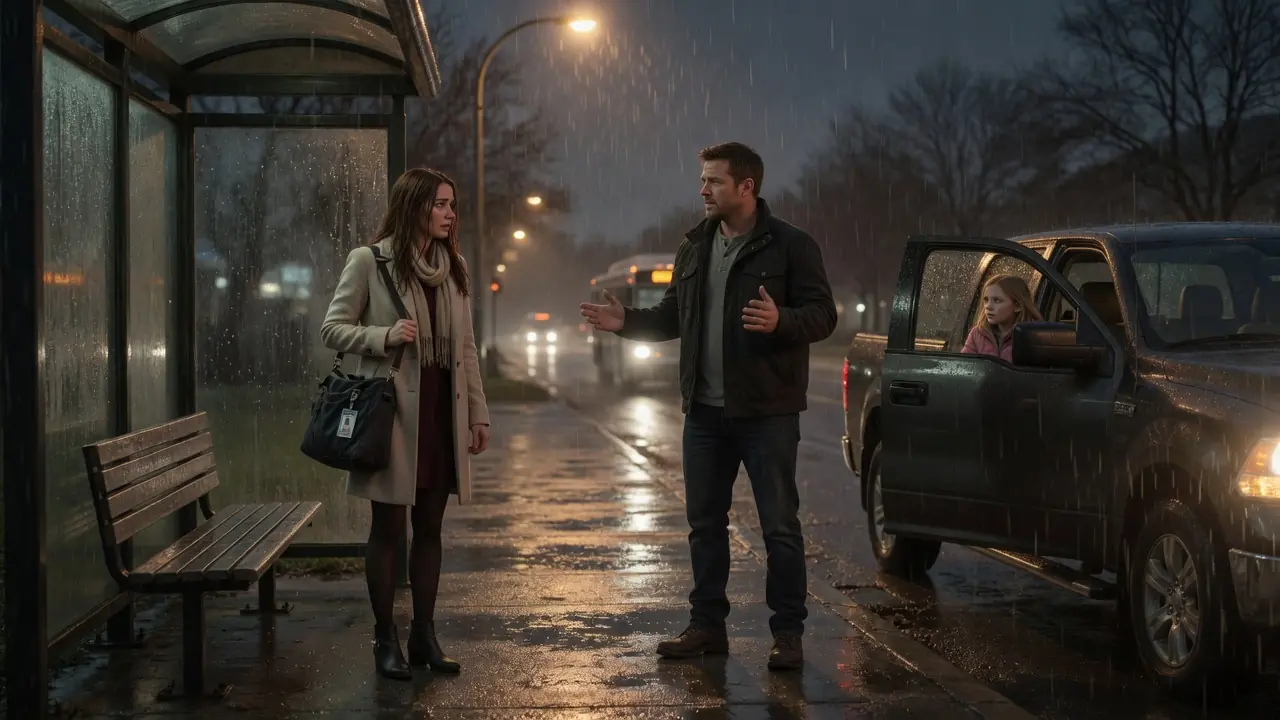
Not because she thought the driver had seen her running and would suddenly take pity.
She stared because her body had not yet accepted what her mind already knew.
She had missed it.
By maybe ten minutes.
Maybe less.
The red taillights blurred through the rain until they looked like two dying embers floating away into the dark. Then the bus turned the corner, vanished behind a line of wet pine trees and closed storefronts, and left Megan completely alone beneath the flickering shelter light.
She wanted to scream.
A real scream.
The kind that came from the center of the chest and tore its way out.
But she was too tired even for that.
The rain fell cold and sharp, not soft enough to be romantic and not heavy enough to be dramatic. It was just miserable Oregon winter rain, thin as needles, blown sideways by a wind that found every gap in her clothing.
Megan was wearing navy scrubs, running shoes that had lost their grip months ago, and a thin black jacket that had been fine at 3:00 in the afternoon and absolutely useless at midnight.
The temperature sign outside the closed pharmacy across the street read twenty-eight degrees.
Twenty-eight.
Cold enough for the rain to freeze on the edges of the curb.
Cold enough to make her fingers ache inside her pockets.
Cold enough to remind her that she was stranded in a town where she still did not have anyone she could call.
She had just finished a brutal sixteen-hour shift at Will Valley Hospital.
Her official shift was supposed to end at 10:00 p.m.
It had not.
Nothing at the hospital ever ended when it was supposed to.
A coworker had called in sick that morning, leaving the oncology unit short-staffed on one of the worst possible nights of the year. New Year’s Eve made everything louder somehow. Families who visited brought balloons, glittery hats, noise makers, and desperate cheer. Patients smiled because they did not want to ruin the mood. Nurses smiled because the patients deserved it.
Megan had smiled until her cheeks hurt.
She had changed IV bags.
Checked vitals.
Called doctors.
Cleaned spills.
Calmed families.
Adjusted pillows.
Explained medication schedules to people too frightened to remember them.
Listened to one woman cry in the supply closet because her husband’s scan results had come back worse than expected.
Then, when her replacement finally arrived, Megan stayed another forty-five minutes.
Not because she was required to.
Not because anyone would pay her properly for it.
Because Mr. Chen was dying.
His first name was Liang, though most of the staff called him Mr. Chen because he preferred formality from strangers. He was eighty-two years old, a retired watch repairman who had once owned a tiny shop in Portland. He had no local family. His wife had died twelve years earlier. His daughter lived overseas and had not been able to get a flight in time.
By 10:30, his breathing had changed.
Megan knew that sound.
She had heard it too many times.
The soft rattle.
The long pauses.
The body letting go in slow, uneven steps.
A younger nurse had offered to sit with him, but she had three other patients and tears already gathering in her eyes.
So Megan stayed.
She pulled a chair beside his bed, took his cool hand in both of hers, and talked to him even though she was not sure how much he could hear.
She told him the rain had started again.
She told him the hospital cafeteria had run out of decent coffee.
She told him fireworks were probably illegal inside city limits but people would set them off anyway.
She told him he was not alone.
At 11:15 p.m., while early fireworks popped somewhere beyond the hospital windows, Mr. Chen took one final breath.
Megan held his hand through the silence that followed.
She did not cry right away.
Nurses learn strange timing for grief.
You hold it until the family leaves.
You hold it until the doctor signs.
You hold it until the room is cleaned.
You hold it until you are no longer useful.
Then, sometimes, it catches you in a hallway.
Or a parking lot.
Or under a bus stop shelter at 11:47 on New Year’s Eve with no ride home.
Megan had stayed with Mr. Chen until the funeral home came. She had helped straighten the blanket, cleaned the bedside table, and placed his small paper bag of belongings carefully into the designated cabinet.
Then she ran.
She had run down the hospital hallway, across the lobby, past the security guard who wished her a happy New Year, and out into the rain. She had run three blocks toward Willow Street, lungs burning, shoes slipping, her backpack thumping against her shoulder.
But the bus was gone.
Now her phone was at three percent battery because she had forgotten to charge it during the double shift.
She opened the Uber app with trembling fingers.
The screen loaded slowly.
Then the price appeared.
Eighty-seven dollars.
Megan stared at it.
Eighty-seven dollars to get to Riverside Apartments on Fourth Street.
Eighty-seven dollars might as well have been eight thousand, because Megan had exactly thirty-two dollars in her checking account until payday on Friday.
She closed the app and opened her contacts.
Then she closed that too.
There was no one to call.
That was the thing about moving to a small town six months ago to escape a bad breakup and start over completely alone.
You could be strong for a while.
You could tell yourself independence was empowering.
You could unpack four boxes in a cheap apartment and call it a fresh beginning.
You could learn the grocery store layout, memorize the bus schedule, find the cheapest laundromat, smile politely at coworkers, and tell everyone you were “settling in.”
But when things went wrong at midnight in freezing rain, independence did not answer the phone.
No friends to pick her up.
No family within five hundred miles who cared whether she froze on the side of the road.
Her mother had stopped calling years ago unless she needed money. Her father had a new wife, a new family, and a remarkable talent for forgetting Megan existed unless someone mentioned Christmas cards. Her ex, Brad, had once told her she was “too emotionally intense” because she cried after a patient died.
She had left him two weeks later.
She had left everything.
Then she had moved to Willow Falls, Oregon, because Will Valley Hospital was hiring oncology nurses and because a town surrounded by pine trees sounded like a place where a person could become new.
Six months later, she was sitting at a bus stop with three percent battery, thirty-two dollars, and rainwater soaking through her socks.
Megan sat down on the frozen bench.
The cold shot through her body immediately.
That was when she started crying.
Not pretty crying.
Not quiet cinematic tears.
Ugly, exhausted, shaking crying.
She cried for Mr. Chen, who had died holding the hand of a nurse he had only known for three weeks because nobody else could get there in time.
She cried for the bus.
She cried for her wet shoes.
She cried because the whole world was counting down to a new year, and she had never felt more stuck in the old one.
Most of all, she cried because she had been in this town for half a year and still did not have a single person she could call in an emergency.
Five miles away, Nathan Sullivan was driving home from his sister Jess’s New Year’s Eve party with his seven-year-old daughter, Ellie, half asleep in the back seat.
He hated New Year’s Eve.
Not disliked.
Not avoided when possible.
Hated.
With the deep, irrational resentment of a man who knew the date was not personally responsible for destroying his life but blamed it anyway.
His wife, Clare, had died on January 2, three years earlier, after an eight-month battle with ovarian cancer. Every New Year’s Eve since then felt like the anniversary of the beginning of the end, the final holiday they had celebrated before everything fell apart.
The last New Year’s Eve with Clare had been quiet.
She had already been sick, though not yet visibly dying. They had stayed home because she was tired. Ellie, then four years old, had fallen asleep before nine with glitter stickers on her pajamas. Clare had insisted they stay up until midnight.
“I want to kiss my husband in the new year,” she had said.
Nathan had teased her for being sentimental.
Then she had fallen asleep on his shoulder at 11:38.
He had kissed her hair at midnight anyway.
Two days later, she collapsed in the bathroom.
After that, life became hospitals, scans, treatment plans, hope, bad news, worse news, casseroles from neighbors, whispered calls in hallways, and Ellie asking when Mommy would come home.
Eight months later, Clare was gone.
Nathan had never fully learned how to live after that.
He functioned.
He ran Sullivan Construction.
He packed Ellie’s lunches.
He paid the mortgage.
He attended school conferences.
He read bedtime stories.
He remembered which stuffed animal Ellie needed when she had nightmares.
He took out the trash, answered invoices, fixed leaking faucets, and showed up where he was expected.
But he did not really live.
Not in the way Clare had meant it.
His sister Jess knew that, which was why she had bullied him into coming to her New Year’s Eve party.
“You need to be around people,” she had said.
“I am around people every day. I employ eighteen of them.”
“People who work for you don’t count.”
“They count to payroll.”
“Nathan.”
He had gone because Ellie needed cousins, noise, cake, and proof that her father could stand in a decorated room without looking like a ghost.
He lasted until 11:30.
Then he gathered Ellie, made excuses, hugged Jess, ignored her worried eyes, and left before midnight could reach him.
Now Ellie was in the back seat wearing silver leggings under her party dress, her hair half fallen from its braid, clutching a stuffed rabbit named Pancake.
Nathan drove slowly through the rain, windshield wipers beating back and forth.
He was thinking about Clare.
He always thought about Clare this close to midnight.
He thought about the way she used to sing badly in the kitchen. The way she left sticky notes on his lunch. The way she used to stop for stray dogs, lost tourists, crying strangers, elderly neighbors, anyone who looked even slightly abandoned by the universe.
Clare had believed kindness was not an emotion.
It was an obligation.
Sometimes Nathan admired that.
Sometimes it exhausted him.
Sometimes, now, it haunted him.
He was driving down Willow Street when he saw the woman at the bus stop.
Scrubs.
Thin jacket.
Face in her hands.
Clearly crying.
Nathan’s first instinct was to keep driving.
It was late.
It was freezing.
He had Ellie in the car.
The world had become the kind of place where stopping for strangers felt complicated, especially as a man approaching a woman alone at night. He did not want to scare her. He did not want to put his daughter at risk. He did not want to invite trouble into an already heavy night.
He drove past.
For two blocks, he told himself she was fine.
Maybe she was waiting for someone.
Maybe she had already called a ride.
Maybe she just needed a minute.
Maybe it was none of his business.
Then Ellie’s sleepy voice came from the back seat.
“Daddy?”
“Yeah, Bug?”
“Why didn’t we help that sad lady?”
Nathan’s hands tightened on the steering wheel.
“She’s probably waiting for someone, honey. I’m sure she’s fine.”
Even as he said it, he knew it was a lie.
Nobody was fine sitting alone at a bus stop crying in freezing rain on New Year’s Eve.
Ellie sat up straighter.
“But she was really crying. Like, a lot.”
Nathan exhaled.
“Sometimes people cry and still don’t need help.”
“Mommy always said we should help people who are sad,” Ellie said. “Especially if they’re alone. Remember Mommy said that?”
The guilt hit Nathan like a fist to the chest.
Because yes.
Clare had said that.
Clare had lived that.
Clare had been the kind of woman who would have made him pull over before Ellie even noticed.
He could hear her voice now, gentle but firm.
Nathan, don’t drive past people like they’re scenery.
He slowed the truck.
Ellie leaned forward between the seats.
“Daddy?”
“I’m turning around.”
Ellie sank back with satisfaction, as if she had successfully corrected a moral failing in the adult world.
Nathan made a U-turn in the empty street and drove back to the bus stop.
When he pulled near the curb, the woman looked up.
Fear flashed across her face.
She stood quickly and stepped back.
Nathan stopped several feet away, rolled down his window, and kept both hands visible on the steering wheel.
“Hey,” he called gently. “I know this is really weird, and you have zero reason to trust me, but my daughter saw you sitting here, and we were wondering if you need a ride somewhere. It’s freezing out here.”
The woman did not move closer.
Smart, Nathan thought.
Good.
She should be careful.
He continued, “My name is Nathan Sullivan. I own Sullivan Construction here in town. You can look me up if your phone works. I have my seven-year-old daughter in the back seat. I promise I’m not a creep. I’m just a dad who got guilted into stopping.”
Ellie popped her head up and waved through the window.
“Hi. I’m Ellie. You look really cold. We have heat in our car.”
Despite everything, the woman laughed.
It was a small laugh.
Broken around the edges.
But real.
She stepped closer, still cautious.
“I’m Megan. Megan Morrison. I’m a nurse at Will Valley Hospital. I just got off a double shift, and I missed the last bus, and my phone’s basically dead, and I can’t afford an Uber.” She swallowed hard. “Are you sure this isn’t too much trouble?”
Nathan unlocked the doors.
“It’s no trouble. Where do you need to go?”
“Riverside Apartments on Fourth Street. If that’s not too far out of your way.”
“It’s fine.”
Megan opened the back door and climbed in beside Ellie instead of sitting in the front.
Nathan respected that.
It showed she was being smart.
The heat inside the truck hit Megan so suddenly that pain rushed into her fingers and cheeks as feeling returned. She tucked her hands between her knees and tried not to shake too visibly.
Ellie stared at her with wide, serious eyes.
“Were you crying because someone died?” Ellie asked. “You’re wearing hospital clothes, so maybe someone died, and that’s really sad.”
“Ellie,” Nathan said, glancing in the rearview mirror. “Sweetheart, we don’t ask people things like that.”
Megan wiped her face with the sleeve of her jacket.
“It’s okay. Actually, yes. I was with a patient who passed away tonight. He didn’t have any family there, so I stayed with him so he wouldn’t be alone.”
Ellie nodded solemnly.
“My mom died three years ago. It’s really sad when people die. I’m sorry your patient died. You’re really nice for staying with him.”
The words landed softly in the truck.
Megan looked at Nathan in the mirror.
His face had changed, but only for a second.
A tightening around the eyes.
A grief reflex.
Then it was gone.
“I’m sorry about your mom,” Megan said gently.
Ellie hugged Pancake tighter.
“Daddy says she loved fireworks, but he doesn’t like New Year’s anymore.”
“Ellie,” Nathan said quietly.
“What? It’s true.”
Megan gave him the smallest sympathetic smile through the mirror.
“I don’t like New Year’s much either.”
Ellie considered this.
“Maybe it’ll be better next year.”
Nathan and Megan both almost answered.
Neither did.
They drove toward Riverside Apartments with the windshield wipers pushing rain aside in rhythmic sweeps. The town looked sleepy and wet. Christmas lights still hung from porches. A few houses had people gathered by windows, waiting for midnight. Somewhere far away, early fireworks cracked across the sky.
Nathan asked Megan how long she had lived in Willow Falls.
“Six months,” she said. “I moved from Spokane.”
“For the hospital?”
“Mostly. Also because I needed a restart.”
He heard the meaning beneath that sentence and did not push.
She asked about him.
He gave the short version.
Construction company.
Born and raised nearby.
Married young.
Lost Clare to ovarian cancer.
Just him and Ellie now, figuring life out one day at a time.
Megan listened with the careful attention of someone accustomed to grief. She did not rush to comfort him. She did not say everything happens for a reason or she’s in a better place or any of the phrases people use when silence makes them nervous.
She only said, “That must have been unbearable.”
Nathan’s grip tightened on the wheel.
“It was.”
When they pulled up to Riverside Apartments at 12:03 a.m., the building was surrounded by fire trucks, utility vans, and emergency vehicles.
Red tape blocked the entrance.
Water poured from a second-floor window in a steady, shining sheet.
Megan’s face went white.
“No.”
She was out of the truck before Nathan had fully shifted into park.
He and Ellie followed because there was no version of this that looked good.
The building manager, a thin man named Carl with rain dripping from the hood of his jacket, stood near the entrance with a clipboard and the miserable expression of someone who had been yelled at by residents for four straight hours.
“What happened?” Megan demanded.
Carl looked at her, then at his clipboard.
“Unit?”
“2B. Megan Morrison. I live in 2B.”
His expression softened with recognition.
“We tried calling you.”
“My phone died. I was at work.”
“A pipe burst around eight. Main line near the upper hallway. Flooded four units badly and damaged most of the second floor. Fire department shut off water. Inspector says the building is condemned until repairs are done.”
Megan stared at him.
“Condemned?”
“Temporarily.”
“How temporary?”
“Two to four weeks minimum. Maybe longer depending on the contractor.”
Megan looked past him toward the building.
“My things are in there.”
“I’m sorry. Nobody can go in tonight. Safety issue.”
“What am I supposed to do tonight? Where am I supposed to go?”
Carl gave the helpless shrug of someone with no good answer and too many people needing one.
“Hotel maybe? Family?”
Like it was the most obvious thing in the world.
Hotel.
Family.
Two words that belonged to other people.
Megan’s face crumpled.
The strength she had been holding together with cold fingers and professional habits finally gave way. She sat down on the curb in the rain with her head in her hands.
At midnight, fireworks began popping in the distance.
The town celebrated the arrival of a new year.
Megan sat outside her condemned apartment building with nowhere to sleep.
Ellie tugged on Nathan’s jacket.
“Daddy,” she whispered, “she doesn’t have anywhere to go.”
Nathan looked down at her.
Her eyes were full of the kind of absolute moral clarity children have before the world complicates them.
“We have the guest room,” she said.
Nathan knew it was crazy.
Of course it was crazy.
You did not invite a stranger into your home because you found her at a bus stop. You especially did not do that when you had a seven-year-old daughter. There were safety issues, boundaries, common sense, every reasonable concern lining up in his mind.
But he also knew Megan was a nurse from the hospital. He knew her building was condemned. He knew every hotel in town would be packed or overpriced because it was New Year’s Eve.
And he knew what Clare would have done.
He walked to Megan and crouched beside her.
“Do you have somewhere you can stay tonight?”
Megan did not look up.
“I’ll figure something out. Thank you for the ride. You’ve already done more than enough.”
Nathan could hear pride and exhaustion fighting in her voice.
Ellie came and stood directly in front of Megan.
“You can stay at our house,” she said. “We have a guest room, and it’s really nice, and Daddy makes good pancakes in the morning.”
Megan looked up, tears running down her face.
“I can’t just move into a stranger’s house. That’s insane.”
Nathan gave a tired laugh.
“It is a little insane.”
“Very insane.”
“Fair. But it’s New Year’s Eve. Every hotel in town is probably booked or charging triple. You clearly don’t have family nearby. You can’t sleep in your car in this weather. Stay tonight. Tomorrow, you can figure something else out.”
Megan shook her head.
“I don’t want to impose.”
“You’re not.”
“I’m a stranger.”
“You’re a nurse who sat with a dying man so he wouldn’t be alone,” Nathan said softly. “That tells me enough for one night.”
Megan looked between him and Ellie.
The rain kept falling.
The building behind her kept leaking.
Somewhere, people were cheering the new year.
Finally, Megan nodded.
“Just tonight,” she whispered. “Just one night. I’ll be out of your hair first thing tomorrow.”
Ellie smiled with heartbreaking relief.
“Good. You can use the blue towel. It’s the softest.”
They drove to Nathan’s house in silence.
Not uncomfortable silence exactly.
More like the silence that follows a day too heavy for language.
Nathan lived in a modest craftsman on a quiet street lined with wet maple trees. Christmas lights still hung from the gutters, their reflection trembling in puddles along the walkway. A wreath with a faded red bow hung on the door.
Inside, the house was warm.
That was the first thing Megan noticed.
Then she noticed the photographs.
A beautiful blonde woman smiled from frames on the mantel, the hallway table, the stairwell, the bookshelf. Clare holding baby Ellie. Clare in a red winter hat. Clare kissing Nathan’s cheek at a beach. Clare laughing beside a Christmas tree.
The house was clean.
Comfortable.
Loved.
But also frozen.
Like a shrine.
Like time had stopped and everyone inside had been carefully stepping around the stopped place ever since.
Nathan seemed to notice her noticing.
He cleared his throat.
“Guest room’s upstairs.”
He led her down the hall to a room that was clearly not just a guest room.
A sewing machine stood in one corner. Shelves held folded fabric, half-finished quilts, jars of buttons, embroidery hoops, and baskets of thread. A yellow scarf hung over the back of a chair. On the wall, a framed print read:
Make beautiful things, even when life is hard.
“This was Clare’s craft room,” Nathan said.
His voice was careful.
“She quilted. Sewed. Made Halloween costumes that were way too ambitious.”
“It’s beautiful,” Megan said.
“It’s also full of stuff I haven’t figured out what to do with.”
He looked embarrassed by the admission.
“Bathroom’s across the hall. Towels in the closet. Help yourself to anything you need. And Megan, seriously, don’t worry about leaving early. Get some rest. You’ve had a hell of a night.”
After he left, Megan sat on the edge of the bed and looked around.
The room smelled faintly of lavender, cedar, and old fabric.
She thought of Mr. Chen’s cold hand in hers.
The bus disappearing.
The flooded apartment.
Ellie’s little voice saying they had a guest room.
Then she looked at the sewing machine and the unfinished quilts and thought:
I just moved into a dead woman’s craft room on New Year’s Eve.
This is either the beginning of something or the biggest mistake of my life.
She was asleep before she could decide which.
Megan woke on January 1 at 8:00 in the morning to the smell of pancakes and the sound of a seven-year-old climbing onto the bed.
“You’re still here,” Ellie announced.
Megan opened one eye.
Ellie knelt beside her in pajamas printed with tiny penguins.
“You didn’t leave. Daddy’s making breakfast, and he never makes breakfast like this unless it’s a special day. This is so exciting.”
Megan blinked.
“Good morning to you too.”
Ellie grinned.
“Good morning. Do you like pancakes?”
“I love pancakes.”
“Good, because Daddy makes weird shapes and says they’re animals, but mostly they look like blobs.”
Megan laughed.
For the first time in six months, she woke feeling like maybe she was not completely alone in the world.
Downstairs, Nathan stood in the kitchen with flour on his shirt, flipping pancakes while an old country song played softly from a radio on the counter. His hair was damp from a shower, and he looked less guarded in the morning light, though still tired around the eyes.
“Morning,” he said. “Coffee?”
“Please.”
“Strong?”
“I’m a nurse.”
“Right. Dangerous question.”
Ellie climbed into her chair.
“Tell her about the pancakes.”
“They are shapes,” Nathan said defensively.
“They are blobs,” Ellie said.
“They are abstract animals.”
Megan accepted the coffee mug he handed her and looked at the pancake on Ellie’s plate.
“I think that one is a turtle.”
Nathan pointed at Ellie.
“See?”
Ellie squinted.
“It was supposed to be a snowman.”
“Art is subjective,” Megan said.
Over breakfast, Megan’s landlord texted her a long, apologetic message. Building inspection would take at least three to four weeks before residents could return. Some units had serious water damage. Temporary housing assistance was “being discussed.”
Being discussed, Megan knew, meant nobody had a real answer.
She stared at the message while cold dread settled in her stomach.
Three to four weeks.
A hotel for a month was impossible.
A short-term rental was impossible.
Her coworkers were kind, but she had known them for six months, and most had families, roommates, or no spare space. Sleeping in the hospital break room would get her written up. Her car was in the hospital lot and barely reliable enough for errands, much less living.
Nathan watched her face.
“That bad?”
“Three to four weeks minimum.”
Ellie’s eyes widened.
“That’s forever.”
Megan forced a smile.
“I’ll figure something out.”
Nathan set down his fork.
“Look. This is going to sound crazy.”
Megan lifted one eyebrow.
“Crazier than last night?”
“Maybe equal.”
Ellie perked up.
Nathan continued, “The guest room is just sitting there. You could stay here until your building is fixed.”
Megan stared at him.
“No.”
“You didn’t even let me finish.”
“I don’t need to. No.”
“Fair reaction,” he admitted. “But hear me out. I work long construction hours. Sometimes Jess watches Ellie after school, sometimes a babysitter does, sometimes I’m juggling calls and pickups and pretending I know what I’m doing. If you were here and happened to be around when Ellie got home, it would help. Not as a nanny. Not as charity. More like roommates.”
Megan shook her head.
“We literally met twelve hours ago.”
“I know.”
“That’s insane.”
“I also know.”
Ellie was practically vibrating in her chair.
“Please stay. Please, please, please. I really like you. And the babysitter always makes me do worksheets before snacks.”
“Worksheets are not abuse,” Nathan said.
“They feel like abuse.”
Megan looked between them.
This warm kitchen.
This grieving father.
This hopeful little girl.
This offer that was too generous, too risky, too exactly what she needed.
“I can pay something,” Megan said.
Nathan shook his head.
“No.”
“I won’t stay for free.”
“You’ll help with groceries when you can. Maybe help with Ellie if schedules line up. That’s enough.”
“It isn’t.”
“It is to me.”
Megan looked down at her hands.
She hated needing help.
Needing help made her feel like a younger version of herself standing in her mother’s kitchen, being told she was too sensitive, too much, too hard to love properly.
Nathan’s voice softened.
“Megan, last night you stayed with a dying man because nobody should be alone. Let someone return a little of that kindness without punishing yourself for needing it.”
That was what broke her.
Not dramatically.
Not all at once.
Just enough.
She nodded.
“Temporarily.”
“Temporarily,” Nathan agreed.
Ellie cheered so loudly Nathan nearly dropped his coffee.
Megan moved in that afternoon with four boxes that contained everything she owned.
Nathan helped her carry them from the water-damaged apartment building after the manager allowed supervised access for essentials. Most of her furniture was ruined. Half her clothes were damp. A cardboard box of books had soaked through and collapsed. Her cheap kitchen table was warped.
Everything she had brought to Willow Falls fit into Nathan’s truck in one trip.
When Nathan saw that, something passed over his face.
Not pity exactly.
Recognition.
As if he had finally understood that Megan had not just moved to town.
She had arrived with almost nothing and built a life from scraps.
Megan looked away before she could cry.
They fell into a routine over the next few weeks that felt shockingly natural.
Megan worked night shifts and came home in the mornings to sleep. Nathan learned to move quietly before leaving for job sites. Ellie made a sign for the craft room door that read:
Megan is sleeping. Do not wake unless bleeding, burning, or dragons.
Nathan added beneath it:
Or fever over 102.
Ellie added:
Or emotional emergency.
By 3:00 most afternoons, Megan woke, showered, made coffee, and was downstairs when Ellie got off the school bus. They would do homework at the kitchen table. Ellie complained about spelling words with dramatic suffering. Megan taught her little memory tricks and rewarded completed worksheets with apple slices and peanut butter.
Sometimes they started dinner.
At first, Megan only reheated leftovers.
Then she made soup.
Then pasta.
Then roasted chicken with lemon and herbs because Nathan had been living on frozen dinners, takeout, and guilt for three years.
The first night he came home to real dinner, he stopped in the doorway like he had forgotten houses could smell like that.
“You cooked,” he said.
Megan shrugged.
“I was awake.”
Ellie bounced.
“She made carrots good. Like, actually good.”
Nathan sat down at the table, still wearing work boots and sawdust on his sleeve.
For a moment, he did not speak.
Then he said quietly, “Thank you.”
Megan pretended not to hear the weight beneath it.
By late January, the house had begun changing in small ways.
Fresh flowers appeared on the kitchen table because Megan bought the discount bundles at the grocery store when they were close to wilting.
Curtains that had been drawn too often were opened.
Ellie’s drawings moved from one corner of the fridge to the entire lower half.
The radio played during dinner.
Someone laughed in the kitchen every day.
Nathan noticed he was smiling more.
Not because grief had left.
It had not.
But because the house no longer felt like it was holding its breath.
Ellie thrived.
Her teacher emailed Nathan to say she seemed brighter, more focused, more confident. Her reading scores improved. She stopped complaining about going to school. She began talking about spring as if Megan would naturally be part of it.
“Megan and I are going to plant flowers.”
“Megan says I can learn to make soup.”
“Megan thinks I should put glitter on my science poster, but classy glitter.”
Nathan did not correct the future tense.
He wanted to.
He told himself he should.
But every time he imagined Megan leaving, the house dimmed in his mind.
Everything shifted one night in late January.
At 2:00 a.m., Ellie woke with a fever of 103.
Nathan panicked.
Not worried.
Not concerned.
Panicked.
Megan heard him in the hallway saying Ellie’s name too loudly and was out of bed before she was fully awake. She found him standing beside Ellie’s bed, holding the thermometer like it was a weapon he did not know how to use.
“She’s burning up,” he said. “We need to go to the hospital. Something’s wrong. We can’t wait.”
Ellie lay under the blankets, flushed and miserable.
Megan moved into nurse mode instantly.
She checked Ellie’s breathing, pulse, skin, throat, hydration, and responsiveness. She asked about symptoms. She remembered the flu had been spreading through Ellie’s class.
“Nathan,” she said firmly. “Look at me.”
He did not.
“Nathan.”
His eyes finally met hers.
“She has the flu. Her fever is high, but it’s manageable right now. I’m a nurse. I’ve got this. But I need you to breathe because you’re scaring her.”
That reached him.
He looked at Ellie.
Her eyes were wet.
“Daddy?”
His face crumpled with guilt.
“I’m okay, Bug. Megan’s going to help.”
Megan stayed up all night.
She gave fever reducer.
Tracked the time.
Kept Ellie hydrated.
Changed damp pillowcases.
Sat on the edge of the bed and told silly stories until Ellie drifted in and out of restless sleep.
Nathan sat in the hallway outside Ellie’s room with his head in his hands.
At 4:00 a.m., Ellie’s fever finally broke. Sweat dampened her curls, and her breathing eased into a peaceful rhythm.
Megan stepped into the hallway and found Nathan still sitting there.
She lowered herself beside him.
“Want to tell me what that was about?”
Nathan stared at his hands.
For a long time, she thought he would not answer.
Then he said, “Clare’s cancer started with symptoms we thought were just the flu.”
Megan’s chest tightened.
He continued, voice wrecked.
“She was tired. Feverish. Achy. We thought she had a virus. Then it didn’t get better. Then there were tests. Then more tests. By the time we understood how serious it was, it was stage four.”
He pressed his palms against his eyes.
“Every time Ellie gets sick, I’m back there. Watching my wife die and being completely powerless to stop it.”
Megan took his hand.
Not as a nurse.
As herself.
“I’m an oncology nurse,” she said softly. “That’s my specialty. I work with cancer patients every day.”
Nathan looked at her with a strange, pained laugh.
“Of course you do. That’s some kind of cosmic joke, isn’t it? The universe putting you in my house when hospitals are the last place I ever want to think about.”
“Maybe,” Megan said. “Or maybe someone who understands hospitals is exactly who you needed here tonight.”
They sat in silence.
Then Nathan whispered, “Thank you.”
“You don’t have to thank me.”
“I do. For knowing what to do. For not letting me spiral. For being here.”
Megan squeezed his hand.
“You’re a good dad, Nathan. You’re doing better than you think.”
He looked at her then.
Really looked.
Something unspoken passed between them in the dim hallway.
Something tender.
Something dangerous.
Something neither of them was ready to name.
February arrived wet and gray.
Megan’s apartment was technically ready by the second week.
She did not move back.
Not right away.
The landlord texted her twice. She told herself she needed a few more days to sort things out. Then a few more. Then another week.
Nathan did not ask.
Ellie definitely noticed.
One night after Ellie went to bed, Megan and Nathan sat on the couch watching a movie neither of them was paying attention to. Rain tapped the windows. The living room glowed with lamplight. Their shoulders touched.
Nathan turned to say something.
Megan turned at the same time.
Their faces were suddenly inches apart.
For one suspended second, neither moved away.
Then they both leaned in.
Almost.
At the last second, Nathan pulled back.
“This is really complicated,” he said.
Megan exhaled shakily.
“I know.”
“I’m sorry.”
“Don’t be.”
She looked around the room.
At Clare’s photos.
At the blanket folded over the chair.
At the unfinished quilt visible through the open craft room door upstairs.
“My apartment has been ready for two weeks,” Megan said quietly.
Nathan’s face changed.
“You don’t have to go.”
“I think I do.”
“I don’t want you to.”
Her heart twisted.
“But I can’t stay like this. I’m not your wife, Nathan. I can’t replace her. And I shouldn’t have to.”
He looked away.
“I never asked you to.”
“No. But this house did.”
He flinched.
Megan hated hurting him, but she could not stop now.
“Look around. Nothing has changed in three years. Clare’s things are exactly where she left them. Her craft room is still frozen in time. Her scarf is still by the door. I’m sleeping inside her unfinished life.”
Nathan’s throat worked.
“That’s not fair.”
“I know. But it’s true.”
For the first time, neither of them had a gentle lie left.
Valentine’s Day made everything worse.
Nathan’s in-laws, Tom and Linda, showed up unannounced for their monthly visit with Ellie. They had loved Clare fiercely and grieved her in their own way, which sometimes looked like visiting Nathan’s house and making sure no one had moved anything their daughter once touched.
They walked in to find Megan cooking dinner while Ellie set the table and Nathan came downstairs carrying laundry.
It looked domestic.
It looked established.
It looked like something they had not been prepared to see.
Linda’s face went cold.
Introductions were painful.
Nathan explained that Megan was staying temporarily because her apartment had flooded.
Tom’s eyes moved toward the staircase.
“Temporarily?” he asked. “It’s been six weeks. That’s not really temporary anymore, is it?”
Megan wanted to disappear into the floor.
Dinner was tense.
Linda barely looked at Megan except when she had to. She spoke often of Clare.
“Clare always made pot roast on Sundays. It was Ellie’s favorite. Remember, sweetheart?”
Ellie nodded uncertainly.
“Clare used to set the table with the blue napkins.”
“Clare loved that serving bowl.”
“Clare never liked too much garlic.”
Megan sat through each comment like someone being quietly erased.
After Ellie went to bed, the confrontation came.
Linda stood in the living room, arms crossed.
“I need to know what’s going on here, Nathan. Who is this woman really? Because it looks an awful lot like you’re replacing our daughter.”
Nathan’s face hardened.
“That’s not fair.”
“Isn’t it?”
“Megan needed help. We had space.”
Tom stepped in, voice controlled but sharp.
“She’s an oncology nurse, Nathan. Really? You don’t see how concerning that is? You’re working through your grief by playing house with someone who reminds you of the doctors who couldn’t save Clare.”
Megan heard everything from the hallway where she had gone to get her phone.
The words hit like a slap.
Playing house.
Someone who reminds you of the doctors who couldn’t save Clare.
A stand-in.
A symptom.
Not a person.
She went upstairs quietly and packed.
By morning, her bags were by the door.
Nathan found her there just after six.
His hair was messy, his face pale.
“What are you doing?”
“Going back to my apartment.”
“Megan.”
“It’s time.”
He stepped closer.
“Because of what they said?”
“Because part of what they said was true.”
“No.”
“Yes.” Her voice broke. “Nathan, your whole house is a museum to Clare. I’ve been living in her room, cooking in her kitchen, helping with her daughter, falling in love with her husband.”
His eyes widened.
The words had escaped before she could stop them.
Megan looked away.
“I can’t compete with a ghost. I can’t be a substitute for everything you lost. And Ellie deserves better than getting attached to someone who might only be here because you’re grieving.”
“That’s not what this is.”
“Then what is it?”
He had no answer fast enough.
That was answer enough.
Ellie came running down the stairs in pajamas, hair tangled, eyes wide at the sight of the bags.
“No.”
Megan’s heart shattered.
“No, Megan, don’t go. Please don’t leave us.”
She knelt and pulled Ellie into her arms.
“I love you so much, sweetheart.”
“Then stay.”
“I can’t.”
“Why?”
Because adults are broken in ways children should not have to understand, Megan thought.
Instead she said, “Because I need to make sure I’m doing the right thing.”
Ellie cried harder.
“I love you.”
Megan closed her eyes.
“I love you too.”
She promised they would see each other again.
But even as she said it, all three of them knew promises like that often became stories adults told to make leaving less cruel.
March and April were miserable.
For everyone.
Ellie’s grades dropped. She had tantrums over small things. She refused pancakes because Megan used to flip them better. She asked every day when Megan was coming back until Nathan finally had to say he did not know.
After that, she stopped asking out loud.
That was worse.
Nathan threw himself into work.
Twelve-hour days.
Thirteen.
Fourteen.
He took projects he did not need. He answered calls he could have ignored. He stayed late at job sites because coming home meant entering a house that had briefly remembered how to breathe and had now gone silent again.
Megan picked up every extra shift the hospital offered.
She worked until her feet went numb.
She drank bad coffee.
She slept badly in her repaired apartment, surrounded by replacement furniture that did not feel like hers. At night, she dreamed of Ellie’s voice, Nathan’s hallway, Clare’s craft room, pancakes shaped like questionable animals, and a house she had no right to miss as much as she did.
Neither Nathan nor Megan texted.
Both drafted messages.
Both deleted them.
Both convinced themselves silence was dignity when really it was fear wearing clean clothes.
One day in late April, Nathan found a letter Ellie had written but never sent.
It was folded beneath her pillow.
He had only found it because he was changing sheets after she spilled juice, and the paper slipped out onto the floor.
The handwriting was crooked.
Dear Megan,
I miss you so much. Daddy is sad again like he was before you came. I think he loves you, but he’s too scared to say it. Can you please come back?
Love, Ellie
Nathan sat at the kitchen table staring at the letter for more than an hour.
The house was silent around him.
Not peaceful.
Empty.
He looked toward the hallway where Clare’s yellow scarf still hung by the door.
For three years, he had believed keeping everything unchanged was proof of love.
Now he wondered if it had been fear.
On April 30, Nathan drove to the cemetery where Clare was buried.
The sky was gray, and the grass was damp beneath his boots. He stood before her headstone holding Ellie’s letter in one hand.
For a long time, he said nothing.
Then finally, voice rough, he spoke.
“I think I’m falling in love with someone.”
The words sounded impossible out loud.
He waited for guilt to swallow him.
It did.
But not alone.
There was relief too.
“I feel like I’m betraying you,” he continued. “And I know you’d probably call me ridiculous for that. But I don’t know how to love someone else without feeling like I’m letting go of you.”
Wind moved through the cemetery trees.
Nathan looked down at Clare’s name.
“She’s a nurse,” he said. “An oncology nurse, which feels cruel and perfect at the same time. She’s kind. She’s exhausted all the time and still notices everyone else’s pain. She makes Ellie laugh. She tells me the truth even when I don’t want it. She doesn’t make the house forget you. She makes it feel like it can hold more than grief.”
His voice broke.
“I’m so tired of being sad, Clare. Ellie needs to live. I need to live. And I think you’d like Megan. She saves people for a living.”
A voice behind him said, “She would.”
Nathan turned.
Linda stood a few feet away holding flowers. Her face looked different than it had on Valentine’s Day. Softer. Ashamed.
“Tom and I have been talking,” she said.
Nathan wiped his face quickly.
“I didn’t know you were here.”
“I come on the thirtieth sometimes. I don’t know why. The end of each month feels like checking in.”
They stood in silence for a moment.
Then Linda stepped beside him and placed the flowers near Clare’s stone.
“We were wrong,” she said.
Nathan looked at her.
“On Valentine’s Day. About Megan. About you.”
He did not speak.
Linda folded her hands tightly.
“I saw that house, and I panicked. I saw another woman in Clare’s kitchen, and all I could think was that my daughter was being erased. But that wasn’t fair. Clare wouldn’t want Ellie frozen in grief. She wouldn’t want you alone forever just to prove you loved her.”
Nathan’s throat tightened.
Linda smiled sadly.
“She would have liked Megan. I hate admitting Tom was wrong about anything, but he was wrong too.”
Despite himself, Nathan almost laughed.
Linda reached into her purse and pulled out a small envelope.
“Ellie gave me a drawing last week. It was you, her, and Megan standing outside the house. She labeled Megan as ‘almost family.’”
Nathan closed his eyes.
“Go get her,” Linda said. “Before fear ruins what grief left behind.”
Nathan showed up at Will Valley Hospital on May 1 at 11:00 p.m., knowing Megan’s shift ended at midnight.
He sat in his truck in the parking lot, rehearsing what he was going to say until every version sounded terrible.
Too much.
Too little.
Too late.
Ellie was supposed to be at Jess’s house.
Supposed to be.
At five minutes past midnight, Megan walked out of the hospital entrance looking exhausted. Her hair was pulled back messily, her scrubs wrinkled, her shoulders bowed with the weight of another shift.
When she saw Nathan leaning against his truck, her face went through shock, fear, hope, and caution before landing on confusion.
She walked over slowly.
“Nathan? What are you doing here? Is Ellie okay?”
“Ellie’s fine,” he said quickly. “She’s at Jess’s.”
Mostly.
“I came because I needed to see you. I needed to say something I should have said two months ago.”
Megan’s eyes filled with wary pain.
“Nathan—”
“Please. Just let me say it badly before I lose my nerve.”
She nodded.
He took both her hands.
She let him.
“You’re not a replacement,” he said. “You’re not a stand-in for Clare or for the doctors who couldn’t save her. You’re not filling a Clare-shaped hole in our lives. You’re Megan. The real, actual you. The woman who sat with Mr. Chen so he wouldn’t die alone. The woman who got into my truck even though she was scared because my daughter told her we had heat. The woman who made carrots my kid actually eats.”
Megan laughed through the tears already gathering.
Nathan kept going.
“I’ve been living in the past for three years because changing anything felt like admitting Clare was really gone. But you showed me something I should have known. Loving again doesn’t erase her. Moving forward doesn’t betray her. The house can remember Clare and still make room for you.”
Megan was crying fully now.
“I’m scared,” she whispered. “I’m terrified of not being enough. Of you comparing me to her. Of Ellie losing someone else if this doesn’t work. I can’t break that little girl’s heart.”
Nathan touched her face gently.
“I can’t promise perfect. I can promise honest. I can promise I see you. Not anyone else. You.”
His own eyes filled.
“And Ellie already lost you once. She’s been grieving you for two months. She wrote you a letter saying I love you but I’m too scared to say it.”
Megan’s breath caught.
“She was right,” Nathan said.
Megan covered her mouth.
“I love her so much.”
“I know.”
“I love you too,” she whispered. “And it terrifies me.”
Nathan smiled through tears.
“Then come home for real this time. Not as a temporary roommate. Not as someone sleeping in a room we refuse to change. Come home and let’s build something together.”
Megan stepped into him.
Their kiss happened under the hospital parking lot lights, with rain misting around them and midnight behind them like an old wound finally closing.
It was perfect.
Until a small voice from inside Nathan’s truck said, “Finally. Oh my God, you guys took forever.”
Both adults jumped.
Ellie popped up from the back seat, where she had apparently been hiding under a blanket.
Nathan stared at her.
“Ellie Marie Sullivan. You were supposed to stay at Aunt Jess’s house.”
“I snuck out.”
“How did you even get in my truck?”
“You left it unlocked when you were nervous.”
“I did not.”
“You did. Also, Aunt Jess knows.”
“She knows?”
“She said, ‘I don’t approve, but bring me details.’”
Megan started laughing so hard she cried again.
Ellie scrambled out of the truck and ran into her arms.
“I missed you so much.”
“I missed you too, baby.”
Nathan looked between them and shook his head.
“You brought a seven-year-old on your grand romantic gesture,” Megan said.
“Technically, she brought herself.”
“But yes,” Ellie added proudly, “he needed backup.”
They drove home together.
All three of them.
When Megan walked into the house, she noticed immediately that things had changed.
Clare’s photos were still there.
But they had been rearranged.
A few new pictures were mixed in: Ellie and Megan making soup, Nathan covered in flour, the three of them after the snow day in January. Clare’s yellow scarf was no longer by the door. It had been folded carefully into a shadow box beside a photo of her laughing.
The craft room had been partially cleared.
Some of Clare’s fabric remained, but shelves had been opened for Megan’s things. The sewing machine had been moved near the window. The unfinished quilts were folded with care, not abandoned but honored.
Small changes.
Huge changes.
Nathan stood beside Megan.
“I started grief counseling,” he said.
She looked at him.
“Really?”
“Yeah. Jess drove me there the first time because I tried to back out.”
Megan smiled.
“That sounds like Jess.”
“I also talked to Tom and Linda. They want to apologize.”
Megan’s smile faded slightly.
“I don’t know if I’m ready.”
“You don’t have to be. They can wait.”
That was when Megan knew this time was different.
Not because everything was fixed.
Because Nathan was no longer asking her to fit into a house that could not move.
He was moving with her.
Over the next seven months, they made the house truly theirs.
Not by erasing Clare.
By making room around her memory.
Clare’s photos stayed in places of honor. Ellie still talked about her mother. Nathan still visited the cemetery. Megan asked questions about Clare instead of avoiding her name, and slowly, Clare became less like a ghost in the room and more like part of the family’s story.
Megan brought her own things in.
Books.
A blue quilt her grandmother had made.
A chipped mug from nursing school.
Plants that Ellie named with unnecessary seriousness.
Nathan built shelves in the former craft room, then helped Megan paint one wall a soft green. Ellie insisted on helping and got paint in her hair. They ordered pizza and ate it on the floor.
In July, Tom and Linda came for dinner.
The visit was awkward at first.
Then Linda brought a worn recipe book tied with a ribbon.
She handed it to Megan with trembling hands.
“Clare wrote notes in the margins,” she said. “Some recipes are terrible because she experimented too much.”
Nathan smiled.
“She did.”
Linda swallowed.
“She would want Ellie to still have these. And I think… I think she would want you to have them too.”
Megan held the book carefully.
“I don’t want to take anything that belongs to you.”
Linda’s eyes filled.
“You’re not taking. You’re joining.”
Tom cleared his throat.
“We were unfair to you. Both of us.”
Megan looked at him.
“You were grieving.”
“That explains it,” Tom said. “Doesn’t excuse it.”
Linda reached across the table.
“You’re family now, Megan. If you’ll let us learn how to be decent about it.”
Megan cried before dessert.
Ellie announced that grown-ups cried too much and passed everyone napkins.
December 31 came again.
Exactly one year after the night Megan missed the bus.
Nathan told Megan he wanted to take her somewhere special, but he would not say where.
Ellie was suspiciously dressed in her favorite red coat and kept whispering to Jess on the phone all afternoon. Megan pretended not to notice, mostly because it was adorable and partly because she was nervous.
At 11:35 p.m., Nathan drove through town.
The roads were wet, but this year the rain was softer. No freezing wind. No bus disappearing into darkness. No panic pressing against her ribs.
When he turned onto Willow Street, Megan looked at him.
“Nathan.”
He only smiled.
At 11:47, he parked beside the bus stop.
The same bench stood beneath the same flickering shelter light.
Megan stared at it.
For a moment, she could see herself there again.
Soaked.
Exhausted.
Alone.
Believing nobody was coming.
Nathan got out, walked around, and opened her door. He took her hand and led her to the bench.
“One year ago,” he said, “you were sitting right here, crying and freezing.”
Megan’s eyes filled instantly.
“I almost drove past you,” he continued. “I almost let fear and grief and inconvenience make me keep going.”
“But Ellie made you come back.”
“She did.”
He looked toward the truck, where Ellie was visibly ducking and failing to hide.
Nathan smiled.
“You changed our lives, Megan. You brought light back into a house that had been dark for three years. You showed me moving forward isn’t betrayal. You taught Ellie that love can grow after loss. You taught me that home is not a museum. It’s a place where people keep choosing each other.”
Megan covered her mouth.
Nathan got down on one knee.
Right there at the bus stop.
In the exact place where her worst night had turned into the beginning of everything good.
“Megan Morrison,” he said, opening a small box, “will you marry me? Will you be my wife, Ellie’s bonus mom, my partner, my home? Will you make this family permanent?”
Megan was crying too hard to speak.
So she nodded.
Again and again.
Nathan slipped the ring onto her finger and stood just in time for her to throw herself into his arms.
Ellie came running from the truck, holding a glitter-covered sign that read:
WE’RE A FAMILY NOW
She had clearly made it herself, because several letters tilted in different directions and there was glitter everywhere, including on her face.
At midnight, fireworks rose over Willow Falls.
Megan stood at the bus stop where she had once believed she was completely alone, wrapped in Nathan’s arms with Ellie hugging them both around the waist.
A year earlier, she had missed the last bus.
Now she had found home.
They married in June in Nathan’s backyard.
Fifty people came.
Maybe sixty if you counted Ellie’s stuffed animals, which she had arranged in chairs because “they were emotionally important witnesses.”
Jess cried before the ceremony began.
Linda cried when she saw Megan in her dress.
Tom walked Megan down the aisle because her own father did not come. They had been estranged for years, and when she told him she was marrying a widower with a child, he had said he hoped she knew what she was doing.
Tom had squeezed her hand and whispered, “You’re our daughter now too.”
Megan cried before reaching Nathan.
Ellie served as flower girl and took the role with military seriousness. She wore a dress she chose herself and carried a basket of white petals, tossing them with intense focus. Halfway down the aisle, she turned to the guests and whispered loudly, “This is the important part.”
Everyone laughed.
Nathan’s vows wrecked them.
“You taught me that hearts can break and heal and love again,” he said, voice shaking. “Clare will always be part of my story. She gave me Ellie. She taught me kindness. She taught me to stop for people. But you, Megan, are my future. You are not my second chance because you are not second to anyone. You are my new beginning. You are my home.”
Megan’s vows were no safer.
“I was lost and alone on the coldest night of the year,” she said. “And you stopped when nobody else would. You gave me shelter, then friendship, then love, then family. You showed me home is not a place you earn by being perfect. It is the people who refuse to leave you stranded.”
Ellie sobbed into Jess’s dress and later denied it.
At the reception, Nathan danced with Megan under string lights while Ellie ate too much cake. The old craft room had become Megan’s office and sewing space, though Clare’s framed saying still hung on one wall.
Make beautiful things, even when life is hard.
Megan thought that might have been the real blessing of the house.
It had made room for beauty again.
Two years later, on New Year’s Eve, they stayed home.
Ellie was ten now and holding her six-month-old baby brother, Noah, on the couch. She took her role as big sister very seriously, though she claimed the baby drooled “without professional standards.”
Nathan had made pancakes for dinner because traditions in their house did not always need to make sense. Megan held Noah after Ellie got tired, rocking him gently while the television counted down to midnight.
On the wall above the mantel were photographs.
Clare smiling with baby Ellie.
Nathan and Clare on the beach.
Nathan and Megan’s wedding.
Ellie holding the glitter sign at the bus stop.
Baby Noah in a ridiculous hat Jess had bought.
Past and present lived side by side.
Not competing.
Not erasing.
Coexisting peacefully, just as Nathan had promised they could.
At midnight, Nathan kissed Megan while Ellie made gagging noises and Noah laughed because everyone else was making noise.
Nathan leaned his forehead against Megan’s.
“Remember when you missed that bus?”
Megan smiled.
“Best missed bus in the entire history of transportation.”
Ellie pointed at both of them.
“I am basically the reason you guys are married. I told Daddy to help you. So this whole family exists because of me.”
Nathan and Megan looked at each other.
Then both said, “You’re absolutely right.”
Ellie nodded, satisfied.
Because it was true.
None of it would have happened without a seven-year-old’s insistence that they help a sad stranger.
Sometimes the worst night of your life becomes the doorway to everything good.
Megan missed the last bus on New Year’s Eve and thought she had lost everything. Her apartment was flooded, her phone was dying, and she was stranded in a town where she thought nobody cared whether she made it home.
Nathan almost drove past her.
Almost let grief keep him from kindness.
But Ellie remembered what her mother had taught her.
“Daddy, help her.”
Three words.
That was all it took to change three lives.
Moving on from grief does not mean forgetting the people we have lost. It means honoring them by choosing to keep living, keep loving, and keep opening the door when someone is standing alone in the cold.
Nathan learned he could cherish Clare’s memory and still build a future with Megan.
Megan learned family is not always the one you are born into, or the one that never lets you down. Sometimes family is the man who turns the truck around, the little girl who offers you a guest room, and the home that slowly makes space for your heart.
And every New Year’s Eve after that, before fireworks and countdowns and kisses, the Sullivan family drove by the bus stop on Willow Street.
Not because they wanted to remember the cold.
But because they wanted to remember the moment kindness stopped.
The moment loneliness lost.
The moment a stranger became family.