“Please let me go,” the woman whispered. “I said I don’t want to leave with you.”
The words barely carried across the valet lane outside the Arcadia Hotel, but Logan Pierce heard them. He had been halfway to his aging gray sedan, carrying a sealed legal envelope beneath one arm while checking the time on his cracked phone. His six-year-old daughter was asleep at home with a babysitter charging by the hour, and Logan had promised himself he would not accept another late-night delivery that week.
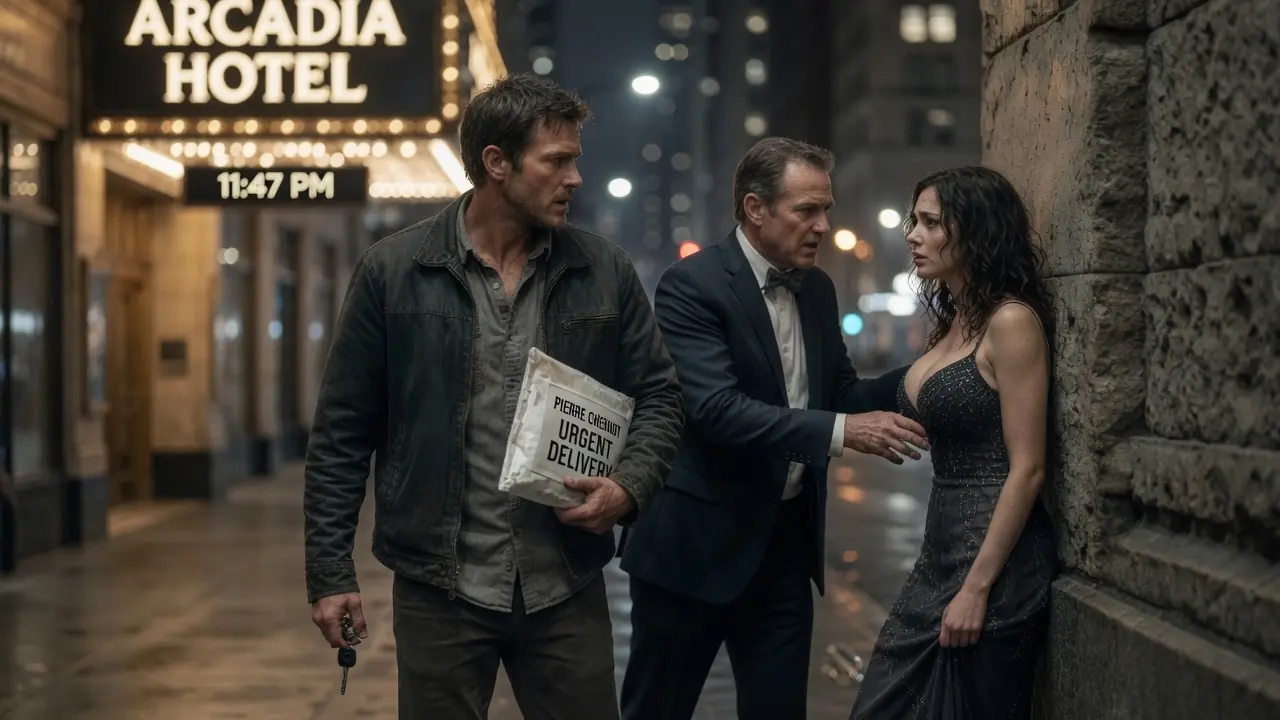
Then he saw the man gripping the woman’s arm.
“Why are you holding her when she’s begging you to stop?” Logan asked.
The man turned slowly, revealing the controlled irritation of someone unaccustomed to being questioned. He was in his mid-forties, with silver at his temples, a tailored navy suit, and a watch worth more than Logan’s courier van. One hand remained wrapped around the woman’s bare forearm as though her refusal were an inconvenience rather than an answer.
“This is a private conversation,” the man said. “Keep walking.”
Logan did not.
Behind them, the Arcadia’s glass doors glowed beneath chandeliers and strings of white lights. A charity gala was ending inside, sending wealthy guests toward waiting limousines while jazz music drifted faintly through the lobby. Outside, the cold Chicago wind moved between the towers, carrying the smell of wet pavement and engine exhaust.
The woman looked as if she had stepped out of that glittering world and fallen apart the moment the doors closed behind her. She wore a black evening gown and silver heels, but one strap had slipped from her shoulder and her dark hair had loosened around her pale face. A champagne glass lay broken near the wall beside her, and she was leaning against the stone as though it were the only thing keeping her upright.
Logan moved closer but stopped beyond arm’s reach.
“Ma’am,” he said, keeping his voice steady, “do you want to go with him?”
Her eyes struggled to focus on him. Fear moved across her face before pride covered it.
“No.”
The answer was quiet.
It was enough.
Logan turned toward the man. “Let her go.”
The man’s fingers tightened. “You have no idea who you’re speaking to.”
“That makes two of us.”
A valet near the hotel entrance glanced toward them, then quickly looked away. Two guests passed within several feet and pretended not to notice. Logan felt anger rise beneath his exhaustion, not only at the man, but at everyone who had decided the situation was too uncomfortable to interrupt.
The woman pulled her arm again.
“Marcus, stop.”
Marcus released her only after Logan stepped between them.
“You’re embarrassing yourself, Isabella,” he said. “You’ve been drinking, you can barely stand, and you need someone responsible to take you home.”
“I would rather sleep on the pavement.”
Marcus smiled without warmth. “You’ll regret saying that when the photographs appear tomorrow.”
The threat changed the air.
Logan angled his body so Isabella stood behind his shoulder. “Walk away.”
Marcus looked him over from his faded jacket to his worn leather shoes. “And who exactly are you?”
“Someone who heard her say no.”
“That will not protect you.”
“I’m not the one who needs protection from the truth.”
For the first time, Marcus’s composure cracked. His eyes narrowed, and he glanced toward the valet who had begun speaking into a radio. Marcus finally stepped backward, adjusting his cuffs as though he had simply ended an unpleasant business meeting.
“This city has a long memory,” he told Logan.
“So do witnesses.”
Marcus looked past him at Isabella. “We will speak tomorrow.”
“No,” she answered, her voice stronger now. “We will not.”
He entered the hotel without another word.
The moment the doors closed behind him, Isabella swayed.
Logan turned and caught her elbow before she fell onto the broken glass. She flinched at the contact, and he released her immediately.
“Sorry.”
“No,” she murmured, pressing one hand to her forehead. “I’m sorry. I just need a minute.”
“You need somewhere warm.”
“I need my car.”
“Do you have a driver?”
She opened her small purse and stared inside. “My phone is dead. My driver left after Marcus told him I had changed plans.”
Logan looked toward the hotel. “That sounds deliberate.”
“It was.”
He took out his phone and held it toward her. “Call someone.”
She hesitated before accepting it, then stared at the screen as though she did not know which name could be trusted. After several seconds, she handed it back without dialing.
“There is no one I want to call.”
Logan recognized the loneliness in that sentence. It was the same loneliness that filled his apartment after his daughter went to sleep and every decision, bill, emergency, and fear became his alone. Isabella’s dress, jewelry, and polished voice belonged to a life far beyond his, but loneliness did not seem impressed by wealth.
“My car is across the curb,” he said. “I can drive you home.”
Her expression closed instantly. “I don’t enter cars with strange men.”
“Good rule.”
“Then why suggest it?”
“Because you don’t want to return inside, your phone is dead, and Marcus may be waiting nearby.”
She studied him carefully.
Logan pointed toward the sedan. “You can sit in the back. The doors stay unlocked, the window stays open, and you can use my charger. Take a picture of my license plate when your phone turns on. Send it to whoever you trust.”
“I just told you there is no one.”
“Then send it to yourself. At least there will be a record.”
Something in her face softened.
“What is your name?”
“Logan Pierce.”
“Do you know who I am?”
He looked at her again. The name Isabella had sounded familiar when Marcus said it, but the full recognition arrived only now.
“Isabella Vaughn.”
Her name appeared on towers, development projects, and business magazines throughout Chicago. At thirty-one, she controlled Vaughn Urban Group, one of the largest privately held property and infrastructure companies in the Midwest. Newspapers described her as brilliant, ruthless, disciplined, and worth several billion dollars.
“Yes,” Logan said. “I know.”
“And you are still offering?”
“You being rich does not make that man less dangerous.”
For a moment, Isabella looked as though no one had ever spoken to her so plainly.
Logan opened the rear door of his car and stepped away, leaving the choice to her. She remained beside the hotel wall for several seconds before walking toward him. Each step was controlled, but the effort showed.
Once she was inside, Logan handed her a charging cable and entered the address she gave him. The Gold Coast tower appeared on his map twenty minutes away. He started the engine while Isabella sat rigidly in the back seat.
The booster seat beside her was covered with stickers.
“Your child?” she asked.
“My daughter. Mia.”
“How old?”
“Six.”
“And you are out making deliveries at midnight?”
“I own a courier company. Midnight is when people suddenly remember that documents were supposed to arrive before morning.”
“You own the company?”
“Technically. The bank probably feels differently.”
She almost smiled.
They drove through streets shining from an earlier rain. Isabella kept watching the side mirror, checking whether anyone followed. Logan noticed but did not ask until she had relaxed slightly.
“Has Marcus done this before?”
Her eyes lifted to the rearview mirror. “You ask direct questions.”
“It saves time.”
“Yes,” she said after a pause. “He has tried to isolate me before.”
“Why?”
“He wants control of a redevelopment project my company refuses to sell him. He also dislikes hearing no from women.”
“That second part seemed clear.”
She looked out the window. “Tonight was my fault.”
“No.”
“I drank too much.”
“You still said no.”
“I allowed myself to become vulnerable around a man I knew I could not trust.”
“That was unwise. It was not permission.”
The distinction silenced her.
A few blocks later, she asked, “Why did you stop?”
“Because you asked him to let you go.”
“Everyone heard me.”
“Apparently hearing and helping are different skills.”
She looked down at her hands. “Most people are careful around powerful men.”
“My daughter is waiting for me at home. One day she may need someone to be less careful.”
Isabella turned toward the window before he could see her expression clearly.
When they reached her building, a doorman hurried to open the door. Logan expected her to leave without another word. Instead, she paused beside his car.
“You did not ask me for anything.”
“You needed a ride, not an invoice.”
“People always ask eventually.”
“Maybe you know the wrong people.”
She removed a heavy cream-colored business card from her purse and wrote a private number on the back.
“If Marcus contacts you, call me immediately.”
Logan accepted the card. “You think he will?”
“I think he notices anyone who prevents him from getting what he wants.”
“Then maybe he should become accustomed to disappointment.”
A small laugh escaped her. It was tired but genuine.
“Good night, Logan Pierce.”
“Good night, Isabella Vaughn.”
He watched until she entered the building, then drove home.
Mia was sleeping sideways across his bed when he arrived. The babysitter explained that she had woken during a storm and refused to return to her own room. Logan paid the additional hour, then sat beside his daughter and brushed tangled hair away from her forehead.
“Did you help somebody?” Mia mumbled without opening her eyes.
Logan froze. “Why would you ask that?”
“You smell like outside.”
“That is not evidence.”
She curled closer to his side. “You always come home late when somebody needs something.”
He kissed her forehead. “Go back to sleep.”
The following morning, Logan found Isabella’s business card on the kitchen table beside Mia’s bowl of cereal. He considered placing it in a drawer, but before he moved it, his phone rang from an unknown number.
“This is Logan.”
“It’s Isabella.”
Her voice was controlled, but tension ran beneath it.
“Are you safe?”
“I was about to ask you the same thing.”
“Marcus called me this morning. He said the night could be described in several ways.”
Logan leaned against the counter. “Only one way is true.”
“He believes truth is whatever the most powerful person can make others repeat.”
“What do you need?”
“A statement. Written, signed, and dated.”
“You will have it.”
She was silent.
“That was easy.”
“I’m not inventing anything. I will write what I saw.”
“Marcus could retaliate against your business.”
“He could.”
“And that does not frighten you?”
“It does.”
The honesty seemed to surprise her more than bravery would have.
“But I’m doing it anyway,” Logan continued. “Those are different things.”
Mia entered the kitchen wearing one sock and carrying a plastic dinosaur. Logan turned away slightly, but she climbed onto a chair and listened with great interest.
“Is that the lady from last night?” she whispered loudly.
Isabella heard her.
“Is that Mia?”
Logan sighed. “Unfortunately, yes.”
“Hello, Mia.”
Mia leaned toward the phone. “Did my dad save you?”
“He helped me.”
“Dad says saving makes people feel like they owe you.”
Logan closed his eyes. They had discussed this once after Mia described him as saving an elderly neighbor from carrying groceries.
Isabella’s voice softened. “Then I will say he gave me a choice when I needed one.”
Mia considered that. “That sounds better.”
After the call, Logan wrote a detailed account of the hotel incident and sent it to Isabella’s attorney. By the afternoon, an investigator contacted him for clarification. The next day, a valet came forward and confirmed that Marcus had dismissed Isabella’s driver shortly before following her outside.
Marcus responded exactly as Isabella predicted.
Anonymous callers contacted Pierce Priority Logistics pretending to request quotes, then asked strange questions about Logan’s finances. A corporate client delayed payment without explanation. Another suddenly canceled a year-long contract, claiming a change in vendor policy.
Nora Benson, Logan’s sixty-two-year-old office manager, placed the cancellation notice on his desk.
“This smells expensive,” she said.
“It smells like Marcus Webb.”
“Same thing.”
Logan rubbed his forehead. Losing one large client could be absorbed. Losing two might force him to sell a van and reduce his only driver’s hours.
His phone rang again.
“I heard about the contract,” Isabella said.
“How?”
“I have investigators watching Marcus’s communications.”
“That sounds healthy.”
“It is not. I am aware.”
He heard papers moving across her desk.
“I can transfer all Vaughn Urban Group courier work to your company by tomorrow.”
“No.”
The movement stopped.
“Logan, the contract would be legitimate.”
“It would also look like payment for my statement.”
“I don’t care how it looks.”
“I do.”
“He is attacking you because of me.”
“He is attacking me because he thinks ordinary people can be frightened into silence.”
“And you are willing to lose your company to prove him wrong?”
“I am willing to protect my company without becoming dependent on the woman I defended.”
Her voice cooled. “Is accepting business from me beneath you?”
“No. Accepting emergency business before a competitive review would be.”
Silence followed.
Logan regretted the sharpness but not the meaning. Isabella had spent her life solving obstacles by applying wealth, influence, or pressure. She was offering the tool she understood best, but using it now would allow Marcus to claim Logan had been purchased.
“I’m trying to help,” she said quietly.
“I know.”
“Then tell me how.”
“Tell the truth publicly. Give investigators everything. Let me protect my own business.”
She exhaled slowly. “I hate this.”
“That makes two of us.”
“But you are right.”
Those words cost her more than money ever would have.
The next morning, a local gossip site published a photograph of Logan and Isabella outside her building. The caption implied a relationship had begun before the hotel incident and suggested Logan’s testimony had been motivated by financial opportunity. Within hours, two more clients requested explanations.
Nora slammed her coffee onto his desk. “We sue everyone.”
“With what money?”
“I have forty-three dollars and deep anger.”
Logan almost laughed, but his phone was already buzzing.
Isabella stood before reporters that afternoon.
She did not hide behind a written statement or allow her attorney to answer. She explained that Marcus had cornered her while she was impaired, ignored her refusal, and attempted to remove her from the hotel. She confirmed that Logan had intervened without knowing her personally and had accepted neither money nor business from her.
A reporter raised his hand. “Are you romantically involved with Mr. Pierce?”
Isabella did not flinch.
“Mr. Pierce is a private citizen whose livelihood is being attacked because he told the truth about a powerful man,” she answered. “Any effort to punish him for helping me demonstrates exactly why witnesses so often stay silent.”
Another reporter shouted, “But is there a relationship?”
“There is respect,” she said. “More than I can say for the people spreading these lies.”
The statement changed the story.
The law firm that canceled Logan’s contract called the following morning and admitted an outside consultant had pressured them to cut ties. The clinic restored its delivery agreement. Three new clients contacted Pierce Priority Logistics because they wanted to support a business owner who had refused to be intimidated.
Marcus’s plan had not destroyed Logan.
It had exposed him.
Weeks passed while formal complaints grew against Marcus. Two women who had remained silent for years came forward after Isabella spoke publicly. Hotel footage, driver records, and witness statements created a pattern too strong for his attorneys to dismiss as misunderstanding.
During those weeks, Isabella kept calling Logan.
At first, they discussed investigators and contracts. Then they discussed smaller things. Mia’s missing front tooth, Isabella’s inability to cook anything except coffee, and the fact that Logan had not taken a full day away from work in almost two years.
One evening Isabella asked, “Does Mia know what I do?”
“She knows you own tall buildings.”
“That is an incomplete description.”
“She is six. She thinks owning a trampoline is the highest possible form of success.”
“I never had a trampoline.”
“That may explain several things.”
She laughed.
The sound was different from the controlled laugh she used in interviews. It was lighter and surprised her each time it escaped.
Three weeks after the gala, Logan invited her to breakfast at a crowded diner near Lincoln Park. Isabella arrived wearing jeans, a cream sweater, and dark glasses despite the cloudy morning. She looked less like the woman on financial magazines and more like someone who had forgotten how to spend a Saturday.
Mia studied her across a plate of pancakes.
“Are you rich-rich?”
“Mia,” Logan warned.
Isabella considered the question. “Yes.”
“Then why didn’t you call a limousine that night?”
“Because someone made sure my driver left.”
“Did Dad punch him?”
“No,” Isabella said. “Your father did something more dangerous.”
Mia’s eyes widened. “What?”
“He told him no.”
Logan looked at Isabella.
The answer seemed to mean more to her than Mia understood.
After breakfast, they walked through the park. Mia ran ahead collecting leaves while Isabella remained beside Logan. Her shoulders slowly relaxed as no reporters, investors, attorneys, or executives approached her.
“This feels strange,” she admitted.
“Walking?”
“Being somewhere no one expects a decision from me.”
“Then don’t make one.”
“I built my entire life around decisions.”
“Today you only need to decide whether Mia is allowed ice cream before lunch.”
Isabella watched the child skipping along the path. “Is she?”
“Absolutely not.”
“Then I disagree.”
Ten minutes later, Mia had ice cream.
Their connection grew through ordinary moments rather than dramatic promises. Isabella attended Mia’s school play and sat in the back row so her presence would not become a distraction. Logan visited Isabella’s office and was startled by how alone she looked behind the immense glass walls.
She began therapy after admitting that she had spent years mistaking emotional isolation for strength. Logan learned to accept small gestures without assuming every kindness was an attempt to control him. When Isabella offered to pay for Mia’s private school, he refused, and she learned to ask what support was welcome instead of deciding what someone needed.
Marcus’s power declined slowly.
Investors withdrew from his projects. The Arcadia Hotel banned him from future events. An independent investigation uncovered improper pressure placed on several vendors and former employees.
Still, he fought until the end.
At the hearing where Isabella testified, Marcus’s attorney tried to portray her as an unstable woman who had misunderstood concern. Logan sat behind her beside Mia’s babysitter, close enough for Isabella to find him whenever the questions became cruel. She never needed him to rescue her from the room.
She only needed to know he had not left.
After the hearing, they stood beneath the courthouse steps while cameras waited beyond the barricades. Isabella’s hands trembled despite her steady expression.
“You were magnificent,” Logan said.
“I was terrified.”
“Those can be true at the same time.”
She looked at him with tears gathering in her eyes. “You keep teaching me that.”
“No. You keep proving it.”
Marcus eventually lost two major partnerships and resigned from the investment council that had protected him for years. The outcome was not a perfect victory, and it did not erase what he had done. It gave his victims a documented truth and made it harder for power to hide him.
Six months after the hotel incident, Isabella stood in Logan’s small kitchen washing dishes while Mia colored dinosaurs at the table. Her expensive blouse sleeves were rolled up, and soap covered one wrist. Logan leaned against the doorway, watching her place chipped plates into a drying rack.
“You know billionaires usually hire people for this.”
“I ate from the plate.”
“That has never stopped you before.”
She looked over her shoulder. “I’m evolving.”
Mia glanced up. “Why do you wash dishes here when you have a giant house?”
Isabella turned off the water.
“Because helping clean up makes me feel like I belong.”
Mia accepted that answer immediately. Children often understood emotional truths that adults spent years avoiding.
After Mia went to sleep, Isabella stood by the apartment window. The Chicago skyline glittered beyond the glass, including two towers her company owned. From Logan’s modest apartment, they looked no more important than the lights around them.
“I thought money would make me safe,” she said.
“Did it?”
“It made me difficult to reach. I confused that with safety.”
Logan stepped beside her. “And now?”
“Now I’m frightened almost every day.”
“That sounds worse.”
“It is not.” She turned toward him. “Now I’m frightened because I have people I don’t want to lose.”
He took her hand.
“I’m in love with you,” Isabella said.
Her voice remained steady, but her fingers trembled inside his.
Logan thought of the woman pressed against the hotel wall, begging to be released while dozens of people looked away. He thought of the billionaire who had offered to replace his losses with money, then respected him enough to stop when he said no. He thought of the woman washing dishes because belonging mattered more than appearing powerful.
“I’m in love with you too.”
A tear slid down her cheek.
“This scares me.”
“I know.”
“What if I ruin it?”
“Then we repair it honestly.”
“What if I run?”
“I won’t chase you.”
The answer surprised her.
Logan squeezed her hand. “But I’ll remind you there is somewhere safe to come back to.”
She stepped into his arms by choice.
A year after the night they met, Logan, Isabella, and Mia walked past the Arcadia Hotel together. The valet lane was crowded, music drifted through the glass, and the stone wall beside the entrance looked ordinary. Isabella slowed when she reached the place where her champagne glass had shattered.
“Is this where Dad saved you?” Mia asked.
Isabella looked at Logan before answering.
“No. This is where your father stopped pretending someone else would help.”
Mia considered that. “Is that romantic?”
“More than flowers,” Isabella said.
Logan took her hand.
The hotel had once represented the night Isabella’s carefully constructed strength failed in public. Now it represented the moment a tired single father noticed her fear and gave her something no amount of money had purchased.
A choice.
He had not changed her because she was a billionaire. He had not helped her because he expected his life to improve. He had simply heard a woman begging to be released and decided her fear mattered more than his comfort.
Isabella looked at the man beside her and the child holding his other hand.
“You could have kept walking,” she said.
Logan smiled. “I know.”
“Why didn’t you?”
He glanced down at Mia.
“Because I wanted my daughter to grow up believing someone would stop.”
Isabella rested her head against his shoulder.
“She will.”
They continued down the street together, leaving the hotel behind them.
This time, Isabella did not need Logan to lead her somewhere safe.
She had chosen where she belonged.