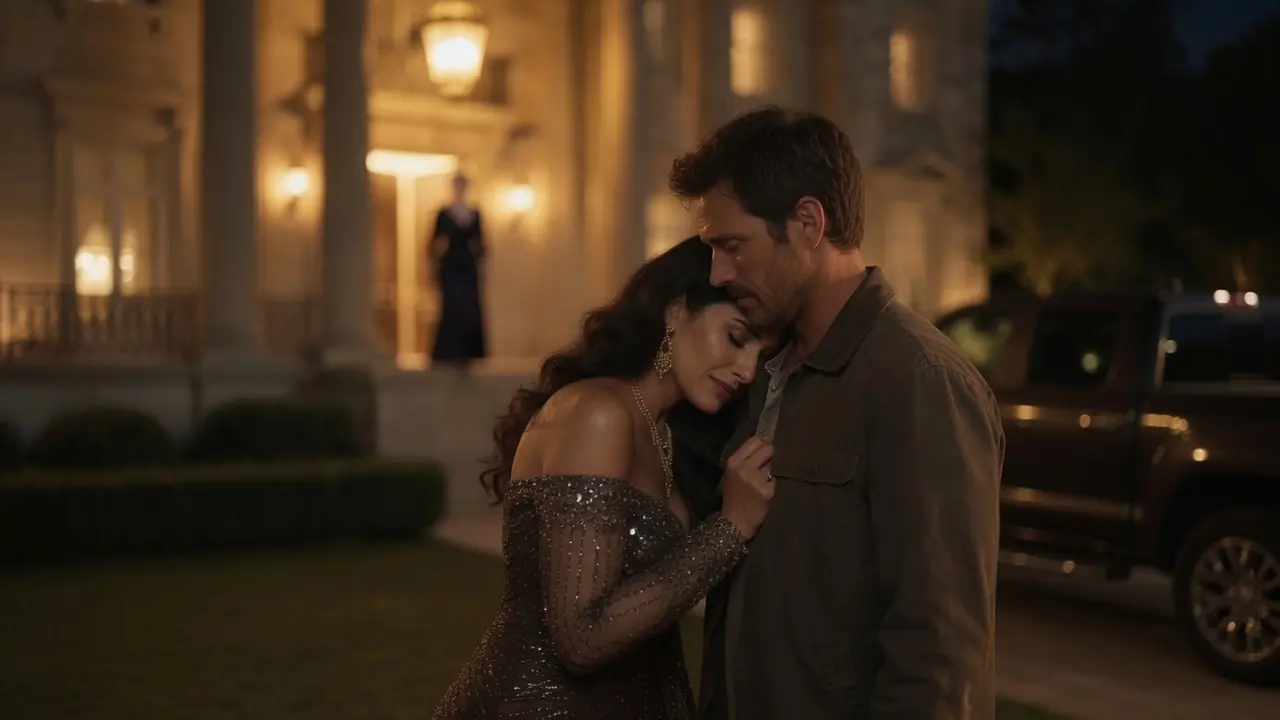
Adam Reed had driven Isabella Vale through investor meetings, charity galas, and midnight emergencies for nearly three years, yet he had never seen the powerful CEO look as broken as she did that Saturday night. She sat silently in the rear of the black town car, still wearing a glittering dark-brown evening gown with slender straps, sheer fitted sleeves, and a high slit, while diamond earrings moved against her long dark waves. The woman whose name appeared on magazine covers now stared through the window with tears gathering beneath her dark lashes. When the car stopped before her family’s waterfront mansion, she made no move to leave.
“Ms. Vale,” Adam said gently. “We’re home.”
Isabella looked up as though she had forgotten he was there. At twenty-nine, she was breathtakingly beautiful, with luminous olive-toned skin, large brown eyes, full glossy lips, and long dark hair falling in loose waves over one shoulder. Yet the elegance that made strangers turn toward her in crowded rooms could not disguise how much wine she had consumed—or how desperately she was trying not to cry.
“My mother calls it home,” she whispered. “I call it the place where everyone knows which version of me they expect.”
Adam left the driver’s seat and opened her door. He was thirty-six, tall and broad-shouldered, with short dark hair, quiet gray eyes, and the strong, tired face of a man who had learned how to function through grief. His black suit remained neat despite the long evening, though the cuff of his shirt carried a faint blue mark from the pen his eight-year-old son had used while drawing at breakfast.
Isabella accepted his hand and stepped onto the driveway. Her heel slipped against the stone, and Adam caught her around the waist before she fell. For one breath, she remained against him, one hand pressed to his chest while her perfume and the sharp trace of wine filled the space between them.
“You always catch me,” she said.
“That is part of the job.”
Her expression changed. “Is that all it is?”
Adam released her carefully. “You have had a difficult evening.”
“My stepfather announced a board vote against me at my own charity gala. Half the guests knew before I did.” Isabella looked toward the dark windows of the mansion. “Everyone smiled while they waited to see whether I would break.”
“You didn’t.”
“I waited until the car.”
Adam reached for the gold clutch she had left on the seat. When he lifted it, the clasp opened and a black-and-white photograph slipped onto the floor mat. He bent to retrieve it, but the moment the image reached the driveway light, his hand stopped.
The picture showed a young woman standing beside a gray porch, perhaps nineteen years old, her dark hair lifted by coastal wind. Adam had seen the exact photograph hundreds of times. His late wife, Grace, had kept another copy inside a wooden box beside their bed.
Isabella took the photograph from him before he could speak.
“That belonged to my mother,” she said. “I found it hidden in an old book.”
Adam forced his face back into professional calm. “You should keep it somewhere safer.”
He escorted her across the front yard toward the wide porch. At the steps, Isabella turned and caught his wrist before he could return to the car.
“Don’t go yet.”
“Isabella—”
“I’m not asking as your employer.”
Adam looked toward the road. His sister was watching Noah for the evening, but he had promised his son he would return before bedtime. Noah still waited each night with a book open, believing his father’s voice made even frightening stories safe.
“My son is waiting for me at home,” Adam said.
Isabella’s hand loosened, though she did not release him. “Of course he is.”
“You should get inside. Drink water. Sleep.”
She glanced toward the mansion and then back at him. “Everyone in that house wants something from me. My name, my shares, my signature, my failure. You are the only person who has ever sat three feet away from my worst moments and never used one against me.”
Adam’s resolve weakened.
“Stay one minute,” she whispered. “Not as my driver. Just as the man who knows what loneliness looks like.”
He should have left.
Instead, he guided her toward a bench beneath the porch light and sat beside her. The night air moved gently through the hedges while Isabella rested her head against his shoulder. Adam remained still, acutely aware of the line between kindness and something more dangerous.
“I used to think money protected people,” she said. “Now I think it only teaches betrayal to dress better.”
“My wife used to say money makes good people louder and bad people harder to ignore.”
Isabella raised her head. “You never talk about her.”
“Grace died five years ago.”
“I’m sorry.”
“So am I.”
The front door opened before either could say more.
Eleanor Vale stepped onto the porch wearing a silk robe beneath a dark coat. At fifty-two, Isabella’s mother remained elegant and severe, with silver beginning near her temples and the controlled posture of a woman who had survived by never allowing emotion to reach her voice.
Her gaze moved from Isabella’s hand on Adam’s arm to the closeness between them.
“Take your hands off my daughter and leave this property,” Eleanor said coldly. “You are an employee, not a member of this family.”
Adam rose slowly. “I brought her home safely. Do not speak to me like I came here begging for entry.”
Isabella stood beside him. “Enough, Mother. He stayed because I asked him.”
Eleanor’s attention dropped to the photograph still held loosely in Isabella’s hand.
Then she saw Adam’s face.
The color left hers.
“That photograph,” Eleanor whispered. “Where did you see it before?”
Adam reached into his wallet and removed a smaller picture protected beneath clear plastic. It showed Grace smiling beside the same black-and-white photograph.
“My wife kept this beside our bed for ten years,” he said. “She died believing the woman in it was the mother who never wanted her.”
Eleanor gripped the doorframe.
“No,” she breathed. “What was your wife’s name?”
“Grace Margaret Reed.”
Eleanor’s knees nearly failed.
Isabella caught her before she fell, but Eleanor stared only at Adam.
“She kept Margaret?”
Adam’s expression hardened. “Who kept it?”
Eleanor closed her eyes.
“The family who adopted my first daughter.”
The porch became completely silent.
Adam left shortly afterward because Noah was still waiting, but he carried more questions home than he could speak aloud. His son was asleep on the sofa with a picture book resting across his chest. Emma had waited beside him, though one look at Adam’s face made her stop complaining about the hour.
“What happened?”
Adam placed both photographs on the kitchen table.
Emma recognized Grace immediately. She listened while Adam explained what Eleanor had confessed on the porch, then stared at the matching images without speaking. Grace had spent years searching sealed adoption records, writing letters to agencies that never replied, and wondering why her birth mother had surrendered her.
“She found them after Grace died,” Emma said bitterly.
“She did not know Grace’s name.”
“That does not make the years disappear.”
“No.”
Adam carried Noah to bed and remained beside him until dawn began lightening the curtains. The boy had Grace’s dark hair and the thoughtful crease between his eyebrows. If Eleanor’s confession was true, Noah was her grandson, and Isabella was his aunt.
The revelation made the tenderness on the porch feel more complicated, though not shameful. Isabella and Adam shared no blood, and neither had known the truth. Still, Grace’s memory stood between them like a door neither understood how to open.
At seven that morning, Isabella called him directly.
“My mother told me everything,” she said. “She had Grace when she was nineteen.”
Adam walked into the kitchen so his voice would not wake Noah. “Why did she give her away?”
“Her parents threatened to disown her and destroy the young man she loved. They arranged the adoption through a private hospital in Portland.”
“She could have searched later.”
“She did.”
Adam said nothing.
Isabella continued carefully. “She hired attorneys after my grandfather died, but the records remained sealed. She created a trust for Grace and contributed to it every year.”
“A trust?”
“Mother says it was meant for Grace or any direct descendant if one could be located.”
Adam looked toward his sleeping son’s room.
“Who controls it?”
A long silence followed.
“My stepfather.”
That answer explained the attack against Isabella at the gala. Richard Vale had served as chairman of Vale Atlantic Group for twenty-two years. He controlled family investments, trusts, and board relationships while Isabella handled operations as chief executive. If Grace’s trust still existed and Noah was its legal heir, Richard had a powerful reason to prevent the family connection from becoming public.
Adam opened the wooden box that had remained untouched since Grace’s death. Beneath her scarf and letters, he found adoption inquiries, rejected requests, and handwritten notes tracing names she had never confirmed. One page mentioned Eleanor Crane, nineteen years old in 1994.
Grace had come closer than anyone realized.
Isabella arrived at Adam’s small house before noon. She wore dark trousers and a simple cream blouse, with her hair pulled into a loose ponytail rather than arranged for cameras. Without the glittering dress and diamonds, she looked less like an unreachable CEO and more like a frightened younger sister arriving years too late.
Noah opened the door.
He studied her face with the direct curiosity children reserve for strangers who somehow feel familiar.
“You look like my mom,” he said.
Isabella’s composure broke.
She knelt before him and pressed one hand over her mouth. “I think she was my sister.”
Noah looked toward Adam for confirmation.
“We are still learning the truth,” Adam said.
The boy considered that before offering Isabella the toy car in his hand. “Mom liked blue.”
Isabella accepted it carefully. “So do I.”
Eleanor came later that afternoon, but Adam did not allow her to rush into a grandmother’s role. She sat at the kitchen table while Noah remained upstairs with Emma. Adam placed Grace’s letters before her and asked her to read every one.
“I do not want a softened version,” he said. “She believed you chose your life over hers.”
Eleanor’s eyes filled. “At nineteen, I was frightened.”
“She was frightened at twenty-eight when doctors told her she had four months.”
Eleanor lowered her head.
“She wanted to know what your voice sounded like,” Adam continued. “She died without hearing it.”
“I cannot repair that.”
“No.”
Eleanor touched one of the letters but did not open it. “May I know my grandson?”
“That decision will belong partly to him, and it will happen slowly. You do not arrive with gifts, money, or demands for forgiveness.”
“I understand.”
“You will understand when he asks where you were.”
Eleanor looked at him through tears. “I will tell him the truth.”
That was the first condition Adam accepted.
The second was the trust.
Adam had not told Isabella that before Grace became ill, he worked as a federal investigator specializing in financial fraud. He resigned after her diagnosis because no conviction mattered more than the four months remaining with his wife. After Grace died, he took executive-driving work because the hours allowed him to raise Noah without returning to a life that consumed every part of him.
When Isabella learned his past, disbelief replaced grief.
“You have driven me for three years while knowing how to dismantle shell companies?”
“I knew how to arrive on time and keep your conversations private. That was the work you hired me to do.”
“And now?”
“Now someone may have stolen from my son.”
The trust records provided by Eleanor showed a balance far below what decades of deposits and investment growth should have produced. Transfers moved through Delaware management companies, Bermuda accounts, and Cayman entities controlled indirectly by Richard’s business partners.
Adam recognized the structure.
He had prosecuted almost the same scheme years earlier.
Richard had copied techniques exposed in one of Adam’s federal cases, believing no one within the Vale family understood them well enough to notice. He had also scheduled the no-confidence vote against Isabella for Friday, intending to remove her before Eleanor could challenge the trust.
For three nights, Adam and Isabella worked across the dining table in her rented coastal house. Documents covered every surface, organized into transfers, shell companies, false statements, and board communications. Their hands occasionally met above the papers, and neither pretended the awareness between them had disappeared.
On the final night, Isabella stood beside the window overlooking the harbor.
“I remember the porch,” she said.
“So do I.”
“I stopped you because I was drunk and lonely.”
“You were more lonely than drunk.”
She turned. “You said Noah was waiting.”
“He was.”
“But you stayed.”
Adam looked at her for a long moment. “Because leaving you there felt wrong.”
“Do you regret it now?”
“No.”
“Even knowing who Grace was to me?”
“You are not Grace.”
The words struck them both.
Adam stepped closer. “That matters. You resemble her sometimes, but you are not a replacement for my wife. I would never do that to you or to her.”
Isabella’s eyes glistened. “Then what am I?”
“The woman who asked me to stay.”
The distance between them narrowed, but Adam stopped before their lips met.
“After Friday,” he whispered.
“After Friday,” she agreed.
The Vale Atlantic board gathered on the thirty-fourth floor overlooking Boston Harbor. Richard sat at the head of the table, confident that he had already secured enough votes to remove Isabella. His confidence faltered when she entered with Eleanor on one side and Adam on the other.
Richard stared at Adam’s charcoal suit.
“The driver?”
Isabella placed an identification card on the table.
“Holt Adam Reed,” she said. “Former federal financial-crimes investigator and legal representative for Noah Reed, the direct heir of the Grace Margaret Trust.”
Richard’s face went pale.
Adam spoke for seven minutes.
He described the layering system without anger, explaining how trust funds had been routed through six entities and returned as management fees to companies controlled by Richard. He did not call Richard a thief. He simply showed the board the numbers that made any other conclusion impossible.
When he finished, Eleanor stood.
“You stole from the daughter I lost before I could ever find her,” she said. “Then you tried to remove my second daughter before she found the truth.”
Richard pushed back his chair. “Eleanor, this is a misunderstanding.”
“You will resign today, or tomorrow I will file for divorce, fraud recovery, and criminal referral before the markets open.”
Richard looked toward the board.
No one defended him.
He signed his resignation before the vote. The directors voted anyway, removing him eleven to zero. By Monday, federal authorities had received the complete file, and the trust’s remaining assets were frozen pending recovery.
The legal process lasted months, but most of the stolen funds were eventually restored. The money belonged to Noah, not Adam, and Adam placed it under independent management with strict protections until his son reached adulthood.
He did not buy a mansion.
He repaired the roof, funded Noah’s education, and opened a small consulting practice investigating family-trust fraud. The work allowed him to remain home when school ended.
Eleanor visited every second Saturday.
At first, Noah called her Mrs. Vale. Months later, he called her Grandma Eleanor after she spent an entire afternoon helping him rebuild a cardboard harbor without once mentioning the fortune legally waiting for him.
Isabella resigned as chief executive and became chairwoman, appointing an experienced operations leader to run the company. She spent more time near the coast, claiming the distance helped her think, though everyone understood another reason existed.
She and Adam moved carefully.
Their first real kiss happened in the same front yard where she had asked him not to leave. This time, she wore jeans and a wool sweater rather than diamonds, and Adam had no uniform separating the man from the employee.
“Noah is waiting for me inside,” he said.
Isabella smiled. “Then you should go.”
Adam took her hand. “I did not say I was leaving alone.”
The front door opened.
Noah leaned outside. “Are you two going to stand there all night?”
Adam laughed. “Apparently not.”
Isabella looked toward the house, then back at him. “Are you sure?”
“No.” He squeezed her hand. “But I am ready.”
They walked inside together.
Isabella never replaced Grace. She learned about her through stories, letters, photographs, and the son who carried pieces of both families in his face. Adam never confused gratitude with love or grief with destiny.
They simply became two people connected first by a painful truth and later by a choice freely made.
Years after that first night, Isabella kept the glittering brown dress stored in the back of her closet. She never wore it again, but she could not give it away. It reminded her of the evening she stood in her mother’s front yard, reached for the man preparing to leave, and admitted she did not want to be alone.
Adam had said his son was waiting.
He stayed anyway.
And by staying for one minute, he uncovered the family Grace had searched for, protected the inheritance stolen from Noah, and gave three generations a chance to confront the truth.
The mansion had once represented every expectation Isabella wanted to escape.
Eventually, the smaller coastal house became home.
Not because of its view, its value, or the powerful family names connected to it.
Because each evening, when Adam’s car entered the drive, Noah ran toward the door, Eleanor sometimes waited with a map spread across the table, and Isabella no longer needed to ask the man she loved to remain.
He already had.