There is a particular kind of tiredness that settles into a person’s shoulders after a long flight with a sleeping child.
It is not simply physical exhaustion, though there is plenty of that. The stiffness from holding a small body still for hours. The dull ache that travels from the neck down through the back.
The quiet burning in the arm that refuses to shift too much because the child resting there trusts you completely.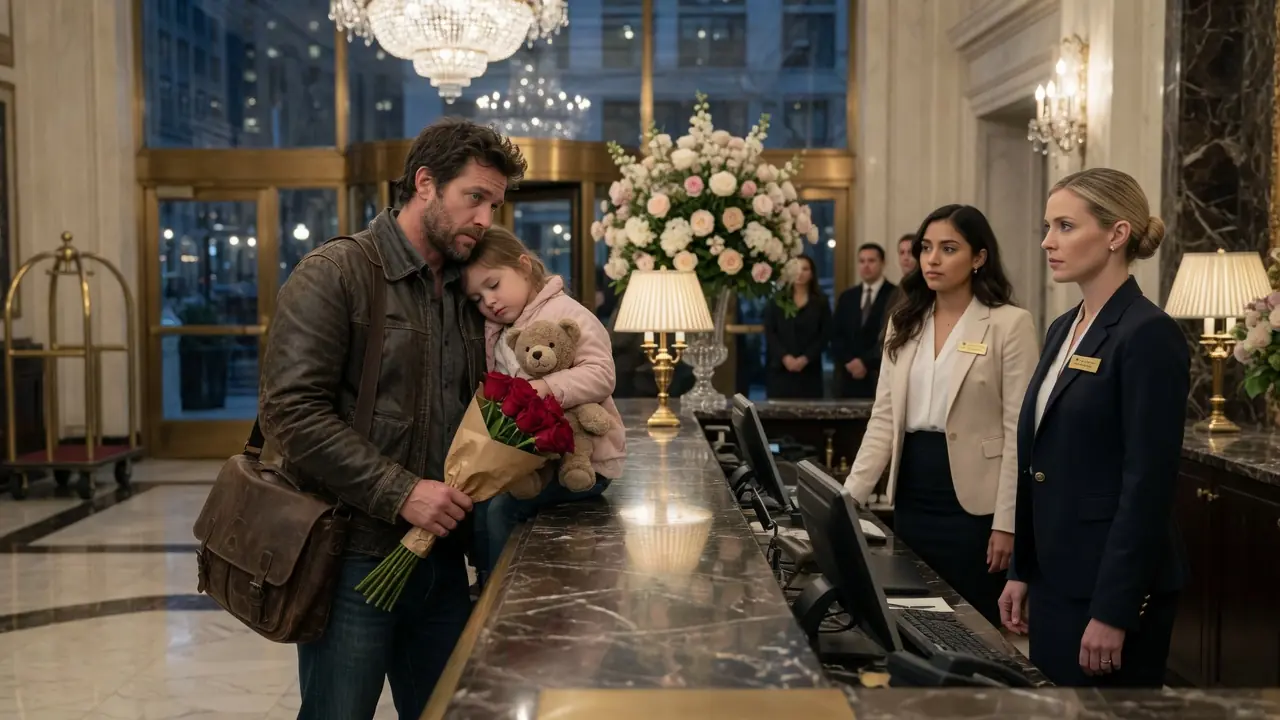
It is something else too.
A tenderness.
A vigilance that does not turn off, even when the plane lands, the bags come down, the city lights appear through wet windows, and everyone around you behaves as if the hard part is over.
For a parent traveling alone with a child, the hard part is never truly over.
It only changes shape.
It was that particular tiredness that Marcus Whitfield carried with him through the revolving doors of the Aldridge Grand Hotel on a Thursday evening in early November. His six-year-old daughter, Sophie, was asleep against his shoulder, her cheek pressed into the worn brown leather of his jacket. In his free hand, he held a small bouquet of red roses, the stems gripped low so the blooms would not brush against Sophie’s sleeping face.
He had bought the roses at the airport in the last few minutes before boarding his flight.
They were not perfect roses. A few petals had bent along the edges. One stem had gone slightly crooked after being pressed against his messenger bag during the flight. But they were red, and they were alive, and tomorrow was the anniversary of his wife’s passing.
Somewhere over Ohio, with Sophie asleep beside him and the cabin lights dimmed, Marcus had decided he would not let that day arrive without flowers in the room.
Elena had loved red roses.
Not because they were expensive or dramatic, but because, as she used to say, red flowers were honest. They did not pretend to be shy. They entered a room and admitted they had something to say.
Every year since she passed, Marcus and Sophie placed red roses in a vase.
At first, Sophie had not understood.
She was only three then, still young enough to ask when Mommy was coming back with a seriousness that broke Marcus in places he could not name. He had told her, as gently as he could, that some people stayed in your heart but could not come home with their body anymore.
Sophie had thought about that for a long time.
Then she had asked if flowers could still find Mommy.
Marcus had said yes.
He had no idea whether that was the right answer.
But it became their tradition.
Some traditions survive grief by sheer stubbornness.
This was one of his.
The lobby of the Aldridge Grand was glowing when Marcus entered. Warm chandelier light fell across the polished marble floors. Tall floral arrangements stood on dark wood tables. The scent of lemon polish and expensive perfume drifted through the air. Near the bar, soft jazz played beneath the murmur of guests dressed for the corporate event upstairs.
The hotel looked exactly as Marcus remembered approving it after the final renovation.
Elegant, but not cold.
Historic, but not fragile.
At least, that was what he had intended.
He walked toward the front desk slowly, careful with each step, the way a parent learns to walk when waking a child is the only thing in the world they are trying to avoid.
Marcus Whitfield was forty years old. He had dark, slightly unruly hair that no amount of professional grooming ever fully tamed and a beard that suggested several days of travel rather than careful cultivation. He wore a brown leather jacket, worn soft at the elbows, the kind of jacket that had been broken in over years rather than purchased to look that way.
Slung across his body was a leather messenger bag, heavy with the particular chaos that accompanies traveling with a small child. Snacks, a tablet, a spare change of clothes, travel wipes, a folder of papers he had not had time to read, and a stuffed bear with one ear slightly more loved than the other.
Sophie slept against his shoulder with the complete and unguarded trust that children carry before the world teaches them to be careful. Her pink jacket was rumpled from the flight. Her dark hair, braided that morning into two neat braids, had come half undone on one side. She held the stuffed bear loosely in one arm, her small hand resting against the leather of her father’s jacket.
To anyone observing the scene from across the lobby, they would have looked like exactly what they were.
A tired father traveling alone with his daughter.
Arriving somewhere late.
Hoping for nothing more complicated than a bed.
What the lobby did not know, what Marcus had no reason to announce, because announcing it had never been the point, was that he owned the building they were standing in.
The Aldridge Grand was the seventh property in a small, carefully built hospitality group that Marcus had started eleven years earlier, before Sophie was born, before Elena got sick, before the world rearranged itself into the shape it now held.
He did not run the day-to-day operations of any single property. He had people for that. Regional managers, hotel directors, a small executive team that handled what needed handling.
But he made it a quiet, unannounced practice to visit his own properties from time to time, unrecognized, dressed exactly as he was now.
Not as a trap.
Not as a test.
At least, not the cruel kind.
He did it because he had learned over the years that the only way to understand how a place actually treated people was to be treated as an ordinary person yourself.
A report could tell him guest satisfaction numbers.
A dashboard could tell him check-in times.
A regional manager could tell him whether rooms were turning over properly and whether the loyalty program was hitting targets.
But only a lobby could tell him the truth.
Only a tired front desk at 9:40 at night could show him whether hospitality lived inside the building or only in the training manual.
He approached the front desk.
Two women stood behind it.
The first was tall and blonde, her hair pulled into a neat low bun, wearing a navy blazer with a brass name tag that read Claire. Her arms were crossed loosely, and her eyes moved over Marcus with a quick, assessing glance that took in the leather jacket, the sleeping child, the bouquet of roses, and arrived at a conclusion before he had said a single word.
Beside her stood another woman in a cream blazer, dark hair cut in a sharp bob, arms also crossed, watching with an expression that mirrored her colleague’s. Her name tag read Renata. Not hostile, exactly, but guarded in a way that suggested she had already decided what kind of evening this was going to be.
A few feet away, near the far terminal, stood a third receptionist.
She was younger than the others, perhaps twenty-seven, with warm brown skin, long dark hair tucked neatly behind one ear, and soft hazel eyes that noticed things before anyone asked her to. Her name tag read Isabella Rivera.
She wore the same Aldridge Grand uniform as the others, a navy blazer over a white blouse, but on her it looked less like armor and more like care. There was something graceful about the way she moved, not polished in the artificial way of hotel training videos, but naturally attentive. She was beautiful, yes, in a way that would have drawn attention even if she had tried to disappear, but it was not her beauty that first separated her from the others.
It was the way her eyes moved to Sophie.
Not with annoyance.
Not with judgment.
Concern.
Marcus noticed it and then forgot he noticed it, because he was too tired to file the moment properly.
“Good evening,” Marcus said quietly, careful not to raise his voice and wake his daughter. “I have a reservation. Whitfield. Just checking in for the night.”
Claire’s eyes moved to the computer screen in front of her, then back to Marcus.
“I’m not seeing a reservation under that name.”
“It should be there,” Marcus said. “It may have been booked through corporate. Could you check again?”
There was a pause.
The particular pause of someone deciding how much effort a request deserves before they have finished hearing it.
“Sir,” Claire said, “even if there were a reservation issue, we’re fully booked this evening. There’s a corporate event upstairs. I’m afraid we don’t have anything available.”
Marcus shifted Sophie slightly, careful not to wake her.
“I understand you’re busy,” he said. “But I’d really appreciate it if you could look a little more carefully. It’s been a long flight, and my daughter needs to sleep somewhere that isn’t an airport chair.”
It was the kind of moment that reveals something true about a person, not because the words spoken are dramatic, but because of the small choices made in an unguarded instant.
The tone selected.
The level of effort offered.
The willingness or unwillingness to simply look again.
Claire glanced at Renata.
Something passed between them, not spoken but understood, the way unkindness sometimes moves between people without language.
“I really am sorry,” Claire said in a tone that did not sound sorry at all, “but there’s simply nothing we can do. You might try the Marriott two blocks over.”
Renata added, not unkindly in tone but carelessly in effect, “Sometimes this time of year, walk-ins just don’t work out. I’d recommend calling ahead next time.”
Marcus stood there for a moment.
He was not angry.
Not yet.
Not in the way the moment might have suggested he should be.
He had built his career, in part, on a simple principle he had learned long before he owned a single building. You could often learn more about a person’s character by watching how they treated someone they believed had no power.
He was, at that moment, a tired man in a worn jacket holding his sleeping daughter and a bouquet of roses.
To Claire and Renata, that was apparently all he was.
He shifted Sophie’s weight again. She stirred slightly, murmured something into his shoulder, and settled back into sleep.
“Is there a manager I could speak with?” he asked quietly.
“The manager is currently occupied with the event upstairs,” Claire said. “I really can’t interrupt him for a room availability question. As I said, we’re full.”
Marcus was about to answer when Isabella Rivera stepped away from her terminal.
“Claire,” she said softly.
Claire did not turn.
Isabella came closer.
“Did you check the executive booking tab?”
Renata’s eyes narrowed slightly.
Claire’s expression barely moved.
“I checked the system.”
“The regular system,” Isabella said. “But some corporate reservations don’t show unless you switch to secondary.”
Claire’s fingers stilled over the keyboard.
Marcus looked at Isabella.
She did not look triumphant. She did not look nervous either, though Marcus could see it cost her something to interrupt her senior colleague. Her shoulders were squared, her hands folded lightly in front of her, and her gaze stayed calm.
“I’m sure Claire already checked properly,” Renata said.
Isabella looked at Marcus, then at Sophie, then back to Claire.
“The child is asleep,” she said, her voice still gentle but firmer now. “It would only take a moment to check.”
There it was.
The difference.
Not a grand speech.
Not a heroic intervention.
Only someone deciding that a sleeping little girl was worth one more click.
Claire’s jaw tightened.
For a moment, Marcus thought she might refuse.
Then, with visible irritation, she turned back to the computer and clicked through the reservation system. Her fingers moved quickly, almost sharply. A moment passed. Then another.
Her face changed.
“There is a reservation,” she said slowly.
Renata leaned toward the screen.
Claire swallowed.
“Whitfield. Executive booking category. Ninth floor suite.”
“I thought there might be,” Isabella said simply.
Marcus said nothing.
He did not need to.
Isabella turned fully to him then, and for the first time since he had arrived, someone at the front desk truly looked at him.
Not through him.
Not over him.
At him.
Her eyes settled briefly on the roses in his hand.
“They’re beautiful,” she said softly. “Is tomorrow a special day?”
Marcus looked down at the bouquet, slightly crushed now from the long flight, but still holding its color.
“It’s the anniversary,” he said quietly. “Of my wife. She passed three years ago tomorrow. We always…”
He paused, adjusting Sophie against his shoulder.
“We always put flowers out. It’s become our tradition. Sophie picks the vase.”
Isabella’s expression changed.
Not with pity.
Marcus had learned to recognize pity. Pity had weight. It pressed down. It made the person offering it feel taller and the person receiving it feel smaller.
This was not pity.
This was sorrow meeting sorrow carefully at the door.
“I’m so sorry,” Isabella said.
Then, looking at Sophie’s sleeping face pressed against her father’s shoulder, the small hand curled around the worn stuffed bear, she added, “She’s beautiful. She looks exhausted, poor thing.”
“It’s been a long day for both of us,” Marcus admitted.
Isabella looked at the bouquet again.
One rose had bent awkwardly near the top, its head hanging lower than the others. Without assuming, Isabella lifted one hand slightly.
“May I?”
Marcus hesitated only a moment, then lowered the bouquet.
She adjusted the bent stem with careful fingers, supporting it with another so it would not break. It was a tiny gesture. Unnecessary, according to any formal job description. The sort of thing no manager could measure on a performance chart.
But Marcus watched her do it and felt something settle in his chest.
Someone had finally seen him.
Not the reservation.
Not the problem.
Not the inconvenience.
Him.
A grieving husband.
A tired father.
A man carrying flowers for a woman who was no longer there to receive them.
“Let me find you a vase before you go up,” Isabella said. “You shouldn’t have to carry them bent like this all the way to your room.”
Claire made a faint sound, barely audible.
Isabella ignored it.
“It’s really fine,” Marcus said.
“It will take one minute,” Isabella replied. “And if Sophie is choosing the vase tomorrow, the roses should make it to morning properly.”
Sophie stirred at the sound of her name, her eyelids fluttering.
Marcus rocked her gently once.
Isabella immediately lowered her voice.
“I’ll be right back.”
She stepped away and returned with a simple glass vase from the concierge storage room. She filled it halfway with water from a discreet service station, wrapped the stems in a damp cloth, and placed the bouquet carefully inside.
“There,” she said. “They’ll travel better now.”
Marcus looked at the vase.
Then at her.
“Thank you,” he said. “That was very kind.”
“It’s not kindness,” Isabella said softly. “It’s hospitality.”
The word landed exactly where Marcus had always believed it belonged.
Not as a slogan.
As a truth.
He completed the check-in without raising his voice, without announcing himself, without making Claire or Renata understand yet exactly what had happened.
But before he went upstairs, he asked quietly to see the hotel’s general manager.
After all, not in anger, but because he believed patterns of behavior were worth understanding before they were corrected.
Gregory Sandoval arrived within minutes.
He was a composed man in his early fifties, the Aldridge Grand’s general manager, with silver at his temples and the polished calm of someone who knew how to move through crises without appearing to hurry.
Then he saw the name on the registration screen.
His face changed.
“Mr. Whitfield,” he said.
Claire went still.
Renata’s head turned sharply.
Isabella looked from Gregory to Marcus, confusion flickering across her face.
Marcus held Sophie a little closer.
“Gregory.”
“I had no idea you were arriving tonight. I’m terribly sorry. Had I known—”
“I know,” Marcus said.
The two words were gentle, but they stopped Gregory cold.
Had I known.
That was always the problem.
Marcus looked briefly at Claire, at Renata, then at Isabella.
“I’d like to talk about what happened here tonight,” he said. “Not because I was the owner standing at the desk. Because I was a guest standing here with a sleeping child, and for several minutes, only one person behaved as if that mattered.”
Gregory’s face tightened.
Claire had gone pale.
Renata looked toward the floor.
Isabella’s eyes widened.
“Owner?” she whispered before she could stop herself.
Marcus turned to her.
“Yes.”
Her cheeks flushed instantly.
“I didn’t know.”
“I know,” Marcus said. “That is why it mattered.”
The lobby seemed to quiet around them.
A guest with luggage paused near the elevator. A bellman stopped pretending not to listen. Claire’s mouth opened, then closed.
Marcus did not humiliate them in the lobby.
That was not his way.
He asked Gregory to review the incident, the reservation logs, and any past guest complaints involving front desk dismissiveness or failure to check properly. He asked for written documentation by morning. Then he asked that Isabella not be penalized for stepping in.
“Penalized?” Gregory repeated, offended by the idea.
Marcus looked at him.
“People are often penalized quietly for doing the right thing in front of the wrong superior.”
Gregory had no answer.
“Make sure that does not happen here.”
“Yes, sir.”
Marcus turned back to Isabella.
“Thank you again for the vase.”
She nodded, still slightly stunned.
“You’re welcome, Mr. Whitfield.”
Sophie stirred again, opening her eyes just enough to see the bouquet.
“Daddy?” she mumbled.
“Yes, sweetheart.”
“Are those Mommy’s flowers?”
Marcus swallowed.
“Yes.”
Sophie’s sleepy gaze drifted to Isabella.
“Pretty vase,” she whispered.
Isabella smiled, and something in that smile softened the entire lobby.
“I picked the simplest one,” she whispered back. “So you can choose a better one tomorrow.”
Sophie seemed satisfied.
Then she fell asleep again.
Upstairs, in the ninth-floor suite, Marcus placed Sophie carefully on the bed. She woke only long enough for him to take off her shoes and help her into pajamas. Then he set the roses on the small table by the window, still in Isabella’s temporary vase.
Outside, the city glowed beneath November rain.
Marcus stood there for a long time.
He thought about Elena.
He thought about how she would have noticed Isabella immediately.
Elena had always been the person who saw the helper first. At parties, she noticed the exhausted caterer. In hotels, she noticed the housekeeper. In restaurants, she noticed the busboy refilling water too quietly for anyone to thank him.
“People show you who they are in small moments,” she used to say. “Pay attention before the big ones.”
Marcus had built an entire hospitality company around that belief.
Somewhere along the way, some parts of that company had forgotten it.
But Isabella Rivera had not.
The next morning, Sophie picked the real vase.
It was blue glass with a narrow neck, sitting on the suite’s sideboard as part of the room decor. She chose it because blue had been Elena’s favorite color, and because, according to Sophie, the roses “looked less sad” in it.
Marcus did not argue with the logic.
They placed the vase near the window. Sophie stood on a chair and touched one rose petal with the tip of her finger.
“Hi, Mommy,” she whispered.
Marcus stood behind her and placed one hand lightly on her back.
He had expected the morning to hurt.
It did.
But not as sharply as he feared.
Something about the night before had steadied him. The kindness at the desk, the vase, the way Isabella had said Sophie’s name softly once she knew it mattered. It had not erased grief. Nothing did that.
But it had made the grief feel less alone in the room.
Before checking out two days later, Marcus asked Gregory for the review.
It was worse than he expected.
There had been complaints.
Not many.
But enough.
Guests with modest clothes being turned away too quickly.
Guests with service animals treated coldly.
A young mother told there were no rooms before a reservation was properly checked.
An elderly couple made to wait nearly forty minutes because a staff member assumed they could not be loyalty members at the tier they claimed.
Every complaint had been smoothed over with apologies and points.
None had been treated as a pattern.
Claire and Renata were placed on administrative leave, then let go after further review. Marcus took no pleasure in it. He never enjoyed firing people. To him, a termination was not proof of strength. It was proof that something had failed earlier and no one had corrected it in time.
But what stayed with him was not Claire.
Not Renata.
It was Isabella.
He found her the morning he was leaving, near the end of her shift, restocking key card envelopes at the side counter.
“Isabella,” he said.
She turned quickly.
“Mr. Whitfield.”
“Do you have a minute?”
“Yes, of course.”
There was formality in her voice now that had not been there the first night. He understood it. The power dynamic had changed because she now knew who he was. He disliked that, but he could not undo it.
“I wanted to thank you properly.”
“You already did.”
“Not properly.”
She looked down briefly, then back up.
“I only did what anyone should have done.”
“Yes,” Marcus said. “That is not the same as saying anyone would have done it.”
She had no answer for that.
He asked how long she had worked at the Aldridge Grand.
“Seven months.”
“And before that?”
“Two years at a smaller hotel near the airport,” she said. “Before that, community college part-time. Before that, a restaurant hostess job and whatever helped pay rent.”
“You like hospitality?”
Isabella looked toward the lobby.
“I like making tired people feel less alone when they walk in,” she said. “I don’t know if that counts.”
Marcus smiled faintly.
“It counts more than almost anything.”
Her cheeks warmed again.
He told her he was restructuring the company’s guest experience training. Not with scripts, not with empty slogans, but around real judgment, attention, dignity, and the ability to see guests clearly before deciding what they needed.
“I’d like you to help design it,” he said.
Isabella stared at him.
“I’m a receptionist.”
“Yes.”
“I’ve been here seven months.”
“Yes.”
“I don’t have a degree.”
“I didn’t ask for one.”
She looked at him as though he had spoken in a language she almost understood but did not yet trust.
“Why me?”
“Because you saw a tired father, a sleeping child, and a bent rose stem,” Marcus said. “And in less than two minutes, you did more hospitality work than the entire front desk had done before you stepped in.”
Isabella’s eyes softened, but she looked away.
“My mother always said people arrive carrying more than luggage.”
Marcus went still.
Elena had once said almost the same thing.
“What was your mother’s name?”
“Camila,” Isabella said. “She cleaned hotel rooms for twenty-eight years. She used to say if you want to understand a hotel, don’t watch how it treats the rich man with the black card. Watch how it treats the woman who asks for extra towels because her child spilled juice on the bed.”
Marcus felt the sentence settle deeply.
“Your mother was right.”
“She usually was.”
“Is she still here?”
Isabella’s expression shifted.
“No. She passed four years ago.”
“I’m sorry.”
“Thank you.”
For a moment, they stood in a shared quiet neither of them tried to fill.
Then Sophie appeared beside Marcus, dragging her stuffed bear by one ear.
“Daddy, are we going?”
“In a minute.”
Sophie looked up at Isabella.
“You fixed Mommy’s flowers.”
Isabella crouched slightly to meet her eyes.
“I only helped a little.”
“They looked better after,” Sophie said seriously.
“Then I’m glad.”
Sophie studied her for another moment.
“Do you like pancakes?”
Isabella blinked.
Marcus looked down.
“Sophie.”
“What? It’s a question.”
Isabella laughed softly.
“I do like pancakes.”
“Daddy burns the first one.”
“The first pancake is always a test pancake,” Marcus said.
Sophie looked at Isabella.
“That’s what he says when he burns it.”
Isabella’s laugh came again, warmer this time.
Marcus found himself wanting to hear it again before the thought was fully formed.
That was how it began.
Not with romance.
Not with dramatic recognition.
With a reservation that had almost been ignored.
A vase.
A child asking about pancakes.
And a young receptionist who had carried her mother’s wisdom into a lobby that desperately needed it.
Over the next three months, Isabella became part of the company’s training redesign.
Officially, she was promoted to Guest Experience Development Associate, reporting not directly to Marcus but to the regional training director. Marcus made sure of that. He was careful. He understood power too well to pretend it did not exist. He did not want gratitude, ambition, or professional obligation tangled with anything personal.
So he kept distance.
Professional meetings.
Group settings.
Clear reporting lines.
No private dinners.
No late-night messages that could be mistaken for something else.
But life has a way of finding the spaces rules cannot fully occupy.
Sophie asked about Isabella often.
“Is Miss Rivera coming to the next hotel?”
“Does Miss Rivera teach people how to be nice?”
“Can Miss Rivera come when we pick flowers for Mommy next year?”
Marcus answered carefully.
Sometimes yes.
Sometimes no.
Sometimes, “We’ll see.”
Isabella, for her part, treated Sophie with the same careful warmth she had shown that first night. Not too much, not too fast, never trying to step into a space that did not belong to her. She never asked Sophie to talk about Elena. She simply listened when Sophie did.
During one training session at another property, Sophie sat in the back with a coloring book because Marcus’s childcare had fallen through. Isabella noticed the child drawing a vase with red flowers.
“Those are beautiful,” Isabella said during a break.
“They’re for Mommy,” Sophie replied.
“I thought so.”
Sophie glanced at her.
“Do you have a mommy in heaven too?”
Isabella sat beside her, not too close.
“Yes.”
“Do you bring her flowers?”
“Sometimes. Sometimes I make her coffee the way she liked it and sit with it for a while.”
Sophie thought about this.
“Daddy talks to Mommy when he thinks I’m asleep.”
Marcus, standing near the doorway, froze.
Isabella did not look toward him.
She kept her eyes on Sophie.
“I think that’s a very loving thing.”
“Do you think Mommy hears?”
Isabella’s voice was gentle.
“I think love hears love, even when we don’t know how.”
Sophie accepted this with the seriousness children bring to answers that satisfy the heart even when they do not solve the mystery.
Marcus stepped away before they could see his face.
That evening, he sent Isabella a brief message through the company system.
Thank you for what you said to Sophie today.
Her reply came ten minutes later.
She asked a hard question. I only tried to answer gently.
Marcus read the sentence twice.
Then he did not reply, because anything else felt too much.
Spring came slowly that year.
By April, the training program had begun rolling out across all seven properties. Isabella had turned out to be more than kind. She was sharp. She noticed weak systems quickly, understood staff anxiety, and had an instinct for translating values into practical behavior.
She argued with Marcus once in a meeting.
Not loudly.
Not disrespectfully.
But firmly.
He had suggested adding another section to the training manual on guest language standards.
Isabella listened, then said, “That won’t fix the problem.”
The room went quiet.
Marcus looked at her.
“Why not?”
“Because the people who need the training most already know the right language. Claire knew how to say ‘I’m sorry’ while meaning nothing by it. We don’t need to teach people better phrases first. We need to teach them better attention.”
The regional director looked nervous.
Marcus looked at Isabella for a long moment.
Then he smiled.
“You’re right.”
Her expression flickered, surprised.
“Put that in the program,” he said. “Better attention before better phrases.”
After the meeting, he found her in the hallway, stacking papers into a folder.
“You were right in there,” he said.
“I was worried I’d overstepped.”
“You didn’t.”
“You’re very calm when someone disagrees with you.”
“I married a woman who once told me my entire business plan was emotionally intelligent and financially delusional.”
Isabella smiled.
“Was she right?”
“Only about half of it.”
“The emotional half or the financial half?”
“That depended on the quarter.”
She laughed.
This time, he did not look away from it.
For a second, the hallway became dangerously quiet.
Then Marcus stepped back.
“I should get Sophie.”
“Yes,” Isabella said. “Of course.”
They both understood what had nearly happened.
Something honest.
Something that was not ready.
Summer arrived with heat, thunderstorms, and Sophie losing her first front tooth. She insisted on calling Isabella from Marcus’s phone to report the news because, according to Sophie, “Miss Rivera understands important things.”
Isabella answered on speaker.
“That is very important,” she said solemnly. “Did you save it?”
“Yes. Daddy says the Tooth Fairy will come.”
“Your father seems reliable about magical logistics.”
“He forgot glitter last time.”
Marcus closed his eyes.
Isabella laughed.
“I’ll remind him.”
“You’re better at remembering things,” Sophie said.
Marcus opened one eye.
“Excuse me?”
Sophie ignored him.
After the call, Marcus sat at the kitchen table with his daughter and watched her place the tiny tooth in an envelope. Their home was quiet, filled with the ordinary softness of evening. A half-finished puzzle sat on the coffee table. Elena’s photograph rested on the mantel. The vase from the Aldridge Grand suite, the blue one Sophie had chosen, sat beside it now.
He had bought it from the hotel after that stay.
He told himself it was for Sophie.
That was only partly true.
It reminded him of the night someone had seen the grief in his hands and treated it with care.
In August, the company held its annual leadership retreat at a quiet lakeside property two hours outside the city. Isabella attended as part of the training team. Marcus brought Sophie for the final day, when families were invited.
There was a picnic on the lawn, games for the children, and a casual dinner near the water.
Sophie found Isabella immediately.
Marcus watched from a distance as his daughter took Isabella by the hand and led her toward the dessert table as if this were the most natural thing in the world.
His heart did something both warm and painful.
He had spent three years making sure Elena was never replaced.
That had been his private vow.
But standing there, watching Sophie laugh as Isabella pretended to seriously evaluate three kinds of cookies, Marcus understood something he had been avoiding.
Love was not a room with only one chair.
Elena would always have hers.
That did not mean the room had to remain empty around it.
Later that evening, after Sophie fell asleep on a bench with a blanket over her shoulders, Marcus found Isabella standing near the edge of the lake. The sunset had faded into blue. Lights from the lodge trembled on the water.
He stood beside her, leaving careful space.
“Sophie adores you,” he said.
“I adore her too.”
The answer was immediate.
No performance.
No hesitation.
Then Isabella looked at him.
“I hope that’s all right.”
“It is.”
“Marcus…”
It was the first time she had used his first name when they were alone.
He felt it.
She seemed to as well.
“I need to say something before this becomes harder not to say,” she continued.
He turned toward her.
“All right.”
“I care about Sophie. Deeply. And I care about the work. I don’t want either of those things confused with…” She stopped, searching for the right word. “With whatever has been happening quietly.”
Marcus exhaled slowly.
“You noticed.”
“I think we both did.”
“Yes.”
The lake moved softly against the shore.
“I won’t put you in an unfair position,” Marcus said. “I’ve been careful because I don’t want you to feel your career depends on how you respond to me.”
“I know,” Isabella said. “That’s part of why I trust you.”
He looked at her then.
Really looked.
The young woman who had stepped forward in a lobby when others would not.
The receptionist who became a trainer because she understood hospitality better than anyone with a larger office.
The woman who spoke gently to his daughter about love hearing love.
The woman standing beside a lake, brave enough to name what neither of them had dared touch.
“I have feelings for you,” Marcus said.
Isabella’s eyes softened.
“I know.”
“I wasn’t looking for that.”
“I know that too.”
“I still love my wife.”
“I would not trust you if you didn’t.”
That broke something open in him.
Not grief.
Not exactly.
The loneliness around grief.
His voice was lower when he spoke again.
“I don’t know how to do this.”
Isabella’s smile was small and sad and beautiful.
“Neither do I.”
They stood there for a long moment.
Then Marcus said, “We go slowly.”
“Yes.”
“And carefully.”
“Yes.”
“And if you ever feel uncomfortable professionally—”
“I’ll tell you.”
“You will?”
“I argued with you in a meeting about training language.”
“That’s true.”
“I’m not that afraid of you.”
For the first time in a long while, Marcus laughed without feeling guilty for it.
Their first dinner was not dramatic.
It happened three weeks later, after Isabella officially moved into a role reporting outside Marcus’s direct chain. Marcus insisted on the structural change before anything personal began. Isabella told him she respected the caution and also that he was “almost aggressively ethical,” which Sophie later repeated with delight without understanding half the words.
They went to a small Italian restaurant where no one knew Marcus and the owner greeted every guest as if they had been expected all week.
They talked about Elena.
About Isabella’s mother, Camila.
About grief.
About work.
About how Sophie had once tried to make pancakes and created something Marcus described as “structural foam with syrup.”
Isabella laughed until she had to press her napkin to her mouth.
Marcus watched her and realized he was not comparing her to Elena.
That had been his fear.
Instead, she existed wholly as herself.
And his heart, battered but not dead, made room.
Sophie adapted with the emotional intelligence children sometimes have before adults ruin it by explaining too much. When Marcus told her he was taking Miss Rivera to dinner, Sophie considered this from the kitchen table.
“Like a date?”
Marcus almost dropped the glass he was holding.
“Yes,” he said carefully. “Like a date.”
Sophie looked toward Elena’s photograph on the mantel.
“Mommy won’t be sad?”
Marcus knelt beside her.
“No, sweetheart. I don’t think Mommy would be sad.”
Sophie thought about it.
“Because Miss Rivera is nice to the roses.”
His throat tightened.
“Yes,” he said. “Because Miss Rivera is nice to the roses.”
Sophie nodded.
“Okay.”
That was all.
Children can sometimes open doors adults have been leaning against for years.
By winter, Isabella had become part of their lives in small, steady ways.
Sunday pancakes, where the first one remained, officially, a test pancake.
Walks in the park when the air was cold enough for scarves.
Movie nights where Sophie always fell asleep halfway through and Marcus carried her to bed while Isabella folded the blanket.
The anniversary of Elena’s passing came again.
Marcus feared it.
Not because Isabella would be there.
Because he did not know whether grief and new love could stand in the same room without hurting each other.
That morning, Sophie picked red roses.
Marcus bought them.
Isabella came over in the afternoon carrying no flowers, only a simple ribbon the same shade of blue as the vase.
“I thought Sophie might want to tie it around the glass,” she said.
Sophie did.
The three of them placed the roses near Elena’s photograph.
For a moment, no one spoke.
Then Isabella stepped back, giving Marcus and Sophie space.
Sophie reached for her hand and pulled her gently closer.
“You can stand here too,” she said.
Isabella’s eyes filled instantly.
Marcus looked at Elena’s photograph.
There was no voice.
No sign.
No sudden spiritual certainty.
Only the quiet feeling that love had not been replaced.
It had been honored enough to grow.
Two years after that rainy November night, the Aldridge Grand held a company-wide event celebrating the launch of the Whitfield Hospitality Institute, a training program for hotel staff across the region. Its founding principle was printed on the first page of every manual:
Hospitality is not how we treat important people.
Hospitality is how we decide every person is important.
Isabella Rivera stood at the podium that evening, no longer a receptionist, no longer uncertain of whether her voice belonged in executive rooms. She was the director of guest experience for the entire company, respected, listened to, and known for being kind without ever being weak.
Marcus sat in the front row with Sophie beside him.
Sophie was eight now, wearing a blue dress and holding a small bouquet of red roses she had insisted on bringing because, in her words, “This all started with flowers.”
When Isabella finished her speech, the room rose in applause.
She looked startled for one second, then found Marcus in the crowd.
He smiled.
Sophie waved both hands.
Later that night, after the ballroom emptied and the staff began clearing glasses, Marcus found Isabella near the lobby windows, looking out over the city lights.
“The speech was beautiful,” he said.
“I almost forgot the middle.”
“You didn’t.”
“I did. I just hid it well.”
“Elena used to say hiding panic was half of leadership.”
Isabella smiled.
“I wish I could have known her.”
Marcus looked at her.
“She would have loved you.”
The words came easily.
No guilt.
No hesitation.
Only truth.
Isabella’s eyes softened.
“I love you,” she said.
It was the first time she had said it.
Marcus did not answer immediately because the words moved through him slowly, lighting rooms he had kept dark for years.
Then he took her hand.
“I love you too.”
Six months later, he asked her to marry him.
Not in a ballroom.
Not at a company event.
Not anywhere public.
He asked in the kitchen of the home he shared with Sophie, while pancakes burned on the stove because Sophie had distracted them both by claiming Daisy the stuffed bear needed a plate.
The first pancake smoked quietly in the pan.
Sophie yelled, “Test pancake!”
Isabella turned to laugh, and Marcus, standing there with flour on one sleeve and a ring in his pocket, knew there would never be a better moment.
He asked her beside the stove, with the smoke alarm threatening to complain, red roses on the counter for Elena, and Sophie holding her breath so hard her cheeks puffed.
Isabella said yes.
Then Sophie cheered so loudly the smoke alarm finally went off.
Years later, people at Whitfield Hospitality still told the story of the night the owner of the company walked into one of his own hotels looking like an exhausted single father and was nearly sent away.
They told it in training rooms.
They told it to new hires.
They told it whenever someone forgot that the guest in front of them might be carrying more than luggage.
But Marcus never told the story as a tale of exposure or punishment.
To him, it was never really about Claire or Renata.
It was about Isabella Rivera.
The young receptionist who noticed a sleeping child.
The woman who checked one more tab when no one else wanted to bother.
The person who saw a bent rose stem and understood that some flowers carry more than decoration.
It was about the quiet, ordinary kind of kindness that changes the direction of a life before anyone realizes the turn has happened.
And if anyone asked Sophie what she remembered from that night, she would say she remembered waking just enough to see a pretty lady fixing Mommy’s roses.
Then she would add, with the certainty of a child who had grown into the story and made it part of her own heart, that some people come into your life like a front desk light left on after a long trip.
You are tired.
You are grieving.
You are carrying too much.
And then someone looks up, sees you clearly, and says without saying it:
You made it.
You can rest now.
We have a room for you here.