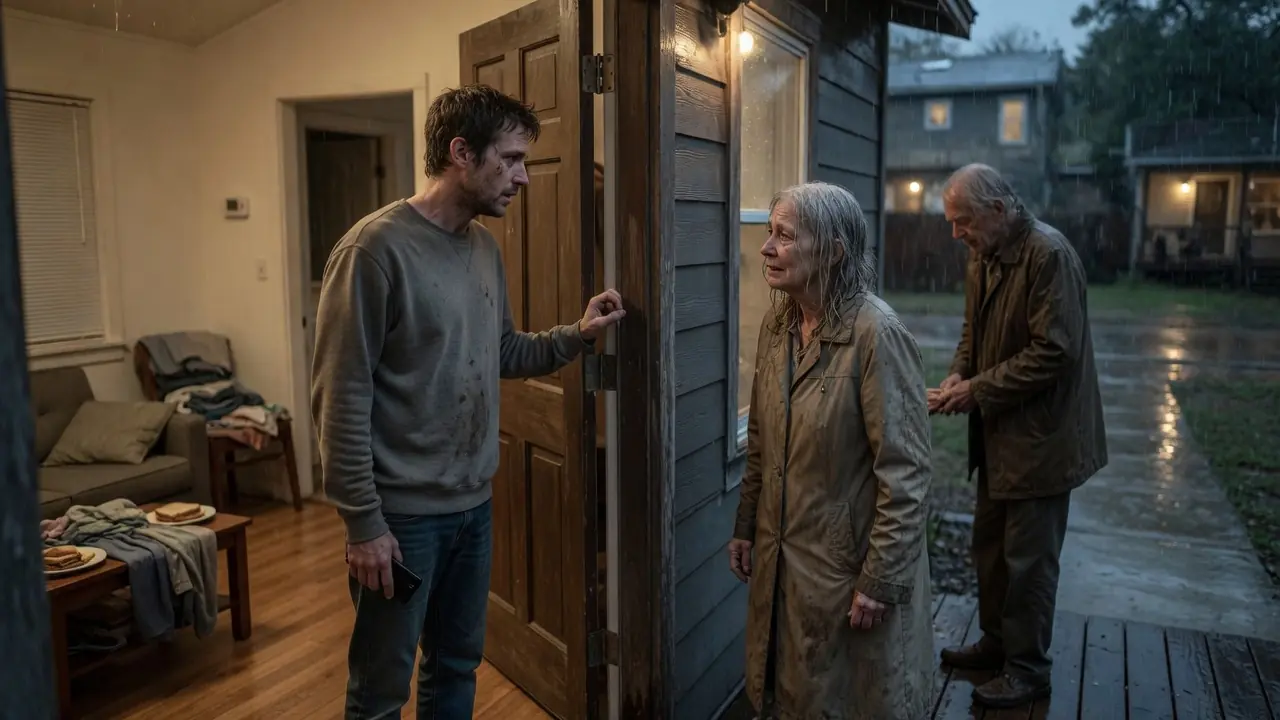
Marcus Bennett was struggling around his tiny apartment with his sick, screaming infant when a sudden, frantic pounding echoed from the front door.
When he opened it, he found an elderly couple huddled in the hallway, their thin coats soaked through, their hands shaking uncontrollably from the cold.
Even though Marcus was barely scraping by, he still stepped aside, pulled the trembling couple into his warm little living room, and gave them hot food.
What he did not know was that the truth they were about to reveal would change all of their lives forever.
The apartment sat quiet except for the soft whimper of a five-month-old baby who had been crying on and off for the past two hours.
Marcus paced the small living room with his daughter Maya pressed against his shoulder, her tiny body rigid from the colic that had been getting worse every night.
He moved in slow circles between the couch and the window, one hand supporting her head, the other rubbing tiny circles on her back.
“Shh, baby girl,” he whispered. “Daddy’s here. I know it hurts. I’m sorry. I don’t know how to fix it.”
It had been six months since Jennifer was gone. Six months since Marcus had stopped believing the world was fair. Six months since his life had turned into diapers, bills, grief, and the sound of his daughter crying when he had nothing left to give except his arms.
It was 7:43 on a Friday evening in late November, and Marcus was at the end of his rope. The first real cold snap had hit Austin hard, dropping temperatures into the thirties, unusual for Texas but not impossible. Snow had been forecast for later that night, which felt almost apocalyptic for a city that shut down when the thermometer dipped below fifty.
Marcus had tried everything with Maya. The bicycle legs the pediatrician recommended, the gas drops that cost too much and did nothing, walking in circles until his legs ached, singing every lullaby he could remember. Nothing worked. Maya’s cries only grew sharper, her little face turning red, her body arching in pain.
“I know, sweetheart,” Marcus whispered again, his voice breaking. “I know. I’m sorry.”
Then came the knock.
Soft at first. Hesitant. Almost easy to miss beneath Maya’s crying. Then it came again, more insistent, urgent enough that Marcus froze in the middle of the room.
Nobody knocked on his door at 7:43 on a Friday night. His neighbors in the aging apartment complex mostly kept to themselves. His brother Kenneth had not spoken to him in three weeks, not since their last argument about Marcus needing to “get his life together.” The few friends Marcus had before Jennifer died had long since stopped checking in because grief made people uncomfortable, especially when it did not end on schedule.
The knock came again, desperate now, almost frantic.
Marcus’s first instinct was to ignore it. He had enough problems already. A screaming baby, mounting medical bills, a job at a commercial real estate firm that paid $47,000 a year and barely covered rent and basics, and an apartment that still seemed to hold pieces of Jennifer no matter how many times he washed the sheets.
He had no room in his life for other people’s tragedies. He barely had room for his own.
But Maya was already screaming. Whoever was at the door already knew someone was home. And something about that knock, the raw urgency in it, pulled at something deep in Marcus’s chest.
He walked to the door, still bouncing Maya, and looked through the peephole.
An elderly couple stood in the hallway, bundled in thin coats that were completely inadequate for the sudden cold. The woman’s silver hair was disheveled, and even through the distorted fisheye view, Marcus could see that her eyes were red and swollen from crying. The man beside her, white-haired and stooped, had his arm around her shoulders like he was the only thing keeping her upright.
They looked terrified. Desperate. Lost.
Marcus’s hand hesitated on the deadbolt.
Mind your business. You have enough problems. They could be dangerous. This could be a scam.
But something about the way they stood there stopped him. The woman’s hand clutched the man’s coat like she was drowning. The man’s weathered face carried a kind of shame Marcus recognized too well.
He had worn that look himself six months ago.
What if they hurt Maya? What if this is a mistake?
But the woman was shivering so hard she could barely stand. Her lips had a bluish tint even through the peephole. Marcus knew enough first aid to understand that cold like that was not just discomfort anymore.
He made a choice.
He opened the door.
The woman’s eyes went immediately to the screaming baby in his arms, then back to his face. Relief and guilt warred in her expression, as if she understood exactly how much she was interrupting and had no other choice. The old man beside her tightened his arm around her shoulders.
“Oh, sweetheart,” the woman said, her voice rough like she had been crying for hours. “I’m so sorry to bother you. I know you have your hands full. We just didn’t know where else to go.”
Marcus had to raise his voice over Maya’s cries. “What kind of help do you need?”
The man spoke next, his voice shaking from cold and shame. “We’re lost. We’ve been walking for hours trying to find our house. It’s gotten so cold, and our phone doesn’t work. My wife Catherine, she’s not well. We just need to get warm for a bit. Maybe use your phone to call someone.”
Marcus looked at them. Really looked.
Their coats were decorative, the kind people wore in October, not in near-freezing weather with snow coming. No gloves. No scarves. Catherine’s hands were shaking so violently she could barely stand still, and her lips had that bluish tint that made Marcus’s stomach tighten.
Maya shrieked louder, her little body twisting in pain. Catherine’s expression changed instantly. The fear in her face shifted into something else, something older than fear, stronger than exhaustion.
Concern. Recognition. Instinct.
“That baby’s got colic,” Catherine said with sudden certainty. Her voice cut through Maya’s screams with unexpected strength. “Bad colic. I can hear it in her cry. How long has she been like this?”
“Two hours tonight,” Marcus said. “Five months in general. The doctor says there’s nothing to do but wait it out. Nothing helps.”
“May I?”
Catherine’s hands were already reaching out, not demanding, just ready. It was instinctive, automatic, the muscle memory of a woman who had held many babies in her life. Marcus saw the way she looked at Maya, not with curiosity and not with pity, but with practical, focused compassion.
Every instinct he had screamed that this was a bad idea. Do not let strangers into your home. Do not hand your baby to people you do not know. What if they are lying? What if they hurt her?
But Maya was screaming, and Marcus was failing her. Catherine’s eyes held real knowledge, real concern. More than that, she looked minutes away from collapsing from the cold. If he closed the door now, these two people might walk back out into the night and not make it safely anywhere.
Marcus hesitated one more heartbeat.
Then he stepped aside.
“Come in,” he said carefully. “Please. But I need to be honest. I’m keeping my phone in my hand. I don’t know you, and I have to protect my daughter. I hope you understand.”
The relief that washed over their faces was profound, almost painful to witness.
“Of course,” the old man said quickly. “Of course you should be careful. We understand. Thank you. Thank you so much.”
“Oh, thank you,” Catherine whispered. “We won’t stay long. I promise. We just need to get warm.”
Marcus led them into the small living room, suddenly aware of how everything must look. Baby toys scattered across the floor. His dinner, a sad sandwich, half-eaten on the coffee table. Laundry piled on a chair he had meant to fold for three days. Bottles by the sink. A blanket on the couch where he had been sleeping most nights because sometimes climbing into the bed he had shared with Jennifer felt impossible.
Everything in the room screamed that he was barely holding it together.
“Sit down,” Marcus said over Maya’s continued crying. “Let me turn up the heat.”
He moved to the thermostat first and cranked it up to seventy-five, despite what it would do to next month’s electric bill. Harold and Catherine were shivering so violently that their whole bodies shook. While part of Marcus remained wary, another part of him could not ignore the basic humanity of the situation.
These were people who needed help.
Whatever else was true, that much was undeniable.
Marcus went to the hall closet and pulled out the thick fleece blanket Jennifer’s mother had given them two Christmases ago. He had barely been able to look at it since the funeral. But watching Catherine’s blue-tinged lips and Harold’s shaking hands, he knew what needed to be done.
He draped the blanket over Harold’s shoulders.
“Here,” Marcus said. “You need to warm up slowly.”
“You’re very kind,” Harold said, his voice cracking with emotion and cold.
Marcus nodded, then turned to Catherine. “Ma’am, I have another blanket. Would you…”
But Catherine was still focused on Maya.
Marcus looked at her shaking hands, at the desperation in her eyes, at the way she was already moving with the instinctive motions of someone who knew exactly what she was doing.
This could be a terrible mistake.
But she was freezing. And Maya would not stop screaming.
“Okay,” Marcus said carefully. “But I’m staying right here. If anything seems wrong…”
“We understand,” Harold said firmly. “You are being kind to let us in at all.”
Marcus placed Maya in Catherine’s arms, watching carefully, ready to take his daughter back at the first sign of trouble. Catherine immediately adjusted the baby’s position, laying her face down along her forearm, Maya’s head resting in Catherine’s palm, her tiny legs dangling on either side. Then Catherine began a gentle but firm rubbing motion along Maya’s back.
“Gas pain,” Catherine murmured. Her focus was entirely on the baby despite her own shivers. “Pressure on the tummy helps, and this position lets gravity do some of the work. I had two daughters, five grandchildren, and I worked seven years in a pediatric clinic before I retired.”
Marcus stood frozen, watching carefully. His hand was still near his phone. But what he saw was not threat.
It was care.
This woman was holding his screaming baby while her own hands were still trembling from cold. Whatever her story was, that kind of instinct could not be faked.
“Let me make you both something hot to drink,” Marcus said, moving toward the kitchen. “And some food. When was the last time you ate?”
“This morning,” Harold said quietly. “We had breakfast at the motel before Derek picked us up. Around eight.”
Marcus glanced at the clock. Almost eight at night.
Twelve hours.
He moved through the kitchen with purpose, no longer constantly glancing back over his shoulder. He could see them clearly from where he stood anyway. Harold wrapped in the fleece blanket. Catherine focused entirely on soothing Maya. Both of them looked exhausted, but less alone than they had looked in the hallway.
The soup from three nights ago was still in the fridge, homemade chicken noodle his neighbor Mrs. Ramirez had brought over when she heard Maya crying through the walls. Marcus had barely touched it. He poured it into a pot and turned the burner to medium high.
While it heated, he put the kettle on for tea. He found the chamomile Jennifer had loved. It calms the nerves, she used to say. He set out two mugs and found the honey she had always used.
Her handwriting was still on the label.
J’s special honey. Hands off, Marcus.
His throat tightened, but he kept moving.
He pulled out bread, not stale yet, thank God, and made four slices of buttered toast. Simple. Warm. Easy to digest. His mother used to say comfort food did not have to be fancy. It just had to be made with care.
Maya’s screams began to quiet.
First to whimpers. Then to hiccuping sobs. Then, impossibly, miraculously, silence.
Within seven minutes of entering his apartment, this stranger had accomplished what Marcus had not managed in five months of sleepless nights. Maya’s eyes fluttered closed. Her body loosened in Catherine’s arms.
She slept.
The silence felt surreal, like the world had shifted on its axis. Marcus realized he was holding his breath. His hand moved away from his phone.
“I’ll hold her a while longer,” Catherine said softly, still swaying slightly in that universal grandmother rhythm. “She needs to stay like this at least fifteen minutes, or the gas may come right back. Poor little thing. She’s been suffering a while, hasn’t she?”
“Yes,” Marcus said, his voice hoarse. “Yes, she has.”
The kettle whistled.
Marcus poured hot water over the tea bags, added honey to both cups, and stirred carefully. The soup was bubbling now, filling the small apartment with the smell of chicken and herbs and something that felt almost like normal life. He brought the tea first, setting the mugs on the coffee table within easy reach.
“Careful,” he said. “It’s hot, but it’ll help warm you from the inside.”
“You didn’t have to do all this,” Catherine said, but her eyes were bright with gratitude.
“You’re cold and hungry,” Marcus said simply. “This is what people do.”
Harold reached for his mug with shaking hands, cradling it like it was precious. The steam rose into his face, and Marcus watched the old man close his eyes, just breathing it in.
“This is chamomile,” Harold said softly. “Catherine’s favorite.”
“Mine too,” Catherine said. “My mother used to make it for me when I was upset.”
Marcus went back to the kitchen, ladled soup into two bowls, and brought them out with the toast on a tray. He set everything on the coffee table carefully.
“I know it’s not much,” Marcus said, “but it’s hot, and it’s real food. Please eat.”
Harold had collapsed into Marcus’s armchair, his thin coat still on under the blanket. Now that they were inside under the apartment’s harsh lighting, Marcus could see how exhausted they both looked. Not just tired, but depleted. Hollowed out.
But as Harold took the first spoonful of soup, and as Catherine managed a bite of toast while still cradling the sleeping Maya, Marcus saw something else in their faces.
Relief.
Hope.
The kind of hope that comes when kindness appears in the darkness.
“I’m Harold Whitmore,” the man said, managing a weak smile. “This is my wife, Catherine. I’m sorry we had to impose like this. We’ve just had a terrible few days.”
Marcus pulled his own coat from the hook by the door and draped it over Harold’s shoulders on top of the blanket. The old man looked up, startled, then nodded gratefully.
“I’m Marcus Bennett,” Marcus said. “That’s Maya. And you’re not imposing.”
Harold nodded, but his eyes filled.
“Our son-in-law, Derek Morrison,” Harold began, the words tumbling out like he had been holding them in for hours, “he’s a financial adviser. About a month ago, he told us he had found the perfect house for us here in Austin. Said we should move closer to him and our daughter Rebecca. Said he could handle everything. Selling our house in Houston, buying the new one, all the paperwork.”
“We trusted him,” Catherine said softly. “He’s family.”
Marcus felt a sick pressure building in his stomach. He had worked in commercial real estate for ten years. He had seen enough scams to recognize the shape of one forming before all the details were even spoken.
Harold took a long drink of water, then continued.
“Derek drove us from Houston Tuesday morning. He picked us up around nine, and we got to Austin around noon. He dropped us off at a coffee shop downtown, the Blue Owl on Sixth Street. He said, ‘Wait here for twenty minutes. I need to run to the bank and sign the final papers. Then we’ll go straight to the house.’”
“We waited,” Catherine said. “We waited until after five-thirty. The coffee shop closed and asked us to leave.”
“Our cell phone is one of those old flip phones,” Harold said. “The screen cracked the day before when Catherine dropped it, and it won’t turn on at all. We don’t have Derek’s number memorized. It was always just saved in the phone. We don’t even remember Rebecca’s address here in Austin. Derek always handled visits, always drove us.”
“We had no money for a taxi,” Catherine added quietly. “Just a few dollars in change. So we asked people for directions to Willow Creek Estates. That’s where Derek said the house was. People gave us all kinds of conflicting directions. We walked for hours in the cold. It got dark. We kept walking, asking more people, getting more confused directions.”
“By almost eight,” Harold said, “we couldn’t walk anymore. We saw your apartment lights still on, and we knocked. We had to.”
Marcus sat down heavily on the couch. His investigator instincts were already firing.
“What’s the exact address of the house he bought you?”
“56 Maplerest Lane,” Harold said immediately. “Willow Creek Estates. Derek drove us past it from a distance about two weeks ago. Said they were repainting the interior, so we couldn’t go inside yet. He even showed us photocopied paperwork. It looked legitimate. We’re old. We didn’t think to check carefully.”
Marcus was already pulling out his laptop, fingers flying across the keyboard. The sick feeling in his stomach got worse with every search result. Willow Creek Estates loaded on his screen. Real neighborhood. Developed about five years earlier. Nice area.
He searched for Maplerest Lane. The street existed. He pulled up the property records for 56 Maplerest Lane.
His stomach dropped.
Harold and Catherine watched his face.
“Marcus?” Catherine whispered.
He turned the laptop so they could see.
“56 Maplerest Lane is a real address,” Marcus said carefully. “But it was sold three weeks ago to a family named Johnson for $635,000. They have already moved in. Derek couldn’t have bought it for you. It belongs to someone else.”
Harold stared at the screen like it might change if he looked long enough.
“How much did Derek say you sold your Houston house for?” Marcus asked, though he already dreaded the answer.
“$340,000,” Harold whispered. “He said the new house cost exactly $340,000. Said it was fate that the numbers worked out perfectly.”
Marcus pulled up Houston real estate records. 2314 Yale Street, The Heights. Sold three weeks ago.
Sale price: $635,000.
Marcus felt anger rise hot in his chest.
“Your house didn’t sell for $340,000,” he said. “It sold for $635,000. Derek stole $295,000 from you. And the house he supposedly bought you belongs to someone else. He never bought you a house at all.”
Catherine made a sound like she had been struck. Maya stirred but did not fully wake. Harold’s face went gray.
“That’s not…” Harold’s voice broke. “Derek wouldn’t. He’s married to our daughter. He’s been handling our finances for eight years. When I had my heart surgery, when Catherine’s mother died, he took care of everything. He’s family.”
“He’s a thief,” Marcus said flatly. “And he left you to freeze on the street while he ran with your money.”
Catherine was crying silently now, tears running down her face while she automatically continued soothing Maya.
“We gave him power of attorney,” she whispered. “Full access to our accounts. Our retirement savings were in that house. We were supposed to live there, and when we died, Rebecca and her sister Anne would split what was left.”
“But now there’s nothing,” Harold finished. “We’re seventy-six years old, and we have nothing. No house, no savings, nothing.”
He looked at Marcus with devastated eyes.
“Where are we supposed to go? We can’t work anymore. We can’t start over. We’re too old. Where?”
“You’re staying here,” Marcus said.
Both of them looked up, shocked.
“What?” Harold whispered.
“Tonight,” Marcus clarified. “You’re staying here tonight. Tomorrow we’ll call a lawyer and figure out legal options. But tonight, you stay. You’re freezing, exhausted, and you need to sleep. I have a bedroom. I’ll take the couch.”
“We couldn’t possibly,” Catherine started.
“You just got my daughter to sleep for the first time in five months,” Marcus interrupted. “You think I’m going to let you walk back out into the cold? No. You stay.”
“We don’t want to be a burden,” Harold said, but Marcus could hear the desperate hope beneath it.
“You’re not a burden,” Marcus replied, his voice softening. “Six months ago, my wife died. I was drowning. I needed help. I needed someone to stay. Nobody did. My brother told me to handle my responsibilities. My friends stopped calling. I know what it feels like to need help and have everyone walk away.”
He looked at both of them directly.
“I’m not walking away. You need help. I can give it. That’s how it’s supposed to work. People are supposed to stay.”
Catherine was crying openly now, but she smiled through the tears. Maya slept peacefully in her arms.
“Thank you,” Catherine whispered. “Thank you for not closing the door.”
Morning brought cold November sunlight and the full weight of reality.
Marcus woke on the couch at 6:30, his back aching, disoriented for a moment before remembering. Harold and Catherine were in his bedroom. Maya was in her crib. Catherine had put her down the night before using some technique involving white noise and precise swaddling.
The baby had slept five straight hours.
Five hours.
Marcus had not slept five consecutive hours since Jennifer died.
He lay there for a moment, listening to unfamiliar sounds. Harold’s soft snoring from the bedroom. Catherine moving quietly, probably checking on Maya. Then he heard Catherine’s soft voice from the nursery, singing something gentle, and Maya responding with a happy coo.
Not a cry. A happy baby sound.
Marcus got up and found Catherine changing Maya’s diaper with practiced efficiency.
“I hope you don’t mind,” Catherine said. “She woke up, and I heard her. You should turn that monitor up, by the way. I thought I’d handle it so you could sleep.”
“I don’t mind at all,” Marcus said. “How did you sleep?”
“Better than I have in three days. That bed was heaven. Harold is still out cold. First time he’s really slept since Derek.”
She stopped, composing herself.
“We need to call a lawyer,” Marcus said gently. “A friend of mine, Thomas Davis. He handled my wife’s estate. He’s good, and he’ll help.”
“Pro bono means free?” Catherine asked, almost ashamed to say it. “Because we don’t have money for anything.”
“He’ll help,” Marcus said. “Let me call him now.”
Thomas Davis answered on the third ring. He listened to the story with increasing anger and promised to come by at lunch.
“This is elder financial abuse,” Thomas said, his voice tight. “Classic pattern. I’ll need documentation, but if what you’re telling me is accurate, Derek Morrison is looking at serious criminal charges.”
“Can they get their money back?” Marcus asked.
There was a long pause.
“Honestly, probably not all of it. People like this hide assets, move money through shell companies, declare bankruptcy, or push funds offshore. We can pursue it, but recovery rates are rough. I’m sorry, Marcus. I’ll do everything I can, but they need to be prepared that the money may be gone.”
After hanging up, Marcus found Harold in the kitchen struggling with the coffee maker.
“Here,” Marcus said. “Let me. It’s temperamental.”
“Everything okay?” Harold asked, looking older in the morning light.
“Lawyer’s coming at noon. Thomas Davis. He’ll help.”
Harold nodded slowly. “And after that? After we know for sure Derek stole everything?”
“Then we figure out next steps.”
“We should start looking at shelters,” Harold said quietly. “Resources for homeless seniors. It’s not your responsibility.”
“You are not going to a shelter.”
“Marcus…”
“No.” Marcus set down the coffee pot firmly. “I meant what I said. You stay here. We figure this out together.”
“We can’t impose.”
“You’re not imposing.” Marcus’s voice rose, then he took a breath. “Harold. Yesterday my daughter slept five hours straight for the first time since she was born. Do you understand that? I was thinking I couldn’t do this anymore. I was drowning. Catherine walks in, and within seven minutes, Maya is asleep. You think that’s nothing?”
Harold looked at his hands. “You’re kind, but we’re strangers. You don’t owe us anything.”
“You’re right,” Marcus said. “I don’t owe you. I’m choosing to help anyway. That’s what people are supposed to do.”
“Most people don’t,” Harold said softly. “Most people close doors.”
“Then I’m not most people.”
Thomas Davis arrived at noon with a grim expression. They sat around the kitchen table while Maya napped peacefully in the next room. Thomas took detailed notes as Harold and Catherine recounted everything: the conversations with Derek, the house sale, the paperwork they had signed without reading carefully because they trusted family.
“Power of attorney,” Thomas said, shaking his head. “Complete control.”
“We thought…” Catherine’s voice cracked. “He’s our son-in-law. Why would we question it?”
“Because people are sometimes horrible,” Thomas said, then softened immediately. “I’m sorry. But this is textbook exploitation. I need a few hours to pull records and trace the money. I’ll be back by four.”
When he returned, his expression told them everything.
“It’s worse than we thought,” Thomas said, spreading documents across the table. “Derek ran a complex scheme. First, he used his power of attorney to sell your house to a shell company, Morrison Holdings LLC, for only $295,000. Then that same shell company, which he secretly owns, immediately resold it for $635,000 to a legitimate buyer. He pocketed the difference.”
Catherine’s hands went to her mouth. Harold went completely still.
“And there’s more. Federal investigators have been tracking him for over a year because of offshore transactions. They found at least six other couples in Houston, San Antonio, and Corpus Christi. Same pattern. Elderly clients. Power of attorney. Shell company property sales. He’s been running this for at least four years.”
“So we’re not the only ones,” Harold said numbly.
“No,” Thomas said. “And that helps the criminal case. I’m contacting the district attorney Monday morning.”
“But can we get our money back?” Catherine asked, though her voice suggested she already knew.
Thomas sighed. “I have to be honest. Recovery is extremely difficult. Derek moved the money through multiple LLCs and offshore accounts. Even with a criminal conviction, even with a civil judgment, you might recover ten to twenty cents on the dollar, and it could take years.”
The crushing silence that followed was broken only by Maya’s soft breathing from the other room.
“So we really have nothing,” Harold finally said.
“You have a criminal case,” Thomas said gently. “Derek Morrison is looking at serious federal prison time, and we’ll pursue civil remedies. But financially, in terms of immediate recovery, I’m sorry. It could be years.”
“Where is he now?” Marcus asked.
“Unknown. Disappeared after dropping them at that coffee shop. I’ll flag him with law enforcement, but until he surfaces…”
“He’s gone,” Catherine said flatly. “He got what he wanted.”
After Thomas left, promising to start proceedings immediately, the three of them sat in silence. Catherine was holding Maya again, finding comfort in the baby’s weight.
“We should go,” Harold said without conviction.
“Where would you go?” Marcus asked directly.
Harold did not answer.
“There’s a shelter on the east side,” Catherine said softly. “We saw it yesterday while we were walking.”
Her voice failed before she could finish.
Marcus thought about Kenneth telling him to handle his own responsibilities. He thought about friends who had promised help and disappeared. He thought about being thirty-two years old and completely alone except for a screaming baby.
“You’re not going to a shelter,” Marcus said firmly. “You’re staying here.”
“Marcus, we can’t.”
“Yes, you can, and you will.” Marcus leaned forward. “Here’s what’s going to happen. Catherine, you help with Maya, not as a job, but because you’re good at it, and I desperately need help. Harold, I saw you looking at the leaking faucet this morning. I haven’t had time to fix anything in six months. If you want to help with that, I’d be grateful.”
“That’s not equal,” Catherine protested. “You’d be providing everything.”
“Child care in Austin costs at least $1,600 a month,” Marcus interrupted. “I was about to have to hire someone, which I can’t afford, or quit my job, which I also can’t afford. You’re not taking charity. You’re saving my life.”
“What about long-term?” Harold asked. “When we get sick? When we need medical care?”
“Then we handle it,” Marcus said simply. “Together. Like family does.”
“But we’re not family,” Catherine whispered.
“Yes, we are.” Marcus’s voice was gentle but absolute. “Not by blood. By choice. You’re my family because I choose you. You can choose me back or walk away, but I hope you choose to stay.”
Catherine started crying. Maya reached up with one tiny hand and touched her face.
“We choose to stay,” Catherine said.
“Equal partners,” Harold added, his eyes wet. “We contribute what we can. We’re not dependent.”
“We’re family,” Marcus finished.
“We’re family,” Harold repeated.
The next four months became a revelation in what family could be when it was built on choice instead of obligation.
Catherine transformed Maya’s care with quiet confidence. She established routines Marcus had been too exhausted to create: consistent nap times, specific feeding schedules, the exact right bath water temperature. She knew which cry meant hunger, which meant gas, which meant tired, and which meant Maya simply needed the steady weight of arms around her.
The colic did not disappear immediately. It rarely did. But Catherine managed it. The specific holds, the right pressure on the tummy, the bicycle legs done slowly and rhythmically, the warm baths at 6:30 every evening, the swaddle that made Maya feel secure.
What had been six hours of screaming every night became two hours by January. Then one hour by February. Then occasional fussiness by March that Catherine could soothe within minutes.
Marcus started sleeping again.
Real sleep.
Five hours became six, then seven. The fog that had surrounded him since Jennifer’s death began to lift. For the first time in months, he did not wake every morning feeling like he had already failed before the day began.
At work, his performance improved dramatically. He closed two major deals in January, a warehouse conversion in South Austin and a retail plaza in Round Rock. His boss, Richard Sterling, who had nearly put him on probation in October, instead started talking about promotions and year-end bonuses.
“Whatever changed,” Richard said one Thursday in early February, “keep it up. You’re like a different person.”
Harold quietly took over apartment maintenance. The leaking faucet was fixed within his first week. Loose floorboards were secured. Windows were weatherproofed. He fixed the garbage disposal, repainted the bathroom, organized the storage closet, and figured out the rattling air conditioner.
Though Harold occasionally felt tired and had to rest, he kept his dignity through usefulness. He went for regular blood pressure checkups. He found purpose in the work, and purpose returned color to his face.
He also cooked dinner every night.
Simple meals. Meatloaf on Mondays. Spaghetti on Tuesdays. Roast chicken on Wednesdays. Chicken and dumplings on cold nights. Nothing fancy, but hearty and warm.
The apartment stopped smelling like takeout and exhaustion. It started smelling like home.
Marcus tried to pay them in early January. He pulled out a checkbook after dinner one evening, his hands awkward around the gesture.
“I want to compensate you properly,” he said. “For the child care, the housework, everything.”
“No,” Catherine said firmly.
“But…”
“We’re not employees,” Harold interrupted. “We’re family. You don’t pay family.”
“Then let me…”
“Marcus.” Catherine put her hand over his. “If you pay us, this becomes a transaction. We become hired help. That’s not what this is. We contribute because we want to, because we can, because it gives us purpose. The only payment we need is a roof and knowing we matter.”
Marcus looked at these two people who had walked into his life as desperate strangers and somehow become necessary.
“You matter,” he said quietly. “More than you know.”
But Derek Morrison’s betrayal still haunted them.
Thomas Davis kept them updated. In mid-January, Derek was tracked to Tucson, Arizona, attempting the same scam on an eighty-one-year-old widower named Frank Patterson. The victim’s daughter was a Tucson police officer who immediately recognized the fraud. She called her colleagues, and Derek was arrested on January 19.
“The federal investigators had been watching him for over a year because of offshore transactions,” Thomas explained. “The Tucson case just gave them the excuse to finally arrest him.”
The charges were extensive: twenty-three federal counts of elder financial abuse across seven victims, wire fraud, mail fraud, identity theft, and forgery. The evidence was overwhelming. Derek was denied bail and remained in federal custody while prosecutors built their case.
But the money remained elusive.
“He moved it through too many shell corporations and offshore accounts,” Thomas explained during a March update. “Cayman Islands, Panama, possibly Singapore. Even with convictions, civil asset recovery is incredibly difficult. You may never see that money again. Or maybe five or ten years from now, only a fraction.”
“We’ve accepted that,” Harold said, though his voice carried the weight of it.
They were not healed, but they were learning to live.
By March, Maya was eight months old and thriving. She could sit up unsupported, was starting to crawl, and had two tiny bottom teeth. The colic had finally, mercifully passed. Catherine took her to the park every afternoon, where Maya squealed with joy at the ducks.
Harold made friends with neighbors. He helped Mr. Rodriguez in 314 fix a leaky pipe. He taught Mrs. Park in 312 how to winterize her plants. He joined weekly domino games in the community room. Slowly, the old man who had arrived shaking in a wet coat began to become part of the building’s rhythm.
Life found a rhythm.
A good rhythm.
Then Adult Protective Services came knocking.
The knock came on a Tuesday afternoon in late March. Marcus was at work. Catherine was giving Maya a bath. Harold was in the kitchen starting dinner, chicken and dumplings.
Harold answered the door to find a middle-aged woman with an official badge and a leather portfolio. She wore a gray suit and the expression of someone who had seen too much suffering to assume innocence.
“Mr. Harold Whitmore?”
“Yes?”
“I’m Patricia Gonzalez with Adult Protective Services for Travis County. I need to speak with you and Catherine Whitmore about your current living situation.”
Harold’s stomach dropped. “What’s this about?”
“We received a report alleging that you and your wife are being financially and emotionally exploited by Marcus Bennett. May I come in?”
Harold’s hands began to shake. “We’re not being exploited. Marcus has been…”
“I’d prefer to assess that myself, Mr. Whitmore. May I come in, or do I need to return with law enforcement and a court order?”
Harold stepped aside, his mind racing.
Later, when Marcus came home and they discussed it, Harold remembered that Mrs. Park had asked too many worried questions a few days earlier. She had heard that Harold and Catherine did not pay rent. Catherine had tried to explain that they lived there like family, by choice. Mrs. Park, kind but anxious, had apparently decided kindness might be hiding danger.
Patricia Gonzalez conducted her investigation with cold efficiency. She interviewed Harold and Catherine separately. She examined the apartment. She checked their bedroom, the bathroom, the kitchen, and the sleeping arrangements. She documented everything in her portfolio with notes that felt ominous.
“You’re living here rent-free,” Patricia said to Harold during his interview. “You receive no compensation for child care and housework. No written agreement. No lease. No legal protections. Mr. Bennett could evict you any time with no notice.”
“He would never do that,” Harold said firmly.
“With respect, Mr. Whitmore, you’ve known him four months. You can’t know what he’ll do. Circumstances change. People change. I’ve seen dozens of cases where elderly individuals thought they were family with someone, only to find themselves on the street when that person’s situation shifted.”
“This is different,” Harold insisted.
“That’s what everyone says.” Patricia made a note. “You were recently victims of significant financial fraud by a family member you trusted. That history makes you vulnerable. Vulnerable people are often targeted by others who exploit that vulnerability under the guise of kindness.”
“Marcus isn’t exploiting us,” Harold said, his voice rising. “He saved us. We were freezing and lost, and he opened his door.”
“Or he saw an opportunity,” Patricia replied. “Free child care, free housekeeping, free home maintenance, all in exchange for letting you sleep in his spare bedroom. The power imbalance is significant.”
“We’re not dependent. We’re partners. We contribute.”
“Unpaid labor is not partnership,” Patricia said. “It can become exploitation even when disguised as family.”
When Marcus came home at 6:15, Patricia Gonzalez was sitting in his living room, portfolio open, expression professional and disapproving. Harold and Catherine looked terrified and guilty. Maya sat on the rug playing with blocks, oblivious to the tension in the room.
“Mr. Bennett,” Patricia said. “We need to talk about your arrangement with Harold and Catherine Whitmore.”
Marcus looked at Harold and Catherine, reading the fear in their eyes. He set down his briefcase carefully.
“What arrangement?”
“The one where two elderly victims of recent financial fraud are living in your home providing unpaid child care and household services with no formal agreement, no compensation, and no legal protections.”
“They’re family,” Marcus said.
“Not legally,” Patricia replied. “And I’m concerned about several things. First, the power dynamic. You control housing, giving you significant leverage over two people with no other options. Second, environmental suitability. You’re a single father with a demanding job. What happens if your circumstances change?”
“Then we handle it together,” Marcus said, struggling to keep his voice level. “That’s what families do.”
“That’s not a plan. That’s an aspiration.” Patricia stood and gathered her portfolio. “I’ll be filing a recommendation that Mr. and Mrs. Whitmore be evaluated for placement in an assisted living facility with proper oversight, medical support, and social services.”
“You can’t do that,” Marcus said, his voice rising. “They are competent adults making their own choices.”
“They are vulnerable adults who may not be in a position to recognize exploitation or make fully informed decisions given their recent victimization.”
“My job is to protect them, Mr. Bennett,” Patricia continued. “I’m not convinced this arrangement does that. You’ll receive formal notification of the evaluation within seven business days.”
After she left, the apartment sat in stunned silence.
Catherine’s voice was small and frightened. “Can they really force us into a home? After everything, after we finally found family, they can just take us away?”
Marcus immediately called Thomas Davis.
“They can make things very difficult,” Thomas said after hearing everything. “APS has broad authority regarding vulnerable adults. They can petition for protective arrangements if they believe someone is being exploited or unable to make informed decisions.”
“But they’re completely competent,” Marcus protested. “They make their own decisions. They chose to stay here.”
“I know that, you know that. But with their recent trauma and their age, APS can build a case that they need protection from themselves. It’s paternalistic, but it can become legally serious.”
“So what do we do?” Marcus asked. “We just built a life together. They’re my family. I can’t lose them.”
There was a long pause on the other end.
“There is one option,” Thomas finally said. “You could establish a formal supported decision-making agreement. It’s recognized in Texas. Basically, Harold and Catherine would retain one hundred percent of their decision-making rights. They would stay fully in control of their lives, but they would formally designate you as their supporter for major decisions. We’d also prepare durable power of attorney and medical power of attorney documents.”
“What does that mean exactly?”
“It means that when APS comes back, you can show legal documentation proving that Harold and Catherine, as competent adults, have formally chosen you as their decision-making supporter. APS can’t easily intervene when mentally competent adults have voluntarily chosen their support person through proper legal channels.”
“Is it complicated?”
“Not really, but Marcus, this is still a serious commitment. You would be involved in major decisions about medical care, living arrangements, and finances. It is not just symbolic.”
Marcus looked across the room at Harold and Catherine, who sat on the couch holding hands. They looked older and more fragile than he had ever seen them. Maya crawled over to Harold and pulled herself up on his leg, grinning. Harold absently stroked her hair, tears running down his face.
“I’m already tied to them,” Marcus said quietly. “I’m already making those decisions with them. Let’s just make it legal.”
“Marcus, this is forever,” Thomas said.
“Yes,” Marcus replied. “They’re my family. Let’s make it official.”
The supported decision-making petition required extensive documentation. Medical evaluations from Dr. Sarah Rodriguez, their new primary care physician, proved Harold and Catherine were mentally competent but would benefit from support as they aged. Cognitive assessments showed full decision-making capacity. Physical examinations documented their overall health.
Harold had high blood pressure controlled with medication. Catherine had early arthritis, but nothing debilitating. Financial records showed complete destitution: bank statements with a combined balance of $673 from Social Security, no assets, no property, no retirement accounts.
Derek had drained those too.
Character references came from neighbors. Mrs. Eleanor Park from 312, perhaps regretting the damage her concern had caused, wrote a glowing letter about Catherine’s care for Maya and the obvious love between them. Mr. James Rodriguez from 314 described Harold helping him fix his garbage disposal and refusing payment, wanting only company.
A home inspection report showed the apartment was clean, safe, and well-maintained. Background checks on Marcus showed no criminal history, stable employment, and no red flags.
But the hardest part was confronting what they had been avoiding.
Rebecca.
“She’s been calling,” Catherine admitted one evening in early April. They sat at the kitchen table after Maya was asleep, legal paperwork spread between them like accusations. “Every week since we found out about Derek. She leaves messages. Says she wants to see us, explain, make it right somehow.”
“Derek’s trial is scheduled for June,” Harold added quietly. “His lawyer contacted her. She knows everything now. About the fraud, about us living here, about the legal agreements.”
Rebecca had known everything since the day Derek was arrested. She had called a few times crying, but Harold and Catherine had told her that when she was ready to trust her parents more than Derek, she could call back.
For a while, she had gone silent.
“Do you want to see her?” Marcus asked carefully.
Catherine’s expression was complicated. Layers of hurt and longing and anger tangled together.
“She’s my daughter,” Catherine said slowly. “I carried her nine months. Felt her first kick. Held her when she was born. Raised her eighteen years. Watched her marry Derek. Loved her forty-seven years.”
She looked down at her hands.
“But when we needed her, when we were scared and confused and telling her something was wrong, she chose him. She looked at us like we were senile, like we were problems to be managed.”
“She thought she was helping,” Harold said weakly.
Catherine’s voice hardened. “She thought we were incompetent. She looked at the people who raised her and decided we were too old to know what was happening. When I called her crying, saying the house address didn’t make sense, she told me I was getting the numbers confused. When your father said something felt wrong about the sale price, she said we didn’t understand modern real estate.”
“She was wrong,” Harold said.
“She gaslit us, Harold,” Catherine said. “Our own daughter made us doubt ourselves while we were being robbed.”
“She’s still your daughter,” Marcus said gently. “And the court will ask why she’s not providing care. Why I’m petitioning to be your formal supporter instead of your own child.”
“Because she didn’t stay,” Harold said simply. “You did.”
Thomas arranged the meeting for a Thursday afternoon at his office. Neutral territory. Legal witnesses. Controlled setting.
Rebecca Morrison arrived ten minutes early. Thomas had briefed them beforehand. Rebecca had moved back in with her sister Anne in San Antonio after Derek was arrested. She had filed for divorce, lost the house, and begun therapy.
She looked like she had aged a decade in six months. She was forty-seven but could have passed for sixty. Expensive clothes hung loose on her frame. Her hands shook when she saw her parents.
“Mom,” she said. “Dad.”
Her voice cracked immediately.
“I’m so sorry. I’m so, so sorry.”
“Sorry doesn’t give us back our house,” Catherine said, her voice carefully controlled. “Sorry doesn’t give us back our savings, our security, or the thirty-one years we lived in that home.”
Rebecca’s face crumpled. “I didn’t know. I swear I didn’t know what Derek was doing. I thought he was helping.”
“But you chose to believe him instead of us,” Harold said quietly. “When we told you something felt wrong, you told us to trust Derek. You made us feel foolish for questioning family.”
“I thought you were…” Rebecca’s voice broke. “I thought you were forgetting things, Dad. You couldn’t find your car keys for a week last year. Mom called me three times in one day asking when Thanksgiving was. I thought you were declining. I thought Derek was helping manage complicated finances so you wouldn’t be stressed.”
“We weren’t declining,” Catherine said firmly, leaning forward. “We were stressed because we knew something was wrong, and nobody would listen. We weren’t losing our minds, Rebecca. We were being robbed. And when we reached out to you, our daughter, for help, you sided with the thief.”
“I know that now.” Rebecca was crying openly. “I know that now, and I’ll never forgive myself. Derek fooled me too. He was having affairs. He had gambling debts I didn’t know about. He lied to me for years about everything. I filed for divorce the day he was arrested. I’ve lost everything too.”
“That doesn’t fix what you did to us,” Catherine said, and Marcus could hear how much it cost her to stay firm. “You’re our child. You were supposed to protect us, or at least believe us. You didn’t.”
“I thought I was protecting you,” Rebecca whispered.
“No,” Harold interrupted, his voice harder than Marcus had ever heard it. “You thought Derek was more trustworthy than your own parents. You thought we were too old, too foolish, too mentally diminished to know when we were being manipulated. You chose convenience over difficult truth. You chose not to believe your husband could be a monster, so you decided we were confused old people instead.”
“I’m sorry,” Rebecca said again, helplessly.
“You already said that,” Catherine replied. “We heard you. We believe you mean it. But sorry doesn’t mean we forget. Sorry doesn’t mean you get to be back in our lives like nothing happened. You broke something, Rebecca. You broke trust. Trust takes time to rebuild, if it can be rebuilt at all.”
“Mom, please.”
Rebecca reached out, but Catherine stepped back.
“We have a family now,” Catherine said, her voice shaking but determined. “People who believed us when we said something was wrong. People who helped us when we had nothing. People who stayed. You didn’t stay. You chose Derek. You chose wrong.”
Rebecca turned to Marcus then, really seeing him for the first time.
“You’re the one who took them in,” she said. “The stranger who gave them a home.”
“I opened a door,” Marcus corrected. “They are the ones who saved my life.”
Thomas explained the supported decision-making agreement. Rebecca listened, trying to reconcile the elderly, vulnerable parents she had imagined with the strong, angry people sitting across from her.
“You really found a family,” Rebecca said quietly. “A real family, with a stranger who opened his door.”
“He wasn’t a stranger for long,” Harold said.
“Can I…” Rebecca’s voice was barely audible. “Can I at least know you’re safe? Can I call sometimes? Not to push back into your life. Just to know you’re okay?”
Harold and Catherine looked at each other, having one of their silent married conversations.
“You can call,” Harold finally said. “Once a month. We won’t promise more than that. We won’t promise forgiveness. But you can call once a month, and we’ll tell you we’re okay.”
“Thank you,” Rebecca whispered. “That’s more than I deserve.”
“Yes,” Catherine said bluntly. “It is.”
After Rebecca left, Catherine sat back down heavily. Her hands were shaking.
“That was harder than I expected,” she said.
“You did well,” Marcus said gently. “You set boundaries. That’s healthy.”
“Did I?” Catherine looked at him with haunted eyes. “She’s my daughter, Marcus. I just told my daughter she can call once a month like she’s some distant acquaintance.”
“She broke your trust,” Marcus said. “Trust has to be earned back. It doesn’t just return because she’s sorry or because she’s your daughter.”
“Is that what you’d tell Kenneth?” Harold asked softly. “If your brother showed up and apologized, would you make him earn it back too?”
Marcus thought about Kenneth. The closed doors. The refused help. The judgment. Being called pathetic for helping people who needed help.
“I don’t know,” he admitted. “Part of me wants to say yes. Make him earn it. But another part, the part that remembers when we were kids and he was my hero, would probably forgive him too quickly.”
“That’s the hard part about family,” Harold said. “The line between love and enabling. Between forgiveness and being a doormat. I don’t know if we made the right choice with Rebecca, but it’s the choice we made.”
“She can earn her way back,” Marcus said. “If she really wants to. But she has to do the work. You’re not wrong to make her prove it.”
The hearing for the supported decision-making agreement was set for April 23 at two in the afternoon. Judge Maria Santos presided.
In the week leading up to it, Marcus barely slept. He reviewed Thomas Davis’s materials endlessly. He rehearsed testimony in the shower, in the car, while walking Maya around the park. Every worst-case scenario lived in his head.
“You’re going to do fine,” Catherine told him the night before as she rocked nine-month-old Maya. “Just tell the truth.”
“What if the truth isn’t enough?” Marcus asked, pacing.
“Then we’ll figure out plan B,” Harold said calmly, fixing a sticky drawer. “Worrying tonight just steals your peace twice.”
“When did you get so wise?”
“Seventy-six years of mistakes,” Harold said with a small smile.
The Travis County Courthouse was imposing. Marble columns, vaulted ceilings, and the heavy gravity of authority pressed down on them. They arrived at 1:45, Maya with them because Catherine insisted the judge should see the child she had been caring for.
Thomas Davis met them in the hallway, composed and confident.
“Remember, this isn’t a trial,” he said. “It’s a hearing. Just show her who you are. Show her the family you’ve built.”
Inside, Patricia Gonzalez sat with a younger social worker, portfolio open, expression unreadable. Judge Santos entered precisely at two. Her eyes were sharp, taking in everything.
“This is a petition for a supported decision-making agreement,” she began. “Adult Protective Services has raised concerns.”
Patricia stood. “Yes, Your Honor. The Whitmores are elderly, recently defrauded by a family member. They now live with Mr. Bennett rent-free, providing unpaid child care and household labor with no compensation or legal protection. We’re concerned this arrangement may constitute exploitation or could easily become so.”
“Do you have evidence of actual exploitation?” the judge asked. “Financial access, control, isolation?”
“No direct evidence,” Patricia admitted. “But the power imbalance is significant. This could become exploitation without safeguards.”
“So your concern is potential exploitation rather than current exploitation.”
“Our concern is vulnerability. Trauma can make victims susceptible to manipulation, even when the manipulation is wrapped in kindness.”
Thomas rose. “Your Honor, what APS calls exploitation is, in fact, family. Families share resources. They care for each other without contracts. Medical records show both Whitmores are cognitively sound. We have letters from neighbors, employers, and health care providers, all attesting that this household is mutually supportive and beneficial.”
“I want to hear witnesses,” Judge Santos said.
Patricia called Linda Morrison, the social worker who evaluated the home. She described the apartment as small, lacking formal agreements, and potentially unstable long-term.
“In your professional opinion,” Patricia asked, “is this appropriate long-term for elderly individuals?”
“It’s unconventional and carries risk,” Linda said. “Current conditions are safe, but if Mr. Bennett’s circumstances change, the Whitmores could be left homeless again.”
Thomas cross-examined her.
“The apartment is clean?”
“Yes.”
“Safe?”
“Yes.”
“Mr. and Mrs. Whitmore appear well-nourished and well-groomed?”
“Yes.”
“Maya Bennett is thriving?”
“Yes.”
“So your concern is not current danger, only hypothetical future changes.”
“Yes,” Linda conceded.
Patricia next called Dr. James Morrison, a geriatric psychiatrist who had never personally evaluated Harold or Catherine.
“Can trauma increase susceptibility to manipulation?” she asked.
“Absolutely,” he said. “Elderly victims may trust the wrong people out of need.”
“Can you assess Harold and Catherine Whitmore specifically?”
“No. I have not evaluated them.”
Thomas highlighted that point under cross-examination. The testimony was theoretical, not based on personal evaluation.
Then Thomas called Eleanor Park.
“I’ve seen a family,” Eleanor said. “When they arrived, Harold and Catherine looked defeated. Now they have purpose. Catherine walks Maya every afternoon. Harold helps neighbors. They all care for each other. That’s not exploitation.”
James Rodriguez testified next.
“Harold fixed my sink,” he said. “Wouldn’t take a penny. They invited me to dinner. Exploiters don’t do that.”
Then Dr. Sarah Rodriguez, Maya’s pediatrician, provided the most powerful testimony.
“When I first saw Maya at six months,” she said, “she was underweight, severely colicky, and her father was overwhelmed. Hospitalization or foster care was a real possibility. Now she is thriving. Catherine’s care changed everything. I believe she may have saved Maya’s life.”
Finally, Harold and Catherine testified together.
“Mrs. Whitmore,” Judge Santos asked, “do you feel exploited?”
“Absolutely not,” Catherine said. “Marcus didn’t victimize us. He gave us choice, dignity, and purpose. I care for Maya because I want to, not because I have to.”
“Mr. Whitmore,” the judge asked, “are you concerned that Mr. Bennett might end this arrangement someday?”
“Every relationship carries risk,” Harold said softly. “Our daughter chose someone else over us. But Marcus has proven himself again and again. We trust him.”
“You understand he will be involved in major decisions about your medical care, finances, and living arrangements?”
“Yes,” Harold said.
“And you consent?”
“Absolutely,” Catherine said.
Then Marcus testified.
“Mr. Bennett,” the judge said, “what happens when Harold and Catherine need more care than you can provide?”
“Then I find the resources,” Marcus said. “Home health aides, physical therapy, whatever they need. And if they require nursing care someday, I will find the best place possible and visit daily. They will never be abandoned.”
“What if you want to remarry? What if a partner objects to their presence?”
“Then that partner isn’t for me,” Marcus said simply. “Harold and Catherine are part of my family permanently.”
“Those are significant limitations for a thirty-two-year-old.”
“They’re not limitations,” Marcus said. “They’re priorities.”
Judge Santos called a recess.
Ninety agonizing minutes crawled by as they waited in the hallway. Catherine soothed a fussy Maya. Harold sat with his head in his hands. Marcus stood by the window, forcing himself to breathe.
“There is no other way,” Harold whispered. “If she denies this, APS could separate us.”
“Then we fight,” Marcus said. “We don’t give up.”
When they returned, the judge’s expression was unreadable.
“This court takes exploitation seriously,” Judge Santos began. “Ms. Gonzalez raises valid concerns about risk. Elderly individuals can indeed be vulnerable.”
Marcus’s heart plummeted.
“However,” the judge continued, “I am persuaded by three things. The extraordinary improvement in Maya’s health due to Catherine’s care. Compelling testimony from neighbors describing a household of mutual support. And the clear demonstration that family can be formed through choice and commitment.”
She looked at Patricia.
“Your caution is understandable. But in this case, it risks harming what is evidently a genuine, healthy family.”
Turning to Marcus, she said, “This agreement is a serious responsibility. There will be quarterly reviews for the first year and annual reviews thereafter. If evidence of exploitation appears, I will revoke it immediately. Are you prepared for that scrutiny?”
“Yes, Your Honor.”
“Mr. and Mrs. Whitmore, do you consent to this agreement?”
“Yes,” they said together.
Judge Santos signed the order.
“The supported decision-making agreement is approved.”
Outside the courthouse, Marcus hugged Harold and Catherine tightly.
“We did it,” Catherine said, crying. “We’re really legally family.”
“We’ve been family since November,” Marcus said. “Now it’s official.”
At that moment, Maya reached for Harold for the very first time and said, clear as a bell, “Pops.”
Harold burst into tears.
“She called me Pops.”
“Of course she did,” Catherine whispered. “Because that’s who you are.”
Derek Morrison’s criminal trial began June 10 in federal court. Marcus, Harold, and Catherine attended every day, sitting in the gallery and listening as seventeen victims described the devastation Derek had caused. An eighty-three-year-old widower who lost the home he had shared with his wife for forty years. A seventy-nine-year-old couple left sleeping in their car for weeks. A seventy-one-year-old man whose wife’s health collapsed under the shock of losing everything.
Derek showed no remorse.
He sat expressionless, occasionally whispering to his lawyer, never reacting to grief, loss, or betrayal. His attorney tried to argue addiction and mental illness, but the jury was unmoved.
After three hours and forty minutes of deliberation, they returned guilty verdicts on all twenty-three counts.
Sentencing took place June 26. The courtroom was packed with victims. Harold and Catherine stood together, hands clasped.
“You were family,” Catherine told Derek, her voice steady. “We trusted you because you were our daughter’s husband. You stole our home, our savings, our safety. You left us to freeze.”
“But you didn’t win,” Harold continued. “Because we found real family. People who chose to stay when you chose to steal. You taught us who we could truly trust.”
For the first time, Derek reacted. Not with remorse, but anger. His jaw tightened. His fists clenched.
The judge sentenced him to twelve years in federal prison, five years of supervised release, and more than two million dollars in restitution.
Money that would almost certainly never be paid.
“Mr. Morrison,” the judge said, “you targeted the vulnerable and destroyed lives. This sentence reflects society’s condemnation.”
As the bailiffs led Derek away, he looked back at Harold and Catherine. Not with regret. With calculation.
Some people never change.
Civil recovery proceedings dragged on for two years. Despite relentless work by Thomas Davis and other attorneys, most of Derek’s assets were unrecoverable, hidden offshore, buried in shell corporations, tucked into accounts no one could reach. In the third year, the civil case settled for $87,000 total.
Harold and Catherine received $12,400.
“It’s something,” Harold said when Thomas delivered the news.
“What will you do with it?” Thomas asked.
“College fund,” Catherine said instantly. “For Maya and Daniel. Education is one thing no one can take away.”
Marcus protested. “It’s your money.”
But they refused. The funds went straight into a 529 plan for both children.
By then, Marcus’s life had changed again. He received a call from Richard Sterling, his former boss in Austin, about a senior acquisitions manager position at Hartman Properties in Dallas. The salary was nearly double what Marcus had been making.
At the interview, Marcus impressed the partners with his market knowledge and calm precision. They offered him the job on the spot.
“There’s one thing,” Marcus said carefully. “My family situation is unconventional.”
“We provide relocation for employee spouse and children,” one partner said.
“My immediate family,” Marcus said, “is me, my daughter, and two adults in their mid-seventies under my supported decision-making agreement. If you hire me, you’re hiring all of us. Full relocation for four people, and written guarantees that future relocations will also accommodate my family structure.”
The partner blinked. “That’s unusual.”
“My family is unusual,” Marcus replied. “But they’re non-negotiable. I understand if this is a deal breaker.”
The next afternoon, his phone rang.
“Mr. Bennett,” the partner said, “we’ve reviewed your situation. We’re prepared to offer full relocation for four individuals, including temporary housing for up to sixty days. We’ll also add contract language guaranteeing future relocations will consider your family structure.”
Marcus sat down, overwhelmed.
“You’re serious?”
“We are. Your work speaks for itself, but your commitment to your family speaks even louder. If family is your priority, we respect that.”
They moved to Richardson in early October, their second October as a family. The relocation package covered a rental house on a quiet street. Three bedrooms, two bathrooms, a small yard with an oak tree already dropping leaves. After the cramped Austin apartment, it felt like a mansion.
Maya was now sixteen months old, walking steadily and beginning to string two words together. “Pops garden” meant she wanted Harold to take her outside. “Gamma book” meant she wanted Catherine to read to her. She was a happy, healthy toddler with no memory of the screaming colicky infant she had once been.
Harold discovered community gardening within their first week. The Richardson Senior Center had plots available for a small annual fee. Harold claimed a ten-by-ten plot and immediately began planning.
“Tomatoes here,” he explained to Marcus one Saturday morning, sketching in a notebook. “Bell peppers here. Maybe some jalapeños if Catherine wants them. Herbs along this edge. I’ll teach Maya about growing things. Every child should know where food comes from.”
He spent afternoons at the garden, dirt under his fingernails, sun on his weathered face. He met other retirees: George, a former engineer, Patricia, a retired librarian, and Tom, an eighty-year-old veteran who could make anyone laugh. They swapped gardening tips, life stories, and occasionally went out for coffee.
Catherine found her own community at the Richardson Public Library. She joined a Thursday morning book club, a group of women ranging from fifty-five to eighty-two who read everything from literary fiction to mysteries to romance novels. She also started attending story time with Maya, reading to crowds of toddlers and their caregivers.
“I haven’t had friends in years,” Catherine admitted to Marcus one evening. “After we retired, we spent so much time with just each other. It’s nice to have people again. People who like me for me, not because I’m someone’s wife or mother.”
Marcus threw himself into the new job at Hartman Properties. The work was challenging: managing acquisitions for commercial properties across North Texas, coordinating with investors, evaluating potential deals, and traveling occasionally. But it was rewarding.
For the first time since Jennifer’s death, Marcus was not living paycheck to paycheck. He paid off Jennifer’s remaining medical bills in November. He built up a savings account. He bought Maya new clothes without checking his bank balance first.
In December, Marcus met Elena Rodriguez at a neighborhood holiday party hosted by Sandra, one of Catherine’s book club friends. Elena was a nurse at Richardson Methodist Hospital, thirty-five years old, divorced, with no children. She had warm brown eyes, an easy laugh, and the slightly exhausted look of someone who worked too many twelve-hour shifts.
They talked for three hours.
Marcus found himself telling her about Jennifer, about grief, about the strangeness of living with loss and still wanting to laugh.
“I’m sorry,” he said eventually. “That’s too heavy for a party.”
“No,” Elena said. “I asked, and I meant it. People always want to pretend grief doesn’t exist. But it does. It’s part of you now.”
“Does that bother you?”
“Why would it?” she asked. “You loved your wife. That’s beautiful. It doesn’t mean you can’t love again.”
On their second date, Marcus explained his family situation.
“I need you to understand something before this goes any further,” he said. “My family is complicated. I have Maya, obviously. But I also have Harold and Catherine. They’re under my formal support agreement. They live with me. They’re not going anywhere. If that’s too much, if you need something simpler, I understand. But I can’t choose between you and them. I won’t.”
Elena looked at him for a long moment.
Then she started laughing.
“You’re serious?”
“Yes.”
“Marcus, you have a toddler and two surrogate grandparents who help with child care, home maintenance, cooking, and love. That sounds like the best possible setup. Most single parents I know are desperate for that kind of support. You’re apologizing for having an amazing family.”
“It’s unconventional.”
“Conventional is overrated,” Elena said. “I’d rather have real than conventional any day.”
She meant it.
Elena came to dinner the following week, played with Maya, chatted with Catherine about books, and talked gardening with Harold. She fit into their lives like she had always been there.
Eight months later, on a warm July evening in their backyard, Elena proposed. Marcus had been grilling burgers. Harold was teaching Maya the names of herbs from his garden. Catherine was setting the picnic table.
Elena walked into the middle of the yard and said, “Can I have everyone’s attention?”
They all turned.
Elena knelt in the grass and pulled out a ring box.
“Marcus Bennett,” she said, “I’m not asking you to marry just me. I’m asking to marry into all of this, into this beautiful, complicated chosen family. Will you marry me?”
Maya started clapping, not understanding but sensing something important was happening. Catherine had both hands over her mouth. Harold was grinning.
Marcus said yes.
They married the following February, eighteen months after meeting, in a small ceremony at a Richardson chapel. Forty people attended, mostly friends from work, the neighborhood, Catherine’s book club, and Harold’s garden group.
Rebecca and her daughter Ashley came and sat in the back. Rebecca had been slowly, carefully working her way back into her parents’ lives over the past two years. The monthly phone calls had become cautious visits. She would never have the relationship she had before Derek. Trust, once shattered, reforms with permanent cracks. But she was building something new, something more honest, if more fragile.
Kenneth had been invited. Marcus sent a formal invitation to his last known address. He did not respond.
Some doors stay closed.
Harold walked Marcus down the aisle. Catherine stood as Marcus’s matron of honor, crying through the whole ceremony. Maya was the flower girl, two and a half years old, throwing petals with wild abandon.
Daniel Harold Bennett, three months old, slept through the ceremony in Catherine’s arms. Marcus and Elena’s son. Named for the man who taught Marcus what family really meant.
“Jennifer would have loved you,” Catherine whispered to Elena during the reception.
Elena cried and hugged her.
“I hope so,” Elena said. “I hope I’m honoring what she started.”
The years that followed were the kind of ordinary happiness that felt extraordinary after everything they had survived.
Maya started preschool, then kindergarten. She was bright, social, and kind. She once spent her entire birthday money buying books for her classroom because “some kids don’t have books at home.”
Daniel grew from infant to toddler to little boy. He looked like Marcus but had Elena’s temperament: calm, observant, slow to anger. He was obsessed with building things, spending hours with blocks and Legos, and eventually Harold’s tools.
Harold taught both children about gardening. Maya had her own plot by age six, growing cherry tomatoes and marigolds. Daniel preferred tools, learning how to use a hammer, a level, and a saw under Harold’s patient guidance.
Catherine read to them every night. Classics, picture books, and eventually chapter books. When Maya got older, Catherine taught both children to cook, standing them on stools at the counter, letting them crack eggs, measure flour, and stir batter.
Rebecca slowly earned her way back into their lives. Monthly calls became every-other-month visits. Then monthly visits. She never regained what she had before Derek, but she built something new.
Ashley, Rebecca’s daughter, made more consistent effort. She called her grandparents weekly and brought her children to visit once a month. Maya and Daniel knew their cousins, played with them, and saw them as extended family.
Life was good.
Stable.
Full.
Then came November, seven years after that desperate knock on Marcus’s door in Austin.
Catherine collapsed while making breakfast.
Marcus had been getting ready for work upstairs in the bedroom he shared with Elena. He heard the crash, the sound of a body hitting tile, and ran downstairs to find Catherine on the kitchen floor. Harold was kneeling beside her, his face gray with terror.
“Call 911,” Marcus shouted to Elena, dropping to his knees beside Catherine.
He checked her pulse. Irregular. Weak. He started chest compressions while Harold held her hand and whispered her name over and over.
The ambulance came within seven minutes. The paramedics worked efficiently, asking questions Marcus answered automatically.
How old?
Seventy-eight.
Medical history?
High blood pressure controlled with medication. Arthritis. No previous heart issues that they knew of.
They loaded Catherine onto a stretcher. Harold tried to climb into the ambulance, but the paramedics stopped him. Only one person allowed, and Marcus was technically her legal supporter.
“I’ll drive you, Pops,” Elena said immediately. “Maya, Daniel, you’re staying with Sandra next door. Go.”
At the hospital, they learned Catherine had been having cardiac warning signs for months but had not mentioned them. Chest tightness she dismissed as indigestion. Fatigue she blamed on age. Shortness of breath she attributed to being out of shape.
“Didn’t want to be a burden,” she whispered, gripping Harold’s hand, surrounded by tubes and machines. She looked smaller and frailer than Marcus had ever seen her.
“You are not a burden,” Marcus said, his voice breaking. “You saved my life. You saved Maya’s life. You’re everything.”
Catherine smiled weakly. “I got seven years I never expected. Seven years of purpose and family and joy. Seven years of being Gamma. Of watching you and Elena fall in love. Of meeting Daniel. That’s more than most people get.”
“You deserved more,” Harold said, tears streaking his weathered face.
“No one gets what they deserve,” Catherine murmured. “They get what they get. And I got you, Harold. For fifty-eight years, I got Marcus when we were drowning. I got Maya and Daniel. I got Elena. I got to be family again. That’s enough.”
She died three days later, November 16, peacefully and with all of them at her side. Harold held one hand. Marcus held the other. Elena stood behind Marcus, her hand on his shoulder. Maya and Daniel were at home because Catherine had insisted the children not see her like that.
Her last words were to Harold.
“Thank you for fifty-eight years. Thank you for not giving up when Derek took everything. Thank you for choosing to stay.”
Harold whispered, “I’ll never stop choosing you.”
The funeral was two days later at the same chapel where Marcus and Elena had married. Over a hundred people came: neighbors, book club friends, gardening buddies, families from story time, church members, Marcus’s colleagues, Elena’s nursing friends.
Rebecca came with Ashley and Ashley’s children, crying through the service. Grief mingled with regret for all the time she had lost.
After the funeral, Harold seemed to shrink. The light dimmed in his eyes. He moved like a ghost through the house.
“I don’t know how to be without her,” he confessed one December night. “We were together since I was eighteen. Even in our worst times, I had her. Now I don’t.”
“You have us,” Marcus said. “Me, Elena, Maya, Daniel.”
“I know,” Harold whispered. “But it’s not the same. It’s like half of me is gone.”
“Then we’ll help you walk,” Elena said gently.
Winter dragged by. Harold kept his routines. He tended the garden. He taught Daniel how to hold tools safely. He cheered at Maya’s soccer games. But he seemed to fade like a photograph left in the sun.
Then, on a cold afternoon in late March, another knock came.
Marcus opened the door and found Derek Morrison on the porch.
Rage surged through him instantly.
Derek looked older, thinner, and yellowed by illness. Three years in federal prison followed by medical release had taken something from him. Beside him stood a man in a cheap suit holding a leather portfolio.
“Mr. Bennett,” the man said, “Officer Peterson, Mr. Morrison’s probation officer. He’s terminally ill. He requested permission to come here. I’m supervising the visit.”
“I don’t care if he’s dying,” Marcus said. “He’s not welcome.”
“I just need to see Harold,” Derek rasped. “I won’t stay long.”
“No,” Marcus began.
But Harold’s voice came from behind him.
“Let him say what he came to say.”
Marcus turned, stunned. Harold stood in the hallway, exhausted but resolute.
“Please, Marcus,” he said softly. “Let him in.”
Against every instinct, Marcus stepped aside, positioning himself protectively between Derek and Harold.
Derek entered slowly, holding a small cardboard box.
“I came to apologize,” Derek said, his voice rough. “Not the courtroom version. A real apology. For what I did to you and Catherine.”
“Sorry doesn’t give us back our money,” Harold said flatly. “Sorry doesn’t bring Catherine back.”
“I know. Nothing will.” Derek extended the box. “This is $22,000. Everything I have. Prison work wages and what my mother left me. Officer Peterson witnessed the withdrawal. It’s not enough. It’ll never be enough. But please take it.”
Harold stared at him.
Derek swallowed hard. “I’m dying. Six months, maybe less. They let me out because there’s no point keeping a dying man in prison. I can’t die without trying to make it right.”
Officer Peterson nodded. “No strings attached. It’s legitimate.”
“We don’t want your money,” Harold said, though his voice wavered.
“I know,” Derek whispered. “But I need you to take it. Rebecca told me about Catherine. That she died happy, surrounded by family. Real family. I’m glad you found that. I’m glad someone stayed when I ran.”
Harold stared at him for a long silent moment. Anger, grief, and something else flickered behind his eyes.
Then he took the box.
“I forgive you,” Harold said.
Derek’s knees buckled. Officer Peterson caught him.
“How?” Derek whispered. “How can you? After everything?”
“Catherine’s last words were about not wasting time on hate,” Harold said. “Marcus taught me family is choosing to stay, choosing to forgive when it seems impossible. I had seven beautiful years with people who loved me. I won’t dishonor that by holding on to hate.”
He stepped closer.
“I forgive you, Derek. Not because you deserve it. You don’t. But because I deserve peace.”
Derek broke into deep, wrenching sobs.
Marcus watched in awe as Harold offered mercy to the man who had destroyed his life.
“This is what you taught me,” Harold said to Marcus. “When someone is drowning, you don’t close the door, even if they’re the one who pushed you in.”
Derek stayed for an hour. He spoke of getting sober in prison, attending therapy, trying to make amends, though most victims refused to see him.
“I don’t blame them,” Derek said. “I deserve their hate.”
“Hate only destroys the person holding it,” Harold replied. “You destroyed my past, but Marcus gave me a future. I won’t poison that future with hate.”
As Derek and Officer Peterson prepared to leave, Harold stopped them.
“Rebecca wants to see you. She deserves closure. I’ll tell her you’re willing.”
Officer Peterson handed Marcus a card.
“What you’ve built here is remarkable,” he said. “I’ve never seen anything like this.”
After they left, Marcus turned to Harold.
“I don’t understand how you did that.”
“He didn’t take everything,” Harold said. “I still had Catherine for seven more years. I still found you. I still got to be Pops to Maya and Daniel. He took things, but not love.”
Derek died three months later in late June. Harold attended the funeral at Rebecca’s request. Marcus and Elena went with him. Rebecca was there, broken, grieving the man she had divorced but never fully stopped loving.
“Dad,” Rebecca said. “You came. After everything he did, you came.”
“He was still family,” Harold said. “Broken family, damaged family, but family. And you’re my daughter. Both things can be true.”
The funeral was sparsely attended. Harold asked to speak.
“Derek Morrison took everything from me and my wife,” he said at the podium. “Money, security, trust. He left us to freeze on a November night.”
Rebecca wept quietly.
“But in doing so,” Harold continued, “he led me to Marcus Bennett, a stranger who opened his door when he was drowning himself. A man who taught me that family is not blood. It is choosing to stay. Choosing to open doors instead of closing them.”
He drew a steady breath.
“Derek died forgiven. Not because he earned it, but because Catherine and Marcus taught me that forgiveness is choosing not to let theft win. Derek stole our past, but Marcus gave us a future, and that future was built on kindness, not revenge.”
He looked at Rebecca.
“Derek is gone, but you’re still here. You’ve been working your way back into our family slowly, carefully, and the door is still open. It has always been open. You just have to choose to walk through it.”
Harold died four months later in October, at eighty-three, peacefully in his sleep, exactly eight years after Marcus opened his door on that desperate November night.
In his final months, he taught Daniel how to measure twice and cut once, cheered at Maya’s soccer games, and carefully rebuilt pieces of his relationship with Rebecca and Ashley.
He left behind a single letter, one addressed to all of them.
My dear family,
If you are reading this, it means my time here has ended. But I want you to know what these eight years meant to me. I want each of you, Maya, Daniel, and Marcus, to hear this together because everything I learned and everything I leave behind belongs to all of you.
On a freezing November night, when Catherine and I had nothing left, your father opened his door to us. He was drowning himself, a widower with a screaming baby, barely keeping his head above water. Yet he chose to help anyway. That single choice saved our lives and rebuilt everything we lost.
Marcus, you taught me that family is not blood or obligation. It is choosing to stay. You opened your door when you had every reason to close it. The world had taken so much from you, yet you still gave. That is the truest form of love I have ever known. You became my son in every way that matters.
Maya, by the time you read this, you will be old enough to understand how a family like ours was built. You were a colicky baby crying with a grief you could not name, and yet you were the light that pulled all of us into the same orbit. I hope you remember this: the best things in life come from opening doors, not closing them. Be kind. Stay when others run. That is the legacy Catherine and I leave for you.
Daniel, you carry my name, something I never expected and will always cherish. I taught you how to build things with your hands, but the strongest things you will ever build are made of love and choice. Use your hands and your heart to build things that last. Remember, family is not who you are born to. Family is who stays.
To all of you, Catherine and I got seven beautiful years we never expected. We saw Maya grow. We helped raise Daniel. We watched Marcus find love with Elena. We got to be Gamma and Pops. We got to matter again.
The money Derek stole bought nothing compared to what your kindness gave us. Derek took our past, but Marcus, you gave us a future. So keep the door open. For Rebecca, who is trying. For strangers who come knocking in desperation. For anyone drowning.
You never know who might save you while you are saving them.
Thank you for giving two broken people a home, a purpose, and a family.
Love always,
Pops.
Marcus could not get through the letter without crying. Elena held his hand. Maya held the other. Daniel sat in his lap. Rebecca and Ashley stood nearby, part of the family again, scarred but healing.
Five years after Harold’s death, Marcus was forty-four. Maya wanted to study social work because “Gamma taught me what helping people looks like, and Pops taught me what staying means.” Daniel loved building things and talked about becoming an architect.
Elena still worked at Richardson Methodist, still the steady center of their life. Rebecca had become a regular presence: Sunday dinners, shopping trips with Maya, baking Catherine’s cookies with Daniel. Ashley’s kids visited often, learning family history through laughter and stories.
Marcus bought the Richardson house, turning it into a home layered with memory. Catherine’s books stayed on the shelves. Harold’s tools stayed in the garage. Daniel’s tomatoes grew where Pops had taught him to plant them.
Marcus had been promoted to vice president of acquisitions. He traveled rarely, always choosing family first.
Then one November evening, fourteen years after that first desperate knock, a new knock sounded at the door.
Daniel ran to answer it before Marcus could caution him. A young woman stood on the doorstep holding a sleeping infant, exhausted and desperate, her eyes red from crying.
“I’m so sorry,” she said, her voice shaking. “My car broke down three blocks away. My phone died. My baby needs his medicine. I saw your lights, and I just…”
She stopped when she saw Marcus.
He knew that expression instantly. He had seen it on Harold and Catherine’s faces all those years ago.
The look of someone drowning.
“Come in,” Marcus said without hesitation. “Please. Both of you, come in.”
“I can’t pay you,” she whispered.
“You don’t have to,” Marcus said gently. “You just need help.”
Elena appeared beside him, already calling their mechanic. Maya rushed down the stairs. Daniel watched with wide, knowing eyes.
“I’ll make up the guest room,” Maya said.
The woman’s name was Jessica. Her son was Michael, four months old, colicky and exhausted from crying. Elena held him the exact way Catherine had once held Maya, face down along her forearm, rubbing his back in gentle circles.
Seven minutes later, he was asleep.
Jessica broke into tears.
“How did you… Nothing works.”
“Someone taught me,” Elena said softly. “And we pass it on.”
They called a tow truck, got Michael’s medicine, and fed Jessica a real meal. Maya entertained her. Daniel showed her his Lego castle, explaining solemnly, “Pops taught me how to build things that don’t fall down.”
Jessica stayed three days. They helped her find an apartment, connected her with resources, and gave her space to breathe again.
On the morning she left, she tried to hand Marcus $200.
“For your kindness,” she whispered. “I can’t repay you.”
“You don’t need to pay,” Marcus said. “Someday, when you’re doing better and someone knocks on your door needing help, open it. That’s the only payment.”
Jessica cried again.
“I will,” she said. “I promise. I’ll teach Michael what you did for us.”
After she drove away, the family sat together in the living room.
“We’re going to keep doing this, aren’t we?” Maya asked.
“Yes,” Marcus said.
Daniel was building again, blocks clicking together.
“When I grow up,” he said, “I’m going to build houses for people who don’t have one. Like Daddy gave Gamma and Pops a house.”
“That’s a beautiful dream,” Marcus said, pulling him close.
Rebecca’s voice was soft. “Dad, Harold would be proud of what you’ve built.”
“What we’ve built,” Marcus corrected. “All of us.”
The doorbell could ring again tomorrow, next week, or years from now. Someone desperate. Someone drowning. Someone at the end of everything.
Marcus knew absolutely that he would open that door.
Because family was not blood. It was the choice to stay, the choice to help, the choice to open the door.
And the door would always be open for whoever came next.