Maya Carter had learned to measure every day by what she could carry. Grocery bags for customers, heavy trays inside Tulsa Lunch Diner, overdue bills folded inside her purse, and the quiet fear that one unexpected expense might leave her eight-year-old son without a home. At thirty, she worked double shifts whenever the manager allowed them, then hurried across town before her neighbor had to leave for her night job. On the evening she met the old man, Maya was carrying more exhaustion than anything else.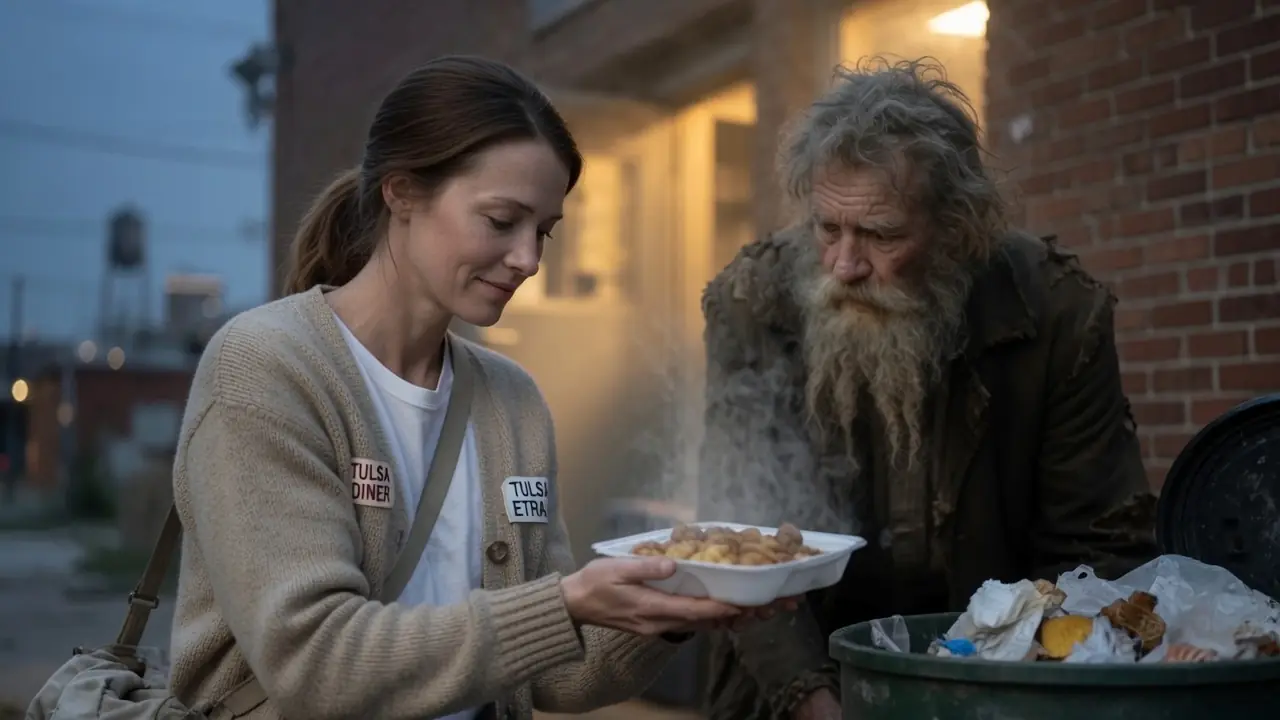
The diner stood at the edge of an aging industrial neighborhood in Tulsa, Oklahoma, where abandoned warehouses shared streets with small brick houses and auto shops. A faded red-and-white sign above the entrance read TULSA LUNCH DINER—EST. 1957, though few customers ever asked who had founded it. Inside, cracked vinyl booths lined the walls, coffee flowed from sunrise until midnight, and the smell of fried onions seemed permanently trapped in the ceiling. Maya had worked there for nearly four years without receiving a raise.
She was beautiful in a way exhaustion could not hide, with warm brown skin, expressive dark eyes, short natural curls, and a gentle face that became firm whenever someone tried to take advantage of her. Her gray-blue uniform was faded at the shoulders, and the name patch reading MAYA had begun coming loose at one corner. That night, her feet hurt from serving a bus tour that had arrived without warning, and she had eaten nothing since breakfast. She wanted only to collect her coat, catch the final bus, and reach her son before he fell asleep.
The diner’s acting manager, Victor Hale, stopped her near the kitchen door. He was forty-three, polished and impatient, with slicked-back hair, expensive shoes, and a habit of checking the time whenever an employee spoke to him. Victor told Maya to carry several trash bags outside because the dishwasher had already left. When she reminded him that her shift had ended twenty minutes earlier, he stared at her as though she had asked for ownership of the building.
“You need these hours more than I need your excuses,” Victor said.
Maya swallowed her anger and carried the bags through the rear door. Freezing wind rushed down the alley, lifting scraps of paper from the pavement and rattling the metal lid of the dumpster. She dropped the first bag inside, then heard a soft scraping sound behind it. At first, she assumed a stray animal was searching for food.
An elderly man rose slowly from the far side of the dumpster. He appeared close to eighty, with a deeply wrinkled face, tangled gray hair, a long unwashed beard, and frightened eyes that struggled to focus. His brown coat was torn along one sleeve, and his thin trousers were stained with mud. In his trembling hands, he held half of a discarded dinner roll.
Maya froze. “Sir?”
The man stepped backward as though expecting her to shout. His shoulders curled inward, and he tried to hide the bread inside his coat. Maya noticed how pale his lips looked and how badly his fingers shook. Whatever danger he might have represented disappeared beneath the obvious fact that he was starving.
She returned to the kitchen before Victor could leave. Two meatloaf dinners remained under the warming light, meals that would be thrown away because no one had ordered them. Maya placed one inside a clean container, added mashed potatoes, green beans, and two fresh rolls, then poured coffee into a paper cup. Victor appeared as she reached for a plastic fork.
“That food is inventory,” he said.
“It becomes garbage in ten minutes.”
“It still belongs to the diner.”
Maya took five dollars from her purse and placed it beside the register. “Then I’m buying it.”
Victor looked at the money but did not touch it. “You’re already behind on the staff meal account.”
“Take it from my next check.”
“If there is a next check, stop giving me reasons to reconsider it.”
Maya carried the food outside before he could change his mind. The old man had returned to the dumpster, searching among torn wrappers with the concentration of someone who had forgotten that shame should matter. She approached slowly and held out the container. Steam escaped when she lifted the lid.
“Here, sir, eat something warm.”
The man stared at the meal. “For me?”
“Yes.”
“I don’t have money.”
“I didn’t ask for any.”
He accepted the container with both hands and lowered himself onto an overturned milk crate. Maya gave him the coffee, then watched as he took his first bite too quickly and began coughing. She placed a hand between his shoulders and told him to eat slowly.
“What’s your name?” she asked.
The man’s expression became empty. “I don’t know.”
“You don’t remember?”
He touched his forehead. “There are pieces. A red door. Coffee. A woman laughing near a stove.”
“Do you know where you live?”
“No.”
Maya looked toward the street. Snow was not falling, but the wind had become sharper, and temperatures were expected to drop below freezing before midnight. She could call the police, yet the man’s fear increased when she mentioned it. He could not explain why, only repeating that uniforms and bright lights made his head hurt.
Maya called two shelters instead. The first had no beds, and the second would not admit anyone after nine. She tried an emergency warming center, but it was across town and required transportation she could not afford. The final bus would arrive in twelve minutes.
“You can’t stay here,” she said.
The old man lowered his fork. “I’ll be all right.”
“No, you won’t.”
“You have somewhere to go.”
Maya thought of her small apartment and the sofa where she slept so her son could have the bedroom. She thought of Mrs. Alvarez waiting upstairs, and of how difficult it would be to explain why she had brought home a stranger with no memory. Then she looked at the torn coat and trembling hands.
“Come with me for tonight,” she said. “Tomorrow, we’ll find someone who can help.”
The old man hesitated. “You don’t know me.”
“That makes two of us.”
His tired eyes filled with unexpected tears. Maya helped him stand, handed him the remaining roll, and guided him toward the bus stop. He walked slowly, dragging one foot slightly behind the other. Every few steps, he looked back at the diner as though something about the building troubled him.
At the apartment, Mrs. Alvarez reacted exactly as Maya expected. The sixty-five-year-old neighbor planted both hands on her hips and asked whether Maya had finally lost her mind. Eli stood behind her in dinosaur pajamas, watching the old man with open curiosity. Maya explained the shelters were full and promised the stranger would sleep on the living-room floor only until morning.
Mrs. Alvarez studied him more closely. “He needs a doctor.”
“I know.”
“And clean clothes.”
“I know.”
“And you don’t have money for either.”
“I know that too.”
The old man lowered his head. “I can leave.”
Eli stepped forward before Maya answered. “You can have my blanket.”
The child disappeared into the bedroom and returned carrying a blue blanket decorated with planets. Mrs. Alvarez sighed, defeated by the same kindness that had defeated Maya. She helped heat soup while Maya filled the bathtub and searched through an old box of clothes left by a former tenant.
After bathing and trimming most of his beard, the elderly man looked less frightening but even more vulnerable. A pale scar curved near his right temple, and another mark crossed his wrist beneath a faded hospital band. The printing had worn away except for two letters and the number seven. Maya photographed the band in case it later helped identify him.
Eli decided they should call the man Mr. Thomas until he remembered his real name. The suggestion made the old man smile for the first time. He repeated the name carefully, testing it, then admitted it did not feel familiar. Still, he allowed Eli to use it.
The next morning, Maya took him to a free clinic before work. A physician found signs of an older head injury, dehydration, and possible memory loss caused by trauma. The man knew how to read, count money, and describe mechanical tools, yet he could not recall his address or family. The clinic contacted local hospitals and missing-person databases, but no immediate match appeared.
Maya left her phone number and brought him back to the apartment. She had planned to ask Mrs. Alvarez to watch him, but he insisted on coming to the diner. He said remaining alone made the room feel smaller and his thoughts more confused. Maya reluctantly agreed.
Victor’s face hardened when he saw them enter through the rear door. “This is not a shelter.”
“He’ll sit quietly until my shift ends.”
“He’ll frighten customers.”
“He’s clean, fed, and quieter than half the men who drink here after midnight.”
Victor told her the old man had to leave. Before Maya could argue, the kitchen’s aging dishwasher began leaking water across the floor. The machine had failed twice that month, but Victor refused to pay for a proper repair.
The old man knelt beside it. He removed the lower panel, examined the pump, and asked for a screwdriver and a strip of rubber. Within fifteen minutes, he had tightened the housing and replaced a cracked seal with a temporary patch. The leaking stopped.
The cook stared at him. “You’ve done that before.”
The old man touched the machine as though it carried a memory. “Maybe.”
Victor appeared less impressed. “Temporary repairs create liability.”
“So does water beside an electrical outlet,” Maya replied.
Victor allowed the man to remain only because hiring a repair technician would cost more than he wanted to spend. Over the next two days, “Mr. Thomas” helped without being asked. He tightened loose stool legs, repaired a broken cabinet hinge, and showed the cook how to adjust an old burner that kept extinguishing.
He refused payment because Maya was feeding and sheltering him. She repeatedly told him he did not owe her labor, but he said working made the missing parts of his mind feel closer. Certain sounds affected him strangely: the lunch bell, the coffee grinder, and an old country song that played on the kitchen radio. Each time, he stopped moving and stared into the distance.
On the third afternoon, Maya carried trash into the alley and noticed a piece of paper tied to the chain-link fence. Rain and wind had torn one corner, but a large black word remained visible at the top.
MISSING.
Below it was a photograph of a clean-shaven elderly man wearing a dark suit. His hair was neatly combed, and he looked healthier, but the eyes were unmistakable. Maya pulled the flyer free and read the name.
HENRY THOMPSON, AGE 79. LAST SEEN IN TULSA. FAMILY SEEKING INFORMATION.
A telephone number appeared beneath the photograph, along with a substantial reward. Maya felt relief first. The man had a name, and someone was looking for him. Then she read the smaller line at the bottom.
Founder and legal owner of Thompson Family Restaurants, including the original Tulsa Lunch Diner.
The back door opened behind her. Henry pushed a stack of flattened cardboard toward the recycling bin, then stopped when he saw the flyer in her hands. His face became pale.
Maya turned it toward him. “This says you’re Henry Thompson—the missing owner of this diner.”
Henry stared at the photograph. “Henry.”
“You founded this place.”
His eyes moved toward the brick wall, the faded sign, and the kitchen windows. “I built it with my wife.”
Maya stepped closer. “Then why were you starving behind the restaurant that still carries your name?”
Henry pressed one hand against his temple. His breathing quickened as memories began returning in broken pieces. A mahogany desk, papers pushed across it, Victor standing beside a much younger attorney, and a glass of water that tasted bitter.
“Because the man running it stole everything,” Henry whispered. “And he never expected me to come back.”
Maya immediately called the number on the flyer. A man answered after the first ring and identified himself as Daniel Thompson, Henry’s son. His voice broke when Maya explained where Henry was. He said he would arrive within an hour.
Victor emerged from the diner before Maya finished the call. He saw the flyer, then looked at Henry. For the first time since Maya had known him, all confidence disappeared from his face.
“Where did you get that?” Victor demanded.
“It was tied to the fence.”
“That man is confused.”
“He remembered owning the diner.”
Victor stepped forward. “His memory has been failing for years.”
Henry looked directly at him. “You brought me papers.”
Victor’s jaw tightened. “You signed management authority because you were incapable of running the company.”
“You said Daniel wanted to sell.”
“He did.”
“No,” Henry whispered. “You said he did.”
Maya positioned herself between them. “Step back.”
Victor laughed coldly. “You are an employee. Do not involve yourself in family business.”
“You let the owner of this diner dig through its trash.”
“I had no idea who he was.”
Henry’s gaze sharpened. “You knew exactly who I was.”
The kitchen staff began gathering near the doorway. Victor ordered everyone back to work, but no one moved. For years, they had endured reduced hours, missing overtime, and constant claims that the Thompson family had demanded cost-cutting. Now the missing founder stood before them accusing Victor of deception.
A dark sedan pulled into the alley. A tall man in his late forties stepped out, followed by a woman carrying a medical bag. The moment Henry saw him, recognition crossed his face.
“Daniel.”
The man ran forward and embraced his father. Henry initially stiffened, then clutched his son’s coat and began crying. Daniel held him as though afraid he might disappear again.
“We thought you were dead,” Daniel said.
Victor moved toward them. “Daniel, this situation is not what it appears to be.”
Daniel turned slowly. “You told us he left the country after refusing treatment.”
“That was the information I received.”
“From whom?”
Victor did not answer.
The woman accompanying Daniel examined Henry and recommended immediate hospital care. Before leaving, Henry took Maya’s hand. He asked her not to trust Victor and told Daniel that she had found him behind the diner.
Daniel looked at Maya with stunned gratitude. “You saved my father.”
“I gave him dinner.”
“You gave him somewhere safe when we couldn’t find him.”
Maya shook her head. “Find out what happened before you thank me.”
The investigation began that evening. Hospital scans showed Henry had suffered a head injury several months earlier, followed by long-term exposure and poor nutrition. His memory returned gradually, strengthened by familiar photographs and conversations with Daniel.
Henry remembered that Victor had served as operations director for Thompson Family Restaurants. After Henry’s wife died, Victor began isolating him from senior employees and claiming Daniel wanted the company sold. He pressured Henry to sign temporary management documents while recovering from surgery.
When Henry refused to transfer ownership, Victor arranged a meeting at an empty warehouse supposedly involving potential investors. Henry remembered drinking water, becoming disoriented, and waking inside a car far outside Tulsa. He escaped at a gas station but fell near a drainage ditch, striking his head.
Victor later claimed Henry had disappeared voluntarily. He used the temporary management authority to close several accounts, redirect profits, and remove Daniel from company records. Because Henry was missing rather than legally dead, Victor could manage the restaurants but could not sell them outright.
The flyer on the diner fence had not been placed there by Victor. Daniel had spent months distributing notices throughout Tulsa, but employees were ordered to remove them whenever they appeared near company property. The damaged flyer Maya found had been tied high enough that no one noticed it until wind loosened the string.
Police searched Victor’s office and discovered altered documents, hidden financial records, and messages proving he knew Henry was alive after the disappearance. A private investigator hired by Victor had located Henry at a shelter weeks earlier. Instead of notifying the family, Victor paid the investigator to remain silent.
Victor was arrested on charges involving fraud, financial exploitation, forgery, and conspiracy. Further investigation connected one of his associates to the night Henry had been abandoned outside the city. The restaurants remained temporarily closed while auditors examined the accounts.
The employees feared they would lose their jobs. Maya feared it most because she had spent almost all her savings supporting Henry while missing several shifts during the investigation. Daniel assured everyone that unpaid wages and stolen overtime would be reviewed.
One week later, Henry asked Maya to visit him at the hospital. His beard had been trimmed, and clean clothes made him resemble the man on the flyer, though weakness remained in his face. A legal adviser and Daniel sat near the window.
Henry pointed to a chair. “Sit down.”
Maya remained standing. “Is something wrong?”
“Yes. My diner employed a woman for four years and failed to pay her fairly.”
“That wasn’t your decision.”
“It happened under my name.”
“You were missing.”
“I was absent before I disappeared. I stopped asking what was happening inside the place I built.”
Daniel placed a folder on the table. It contained payment for every missing overtime hour, reimbursement for the money Maya had spent helping Henry, and compensation for the shifts she had lost. The amount was enough to clear her overdue rent and several debts.
Maya accepted the wages but pushed back the reimbursement. “Feeding him was my choice.”
Henry smiled faintly. “Then consider it repayment for repairing my dishwasher.”
“You repaired it.”
“Then I deserve the money even less.”
For the first time, Maya laughed.
Henry explained that the original diner would reopen under direct family management. He wanted to restore the values he and his wife had built into it: fair wages, affordable meals, and dignity for anyone entering hungry. Daniel would handle the company, but the Tulsa location needed a general manager.
Maya stared at him. “I’m a waitress.”
“You understand the building, the customers, and the employees.”
“I don’t know accounting.”
“You can learn.”
“I’ve never managed anyone.”
“You already protected every person in that kitchen from a man who controlled your paycheck.”
Maya looked toward Daniel. “Is this because I helped your father?”
Daniel answered honestly. “That is why we noticed you. Your work record is why we are making the offer.”
The position included training, health insurance, regular hours, and a salary nearly three times what Maya had previously earned. She would not own the diner or receive a miraculous fortune. She would have a real job with clear responsibilities and a probationary period.
Maya accepted.
The diner reopened six weeks later. Its sign was repaired, the kitchen equipment replaced, and every employee received proper contracts. Maya kept the old uniforms but ordered new name patches that did not peel at the corners.
Henry returned on opening morning using a cane. Customers applauded when he entered, but he walked directly to the booth where Maya and Eli were eating breakfast. Eli had finally met the man whose photograph had appeared on the missing flyer.
“You look different without the giant beard,” Eli said.
“So do you without dinosaur pajamas,” Henry replied.
Eli considered this fair.
Henry returned to work only in small ways. He greeted customers, told stories about the diner’s early years, and occasionally disappeared into the kitchen to inspect equipment no one had asked him to repair. Maya caught him tightening a cabinet hinge during his first week back.
“You hired someone for that,” she reminded him.
“Old habits.”
“Sit down before your son blames me.”
Henry obeyed.
Under Maya’s management, the diner became profitable again without cutting wages. She introduced a meal program allowing customers to purchase suspended breakfasts for people who could not pay. No one had to prove they were homeless or explain why they were hungry.
A small sign near the register read:
ASK FOR THE HOUSE SPECIAL. NO QUESTIONS.
The first person to order it was an elderly woman living in her car. Maya served her personally and sat nearby long enough to make sure she ate slowly. Henry watched from the counter.
“You notice hunger before anyone else,” he said.
Maya shook her head. “I know what people look like when they’re trying to hide it.”
A year later, Maya moved with Eli into a safe two-bedroom apartment near his school. She bought furniture gradually and refused Henry’s offer to pay the deposit. Her salary allowed her to build savings, take Sundays off, and attend every one of Eli’s school events.
Henry became the grandfather Eli had never known. He taught the boy how to repair small appliances and how to make pancakes without burning the edges. In return, Eli helped him use a smartphone and repeatedly reminded him not to trust links promising free vacations.
Three years after Maya found him behind the dumpster, Henry placed the damaged missing-person flyer inside a frame. He hung it beside the diner’s entrance, not as proof of his importance, but as a reminder of how close people had come to ignoring him completely.
Beneath it was a second photograph. It showed Maya standing in her faded uniform, holding out a container of hot food to a frightened old man. Daniel had recreated the moment only symbolically, because no photograph existed from the night itself.
The plaque below both frames read:
A name can be forgotten. A title can be stolen. Kindness still recognizes a human being.
Maya never claimed she had rescued a wealthy founder. That was not the man she had seen beside the dumpster. She had seen someone hungry, confused, and alone.
Henry never said he had made Maya successful. He had only returned an opportunity that Victor’s greed had denied her. Maya’s courage, discipline, and compassion did the rest.
One winter evening, Maya locked the diner after closing and found Henry waiting near the rear door. He wore a proper coat now, with gloves and a scarf Eli had chosen for his birthday. Snow drifted lightly across the alley.
Henry looked toward the dumpster. “Do you ever think about that night?”
“Every time you try to repair something without permission.”
“I was serious.”
Maya softened. “Yes. I think about it.”
“You could have walked away.”
“So could everyone else.”
“But you didn’t.”
Maya locked the final door and offered him her arm as they crossed the icy pavement. “You were hungry, Henry. It wasn’t complicated.”
For him, however, that simple act had changed everything.
A struggling single mother had offered a homeless old man a warm meal without knowing his name. She brought him into her home when his own family could not find him and protected him when the man who stole his life tried to silence him.
Days later, a missing-person flyer revealed that he was the founder of the diner where she worked.
But the greatest discovery was not that the helpless stranger had once been wealthy.
It was that when Henry Thompson had lost his memory, his home, his appearance, and every sign of status, Maya Carter had still treated him as though his life mattered.