The breakfast rush at Carter’s Roadside Diner began every morning before sunrise, when truck drivers pulled off Highway 17 looking for hot coffee and construction crews filled the booths nearest the windows. By seven o’clock, the air smelled of bacon grease, burned toast, and the strong coffee that customers joked could remove paint from a truck. Maya Carter moved between the tables wearing a fitted pale-pink waitress dress with white piping, a white waist apron, and an oval badge displaying her name. At twenty-nine, she had learned how to carry four plates with one hand, remember twelve drink orders, and hide exhaustion behind a welcoming smile.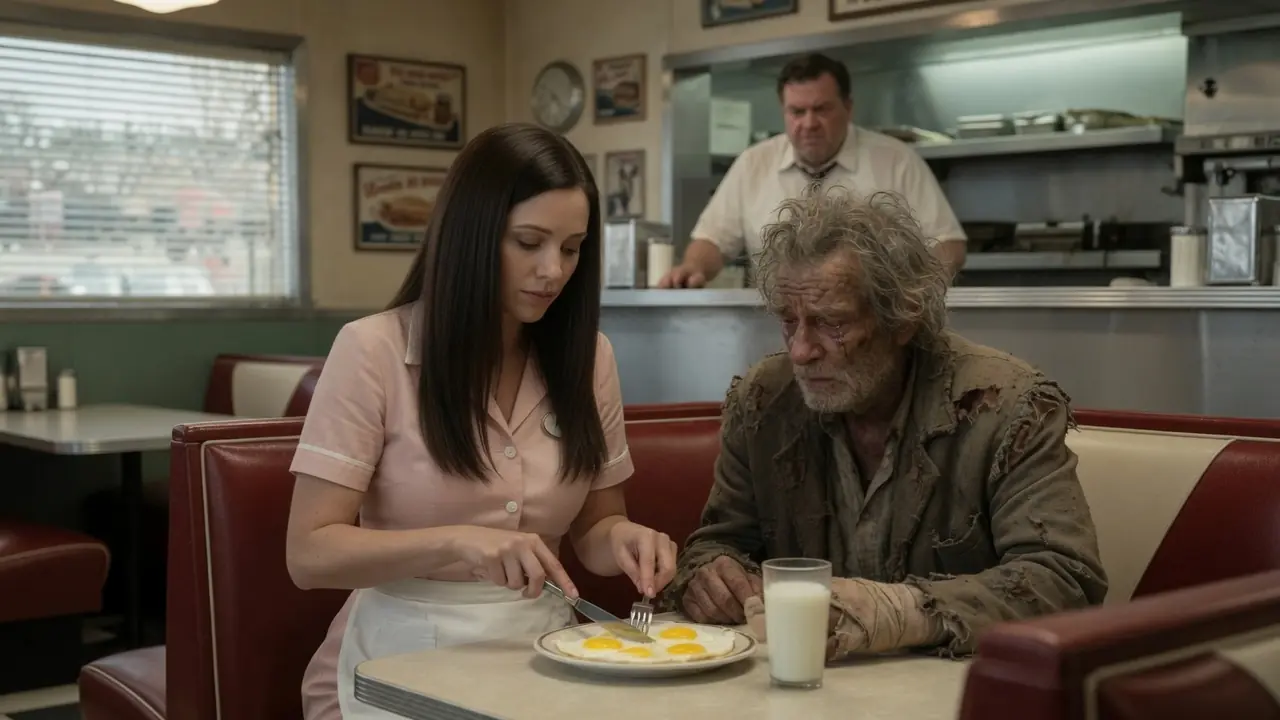
Maya was raising her seven-year-old daughter, Sophie, alone in a rented apartment above a laundromat. Sophie’s father had disappeared before her second birthday, leaving behind an unpaid phone bill and several promises that eventually stopped arriving. Maya worked six days a week at the diner, cleaned an insurance office twice a week after closing, and still sometimes counted coins at the grocery store. She never told Sophie how close they were to losing their apartment, because children should not have to measure love in overdue notices.
The diner’s owner, Leonard Briggs, cared more about appearances than people. Leonard was sixty-two, balding, and permanently irritated by anything that did not increase sales. He charged employees for broken dishes, limited free coffee refills when he believed customers had stayed too long, and kept a handwritten list of people he considered bad for business. Homeless customers were at the top of that list.
Maya had already received two warnings for giving away food. The first came after she slipped a sandwich to a pregnant teenager sleeping behind the bus station. The second came when she served soup to an elderly veteran whose wallet had been stolen. Leonard told her that kindness was not part of the menu and promised that a third incident would cost her job.
On a cold Tuesday morning in November, an elderly man entered the diner shortly after the main rush ended. He was tall but stooped, with tangled gray hair, a deeply weathered face, and a torn brown coat that looked too thin for the weather. One hand was wrapped in a dirty bandage from the wrist to the fingertips, while his other hand trembled against the doorframe. Several customers stopped eating long enough to watch him cross the room.
The man chose the smallest booth near the kitchen, the one beside the humming drink refrigerator. He sat carefully and placed three coins on the table. The money was not enough for anything on the breakfast menu except a cup of coffee, and even that would leave him without a penny. Maya approached with a menu, though she already knew he could not afford what was printed on it.
“Good morning,” she said. “Would you like coffee?”
“Water is fine.”
His voice was quiet and educated, which did not match the assumptions several customers had already made about him. Maya noticed the bandage was badly tied and stained near the palm. The man kept his injured hand pressed against his chest as though even resting it on the table caused pain.
“Have you seen a doctor?”
“No.”
“Did you break it?”
“I believe so.”
“You believe so?”
He gave a tired smile. “I have been avoiding places where people ask questions.”
Maya glanced toward Leonard, who was counting receipts behind the pie display. “Are you hungry?”
The elderly man looked down at the three coins. “I can afford coffee.”
“That wasn’t my question.”
He hesitated before answering. “Yes.”
Maya took the menu from his hands. “Eggs, toast, and milk.”
“I cannot pay for that.”
“You can pay for the coffee.”
Before he could object, Maya walked toward the kitchen and entered the order under her employee meal. She had not eaten breakfast and knew it would be nearly ten hours before her shift ended, but she could survive on crackers from Sophie’s lunch supplies. The elderly man looked as though one missed meal might become dangerous.
Leonard noticed the plate when it reached the service window. “Who ordered this?”
“I did.”
“You already ate your employee meal yesterday.”
“This is today.”
“You’re working a double shift. You’ll need it.”
“I changed my mind.”
Leonard followed her gaze toward the elderly man. His expression immediately hardened. “Absolutely not.”
“The food is already cooked.”
“Throw it away.”
Maya stared at him. “You would rather waste it than let him eat?”
“I would rather not turn my diner into a shelter.”
“He has a broken hand.”
“He also has no money.”
“He has three coins.”
“Then give him coffee and send him away.”
The cook, Ernesto, looked down at the grill and pretended not to hear. Leonard stepped closer to Maya, keeping his voice low enough that customers could not clearly hear him. “You already have two warnings. Carry that plate to him, and you can start looking for another job.”
Maya thought about the rent notice tucked inside her purse. She thought about Sophie’s field trip fee, the electricity bill, and the winter coat her daughter needed before temperatures dropped further. Losing the diner job could put them on the street within weeks. Then she looked at the elderly man trying to unwrap a paper napkin with one working hand.
Maya picked up the plate.
Leonard caught her wrist. “Do not test me.”
She pulled free. “Then fire me after he finishes eating.”
The diner became quieter as Maya crossed the floor. Leonard remained behind the counter, his face reddening with anger. Maya placed the eggs and toast before the man, followed by a glass of milk.
The old man looked at the food without touching it. “I heard what he said.”
“Then you know breakfast should not be wasted.”
“I do not want you to lose your job.”
“I don’t want you to pass out on the highway.”
He attempted to lift the fork with his left hand, but his fingers shook badly. When he tried to cut the eggs, the plate slid across the table. Two men at the counter laughed quietly, and Leonard shook his head as though the struggle proved his point.
Maya sat beside the elderly man.
She picked up the knife and fork and cut the eggs into small pieces. Then she divided the toast, opened the butter packet, and moved the plate close enough for him to eat with his uninjured hand. She did not speak to him like a child or offer exaggerated sympathy. She simply gave him the assistance he needed while allowing him to keep the dignity everyone else seemed determined to remove.
The man lifted the first bite slowly. Tears gathered in his eyes before he swallowed.
“Thank you,” he whispered. “I thought I couldn’t eat with a broken hand.”
Maya continued cutting the toast. “Then borrow mine. No one should go hungry because they’re hurt.”
“Your employer may dismiss you.”
“Probably.”
“And you are not afraid?”
“I’m terrified.”
Her honesty surprised him. “Then why help me?”
Maya placed the milk beside his plate. “Because my daughter watches everything I do. I cannot teach her to be kind only when kindness is cheap.”
The elderly man studied her face for several seconds. “What is your daughter’s name?”
“Sophie.”
“How old?”
“Seven.”
“Does she know how fortunate she is?”
Maya smiled faintly. “She knows we have cereal for dinner sometimes, so she may disagree.”
The man ate every piece of food. He drank the milk slowly, as though he feared someone might take it away. Maya brought him a cup of coffee and placed his three coins back into his coat pocket when he was not looking.
Leonard waited until the man left before confronting her near the kitchen. “Take off the apron.”
Maya swallowed. “Leonard—”
“You made your choice.”
“He was injured.”
“And now every drifter who hears about this will expect free food.”
Maya untied the apron. “Then perhaps you should stop hanging a sign that says ‘Everyone Welcome.’”
Leonard’s face hardened. “You’re finished.”
Ernesto stepped away from the grill. “She is the best server you have.”
“I did not ask you.”
Three regular customers protested, but Leonard refused to reconsider. Maya collected her purse, folded the apron across the counter, and walked out before tears could give him the satisfaction of seeing her break.
The elderly man was waiting beneath the diner’s awning.
“You were dismissed,” he said.
“Yes.”
“Because of me.”
“Because Leonard wanted an excuse.”
The rain had begun lightly, tapping against the metal roof. Maya asked whether he had somewhere safe to sleep. He pointed toward the old bus shelter half a mile away.
“That is not safe.”
“It is dry enough.”
“No, it isn’t.”
Maya took out her phone and called a community clinic that offered emergency care regardless of payment. Then she contacted a church shelter whose director sometimes reserved beds for elderly people. She wrote both addresses on the back of a diner receipt and pressed it into the man’s good hand.
“The clinic closes at five,” she said. “Go there first. They will arrange transportation to the shelter.”
The man looked at the receipt. “What if I told you I had nowhere to repay this kindness?”
“I would tell you that repayment is not required.”
“My name is Arthur.”
“Maya.”
“I know. It is written on your badge.”
She looked down, realizing she had forgotten to remove it. Arthur smiled, and for the first time he seemed less exhausted.
“I hope Sophie understands what kind of mother she has,” he said.
Maya watched him walk toward the bus stop until the rain swallowed his shape. Then she called the insurance office and asked whether they had any additional cleaning shifts. By afternoon, she had secured twelve extra hours a week, though the money would not replace what she lost at the diner.
For the next two days, Maya applied everywhere she could. She filled out forms at grocery stores, hotels, restaurants, and a hospital cafeteria. Most managers promised to call, but their polite expressions told her they had already noticed the limited hours caused by Sophie’s school schedule. Maya began calculating which bills could be delayed without immediate consequences.
On Friday morning, she returned to Carter’s Diner to collect her final paycheck. Leonard made her wait near the entrance while he served customers, clearly enjoying the chance to remind her she no longer belonged behind the counter. Maya stood in her winter coat, holding Sophie’s hand because school had been canceled for a teacher training day.
Sophie looked around the diner. “Is this where you helped the old man?”
Maya nodded.
“Did he get better?”
“I hope so.”
“Did Mr. Briggs fire you because you fed him?”
Leonard heard the question but continued filling coffee cups.
“Yes,” Maya said.
Sophie considered this with the seriousness she gave important matters. “Then he is not a very good boss.”
Several customers laughed. Leonard slammed the coffee pot onto the warmer.
Before he could respond, two black sedans stopped outside the diner. Three men and one woman stepped onto the sidewalk wearing dark overcoats and carrying leather document cases. They entered together, bringing the conversation inside the diner to an immediate stop.
The woman approached the counter. “We are looking for Maya Carter.”
Leonard pointed toward Maya. “She no longer works here.”
The woman turned. “Ms. Carter?”
“Yes.”
“My name is Evelyn Hart. I represent Whitmore Holdings and the Whitmore Family Trust.”
Maya did not recognize either name. “I think you have the wrong person.”
Evelyn opened a folder and placed a photograph on the nearest table.
It showed Arthur wearing a tailored black suit beside the entrance of a glass office tower. His gray hair was neatly combed, his posture straight, and his expression unmistakably powerful. The torn coat, dirty bandage, and exhaustion were gone.
Maya stared at the photograph. “That’s the man from Tuesday.”
“Arthur Whitmore,” Evelyn said. “Founder and controlling owner of Whitmore Holdings.”
Leonard stepped closer. “The billionaire?”
One of the men beside Evelyn looked at him coldly. “Mr. Whitmore prefers not to be described by his bank balance.”
Arthur Whitmore controlled manufacturing companies, commercial properties, freight businesses, and agricultural investments across six states. Financial magazines estimated his personal fortune at more than two billion dollars, though his private companies made the true number difficult to determine. He had vanished from public view eleven months earlier after surviving a serious illness and becoming suspicious of the relatives surrounding him.
Maya looked toward Evelyn. “Why was he dressed like that?”
“He was conducting a personal test.”
“A test of whom?”
“Everyone.”
Arthur had recently discovered that his nephew, Charles Whitmore, and two senior executives were attempting to have him declared mentally incompetent. They claimed his age and health made him incapable of managing the trust. Arthur suspected they cared less about his condition than the voting control they would gain if he were removed.
Rather than confronting them immediately, he disappeared for several weeks. He traveled without assistants, bank cards, or identification, wanting to see how institutions and ordinary people treated someone who appeared powerless. During that period, he injured his hand after falling near a freight yard and refused hospital treatment because his family’s investigators were searching medical facilities.
“He came into this diner deliberately?” Maya asked.
“No,” Evelyn replied. “He was hungry, injured, and genuinely without access to his money. Meeting you was not planned.”
Sophie tugged Maya’s sleeve. “Is the old man okay?”
Evelyn crouched slightly. “His hand is broken, but doctors are treating it. He asked me to tell you that the eggs helped.”
Maya felt relief before confusion returned. “Why are lawyers looking for me?”
Evelyn placed a thick envelope on the table. “Because Mr. Whitmore signed a new will and trust amendment yesterday.”
Leonard moved closer, openly listening.
“Could we discuss this privately?” Maya asked.
Evelyn glanced around the diner. “Mr. Whitmore instructed us to deliver the documents here.”
“Why?”
“He wanted every person who watched you help him to witness what followed.”
The customers fell silent.
Evelyn explained that Arthur had not simply rewarded Maya with money. His decision was far more complicated and potentially dangerous. He had named Maya an independent human-interest trustee over a new charitable fund containing two hundred million dollars.
The fund would provide emergency housing, medical care, food assistance, and legal support to elderly people abandoned by their families or ignored because they appeared poor. Maya would hold one of three deciding votes governing how the money was used. The other two trustees were Evelyn and a retired federal judge.
Maya stared at her. “I am a waitress.”
“You were a waitress,” Leonard muttered.
Evelyn ignored him. “Mr. Whitmore selected you because you made a costly decision without knowing anyone was watching.”
“I cannot manage two hundred million dollars.”
“You would not manage investments or daily operations. Professionals will do that. Your responsibility would be ensuring that the people receiving help are treated like human beings rather than statistics.”
Maya shook her head. “He met me once.”
“He spent two days investigating you.”
Her employment history, debts, housing situation, and prior acts of kindness had all been reviewed. Investigators discovered that Maya regularly paid for customers’ meals, volunteered at a women’s shelter, and once returned a wallet containing several thousand dollars. They also confirmed that she had never asked Arthur for his name, money, or future favor.
Evelyn opened another document. “Mr. Whitmore has also placed five million dollars in a protected personal trust for you and Sophie.”
The diner erupted in whispers.
Maya gripped the back of a chair. “Five million?”
“It cannot be sold, borrowed against, or transferred to anyone else for ten years. It will provide housing, education, healthcare, and a monthly income. Mr. Whitmore designed the restrictions because he expects certain people to pressure you.”
“Which people?”
Evelyn’s expression became serious. “His family.”
Charles Whitmore had already learned about the new will. He claimed Maya manipulated an injured elderly man and intended to challenge the documents in court. Arthur’s niece, Victoria, had hired private investigators to search Maya’s history. Two executives threatened to resign unless Arthur removed the “unknown waitress” from the charitable trust.
“This sounds like a nightmare,” Maya said.
“It may become one.”
“Then why would he put me inside it?”
“Because he believes you will say no if the money requires sacrificing your values.”
Maya looked at Sophie, who was staring at Arthur’s photograph. Her daughter understood only that the hungry man had been important and that the adults were discussing impossible numbers.
“I need to speak with him,” Maya said.
Evelyn handed her a phone.
Arthur answered after one ring.
“Maya.”
His voice was stronger but unmistakably the same.
“You should have told me who you were.”
“Would you have cut my food?”
“Yes.”
“Would Leonard have allowed it?”
“No.”
“Then my name would only have made the truth harder to see.”
“You changed your will after one breakfast.”
“I changed it after seventy-eight years of watching people explain why compassion was impractical.”
Maya moved toward the window, lowering her voice. “Your family is going to say I used you.”
“They already have.”
“I do not know anything about trusts.”
“You know hunger when it is sitting in front of you.”
“That does not make me qualified.”
“No,” Arthur replied. “Losing your job to preserve another person’s dignity does.”
Maya looked toward Leonard. He had stopped pretending not to listen.
“Why five million dollars?”
“Because you and Sophie should never again face homelessness because you chose kindness.”
“I didn’t help you for money.”
“That is exactly why I can trust you with it.”
Arthur explained that she could refuse everything. No money would be transferred and no public announcement made without her consent. If she declined the trustee role, the charitable fund would still exist, but he believed it would become another institution run by people who spoke about poverty without ever listening to poor people.
Maya closed her eyes. “I need time.”
“Take it.”
“Will you still be there if I say no?”
A pause followed.
“Yes,” Arthur said. “I would like to meet Sophie.”
Maya smiled despite herself. “She would like to know whether you finished the milk.”
“I did.”
She ended the call and returned the phone to Evelyn.
Leonard finally spoke. “Maya, perhaps we should discuss your position here.”
She looked at him. “My position ended when I carried that plate.”
“I may have reacted too quickly.”
“You threatened me because I fed an injured man.”
“I was protecting the business.”
Evelyn closed the folder. “Mr. Whitmore’s companies own this building.”
Leonard’s face changed.
The diner operated under a long-term lease from a commercial property company acquired by Whitmore Holdings six years earlier. Arthur had not known he owned the property when he entered, but his lawyers discovered the connection during their investigation.
Evelyn placed a second envelope on the counter. “Your lease contains a morality and public-safety clause. Mr. Whitmore has requested a full review of your treatment of vulnerable customers and employees.”
Leonard stared at the envelope. “You cannot close my diner over one plate of eggs.”
“No,” Evelyn said. “But wage violations, improper payroll deductions, health-code complaints, and retaliation against employees may prove more relevant.”
Ernesto looked up sharply from the kitchen. Several waitresses exchanged glances.
Leonard turned toward Maya. “Tell them this is unnecessary.”
“You wanted me to go quietly,” Maya replied. “Now answer your employees honestly.”
Within hours, the review uncovered years of illegal deductions, unpaid overtime, and falsified time records. Leonard had charged workers for customer walkouts, broken dishes, and register shortages without proper evidence. He had also threatened undocumented kitchen employees with deportation whenever they questioned missing wages.
Whitmore Holdings terminated the lease after an independent investigation. The diner did not close permanently, however. Arthur offered the employees an unusual option: form a cooperative, hire professional management, and reopen under a new name with shared ownership.
Maya insisted the sign remain partly familiar.
Three months later, Carter’s Community Diner opened in the same building. Leonard’s name disappeared from the ownership documents, while Maya, Ernesto, and seven longtime employees became stakeholders. A small sign near the entrance read:
No one is turned away hungry.
Maya accepted Arthur’s offer after meeting with independent attorneys who represented only her interests. She agreed to serve as trustee but demanded strict transparency, local advisory boards, and direct input from people who had experienced homelessness. Arthur approved every condition.
The Whitmore Dignity Fund opened its first emergency center six months later. It provided temporary rooms, medical evaluations, legal assistance, hot meals, and secure storage for documents and belongings. Guests were addressed by name rather than room number.
Charles Whitmore challenged the will, claiming Arthur lacked mental capacity when he signed it. In court, however, doctors testified that Arthur remained fully competent. Financial records showed that Charles and Victoria had secretly tried to transfer voting control while their uncle recovered from surgery.
The case collapsed when Arthur entered the courtroom wearing the same torn brown coat he had worn inside the diner. Beneath it, he wore a tailored suit.
“My relatives recognized my value only after seeing the suit,” he told the judge. “Maya Carter recognized it while cutting my eggs.”
The judge upheld every amendment.
Arthur’s family lost access to several discretionary trusts after evidence revealed their attempted manipulation. They retained personal inheritances already secured years earlier, but control of Whitmore Holdings transferred to a professional board rather than greedy relatives.
Maya did not become reckless with the five-million-dollar trust. She bought a modest house with a bedroom for Sophie, paid her debts, and established an education account. She continued working several shifts each week at the diner because she liked knowing customers’ names and because wealth had not changed what meaningful work felt like.
Sophie eventually met Arthur at Carter’s Community Diner. She sat across from him in the same booth where Maya had cut his breakfast and examined his healed hand.
“Can you eat by yourself now?” she asked.
“Yes.”
“That’s good. Mom is busy.”
Arthur laughed so hard that tears filled his eyes.
Maya brought them two plates of eggs and a glass of milk. Arthur lifted his fork, then paused.
“I have wondered something,” he said. “If Evelyn had never walked through that door, would you regret helping me?”
Maya looked toward the kitchen, where Ernesto teased a new cook while customers filled the booths. Outside, a retired man who had once slept beneath a bridge was helping another guest carry groceries to the bus stop.
“I regretted losing my job,” she said. “I regretted being afraid about rent. But I never regretted the food.”
Arthur nodded. “That answer is why the fund will survive after I’m gone.”
He lived four more years.
During that time, the Whitmore Dignity Fund opened twelve centers across three states. Maya visited each one, speaking privately with guests before reading management reports. Whenever executives focused too heavily on efficiency, she reminded them that the program began because one injured man could not cut his own breakfast.
Arthur’s final will divided most of his remaining fortune among the charitable fund, environmental land trusts, employee retirement programs, and medical research. Maya received no additional fortune beyond the protected trust already established. She had asked him not to leave her more.
At Arthur’s memorial, Sophie wore the silver bracelet he had given her on her tenth birthday. Maya carried the faded diner receipt on which she had once written the addresses of a clinic and shelter. Arthur had preserved it inside his desk for years.
On the back, beneath Maya’s handwriting, he had later added one sentence:
She gave directions to safety before knowing I could buy the road.
Maya framed the receipt and hung it beside the diner entrance.
Years later, customers still asked whether the story was true. They wanted to know whether a homeless man had truly been a billionaire and whether lawyers had really entered the diner carrying documents worth millions.
Maya always gave the same answer.
“The fortune was real,” she said. “But it was never the important part.”
The important part happened before the attorneys, before the will, and before anyone knew Arthur Whitmore’s name. It happened when an elderly man with a broken hand sat hungry in a booth while an entire room decided he was not worth helping.
Maya chose differently.
She sat beside him, cut his food, poured his milk, and allowed him to eat without shame.
Three days later, lawyers entered the diner and changed her life.
But one simple breakfast had already changed his.