Rain slid down the front windows of Miller’s Bakery in long silver lines, blurring the shops across the street and turning the late-afternoon traffic into soft shapes of color. Inside, the bakery smelled of butter, cinnamon, fresh bread, and the chocolate cake Hannah Miller had removed from the oven less than an hour earlier. The display case still held several fruit tarts, three lemon cakes, a dark chocolate layer cake, and a small red velvet cake decorated with fresh berries. Hannah stood behind the counter in her pale-blue uniform and white apron, watching the rain while wondering whether anyone else would come in before closing.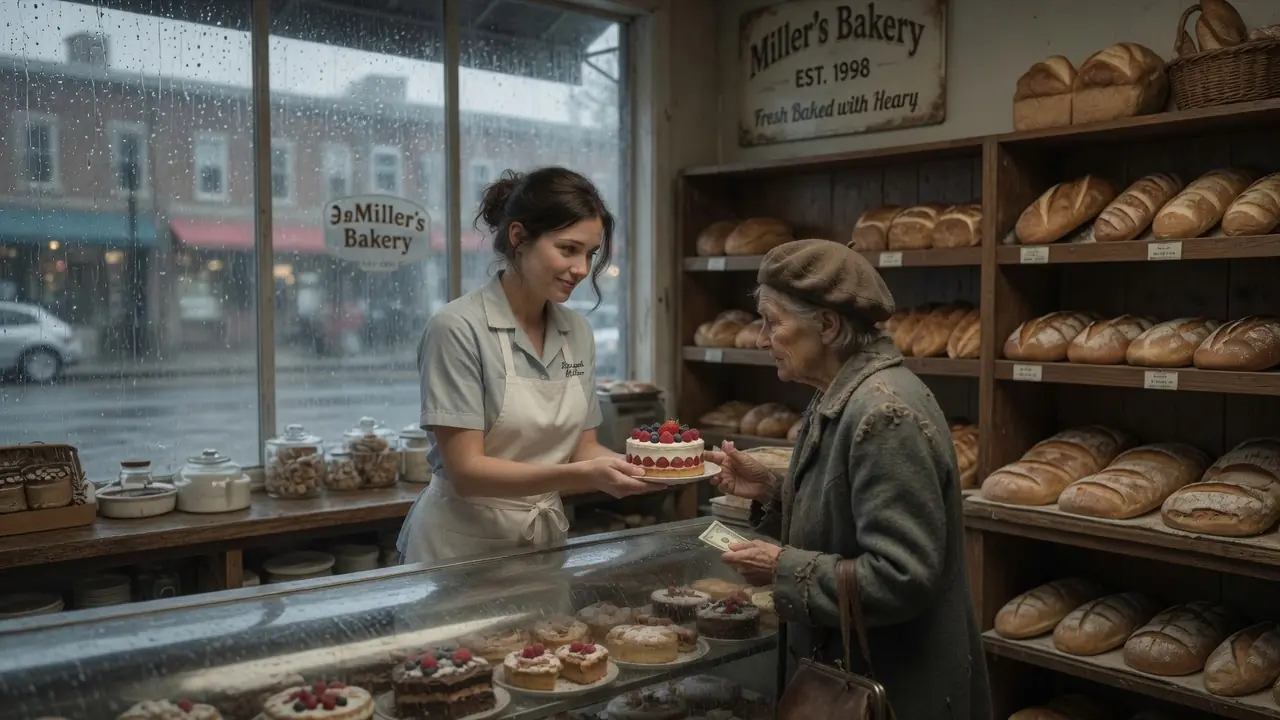
At twenty-seven, Hannah had already worked in the bakery for nearly twelve years. Her father, Samuel Miller, had taught her how to knead dough before she was tall enough to reach the worktable without standing on a wooden crate. After he died suddenly from a heart attack, Hannah inherited the business along with its aging ovens, unpaid supplier invoices, and a lease that increased every year. She kept the bakery open partly because it was her livelihood and partly because closing it would feel like losing her father a second time.
The afternoon had been unusually quiet. Bad weather kept customers home, and Hannah had already calculated that the day’s sales would barely cover the ingredients used to make everything still sitting behind the glass. Her assistant had gone home early to care for a sick child, leaving Hannah alone to clean the counters, prepare tomorrow’s dough, and worry about the red envelope hidden beneath the register. It contained a final notice from the landlord demanding three months of overdue rent.
The bell above the door rang at four thirty-seven.
An elderly woman stepped inside, closing a broken umbrella before the wind could pull it back through the doorway. She was small and thin, with silver hair hidden beneath a worn brown beret and a gray coat darkened by rain. A leather handbag hung from one shoulder, its surface cracked with age, and her shoes left small wet prints across the tile. She paused near the door as though entering the bakery required more courage than walking through the storm.
“Take your time,” Hannah said. “The floor is slippery.”
The woman nodded and approached the display slowly. She looked at every cake without the eager expression most customers carried, studying the price cards instead of the frosting. Her gaze lingered on the small berry cake near the front, then moved toward the single slices displayed on white plates. Hannah noticed her open the leather handbag and count three folded bills and several coins twice.
“I don’t have enough money,” the woman said quietly. “Do you have any tiny cake?”
Hannah glanced toward the price list. “How tiny?”
“Tiny enough for one person.” The woman smiled weakly. “Or perhaps half a person.”
Hannah smiled back, but the sadness behind the joke was impossible to miss. “Is it for a birthday?”
“My husband’s.”
“That sounds important.”
“He would have been seventy-eight today.”
The woman’s voice changed slightly on the word would. Hannah looked at the wedding ring still resting on her thin finger and understood that the cake was not meant for someone waiting at home. The elderly woman had come to mark a birthday belonging to someone who could no longer celebrate it with her.
“What was his name?” Hannah asked.
“Thomas.”
“What kind of cake did Thomas like?”
“Anything with chocolate.” A genuine smile briefly softened the woman’s face. “He claimed fruit had no place inside dessert, but he always ate the berries from my plate.”
Hannah looked at the fresh chocolate-and-berry cake she had decorated that afternoon. It was far larger than the woman had requested and cost almost everything she had counted inside her purse. Hannah knew she should offer a single discounted slice, take the few bills, and protect the bakery’s already narrow margins. Instead, she reached into the display case and lifted the entire cake onto the counter.
The woman’s eyes widened. “No, dear. I cannot afford that.”
“This one is already paid for.”
“By whom?”
“Thomas.”
The elderly woman stared at her.
Hannah placed the cake inside a white box and tied it with blue string. “Anyone who spent seventy-eight years reaching a birthday deserves a proper cake.”
“He is not here to eat it.”
“Then eat his half too.”
The woman looked down at the money in her hand. “Please take what I have.”
Hannah closed the woman’s fingers over the bills. “Keep it for the bus or a warm dinner.”
“I cannot accept something this expensive from a stranger.”
“Then we should introduce ourselves.” Hannah touched the badge pinned to her uniform. “I’m Hannah Miller.”
“Eleanor Grace.”
“Now we are not strangers.”
Eleanor’s eyes filled with tears. She quickly looked toward the rain-covered window, embarrassed by the emotion. Hannah pretended to adjust the ribbon on the cake box until the woman regained control. Kindness, she had learned from her father, should never make the person receiving it feel smaller.
“Why would you do this?” Eleanor asked.
Hannah placed the box carefully into her hands. “Because one day, I hope someone remembers you were worth the whole cake.”
Eleanor held the box against her chest. “I will remember you.”
“You don’t have to.”
“I think I do.”
Before leaving, Eleanor asked whether Hannah had made the cake herself. Hannah explained that the chocolate recipe came from her father, while the berry filling was her own addition. Eleanor laughed and said Thomas would have complained about the berries before eating every bite. Then she stepped back into the rain carrying the cake beneath her coat as though it were something precious.
Hannah watched her walk toward the bus stop. For several minutes, she felt lighter than she had all week. Then she returned to the counter, opened the landlord’s red envelope, and faced the reality waiting beneath the warmth of the moment.
The final notice gave her thirty days.
If Hannah failed to pay the overdue rent, Miller’s Bakery would lose its lease before Christmas.
The following weeks became a battle against numbers that never improved. Flour prices increased, one oven stopped heating evenly, and the neighborhood bank denied Hannah’s application for a small-business loan. The manager explained that the bakery’s revenue had declined for three consecutive years and that sentiment could not replace collateral. Hannah thanked him politely, then cried inside her car before returning to work.
She considered selling her father’s old delivery van, but the vehicle was worth little and essential for wedding orders. She tried introducing lunch sandwiches, weekend classes, and holiday gift baskets. Each idea brought a few customers but not enough to erase the debt. At night, she slept in short intervals, waking whenever she imagined the bakery sign being removed from the building.
Eleanor returned once before Christmas.
She wore the same gray coat but carried a small glass jar containing two slices of preserved orange peel. She explained that Thomas had made the recipe every winter and that she wanted Hannah to have something from his kitchen in exchange for the cake. Hannah accepted the gift, served Eleanor tea, and sat with her near the window after closing.
“The cake was beautiful,” Eleanor said. “I placed two plates on the table.”
Hannah did not ask why.
“I spoke to him while I ate,” Eleanor continued. “That may sound foolish.”
“It doesn’t.”
“I told him about you.”
“What did you say?”
“That a young woman gave an old widow more than dessert.”
Hannah lowered her eyes. “It was only cake.”
“No,” Eleanor said. “It was permission to remember him without feeling ashamed that grief had made me poor.”
The sentence stayed with Hannah long after Eleanor left.
Two days before Christmas, the landlord agreed to extend the deadline by three months in exchange for a higher monthly rent. Hannah signed because she had no alternative. She worked through the holiday season, slept in the small office during particularly busy nights, and kept the bakery alive by postponing every repair that was not immediately necessary. The red envelope disappeared, but the threat behind it never truly left.
Eleanor visited several more times during the following year. Sometimes she bought one cup of tea, sometimes a small roll, and occasionally nothing at all. Hannah never charged her for tea. Eleanor disliked accepting free things, so Hannah created an unofficial arrangement in which Eleanor folded pastry boxes, sorted ribbons, or shared old recipes in return.
Through these afternoons, Hannah learned pieces of Eleanor’s life. She and Thomas had been married for fifty-one years. He had taught history at a public high school, while Eleanor worked in a hospital records department before retiring. They had no children, though they once cared for a nephew who eventually moved overseas and rarely contacted her.
Thomas had died after a long illness that consumed nearly all their savings. Medical bills, home repairs, and funeral costs forced Eleanor to sell their small house. She now lived in a modest apartment and survived on a pension that covered necessities but left almost nothing for memory, celebration, or comfort. She did not complain; she simply adjusted her life until it fit the amount she could afford.
Hannah understood that kind of adjustment.
Over time, Eleanor became part of the bakery’s quiet rhythm. She arrived on rainy afternoons, sat at the same table near the window, and watched Hannah decorate cakes. She had a sharp eye for detail and often noticed a crooked ribbon or misspelled name before anyone else. Customers occasionally assumed she was Hannah’s grandmother, and neither woman corrected them immediately.
One spring morning, Eleanor brought Hannah a worn notebook filled with Thomas’s handwritten recipes. Most were ordinary—stews, biscuits, preserved fruit—but one page described a dense chocolate cake made with coffee and orange peel. Hannah tested it after closing and discovered the flavor was rich, bitter, and unexpectedly bright.
She placed it on the menu as Thomas’s Rainy-Day Cake.
It became one of Miller’s Bakery’s most popular items.
For a while, things improved. Customers shared photographs of the cake online, and a local newspaper published a short story about the recipe. Weekend sales increased enough for Hannah to repair one oven and hire a part-time assistant. She began believing the bakery might survive without constantly standing at the edge of disaster.
Then the building was sold.
The new owner was a property development company that planned to renovate the entire block into luxury apartments and upscale retail spaces. Existing tenants received notice that their leases would not be renewed after eighteen months. Several businesses closed immediately, while others began searching for new locations.
Hannah visited every available storefront within five miles. Most were too expensive, too small, or located far from the customers who had supported the bakery for decades. Moving the ovens, display cases, mixers, and ventilation equipment would cost more than she had saved. The most affordable option was an empty shop near the highway, but its rent still required a substantial deposit and complete kitchen renovation.
She did not tell Eleanor immediately.
By then, Eleanor had begun appearing less often. Her health seemed weaker, and she sometimes forgot details from conversations they had shared only days earlier. Hannah worried, but Eleanor dismissed every question with a joke about old age and promised that she was receiving medical care.
One rainy afternoon, nearly three years after their first meeting, Eleanor entered the bakery wearing a navy coat Hannah had never seen. She looked unusually formal and carried a leather folder beneath one arm.
“You look like you are attending a serious meeting,” Hannah said.
“I am.”
“With whom?”
“You.”
Hannah laughed. “Then I should have worn a better apron.”
Eleanor did not laugh. “Sit with me.”
They chose the table near the window. Hannah poured tea while Eleanor placed the folder between them. For several seconds, the old woman studied the rain as though arranging her thoughts carefully.
“I know about the building,” Eleanor said.
Hannah looked up. “Who told you?”
“You did, indirectly. You stopped speaking about Christmas orders and started measuring the mixers.”
“I did not want to worry you.”
“You have spent three years pretending not to worry me.”
Hannah folded her hands. “I will find another location.”
“Can you afford one?”
“Not yet.”
“Will the bank lend you money?”
“No.”
“Do you plan to close?”
The word struck harder when spoken aloud. Hannah looked toward the display case, the hand-painted sign, and the shelves her father had built. “I don’t know.”
Eleanor opened the leather folder.
Inside were legal documents, property photographs, and architectural plans. The first photograph showed a two-story brick building on Hawthorne Street, less than one mile from the bakery. Hannah recognized it as the former Grace Department Store, a business that had closed more than twenty years earlier and remained mostly empty.
“My husband’s family owned that building,” Eleanor said.
Hannah stared at her. “Your family?”
“Thomas inherited it from his uncle. We leased the lower floor for many years, but after the final tenant left, we could not afford the renovations. The property has remained inside a trust.”
“I thought you sold your house because you had nothing.”
“I had almost no cash. Property is not the same as money, especially when it requires repairs, taxes, and lawyers.”
Eleanor turned the first document toward Hannah. It was an independent valuation of the building and the land beneath it.
The number at the bottom made Hannah sit back.
“This cannot be yours.”
“It is.”
“Why have you been living in a small apartment?”
“Because I did not want to sell the last thing bearing Thomas’s family name. Also, the trust restricts how it can be transferred.”
Hannah looked at the architectural plans. The ground floor contained enough space for a large bakery, kitchen, classroom, and café. The upper floor had four apartments and two small offices.
“What does this have to do with me?”
Eleanor took a slow breath. “I want to offer you the building.”
Hannah laughed once, certain she had misunderstood. Eleanor remained serious.
“You mean lease it?”
“No.”
“Sell it?”
“No.”
“Then what are you saying?”
“I want to place it into a partnership trust. You would own forty percent immediately and earn the remaining shares over ten years by operating the bakery, maintaining the property, and preserving part of the building for community use.”
Hannah stared at her.
Eleanor continued before she could protest. “The upper apartments would produce rental income. One unit would remain affordable for an elderly tenant, and the offices could be leased to small local businesses. The ground floor would become Miller and Grace Bakery.”
“No.”
Eleanor blinked. “No?”
“I cannot accept a building because I gave you a cake.”
“You are not accepting it because of cake.”
“That is how this began.”
“It began because you saw a person instead of a problem.”
Hannah closed the folder. “This property must be worth more than I could earn in a lifetime.”
“Yes.”
“Then give it to your nephew.”
“My nephew asked me to sell it and transfer the money to him.”
“He is family.”
“He remembers that when documents are involved.”
Hannah pushed the folder back. “I am not qualified to own property like this.”
“You kept a bakery alive through debt, rising costs, equipment failures, and a landlord who raised your rent while the roof leaked.”
“That is survival, not qualification.”
“Survival is often the best qualification.”
Hannah stood and walked toward the counter. The offer frightened her more than closure because accepting it meant carrying responsibility for something much larger than the business she already struggled to protect. It also felt dangerously close to being rewarded for kindness, turning the cake into a transaction after all.
Eleanor followed slowly.
“You told me repayment was not required,” she said.
“I meant it.”
“I know. That is why I trust you.”
Hannah shook her head. “You barely knew me.”
“I have known you for three years.”
“You know how I behave inside a bakery.”
“I know you paid your assistant’s wages before paying yourself. I know you kept Ernesto’s daughter employed after she made mistakes that cost you money. I know you send unsold bread to the shelter instead of claiming it as waste. I know you refused to use Thomas’s name in advertising until I gave permission.”
Hannah turned toward her. “How do you know all of that?”
“I paid attention.”
Eleanor placed one hand over the folder. “The building has been waiting for someone who understands that a business can serve people without becoming charity. I do not want it sold to developers. I do not want luxury shops that close after two years. I want something alive inside it.”
“What happens to you?”
“I retain lifetime income from the rental units and an apartment upstairs.”
“You would live there?”
“If you can tolerate an old woman correcting your ribbon placement.”
Hannah’s eyes filled with tears. “Why me?”
Eleanor’s answer was immediate.
“Because when I asked for the smallest cake, you gave me the whole one without making me feel poor.”
Hannah did not accept that day.
She hired an independent attorney, reviewed the trust documents, inspected the building, and demanded that Eleanor receive separate legal representation. The structure was legitimate. Eleanor would retain security, income, and control over major sales during her lifetime, while Hannah would receive ownership gradually through work rather than a simple gift.
The building needed extensive repairs. The roof leaked, the electrical system was outdated, and the ground floor required a complete commercial kitchen. Renovation estimates nearly destroyed Hannah’s courage. Eleanor introduced her to a community-development lender willing to finance part of the project because the property itself provided collateral.
Hannah invested every dollar she had saved.
She also invited several longtime bakery employees to become profit-sharing partners. Eleanor approved, explaining that Thomas believed businesses lasted longer when the people doing the work had a reason to protect them. Over the next eleven months, the abandoned department store became something new.
Workers restored the brick walls, repaired tall windows, and uncovered an old mosaic floor hidden beneath layers of tile. Hannah designed an open kitchen where customers could watch bread being made. One room became a teaching space for free monthly baking classes, while another became a community dining area where anyone could receive a simple meal without being questioned about money.
The original Grace Department Store sign remained above the entrance.
Beneath it, a new sign read:
Miller & Grace Bakery
On opening morning, rain fell across Hawthorne Street.
Eleanor stood beside Hannah near the entrance wearing a deep-blue dress and the same brown beret from the day they met. Dozens of customers waited outside, including people who had followed Miller’s Bakery for years. The first cake inside the display was Thomas’s Rainy-Day Cake.
Hannah handed Eleanor the ribbon-cutting scissors.
“This belongs to you,” Eleanor said.
“It belongs to us.”
They cut the ribbon together.
The bakery became successful more quickly than either woman expected. The new location offered enough room for breakfast, lunch, custom cakes, and classes. Rental income from the upper floor stabilized the business during slow months, while the community dining program received donations from customers who wanted to help without embarrassing anyone.
Hannah never became wealthy overnight. She still woke before dawn, negotiated with suppliers, repaired broken equipment, and worried about payroll. But the fear of losing everything no longer stood behind every decision.
Eleanor moved into the second-floor apartment overlooking the bakery courtyard. She visited the kitchen each morning, inspected the cakes, and claimed that Thomas’s recipe contained too much orange peel whenever she wanted attention. Hannah kept a small table reserved for her near the front window.
Two years after the opening, Eleanor’s health declined sharply.
She was diagnosed with heart failure and began spending more time inside her apartment. Hannah arranged meals, drove her to appointments, and often sat beside her in the evenings while they reviewed the bakery accounts or spoke about Thomas. Eleanor disliked being treated as fragile, so Hannah continued asking her opinion on every important decision.
One evening, Hannah carried a small chocolate cake upstairs.
“No birthday today,” Eleanor said.
“I know.”
“Then why cake?”
“Some memories should not wait for dates.”
They ate at Eleanor’s small kitchen table. Rain tapped against the windows while light from the bakery glowed beneath them. Eleanor looked toward the street where customers moved in and out of the building she had feared would die empty.
“You saved it,” she said.
“You gave it to me.”
“I gave you walls. You made them useful.”
Hannah reached across the table and held her hand. “You saved my father’s bakery.”
“No.” Eleanor smiled. “You saved it every morning you unlocked the door. I only gave it somewhere to stand.”
Eleanor died peacefully the following spring.
Her nephew challenged the partnership trust within two weeks, claiming Hannah had manipulated a vulnerable widow. He argued that Eleanor’s modest lifestyle proved she lacked the ability to understand the property’s value. The case became painful and public, forcing Hannah to defend a friendship she had never wanted examined by strangers.
The evidence favored Eleanor.
Medical records confirmed her mental competence. Attorneys testified that she initiated the offer and received independent advice. Years of correspondence showed that she had considered selling the property long before meeting Hannah but rejected every proposal involving demolition or luxury redevelopment.
The strongest evidence was a letter Eleanor recorded on video six months before her death.
She appeared seated at the bakery’s window table wearing her brown beret.
“Hannah Miller did not ask me for this building,” Eleanor said. “She argued against accepting it so stubbornly that I nearly lost patience. I chose her because she understood something my nephew never did: value is not only what a property can be sold for. Value is also what happens inside it.”
The court upheld the trust.
Hannah completed the ten-year ownership period exactly as planned. By then, Miller & Grace employed thirty-two people, supplied bread to three shelters, and operated a scholarship program for young bakers from low-income families. The affordable apartment Eleanor required remained occupied by an elderly retired teacher who often ate breakfast downstairs.
A framed photograph of Eleanor and Thomas hung beside the bakery entrance. Beneath it sat the original handwritten recipe for Rainy-Day Cake and the old brown beret inside a glass case. Customers who knew the story sometimes asked Hannah whether giving away the cake had been the best business decision she ever made.
She always corrected them.
“It was not a business decision.”
That was why it mattered.
Years earlier, Eleanor had entered a warm bakery carrying a few folded bills and the private humiliation of being unable to afford a cake for her dead husband’s birthday. Hannah could have offered a cheap slice, accepted the money, and forgotten her before closing. Instead, she gave Eleanor the freshest cake in the display and allowed her to leave with dignity.
Hannah never expected the old woman to return with an offer.
She did not know Eleanor owned an abandoned building, needed someone she could trust, or would become the closest thing to family Hannah had after losing her father. She simply saw a lonely widow counting coins and chose not to measure the moment by price.
The cake cost Hannah money on a day she could barely afford generosity.
The kindness returned years later as bricks, ovens, apartments, jobs, and a future large enough to hold two names above the door.
But even then, the building was not Eleanor’s true gift.
Her true gift was proving that mercy can remain inside a person long after the moment appears to end.