At twenty-eight, Rachel Morgan had learned that being a single mother meant noticing cold before anyone else did. She noticed it in her six-year-old son’s fingers when his gloves became damp, in the thin walls of their apartment when the heater clicked without producing enough warmth, and in the silence that settled over the kitchen whenever another unpaid bill arrived. That December evening, she noticed it in the trembling hands of an elderly woman sitting alone at a bus stop beneath the Christmas lights of downtown Bellford, North Carolina. Everyone else passed the bench without slowing down.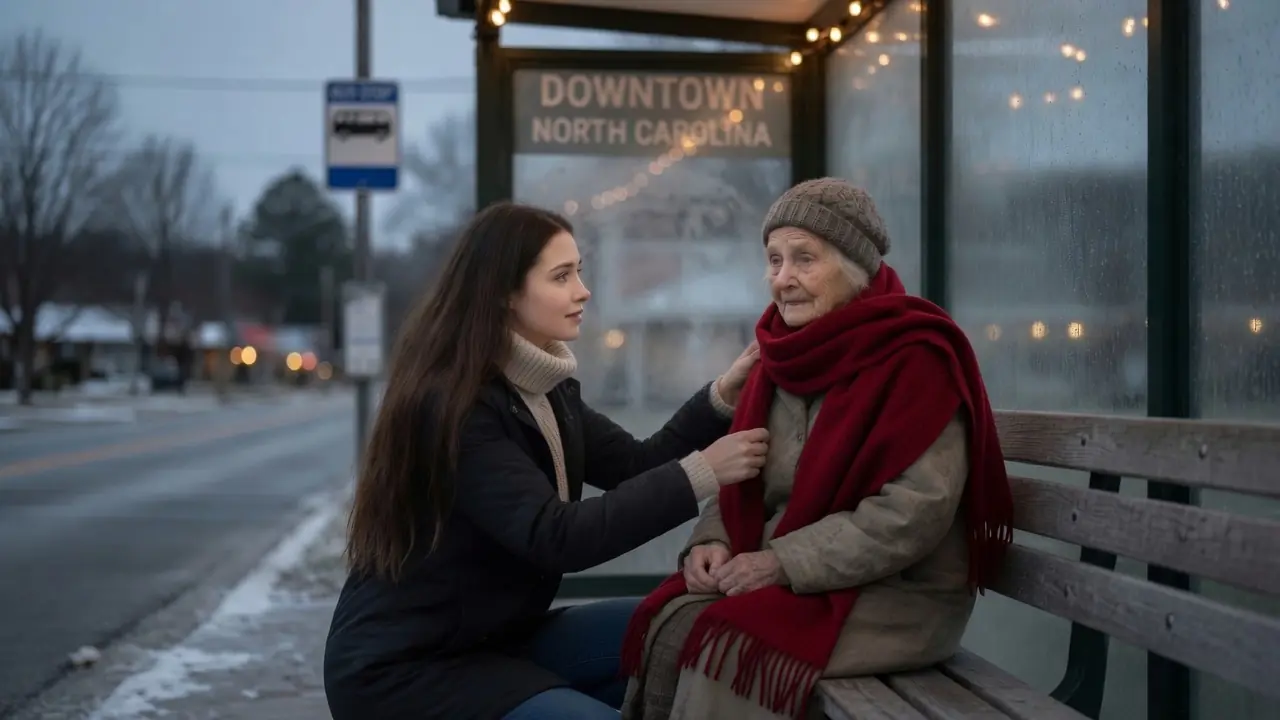
Rachel was breathtakingly beautiful, though hardship had taught her not to think much about it. She had luminous fair skin, large soft-brown eyes, full pink lips, and very long straight dark-brown hair that escaped the collar of her worn navy coat. Beneath it, she wore a modest cream sweater, faded jeans, and brown boots that had begun separating near one heel. Her son, Noah, stood beside her holding a small green dinosaur while snow gathered on his blue jacket.
The elderly woman looked at least eighty, perhaps older. Deep wrinkles crossed her pale face, her cheeks were hollow, and her watery blue eyes carried the exhausted expression of someone who had spent years expecting people not to see her. Thin white hair showed beneath an old knitted cap, while a faded beige coat hung loosely around her narrow body. Her hands shook so badly that she could not fasten the top button.
Rachel stopped in front of her.
“Ma’am, you shouldn’t be freezing out here.”
The woman lifted her face slowly. “The shelter is full.”
“Do you have family nearby?”
“No one who wants to be found.”
Rachel glanced at the bus schedule. The final bus had already passed fifteen minutes earlier, and the temperature was dropping quickly. She had exactly eighteen dollars in her checking account, two days before payday, and a heater at home that might fail before morning. Still, leaving the woman there felt impossible.
Rachel removed the thick burgundy scarf from around her neck.
Noah looked up. “Mom, that’s your warm one.”
“I know, sweetheart.”
She wrapped it carefully around the elderly woman’s neck, folding it twice so the fabric covered the thin coat collar. The woman touched the scarf as though Rachel had placed something priceless in her hands. Tears immediately filled her eyes.
“You need this more than I do,” Rachel said. “Noah and I only live six blocks away.”
The woman caught Rachel’s wrist. “What is your name?”
“Rachel Morgan.”
“And the boy?”
“Noah.”
The elderly woman repeated both names quietly, committing them to memory.
Rachel considered taking her home, but the apartment was barely large enough for herself and Noah, and the building manager had strict rules about overnight guests. Instead, she called every church and warming center listed on the public notice beside the bus stop. The fourth number answered, and a volunteer from Saint Andrew’s agreed to collect the woman within twenty minutes.
Rachel and Noah waited with her.
The elderly woman said her name was Evelyn Hart. She did not explain why she was alone or how she had ended up without a safe place on such a cold evening. Rachel did not force her to speak. She simply sat beside Evelyn and held one of her trembling hands until a church van arrived.
Before climbing inside, Evelyn looked back at Rachel. “I won’t forget this.”
“You don’t owe me anything.”
“That is exactly why I will remember.”
Rachel watched the van disappear beneath the glowing Christmas decorations. Then she took Noah’s hand, and they walked home through the snow without her scarf. By the time they reached the apartment, her neck was numb and Noah’s little fingers had begun trembling inside his gloves.
Their home consisted of one bedroom, a narrow kitchen, and a living room where Rachel slept on a secondhand sofa so Noah could have the bed. She worked mornings at a bakery and evenings cleaning offices in a medical building. Between shifts, she handled school pickups, laundry, meals, and the endless small emergencies that arrived whenever she had no money left.
Noah’s father had disappeared before the boy turned two. He sent one birthday card, made three promises to visit, and eventually stopped answering calls. Rachel never spoke badly about him in front of Noah, but she also stopped inventing excuses for his absence. Her son deserved truth without cruelty.
The heater failed that night.
At two in the morning, Rachel woke to Noah standing beside the sofa, wrapped in his blanket. She carried him into the kitchen, turned on the oven, and sat with him on the floor while they waited for enough warmth to fill the room. Noah rested his head against her shoulder.
“Is the old lady warm now?” he asked.
“I think so.”
“Then it was okay that you gave her the scarf.”
Rachel kissed his hair. “Yes.”
The next morning, she called the landlord. He promised someone would inspect the heater by the end of the week, then reminded her that the rent was already five days late. Rachel thanked him instead of arguing because she could not afford to give him another reason to threaten eviction.
She thought of Evelyn often during the following weeks. Rachel called Saint Andrew’s twice, but volunteers would only confirm that the elderly woman had been safely placed in temporary accommodation. Privacy rules prevented them from saying more. Rachel accepted that the brief meeting might be the only part of Evelyn’s story she would ever know.
Life moved forward because it had no interest in waiting for Rachel to recover. The bakery reduced her hours after Christmas. Noah developed a chest infection that required medicine the insurance plan barely covered. Her car failed its inspection, forcing them to depend on buses and long walks.
Yet Rachel continued noticing people who were colder, hungrier, or more frightened than they appeared. She brought unsold bread from the bakery to a neighbor recovering from surgery. She watched another tenant’s children during an emergency night shift. When an exhausted nurse dropped her grocery bag in the parking lot, Rachel helped gather everything before catching the final bus home.
Kindness did not make Rachel’s life easier.
It simply prevented hardship from deciding what kind of woman she would become.
Nearly three years passed.
By then, Noah was nine and tall enough to believe he no longer needed to hold his mother’s hand while crossing streets. Rachel worked full-time as a receptionist at a small dental clinic after the bakery closed. The position paid more consistently, but rising rent consumed every increase, and the office offered no health benefits.
Their apartment had deteriorated around them. Water stains spread across the bedroom ceiling, the bathroom floor softened near the tub, and a permanent draft entered through the living-room window. Rachel submitted repair requests, but the property company changed owners twice and lost each record.
Then a letter arrived beneath the door.
The building would be renovated and converted into higher-priced units. Every month-to-month tenant had thirty days to leave. Those who remained after the deadline would face formal eviction.
Rachel read the notice three times.
Noah watched from the table where he was finishing homework. “Are we moving?”
“We may have to.”
“Where?”
“I’m figuring that out.”
She searched every rental listing within bus distance of her job. Most required deposits larger than her savings. Others demanded income she could not prove, even though she had paid rent for years. One landlord refused immediately after learning she was a single mother.
Rachel began packing anyway.
She wrapped dishes in old newspapers and placed Noah’s school projects inside a plastic storage box. At night, after he slept, she calculated whether they could afford two weeks in an inexpensive motel while she searched for something permanent. Every version of the numbers ended badly.
On the twenty-sixth day, Rachel received a final notice.
The apartment had to be empty by Friday evening.
She sat on the kitchen floor surrounded by boxes and covered her face with both hands. She had worked constantly for years, avoided unnecessary spending, and accepted every extra shift offered. Still, she was four days from having nowhere safe to take her son.
Someone knocked.
Rachel wiped her eyes before opening the door.
An elderly woman stood in the hallway wearing a clean gray wool coat. Her white hair was neatly arranged beneath a cream hat, but age had deepened the wrinkles around her eyes and mouth. She held a burgundy scarf in one hand and leaned lightly on a polished wooden cane.
Rachel stared at the scarf first.
Then she recognized the eyes.
“Evelyn?”
The woman smiled. “You remembered.”
Rachel opened the door wider. “How did you find me?”
“It took longer than I expected.”
Evelyn entered slowly and looked around the apartment. Packed boxes filled the living room, and the eviction notice remained on the kitchen counter. Her gaze rested on it for a moment before returning to Rachel.
“You’re leaving?”
“We don’t have much choice.”
“Where will you go?”
“I’ll find somewhere.”
Evelyn’s expression showed that she recognized the answer. It was what people said when the truth felt too frightening to speak aloud.
Noah emerged from the bedroom. He had changed so much that Evelyn might not have recognized him, but he still carried the same green dinosaur, now missing one eye and most of its painted spots.
“You’re the scarf lady,” he said.
Evelyn’s smile widened. “And you’re the little boy who made sure your mother didn’t regret helping me.”
Noah looked at Rachel. “I told you she’d remember.”
Rachel invited Evelyn to sit, though nearly every chair had been packed. They settled around the small kitchen table while Evelyn placed the burgundy scarf between them. The fabric had been washed carefully and preserved inside tissue paper.
“I wanted to return it,” Evelyn said.
“You should keep it.”
“I did keep it. For three years.”
Rachel touched the edge of the fabric. “What happened after that night?”
Evelyn looked down at her hands.
Her husband, Thomas Hart, had owned a small senior-care residence outside Bellford. After his death, Evelyn inherited the property but trusted management to her nephew, who convinced her to sign documents she did not fully understand. Within two years, he had transferred most operating funds, sold her home, and placed her in an assisted-living facility where he rarely visited.
When Evelyn questioned the financial records, he accused her of confusion.
She left the facility during an argument and took a bus into town, believing she could reach a former attorney. The weather worsened, her money ran out, and she found herself at the bus stop where Rachel discovered her. The shelter placement led eventually to a legal-aid organization that investigated the nephew’s actions.
“The court returned part of what he stole,” Evelyn said. “The care home was still legally mine because he had failed to complete the transfer properly.”
“I’m glad.”
“It took two years to repair the damage.”
Evelyn reopened the residence under new management and renamed it Hart Haven. Rather than serving only wealthy families, it reserved rooms for older adults facing abandonment, financial abuse, or housing emergencies. Evelyn no longer ran daily operations, but she remained chairwoman of the nonprofit organization that now managed the facility.
Rachel smiled softly. “That sounds like a good place.”
“It needs good people.”
Evelyn reached into her handbag and placed a folder on the table.
Rachel did not touch it.
“What is that?”
“A job description.”
Hart Haven needed a resident-services coordinator—someone who could speak with families, organize appointments, notice when elderly residents were frightened, and treat people with dignity even during difficult moments. The position included full benefits, reliable hours, and a salary nearly twice what Rachel earned at the dental clinic.
“I’m not qualified,” Rachel said.
“You have managed work, bills, illness, public transportation, a child, and every crisis adulthood has placed in your path. You are more qualified than many people with expensive certificates.”
“But you barely know me.”
“I spent three years learning.”
Rachel’s expression changed. “What do you mean?”
Evelyn had asked the Saint Andrew’s volunteers about Rachel, but they protected her privacy. Later, through legal records and local contacts, Evelyn learned where she worked. She never approached because she wanted to know whether Rachel’s kindness at the bus stop had been unusual or simply part of who she was.
Evelyn spoke with the bakery owner, the dental-clinic manager, and two neighbors. She learned about the bread Rachel delivered, the children she watched, and the way she remained patient with frightened patients at the clinic. Each person described the same woman.
“You watched me?” Rachel asked carefully.
“I asked about you. I did not enter your life because I wanted gratitude to influence what people said.”
Rachel looked uncomfortable. “I don’t want a job because I gave you a scarf.”
“Good.”
Evelyn slid the folder closer.
“You are not being offered employment because of one scarf. You are being invited to interview because you have spent years doing the work this position requires without receiving the title or pay.”
Rachel opened the folder.
The salary made her stop breathing for a moment. The benefits included health insurance for herself and Noah. The hours ended before his school day finished, and Hart Haven offered after-school space for employees’ children.
Then Evelyn placed two keys beside the contract.
Rachel immediately pushed them back. “I can’t accept a house.”
“It is not a house.”
Hart Haven owned a small two-bedroom apartment above its administrative offices. The previous coordinator had moved away, leaving the unit vacant. Housing was included during the first year as part of the employment transition, after which Rachel could lease it at a reduced rate or move elsewhere.
Rachel shook her head. “This is too much.”
“No. It is structured compensation.”
“I never helped you for a reward.”
Evelyn’s watery eyes filled.
“That is why this is not a reward. It is the life you earned by never allowing hardship to make you cruel.”
Rachel looked toward Noah.
The boy stared at the keys as though they opened a castle.
“I still have to interview?” Rachel asked.
“With the full hiring committee. I do not control the final vote.”
“And they can say no?”
“Yes.”
Rachel finally trusted the offer enough to accept the interview.
She attended two days later wearing the cream sweater Evelyn remembered from the bus stop, paired with borrowed black trousers and the cleanest shoes she owned. Three people sat across from her: the facility director, a nurse supervisor, and a representative from the nonprofit board. Evelyn was not present.
They asked what Rachel would do if a resident refused medication, how she would respond to an angry family, and whether she could remain calm during emergencies. Rachel answered honestly, admitting what she did not know and explaining how she would ask trained staff for help.
The final question came from the nurse supervisor.
“What does dignity mean in senior care?”
Rachel thought of Evelyn trembling at the bus stop while strangers walked around her.
“It means not making someone prove they deserve warmth before you give it.”
The hiring committee offered her the job that afternoon.
Rachel cried in the employee restroom at the dental clinic after submitting her resignation. Her manager hugged her and admitted she had wanted to pay Rachel more but lacked the authority. For once, Rachel left a workplace without fear about the following month.
The apartment above Hart Haven had two bedrooms, clean windows, a working heater, and a small kitchen overlooking a garden. Noah ran from room to room counting electrical outlets and announcing where his dinosaur collection would live. Rachel stood in the doorway of her own bedroom, overwhelmed by the sight of a bed she would not need to surrender to her son.
Evelyn watched from the hall.
“Do you approve?” she asked Noah.
“The heater doesn’t click.”
“That is an excellent sign.”
Rachel turned toward Evelyn. “I don’t know how to thank you.”
“By doing the work well.”
The work was harder than Rachel expected.
Hart Haven residents arrived with complicated lives. Some had loving families who felt guilty about needing help. Others had children who visited only when inheritance documents required signatures. Several residents suffered from memory loss, while others remained mentally sharp but physically dependent.
Rachel learned names, routines, fears, and small preferences. She knew who needed tea before discussing medical appointments, who became anxious during thunderstorms, and who pretended not to care when birthdays passed without visitors. She did not try to become everyone’s daughter.
She simply made sure no one became invisible.
One resident named Arthur shouted at staff each morning because he could not accept needing help to dress. Rachel never argued with him in front of others. She waited outside his room, gave him time, then returned with two shirt choices so he could control something.
Another woman, Ruth, refused to eat in the dining room because her hands shook. Rachel arranged a quieter table and found weighted utensils that made meals easier. Within a month, Ruth began joining the others.
Evelyn observed without interfering.
“You see the cold before anyone else,” she told Rachel one evening.
Rachel smiled. “Sometimes cold isn’t about temperature.”
“No. It rarely is.”
Noah became part of Hart Haven’s life too. He completed homework in the administrative office and spent afternoons playing board games with residents. Evelyn taught him chess, though he accused her of cheating whenever she won.
For the first time, Noah had older adults in his life who remembered his school projects, attended his concerts, and asked about the green dinosaur. He stopped asking why his father did not visit as often. His world had gained enough reliable people that one absence no longer defined it.
A year later, the board promoted Rachel to director of resident advocacy. She completed professional training through a scholarship program and began helping families recognize financial exploitation. Her experiences with poverty made her unusually skilled at distinguishing neglect from genuine hardship.
She never shamed relatives who needed assistance.
She did confront those who treated elderly parents like inconvenient assets.
Three winters after Rachel began working at Hart Haven, Evelyn’s health declined. She remained mentally sharp, but her heart weakened, and walking became difficult. Eventually, she moved into one of the residence rooms she had once helped restore.
Rachel visited every morning before starting work.
On Christmas Eve, snow covered the garden, and burgundy decorations hung throughout the halls. Evelyn sat near the window with the old scarf around her shoulders.
“You’re still keeping that?” Rachel asked.
“It’s warmer now.”
“It’s the same scarf.”
“No. Now it carries six years.”
Noah, nearly thirteen, entered carrying hot chocolate. He had grown taller than Rachel expected and no longer carried the dinosaur, though it remained on a shelf inside his room.
Evelyn took his hand. “Do you remember the bus stop?”
“Some of it.”
“You told your mother giving me the scarf was okay.”
“I was right.”
“Yes.”
She looked toward Rachel. “He understood kindness before most adults.”
Rachel sat beside her.
“You changed our lives.”
Evelyn shook her head. “I opened one door. You walked through it and kept going.”
“That door mattered.”
“So did the scarf.”
Evelyn died peacefully the following spring.
Her will left no secret fortune to Rachel, and Rachel expected none. Most of Evelyn’s estate passed permanently into the nonprofit trust supporting Hart Haven. Her personal possessions were divided among a few old friends and the residents who had become her final family.
Rachel received one wooden box.
Inside lay the burgundy scarf, neatly folded beside a handwritten letter.
Dear Rachel,
When you found me, I had spent years believing kindness was something people offered only when it benefited them. You gave warmth you could barely afford and asked for nothing in return. That scarf did not save my life by itself, but it reminded me that my life might still be worth saving.
Please do not remember me as the woman who rescued you. Remember me as the woman who finally learned how kindness should move: not backward as repayment, but forward as responsibility.
Keep noticing who is cold.
Rachel pressed the scarf against her face and cried.
Years later, she became executive director of Hart Haven. The organization expanded into three counties, creating emergency housing for elderly people escaping financial abuse and support services for single parents working in caregiving roles. Rachel insisted every expansion maintain the same principle Evelyn had taught her.
Help should preserve dignity.
It should never purchase obedience.
On a freezing December evening, nearly fifteen years after the original meeting, Rachel left the Bellford office with Noah, now a college student home for winter break. They passed the renovated bus stop beneath the Christmas lights.
An elderly man sat alone on the bench wearing a thin jacket.
Rachel stopped.
Noah looked at her, already knowing.
“Go ahead,” he said. “I’ll call the shelter.”
Rachel removed the burgundy scarf from around her neck.
It had faded with age, and one edge had been repaired by hand. She wrapped it gently around the man’s shoulders before asking his name and whether he had somewhere safe to sleep.
The scarf had begun as fabric.
Then it became warmth.
Then memory.
Then opportunity.
Now it was moving forward again, exactly as Evelyn intended.
Rachel had once believed kindness disappeared after the moment passed. She understood better now. Sometimes it remained hidden for years, carried quietly inside another person until the day it found a path back into the world.
One cold evening, a struggling single mother noticed an eighty-two-year-old woman everyone else had ignored.
She gave away the warmest thing she owned.
Years later, that small kindness returned—not as a debt, not as charity, and not as a miraculous fortune.
It returned as fair work, a safe home, and the chance for Rachel to spend the rest of her life making sure fewer people were left alone in the cold.