The late afternoon sun had begun its slow descent over the small town of Brookhaven, painting the streets in burnt shades of orange and gold.
Susan Miller adjusted the strap of her worn handbag against her shoulder and shifted the weight of two grocery bags in her hands.
The handles cut into her fingers, but she did not stop. 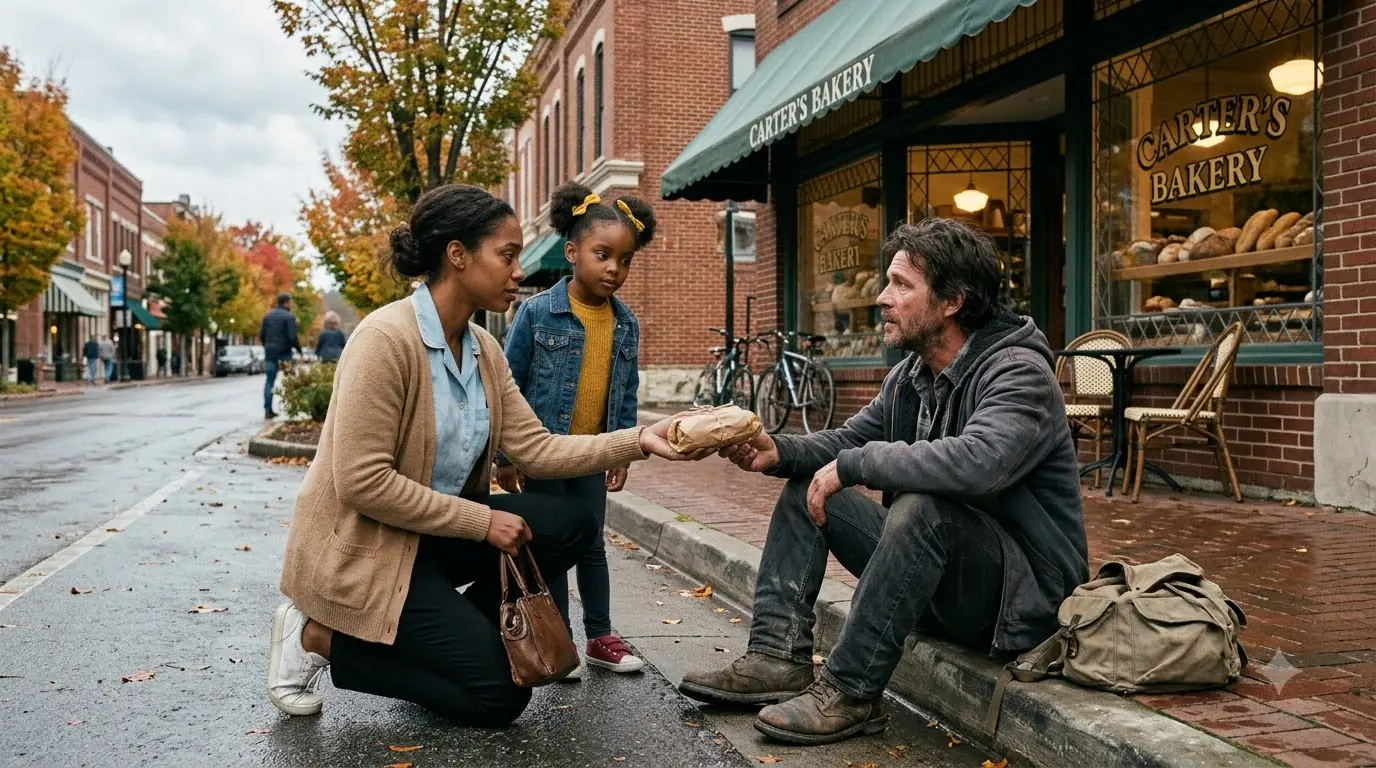
She had learned long ago that discomfort was not an emergency. It was simply something to carry until you reached home.
The air smelled faintly of rain, hot pavement, and bread from the corner bakery. Cars passed slowly along Main Street, their windows catching the last light of day. Storefronts glowed one by one as the evening settled in, and people hurried toward dinner, toward family, toward warm rooms waiting for them.
Susan quickened her steps.
Her daughter Zuri would be waiting.
At six years old, Zuri had a way of asking where dinner was that made the question sound like both curiosity and accusation. She would stand in the tiny kitchen of their apartment, curls bouncing around her face, one hand on her hip, and say, “Mommy, is food almost ready, or should I tell my stomach to be patient?”
Susan always laughed, even on nights when there was barely enough.
Especially on those nights.
Her life had become a series of careful calculations. Every dollar had a purpose. Every hour was divided before she reached it. Every decision had to answer the same question first: would this keep Zuri safe, fed, and unaware of how close they often stood to the edge?
Susan was twenty-eight years old, though exhaustion sometimes made her feel much older. She worked morning shifts at Rosie’s Diner, where she carried plates, poured coffee, smiled through rude customers, and went home smelling like bacon grease and burnt toast. Three nights a week, she cleaned offices after they closed, emptying trash cans beneath framed diplomas and polishing desks that cost more than a month of her rent.
Between the diner and the cleaning job, exhaustion had become her constant companion.
Still, she never allowed herself to falter in front of Zuri.
Her daughter deserved laughter. Love. Bedtime stories. The sense that their tiny, cluttered home was still safe. Susan could not give Zuri everything, but she could give her warmth. She could give her songs while they washed dishes. She could give her pancakes shaped like crooked hearts on Sunday mornings when they had enough flour. She could give her the belief that they were not poor, only “careful.”
Careful sounded softer.
Careful let a child sleep.
Susan carried herself with a strength born of necessity, but the weariness showed if anyone looked closely. Her hands bore faint cracks from dish soap, bleach, and harsh cleaners. Her shoulders ached from long shifts. Her hair, once styled every morning before life grew too expensive for time, was now often swept into a quick bun at the back of her head.
Yet even in her fatigue, there was a quiet beauty about her.
She never noticed it.
Others sometimes did.
There was beauty in the way she kept walking when life gave her every reason to sit down. There was beauty in the way she made cheap soup taste like home. There was beauty in the way she kissed Zuri’s forehead every morning and whispered, “You are my best thing,” as if the whole world needed to know.
It was on this particular evening, as the air hinted of rain and the sky darkened behind the bakery windows, that Susan first saw him.
He sat on the curb outside Maribel’s Corner Bakery, half in shadow, half in the fading orange light. His hood was pulled low over his face, and his clothes were rough and rumpled. A dark coat hung loose over his broad shoulders, frayed near one sleeve. His jeans were worn at the knees, and his shoes looked as though they had carried him across more roads than they could name.
To most people passing by, he was just another homeless man.
Something to avoid.
Something to pity briefly, then forget.
His beard was several days untrimmed, and his hands were tucked into his coat pockets as though bracing against a cold only he could feel. He did not hold a sign. He did not ask for money. He simply sat there, watching the stream of people move past him without seeing him.
In truth, Joel Tally was neither destitute nor desperate.
Only a handful of people in the world knew that the man sitting outside the bakery in a worn coat was actually Joel Tally, billionaire tech mogul, founder of Tally Tech, and one of the most powerful men in the country’s technology industry.
His face had appeared on magazine covers, investment panels, business programs, and charity gala invitations. Reporters had called him brilliant, impossible, difficult, visionary, private, cold, generous, unpredictable, and lonely. Some of those words were true. Some were lazy. None of them had ever fully reached him.
Joel had spent nearly two decades building a company that reshaped the way businesses handled secure digital infrastructure. He had started with code written in a rented room above a laundromat and turned it into an empire with offices in twelve cities and clients across the world.
But success had become a cage with better lighting.
Every conversation in his life had become a negotiation. Every kindness came with a hidden invoice. Every smile seemed to ask for access, investment, approval, influence, or rescue. People laughed too loudly at his jokes. Agreed too quickly with his opinions. Praised his simplest sentences as though he had invented wisdom itself.
He had money beyond anything he had once imagined.
He also had no idea who would still sit with him if all of it disappeared.
Months earlier, after a board meeting where eight executives spent two hours praising a strategy he secretly hated, Joel had walked out, taken the elevator to the private garage, dismissed his driver, and disappeared.
Not dramatically.
Not publicly.
He told his chief legal officer he needed medical leave. He told his assistant to cancel every nonessential appointment. He left behind his main phone, his watch, his tailored suits, and the life everyone thought he should be grateful to occupy.
Then he began moving through cities and small towns under a false name, dressed in anonymity, staying in cheap rooms, shelters, bus stations, and occasionally nowhere at all.
He wanted to know what remained when nobody knew his name.
He wanted to be looked at without being calculated.
He wanted something real.
That was why he sat outside the bakery in Brookhaven, silent and still, watching people pass.
Most glanced away.
Some looked through him.
A few looked annoyed, as if his presence had made the evening less pretty.
Then Susan noticed him.
She was already past the bakery when something made her slow down. Maybe it was the way he looked up briefly, not pleading, not demanding, just aware. Maybe it was his eyes, blue-gray and startlingly sharp beneath the tired shadows. Maybe it was the loneliness in his posture, the kind that was harder to hide than hunger.
Most people avoided eye contact with the homeless.
Susan knew that.
She had done it herself on days when guilt felt too heavy and her grocery bags too light.
But something about his gaze lingered.
She took three more steps.
Stopped.
Exhaled, half annoyed with her own soft heart.
She barely had enough to keep Zuri fed, let alone offer charity to strangers. The groceries in her hands were already measured against the week ahead. Rice. Beans. Eggs. A small pack of chicken thighs on sale. A loaf of bread. Apples from the bruised discount bag. One wrapped sandwich she had picked up from Rosie’s for Zuri’s after-school snack.
Still, when Susan looked back at the man on the curb, she saw something beyond poverty.
Weariness.
Pride wounded but not gone.
The look of someone who had been invisible too long.
She set one grocery bag down carefully.
“Are you hungry?” she asked.
Joel blinked.
The question startled him more than he expected.
Plenty of people had given him coins during his months of wandering. Some had tossed food in his direction with quick guilt and quicker steps. Others had offered advice, suspicion, or prayers from a safe distance.
Few people had stopped.
Even fewer had spoken to him as if his answer mattered.
He nodded once, almost cautiously.
“I could be,” he replied.
His voice was deep but quiet, polished in a way that might have betrayed him if Susan had not been too tired to analyze it.
She opened one of her bags, pulled out the wrapped sandwich, and held it out.
“It’s not much,” she said. “But here.”
Joel looked at the sandwich.
Then at her.
For one strange moment, he did not know how to take it.
Not physically.
Emotionally.
He had signed checks large enough to fund hospitals. He had donated millions through foundations. He had paid for scholarships in names no one knew belonged to him. But standing there outside a bakery, being offered a sandwich by a woman whose shoes were worn and whose hands looked as tired as his soul felt, he felt humbled in a way wealth had never managed to teach him.
Before he could respond, a small hand tugged at Susan’s sleeve.
“Mommy, why is he sitting in the rain?”
Zuri Miller stood beside her mother, peering up at Joel with wide brown eyes. Her curls were tied into two pigtails that bounced when she tilted her head. She wore a yellow sweater with one loose button and carried a school folder decorated with stickers of stars and cartoon cats.
Susan crouched, brushing a thumb across her daughter’s cheek.
“He just doesn’t have a place to stay, sweetheart.”
Zuri looked back at Joel.
Her gaze did not waver.
Instead, she smiled with the kind of unfiltered kindness only children possess.
“Hi. My name is Zuri. You don’t look scary. You look nice.”
Joel’s throat tightened unexpectedly.
For years, people had called him impressive, brilliant, intimidating, powerful, difficult, rich, impossible to reach.
No one had called him nice.
Not like that.
Not as if it were the first thing they chose to believe.
He found himself smiling back, a small hesitant curve of his lips.
“Hello, Zuri,” he said softly. “That’s a beautiful name.”
“It means beautiful,” Zuri said proudly. “Mommy told me.”
“She was right.”
Susan studied him.
She had learned to be cautious, especially with strangers. Life as a single mother demanded it. A kind face did not guarantee a kind heart. A gentle voice did not erase danger. She had spent years learning how to read men quickly, how to trust the prickling warning at the back of her neck.
But this man did not trigger it.
His posture was unthreatening. His voice calm. His eyes tired but clear. If anything, he looked more broken than dangerous.
Rain began to spit lightly against the sidewalk.
Susan looked up at the thickening clouds.
“You can’t sit out here all night,” she murmured, half to herself.
Joel gave a small shrug.
“I’ve done worse.”
The answer bothered her more than she wanted it to.
She picked up her groceries, then extended one bag toward him.
“Come on. At least walk with us. You can carry this if you want to repay the sandwich.”
Joel stared at her in surprise.
People had offered money before.
Food.
Advice.
Pity.
But not companionship.
Not dignity disguised as a task.
Slowly, he stood and accepted the bag.
“Thank you,” he said.
As they began walking, Zuri slipped her hand into his without hesitation.
Joel froze.
The small warmth of her palm against his disarmed him completely. He looked down at her, stunned, and she simply swung his hand once, as if this arrangement had already been approved by the universe.
Susan watched their joined hands with a mix of weariness and wonder.
It was not every day she trusted someone new around her daughter.
But Zuri’s instincts were rarely wrong.
The narrow brick building that held Susan’s apartment stood three blocks from the bakery, above a closed laundromat with faded blue lettering still painted across the windows. The stairs smelled faintly of dust, old detergent, and rainwater tracked in by tenants.
Susan unlocked the outside door, then glanced back at Joel.
“You can wait here on the steps while I get dinner ready,” she said cautiously. “If you want.”
Joel nodded.
“I’d like that.”
Inside, Susan set the groceries on the counter and leaned both hands against the sink, her mind buzzing.
What was she doing?
Letting a stranger, even one who seemed kind, linger near her home?
But then she looked through the small front window. Joel sat quietly on the steps, the grocery bag placed neatly beside him, his shoulders no longer slumped as heavily.
Zuri leaned beside the window and whispered, “Mommy, he looks less sad now.”
Susan paused.
Then, almost unwillingly, she smiled.
Joel sat outside, staring at the darkening sky.
For the first time in a long time, warmth flickered in his chest. Not from the sandwich. Not from the air, which was growing colder by the minute. But from something far rarer.
Kindness without a price tag.
He thought of the countless dinners he had attended beneath glittering chandeliers, surrounded by champagne glasses, rehearsed laughter, and expensive smiles. He thought of people leaning close to speak to him, not because they cared what he thought, but because being near power made them feel powerful too.
None of it had touched him the way Susan’s simple gesture had.
The door creaked open behind him.
Susan stepped out holding a folded blanket.
“Here,” she said, offering it.
Joel accepted it gently.
His voice lowered.
“You don’t know what this means.”
Susan crossed her arms, her tone firm.
“Don’t mistake kindness for charity. I’m just doing what I’d hope someone would do for me if I were in your place.”
Joel studied her.
She was tired. He could see it in the set of her shoulders, the faint shadows beneath her eyes, the careful way she guarded herself even while giving. Yet she carried herself with dignity, with a strength wealth could never buy.
He wanted to tell her everything.
That he was not homeless.
That he had accounts larger than the debts weighing down her small kitchen table.
That he had the power to change her life with a single phone call.
But the fear rose immediately behind the impulse.
If he told her now, the moment would change.
Her kindness would become embarrassed.
Her trust would turn into suspicion.
The small, real thing he had found would vanish beneath his name.
So instead, he said only, “My name is Eli.”
Susan raised an eyebrow.
“Eli, huh?”
He nodded, choosing the name as a shield.
For now, truth would have to wait.
Later that evening, rain began to patter steadily against the roof and fire escape. Joel remained on the steps wrapped in the blanket. Through the thin walls of the apartment, he heard laughter, Zuri’s bright giggles, Susan’s softer chuckle following behind.
It struck him like a memory of a world he had never truly lived in.
Inside, Susan tucked Zuri into bed beneath a quilt patched from old fabric squares. The little girl’s last words before sleep were simple.
“Don’t let Eli be lonely, Mommy.”
Susan lingered in the doorway.
Her heart tugged in a direction she did not trust.
When she finally stepped back outside, Joel looked up at her. Rain glistened in his hair. The blanket was wrapped around his shoulders, but his shoes were wet and his hands were cold.
She sat beside him on the step, leaving a careful distance between them.
For a while, neither spoke.
The silence was oddly comfortable.
Finally, Susan asked, “Why are you really here?”
Joel hesitated.
He searched for words that were not lies, yet did not expose his secret.
“I guess I’m looking for something,” he said at last.
Susan turned her head and met his gaze.
For a moment, the world narrowed to the space between them.
The tired mother.
The man with a hidden past.
The fragile beginning of something neither of them could yet name.
“What kind of something?” she asked.
Joel looked toward the street, where rain blurred the glow of the streetlights.
“Something real.”
Susan did not know what to say to that.
Neither did he.
The next morning, Susan rose before dawn as she always did, quietly pulling on her diner uniform. The breakfast rush waited for no one, least of all a single mother juggling bills, bus schedules, and a restless child. She padded softly across the apartment, careful not to wake Zuri.
When she opened the front door, she stopped short.
Joel was still there.
He sat on the steps, blanket wrapped around his shoulders, head bowed in sleep. His hair was damp from the night air, and yet he looked peaceful, as if this hard step outside her door had been the most restful place he had known in a long while.
For a moment, Susan simply watched him.
Something about his presence unsettled her, though not in the way a stranger normally would.
Instead, it was the strange familiarity that disturbed her.
He seemed at ease in her world.
In her tiny space where kindness was shared in sandwiches and blankets.
She cleared her throat softly.
Joel stirred and lifted his head. His eyes met hers, still sharp despite sleep.
“You’re still here,” Susan said, her tone caught between surprise and caution.
Joel nodded.
“You said I could wait.”
Her lips twitched.
“I didn’t mean forever.”
“I’ll earn my keep,” he replied quietly. “If you’ll let me.”
Something in his tone, earnest and almost humble, made her pause.
She studied him.
Then sighed.
“Fine. Carry those groceries inside, and we’ll see.”
By the time Zuri woke, Joel was already fixing a squeaky cabinet door in the kitchen using a butter knife, a loose screw, and a patience that made Susan suspicious.
“Uncle Eli!”
Zuri’s voice rang with excitement as she rushed forward.
Joel froze at the name, then glanced at Susan.
Susan arched a brow.
“You’ve made an impression.”
Zuri hugged Joel’s arm.
“Can you come to school with me today?”
Joel chuckled.
“I don’t think your teacher would appreciate that.”
“You could sit in the back.”
“I’m very tall. I would block the board.”
Zuri considered this seriously.
“Okay. Maybe tomorrow.”
From that day on, Joel became a fixture in their lives.
Not all at once.
Not officially.
But steadily, the way some people enter a home first through small usefulness, then through trust.
He picked up chores without being asked. Tightening loose knobs. Sweeping the stoop. Carrying laundry up the worn stairwell. Fixing the kitchen cabinet properly after Susan admitted the butter knife repair could not be trusted long term. He walked Zuri to school twice when Susan had to leave early for the diner, always staying on the far side of the sidewalk, always letting Zuri talk nonstop about spelling tests, lunchbox trades, and which classmate smelled like crayons.
Susan, wary at first, found herself surprised by his willingness to help.
He never complained.
Never acted entitled.
Never made her feel small for needing anything.
Instead, he blended into their daily rhythm as though he had always belonged.
Evenings grew warmer with his presence.
One night, Susan returned from her cleaning shift near midnight to find Joel seated at the kitchen table with Zuri, who had fought sleep stubbornly to finish her math homework. Joel had drawn little apples on a scrap of paper and was gently explaining subtraction.
“If you have eight apples,” he said, “and Zuri eats three because she is very hungry after school, how many are left?”
“Five,” Zuri said.
“And if Mommy comes home and eats two because she worked very hard?”
Zuri giggled.
“Three.”
“And if Uncle Eli tries to eat one?”
“No,” Zuri said firmly. “You already had soup.”
Joel placed one hand over his heart.
“Denied by the accountant.”
Susan stood in the doorway, unnoticed for a moment.
The scene tugged at something deep inside her chest.
For years, she had carried everything alone.
Meals.
Homework.
Tantrums.
Fevers.
Bills.
Bedtime fears.
The questions Zuri asked about the father who had left before she could remember him.
Now, here was this stranger gently explaining numbers as though he had been waiting his whole life to sit at that table.
Later, after Zuri was in bed, Susan found herself laughing.
Really laughing.
Joel had told her a story about trying to sleep in a bus station beside an old man who claimed pigeons were government spies. His delivery was dry and perfect, his face so serious that Susan laughed until she had to wipe her eyes.
Joel watched her with quiet wonder.
He had seen women laugh in penthouses, ballrooms, private dining rooms, and yachts. He had seen laughter used as decoration, as strategy, as seduction, as business diplomacy.
Susan’s laughter was different.
It was tired, reluctant, beautiful, and real.
But Susan noticed things too.
She noticed the intelligence in his phrasing.
The careful courtesy in his manners.
The way his eyes moved through a room, assessing exits, people, problems, as though he were accustomed to being responsible for more than himself.
He might look rough, but nothing about him spoke of a man beaten down by life.
When she asked where he came from, Joel only smiled faintly.
“Nowhere important.”
“That’s not an answer.”
“No,” he admitted. “It isn’t.”
She should have pushed harder.
But part of her was afraid that if she demanded the truth, he might disappear.
And against all caution, Susan did not want him to.
Joel, for his part, felt the weight of secrecy pressing harder every day.
Every laugh he shared with Susan, every small hand clasp from Zuri, every ordinary dinner at their tiny table deepened his fear.
How could he tell them the truth now?
That the man they welcomed into their modest home was actually Joel Tally, founder of Tally Tech, a billionaire whose disappearance had become a quiet crisis among executives, attorneys, board members, and reporters hungry for blood?
His hidden phone buzzed late at night when Susan slept.
He kept it wrapped in a sock inside an old backpack beneath the couch.
Messages piled up.
The board is panicking.
Reporters are speculating.
Joel, this cannot continue.
We need a public statement.
Investors are asking if you’re ill.
Sometimes he answered in hushed tones from the alley behind the building, rain dripping from the fire escape above him.
“Handle it,” he would say. “I’m not ready to return.”
His chief operating officer, Marcus Bell, was one of the few people who knew Joel was alive and moving by choice.
“You can’t hide forever,” Marcus said one night.
“I’m not hiding.”
“Then what are you doing?”
Joel looked up at Susan’s kitchen window. Through the thin curtain, he could see the warm glow of the lamp and the shadow of Zuri’s drawings taped to the wall.
“I’m trying to remember why I built anything in the first place.”
Marcus was silent.
Then he asked, “Is there someone?”
Joel closed his eyes.
“Yes.”
“Do they know who you are?”
Joel did not answer.
Marcus sighed.
“That will not end gently.”
Joel knew he was right.
Still, each time he slipped back into Susan’s apartment, he told himself he would confess tomorrow.
Tomorrow became next week.
Next week became after Zuri’s school recital.
After Susan’s rent was paid.
After one more dinner.
After one more evening when Susan smiled at him like he was simply Eli, not a headline with hands.
Trouble came sooner than expected.
One afternoon, as Susan walked home with Zuri, Mrs. Bellamy from the second floor called across the street.
“Be careful with that drifter, Susan.”
Susan stopped.
Zuri’s hand tightened in hers.
Mrs. Bellamy stood on her porch with a bag of trash in one hand and suspicion on her face.
“Men like him only bring trouble.”
Susan’s jaw tightened.
“He’s been nothing but kind.”
“That’s how they start. Don’t let him near your girl too much.”
Susan pulled Zuri closer, anger flaring through her fatigue.
“You have a good evening, Mrs. Bellamy.”
She walked away before the woman could answer.
But later, alone in the kitchen, doubt knocked.
Not loudly.
Just persistently.
She had fought hard to protect her daughter. She had survived betrayal before, abandonment before, promises that sounded sweet until bills came due and men disappeared. Zuri’s father had been charming too, once. Gentle too. Full of reasons Susan should trust him until the day he decided fatherhood was too heavy and vanished into another state with another woman’s name on his phone.
Could she really trust a man she barely knew?
The seed of uncertainty rooted deeper that evening when Zuri, perched on Joel’s knee while he read from a library book, asked innocently, “Uncle Eli, why don’t you have a house?”
Joel froze.
Susan, washing dishes at the sink, went still too.
Joel closed the book gently.
“Sometimes home isn’t a place, Zuri.”
Zuri tilted her head.
“Then what is it?”
“Sometimes it’s the people who make you feel safe.”
Zuri nodded, satisfied.
But Susan’s gaze lingered on him.
That was no answer.
The days grew colder.
November turned toward December. Rain became sleet on some mornings, and the radiator in Susan’s apartment clanged like it was fighting for its life. Joel continued sleeping on the couch, though Susan told herself this was temporary every night while pulling an extra blanket from the closet.
One rainy evening, the fragile wall between them cracked.
Susan sat at the kitchen table long after Zuri had gone to sleep. Bills lay scattered before her. Rent. Utilities. A notice from the school about winter supplies. A medical bill from when Zuri had bronchitis the previous month. A reminder that the diner had cut two of her weekday shifts because business slowed before the holidays.
Her hands rested against her temples.
She had done the math five times.
It did not change.
Joel found her like that.
Quietly, he pulled out the chair across from her and sat.
For a long moment, he said nothing.
He only waited.
That was one of the things that made him dangerous to her heart. He did not rush to fix what she had not offered. He did not make her pain about his usefulness. He simply sat there as if he could bear the weight of her silence.
Finally, Susan lifted her head.
“I can’t keep doing this.”
Her voice was so quiet he almost missed it.
“No matter how hard I work, it’s never enough.”
A tear slipped free before she could stop it.
She wiped it away angrily.
“I hate this. I hate crying over money. I hate that Zuri asks for things and I have to turn every answer into a lesson about patience. I hate that I’m tired all the time. I hate that one flat tire could ruin us.”
Joel reached across the table, his hand covering hers.
His palm was warm.
Steady.
“You’re not alone,” he said softly. “You don’t have to carry everything by yourself.”
The sincerity in his voice undid her.
For the first time in years, Susan allowed herself to lean slightly on someone else.
Their eyes met.
The air between them changed.
Slowly, Joel leaned closer, his breath mingling with hers. For one heart-stopping moment, she thought he might kiss her.
And she almost let him.
But the memory of her past rose like a wall. Trust given too quickly. Love used as leverage. Men who said “let me help” until helping became control.
Susan pulled back abruptly, standing so fast her chair scraped the floor.
“I can’t,” she whispered, chest heaving. “I won’t.”
Joel’s jaw tightened with regret, but he nodded.
“I understand.”
That night, as he lay awake on the couch, listening to the radiator hiss and the rain tap against the window, Joel knew one thing with absolute clarity.
He had to tell her the truth before this went any further.
The truth, however, had a way of revealing itself sooner than intended.
Two days later, Susan’s boss at Rosie’s Diner flipped through a business magazine during the lull before closing. Marlene was a broad-shouldered woman in her fifties with red lipstick, tired feet, and the ability to see through almost anyone.
She frowned at a page.
“Susan,” she called. “Come here a second.”
Susan wiped her hands on her apron.
“What is it?”
Marlene tapped the magazine.
“Doesn’t this look like your friend? The one who’s been hanging around?”
Susan leaned over reluctantly.
Her breath caught.
There on the glossy page was Joel.
Not Eli.
Joel.
Clean-shaven.
Impeccably dressed in a dark suit.
Standing beside industry leaders beneath crystal lights at some gala.
The caption read:
Joel Tally, billionaire tech visionary and founder of Tally Tech, rumored to be stepping back from the company he built.
The words blurred.
Susan’s heart pounded in her chest.
Joel Tally.
Billionaire.
Founder.
Visionary.
She heard again Mrs. Bellamy’s warning.
The evasive answers.
The mysterious phone calls.
Nowhere important.
Sometimes home isn’t a place.
Every vague sentence rearranged itself into something sharper.
Her stomach twisted.
Marlene looked at her carefully.
“Honey?”
Susan stepped back.
“I have to go.”
When she returned home that evening, Joel was waiting by the door with a small paper bag in his hand.
“I stopped by the bakery,” he said, expression softening when he saw her. “They had those cinnamon rolls Zuri likes.”
Susan could not meet his eyes.
“You’re not who you said you were.”
Joel’s face stilled.
The mask slipped before he could stop it.
“Susan.”
Her hands trembled.
“Who are you really?”
The silence between them was heavy, almost unbearable.
Joel stood frozen, knowing the moment he had dreaded had finally come.
Zuri was asleep in the next room, unaware that the fragile world they had built had begun to fracture.
“My name is Joel Tally,” he said quietly. “I’m the founder of Tally Tech.”
Susan flinched as if the name itself had struck her.
“The magazines call me a billionaire,” he continued. “But to you, I’ve just been Eli.”
“Don’t,” she whispered.
He stepped forward, then stopped when he saw her recoil.
“I didn’t lie to hurt you. I hid because I needed to know if someone could see me for who I am. Not what I own.”
Susan stared at him.
“The world has treated me like a walking wallet for so long,” Joel said, voice roughening. “Everyone wants something. Access. Money. Influence. A favor. A piece of me. And then you…”
His voice cracked.
“You saw me. You gave me kindness when I had nothing to offer in return.”
Tears stung Susan’s eyes, but anger blazed stronger.
“Kindness?” she said. “Joel, I gave you food when I could barely feed my own daughter. I offered you a blanket when I couldn’t even afford a new one for myself. I let you into my home. Near my child.”
Her voice broke.
“And all the while, you let me believe you had nothing.”
Joel’s eyes pleaded with hers.
“Because I needed to know it wasn’t about money.”
Susan gave a small, devastated laugh.
“You needed to know? So what was this? A test?”
“No.”
“You watched me struggle while you sat on a fortune.”
“Susan—”
“You helped with homework. You fixed cabinets. You carried laundry. You sat at my table like you belonged there, and every second, you knew you were lying.”
Every word hit him like a blow because none of it was false.
“I swear I never wanted to make you feel used,” he said. “Every smile, every laugh, every moment with you and Zuri was real.”
“But you weren’t real,” Susan said.
The sentence gutted him.
She wrapped her arms around herself.
“You played with my life like some experiment. You watched me struggle while you had the power to change it. That’s not love, Joel. That’s cruelty.”
He bowed his head.
“I’m sorry.”
The apology sounded too small for the damage.
“I won’t let you near Zuri again,” Susan whispered. “I won’t risk her heart the way I risked mine.”
Joel looked toward the hallway where Zuri slept.
His face broke.
But he did not argue.
He had no right.
He picked up his backpack slowly.
At the door, he turned once.
“If you ever need anything—”
“I needed honesty,” Susan said. “You should have started there.”
Joel left.
And the apartment, somehow, felt smaller than it had before he ever arrived.
The days that followed were heavy with silence.
Susan avoided the diner gossip. Avoided Mrs. Bellamy’s knowing looks. Avoided the magazine still sitting behind Rosie’s counter, folded open to Joel’s picture like proof that she had been foolish.
At home, she tried to smile for Zuri, but her daughter’s questions pierced like tiny knives.
“Where’s Uncle Eli?”
“He won’t be visiting us anymore, sweetheart.”
Zuri frowned.
“But he promised to read me another story.”
Susan swallowed.
“Sometimes people make promises they can’t keep.”
Zuri’s small face crumpled.
“But he kept all the other ones.”
Susan looked away, chest tight.
That was the problem.
Joel had never once broken a promise to Zuri.
He had shown up.
Listened.
Helped.
Waited.
Never shouted.
Never demanded.
Never made either of them feel small.
The lie was real.
But so were the good things.
That truth unsettled Susan more than anything.
Meanwhile, Joel returned briefly to the world he had left behind.
The polished boardrooms.
The glass towers.
The eager faces of lawyers and investors.
The controlled panic of executives pretending they had everything handled.
When he walked back into Tally Tech headquarters, the lobby froze. Assistants whispered. Security straightened. Executives flooded his calendar within minutes.
Marcus Bell met him outside the boardroom.
“You look terrible,” Marcus said.
Joel gave him a tired glance.
“Good to see you too.”
“I mean emotionally terrible.”
“That’s accurate.”
The board wanted explanations. Investors wanted reassurance. Reporters wanted statements. Everyone wanted Joel Tally back in the chair where they understood him.
But he sat through the meetings feeling like a ghost wearing a suit.
The applause rang hollow.
The numbers on spreadsheets meant less than Zuri’s laugh.
The skyline from his office window looked colder than Susan’s small kitchen in the rain.
For the first time, Joel did not want power.
He did not want the empire he had built.
He wanted Susan’s tired smile softening into trust.
He wanted Zuri’s small hand in his.
He wanted the ordinary miracle of being needed for something no money could buy.
But he also knew he had broken something fragile, perhaps beyond repair.
So he did the only thing he could do without forcing himself back into Susan’s life.
Quietly, without fanfare, he arranged for her burdens to ease.
Not through a dramatic check.
Not in his name.
He knew Susan would reject anything that came directly from him.
Instead, he used channels that looked ordinary. A local tenant assistance fund approved her rent support. The utility company suddenly applied a hardship credit. Zuri’s school received a donation for winter supplies, distributed to several families so Susan would not be singled out. Rosie’s Diner received a small business grant that allowed Marlene to restore Susan’s lost weekday shifts.
Joel never intended her to know.
He wanted no credit.
No gratitude.
Only the hope that her load might become a little lighter.
But secrets, even kind ones, have a way of carrying fingerprints.
One evening, Zuri tugged Susan’s sleeve as they washed dishes together.
“Mommy?”
“Yes, baby?”
“Uncle Eli didn’t care about money.”
Susan froze, hands slick with soap.
“He cared about us.”
Susan’s throat tightened.
“Why do you say that?”
Zuri shrugged.
“He liked our soup even when it was watery. And he wore the blanket with the hole. And he helped me with subtraction even when I got mad. Rich people don’t have to do that.”
Susan closed her eyes.
Out of the mouths of children, truth was sometimes clearest.
Joel had lied.
But he had never flaunted wealth.
Never lorded anything over her.
Never treated her poverty as entertainment.
Even when he had nothing to gain from being Eli, he had stayed, fixing cabinets, helping with homework, sitting beside her when she wanted to cry.
Susan dried her hands slowly.
Maybe everything between them had not been a lie.
Maybe the lie had been his name.
Maybe the truth had been everything he did when he thought love might still be possible without money standing in the way.
The next morning, Susan made a decision.
For the first time in her life, she stepped into a world she had only ever glimpsed in magazines.
The Tally Tech headquarters rose from the city like a monument to glass, steel, and money. The lobby was vast, bright, and intimidating, with marble floors, living green walls, and people in tailored suits moving as if every second had a price.
Susan wore her plain navy dress, the one she saved for church and parent-teacher meetings. Her shoes were clean but old. Her handbag was worn at the strap. She felt impossibly small.
But she forced herself forward.
At the reception desk, a woman with perfect hair looked up.
“Good morning. How may I help you?”
“I need to see Joel Tally.”
“Do you have an appointment?”
“No,” Susan admitted. “But tell him Susan is here. He’ll understand.”
The receptionist hesitated.
Something in Susan’s face must have convinced her not to dismiss the request. She picked up the phone.
Minutes later, two men in dark suits escorted Susan to the top floor.
The elevator rose so smoothly she barely felt it move.
When the doors opened, she stepped into a quiet hallway lined with glass and abstract art. At the far end stood Joel’s office, larger than Susan’s entire apartment, with a wall of windows overlooking the city.
Joel stood at the window, his silhouette stark against the skyline.
He wore a dark suit.
Clean-shaven now.
Powerful in a way Eli had never been.
But when he turned and saw her, all the wealth seemed to fall away from his face.
“Susan,” he breathed.
She stood there with her heart in her throat.
“I don’t want your money,” she said quickly. “I don’t want your empire. I don’t want some grand rescue that makes me feel like another project you decided to fix.”
Joel crossed the room, stopping just short of her.
His eyes searched hers, raw and unguarded.
“I know.”
“I just want the truth.”
He nodded.
“Then I’ll give you all of it.”
And he did.
He told her about Tally Tech.
About the loneliness.
About disappearing.
About the way wealth had turned every relationship into suspicion.
He told her about the first night outside the bakery, how her sandwich had undone him because it was the first kindness in years that had nothing to do with his name.
He told her about wanting to confess and losing courage.
He told her about the anonymous help.
Susan’s eyes flashed.
“That was you.”
“Yes.”
“I told you I didn’t want your money.”
“I know.”
“Then why?”
“Because Zuri needed medicine. Because you needed heat. Because I could help without asking you to forgive me.”
She looked away, anger and gratitude fighting inside her.
“That is still a secret.”
“Yes,” he said. “And I’m sorry for that too.”
His honesty disarmed her more than excuses would have.
Joel stepped back slightly, giving her space.
“The truth is, I would walk away from all of this,” he said, gesturing toward the office, the skyline, the empire surrounding him. “If it meant having you and Zuri in my life.”
Susan’s breath caught.
“You’d give it all up?”
“In a heartbeat.”
“That’s easy to say from the top floor.”
He gave a sad smile.
“You’re right. It is. So I won’t ask you to believe a speech. I’ll show you slowly, if you let me.”
She studied him.
“And what does that mean?”
“It means no more lies. No more Eli unless Zuri wants to call me that. No more pretending. No more decisions about your life made behind your back. If I help, I ask first. If you say no, I respect it. If you need time, I wait.”
Susan’s eyes filled.
“I’m scared.”
“So am I.”
“I don’t know how to trust you again.”
“Then don’t rush. Let me earn it properly this time.”
Silence stretched between them, heavy with possibility.
Then Susan stepped forward just enough to close part of the distance.
“I can’t promise anything yet.”
Joel nodded.
“I know.”
“But Zuri misses you.”
His eyes shone.
“I miss her too.”
“And I…”
Her voice trembled.
“I missed you before I was ready to forgive you.”
Joel’s face softened with such hope that Susan almost had to look away.
Slowly, carefully, he reached for her hand.
This time, she let him take it.
Not fully healed.
Not fully trusting.
But willing to begin.
When they returned to the little apartment that evening, Zuri’s squeal of delight filled the hallway.
“Uncle Eli!”
She ran into Joel’s arms so fast he barely had time to kneel.
He caught her, laughing as she wrapped both arms around his neck.
“I missed you,” she said into his shoulder.
“I missed you too, little star.”
Susan stood in the doorway watching them, her heart swelling with something she had thought life had beaten out of her.
Hope.
They ate dinner together that night at the same small table that had held bills, tears, watery soup, laughter, and homework. Joel did not speak of stock markets or valuations. He spoke of dreams. Not grand ones. Real ones.
A safer apartment.
A school fund for Zuri, if Susan allowed it.
A community program for single mothers who needed emergency support without shame.
A life where Susan did not have to choose between pride and help.
Susan listened carefully.
She corrected him often.
“No, you don’t get to just throw money at people and call it care.”
“You’re right.”
“And don’t build something without asking the people who need it what they actually need.”
“You’re right again.”
“And if you ever lie to me again, I don’t care how tall your building is, I will walk out of it.”
Joel smiled.
“I believe you.”
“Good.”
Trust returned slowly.
Over weeks.
Then months.
Joel began showing up as himself, not as Eli, though Zuri stubbornly insisted he was both.
He came to school pickup in jeans and a plain jacket, ignoring the security detail watching discreetly from across the street. He attended Zuri’s winter recital and clapped so loudly Susan had to elbow him. He sat through dinner at Rosie’s Diner and let Marlene interrogate him like a customs officer.
“You hurt my girl again,” Marlene said, pointing a coffee pot at him, “and I’ll make sure every waitress in this town knows your face.”
Joel nodded solemnly.
“Yes, ma’am.”
Marlene narrowed her eyes.
“I like him better scared.”
Susan laughed.
The townsfolk who once whispered suspicion began watching with quiet awe as Joel Tally, the billionaire who could have had anything, knelt to fix a neighbor’s broken fence, carried groceries for elderly women, and walked hand in hand with a single mother and her daughter.
He did not do it for performance.
He refused interviews.
Declined photo opportunities.
When a reporter tried to frame Susan as “the woman who tamed a billionaire,” Joel shut it down publicly.
“Susan did not tame me,” he said. “She reminded me how to be human. There is a difference.”
Susan saw the clip later and cried in the bathroom where Zuri would not see.
One year after the evening outside the bakery, Joel proposed.
Not in a ballroom.
Not beneath chandeliers.
Not in front of cameras.
He proposed in Susan’s kitchen while Zuri stood on a chair stirring pancake batter with too much enthusiasm.
Joel was holding a small velvet box in one hand and a dish towel in the other because Zuri had splashed batter across the counter.
Susan looked at the box.
Then at him.
“Joel.”
“I had a speech,” he admitted. “A good one. Very polished.”
Zuri whispered loudly, “I helped.”
“It had dinosaurs in it,” Joel added.
Susan laughed through sudden tears.
Joel knelt on the worn kitchen floor.
“Susan Miller,” he said, voice thick with emotion, “you met me when I was hiding from the world and still managed to see me more clearly than anyone ever had. You gave me kindness when you thought I had nothing. Then, when I hurt you, you taught me that love without honesty is not love at all.”
Susan covered her mouth.
He continued.
“I don’t want to rescue you. I don’t want to own your life. I want to build one beside you. With truth. With respect. With Zuri correcting both of us when we forget something important.”
Zuri nodded seriously.
“I will.”
Joel smiled through tears.
“I love you. I love your daughter. I love the home you made before I ever deserved to enter it. Will you marry me?”
Susan looked at him, then at Zuri, whose eyes were huge with hope.
“Yes,” Susan whispered.
Zuri screamed.
The pancake batter spilled.
Nobody cared.
The engagement party came months later, because Joel’s world insisted on celebrating, and Susan finally agreed on one condition.
“No showing off.”
Joel looked around the grand ballroom his event team had already begun planning.
“I may need you to define that.”
“Joel.”
“Right. No showing off.”
The final celebration was elegant, but not cold.
The chandeliers sparkled like constellations above the grand ballroom, but Susan felt as though all the light in the world was already in her heart. Cascading white roses adorned the tables, their fragrance mingling with the soft notes of a string quartet tucked into the corner. Golden lights glowed warmly against tall glass windows, reflecting the city skyline Joel had once stood in front of when he thought he might lose her forever.
Now that same city bore witness to their joy.
Susan wore an ivory gown of understated elegance, silk skimming her figure with quiet grace. Her pearl earrings had been a gift from Joel, but the bracelet on her wrist was one Zuri had made from plastic beads spelling Mommy Susan in bright colors.
She wore both proudly.
Joel stood beside her in a tailored black suit, unable to take his eyes off her. Not because she looked like she belonged in his world now, but because she had never needed his world to be worthy of admiration.
“Look at Mommy,” Zuri squealed, twirling in her tiny lavender dress, curls bouncing as she clutched a small bouquet. “She’s a princess tonight.”
Laughter rippled through the room.
Warm.
Unforced.
For many of Joel’s old colleagues and investors, this was the first time they had seen him truly at peace. His usual guarded reserve was gone, replaced by something softer, stronger, and unmistakably real.
When it was time for Joel’s toast, the clinking of glasses silenced the crowd.
He stood tall, his hand never leaving Susan’s.
“I used to believe my greatest achievement was what I built with money,” Joel said, his voice steady but thick with emotion. “Companies. Products. Towers. Numbers that impressed people who were already too easily impressed.”
A few people chuckled softly.
“But then I met Susan.”
He looked at her.
“She gave me a sandwich when she thought I had nothing. Not because I deserved it. Not because she expected repayment. Because kindness was part of who she was, even when life had given her every excuse to protect it less.”
Susan’s eyes filled.
Joel glanced at Zuri, whose face shone with pride.
“And Zuri looked at me on the worst day of my life and said I didn’t look scary. I looked nice.”
The room softened with laughter.
“She was very wise,” Joel added.
Zuri nodded from her place beside Marlene.
Joel’s voice grew quieter.
“Susan and Zuri reminded me that real wealth is not what people praise when they know your name. Real wealth is being welcomed at a small table. Being trusted with a child’s homework. Being forgiven after you have failed. Being loved not for what you can give, but for who you are willing to become.”
The room went still.
He lifted his glass.
“To truth. To second chances. To the family that found me when I was lost.”
Applause rose gently, then fully.
Susan leaned in and whispered, “You’re making me cry in front of all these people.”
Joel smiled.
“Then let them see what real love looks like.”
Later, as the orchestra shifted into a slow waltz, Joel drew Susan into his arms. The world blurred away. The roses, the chandeliers, the glittering city, the executives, the cameras kept respectfully outside.
All that remained was the steady rhythm of their steps and the warmth of his hand at her back.
“I still can’t believe this is real,” Susan whispered, her cheek against his shoulder.
“It’s real,” Joel murmured. “Forever real. If you’ll keep choosing it with me.”
She lifted her head.
“I will.”
Zuri spun circles around them, laughter ringing like music itself, completing the portrait of a love that had been tested, broken, healed, and finally crowned with joy.
It was more than an engagement party.
It was proof that even in the unlikeliest places, a curb outside a bakery, a modest kitchen filled with bills and weary hands, true love could find its way home.
In the years that followed, Joel and Susan built a life that surprised them both.
Not perfect.
Never perfect.
Susan still argued with him when he tried to solve too much with money. Joel still had moments when old secrecy rose from habit and had to be corrected with honesty. Zuri still asked questions at the worst possible times and somehow made every room better because of it.
But love grew.
So did trust.
Together, they created the Zuri House Initiative, a community fund that helped single parents with emergency rent, childcare, groceries, school supplies, and job training. Susan insisted the program have dignity built into every step.
“No pity,” she said at the first planning meeting. “No making people perform their pain. Help should feel like a door opening, not like standing under a spotlight.”
Joel wrote that sentence down.
It became policy.
Marlene joined the advisory board.
Zuri drew the first logo.
The same bakery where Susan first met Joel became the site of the first community meal program. Every Friday evening, families could eat without questions, without shame, and without anyone knowing who had paid unless they wanted to know.
Sometimes Susan stood outside that bakery at sunset and remembered the man on the curb.
The hood pulled low.
The tired eyes.
The sandwich in her hand.
She would think about how close she had come to walking past.
How close he had come to staying hidden forever.
How fragile beginnings could be.
One evening, years later, Zuri, older now but still bright-eyed, asked Joel, “Did you know Mommy was going to be your wife when she gave you the sandwich?”
Joel smiled across the dinner table.
“No.”
“What did you know?”
He looked at Susan.
“I knew she was kind.”
Susan shook her head softly.
“That was enough?”
Joel reached for her hand.
“It was the first true thing I had seen in a long time.”
Zuri considered this, then nodded as if approving the answer.
“Good. Because I knew you were nice.”
“You did,” Joel said. “Before anyone else.”
Zuri grinned.
“I’m very smart.”
Susan laughed.
“You are very humble too.”
“No, that’s your job.”
And in that moment, with dinner on the table, laughter in the room, and Joel’s hand warm around hers, Susan understood something she had once been too tired to believe.
True love was never about what someone had.
It was about who they became when stripped of everything else.
Joel had been stripped of his name and found his heart.
Susan had been stripped of certainty and found courage.
Zuri had simply seen what adults were too afraid to trust.
A man on a curb.
A mother with too little and still enough compassion to share.
A child who reached for his hand.
A lie that nearly broke them.
A truth that rebuilt them.
And a family born not of fortune, but of faith, kindness, forgiveness, and the courage to see beyond appearances.
Sometimes love arrives dressed as need.
Sometimes it hides behind a false name.
Sometimes it begins with a sandwich you could barely afford to give away.
But when it is real, it does not stay hidden forever.
It steps into the light.
It tells the truth.
It earns its place at the table.
And if it is blessed, truly blessed, it becomes home.