At thirty-six, Emily Harper had learned that kindness often arrived before answers did.
She lived in a small town in Pennsylvania called Willow Creek, where winter came early and stayed long.
The streets were narrow, the houses were old, and by late November, the air always seemed to carry the smell of wood smoke, wet pavement, and snow waiting somewhere beyond the hills.
Emily was a single mother with fair skin, chestnut-brown hair usually tied into a loose ponytail, soft green eyes, and a tired but gentle face.
She worked as a receptionist at a dental office during the day and took online social work classes at night after her daughter was asleep.
Her daughter, Lily, was eight years old and had learned too early that money could be a quiet shadow inside a home. Emily tried not to let her feel it, but children noticed things adults hoped they could hide.
Lily noticed when Emily skipped dinner and called it not being hungry. She noticed when her mother stretched groceries, delayed buying new shoes, and smiled too brightly while opening bills at the kitchen table.
Emily’s dream was not grand in a flashy way. She wanted to work with elderly people one day, especially those who had no one patient enough to sit with them through confusion, loneliness, or fear.
She knew what it felt like to care for someone and be tired down to the bone. She also knew that being tired did not mean a person had no kindness left to give.
Her grandmother June had been the reason for that dream. When Emily was pregnant with Lily and newly abandoned by Lily’s father, Grandma June had moved in with her and helped her survive the first year of motherhood. Later, when June’s memory began to break apart, the roles slowly reversed. Emily became the one who stayed awake at night, held June’s hand, and whispered, “You’re safe. I’m here. You don’t have to remember everything right now.”
Some days, June knew everyone. Other days, she called Emily by her mother’s name, forgot where the bathroom was, or became frightened by the sound of rain against the window.
Emily had watched relatives grow impatient, not because they were cruel, but because they did not understand how terrifying the world could become when memory began to disappear. Emily understood. She had seen fear in the eyes of someone who could still feel love even when names slipped away.
After June passed, Emily kept those words in her heart. You’re safe. I’m here. You don’t have to remember everything right now.
She said them sometimes to Lily when the little girl woke from nightmares and asked why her father never called. She said them sometimes to herself when the apartment was dark, the bills were late, and the world felt heavier than she could carry.
One bitter Tuesday evening, Emily left the dental office later than usual. The temperature had dropped sharply after sunset, and frost glittered on car roofs like broken glass under the streetlights.
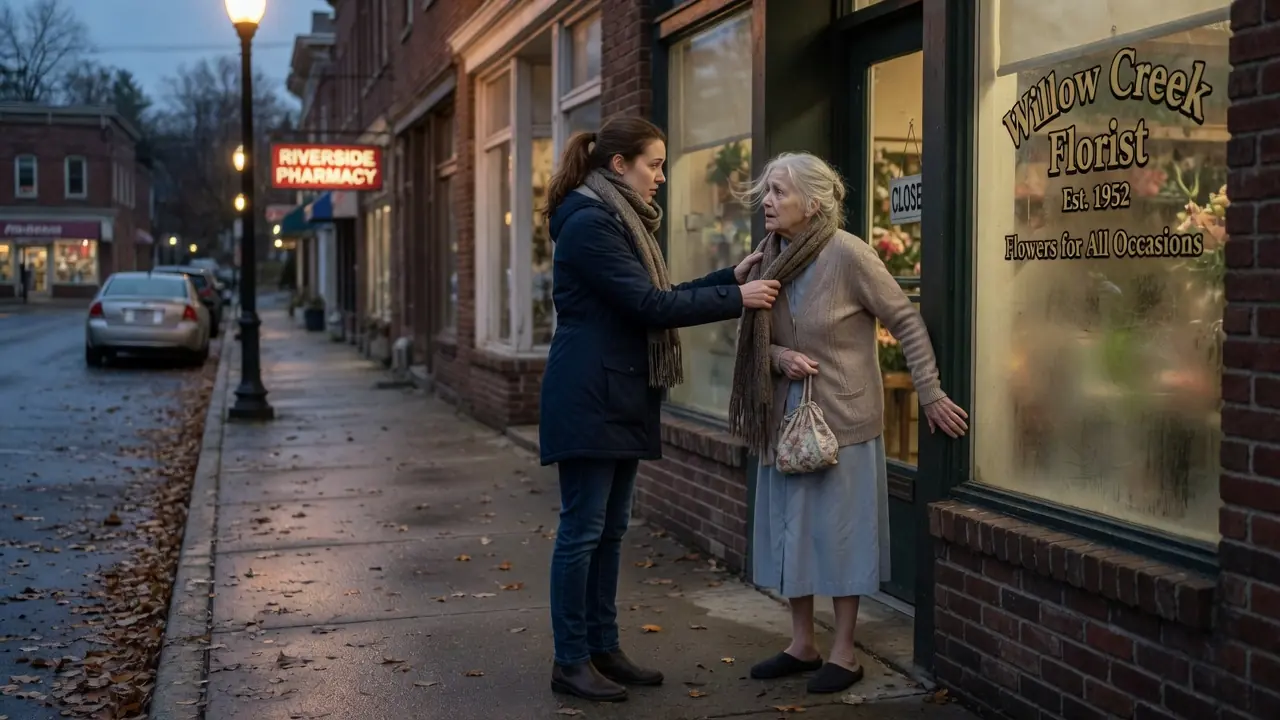
A hard wind pushed dry leaves along the sidewalk, scraping them against curbs and storefronts. Most shops on Main Street had already closed, and the pharmacy sign blinked red against the dark.
Emily pulled her coat tighter and checked the time on her phone. Lily was with Mrs. Alvarez, the retired neighbor who watched her after school on Emily’s late nights. Emily hated being late, even when Mrs. Alvarez insisted it was fine. Single mothers lived by clocks, and every delay carried guilt.
That was when Emily saw the woman.
An elderly woman stood near the corner of Maple Avenue, just outside the closed florist shop. She wore a thin beige cardigan over a pale blue dress, black slippers, and no coat.
Her silver hair was loosely pinned, but strands had fallen around her face in the wind. Her bare hands trembled, one clutching a small cloth purse and the other pressed against the brick wall as if she needed it to stay upright.
Emily stopped.
At first, she thought the woman might be waiting for someone. Then the woman looked around slowly, and Emily saw the confused fear in her pale blue eyes. It was not ordinary uncertainty. It was the look of someone standing in a familiar world that had suddenly stopped making sense.
A car passed, and the woman flinched.
Emily crossed the sidewalk carefully.
“Ma’am?” she called gently. “Are you all right?”
The elderly woman turned toward her.
Her eyes searched Emily’s face as if trying to decide whether she belonged to a memory.
“I’m waiting,” she said.
“For someone?” Emily asked.
The woman frowned.
“I think so.”
Emily thought of Lily waiting at Mrs. Alvarez’s apartment. Then she thought of Grandma June standing confused in the rain years ago because she thought she had to catch a bus to work, though she had been retired for twenty years.
“What’s your name?” Emily asked softly.
The woman opened her mouth.
Then stopped.
Panic filled her face.
“I know it,” she whispered.
“That’s okay,” Emily said quickly. “No rush.”
“I know my name,” the woman said, more to herself than to Emily.
“I believe you.”
The woman looked down the street.
“My husband said he would be right back.”
Emily’s heart sank.
“Where did he go?”
The woman’s face folded in confusion.
“I don’t know.”
“Do you know where you live?”
Again, the woman tried to answer. Again, nothing came. Her eyes filled with shame so quickly that Emily felt it like a hand around her own throat. The woman lowered her head and whispered, “I’m sorry. I’m being foolish.”
“No,” Emily said softly. “You’re cold.”
The woman looked at her hands as if she had only just noticed them.
“I shouldn’t be out here.”
“No, ma’am,” Emily said. “But you are, and I’m here now.”
The woman blinked at her.
Emily slipped off her scarf and wrapped it around the woman’s neck. Then she removed her own gloves and placed them over the woman’s cold fingers. The wind cut into Emily’s bare hands immediately, but she ignored it. Mothers got used to giving warmth away.
“My name is Emily Harper,” she said. “I live two blocks from here with my daughter. I’m going to help you get warm, okay?”
The woman looked uncertain.
“I shouldn’t go with strangers.”
“That’s a very good rule,” Emily said. “So we’ll do this carefully. I’m going to call the police station and tell them exactly where you are. But first, I need to get you out of this cold before you get sick.”
The woman shivered so hard her shoulders shook.
“I don’t want to be trouble.”
“You’re not trouble,” Emily said.
She offered her arm, and the woman held it carefully.
They walked slowly through the cold. Every few steps, the woman looked behind her as if she expected someone to appear from the dark street and explain everything. Emily did not rush her. She kept her voice calm and steady, the way she had learned during nights with Grandma June and mornings with a frightened child.
“You’re doing fine,” Emily said.
“I should remember.”
“It’s okay.”
“My husband will worry.”
“What’s his name?”
The woman frowned, searching through the fog inside her own mind.
“Robert,” she whispered after a moment.
Then she smiled faintly.
“Robert always forgets his hat.”
Emily smiled too, though her throat felt tight.
“Then we’ll make sure he gets a hat when we find him.”
The woman laughed softly, then looked confused again, as if even laughter had surprised her.
Emily’s apartment was small, on the second floor above an old hardware store. It had one bedroom for Lily, a pullout couch where Emily slept, a narrow kitchen, and a dining table covered with school papers, social work textbooks, and one basket of unfolded laundry. It was not much, but it was warm. It was also the first place Emily had ever made fully her own.
She guided the elderly woman inside and helped her sit on the couch.
“I’m going to call someone for help,” Emily said. “But first, I’ll get you a blanket.”
The woman nodded.
Emily brought the thick quilt from her own bed and wrapped it around her shoulders. Then she filled the kettle, turned on the small stove, and warmed leftover chicken and rice soup from the night before. She set a pair of wool socks near the woman’s feet and knelt carefully in front of her.
“Your slippers are damp,” Emily said. “May I help you change into these?”
The woman looked embarrassed.
“Oh, dear, you don’t need to fuss.”
“It’s not fussing,” Emily said. “It’s cold feet.”
The woman looked at her for a long second.
Then she nodded.
Emily helped her gently, the way she had helped Grandma June. She removed the damp slippers, warmed the woman’s feet between her hands for a moment, then slipped on the dry socks. The woman closed her eyes. Her face softened with a grief so tender that Emily almost looked away.
“My mother used to do that,” the woman murmured.
Emily paused.
“What was your mother’s name?”
The woman’s eyes opened slowly.
“I don’t remember.”
The pain in her voice was quiet and devastating.
Emily sat back on her heels.
“That’s okay. You don’t have to force it.”
“I keep losing things.”
Emily touched the edge of the quilt.
“Then for tonight, I’ll keep track.”
The woman looked at her, and tears filled her eyes.
Emily brought her a bowl of soup and a slice of bread. The woman held the spoon with shaky fingers, so Emily sat close and steadied the bowl. A few minutes later, Emily’s phone buzzed. It was Mrs. Alvarez asking if everything was all right.
Emily typed back quickly.
Found an elderly woman confused in the cold. Calling police now. Can Lily stay a little longer?
The reply came within seconds.
Of course. I’ll feed her. Be safe.
Emily exhaled with relief, then called the local police station. She reported that she had found an elderly woman confused and underdressed near Maple Avenue. She gave her address, described the woman carefully, and asked if anyone had reported a missing person.
No report had come in yet.
The officer advised Emily to keep the woman warm and said someone would check soon. There had been a road accident on the edge of town, so it might take time. Emily thanked him, hung up, and looked toward the couch. The elderly woman was staring at the quilt as though it contained a memory she could not reach.
“What’s your name, dear?” the woman asked.
“Emily.”
“That’s a pretty name.”
“Thank you.”
“My granddaughter has a pretty name.”
“What is it?”
The woman smiled.
Then the smile faded.
“I don’t know.”
Emily swallowed hard.
She asked permission before opening the woman’s purse. Inside, she found a tissue, a peppermint candy, a folded grocery receipt, a house key, and a small photograph of a younger woman, a man, and two children. There was no ID. No phone. No address.
Emily took a photo of the woman, but only after asking gently.
“I’m going to post online that you’re safe and looking for family,” Emily said. “Is that okay?”
The woman touched her hair self-consciously.
“I look terrible.”
“You look cold,” Emily said. “And safe.”
She wrote a post in the Willow Creek community group.
Found an elderly woman near Maple Avenue around 7:20 p.m. She is safe, warm, and indoors. She seems confused and does not have ID. If you recognize her or know her family, please contact the Willow Creek Police Department or me immediately.
She included the photo and her phone number.
Then she waited.
The woman finished half the soup. Emily brought warm tea with honey, set the damp slippers near the heater, and placed the beige cardigan over the back of a chair. The woman kept asking the same questions every few minutes, and each time, Emily answered as if it were the first time.
“Where am I?”
“You’re at my apartment. My name is Emily. You’re safe.”
“Am I waiting for Robert?”
“We’re trying to find your family.”
“Did I do something wrong?”
“No. You got cold and confused. That’s all.”
Around nine o’clock, Mrs. Alvarez knocked softly and brought Lily home.
Lily entered quietly, still wearing her school hoodie, her backpack hanging off one shoulder. She looked at the elderly woman on the couch, then at her mother. Emily expected questions, but Lily only took off her coat and whispered, “Should I be quiet?”
Emily’s heart squeezed.
“Yes, baby. She’s had a hard night.”
Lily nodded. Then she disappeared into her room and returned with her softest stuffed rabbit. She placed it on the coffee table near the woman, not forcing it into her hands. “For if she gets scared,” Lily whispered.
The elderly woman looked at the rabbit, then at Lily.
“What a kind child,” she said.
Lily smiled shyly.
“My mom says scared people need soft things.”
Emily had to turn away for a second.
By ten o’clock, a police officer arrived, took basic information, and checked the online post. Still no match.
Because the woman was calm, warm, and safe, and because the nearest emergency department was overwhelmed that night, the officer agreed to continue searching while Emily stayed with her. He promised to call if anyone reported her missing.
Emily put Lily to bed, but her daughter did not fall asleep immediately.
“Mom,” Lily whispered from under the blanket. “Is she like Grandma June?”
“A little,” Emily said.
“Will her family find her?”
“I hope so.”
“What if they don’t?”
Emily sat beside the bed and brushed hair away from Lily’s forehead.
“Then we keep her safe until they do.”
Lily nodded as if that answer made perfect sense.
Because in their little home, safety had always been something shared.
Emily did not sleep much.
The elderly woman dozed on the couch, wrapped in the quilt. Sometimes she woke frightened, and Emily came from the chair beside her. She whispered the words she had once said to June and still said to Lily.
“You’re safe. I’m here.”
Once, near dawn, the woman opened her eyes and said, “My name is Margaret.”
Emily sat up quickly.
“Margaret?”
“Margaret Ellis,” the woman whispered.
Then she fell asleep again.
Emily wrote it down immediately.
At 7:36 the next morning, her phone rang.
A man’s voice came through, breathless and shaking.
“Is this Emily Harper?”
“Yes.”
“My name is Daniel Ellis. I think you found my mother.”
Emily stood so quickly that the chair scraped the floor.
“Margaret Ellis?”
The man made a broken sound.
“Yes. Oh God. Yes. Is she all right?”
“She’s safe,” Emily said. “She’s sleeping right now.”
“I’ve been looking all night. I don’t use Facebook much. A neighbor just saw the post and called me.”
Emily gave him the address.
Fifteen minutes later, Daniel Ellis knocked on her apartment door.
He was a white American man in his early forties, tall, with tired blue eyes, short brown hair, and a winter coat thrown over what looked like pajama pants. His face was pale from fear and lack of sleep. When Emily opened the door, he looked past her and saw the elderly woman sleeping on the couch.
“Mom,” he whispered.
Margaret opened her eyes slowly.
She looked at him without recognition for one heartbreaking second.
Then her face softened.
“Daniel?”
He dropped to his knees beside her.
“Yes. It’s me.”
“You found me.”
He took her hands and began to cry.
“I’m so sorry,” he whispered. “I’m so sorry, Mom.”
Margaret touched his cheek.
“Don’t cry, sweetheart.”
Emily stepped into the kitchen to give them a moment. Lily stood in her bedroom doorway, watching quietly, holding the frame with one hand. Emily walked over and pulled her daughter close. Lily leaned against her side and whispered, “That’s her son?”
Emily nodded.
“He was scared too,” Lily said.
“Yes,” Emily whispered. “He was.”
After a few minutes, Daniel came to Emily with red eyes.
“She has Alzheimer’s,” he said. “It’s gotten worse this year. She lives with me now. Last night, I was upstairs putting my daughter to bed. The back door latch didn’t catch properly, and Mom must have thought she was going to meet my father.”
“Robert?” Emily asked softly.
Daniel nodded, tears filling his eyes again.
“My dad died nine years ago.”
Emily looked toward the couch.
“She kept saying he would be worried.”
Daniel covered his mouth for a moment.
“She asks for him when she’s scared.”
“I called the police,” Emily said.
“I know. They called me after I filed the missing report, but somehow the details crossed. I was driving around all night. I checked the church, the old house, the grocery store.” He looked at Emily with helpless gratitude. “You took her in?”
“She was freezing.”
“You fed her?”
“Soup and tea.”
“You stayed with her all night?”
Emily glanced toward Lily.
“We both did, in our way.”
Daniel noticed Lily for the first time and softened immediately.
“You must be Lily.”
Lily nodded shyly.
“I gave her my rabbit.”
Margaret, from the couch, held up the stuffed rabbit with a faint smile.
Daniel’s face crumpled again.
“Thank you,” he said to Lily.
Lily looked at her mother, then back at him.
“Scared people need soft things.”
Daniel covered his eyes for a second.
When he lowered his hand, he looked at Emily with even deeper respect.
“You treated my mother like family.”
Emily did not know what to say.
Daniel took a long breath.
“I don’t want to insult you by offering money like this was a service.”
“You don’t owe me money.”
“I know. But I need help.” He looked toward Margaret. “I’ve been trying to care for her alone. My wife helps, but we both work. My daughter is eight. I thought I could manage everything. Last night proved I can’t.”
Emily listened.
Daniel continued.
“I run a small elder-care resource office in the next town. Mostly paperwork, caregiver referrals, support groups, respite care lists. My mother used to help me there before she got sick. We’ve been trying to start a volunteer companion program for families dealing with memory loss, but I haven’t found the right person to help organize it.”
Emily’s heart began to beat faster.
“I don’t have a degree yet,” she said.
“I’m not asking you to be a nurse or a doctor,” Daniel said. “I’m asking if you would consider a paid part-time role helping build the program. Outreach calls, caregiver check-ins, safety cards, community posts, sitting with families, helping them feel less alone.”
Emily stared at him.
“You’re offering me a job?”
“I’m offering you a chance to turn what you already do naturally into something that helps more people.” Daniel’s voice softened. “And if you’re studying social work, I can also write a recommendation for your field placement when the time comes.”
Emily looked at Lily, who was now standing beside Margaret while the elderly woman admired the stuffed rabbit. She thought of rent, bills, school supplies, online classes, late nights, and the dream she had almost given up because survival kept demanding everything first. She thought of Grandma June. She thought of the cold street and the woman who had forgotten her own name but not the feeling of being afraid.
“What would the program be called?” Emily asked.
Daniel gave a tired smile.
“My mother named it before she got sick. Safe Return.”
Emily’s eyes filled.
“That’s a good name.”
“She always had good names.”
A week later, Emily visited Daniel’s elder-care office.
It was small, with two desks, a bulletin board, stacks of brochures, and a coffee machine that sounded like it was losing a fight. Margaret sat in a chair by the window, looking through a picture book, calm and neatly dressed. Lily came too, because Emily had not yet found anyone to watch her that afternoon.
When Margaret saw Emily, she smiled.
“I know you,” she said.
Emily smiled back.
“You do?”
“You gave me soup.”
Daniel looked away, emotional.
Lily whispered, “And I gave you the rabbit.”
Margaret looked at Lily, then smiled.
“Yes,” she said. “For scared people.”
Emily began working for Safe Return the following month.
It was only part-time at first. She still worked at the dental office and took classes at night after Lily went to sleep. But two afternoons a week, she helped Daniel call caregivers, create missing-person emergency forms, print ID cards for seniors with memory loss, build a private community alert list, and organize training sessions for families.
She helped write simple scripts for what to say when someone was confused.
She helped create a “go bag” list for caregivers.
She helped families label doors gently, not like warnings, but like reminders.
She helped set up a volunteer check-in group so no family felt completely alone.
Lily sometimes sat in the corner after school coloring quietly while Emily worked. Daniel’s daughter, Ava, occasionally joined her, and the two girls became friends over crayons, snacks, and the shared understanding that grown-ups could love someone and still be very tired. Emily felt less embarrassed about bringing Lily after Daniel told her, “A program about families should make room for yours too.”
That sentence stayed with her.
For years, Emily had believed being a single mother meant apologizing for needing flexibility. She apologized when she was late, when Lily was sick, when childcare fell through, when she could not attend evening events, when she was too tired to pretend everything was fine. At Safe Return, she slowly learned that her life was not an inconvenience to work around. It was part of the reason she understood the work so well.
Margaret became the heart of the office.
Some days, she remembered Emily. Some days, she did not. But she always accepted tea from her, and sometimes, when the room was quiet, she would say, “You’re the girl from the cold.” Emily would answer, “Yes, Mrs. Ellis.” And Margaret would say, “You brought me home.”
Emily never corrected her.
Because in the way that mattered, it was true.
Years later, Safe Return became a respected local program for families caring for loved ones with Alzheimer’s and memory loss. Emily finished her degree with Daniel’s recommendation and became a caregiver support coordinator. The program helped families prepare before emergencies, not after them. It helped local police, libraries, churches, schools, and neighborhoods respond faster when someone wandered.
Lily grew up watching her mother build something from one cold night and one act of kindness.
She learned that helping someone did not always require wealth, certainty, or perfect timing. Sometimes it required a scarf, a bowl of soup, a couch, and the courage to be late for your own life because someone else was standing in the cold. Emily worried that her daughter had seen too much struggle. But Lily once told her, “Mom, I think I saw you become who you were supposed to be.”
Daniel did not give Emily a house.
He did not give her a fortune.
He gave her something smaller, but life-changing.
A part-time job.
A letter of recommendation.
A doorway into the work she had always been meant to do.
And perhaps most importantly, he gave her proof that kindness given from an exhausted heart did not disappear into the world unpaid. Sometimes it returned as opportunity. Sometimes it returned as purpose. Sometimes it returned as a daughter watching her mother and learning that compassion was not weakness.
On the wall of the Safe Return office, Emily framed one sentence Margaret had said the morning Daniel found her.
“You gave me soup.”
People smiled when they saw it.
But Emily knew what it meant.
It meant warmth before answers.
Care before identity.
Safety before explanation.
It meant that on a bitter Tuesday evening, a single mother with too much to carry still stopped for someone who had lost her way. It meant that one act of kindness could become a bridge between grief and purpose. It meant that even when life had made Emily tired, it had not made her hard.
Every winter, when the air turned sharp and the sidewalks glittered with frost, Emily remembered the elderly woman standing outside the florist shop in slippers, waiting for a husband who was no longer alive.
She remembered the cold hands.
The forgotten name.
The bowl of soup.
The online post.
The son knocking at her door with terror in his eyes.
And she remembered the lesson that shaped the rest of her life.
Sometimes, helping someone begins before you know who they are.
Sometimes, love means caring first and understanding later.
And sometimes, a single mother who thinks she is barely holding her own life together becomes the reason someone else finds the way home.