“Go, child—your flight is closing, and I’m not worth losing your future over.”
Seventy-eight-year-old Margo Rivers tried to pull her boarding pass from Kelly Ellis’s hand, but her fingers trembled too badly to hold it. Around them, Hartsfield–Jackson Atlanta International Airport churned with holiday travelers, rolling suitcases, frustrated families, and final boarding announcements echoing from every direction. Kelly’s own flight to Charlotte was already boarding at the opposite end of Terminal B, and her pediatric residency shift began in less than six hours. Still, the frightened widow standing before her was headed toward the wrong concourse and appeared close to tears.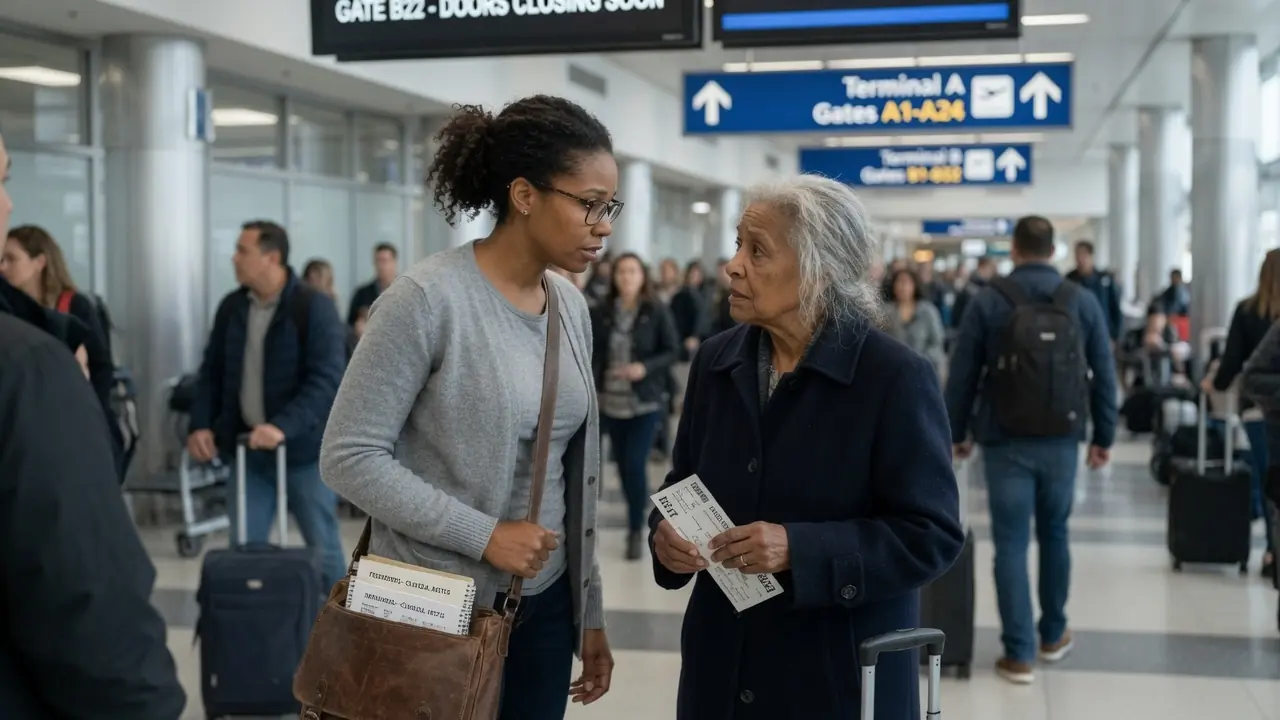
“You’re lost, frightened, and alone,” Kelly said, taking the handle of Margo’s suitcase. “I’m not leaving you here.”
Margo looked at the exhausted young doctor’s worn sneakers, thin cardigan, and leather messenger bag overflowing with medical notes. Kelly’s natural curls had been pinned hastily into a bun, and dark circles shadowed her honey-brown eyes behind narrow glasses. Everything about her suggested someone who had already given too much of herself that day. Yet she stood firmly between Margo and the crowd, refusing to place convenience above another person’s fear.
“Why would you risk everything for an old stranger you’ll never see again?” Margo asked.
Kelly guided her toward the correct gate. “Because your family is waiting. Come with me before both our lives miss their connection.”
The airport signs changed twice while they walked, forcing Kelly to redirect them through a crowded security corridor. Margo apologized every few minutes, explaining that travel had become harder since her husband died the previous year. Harold had always carried the tickets, checked the gates, and remembered which suitcase contained the medicine. Without him, Margo felt as though someone had removed half the instructions from the world.
Kelly listened without rushing her.
She learned that Margo lived outside Atlanta near her son, Ricardo, and his five-year-old daughter, Sophie. Ricardo was raising Sophie alone after losing his wife, while also managing the child’s type 1 diabetes and working at a neighborhood community center. Margo spoke proudly of her son but worried that exhaustion had become so familiar to him that he no longer recognized it. She also worried that Sophie had begun drawing a third figure into every family picture, leaving a space for “someone special.”
“My Ricardo is a good man,” Margo said. “Too good at carrying pain quietly.”
Kelly smiled. “Quiet people usually carry the heaviest things.”
Margo studied her. “You sound as if you know.”
Kelly’s smile faded slightly. She had spent most of her twenties moving from examination halls to hospital corridors, building a career while postponing everything that did not fit into a schedule. Her parents were proud, her patients trusted her, and her colleagues described her as dependable. Yet some nights, after twenty hours of caring for frightened children, she returned to an apartment so silent that even success felt temporary.
They reached Margo’s gate as boarding began.
The widow clasped Kelly’s hand with surprising strength. “You’re an angel.”
“I’m a tired resident who reads airport signs better than you do.”
“No.” Margo’s blue-gray eyes brightened. “Not everyone stops. Most people looked directly at me and kept walking.”
Kelly glanced at the clock and saw that her own gate had closed.
She had missed the flight.
For one second, panic tightened her chest. Her chief resident had already warned her that another delayed arrival could affect her evaluation. The hospital was short-staffed, and every absence meant more pressure on someone else. Kelly pulled out her phone, prepared to explain, and felt Margo’s hand close around hers again.
“I’m sorry,” the older woman whispered.
Kelly looked at her and made a decision. “Don’t be. I’ll find another flight.”
Margo repeated Kelly’s full name twice before boarding, as if committing it to memory. Then she looked back from the aircraft doorway and called, “My son needs someone who notices people the way you do.”
Kelly laughed despite herself. “Get home safely, Mrs. Rivers.”
The next available flight was canceled because of weather. Kelly spent the night on an airport chair, emailed the hospital repeatedly, and arrived in Charlotte just long enough to board another plane back to Atlanta after the rotation schedule changed. By the time she reached Atlanta Metropolitan Hospital, she had slept fewer than three hours and consumed enough coffee to make her hands shake.
She expected reprimands.
Instead, the pediatric ward swallowed her into its usual controlled chaos. A six-year-old needed bloodwork, a frightened mother needed reassurance, and an infant’s fever refused to follow the expected pattern. Kelly moved from room to room, exhaustion disappearing whenever a child looked at her with fear. Helping Margo had cost her rest and possibly professional goodwill, but she still could not regret stopping.
Two days later, a new patient arrived in room 415.
The chart identified five-year-old Sophie Rivers, admitted after a severe hypoglycemic episode complicated by recent insurance disruptions. Kelly read the name twice, then told herself Rivers was common enough to mean nothing. Still, when she entered the room and saw a small girl wearing blue-framed glasses and space-themed pajamas, an uneasy sense of recognition settled over her.
Sophie sat upright in bed, coloring a rocket ship.
A man slept in the visitor’s chair beside her, one hand wrapped around the child’s glucose log. He was in his early thirties, broad-shouldered but lean from stress, with dark hair, faint gray at the temples, and a child-made friendship bracelet around his wrist. Even asleep, his posture remained protective, as though some part of him refused to stop guarding his daughter.
“Hi,” Kelly said softly. “I’m Dr. Ellis.”
Sophie adjusted her glasses. “Are you a space doctor?”
“Not officially.” Kelly lifted her penlight. “But this is a tiny star doctors use to check astronaut eyes.”
The girl immediately became interested.
Kelly turned the examination into a mission briefing. The stethoscope checked Sophie’s spacecraft engine, the pulse oximeter measured her oxygen supply, and the thermometer protected her from alien fever. By the time the man in the chair woke, Sophie was laughing.
He stood so quickly that the medical log fell from his hand. “Is she all right?”
“She’s stable,” Kelly assured him. “I’m reviewing what caused the drop.”
“I track everything.” He unlocked his phone and opened a detailed spreadsheet. “Meals, activity, insulin doses, sleep, symptoms, every reading. Her endocrinologist retired, and the replacement clinic doesn’t accept our insurance.”
Kelly examined the records.
They were more precise than many hospital charts. “You’ve done excellent work.”
The compliment seemed to strike him unexpectedly. “I’m Ricardo Rivers.”
Kelly’s hand paused above the screen.
“Your mother’s name is Margo?”
His tired green eyes sharpened. “You know her?”
Kelly smiled. “I helped her find a gate at this airport two nights ago.”
Ricardo stared at her before laughing softly in disbelief. “You’re Kelly.”
“Apparently she mentioned me.”
“She called you her airport angel before telling me anything about the trip.”
Sophie looked between them. “Grandma said she found Daddy a doctor.”
Ricardo closed his eyes. “She said no such thing.”
“She said you needed someone kind.”
Kelly felt heat rise into her face. “Your grandmother was tired.”
“She’s also persistent,” Ricardo said.
Their shared embarrassment gave way to the reason they were there. Kelly reviewed Sophie’s insulin history, contacted a pediatric endocrinologist willing to accept the family’s insurance, and adjusted the short-term care plan with the attending physician. Throughout the afternoon, Ricardo asked careful questions without pretending to understand what he did not.
Kelly admired that.
Many frightened parents hid uncertainty behind aggression or silence. Ricardo’s fear was visible, but so was his discipline. He took notes, repeated instructions, and never allowed his anxiety to become Sophie’s burden.
When Kelly returned during evening rounds, Sophie held up a drawing.
It showed a space hospital floating among purple stars. Three figures stood beneath it: Sophie in a helmet, Ricardo wearing a blue cape, and Kelly holding a star-shaped stethoscope. A small heart connected all three.
“That’s you,” Sophie explained. “You came because Grandma found you first.”
Kelly looked toward Ricardo.
He appeared equally affected by the picture. “She has been adding people to family drawings without consulting management.”
“Management is too slow,” Sophie replied.
Kelly laughed, and for the first time in months, the sound did not feel borrowed from someone less tired.
Sophie was discharged two days later with a safer treatment plan and an appointment with the new endocrinologist. Kelly made certain another physician assumed primary responsibility before the family left, knowing that her growing personal interest made professional boundaries important. Ricardo thanked her twice in the hallway, then seemed reluctant to walk away.
“I owe you,” he said.
“You don’t.”
“You helped my mother, then my daughter.”
“Both needed help. That doesn’t create debt.”
His expression softened. “Would coffee create a problem?”
Kelly hesitated.
The answer should have been easy. She was a resident with impossible hours, and he was the father of a recent patient. Even though she was no longer involved in Sophie’s care, caution remained necessary. Yet the way Ricardo asked carried no pressure, only hope carefully restrained by respect.
“Coffee after Sophie’s follow-up,” she said. “When everything is formally transferred.”
He smiled. “That sounds fair.”
They met unexpectedly before the coffee could happen.
Kelly went to a Saturday farmers market because her refrigerator contained expired yogurt, mustard, and nothing resembling a proper meal. She wore jeans, a green sweater, and pearl earrings her mother had given her after medical-school graduation. She was comparing tomatoes when a familiar voice shouted across the crowd.
“Dr. Kelly!”
Sophie ran toward her holding a slightly crumpled drawing. Ricardo followed several steps behind, looking healthier than he had in the hospital. Margo walked beside him with the satisfied expression of someone watching a plan develop exactly as intended.
“The stars knew you’d be here,” Sophie announced.
Ricardo shook his head. “We have been searching every stall because she refused to accept that possibility and coincidence are different things.”
“Sometimes they aren’t,” Margo said.
Sophie gave Kelly the space-hospital drawing. New stars filled the page, and a small garden had appeared beside the building. Kelly promised to place it on her refrigerator, then helped the family choose affordable vegetables.
Ricardo admitted that the community center was launching a healthy-cooking program for children but lacked medical guidance. Kelly offered to volunteer one evening, making clear that she did not expect payment. His surprise made her wonder how often generosity had arrived in his life with conditions.
At the flower stall, Sophie bought three daisies with coins from Margo.
“One for me, one for Daddy, and one for you,” she told Kelly.
“Why three?”
“Three is a family number.”
Ricardo nearly dropped the spinach.
Margo looked delighted.
Coffee became dinner at Ricardo’s house the following week. Kelly brought vegetables and garlic bread, while Sophie wore a sparkling apron and appointed herself commander of “Space Spaghetti Mission.” The small home was crowded with medical supplies, community-center paperwork, children’s books, and signs of a father who organized every detail around his daughter’s safety.
A photograph of Ricardo’s late wife stood near the living-room bookshelf.
Her name had been Lisa. She died from complications of an undiagnosed heart condition when Sophie was two. Ricardo spoke about her without hiding love or turning memory into a wall, though Kelly saw how guilt still shadowed his face.
“I worry Sophie won’t remember her,” he admitted after dinner.
“She will remember the love Lisa left in you,” Kelly replied. “It’s in the way you care for her.”
Ricardo looked at her for a long moment. “You always know what to say?”
“No. At work, I’m professionally trained to look confident while panicking internally.”
He laughed.
That laugh became one of Kelly’s favorite sounds.
Over the following months, they built something carefully. Kelly volunteered at the community center, teaching children basic health skills through Sophie’s space-themed lessons. Ricardo attended hospital charity events and waited outside after Kelly’s longest shifts with coffee and food she would otherwise forget to eat.
Sophie accepted Kelly with the uncomplicated certainty of a child who had already decided what adults were still afraid to admit.
Margo offered advice whether requested or not.
Yet love did not erase difficulty.
Ricardo feared another loss so intensely that every change in Sophie’s glucose readings became a warning of disaster. Kelly feared being needed by people she could not guarantee saving. Her work demanded nights, weekends, and sudden departures, while his life required routines stable enough to protect a child with a chronic illness.
Their deepest conflict arrived during another emergency.
Sophie’s glucose levels became dangerously unstable after a birthday party where a supposedly sugar-free cake contained unexpected ingredients. Ricardo texted Kelly from the emergency department, and she arrived off duty before he could tell her not to.
Sophie lay pale beneath hospital blankets.
Ricardo stood beside the bed with terror stripped bare across his face. Kelly helped the medical team understand Sophie’s history, stayed through testing, and told space stories during every procedure. Near dawn, the girl’s numbers finally stabilized.
Ricardo stood near the window while Sophie slept.
“Lisa died in a hospital at sunrise,” he said.
Kelly moved beside him.
“I watched the light come through the window while they told me there was nothing else they could do.” His voice cracked. “When Sophie gets sick, I’m back there. Every time.”
Kelly touched his arm. “You didn’t fail Lisa.”
“I couldn’t save her.”
“You loved her. Those are not the same thing.”
He turned toward her with tears in his eyes. “I can’t lose Sophie.”
“You won’t lose her today.”
“And you?”
The question silenced her.
“I’m terrified of needing you,” Ricardo admitted. “Because once I need someone, I imagine the moment they disappear.”
Kelly understood more than she wanted to.
Medicine had allowed her to care while maintaining enough distance to survive. Ricardo and Sophie had crossed that boundary. Their pain no longer remained in a chart she could close at the end of a shift.
“I’m afraid too,” she whispered. “I spend my life trying to fix things, and loving you means accepting that I can’t control every outcome.”
Ricardo took her hand. “Did you say loving?”
Kelly looked at their joined fingers. “I think I did.”
Sophie stirred in the bed.
Both adults turned instantly, and the child opened one eye. “Astronaut teams don’t explore space alone.”
Kelly laughed through tears.
Ricardo kissed her for the first time beside the hospital window, gently and briefly, while morning light entered the room. It was not a promise against loss. It was an agreement to stop allowing fear to make every decision.
Their relationship deepened through ordinary moments rather than grand gestures. Tuesday breakfasts became sacred, even when Kelly arrived in scrubs after night shifts. Thursday evenings belonged to Ricardo and Kelly while Margo watched Sophie.
Kelly learned how to calculate carbohydrates for pancake shapes, while Ricardo learned that residents needed silence before conversation after difficult cases. Sophie taught both of them that Pluto still counted, failed cookies tasted better, and all medical explanations improved when astronauts were involved.
Six months later, Kelly stood inside the community center after a family science night, taking paper stars down from the ceiling. Ricardo carried a sleeping Sophie from the yoga mats and stopped beside her. His expression was nervous in a way she had rarely seen.
“Move in with us,” he said.
Kelly froze with a paper moon in her hand.
“That sounded less frightening in my head,” he admitted. “Your lease ends next month. Sophie asks whether you’re coming home for dinner. I ask myself the same thing.”
“It’s a huge step.”
“I know.”
“My shifts are terrible.”
“We’ll adjust.”
“I bring work home.”
“So do I.”
“I’m not always patient.”
Ricardo smiled. “You have met my mother.”
Sophie lifted her head from his shoulder. “Please say yes. We can turn the office into your space station.”
Kelly stared at the father and daughter who had transformed her carefully controlled life into something crowded, difficult, and alive. She thought about the airport, the missed flight, and Margo’s prediction that their paths would cross again.
“Yes,” she whispered.
Sophie became instantly awake.
Life together required adjustment. Kelly missed school projects because of emergencies and sometimes returned too exhausted to speak. Ricardo occasionally protected her from family responsibilities so completely that she felt excluded rather than supported.
They learned to argue honestly.
They created a shared calendar, protected family breakfasts, and stopped pretending love removed the need for boundaries. Kelly did not replace Lisa, and no one asked her to. Instead, Lisa’s photographs remained on the walls while new pictures appeared beside them.
A year after meeting at the airport, Kelly and Ricardo returned to Terminal B with Sophie and Margo.
They were traveling to Savannah to visit Kelly’s parents. Margo carried her own boarding pass confidently but allowed Sophie to double-check the gate because the child insisted she had inherited “airport responsibility.” Near the information board, Ricardo took Kelly’s hand.
“This is where it happened?”
Kelly nodded. “Your mother was standing right there.”
Margo smiled. “Lost, cold, and apparently excellent at matchmaking.”
“You could have simply asked for help,” Ricardo said.
“I did ask. Then I observed character.”
Kelly laughed. “You cost me a flight.”
“I gave you a family.”
“That is a very dramatic interpretation.”
“It is also accurate,” Sophie said.
Ricardo reached into his coat pocket.
Before Kelly understood what he was doing, he lowered himself onto one knee in the same airport concourse where she had once chosen a frightened stranger over her own schedule. Travelers moved around them, announcements echoed overhead, and Sophie covered her mouth with both hands.
“Kelly Nadine Ellis,” Ricardo began, “you found my family before you knew we were yours.”
Her eyes filled immediately.
“You stopped for my mother when everyone else kept walking. You cared for my daughter without making her feel broken, and you loved me without asking me to erase who came before you.” He opened a small ring box. “Will you keep choosing this imperfect, complicated crew for the rest of our lives?”
Kelly looked at Margo.
The older woman was crying openly.
Sophie whispered, “Say yes before we miss the flight.”
Kelly laughed and held out her hand. “Yes.”
They married six months later in the backyard beneath paper stars and a simple arch. Sophie served as flower girl, junior astronaut of honor, and unofficial ceremony supervisor.
Margo sat in the front row holding Harold’s photograph.
Kelly’s parents stood beside Ricardo, welcoming him and Sophie with the same warmth their daughter had offered an old woman at the airport. When Kelly and Ricardo exchanged vows, they promised not perfection but presence, honesty, and the courage to remain when fear suggested running.
Sophie asked to speak before the final blessing.
“When my first mom died, Daddy said she became a star,” she told the guests. “Then Grandma found Mom Kelly at the airport, and Mom Kelly found us at the hospital. Now we’re not replacing any stars. We’re making a bigger constellation.”
No one remained dry-eyed.
Years later, when people asked Kelly how she met her husband, she never began with the hospital or the farmers market. She began with a missed flight.
She described a confused widow holding the wrong boarding pass and insisting that her life was not worth delaying someone else’s future. Kelly had not known Margo’s son was a devoted single father or that Sophie would become the child who taught her how large love could grow.
She knew only that someone needed help.
Stopping cost her a flight, sleep, and professional comfort.
It also redirected every road that followed.
One quiet act of kindness carried Kelly from an airport concourse into a hospital room, then into a modest home filled with paper planets, glucose logs, garlic bread, and laughter. It led her to a grieving father brave enough to love again and a little girl who had drawn space for her before they even met.
Margo had been wrong about only one thing.
Kelly did see her again.
And the connection they nearly missed became the one that brought all of them home.