The old man’s voice was so quiet that most people in the checkout line at Dalton Fresh Market barely heard it. Clara Bennett heard every word. She stood behind register four in her green store vest, one hand resting near the scanner, the other beside the open cash drawer, staring at the small pile of crumpled bills and coins the elderly man had placed on the counter.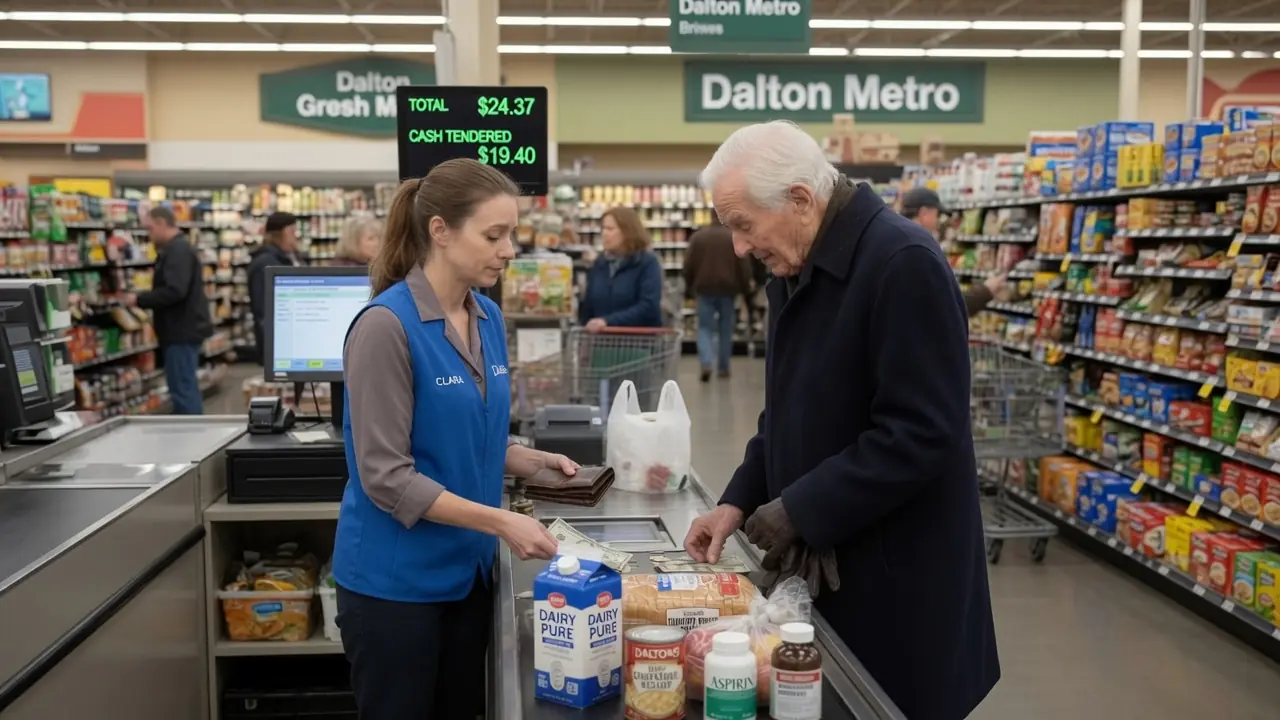
The screen above her lane showed the total in bright green numbers: $24.37. Under it, the cash tendered read $19.40. On the belt sat a carton of milk, a loaf of bread, one can of soup, a bottle of aspirin, and a small bottle of medicine with a white label and a red cap.
The old man looked down as though the whole store had become too bright for him. His white hair was neatly combed, his dark coat was buttoned wrong at the top, and his worn gloves trembled as he touched the medicine bottle. Behind him, two customers shifted impatiently, and someone sighed loud enough to make sure everyone noticed.
Clara looked at his face and saw shame before she saw age. It was not the shame of someone asking for help. It was the shame of someone who had spent his whole life standing on his own feet and now found himself short by less than five dollars in front of strangers.
“It’s all right, sir,” Clara said gently.
The old man shook his head and reached for the medicine. “No, no. I can put it back. I don’t need to make trouble.”
“You’re not making trouble.”
Behind him, a woman with a full cart muttered, “Some of us have places to be.”
Clara glanced at her, then back at the old man. His hand hovered over the medicine, but he did not pick it up. That tiny hesitation told Clara everything. He needed it. He was only pretending he did not.
She thought of her own son, Noah, waiting at home after school with his math worksheet and his worn sneakers that needed replacing. She thought of the last twenty dollars in her wallet, meant for gas and a cheap dinner before payday. Then she thought of her father, who had died three years earlier in a hospital bed, proud until the very end, apologizing to nurses for needing help.
Clara opened her wallet under the counter and pulled out a five-dollar bill.
The old man looked up sharply. “Miss, don’t do that.”
“I already did.” Clara placed the bill beside his money and pressed the total through. “You’re taking the milk, the medicine, and your dignity with you.”
His eyes filled. “I can’t let a stranger pay for me.”
“Then don’t call it payment,” Clara said softly as she bagged his groceries. “Call it someone’s daughter doing what she hopes someone would do for her father.”
The old man stared at her for a moment. His lips parted, but no words came out. Then he nodded once, picked up the bag with both hands, and whispered, “Thank you, Clara.”
She froze slightly. “You know my name?”
He pointed to her name tag with a shy smile. “It says it right there.”
Clara smiled back, though her throat felt tight. “You have a good day, sir.”
He walked away slowly, carrying the white plastic bag like it held something more fragile than groceries. Clara watched him disappear past the produce section, then turned back to the line and kept working. She did not see Richard Hale watching from the end of the aisle.
Richard was the store manager, a man who wore his white shirt like a uniform of authority and kept his tie too tight around his neck. He believed rules made him powerful, and Clara had learned that power was the only thing he enjoyed more than correcting people. He did not shout in front of customers. He preferred to wait until there was a door he could close.
The rest of Clara’s shift crawled by. She scanned cereal, canned vegetables, frozen dinners, diapers, discount meat, and birthday candles. She smiled when customers complained, apologized when things were not her fault, and kept one eye on the clock because Noah’s after-school program charged extra after six.
At 5:03, Richard appeared beside her register.
“Clara,” he said, not looking at her. “My office. Bring your drawer report.”
Her stomach dropped. “Can it wait ten minutes? I need to clock out and pick up my son.”
“No,” he said. “Now.”
Clara’s coworker, Denise, looked over from register two with worried eyes. Clara gave her a tiny shake of the head, trying to say not here. Then she closed her lane, printed the report, and followed Richard through the swinging door into the back hallway.
The manager’s office smelled like stale coffee and printer ink. A whiteboard on the wall listed employee schedules, and through the glass window, Clara could still see the bright aisles of Dalton Fresh Market. It felt cruel that the store kept moving while her life suddenly stood still.
Richard sat behind the desk and placed a paper in front of him. He did not ask her to sit.
“You broke store policy,” he said.
Clara swallowed. “Richard, if this is about the old man, he was short less than five dollars.”
“You used personal cash to complete a customer transaction without supervisor approval.”
“He needed medicine.”
Richard finally looked up. “This store is not a charity.”
Clara felt her hands curl around the drawer report. “It was my money.”
“You were on shift. You involved the company in your personal decision. If he complains, if another customer says you treated him differently, if someone claims you changed the amount or mishandled cash, it becomes our problem.”
“He was embarrassed,” Clara said. “He was going to put back medicine because he didn’t have enough money.”
“And you decided your feelings mattered more than policy.”
Clara stared at him. She was tired in a way that went beyond one shift. Tired of choosing between groceries and gas, tired of being judged by people who had never had to count coins under fluorescent lights, tired of managers who used words like policy when they meant control.
“I covered the rest out of my own pocket,” she said, keeping her voice steady. “That is all I did.”
Richard slid the paper across the desk. “Sign this.”
Clara looked down. The top line read Employee Termination Notice.
Her breath caught. “You’re firing me?”
“You created a violation at the register. You admitted it. I’m documenting it.”
“Richard, I have never been written up. I’m never late. I cover shifts whenever you ask.”
“That does not erase misconduct.”
“It was five dollars.”
“It was policy.”
The word came down like a door slamming. Clara thought of Noah waiting by the school office, his backpack on his lap. She thought of rent due in nine days. She thought of the old car that sometimes needed three tries before the engine turned over.
“Please,” she said, and hated herself for how small it sounded. “I’m a single mom. I need this job.”
Richard’s expression did not change. “Then you should have protected it.”
He opened a drawer and pulled out a small cardboard box. Inside were the kind of things employees kept at work when they had nowhere else to put them: Clara’s notebook, a phone charger, a pack of gum, two pens, and a small photo of Noah in his school uniform. Richard set the box on the desk like a punishment.
“Collect your things,” he said. “Denise will cover your next scheduled shift.”
Clara reached for the box with shaking hands. She could feel tears rising, but she refused to let Richard Hale watch her cry. She lifted the box against her chest and turned toward the door.
That was when a woman stepped into the office doorway.
She was tall, composed, and dressed in a black blazer over a patterned blouse. Her hair was smooth, her posture calm, but her eyes were sharp with something Clara could not place at first. Behind her, two employees had gone still in the hallway.
Richard stood too fast. “Ms. Dalton.”
Clara’s heart stuttered. Vanessa Dalton. The CEO’s name was printed on company emails, training videos, store newsletters, and the plaque near the front entrance. Clara had never seen her in person, but every employee knew who she was.
Vanessa Dalton did not look at Richard first. She looked at Clara, then at the box in her arms, then at the termination paper on the desk.
“What is happening here?” Vanessa asked.
Richard cleared his throat. “A routine personnel matter.”
Vanessa stepped farther into the office. “It does not look routine.”
Richard forced a thin smile. “An employee violated register policy. I was handling it.”
Vanessa looked at the paper. “By firing her?”
“Yes, ma’am.”
Clara stood frozen, still holding the box. She felt like she had accidentally walked into a storm meant for someone else. Vanessa’s gaze moved to her name tag.
“Clara Bennett?” Vanessa asked.
“Yes, ma’am.”
Vanessa’s face softened for only a second before hardening again as she turned back to Richard. “Why are you firing her when she helped my father?”
The office went silent.
Richard blinked. “Your father?”
“The elderly man she paid for at register four,” Vanessa said. “The man you watched leave with milk and medicine.”
Richard’s mouth opened, then closed.
Vanessa placed a brown leather wallet on the desk. “My father is Samuel Dalton. He left this in my car after a doctor’s appointment. He insisted on going into the store alone because he said he still knew how to buy his own groceries. By the time I realized he did not have his wallet, he had already checked out.”
Clara’s grip loosened on the box.
Vanessa looked at her again. “He came back to the car holding that grocery bag and crying. My father does not cry easily, Ms. Bennett. He told me a cashier treated him like a man instead of a problem.”
Clara’s eyes filled before she could stop them.
Richard tried to recover. “Ms. Dalton, I had no way of knowing who he was.”
“That should not matter,” Vanessa said.
Richard flushed. “Of course, but policy exists for a reason.”
“So does judgment.”
He straightened. “I was protecting the company.”
Vanessa’s voice turned cold. “No, Mr. Hale. You were protecting your authority.”
The words struck the room hard enough that Clara almost flinched. Richard’s face turned red. Through the glass window, Denise and another employee stood pretending not to watch while watching everything.
Vanessa picked up the termination notice and read it quickly. “Employee paid customer difference of $4.97 from personal funds to allow purchase of medicine and groceries.”
She looked up slowly. “This is what you considered a fireable offense?”
Richard swallowed. “It was not approved.”
Vanessa tore the paper in half.
Clara gasped softly.
Richard stared. “Ms. Dalton, that document is part of an official record.”
“Not anymore.” Vanessa dropped the torn pieces into the trash can beside his desk. “Clara Bennett is not terminated.”
Clara pressed one hand to her mouth.
Vanessa continued, “She is going home now because her shift is over and because I assume she has a child waiting for her, according to the emergency contact form I reviewed before coming back here.”
Clara nodded, unable to speak.
Vanessa turned to Richard. “You and I will discuss your future with this company after I speak with HR.”
Richard went pale.
Clara should have felt relief, but she mostly felt dizzy. One moment she had been unemployed. The next, the most powerful woman in the company was standing between her and the man who had fired her.
Vanessa stepped closer. “Ms. Bennett, thank you for what you did for my father.”
“I didn’t know he was your father.”
“I know.” Vanessa’s voice softened. “That is exactly why it matters.”
Clara looked down at the box in her arms. “I just didn’t want him to put back his medicine.”
“My father told me that.” Vanessa paused. “He also told me what you said. About being someone’s daughter.”
Clara looked away because the tears had slipped free now.
Vanessa reached into her purse and pulled out a business card. “Please come to corporate office tomorrow at ten. Not for discipline. For a conversation.”
Clara stared at the card. “About what?”
“An offer.”
Richard looked up sharply, but Vanessa ignored him.
Clara took the card with trembling fingers. “I don’t understand.”
“You will tomorrow,” Vanessa said. “Tonight, go get your son.”
That sentence nearly broke her. Clara nodded, whispered thank you, and walked out of the office with the box still in her arms. Denise met her near the break room and squeezed her shoulder. Clara could not explain anything. She only held up the business card, and Denise’s eyes widened.
By the time Clara reached the parking lot, her legs were shaking. She sat in her old sedan and stared at the steering wheel until she remembered she had to pick up Noah. Then she started the car, prayed it would not stall, and drove to the school.
Noah was waiting in the office with his backpack and a library book. At nine years old, he was already too good at reading his mother’s face. He climbed into the car and studied her quietly before buckling his seat belt.
“Bad day?” he asked.
Clara laughed once, but it came out broken. “Very bad. Then maybe not.”
“Did Mr. Richard yell again?”
“Something like that.”
Noah frowned. “I don’t like him.”
“Neither do most adults,” Clara said, then covered her mouth because the answer slipped out before she could stop it. Noah grinned, and the small moment of normal laughter saved her from crying again.
That night, Clara made grilled cheese sandwiches and tomato soup from a can. Noah did homework at the kitchen table while she washed dishes and kept glancing at Vanessa Dalton’s card. Corporate office. Ten o’clock. An offer.
She barely slept.
The next morning, Clara put on her cleanest blouse, tied her hair back, and drove to the Dalton Fresh Market corporate office thirty minutes away. The building was not huge, but to Clara it felt like another world: glass doors, polished floors, framed photographs of store openings, and a receptionist who smiled like Clara belonged there even though she felt certain she did not.
Vanessa came out personally to greet her.
“Ms. Bennett,” she said. “Thank you for coming.”
Clara stood too quickly. “Thank you for inviting me.”
Vanessa led her into a conference room where coffee, water, and a small plate of pastries waited on the table. Clara noticed them, then felt embarrassed for noticing. Vanessa noticed her noticing and gently pushed the plate closer.
“Please,” she said. “You have probably had a difficult twenty-four hours.”
Clara sat carefully. “Is Mr. Hale still my manager?”
“For the moment, he is on administrative leave pending review.” Vanessa folded her hands on the table. “Several employees came forward after yesterday. Apparently, your situation was not the first time he confused cruelty with leadership.”
Clara looked down. She thought of Denise, Tyler, and the teenage stock clerk Richard had once made cry over a missed label. “I’m glad people spoke up.”
“They did because you forced the truth into the open without meaning to.”
Clara did not know how to answer.
Vanessa leaned back slightly. “My father founded the first Dalton Fresh Market with my mother forty-three years ago. He believed a grocery store was not just a place to buy food. He believed it was part of the neighborhood’s safety net.”
Clara listened quietly.
“He has been struggling since my mother died,” Vanessa continued. “Memory lapses. Pride. Good days and bad days. Yesterday was a bad day. He forgot his wallet, but he remembered your kindness.”
Clara’s eyes stung again. “He was very gentle.”
“He used to run three stores before breakfast,” Vanessa said with a sad smile. “Now he gets lost in aisles he helped design. But he is still my father.”
“I’m sorry.”
Vanessa nodded. “Thank you.”
For a moment, they sat in silence. Clara could hear muffled office sounds outside the room: phones ringing, footsteps, printers humming. It struck her that the world was full of people carrying private heartbreak while still showing up for work.
Vanessa opened a folder. “I reviewed your employment record last night. You have worked for Dalton Fresh Market for four years. No write-ups. Excellent customer feedback. Multiple last-minute shift covers. Consistent performance.”
“I need the job,” Clara said quietly.
“I can see that. But need does not create kindness. Plenty of people need work and still become hard.” Vanessa tapped the folder. “You did not.”
Clara swallowed.
Vanessa slid a document across the table. “We are launching a customer care and community assistance program. It was supposed to begin next quarter, but yesterday made it clear we should have done it years ago.”
Clara looked at the document but did not touch it yet.
“We need someone who understands both sides of the counter,” Vanessa said. “Someone who knows what it feels like to count change, to calm embarrassed customers, to notice when a person needs help before they ask. I want you to help build the program.”
Clara stared at her. “Me?”
“Yes.”
“I’m a cashier.”
“You are a cashier who made a better leadership decision in five seconds than your manager made all day.”
Clara gave a shaky breath.
“The position is community care coordinator for three stores to start,” Vanessa said. “Full-time. Better pay. Predictable hours. Benefits. You would train staff on how to handle situations like yesterday with dignity, and you would help manage a small emergency assistance fund for customers facing short-term need.”
Clara read the first line of the offer and felt the room tilt. The salary was more than she had made in any year of her life. Not rich. Not glamorous. But enough to breathe.
“Ms. Dalton,” she whispered, “I don’t have a degree.”
“I am not hiring a degree. I am hiring judgment.”
Clara pressed her hand over her mouth.
Vanessa’s voice softened. “My father asked me to offer you whatever I could. But I am not doing this only for him. I am doing it because I watched you stand in that office with a box in your hands after being punished for kindness. A company that punishes kindness is already failing, no matter what the sales numbers say.”
Clara began to cry then, quietly but helplessly. Vanessa pushed a box of tissues toward her without making the moment awkward. For once, Clara did not apologize for crying.
“What about my register job?” Clara asked after a moment.
“It is yours if you want to stay there. But I hope you take this.”
Clara looked at the document again. She thought of Noah’s shoes, the rent, the car, the medicine she had skipped buying for herself last winter because he needed a coat. Then she thought of Samuel Dalton standing at her register, whispering that he could put his medicine back.
“I’ll take it,” she said.
Vanessa smiled. “Good.”
When Clara returned to Dalton Fresh Market later that week, she did not stand behind register four. She walked in beside Vanessa Dalton with a folder in her hand and a new badge clipped to her blouse. Employees stopped stocking shelves. Customers turned. Richard was gone, and Denise stood at register two with her mouth open in delighted disbelief.
Vanessa gathered the staff near the front.
“Yesterday,” she said, “one of our employees chose dignity over indifference. She helped a customer who was short on essentials, and she did it quietly, respectfully, and from her own pocket. That should never have cost her job. From now on, it will shape our policy.”
Clara stood beside her, overwhelmed.
Vanessa continued, “Clara Bennett will be helping us launch our community care program. If a customer is short on medicine, milk, diapers, or basic food, we will have a process that protects dignity instead of humiliating people. We are not here only to move products across scanners. We are here to serve people.”
Denise started clapping first. Then Tyler. Then half the front end joined in. Clara felt her face burn, but she smiled through it.
Near the entrance, an elderly man stood with his daughter’s hand resting lightly on his arm.
Samuel Dalton.
He looked at Clara and lifted one hand in a small wave.
Clara walked over to him. “Good morning, sir.”
Samuel smiled. “I brought my wallet today.”
Clara laughed softly. “I’m glad.”
He looked around the store, then back at her. “My daughter tells me you’re important now.”
Clara shook her head. “No, sir. Just useful.”
Samuel’s eyes softened. “That is better.”
Vanessa stood nearby, watching them with quiet emotion. Clara reached into her folder and pulled out the first small card for the new program. It read: Dalton Neighbor Fund. Help with dignity, when it matters most.
She handed it to Samuel.
He studied it for a long time, then nodded. “My wife would have liked this.”
Clara smiled. “Then we’ll make sure it works.”
Months later, customers still came through register four with coupons, tired faces, crying babies, empty wallets, and pride they were trying hard to protect. But now there was a way to help. A cashier could call a supervisor, a small fund could cover the gap, and no one had to say “I can put my medicine back” while strangers watched.
Clara’s life did not become perfect. Her car still made strange noises sometimes. Noah still outgrew shoes too fast. Bills still arrived with sharp edges.
But she no longer lived one bad shift away from disaster. She picked up Noah on time. She bought groceries without counting every coin twice. She helped train employees to see people before policies.
One evening, after a long day, Clara and Noah stopped by the market for milk. Denise waved from register four. Samuel Dalton sat on a bench near the entrance while Vanessa helped him button his coat correctly.
Noah looked up at his mother. “Is that the man you helped?”
Clara nodded. “Yes.”
“Did you know he was important?”
She looked at Samuel, then at Vanessa, then at the checkout lane where the new fund card stood beside the scanner. Clara thought about that first day, the old man’s shaking hands, the medicine bottle, and the five-dollar bill she had been afraid she could not spare.
“Yes,” she said softly.
Noah looked confused. “You did?”
Clara squeezed his hand. “I just didn’t know his last name yet.”