Clara Bennett noticed the old man because he counted the same bills three times.
The checkout line at Dalton Fresh Market stretched past the candy display, filled with tired workers, impatient parents, and shoppers anxious to get home before the evening storm. Clara moved quickly behind Register Six, scanning groceries while wearing the store’s royal-blue polo with red piping, black work pants, a red lanyard, and the employee badge she had nearly lost twice that month. At thirty-one, she had learned to smile even when her feet hurt, her rent was late, and her eight-year-old son was waiting at the neighbor’s apartment for her shift to end.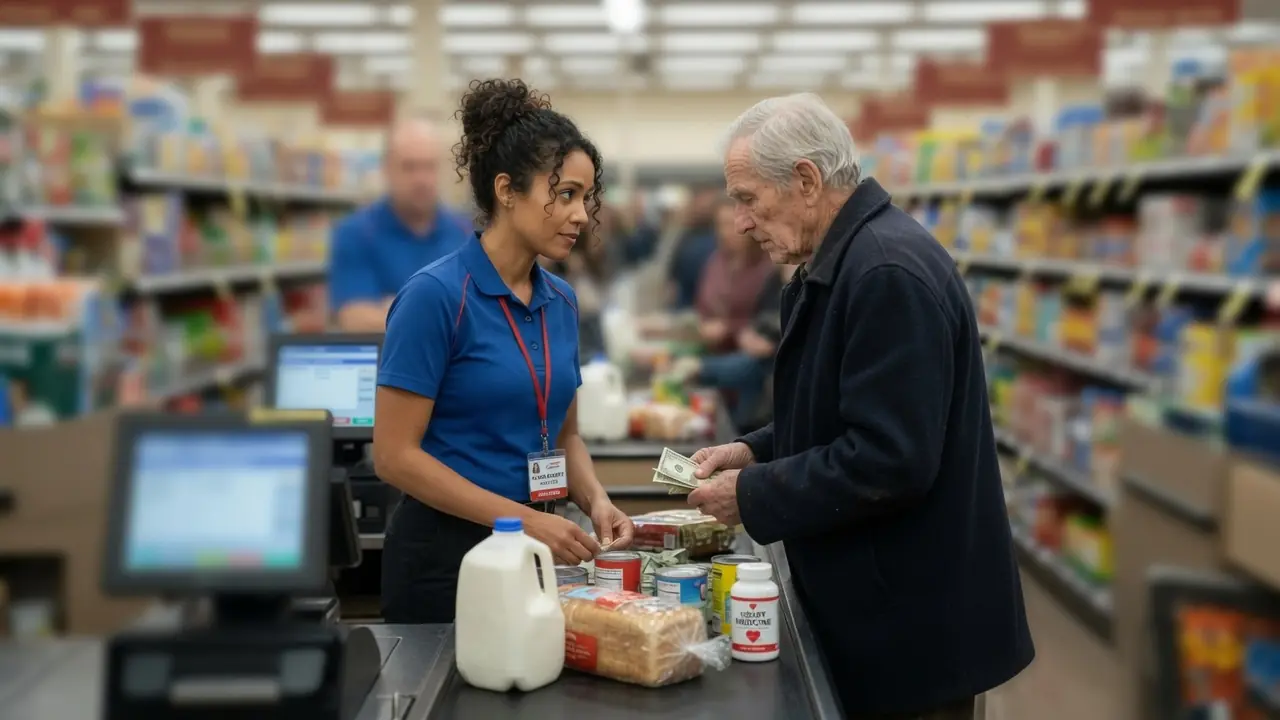
The elderly man stood at the front of her line in a worn navy coat, carefully arranging his purchases on the conveyor belt. There was one carton of milk, a loaf of discount bread, two cans of soup, a small bag of apples, aspirin, and a bottle of heart medicine from the pharmacy counter. His silver hair was neatly combed, but his hands shook as he searched the inside of an old brown wallet. Behind him, a woman sighed loudly and checked her phone.
Clara scanned the final item.
“Your total is twenty-four dollars and thirty-seven cents.”
The old man placed several bills and a handful of coins on the counter. Clara counted nineteen dollars and forty cents. He opened the wallet again, even though both of them could see it was empty.
“I’m sorry,” he said. “I thought I had another five.”
“That’s okay. We can remove something.”
His eyes moved over the groceries. He touched the milk first, then stopped and reached toward the medicine.
“I can put my medicine back, ma’am.”
Clara looked at the bottle in his hand. The prescription label showed that it had been transferred from a nearby clinic, and a warning sticker instructed him not to stop taking it without medical guidance.
“No,” she said. “You need that.”
“I can manage until next week.”
“Is that what your doctor said?”
He lowered his eyes. “No.”
The customer behind him sighed again. “Some of us have places to be.”
Clara ignored her. She reached into the pocket beneath her apron and removed the ten-dollar bill she had planned to use for her son’s school lunch account. She entered the cash into the register and handed the old man his receipt.
His expression changed when he understood what she had done.
“You paid the rest?”
“It was less than five dollars.”
“That money belongs to you.”
“It did. Now it belongs to the register.”
The old man held the medicine against his chest. “Why would you risk your job to help a stranger?”
Clara placed the milk and bread into a bag, then added the medicine carefully on top.
“Because one day, my son may need a stranger to choose kindness too.”
For a moment, the noise of the supermarket seemed to fade around them. The old man stared at her name badge as though committing it to memory.
“Clara Bennett,” he said.
“Yes.”
“My name is Edward Whitmore.”
“It’s nice to meet you, Mr. Whitmore.”
He took the bag with both hands. “You have no idea what you have done.”
“I helped you buy groceries.”
His eyes softened. “Yes. You did.”
Edward left slowly, leaning on the shopping cart until he reached the automatic doors. Clara watched long enough to see that he made it safely into the covered entrance before calling the next customer forward.
She hoped that would be the end of it.
Richard Dalton had been watching from the customer service desk.
Richard was the store manager and the founder’s nephew, a man who cared deeply about policy whenever policy gave him power over someone else. He wore a white dress shirt, striped tie, and a name badge that read STORE MANAGER, though he rarely helped customers unless a complaint threatened to reach corporate headquarters. Clara had worked beneath him for three years and knew the expression that meant he was preparing to punish someone.
He waited until the line became shorter before approaching her register.
“Office. After your shift.”
Clara’s stomach tightened. “I have to pick up my son.”
“You should have considered that before using personal money during a transaction.”
“I paid the shortage.”
“You altered a sale.”
“I entered the correct amount.”
“Office,” he repeated. “Six o’clock.”
For the remaining two hours, Clara tried not to imagine the consequences. Her rent was eleven days overdue, her car needed new brake pads, and the school had already warned her that Noah’s lunch account could not remain negative. She earned barely enough to survive, yet losing even that income would push them into a crisis within weeks.
At six fifteen, Clara stood inside Richard’s office while he examined a printed transaction report. Through the glass windows, she could see employees restocking cereal and customers moving toward the registers. Her supervisor vest felt too tight around her shoulders.
Richard tapped the report. “You know employees are prohibited from interfering with customer purchases.”
“I didn’t interfere. I paid.”
“You created a scene.”
“The man was going to leave his medicine.”
“That was his decision.”
“He couldn’t afford it.”
Richard leaned back in his chair. “Our store is not responsible for every person who fails to manage money.”
Clara stared at him. “He bought milk, bread, soup, and medicine. He wasn’t buying lottery tickets.”
“That is irrelevant.”
“No, it isn’t.”
Richard’s expression hardened. “This is your third policy violation.”
The first violation had occurred when Clara allowed a mother with a crying baby to use an expired coupon. The second happened when she waited ten minutes after her shift to help an elderly customer find a lost wedding ring. Richard called both actions unauthorized interference.
Clara understood that his decision had already been made.
“You’re firing me.”
“I’m terminating your employment effective immediately.”
“My register was never short.”
“This is about judgment.”
“I showed judgment.”
“You showed weakness.”
Clara looked toward the market through the office windows. She had arrived early, accepted extra shifts, trained new employees, and missed Noah’s school play because Richard claimed no one else could cover the evening register. None of it mattered now.
Richard pushed the termination paper across the desk.
“Sign at the bottom.”
“I want a copy.”
“You’ll receive one.”
Clara signed, removed her name badge, and placed it beside the document.
“My son depends on this job.”
Richard looked down at the report rather than at her. “Then you should have followed policy.”
Clara left carrying a cardboard box containing a phone charger, a small notebook, two pens, and the framed photograph of Noah she kept beside her locker. Several coworkers watched silently as she walked through the market. One cashier whispered that she was sorry, but no one challenged Richard.
Outside, rain struck the parking lot hard enough to blur the streetlights.
Clara sat inside her ten-year-old sedan and finally allowed herself to cry.
Noah was waiting at Mrs. Ramirez’s apartment when she arrived. He sat at the kitchen table finishing homework while Mrs. Ramirez heated rice and beans. The moment he saw the cardboard box, his pencil stopped moving.
“Did you quit?”
“No.”
“They fired you?”
Clara set the box near the door and forced a smile. “I’ll find something else.”
“Because you helped that old man?”
She had mentioned Edward during a phone call on her break. Noah listened closely whenever she told him about work, partly because he liked stories and partly because he worried about her more than an eight-year-old should.
“Yes.”
“Was helping him wrong?”
“No.”
“Then why did you get fired?”
Clara sat beside him. “Sometimes people punish you for doing something good because it makes their rules look cruel.”
Noah considered this. “Would you help him again?”
Clara thought about the unpaid rent notice, the empty gas tank, and the lunch money she had given away.
“Yes.”
He nodded. “Then maybe losing the job was worth it.”
She hugged him tightly enough that he complained about being unable to breathe.
That night, Clara applied for nine jobs from her phone. Two required weekend availability she did not have, three paid less than Dalton Fresh Market, and the others demanded experience she could not prove on paper. She stayed awake until nearly two, calculating how long they could survive if the landlord refused another extension.
The following morning, she returned to Dalton Fresh Market to collect her final paperwork. She wore a plain gray sweater and carried the cardboard box because Richard had told her to clear the remaining items from her locker. Noah was at school, and she hoped to finish before anyone recognized her.
Richard summoned her into the office before she reached the employee area.
He sat behind the same desk, acting as if the previous evening had meant nothing. Clara’s termination form rested near his hand.
“You forgot your locker key.”
“I came to return it.”
“Leave it on the desk.”
Clara placed the key beside the form.
Richard pushed another document toward her. “This confirms you received your final pay information.”
Before Clara could read it, a woman appeared in the doorway.
She was around forty, with shoulder-length dark hair, a navy blazer, and the composed expression of someone accustomed to entering rooms where decisions were made. Behind her stood two men carrying leather folders and a younger woman holding a tablet.
Richard rose quickly.
“Can I help you?”
The woman looked at Clara’s cardboard box, then at the termination document.
“You must be Clara Bennett.”
Clara hesitated. “Yes.”
“My name is Vanessa Whitmore.”
The surname immediately caught her attention.
“Are you related to Edward Whitmore?”
“He is my father.”
Clara’s concern replaced her confusion. “Is he all right?”
“He is recovering.”
“Recovering from what?”
“Exhaustion, dehydration, and a heart rhythm problem that could have become fatal if he stopped taking his medication.”
Clara looked toward Richard. He avoided her eyes.
Vanessa entered the office and set a folder on the desk. “My father told me that Ms. Bennett paid for his medicine and groceries.”
Richard straightened his tie. “An employee violated transaction policy. The store handled the matter internally.”
Vanessa’s expression became colder. “You fired her.”
“We maintain professional standards.”
“She covered a five-dollar shortage.”
“That is not the point.”
“No,” Vanessa said. “The point is that you believed a vulnerable man’s health mattered less than asserting authority over a cashier.”
Richard stepped around the desk. “I don’t know who you are, but this is a private employment matter.”
One of the men behind Vanessa opened a leather folder.
“I am David Chen, counsel for Whitmore Retail Partners.”
Richard’s face changed slightly.
Vanessa continued. “Whitmore Retail Partners owns fifty-one percent of Dalton Fresh Market’s parent company.”
The office became silent.
Richard glanced toward the Dalton sign visible through the window. “That isn’t possible.”
“My father invested in this chain twelve years ago through a holding company. He rarely interfered with daily management because he believed local leadership understood its customers.”
Vanessa looked at Clara.
“Yesterday gave him reason to reconsider.”
Richard’s voice dropped. “Mr. Whitmore came here intentionally?”
“No. His car broke down two miles away. His phone had died, he had left his wallet inside the vehicle, and he was experiencing confusion caused by dehydration. He walked into the first market he could reach.”
“He could have called someone.”
“He was embarrassed.”
“That does not make the employee’s conduct acceptable.”
Vanessa placed the folder before Richard. “Your conduct is the subject of discussion now.”
The documents contained employee complaints, payroll reports, scheduling records, and statements collected overnight. After Edward told Vanessa what happened, she contacted corporate compliance and learned that Richard had accumulated twelve unresolved employee complaints. Workers accused him of changing time sheets, denying legally required breaks, punishing employees who helped disabled customers, and assigning favorable schedules to people who brought him gifts.
Clara stared at the pages. “How did you find all this overnight?”
“My father has very efficient attorneys.”
Richard’s face reddened. “These accusations have never been proven.”
“They will be investigated,” David said. “Effective immediately, you are suspended from management duties.”
Richard looked toward the market. “You cannot remove me from my own family’s store.”
Vanessa opened another document.
“Your uncle’s company owns a minority interest. The operating agreement gives Whitmore Retail Partners authority to suspend any manager whose conduct creates legal or reputational risk.”
Richard turned toward Clara. “This is because of you.”
Clara held the cardboard box tighter. “I didn’t know they were coming.”
“You made me look cruel over five dollars.”
“You did that yourself.”
Vanessa allowed security to escort Richard from the office. Employees watching through the windows moved aside as he passed, his face tight with humiliation. No one defended him.
When the door closed, Clara looked at Vanessa.
“I appreciate what you did, but I’m not asking for revenge.”
“This is not revenge. My father believes accountability and revenge are different things.”
“Will I get my job back?”
Vanessa paused. “You can, if that is what you want.”
Clara sensed there was more.
“What did your father send you to offer?”
Vanessa motioned toward the empty chair.
“Please sit.”
Clara remained standing. “I’ve had enough surprises while sitting in this office.”
For the first time, Vanessa smiled faintly.
“Fair enough.”
Edward Whitmore had spent forty-five years building a network of grocery stores, food distributors, community clinics, and low-income housing partnerships. Although he had stepped away from daily leadership, he remained involved in several charitable programs, including one designed to help elderly people afford groceries and medication.
The program had failed to reach many of the people who needed it.
“Our reports say thousands of seniors receive help,” Vanessa explained. “But my father has spent the last six months visiting stores without announcing who he is. He wanted to understand why people were still choosing between food and prescriptions.”
Clara glanced toward the market floor. “What did he discover?”
“That our system is written by people who have never stood at a register with five dollars missing.”
The aid program required online applications, identification documents, proof of income, medical forms, and several weeks of approval time. Many elderly customers lacked internet access, transportation, or the ability to complete the paperwork. Others felt humiliated asking for help.
Edward believed the company needed someone with practical understanding to redesign it.
“He wants you to join the program,” Vanessa said.
Clara nearly laughed. “I’m a cashier.”
“You’re a cashier who saw a problem and solved it in less than thirty seconds.”
“With my lunch money.”
“Exactly.”
“I don’t have a college degree.”
“The current program director has two graduate degrees. Seniors are still leaving medicine at checkout counters.”
Clara looked toward David. “What position are you talking about?”
Vanessa opened a blue folder.
“Community Access Coordinator for the Whitmore Essential Needs Initiative.”
The salary printed on the first page was almost three times what Clara earned at Dalton Fresh Market. The position included health insurance, paid training, childcare support, and flexible hours. Her job would involve visiting stores, speaking with customers and employees, and designing immediate assistance systems that did not force people to prove desperation in public.
Clara read the number again.
“This cannot be real.”
“It is.”
“Your father met me once.”
“He also asked his team to review your employment history.”
Clara stiffened. “You investigated me?”
“We verified what he wanted to know before making the offer.”
They learned she had worked since she was sixteen, had never been accused of theft, and had repeatedly received positive customer feedback. They also discovered that she volunteered twice a month at Noah’s school food pantry and routinely covered small shortages for elderly shoppers despite Richard’s warnings.
“I’m not special,” Clara said.
“My father agrees.”
She looked up, surprised.
Vanessa continued. “He says special people are too easy to admire and too difficult to find. He wants ordinary people who choose decency when it costs them something.”
Clara closed the folder. “I need to speak with him.”
“Of course.”
Vanessa called Edward and placed the phone on speaker.
His voice sounded stronger than it had at the register.
“Clara?”
“How is your heart?”
“Still working, though my daughter insists on supervising it personally.”
Vanessa rolled her eyes.
Clara almost smiled. “Why didn’t you tell me who you were?”
“Would my name have changed what you did?”
“No.”
“It would have changed what your manager did.”
“That may have saved my job.”
“Then you would still be working for a man who punished kindness.”
Clara glanced toward the termination paper. “You’re offering me a position I don’t know how to do.”
“I’m offering training.”
“What if I fail?”
“Then we learn what failed and improve it.”
“What if you only feel guilty because I paid for you?”
Edward was quiet for a moment.
“I have spent much of my life surrounded by people who help after reading my name,” he said. “Yesterday, I had no phone, no driver, no polished shoes, and no proof that I mattered. You helped me because you believed my life was worth five dollars.”
“It was only medicine.”
“It was the medicine keeping my heart stable.”
Clara looked down.
Edward continued. “I am not offering you charity. I am asking you to help prevent what happened to me from happening to someone who does not have a wealthy daughter searching for him.”
That sentence changed everything.
Clara thought about the elderly customers who counted coins at her register, the parents choosing between food and diapers, and the workers too proud to ask for assistance. She understood their hesitation because she lived near it herself.
“What would I do first?” she asked.
“Tell us what we designed wrong.”
Clara opened the folder again.
“The forms,” she said. “There are too many forms.”
Vanessa smiled.
Edward laughed softly over the phone. “You start Monday.”
“I haven’t accepted yet.”
“You just redesigned the first step.”
Clara accepted on Friday after an independent attorney reviewed the contract. She insisted that her employment not depend on supporting every idea the Whitmore family proposed. Vanessa added a clause protecting her right to report problems directly to the oversight board.
On Monday morning, Clara entered the Whitmore Retail Partners office wearing a borrowed blazer and carrying the same notebook Richard had once dismissed as clutter. She spent her first week speaking with cashiers, pharmacy workers, delivery drivers, and elderly customers.
The first change she proposed was simple.
Every participating register would receive an emergency assistance button. If a customer lacked less than fifteen dollars for food, medicine, or essential hygiene items, the cashier could approve the difference immediately without calling a manager. No public explanation would be required.
The company expected abuse.
Abuse remained remarkably low.
The second change replaced the complicated application with a one-page form available in stores, clinics, libraries, and senior centers. The third created transportation vouchers for people unable to reach pharmacies. Clara also insisted that the program hire retired cashiers and former aid recipients as advisers.
Within six months, medication abandonment at participating stores fell by more than half.
Clara did not become wealthy, but for the first time she could pay rent without deciding which bill to delay. She enrolled Noah in the school lunch program with a positive balance, repaired her car, and moved them into a small apartment with two bedrooms. Noah chose the room facing the parking lot because he liked watching people come home.
Edward visited them several times.
He never arrived with security or expensive gifts. The first time, he brought milk, bread, apples, soup, and the same brand of medicine Clara had paid for, placing everything on the kitchen counter with exaggerated seriousness.
“I believe I owe you groceries,” he said.
“You owe me four dollars and ninety-seven cents.”
“I brought thirty dollars’ worth.”
“Then I owe you change.”
Noah watched the exchange with fascination.
“You’re the old man Mom helped?”
Edward nodded.
“You don’t look homeless.”
“I wasn’t homeless.”
“Mom said you didn’t have money.”
“I temporarily failed to possess money.”
Noah looked at Clara. “That sounds like something rich people say.”
Edward laughed until he needed to sit down.
The investigation into Richard Dalton lasted three months. Corporate auditors confirmed that he had altered time records, denied breaks, and retaliated against several employees. He was permanently removed from the company, and the store was placed under new management.
Clara returned once to speak with the staff about the emergency assistance program. Several former coworkers hugged her, while others apologized for remaining silent when Richard fired her.
“You were afraid,” Clara told them. “Next time, be afraid and speak anyway.”
The checkout lane where she helped Edward became the first register equipped with the new assistance system.
One year after the incident, Vanessa invited Clara to a company leadership meeting. Executives from twenty-seven stores gathered inside a hotel conference room to review the program’s results. Clara presented customer stories, employee feedback, and financial data showing that the company had spent far less than expected while building significant community trust.
When she finished, the board approved expansion into four additional states.
Edward sat near the back rather than at the head table. After the meeting, he approached her with a small envelope.
“I’m not accepting another job offer without reading it first,” Clara warned.
“This is not an offer.”
Inside was the original receipt from Dalton Fresh Market. Edward had written beneath the total:
The most important five dollars this company ever spent.
Clara looked at him. “You kept this?”
“I needed proof.”
“Of what?”
“That one person at the bottom of an organization can see more clearly than everyone at the top.”
Years passed.
The Whitmore Essential Needs Initiative expanded into clinics, community centers, and independent grocery stores. Clara eventually became regional director, though she refused to move into an office far from the people the program served. She spent at least two days each month visiting checkout lanes and asking cashiers what the reports failed to show.
Noah grew into a teenager who pretended to be embarrassed whenever Edward told the milk story. Secretly, he kept a copy of the receipt inside his desk.
Edward’s health declined gradually, but he remained involved with the initiative until his final year. During his last public appearance, he stood beside Clara at the opening of a neighborhood resource center offering groceries, medicine support, job counseling, and childcare referrals.
A reporter asked why he had chosen a cashier without corporate experience to redesign a multimillion-dollar program.
Edward looked toward Clara.
“Because experience sometimes teaches people how a system works,” he said. “Clara understood how it failed.”
He died peacefully eighteen months later.
His will left most of his personal fortune to family trusts, employee retirement programs, and charitable organizations. Clara received no mansion, company ownership, or shocking inheritance. She had asked him years earlier never to turn their friendship into a story about a poor woman rescued by a rich man.
He respected that request.
Instead, he left her his old brown wallet.
Inside were the few bills and coins he had counted at her register, along with a handwritten note.
You did not save me from poverty. You saved me from believing the world had stopped noticing people without power. Keep noticing them.
Clara framed the note beside the first grocery receipt.
By then, thousands of people had received immediate help through the program she designed. Some needed medicine. Others needed baby formula, bus fare, or enough groceries to survive until payday. The amounts were usually small.
The dignity preserved by those amounts was not.
Clara’s life changed because Edward’s daughter returned with an offer the morning after she was fired. The salary, security, and opportunity mattered deeply, especially to a single mother who had lived one emergency away from eviction.
But the most important change began before Vanessa entered the manager’s office.
It began when an old man reached for his medicine and quietly offered to put it back.
Clara had only a few dollars in her pocket, no protection from her manager, and every practical reason to remain silent. She paid the difference anyway.
She hoped that one day, if Noah needed help, a stranger might choose kindness.
Years later, when Noah asked whether that stranger had ever appeared, Clara showed him the thousands of names inside the program’s annual report.
“He appeared every time someone pressed the assistance button,” she said.
The five dollars she gave Edward never returned to her pocket.
Instead, they became something far larger—medicine kept in trembling hands, groceries carried home, and dignity protected at checkout counters where no one should ever have to prove that their life was worth the difference.