The nurse stopped beside room 208 and lowered her voice as though the patient inside might be disturbed by the truth. “Henry Raymond hasn’t spoken in eight months. His body is stable, but most of the staff believe he no longer understands who is around him.” Judy Hale tightened her cream cardigan over her dark scrubs and glanced through the narrow window in the door. “Then perhaps someone should keep speaking to him anyway,” she replied.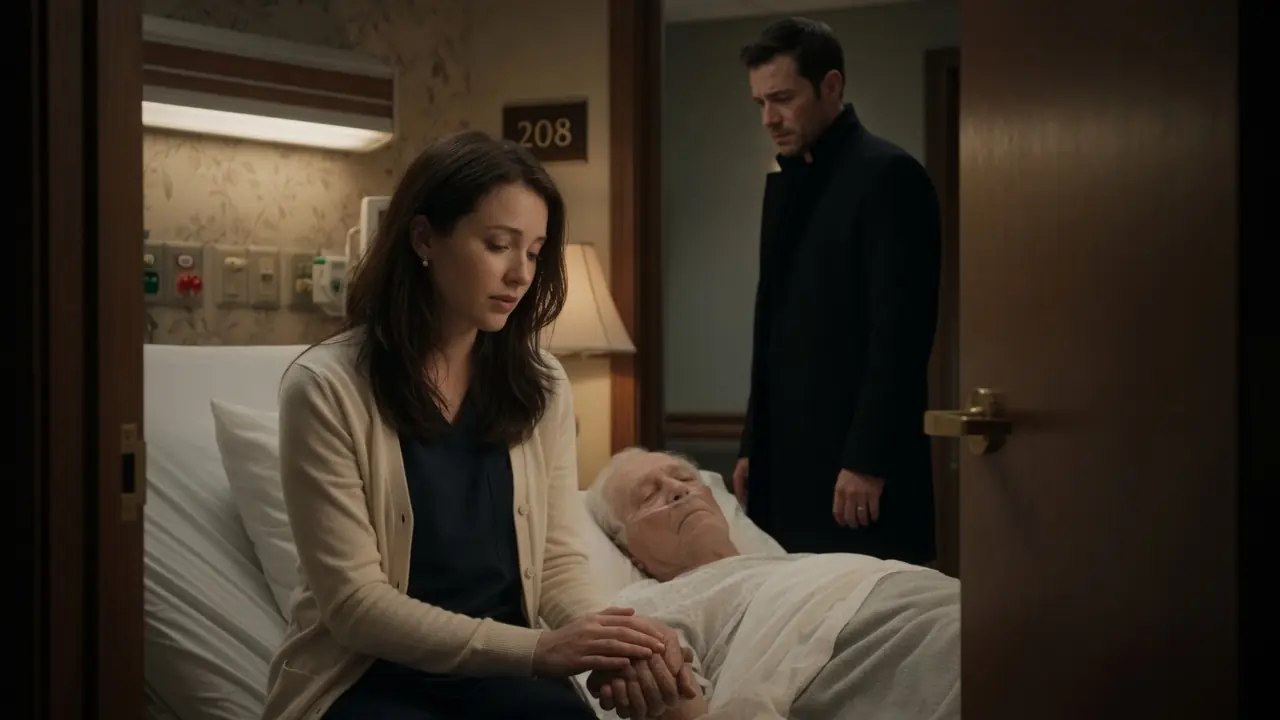
Judy was twenty-seven years old, with long dark-brown hair falling in soft layers around her face, luminous fair skin, warm brown eyes, and delicate features that made strangers assume her life had been gentler than it was. Small pearl earrings were the only jewelry she wore, gifts from her mother before she died. Beneath her natural beauty lived the quiet exhaustion of a single mother who slept too little, worked too much, and calculated every purchase twice. Her six-year-old daughter, Emma, was spending the night with Judy’s elderly neighbor because the care facility had called for an emergency shift.
Room 208 smelled of disinfectant, rain, and the faint medicinal sweetness of oxygen tubing. Henry Raymond lay near the window beneath a pale blanket, his thick silver hair neatly combed and his deeply lined face turned toward the glass. His eyes were open, but they followed nothing—not the storm outside, not the monitor beside him, and not Judy as she entered. The only sound came from the measured beeping of the machine recording a life that seemed to have retreated somewhere beyond reach.
Judy placed a basin on the table and greeted him as if he were waiting for her. She explained that she was going to wash his face, adjust his pillows, and check whether his hands felt cold. The nurses had warned her not to expect acknowledgment, but her father had spent his final hours in a hospital room where people discussed him as though he were furniture. Judy had arrived too late to say goodbye, and she had never forgiven herself for the silence that surrounded him.
“You haven’t spoken in months,” she whispered while smoothing the blanket over Henry’s chest, “but no one deserves to disappear in silence.”
His fingers remained still beneath hers.
Judy sat in the chair beside the bed and looked toward the rain running down the window. Before Emma was born, Judy had sung in small jazz clubs, hotel lounges, and neighborhood restaurants where people arrived for dinner but remained because her voice made them remember something they had lost. She had never become famous, but there had been nights when an entire room stopped moving as she held the final note. Then Emma’s father emptied their savings, stole Judy’s guitar, and disappeared before learning she was pregnant.
Music became a luxury she could no longer afford.
Judy trained as a caregiver because the certification course was short and the night shifts paid slightly more. She learned to lift patients without injuring them, recognize changes in breathing, manage medication schedules, and speak gently to families who mistook fear for anger. She stopped introducing herself as a singer. By the time Emma turned six, Judy had begun to believe that part of her life belonged to someone else.
But Henry’s empty stare reminded her of her father.
Without planning to, Judy began humming the melody of an old song her mother had sung while washing dishes. Her voice entered the room softly, uncertain from years of disuse. She did not perform for Henry or attempt to force a response; she simply offered the sound as proof that someone still believed he was present. Gradually, the trembling left her voice, and the song filled the corners of the room with warmth.
Outside the half-open door, Logan Raymond stopped walking.
He had arrived carrying medical authorization papers, intending to leave them with reception and return to his office before midnight. At thirty-four, Logan was the founder of a software-security company valued at more than sixty million dollars. He wore a tailored black coat, drove a car with a driver when business required it, and spoke in concise sentences that discouraged unnecessary intimacy.
He was also Henry Raymond’s only son.
For eight months, Logan had paid every medical bill without entering his father’s room. He approved specialists, private nurses, neurological consultations, and experimental therapy, telling himself that money was the most practical form of concern. The truth was less respectable. He had not forgiven Henry for spending Logan’s childhood touring as a celebrated violinist while Logan’s mother slowly disappeared inside loneliness.
She died when Logan was twelve.
Henry arrived two days late for the funeral because a storm delayed his flight from Vienna. Logan remembered standing beside the grave in a black suit that did not fit, watching his father approach with a violin case still in his hand. No apology had ever been large enough to cross the distance created that day.
Now Judy was singing the melody Logan’s mother once hummed when thunder frightened him.
He stood beyond the doorway, unable to move. Through the narrow opening, he saw a beautiful young woman seated beside his father, holding Henry’s hand as though it still contained something worth reaching. Her dark hair framed a face softened by compassion, and tears shone along her lashes even though no one was watching her. She sang without polish or performance, giving every note to a man who appeared incapable of returning anything.
When the song ended, Judy squeezed Henry’s fingers.
“I hope some part of you heard that,” she whispered.
A tiny movement passed through Henry’s hand.
Judy leaned closer, but the fingers became still again. She waited, uncertain whether she had imagined it, then adjusted the blanket and left the room to continue her rounds. Logan stepped back before she entered the hallway, remaining hidden beside a linen cart until she disappeared around the corner.
He entered room 208 for the first time since his father’s stroke.
Henry looked exactly as Logan feared: smaller, thinner, and robbed of the authority that had once filled concert halls. Logan sat in the chair Judy had occupied and looked at the hand she had held. He wanted to speak, but resentment and grief had practiced silence for too many years.
“I don’t know who she is,” he finally murmured. “But she saw something in you that I stopped trying to see.”
Henry did not respond.
Still, Logan remained until morning.
The following night, he returned at eight fifty-five.
Judy entered room 208 five minutes later and found Henry’s pillows adjusted differently. A fresh vase of white flowers stood beside the window, and the chair had been moved closer to the bed. She assumed a family member had visited, though the nurses said Henry’s son almost never came inside.
Judy washed Henry’s hands and told him about Emma’s school day. She described the paper moon her daughter had made from silver paint, the argument Emma had with a classmate about whether stars could feel lonely, and the note her teacher sent home praising her kindness. Then Judy sang another quiet melody.
Logan listened from the hallway.
He returned every evening for a week.
Sometimes Judy sang. Other nights, she read newspaper articles aloud or told Henry ordinary stories about grocery prices, children losing teeth, and the neighbor’s dog stealing a loaf of bread. Logan slowly understood that her gift was not merely her voice. It was the way she refused to treat his father’s silence as absence.
On the eighth night, Judy found him standing outside the door.
She stopped abruptly, one hand still on the handle. Logan looked less imposing than he did in photographs, though his black coat and controlled expression still belonged to a world far from hers. His dark hair was slightly disordered, and exhaustion had softened the sharpness around his eyes.
“I’m sorry,” Judy said. “Was I singing too loudly?”
“No.”
“If I disturbed your visit—”
“You didn’t.” Logan glanced toward Henry. “That song was my mother’s. My father hasn’t heard it since she died.”
Judy’s embarrassment faded into understanding. “I only wanted him to feel that someone was still here.”
Logan held her gaze. “He isn’t the only one who heard you.”
The words settled between them.
Judy looked away first. “You’re Logan Raymond.”
“You know me?”
“The nurses talk.”
“That is rarely encouraging.”
Despite herself, she smiled.
Logan looked toward the chair beside Henry’s bed. “Would you sing again?”
“I’m not sure he can hear me.”
“I think he can.” His voice lowered. “And even if he can’t, I can.”
Judy’s heartbeat changed, but she entered the room without answering. Logan remained near the wall while she sat beside Henry and began singing. This time, she was aware of the man listening behind her, and the knowledge made her voice tremble during the opening notes.
Then Henry’s finger moved against her palm.
Logan saw it.
He crossed the room so quickly that Judy stopped singing. Henry’s hand remained motionless, but Logan knelt beside the bed and stared at his father’s face as though willing another sign to appear.
“He moved,” Judy whispered.
“I saw it.”
“It may have been reflexive.”
“Or it may not.”
Hope frightened Logan more than certainty ever had.
Afterward, they sat in the quiet staff lounge with paper cups of coffee. Judy told him about her father’s final hospital stay and admitted she sang to Henry because she could not bear the thought of another man dying without hearing tenderness. Logan listened without checking his phone, an act that seemed unnatural for him.
“You used to sing professionally,” he said.
“A long time ago.”
“You’re twenty-seven.”
“Some lives become long very quickly.”
He understood the sentence without asking for an explanation.
Judy’s phone vibrated. Emma’s face appeared on the screen, smiling beneath a crooked paper crown. Judy answered immediately, her expression changing with the effortless softness reserved for her daughter.
“Did you brush your teeth?”
“Yes.”
“Truthfully?”
A pause followed.
“I brushed some of them.”
Logan looked down to hide his smile.
When the call ended, Judy explained that Emma’s father had left before she was born. She expected pity, but Logan only said, “She sounds loved.”
“She is.”
“That matters more than the person who left.”
Judy studied him. “You sound as though you’re trying to convince yourself too.”
His expression closed briefly, then opened again.
“My father left without physically leaving,” he said. “Sometimes I think that was worse.”
Their conversations became part of the night shift.
Logan brought decent coffee, then dinner after learning Judy often survived on crackers from the vending machine. She refused expensive gifts but accepted soup, sandwiches, and one small box of cookies for Emma. He never arrived without asking whether she had time to speak.
Judy learned that Logan could command a boardroom but became nervous when asked to sing a single note. He learned that she hated being rescued, feared financial dependence, and worked two additional weekend shifts to keep Emma in the same school district. Their differences were obvious, but neither used them as weapons.
One evening, Logan asked Judy to teach him the song she sang to Henry.
“You want singing lessons?”
“I want to sing it to my father.”
“Have you ever sung before?”
“No.”
“Then your father may prefer silence.”
Logan laughed, surprising both of them.
They practiced in the unused common room after Judy’s shifts. Logan missed notes, entered too early, and forgot to breathe at the correct moments. Judy corrected his posture by placing two fingers beneath his chin, and each touch left them briefly unable to remember what came next.
Emma joined them on Saturdays.
She was a small, bright-eyed child with Judy’s dark hair and an uncompromising belief that every song required movement. Logan brought her a simple tambourine after asking Judy’s permission. Emma immediately appointed herself musical director.
“You’re too stiff,” she told Logan during rehearsal.
“I run a company.”
“That is not dancing.”
Judy turned away, laughing.
Henry’s condition began to change.
His eyes followed Judy across the room on some mornings. His fingers closed faintly around Logan’s hand during one visit, though the doctors remained cautious. They explained that recovery after a severe stroke could arrive in fragments and disappear again without warning.
Logan no longer demanded certainty.
He simply stayed.
The first major change came during a small concert Judy organized for the residents. She wore a simple navy dress, her long brown hair loose around her shoulders, while Logan stood beside her holding a guitar he could barely play. Emma sat in the front row with her tambourine, watching them with the seriousness of a conductor.
They sang the melody that had brought Logan into room 208.
When the final note faded, Henry turned his head toward his son.
His lips moved.
No sound emerged, but Logan saw his own name forming there.
He abandoned the guitar and knelt beside the wheelchair. “I’m here.”
Henry’s eyes filled with tears.
Judy stepped away to give them privacy, but Logan reached backward and caught her hand. He did not ask her to speak or repair the moment. He only needed her nearby while the father and son looked at each other across twenty-two years of pain.
Later, Logan found Judy alone in the courtyard.
“You brought him back,” he said.
“No. His doctors, his body, and his own will did that.”
“You reached him first.”
“I sang a song.”
“You gave him a reason to follow the sound.”
Judy lowered her eyes. “Don’t turn me into a miracle, Logan. I’m only a tired woman trying to get through each week.”
He stepped closer but did not touch her. “That is the woman I keep coming back to see.”
Her breath caught.
“This is dangerous,” she whispered.
“Because I have money?”
“Because you belong to a world where people can leave without losing anything.”
Logan looked toward the windows of the care facility. “I have spent my whole life leaving before anyone could discover how much I needed them.”
“And now?”
“Now my father wakes when you sing, your daughter expects me on Saturdays, and I measure my weeks by when I see you.”
Judy’s eyes filled, but fear remained stronger than hope. “Emma cannot survive another man deciding we were temporary.”
“Then don’t trust a promise.” Logan extended his open hand. “Watch what I choose repeatedly.”
Judy placed her fingers in his.
For several months, that was how they moved forward—slowly, without pretending love erased practical differences. Logan visited Henry daily and spent Sundays with Judy and Emma in their small apartment. He washed dishes, repaired a loose cabinet hinge, and allowed Emma to place glitter stickers on his expensive phone case.
Judy began singing again outside the care facility.
Not in lounges or bars, but in afternoon music sessions for residents with dementia, stroke injuries, and terminal illnesses. Logan funded nothing without her permission. Instead, he helped her prepare a fair business plan, apply for a community grant, and negotiate paid hours for the program.
“You could simply pay for all of it,” Judy said once.
“I could.”
“But you aren’t.”
“You deserve something that remains yours even if I disappear.”
She looked at him sharply.
“I’m not planning to disappear,” he added. “I’m making sure loving me never traps you.”
That was when Judy understood he had listened to every fear she tried not to say aloud.
The crisis arrived in early winter.
Logan’s company offered him a three-year executive position in Switzerland to oversee a merger that could double the company’s value. His board expected immediate acceptance. The opportunity represented everything he had spent fifteen years building.
Judy told him to go.
“You deserve it,” she said in the café near the care facility.
“And what about us?”
“We cannot become the reason you resent the life you missed.”
Logan searched her face. “Is that what you believe, or is that what fear is telling you to say before I leave first?”
She looked down.
He did not force an answer.
The following week, Logan accepted the first stage of the assignment and prepared to leave for six months. He told himself distance would reveal whether their relationship was strong enough to survive reality. Judy smiled for Emma, encouraged Henry, and cried only after everyone else slept.
On the evening before his flight, Logan entered room 208 alone.
Henry lay beneath the same window where Judy had first sung. His recovery had given him limited speech and movement, but exhaustion still stole words from him. Logan sat beside the bed with Judy’s handwritten music notes in his hand.
“I spent years believing you chose music over me,” Logan said. “Now I’m about to choose work over the people who taught me how to stay.”
Henry struggled to turn his head.
Logan began singing.
His voice remained imperfect, but Judy had taught him that sincerity mattered more than pitch. He sang the entire melody without stopping. When he finished, Henry’s fingers tightened around his hand.
“Stay,” Henry breathed.
Logan bowed his head.
“I don’t know how.”
Henry gathered what strength he had left. “Learn.”
The following morning, Henry spoke Logan’s name clearly in front of the medical team. Judy called Logan while he was boarding the plane.
“Your father asked for you.”
Logan looked through the airport windows toward the runway.
Then he walked away from the gate.
By evening, he was back in room 208, kneeling beside his father while Judy and Emma waited near the door. Henry raised one shaking hand, and Logan held it between both of his.
“I’m here, Dad.”
Henry’s eyes moved toward Judy. “She taught you?”
“She taught me to sing.”
Henry’s faint smile appeared. “More than that.”
Later, Logan found Judy in the courtyard beneath bare winter trees.
“You came back,” she whispered.
“I never boarded.”
“Because of your father?”
“Yes.” He stepped closer. “And because leaving you to prove I could return would still be leaving.”
Judy’s tears fell freely.
“I’m afraid to believe you.”
“Then don’t believe tonight.” Logan reached for her hand. “Come tomorrow. Watch me stay again.”
She stepped into his arms by choice.
One year later, music filled the care facility’s common room.
Henry sat near the front with a violin beneath his chin, his recovering fingers moving slowly but deliberately across the strings. Emma stood beside him holding her tambourine, waiting for her cue. Judy wore a simple white dress, her dark hair loose over her shoulders, while Logan adjusted the microphone she used for the facility’s new music-therapy program.
They performed the song that began everything.
When the applause faded, Judy stepped away from the microphone. Logan gently caught her hand.
“Stay,” he said.
The room became quiet.
He lowered himself onto one knee and opened a small velvet box. Inside was a simple ring with a deep-blue sapphire, elegant but not extravagant.
“I heard your voice before I knew your name,” Logan said. “You were singing to a man who could not thank you, because kindness was something you gave without demanding proof it would return.”
Judy covered her mouth as tears filled her eyes.
“You brought my father home,” Logan continued. “You showed Emma that someone could enter her life without taking anything away. And you taught me that love is not a place where we perform strength—it is where we finally put it down.”
He looked toward Emma, who was already nodding urgently on Judy’s behalf.
“I don’t want to rescue you, own your dreams, or make you dependent on mine. I want to stand beside the woman you already are and help build a life neither of us needs to escape.”
Logan lifted the ring.
“Will you marry me?”
Judy laughed through her tears. “Yes.”
Emma cheered before the ring reached Judy’s finger.
Henry pushed himself upright with the help of his cane and crossed the small distance between them. He placed one hand over Judy’s and the other over Logan’s.
“Home,” he whispered.
Judy looked at the elderly man she had once sung to in silence, the little girl who had given her courage to survive, and the man who had learned that staying was not a promise made once. It was a choice repeated until fear no longer controlled the room.
She had entered room 208 believing her voice had little value beyond comforting one lonely patient.
Instead, it awakened a father, returned a son, restored the music she had buried, and created a family where neither wealth nor gratitude became a debt.
Logan kissed her forehead while Emma held tightly to them both.
The song had ended.
Their life together was only beginning.