Maya Coleman stood frozen in the open doorway of her little white house on Briar Lane, one hand gripping the doorknob while rain crashed behind the elderly man on her porch. He was soaked from head to toe, his gray hair plastered to his forehead, his cardigan hanging heavy with water, and his thin shoulders shaking so badly that Maya could hear his teeth chatter between words. The storm had swallowed Knoxville just after sunset, turning the street into a silver blur and making the oak branches scrape against the siding like nervous fingers. Behind Maya, her eight-year-old son Caleb sat at the kitchen table with a bowl of chicken stew, staring wide-eyed at the stranger through the warm glow of two candles.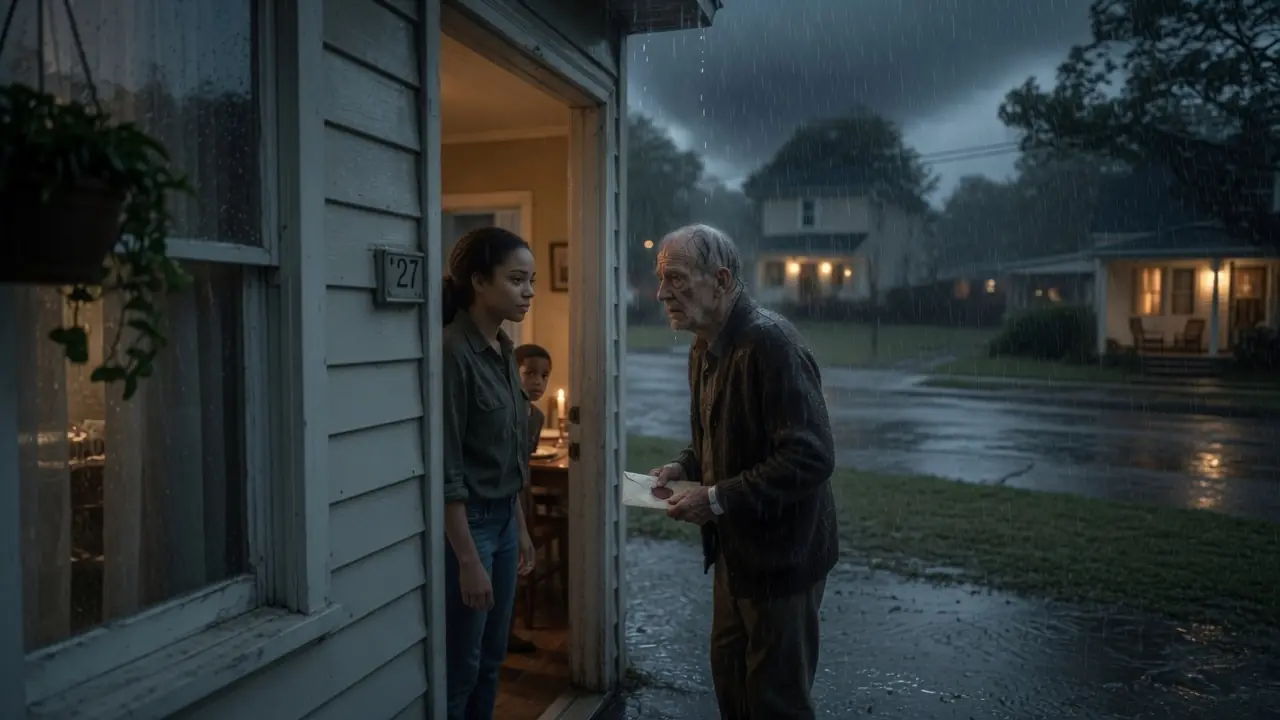
The old man tried to step back from the doorway, but his knees almost failed him. “I’m sorry,” he whispered. “I don’t wanna be a burden.” Maya looked at the hospital bracelet around his wrist, the muddy slippers on his feet, and the sealed envelope he clutched in one trembling hand. Every warning a young mother carried inside her told her to be careful, but every decent part of her understood that leaving him outside would be crueler than fear.
“Come inside before this storm makes you sick,” Maya said, opening the door wider.
The old man blinked at her as if kindness had become a language he only half remembered. “Are you sure?” he asked. Rainwater ran down the side of his face, and for one terrible second, he looked less like a stranger and more like somebody’s forgotten father. Maya stepped aside, keeping her voice calm so Caleb would not panic. “Yes, sir. Come inside.”
His name, after several careful questions, was Arthur Bell. He remembered that much. He also remembered that he had once owned a brown house with a porch swing, that his wife liked lemon pie, and that someone had told him to find “the Coleman house with the porch light.” But he could not remember who told him, why he had come, or where he had been before the storm carried him to Maya’s door.
Maya guided him to the small kitchen table and pulled a towel from the laundry basket near the hallway. Caleb slid his bowl closer to himself but did not look away. The power had flickered twice before finally going out, leaving the kitchen lit by candles and the soft yellow emergency lamp Maya kept for storms. Outside, thunder rolled low over the roofs of the neighborhood, but inside, the little house smelled of chicken stew, cornbread, and rain-damp clothes.
“Sit with us,” Maya said gently, setting a bowl in front of Arthur. “Dinner is still hot.”
Arthur looked down at the food, shame crossing his face. “I don’t wanna eat your family’s food for free.”
Maya placed a spoon beside the bowl and sat across from him. “Don’t worry, sir. You’re welcome here… and my house still has an empty room for you.” Caleb looked at his mother quickly, surprised by the offer, but he did not protest. He had been raised by a woman who stretched food, money, patience, and mercy farther than anyone thought possible.
Arthur stared at the bowl for a long moment before lifting the spoon. His hands shook so badly that Maya reached out and steadied the bowl without making a show of it. “My wife used to make stew,” he said softly. “Miriam. Her name was Miriam.” His eyes filled with sudden confusion. “Is she coming here?”
Maya’s heart tightened. “I don’t know, Mr. Bell.”
He looked embarrassed, as if he had asked something foolish. “Sometimes I lose pieces,” he said. “Streets. Names. Days.” He touched the hospital bracelet with two fingers. “I didn’t mean to run. I just remembered I had somewhere important to go.”
Maya glanced at the envelope in his hand. It was cream-colored, soaked at the edges, but sealed tight. On the front, written in dark ink, was a name she could not see clearly because Arthur kept his fingers over it. She did not take it from him. A lost man still deserved the dignity of holding what belonged to him.
After dinner, Maya helped Arthur into the small spare bedroom at the back of the house. It had belonged to her mother before she passed, and Maya had never fully changed it. A pale quilt lay folded over the bed, framed photos lined the dresser, and a small lamp sat beside a Bible her mother used to read every night. Arthur stood in the doorway and looked around like a man afraid to touch warmth.
“This room is too nice,” he said.
“It’s empty,” Maya replied. “Tonight, it doesn’t have to be.”
Caleb brought him dry socks from a drawer and placed them on the bed without speaking. Arthur looked at the boy and smiled faintly. “You’re a good young man.” Caleb’s face softened, but he still seemed cautious. “My mom says people are less scary after soup.”
Arthur gave a small tired laugh. “Your mom sounds wise.”
Maya called the nearest hospital after Arthur lay down, but the storm had damaged lines, and the call dropped twice before she could explain everything. She tried the non-emergency number next and left a message with Arthur’s name, her address, and the hospital bracelet information. Then she locked the door, checked the windows, and stood in the kitchen listening to the rain slam against the roof. She had invited a stranger into her home, but somehow the house felt less dangerous than the world outside.
Maya Coleman had not lived an easy life, though she rarely said so. She was twenty-nine, widowed for three years, and raising Caleb alone on a home health aide’s paycheck that never stretched far enough. Her husband Andre had died unexpectedly, leaving behind grief, medical bills, and a mortgage Maya had almost lost twice. The little house on Briar Lane was the only thing she had left from her mother, and every month felt like a battle to keep it.
That week had been worse than most. The water heater had failed, the car needed brakes, and a letter from the bank sat unopened on the counter because Maya already knew what it would say. She had applied months ago for a housing assistance grant through something called the Bell Family Home Trust, but she had heard nothing back. Hope, like money, had become something she used carefully.
Around midnight, Arthur began coughing in the spare room. Maya found him sitting on the edge of the bed, confused and shaking beneath the quilt. His forehead was warm, and his eyes were glassy from exhaustion. She brought him tea, helped him change into one of Andre’s old sweatshirts, and spoke softly until his breathing slowed.
“I didn’t mean to trouble you,” Arthur whispered.
“You didn’t,” Maya said.
“My son says I make trouble now.” His mouth trembled. “Victor gets angry when I forget.”
Maya sat in the chair beside the bed. “Forgetting doesn’t make you trouble.”
Arthur looked at her with sudden clarity. “Miriam used to say that.” Then the clarity faded, and he looked toward the window as if the rain had called his name. “I had a letter.”
“You had it when you came in,” Maya said, glancing at the bedside table.
But the envelope was not there.
Maya searched the quilt, the floor, the hallway, and the kitchen table. Nothing. Arthur grew distressed, trying to stand, insisting the letter was important though he could no longer explain why. Maya gently guided him back to bed and promised they would look again in the morning. He held her hand with surprising strength and said, “The boy must find it.”
Maya did not understand what that meant.
The next morning, the storm had weakened into a steady gray rain. The yard was soaked, the porch steps were slick, and leaves clung to the welcome mat in dark wet patches. Caleb woke early, pulled on his rain boots, and opened the front door before Maya could stop him. “Mom,” he called, “there’s something stuck by the porch rail.”
Maya hurried to the door and saw Caleb kneeling near the corner of the porch. In his hands was the cream-colored envelope, damp but still sealed, caught beneath the leg of a flower stand. The ink had blurred slightly, but the name on the front remained clear. Maya Coleman.
Her breath caught.
Caleb looked up at her. “Mom… why does it have your name?”
Maya took the envelope with shaking fingers. Arthur appeared behind them wrapped in the quilt, leaning against the hallway wall, pale but awake. His eyes fixed on the letter, and he whispered, “I was supposed to bring it.” Maya turned it over, broke the seal carefully, and unfolded the papers inside.
The first page was printed on official letterhead from the Bell Family Home Trust. Maya read the opening line once, then again, because her mind refused to accept it. Her application for emergency mortgage assistance and home repair support had been approved. The trust would cover the overdue mortgage balance, repair the water heater, and provide one year of housing stability support while she completed certification for a better-paying healthcare position.
Maya sank slowly into the chair by the front door.
Caleb stood beside her, frightened by her silence. “Mom?”
She covered her mouth with one hand, tears filling her eyes. For months, she had been carrying the fear of losing their home like a stone in her chest, smiling through dinner, homework, and bedtime prayers so Caleb would not know how close the walls were to falling in. Now the answer had arrived on her porch in the hands of a lost old man who could not remember his street.
There was a second page, handwritten.
Maya read it aloud softly.
“Dear Ms. Coleman, my name is Grace Bell. My father, Arthur Bell, founded this trust with my mother after they nearly lost their first home when I was a child. Since my father’s memory has begun to fail, he insists on personally reviewing a small number of applications each month. Yours moved him deeply. He said a mother keeping a porch light on for her son deserved to keep the porch.”
Maya stopped reading because her voice broke.
Arthur lowered his eyes, as if embarrassed by his own forgotten kindness. Caleb moved closer to him and touched his sleeve. “You helped us?” he asked. Arthur looked at the boy, confused for a moment, then smiled faintly. “Did I?” Caleb nodded. “I think you did.”
The letter continued with a warning that made Maya’s stomach tighten. Grace Bell had written that if Arthur was found confused or alone, she should be contacted immediately at the number listed, and that no one named Victor Bell should be allowed to remove him without speaking to Grace or the family attorney first. Maya looked up sharply. Arthur was staring at the floor, his hands twisting together.
“Mr. Bell,” she said gently, “who is Victor?”
Arthur flinched. “My son.”
Before Maya could answer, a black sedan pulled up outside.
A man in a dark coat stepped out into the rain and slammed the car door hard enough to make Caleb jump. He was in his fifties, clean-shaven, sharp-faced, and angry before he reached the porch. Maya instinctively moved between Caleb and the door. Arthur saw the man through the window and whispered, “Victor.”
The knock came hard.
Maya opened the door only halfway. “Can I help you?”
The man’s eyes flicked past her immediately, searching the room. “I’m Victor Bell. My father is inside. He has dementia and wandered away. I’ll take him now.”
Maya kept her hand on the door. “I need to call Grace Bell first.”
Victor’s expression changed. Only slightly, but Maya saw it. “Grace is overreacting. This is a family matter.”
“Then she won’t mind confirming it.”
Victor stepped closer. “Young lady, you have no idea what you’re involving yourself in.”
Maya’s fear rose, but so did something stronger. She thought of Arthur shivering on her porch, apologizing for being a burden. She thought of the letter in her hand, the warning written carefully by a daughter who clearly knew what her brother might do. “I know an elderly man came to my door lost in a storm,” Maya said. “And I know your name is the one the letter warned me about.”
Victor’s face hardened. “That old man doesn’t know what he signs anymore.”
Arthur spoke from behind Maya, his voice frail but clear. “I know kindness when I see it.”
The words froze the doorway.
Victor looked past Maya at his father, irritation flashing across his face. “Dad, get your things. We’re leaving.”
Arthur’s hand tightened around the quilt. “No.”
It was a small word, but it carried more strength than Maya expected. Caleb slipped his hand into his mother’s. The rain continued to fall behind Victor, but inside the house, the air had gone still.
Maya lifted her phone. “I’m calling Grace now.”
Victor swore under his breath and stepped back from the porch. “You people always think you’re heroes until lawyers get involved.” He turned toward his car just as another vehicle pulled onto the street. This one was blue, and a woman jumped out before it had fully stopped.
“Dad!” she cried.
Arthur’s face changed at the sound of her voice. “Gracie?”
Grace Bell ran up the porch steps, ignoring the rain completely. She was in her late forties, with tired eyes, a wrinkled blouse, and the look of someone who had been searching all night. She moved around Victor without a glance and came straight to Arthur, stopping just short of grabbing him too quickly. “Dad, are you hurt?”
Arthur looked ashamed. “I lost the street.”
Grace’s face broke. “I know. But you found a good house.”
Maya stepped aside and let Grace enter. The first thing Grace did was thank Caleb for finding the letter. The second was thank Maya for opening the door. The third was call the attorney listed in the letter while Victor stood on the porch, furious and silent.
Within an hour, the police arrived to take a report, and Victor left after being told he could not remove Arthur against the instructions already filed with the trust and family attorney. Maya learned that Victor had been pressuring Arthur to dissolve parts of the Bell Family Home Trust, claiming the money was being wasted on strangers. Grace had been fighting him quietly for months. Arthur had wandered from a hospital evaluation center during a paperwork dispute, clutching Maya’s approval letter because he had insisted it needed to be delivered by hand.
“He kept saying, ‘The mother with the porch light,’” Grace explained, wiping tears from her cheeks. “I thought he was confused. But he remembered your application.” She looked around the little kitchen, at the candles, the bowls from dinner, and Caleb’s school papers on the table. “He remembered enough.”
Maya could barely process it. “I only let him in.”
Grace shook her head. “You did more than that. You treated him like a person when he was wet, frightened, and confused.” She looked toward Arthur, who was sitting at the table while Caleb showed him a drawing. “People don’t always do that.”
The grant went through the following week.
The water heater was repaired first. Then the bank balance was paid current. A home repair crew fixed the porch steps, sealed the leaking window frame, and replaced the old back door that had never locked properly. Maya cried the day the confirmation letter arrived, not because money solved everything, but because the house felt like it could breathe again.
Arthur came back two Sundays later with Grace. This time he wore a dry coat, polished shoes, and a shy smile. He brought lemon pie because he remembered Miriam liked it, and somehow, he felt Maya’s kitchen should have one too. Caleb greeted him like family, pulling out a chair before Arthur could apologize for needing one.
Over time, Sunday dinner became a habit. Arthur’s memory came and went, but he always remembered the storm in pieces. Rain. A porch light. A young woman saying, “Come inside.” A boy finding a letter. He did not always remember Maya’s name, but he always smiled when he saw her.
One evening, months later, Arthur sat at the kitchen table while rain tapped lightly against the window. It was not a violent storm this time, only a soft one. Caleb was doing homework, and Maya was stirring soup on the stove. Arthur looked toward the front door and said, “I was afraid that night.”
Maya turned. “I know.”
“I thought I was a burden.”
She walked over and placed a bowl in front of him. “You were never a burden, Mr. Bell. You were standing in a storm.”
Arthur’s eyes filled with tears. “Miriam would have liked you.”
Maya smiled softly. “I think I would have liked her too.”
Years later, Caleb would still tell the story of the night an old man came to their porch and forgot his street but remembered their house. He would tell people that his mother opened the door even though she was scared. He would tell them that a letter caught under a flower stand saved their home. But Maya always corrected him gently.
“The letter helped save the house,” she would say. “But kindness opened the door first.”
Because that was the truth she carried from that storm onward. Sometimes help arrives looking powerful, polished, and prepared. But sometimes it arrives soaked, trembling, confused, and apologizing for needing shelter. And sometimes, if you open the door before the storm makes someone sick, you discover that the person you thought you were saving had been carrying an answer for you all along.